
You planted that peach tree years ago, but every summer something goes wrong — bugs chew the leaves, brown rot ruins the fruit before it ripens, or mysterious spots turn your harvest into a mess. A targeted spray solves all of that, and the right one stops insects and fungal diseases at the same time so you finally get the sweet, unblemished peaches you have been waiting for.
I’m Rikta — the co-founder and writer behind Lawn Gear Lab. This guide is built by comparing the manufacturers’ published specifications and the patterns across verified customer reviews, so you get each pick’s real strengths and trade-offs instead of marketing spin.
Whether you are dealing with aphids (tiny soft-bodied insects that suck sap from leaves), plum curculio (a small weevil that lays eggs in young fruit), or peach leaf curl (a fungal disease that makes leaves blister and drop early), the best insecticide for peach trees knocks down the current problem and protects your tree through the season so your fruit actually makes it to your table.
How To Choose The Best Insecticide For Peach Trees
Peach trees attract a specific set of insects and fungal diseases that hit at different times in the growing season. The right product puts a stop to both problems with one application, saving you time and saving your fruit.
Multi-Purpose vs. Single-Target Sprays
A combination spray handles insects, mites (tiny arachnids that cause leaf stippling), and fungal diseases like brown rot and powdery mildew in one bottle. That matters for peach trees because the season is short — you spray at petal fall (when the blossoms have dropped), then again every 10 to 14 days, and a single product that covers everything is much simpler than mixing and timing separate treatments.
Concentrate vs. Ready-to-Spray
A concentrate you mix yourself gives you more control over the strength and costs less per gallon over time. Ready-to-spray (RTU) bottles attach directly to your garden hose, which is faster but limits your ability to adjust the dose for different stages of the tree’s growth. For a single backyard peach tree, a ready-to-spray bottle is usually enough. For a small orchard, a concentrate makes more sense.
Harvest-Day Safety
Check the label for how close to harvest you can apply the product. Some synthetic sprays require a waiting period of 7 to 21 days, while many multi-purpose fungicide-insecticide blends allow spraying right up to the day before you pick. If your peaches ripen gradually over a few weeks, that margin matters.
Quick Comparison
On smaller screens, swipe sideways to see the full table.
| Model | Category | Best For | Key Spec | Amazon |
|---|---|---|---|---|
| Bonide Captain Jack’s Orchard Spray | Multi-Purpose | All-in-one insect, mite & disease control | 32 oz concentrate makes 6.4 gallons | Amazon |
| BioAdvanced 3-in-1 RTU | Ready-to-Spray | No-mix convenience for small trees | 32 oz ready-to-spray bottle | Amazon |
| Hi-Yield 55% Malathion | Insecticide Only | Stubborn scale and spider mites | 55% Malathion concentrate | Amazon |
| Monterey Fruit Tree Spray Plus | Organic | OMRI-listed insect & fungus control | 70% Neem Oil + pyrethrins | Amazon |
| Bonide Fruit Tree & Plant Guard | Premium Concentrate | Season-long intensive treatment | 16 oz concentrate | Amazon |
In‑Depth Reviews
1. Bonide Captain Jack’s Citrus, Fruit & Nut Orchard Spray

32 ounces (946 ml) of concentrate makes up to 6.4 gallons (24.2 liters) of finished spray, making this the top pick for anyone with a single peach tree who wants one product that handles bugs, fungus, and mites without needing a chemistry degree. It kills Japanese beetles in about an hour and reduces pest activity within days, buyers report, while also controlling brown rot and powdery mildew — the two diseases that ruin most home peach harvests. A single bottle lasts multiple seasons on a typical backyard tree.
This spray uses sulfur and pyrethrins as its active ingredients (sulfur is a broad-spectrum fungicide that stops fungal spores from germinating on leaves; pyrethrins are natural compounds from chrysanthemum flowers that paralyze insects on contact), and you can apply it right up to the day before harvest — no waiting period. That flexibility matters when your peaches ripen faster than you expected. It covers apples, citrus, vegetables, and ornamentals too, so you can treat the whole yard with one bottle.
The honest trade-off is the sulfur smell during application and a slight white powdery residue on leaves if you overspray, which some owners mention. But compared to the BioAdvanced 3-in-1 RTU (which you cannot adjust for strength), this concentrate gives you more control and lasts longer per dollar. For most backyard peach growers, this is the one bottle to buy.
Why it’s great
- Insecticide, fungicide, and miticide in one — no separate products needed
- Can be used up to the day before harvest for flexible timing
- One 32 oz bottle makes 6.4 gallons, lasting multiple seasons
Good to know
- Mild sulfur smell during spraying
- Leaves a slight white powder residue if applied too heavily
2. BioAdvanced 3-in-1 Fruit, Citrus & Nut Tree Spray

This ready-to-spray (RTU) bottle attaches directly to your garden hose, so you skip the mixing step required by the Bonide Captain Jack’s concentrate above. It kills caterpillars, aphids, and mites while also controlling black spot and powdery mildew in a single pass. One buyer reports spraying every 3 to 4 weeks on peach and blackberry plants with consistent protection. The 32-ounce (946 ml) bottle covers a good amount of foliage for a small to medium peach tree.
The real strength here is convenience. You hook it up, turn the water on, and spray. Buyers specifically note it eliminated white fly and aphid infestations on orange trees in a month, including cleaning the black coating off leaves and trunks. It also worked for wasps eating apples — after spraying, the wasps stopped coming around. For anyone who dreads mixing chemicals in a sprayer, this removes that barrier completely.
The spray head can pop off under high water pressure (a few buyers mention this), and the ready-to-spray format means you cannot adjust the concentration for a heavier infestation the way you can with the Bonide Captain Jack’s concentrate. Choose this if you value speed and simplicity over mixing control.
Where it shines
- Hooks to hose — no measuring or mixing required
- Controls insects, diseases, and mites in one application
- Customers note visible pest reduction in 3-4 weeks
Worth noting
- Spray head may detach under very high water pressure
- You cannot adjust the concentration for tougher infestations
3. Hi-Yield (32029) 55% Malathion Spray
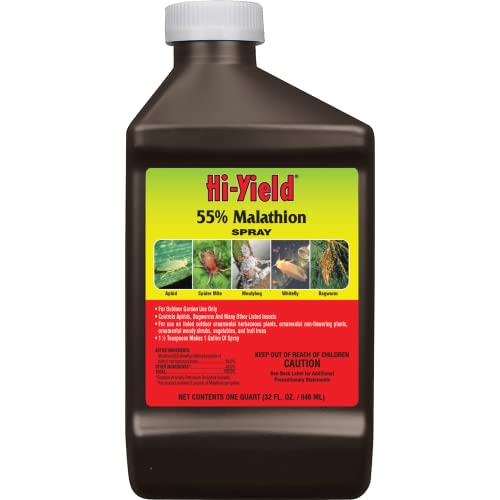
If you tried a multi-purpose spray like the Bonide Captain Jack’s and the scale insects (small, hard-shelled bugs that suck plant sap) or red spider mites are still winning, this 55% Malathion concentrate is the heavy hitter you reach for. Malathion is an organophosphate (a compound that blocks an enzyme insects need for nerve function, killing them). Buyers specifically call it effective on stubborn scale and red spider mites that other products could not touch. It also kills mosquitoes around the yard — one reviewer says “this stuff is Kryptonite for mosquitoes.” It is a single-target insecticide with no fungicide component, so you use it when you are absolutely sure insects are the problem.
You apply this with a hose-end or tank sprayer, and you need calm weather with no rain predicted for 24 hours afterward. At 2.5 pounds (1.13 kg) per bottle, it is more than double the weight of the Monterey spray (1.2 pounds / 0.54 kg), reflecting the concentrated active ingredient inside. It works on fruit trees, vegetables, shrubs, and ornamentals, so it covers your whole landscape.
The big asterisk here is safety. Multiple buyers mention it is a “strong suspected carcinogen” and recommend full protective gear — gloves, goggles, long sleeves — and even suggest hiring a licensed professional for large trees. It is not a casual weekly spray like the BioAdvanced RTU. Only buy this if you have a confirmed, persistent insect problem that weaker products failed to solve.
What stands out
- 55% Malathion concentrate handles scale and spider mites other sprays miss
- Effective against mosquitoes around the yard for season-long control
- USDA-spec certified for fruit trees, vegetables, and ornamentals
The trade-offs
- Insecticide only — no disease or fungus control included
- Strong chemical requires protective gear during application
4. Monterey Fruit Tree Spray Plus Bundled with Measuring Spoon
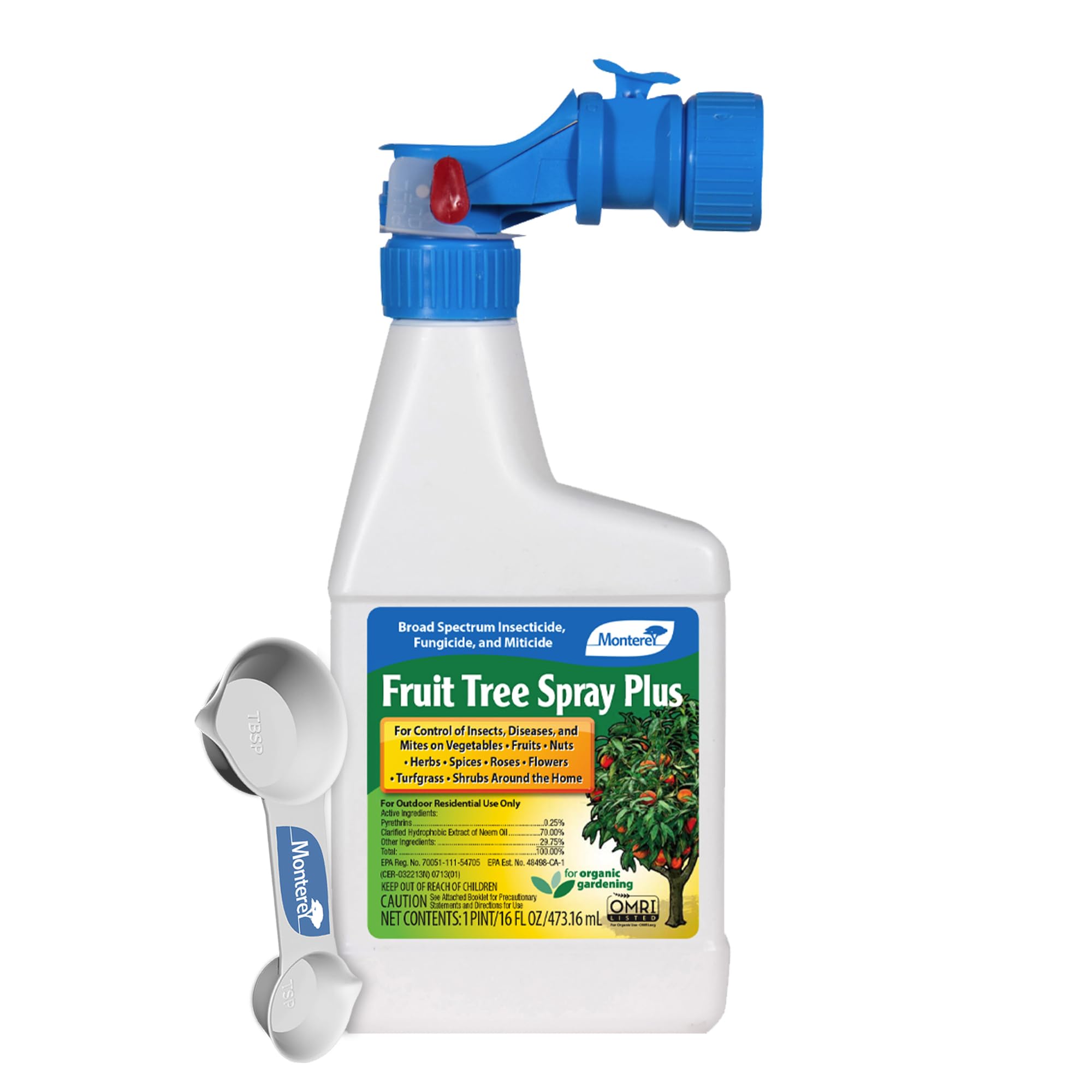
The single number that matters most in this category is 70% Neem Oil, and this 16-ounce (473 ml) spray scores a triple-action formula: it combines that plant-derived oil with natural pyrethrins from chrysanthemum flowers, is OMRI-listed for organic gardening, and controls aphids, scales, whiteflies, caterpillars, and mites while preventing fungal attack on plant tissue. At 1.2 pounds (0.54 kg) per bottle, it is the lightest option here, meaning less concentrated product per bottle but simpler handling.
It comes bundled with a measuring spoon, saving you the hassle of finding the right tool on your first use. Reviewers point out it saved one apple tree completely, and it works well with a standard house sprayer. The natural active ingredients mean it is safe to use close to harvest without worrying about synthetic residue.
The packaging is the weak link here: multiple shoppers say the bottle arrives leaking or the red hose attachment pops off during use due to poor design, so you might need to transfer the liquid to a different sprayer right away. Great organic formula held back by frustrating packaging — buy it knowing you may need your own sprayer, making the price-to-value read as a trade-off between effective ingredients and a flawed delivery system.
The upsides
- OMRI-listed organic formula safe for edible crops up to harvest
- 70% Neem Oil plus natural pyrethrins for quick knockdown and residual control
- Bundled measuring spoon eliminates guesswork for mixing
Keep in mind
- Multiple buyers report bottles arriving with leaking packaging
- Hose attachment may pop off under pressure — consider using your own sprayer
5. Bonide (BND2021) Fruit Tree and Plant Guard Concentrate

What you actually get at this lower price is a 16-ounce (473 ml) concentrate that packs insecticide, fungicide, miticide, aphicide, and scalicide into one bottle — it kills insects, fungi, mites, aphids, and scale insects. For home orchardists who battled brown rot year after year, this is the spray that finally turns the corner. One buyer in humid Kentucky reported no fruit for five years due to mold and blackspot, then after using this spray they got bumper crops of peaches, apples, plums, and grapes. Another review says “two sprays in the spring and we had delicious peaches in September.”
You mix this concentrate yourself using a hose-end or tank sprayer, and the label gives separate mixing rates for each type of plant. The recommended schedule is four sprays per season: at first white bloom, at petal fall (critical for plum curculio control), then two more at 10 to 14-day intervals. That precision is what makes it work for stubborn cases where the simpler Bonide Captain Jack’s might not be enough. It also controls Japanese beetles, leafhoppers, ants, crickets, and cockroaches, so it earns its place as a full-yard protector.
Be careful with shelf life — one reviewer noted an old bottle stored in a garage degraded and lost effectiveness. Buy fresh, use it the same season, and store it in a cool spot. This is the premium choice for the determined grower who follows a spray schedule and wants the highest chance of a perfect harvest — the exact budget buyer it is perfect for.
Why we’d pick it
- Complete 5-in-1 coverage: insecticide, fungicide, miticide, aphicide, and scalicide
- Owners mention first-ever bumper peach crops after years of failure
- Four-spray-season schedule designed for professional-level orchard results
A few caveats
- Shelf life degrades over time — buy fresh and use within the same season
- Concentrate requires careful mixing and a tank or hose-end sprayer
Understanding the Specs
Active Ingredient & Mode of Action
The active ingredient is the chemical compound that actually kills the pest. Multi-purpose sprays often use sulfur (a broad-spectrum fungicide that disrupts spore germination on the leaf surface) plus pyrethrins (natural insect neurotoxins derived from chrysanthemum flowers that paralyze insects on contact). Single-target products like the Hi-Yield Malathion use 55% Malathion, an organophosphate that blocks an enzyme insects need for nerve function — it is powerful but requires careful handling (including wearing gloves, goggles, and long sleeves) as multiple buyers recommend.
Concentrate vs. Ready-to-Spray (RTU)
A concentrate like the Bonide Fruit Tree & Plant Guard (16 oz / 473 ml bottle) needs to be mixed with water in a tank or hose-end sprayer before use. It costs less per gallon and lets you adjust the strength for different stages of growth. A ready-to-spray bottle like the BioAdvanced 3-in-1 (32 oz / 946 ml) screws onto your garden hose and dilutes automatically as you spray. RTU is faster and easier on a single tree, but you cannot change the concentration for heavier pressure, and one bottle covers less total area than a concentrate of the same size.
FAQ
How often should I spray my peach tree with insecticide?
Can I use a peach tree insecticide on other fruit trees?
Is neem oil effective as a peach tree insecticide?
Final Thoughts: The Verdict
For the majority of shoppers, the insecticide for peach trees winner is the Bonide Captain Jack’s Orchard Spray because it combines insect, mite, and disease control into one concentrate that you can use up to harvest day with proven results on Japanese beetles and leaf spots. If you want zero mixing and instant hose attachment, grab the BioAdvanced 3-in-1 Ready-to-Spray. And for the committed orchardist who follows a four-spray schedule and wants the highest chance of a perfect harvest, the standout is the Bonide Fruit Tree & Plant Guard Concentrate.