
Your lawn is emerging from winter dormancy, pale and hungry for a controlled dose of nitrogen. The wrong ratio or timing can burn tender new growth or feed weeds before the grass even wakes.
I’m Rikta — the co-founder and writer behind Lawn Gear Lab. I’ve spent dozens of hours cross-referencing NPK ratios, release technologies, and coverage specs against verified owner experiences to identify which products deliver a safe, rapid green-up without the surge-and-crash cycle.
After comparing seven formulations across slow-release granules, organic blends, and high-nitrogen liquids, I’ve isolated the top performers. This guide breaks down the specifications and real-world results behind the best early spring lawn fertilizer options available today.
How To Choose The Best Early Spring Lawn Fertilizer
Early spring fertilization is about waking the lawn safely — delivering nitrogen for leaf and root growth without pushing a flush of tender tissue that late frosts can kill. The right choice balances three factors: the nitrogen source, the application window, and the existing soil condition.
Nitrogen Release Technology: Quick vs. Slow Release
A quick-release nitrogen source (ammonium sulfate or urea) gives a visible green-up within days, but the spike fades fast and risks burning if temperatures rise unexpectedly. Slow-release nitrogen (polymer-coated or methylene urea) feeds steadily over 6–12 weeks, preventing the surge-and-crash cycle. Many premium products now blend both — typically 70/30 or 60/40 — so the lawn gets an immediate color lift while the slow fraction sustains growth into late spring.
NPK Ratio: What the Numbers Actually Mean
For early spring, the first number (nitrogen) should dominate — look for ratios like 28-0-0, 24-0-6, 16-0-8, or 27-0-5. Phosphorus (the second number) is often restricted by local ordinances because it contributes to algae blooms in waterways; many municipalities now ban it unless a soil test proves deficiency. Potassium (the third number) supports root strength and drought resistance, but a 0-second-number product is generally fine for the early-season green-up phase.
Form: Granular vs. Liquid
Granular fertilizers require rain or irrigation to dissolve and move into the root zone, making them ideal for a scheduled application before a wet forecast. Liquids (like the Petramax 28-0-0) go to work immediately upon contact with foliage and soil, producing faster visual results but demanding more frequent reapplication because the nitrogen pool depletes quicker. Budget-tier granular products must be watered in thoroughly to avoid leaf burn.
Quick Comparison
On smaller screens, swipe sideways to see the full table.
| Model | Category | Best For | Key Spec | Amazon |
|---|---|---|---|---|
| Yard Mastery 24-0-6 | Granular | Premium large-lawn feeding | 24% slow-release N + 3% iron | Amazon |
| Andersons PGF 16-0-8 | Granular | Phosphorus-sensitive soils | Humic DG + 8-week release | Amazon |
| Scotts Turf Builder Weed & Feed5 | Granular | Early weed suppression + feed | Controls 50+ listed weeds | Amazon |
| GreenView Fairway Formula | Granular | Mid-sized lawns needing consistency | 63% slow-release N (27-0-5) | Amazon |
| Purely Organic 10-0-2 | Granular (Organic) | Pet/family-safe organic feed | Plant-based, no biosolids | Amazon |
| Safer Brand Lawn Restore | Granular (Natural) | Non-burning natural recovery | 9-0-2, greens in 3-5 days | Amazon |
| Petramax Liquid 28-0-0 | Liquid | Rapid green-up on small lawns | 70% quick / 30% slow release | Amazon |
In‑Depth Reviews
1. Yard Mastery 24-0-6 Flagship Granular Fertilizer

The Yard Mastery Flagship delivers 24% slow-release nitrogen from a 45-pound bag that covers a generous 15,000 square feet — the highest coverage-to-weight ratio in this guide. The 24-0-6 NPK formula includes 3% iron for rapid color enhancement and 6% potassium to fortify roots against the drought stress that follows spring green-up. Bio-Nite technology supports microbial activity in cool soils, which is critical when soil temperatures linger below 55°F.
Owner reports consistently mention that Bermuda and Zoysia lawns thickened enough to choke out existing weeds after a single application. The granules are fine and dust-free, spreading cleanly through a rotary spreader without bridging or clogging. Several users noted that neighbors assumed they had hired a professional service after the lawn greened up.
The main trade-off is the price per bag, which sits at the premium end of the spectrum. Some reviewers also cautioned that the growth response is strong enough to require mowing twice per week during peak spring growth. For homeowners with large properties who want a single-application solution that lasts into late spring, this is a top-tier option.
What works
- Excellent coverage at 15,000 sq ft per 45 lb bag
- High 3% iron content for deep greening
- 24% slow-release nitrogen feeds consistently for weeks
What doesn’t
- Premium price — the most expensive option in this guide
- Aggressive growth may require more frequent mowing
2. The Andersons Professional PGF 16-0-8 with Humic DG
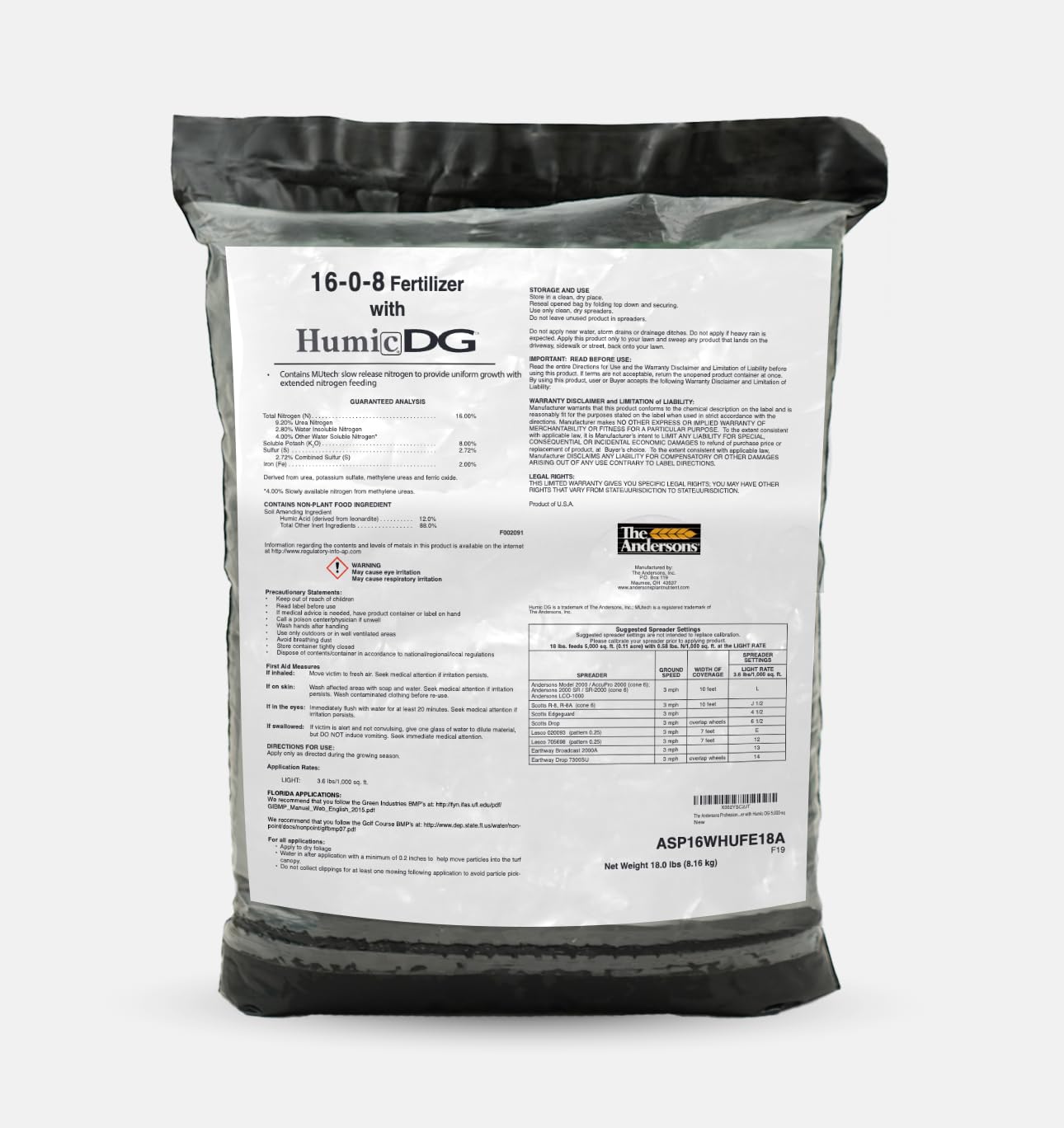
The Andersons PGF line targets lawn managers who have soil test data showing elevated phosphorus levels. The 16-0-8 analysis provides a respectable 16% nitrogen — part quick-release for early color, part slow-release for sustained feeding — plus 8% potassium for drought tolerance. The humic DG (dispersible granule) technology improves nutrient uptake by chelating minerals in the root zone, a distinct advantage in compacted or clay-heavy spring soils.
Users praise the ultra-fine particle size, which delivers about twice as many granules per square foot compared to standard fertilizers. This eliminates the striped pattern that larger, uneven granules can create. Many reviewers specifically mentioned switching to this product after high-phosphorus soil tests came back, and they reported healthier color without the surge of broadleaf weeds that excess phosphorus can trigger.
The bag covers approximately 10,000 square feet, and the 18-pound weight makes it easy to handle. The formula is not available for sale in California or Oregon, so buyers in those states need to check local restrictions. The price is mid-range, but the inclusion of humic substances adds measurable value for improving nutrient efficiency in cool, wet spring soil.
What works
- Ultra-fine granules for even distribution
- Humic DG improves nutrient uptake in cold soils
- Phosphorus-free formula ideal for high-P soils
What doesn’t
- Not for sale in CA or OR
- Requires careful watering-in to avoid burn
3. Scotts Turf Builder Weed and Feed5

For homeowners who want to tackle both early-season feeding and emerging winter annuals like chickweed and henbit, the Scotts Turf Builder Weed & Feed5 offers a two-in-one solution. The 33.95-pound bag covers up to 12,000 square feet with a fertilizer base that strengthens the grass while the herbicide acts on over 50 listed broadleaf weeds, including dandelion and clover.
Application timing is narrower than standard fertilizers: the granules must be applied to wet grass when temperatures are consistently between 60°F and 90°F, and the treated area should not be watered for two to three days afterward to allow the herbicide to adhere to weed leaves. Users who followed these instructions reported significant weed reduction and deep greening within one to two weeks. The dual-action design saves a separate spray pass, which appeals to time-strapped homeowners.
There are important grass-type restrictions — the product should not be used on St. Augustinegrass (including Floratam), Dichondra, Lippia, Carpetgrass, or Bentgrass. Some users noted that the formula did not suppress crabgrass or clover effectively, so a pre-emergent may still be needed for those targets. The price is competitive for a combined product, though the granular herbicide component limits flexibility for targeted spot treatments later in the season.
What works
- Controls over 50 broadleaf weed species
- Feeds and thickens grass simultaneously
- Large bag covers up to 12,000 sq ft
What doesn’t
- Not safe for St. Augustine or Bentgrass lawns
- Narrow application window — must hit 60-90°F and wet grass
4. GreenView Fairway Formula 27-0-5 Lawn Fertilizer

The GreenView Fairway Formula uses a 27-0-5 analysis with 63% slow-release nitrogen — one of the highest ratios of extended-release nitrogen in this guide. The 33-pound bag covers 10,000 square feet and feeds for up to 12 weeks from a single spring application. The high potassium content (5%) supports root development and helps the grass handle temperature swings common in early spring.
Customers consistently report that the lawn darkens within a few days of application, then stays uniformly green without the surge-and-fade pattern associated with quick-release-only blends. The fine granule texture spreads cleanly through drop and rotary spreaders, and there have been no complaints about clumping or bridging. Many users described this as the product that made their lawn the “greenest on the block” without the need for summer reapplication.
The zero-phosphorus formulation means it complies with most municipal phosphorus bans, but gardeners with phosphorus-deficient soil may need a separate supplement. The price sits in the mid-range, offering a strong value for the extended feeding window. For medium-to-large lawns, this is a set-it-and-forget-it granular that reduces the total number of seasonal applications.
What works
- 63% slow-release N for steady 12-week feeding
- Phosphorus-free — meets municipal regulations
- Consistent results without surge patterns
What doesn’t
- No phosphorus — not ideal for deficient soils
- Requires thorough watering for dissolution
5. Purely Organic Products Lawn Food 10-0-2

Purely Organic’s 10-0-2 lawn food is the go-to choice for homeowners who prioritize family and pet safety above raw nitrogen numbers. The plant-based formula uses distillers’ grains and soy as its nitrogen source — no manure, no sewage biosolids, and no synthetic chemicals. The 10-0-2 NPK analysis is moderate, but the organic matter feeds soil microbes and improves cation exchange capacity over time.
The 15-pound bag covers only 3,000 square feet, which is the smallest coverage in this guide. However, owner reviews in warm climates like Florida note that the green-up appeared within four to five days and the lawn stayed thick without any burn. Multiple reviewers specifically mentioned that their dogs could walk on the lawn immediately after application without any irritation or transfer of residues.
The main limitation is the coverage-to-weight ratio: at 44 dollars for a bag that covers 3,000 square feet, the cost per square foot is significantly higher than synthetic counterparts. Gardeners with larger lawns may need multiple bags, which shifts the overall investment upward. For those with small yards or a need for absolute safety, this is the most responsible option.
What works
- Completely plant-based — no manure or biosolids
- Safe for pets, kids, and beneficial insects
- Greens up within 4-5 days in warm conditions
What doesn’t
- Small coverage area (3,000 sq ft per bag)
- High cost per square foot compared to synthetics
6. Safer Brand Lawn Restore 9-0-2 Natural Fertilizer
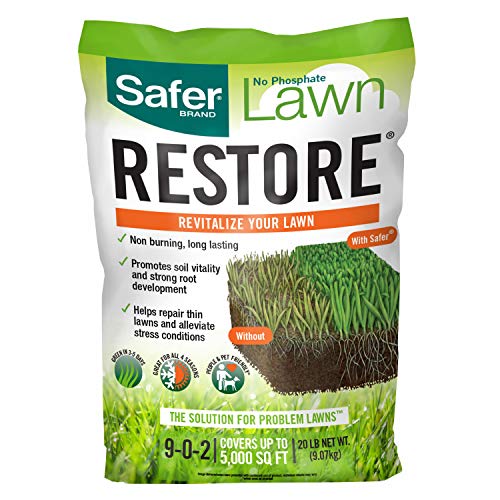
Safer Brand’s Lawn Restore takes a gentle approach with a low 9-0-2 NPK ratio that prioritizes root system strengthening over dramatic foliar green-up. The non-burning formula is fortified with corn gluten, which acts as a natural pre-emergent to suppress spring weed seeds — a dual benefit that reduces the need for separate herbicide applications. Users report visible greening within three to five days of application, even on stressed lawns from the previous season.
The natural backbone of the formula makes it safe for beneficial soil organisms and birds. Multiple reviews describe neighbors’ dead, brown patches reviving into dense turf after a single use. The 20-pound bag is reasonably priced and covers approximately 5,000 square feet. Users note that the product should not be used simultaneously with overseeding because the corn gluten will inhibit grass seed germination. A two- to three-week window must be observed between seeding and application.
For homeowners who want a mild, restorative feed that also reduces weed pressure without synthetic chemicals, this is a strong mid-range choice. The lower nitrogen content means it works best on lawns that already have decent soil biology and do not need a heavy synthetic kick. Some users found the 20-pound bag a bit small for larger properties requiring multiple passes.
What works
- Non-burning formula — safe for drought-stressed lawns
- Corn gluten acts as natural pre-emergent
- Safe for birds, pets, and beneficial insects
What doesn’t
- Corn gluten inhibits grass seed germination
- Lower NPK ratio means less dramatic initial green-up
7. Petramax Liquid Nitrogen Fertilizer 28-0-0

The Petramax Liquid 28-0-0 delivers the highest nitrogen concentration in this guide, formulated as a 70% quick- / 30% slow-release hybrid. The 32-ounce bottle treats up to 12,800 square feet at maintenance rates (5 ounces per gallon) or 6,400 square feet at correction rates (10 ounces per gallon). For homeowners dealing with pale, yellowed grass that clearly signals nitrogen deficiency, this liquid provides the fastest visible rebound.
Owner feedback highlights the convenience of mixing with a tank sprayer — users report noticeable greening within three to four days after application. The liquid format is particularly effective for spot-treating thin patches without wasting product on areas that are already healthy. Several reviewers described themselves as “skeptics turned believers” after seeing the color transformation in their lawns.
The trade-off is the total cost per treatment cycle. Because the quick-release component depletes faster than a granular slow-release feed, maintenance applications every four to six weeks may be necessary to sustain the color through late spring. The liquid also requires a compatible sprayer for even distribution, which adds an equipment cost for users who do not already own one. For small lawns under 5,000 square feet, this is an effective and affordable rapid-rescue tool.
What works
- Extremely fast color response — green in 3-4 days
- Dual 70/30 release split balances immediate and sustained feeding
- Concentrated 32-ounce bottle covers large area
What doesn’t
- Requires tank sprayer for application
- More frequent reapplication needed compared to granular feeds
Hardware & Specs Guide
Quick vs. Slow Release Nitrogen
The “release” column on a fertilizer bag tells you how fast the nitrogen becomes available. Quick-release nitrogen (ammonium sulfate, urea) dissolves immediately in water and produces a visible green-up in 2-5 days, but the effect lasts only 3-4 weeks. Slow-release nitrogen (methylene urea, polymer-coated urea, IBDU) releases gradually through microbial activity or moisture diffusion, sustaining feeding for 8-12 weeks. For early spring, a blend like the GreenView 63% slow-release ensures immediate color without the crash.
Understanding NPK Ratios
The three hyphenated numbers on every fertilizer label represent the percentage by weight of nitrogen (N), phosphorus (P), and potassium (K). A 24-0-6 product therefore contains 24% nitrogen, 0% phosphorus, and 6% potassium. For early spring, prioritize a first number of 16 or higher. The second number (phosphorus) can be zero unless a soil test confirms deficiency — many states now ban phosphorus application on established lawns to protect waterways. The third number (potassium) should be at least 4% for root support.
Iron for Color Enhancement
Iron (chelated iron, ferrous sulfate, or iron EDTA) is not one of the three primary macronutrients, but it directly catalyzes chlorophyll production. Products with 2-3% iron, such as the Yard Mastery Flagship, produce a darker green color within days even before the nitrogen fully kicks in. Iron is particularly effective in cool early-spring soils where microbial activity is still low and nitrogen release may lag. Iron will not burn the lawn at recommended rates.
Humic Substances in Fertilizers
Humic acid and fulvic acid (often listed as humic DG or humates) are naturally occurring organic molecules that improve nutrient chelation and root uptake. In cold spring soils below 55°F, microbial activity is suppressed, making nutrient absorption less efficient. Adding humic substances to the fertilizer — as seen in The Andersons PGF — helps the grass access the nitrogen that is already present, effectively increasing the utilization rate of the applied nutrients without raising the NPK numbers.
FAQ
How do I know if my lawn needs early spring fertilizer?
Can I apply early spring fertilizer before the last frost?
Is a 50% slow-release nitrogen blend better than 100% quick-release?
Should I use a weed-and-feed product in early spring?
What happens if I apply too much nitrogen in early spring?
Final Thoughts: The Verdict
For most gardeners, the early spring lawn fertilizer winner is the Yard Mastery 24-0-6 Flagship because it combines the highest coverage, extended 24% slow-release nitrogen, and 3% iron for immediate deep greening. If you need a phosphorus-free alternative for high-phosphorus soil, grab the Andersons PGF 16-0-8 with Humic DG. And for pet- and family-safe organic feeding, nothing beats the Purely Organic 10-0-2 Lawn Food.