
Every lawn has a few uninvited guests — crabgrass creeping into the fescue, clover patches embarrassing the bluegrass, or nutsedge popping up like it owns the place. The difference between a yard you’re proud of and one you avoid looking at comes down to one decision: choosing a selective herbicide that takes out the invaders while leaving your turf completely untouched. That’s exactly what this guide is built to deliver.
I’m Rikta — the co-founder and writer behind Lawn Gear Lab. I spend my time cross-referencing active-ingredient profiles, studying application windows, and analyzing verified owner experience to separate the herbicides that actually work from the ones that just green up the weeds.
This guide breaks down the top performers, from fast-acting iron-based formulas to specialty nutsedge killers and broad-spectrum concentrates. If you’re serious about a weed-free lawn without damaging your grass, you’ve found the definitive breakdown of the best grass killer for lawns on the market right now.
How To Choose The Best Grass Killer For Lawns
Choosing a lawn herbicide isn’t about picking the strongest chemical; it’s about matching the active ingredient to your specific weed pressure, your grass type, and your tolerance for application effort. The wrong choice nukes your turf; the right one leaves it thriving while the weeds curl and die. Here are the three factors that separate a smart buy from a costly mistake.
Match the Active Ingredient to Your Weed
Not all broadleaf weeds respond to the same chemistry. Dicamba and triclopyr crush clover, chickweed, and creeping charlie. 2,4-D handles dandelions and plantain. Halosulfuron-methyl is the only reliable killer of nutsedge and nutgrass — common products won’t touch it. If you’re fighting crabgrass or annual bluegrass, you need a selective grass herbicide like sethoxydim or fenoxaprop, not a broadleaf formula. Read the label’s weed list before you buy; guessing costs you weeks of regrowth.
Check Your Grass Type Tolerance
Cool-season grasses (fescue, Kentucky bluegrass, ryegrass) tolerate most dicamba-based and 2,4-D formulas. Warm-season grasses like St. Augustine and centipede are far more sensitive — many products will severely damage or kill them. Bermudagrass and zoysia fall somewhere in the middle. If you spray a product labeled “not for St. Augustine,” you will likely destroy your lawn. Always confirm your specific turf type is listed under “tolerant grasses” on the product label before mixing a drop.
Select the Right Formulation and Application Method
Ready-to-use sprayers with battery wands offer immediate convenience for spot-treating scattered weeds in small to medium lawns. Concentrates are more economical for large yards and allow you to control the mixture strength and add a surfactant for better leaf adhesion. Granular pre-emergents serve a different role — they prevent weeds from sprouting but do nothing for existing growth. For active weed problems, a post-emergent liquid is the only option. Think about your yard size and your willingness to calibrate a sprayer before choosing.
Quick Comparison
On smaller screens, swipe sideways to see the full table.
| Model | Category | Best For | Key Spec | Amazon |
|---|---|---|---|---|
| Ortho WeedClear Ready-To-Use | Mid-Range | General broadleaf spot treatment | 1.33 gal ready-to-use with battery wand | Amazon |
| Atticus Empero Q-Pak Nutsedge Killer | Mid-Range | Nutsedge and nutgrass eradication | 5% halosulfuron-methyl, 2-pk packets | Amazon |
| Bonide Captain Jack’s Lawnweed Brew | Mid-Range | Iron-based broadleaf + disease control | 32 oz concentrate, iron-derived formula | Amazon |
| Spectracide Weed and Grass Killer | Mid-Range | Non-selective hardscape and bed clearing | 32 oz concentrate with Accumeasure | Amazon |
| Bonide Chickweed, Clover & Oxalis Killer | Premium | Targeted broadleaf knockdown | 128 oz RTU, dicamba + triclopyr | Amazon |
| Fertilome Over The Top Grass Killer | Premium | Selective grass weed control in beds | 8 oz concentrate, makes 8 gallons | Amazon |
| Fertilome Weed Free Zone | Premium | Tough-to-kill weeds like creeping charlie | 32 oz concentrate, controls 80+ weeds | Amazon |
In‑Depth Reviews
1. Bonide Chickweed, Clover & Oxalis Killer

This ready-to-use spray from Bonide packs a dual-active punch of dicamba and triclopyr, making it one of the most aggressive broadleaf formulas available without mixing. Users report seeing chickweed and clover wilt within 24 hours of application, and the 128-ounce container covers up to 10,000 square feet — enough for several full-lawn treatments. It’s nearly odorless, which is a rare advantage when spot-treating near outdoor living spaces.
The formula is safe on most cool-season turf grasses like fescue and Kentucky bluegrass, but it does not control crabgrass or other grassy weeds. Several owners found that adding a non-ionic surfactant improved coverage on waxy-leafed weeds like oxalis. Bonide recommends applying 48 hours before or after mowing and avoiding rain windows for at least 24 hours to prevent wash-off.
Users on large lawns often abandon the included hand sprayer in favor of a pump or backpack sprayer, as the trigger mechanism wears out over extended use. The cost per treatment is competitive with Ortho Weed B Gone, but the concentrated formulation of active ingredients here delivers faster visual knockdown. For heavy clover or chickweed infestations, this is the most direct and effective selective spray on the list.
What works
- Very fast knockdown on chickweed, clover, and oxalis
- Large 128-ounce RTU container covers up to 10,000 sq ft
- Nearly odorless and safe on most cool-season lawns
What doesn’t
- Hand sprayer wand can wear out on large properties
- Ineffective on crabgrass and other grassy weeds
2. Fertilome Weed Free Zone
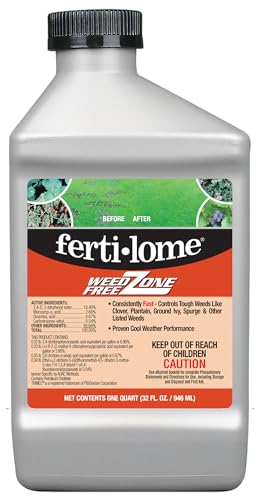
Fertilome Weed Free Zone is the rare product that actually lives up to its name when it comes to creeping charlie — a weed so stubborn that most general-purpose broadleaf killers barely slow it down. The dicamba-based concentrate controls over 80 broadleaf weed species, including spurge, thistle, and chickweed, and starts showing visible injury within hours of application. Users regularly call it the only product that truly works on creeping charlie overnight.
It is safe on Kentucky bluegrass, Bermudagrass, bahiagrass, and zoysia, but must be kept away from St. Augustine and centipede lawns. The concentrate format means you mix your own spray solution, which allows you to double the concentration for persistent clover patches — a trick several experienced users recommend. Adding a few drops of dish soap as a surfactant improves adhesion on waxy weed leaves and reduces runoff.
The price per bottle is higher than many competitors, but a 32-ounce bottle goes a long way. Some owners found they needed a second application at a stronger mix rate for creeping charlie in thick, established patches. The product is rainfast within a few hours, so timing around weather is less stressful. For anyone battling perennial broadleaf weeds that resist cheaper sprays, this concentrate delivers where others fail.
What works
- Only reliable solution for creeping charlie and tough perennials
- Visible injury on broadleaf weeds within hours
- Safe on most warm and cool-season turf types
What doesn’t
- Higher price per bottle compared to general-purpose sprays
- May require double-strength mix for heavy clover
3. Ortho WeedClear Lawn Weed Killer Ready-To-Use

The Ortho WeedClear with Comfort Wand is the gold standard for convenience in selective spot treatment. The battery-powered wand sprays at the push of a button, eliminating the pumping and hose work that turns lawn care into a chore. It’s pre-mixed and ready to go from the box, so there is no measuring, no pouring, and no cleanup. The 1.33-gallon container covers roughly 10,644 square feet of spot treatment, making it a practical choice for medium lawns with patchy weed pressure.
The formula targets over 200 broadleaf weeds including dandelion, crabgrass, clover, chickweed, and creeping charlie while leaving fescue, bluegrass, ryegrass, Bermudagrass, and zoysia unharmed. Users report visible wilting within one to two weeks, though some tough weeds like thistle and tuber-forming species may require a second pass. Reviews consistently praise the wand’s ergonomics — the trigger is light, the spray pattern is accurate, and it reaches under shrubs without stooping.
A smaller but notable number of recent buyers reported that 2025 batch formulations underperformed compared to previous years, with weeds failing to yellow even after thorough spraying. This appears to be a batch-specific quality issue rather than a permanent formulation change, but it’s worth buying from a reputable seller with high turnover to avoid stale stock. For most homeowners, this is the fastest, least messy way to maintain a weed-free lawn with minimal effort.
What works
- Battery-powered Comfort Wand is ergonomic and accurate
- Kills a wide range of broadleaf weeds without harming grass
- Ready-to-use — no mixing, no measuring, no cleanup
What doesn’t
- Recent batch quality issues reported by some customers
- Slow-acting on tough perennial weeds
4. Atticus Empero Q-Pak Nutsedge Killer

If nutsedge — that light-green, fast-growing weed that looks like a mini palm tree — is the bane of your lawn, this is the active ingredient you need. Atticus Empero uses 5% halosulfuron-methyl, the pro-grade compound that travels down to the root tubers and kills the whole plant rather than just the tops. Each pre-measured packet mixes with one gallon of water and already contains a built-in surfactant, so there is no guesswork.
The product is safe on nearly all established warm and cool-season turf including bluegrass, fescue, Bermudagrass, and zoysia. It does not work overnight; most users see the first signs of yellowing and stunting after about two weeks, with full kill taking three to four weeks. Second applications are often needed for heavy infestations or tall blooming patches. The two-pack is enough for two full sprayer loads, which is adequate for small to medium lawns.
Some owners noted that the mixed solution should be used entirely in one session — storing leftover halosulfuron in a sprayer degrades its efficacy. The pre-measured packets also mean you cannot halve the dose for smaller spot jobs without wasting product. For its intended target, however, this is the most effective and most convenient nutsedge killer available. If you’ve tried general weed killers on nutsedge and failed, the issue was the chemistry, not the application.
What works
- Targets nutsedge at the root tuber for complete kill
- Pre-measured packets with built-in surfactant simplify mixing
- Safe on nearly all common turf grass types
What doesn’t
- Very slow acting; 3-4 weeks for full results
- Mixed solution degrades quickly — cannot be stored
5. Fertilome Over The Top Grass Killer

Most lawn herbicides target broadleaf weeds, leaving grassy weeds like Bermudagrass and crabgrass untouched. Fertilome Over The Top flips that script — it is a selective grass herbicide that kills annual and perennial grassy weeds while leaving ornamentals, shrubs, flowers, and trees unharmed. Each 8-ounce bottle makes 8 gallons of spray solution, enough for multiple treatments around garden beds and landscape borders.
The key constraint is grass height. The formula is most effective on weed grasses under 6 inches tall; taller specimens may only stunt rather than die. Users report that combining the concentrate with a few drops of Dawn dish soap as a surfactant significantly improves leaf adhesion and translocation. Most reviews mention it as the only product that successfully removed invasive Bermudagrass from flower beds after years of failed attempts with other products.
There are important label restrictions: this product will damage fescue and other desirable turf grasses, so it must only be used in areas where the target weed is surrounded by non-grass ornamentals. Some buyers expressed frustration at the slow pace — visible damage takes at least a week, and full kill requires around three weeks. For its specific niche, however, it is the only practical chemical option for selectively removing grassy weeds from mixed planting areas.
What works
- Selectively kills grassy weeds without harming ornamentals
- Effective on stubborn Bermudagrass in garden beds
- Concentrate format makes 8 gallons for repeated use
What doesn’t
- Will damage or kill desirable turf grasses like fescue
- Slow acting; takes 1-3 weeks for full control
6. Bonide Captain Jack’s Lawnweed Brew

Captain Jack’s Lawnweed Brew takes an alternative approach to weed control: it uses iron (specifically, iron HEDTA) as its active ingredient rather than synthetic auxin herbicides. This means it kills broadleaf weeds by causing rapid oxidative damage, turning leaves black within hours of application. The same iron content also greens up the surrounding lawn grass, giving the yard a cosmetic boost while the weeds die. It also suppresses lawn diseases like dollar spot, rust, and snow mold.
The biggest advantage is the safety profile: the formula is low-toxicity and considered near-organic, making it a strong choice for households with pets and children who use the lawn frequently. It controls dandelion, clover, chickweed, moss, algae, and ground ivy. However, it absolutely requires warm application temperatures. Users report failure when daytime highs stay below 70°F, with weeds blackening but eventually regrowing because the chemical never fully translocated to the roots.
The concentrate mixes instantly with water but must be applied with a backpack or pump sprayer — the formula is not compatible with hose-end sprayers. Some customers found that it did not fully kill established dandelions or plantain, requiring multiple spot applications. For a low-chem approach to surface weeds and moss in warm climates, this is an excellent tool. For hardy perennials in cooler regions, it may leave you frustrated.
What works
- Iron-based formula is low-toxicity and safe near pets
- Also greens up lawn while killing broadleaf weeds
- Suppresses several common lawn diseases
What doesn’t
- Ineffective in cool weather below 70°F
- Hardy weeds may require multiple applications
7. Spectracide Weed and Grass Killer Concentrate
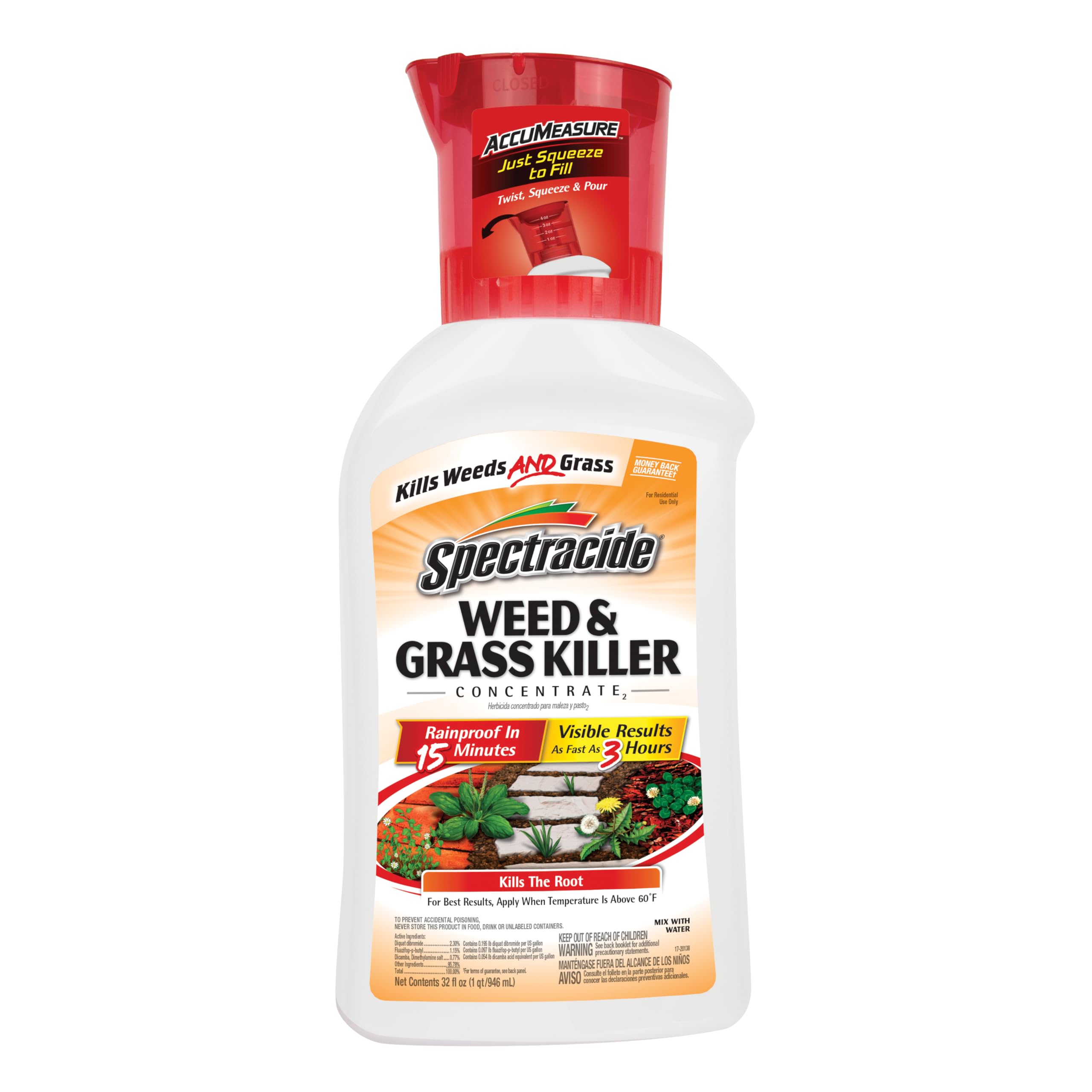
Spectracide Weed and Grass Killer is a non-selective herbicide powered by diquat dibromide, a fast-acting contact killer that shows visible results within three hours. This is not a product for use on your lawn — it will kill any green vegetation it touches, including grass. Its intended use is on driveways, walkways, patios, fences, and around landscape beds where you want to completely clear an area for replanting the same weekend.
The Accumeasure cap system lets you twist and squeeze to dispense the right amount directly into the sprayer, eliminating the need for a measuring cup. Users consistently praise the speed of knockdown — weeds along curbs and cracks in pavement brown up by the end of the day. The formula is rainfast within 15 minutes, so you can spray close to a weather front without losing effectiveness. The 32-ounce concentrate covers roughly 1,350 square feet of spray solution.
Being non-selective, this product carries zero margin for error near desirable plants. Drift from even a light breeze can kill flowers, shrubs, or vegetable leaves. The Accumeasure system has also drawn criticism; many users find it unreliable and replace it with a standard bottle lid from an old container. For hardscape cleaning, fence-line maintenance, and bed renovation where collateral damage does not matter, this is the fastest and most affordable option on the list.
What works
- Visible results in as little as 3 hours
- Rainfast in 15 minutes — weather-resistant
- Accumeasure cap simplifies mixing
What doesn’t
- Non-selective — kills any plant it touches
- Accumeasure cap design is unreliable for some users
Hardware & Specs Guide
Understanding the chemistry and application parameters of a grass killer is what separates a single successful treatment from a season of trial and error. Here are the two most important technical details to get right.
Active Ingredient Targeting
The specific molecule doing the killing determines which weeds die and whether your grass survives. Dicamba and 2,4-D are the workhorses for broadleaf weeds and are safe on cool-season grasses. Triclopyr adds muscle against woody and waxy-leaf weeds like ground ivy. Halosulfuron-methyl is the specialty compound for nutsedge and travels to underground tubers. Sethoxydim and fenoxaprop target grassy weeds like crabgrass and Bermudagrass selectively — most other products that claim to kill “grass” in lawns are actually non-selective and will destroy your lawn. Always cross-reference the label’s active ingredient with your target weed species before mixing.
Application Temperature and Surfactant Use
Herbicide efficacy collapses outside the 60-85°F sweet spot. Cold temperatures slow metabolic uptake, causing weeds to absorb too little chemical to die. High heat causes rapid evaporation, reducing leaf contact time. Iron-based products like Bonide Captain Jack’s are especially sensitive — they need daytime highs above 70°F to work. A non-ionic surfactant (or a few drops of dish soap) reduces the surface tension of the spray solution, helping droplets spread and stick to waxy weed leaves instead of beading up and rolling off. Surfactant use is most critical on clover, oxalis, and creeping charlie.
FAQ
Why does my grass killer not kill nutsedge?
How long after spraying can kids and pets walk on the lawn?
Can I overseed after using a selective grass killer?
Final Thoughts: The Verdict
For most gardeners, the grass killer for lawns winner is the Bonide Chickweed, Clover & Oxalis Killer because its dicamba-triclopyr blend delivers the fastest, most reliable knockdown for the broadest range of common broadleaf weeds without harming cool-season turf. If you need to specifically target creeping charlie or stubborn perennial broadleaf weeds, grab the Fertilome Weed Free Zone. And if convenience is your top priority and you want to spot-treat without mixing or measuring, nothing beats the Ortho WeedClear with Comfort Wand.