
Squash bugs are the most persistent threat to a healthy cucurbit patch. They hide under leaves, lay copper-colored eggs in neat rows, and suck the life out of vines before you even notice the damage. By the time wilting sets in, the infestation has already matured, making early intervention with a targeted spray critical to saving your harvest.
I’m Rikta — the co-founder and writer behind Lawn Gear Lab. I’ve analyzed dozens of formulations, cross-referenced active ingredients against squash bug life cycles, and studied hundreds of verified owner reports to find the treatments that actually break the hatch-and-feed cycle.
If you want to protect your zucchini, pumpkins, and summer squash from vine collapse this season, you need the right chemistry applied at the right time. This guide breaks down the top contenders for the best pesticide for squash bugs and explains exactly how to deploy them for maximum effectiveness.
How To Choose The Best Pesticide For Squash Bugs
Choosing a squash bug pesticide requires understanding that these insects have a protective shield as adults and lay eggs that are immune to most contact sprays. A superior formulation targets both the nymph stage and the egg clusters or works systemically inside the plant to deliver lasting control.
Active Ingredient: Systemic vs. Contact Kill
Systemic ingredients like acephate (found in Bonide Systemic Insect Control) travel through the plant’s vascular system, poisoning squash bugs when they feed. Contact killers like lambda-cyhalothrin (found in Martin’s Cyonara) work on direct hit but offer excellent residual protection on the leaf surface. For heavy infestations, a systemic approach reduces the need for perfect spray coverage.
Residual Duration and Rainfastness
Squash bugs are persistent. A pesticide with a short residual requires reapplication every few days, which is labor-intensive during peak season. Look for formulations that advertise rainfastness within one hour and residual activity of at least two weeks. This feature cuts down the spray schedule and ensures protection through unexpected showers.
Egg and Nymph Specificity
Adult squash bugs are difficult to kill with low-toxicity products. Spinosad-based treatments like Southern Ag Conserve work well on nymphs but may struggle against fully hardened adults. A multi-stage product that includes an ovicidal effect or a broad-spectrum pyrethroid is better for gardens where the infestation has already produced multiple generations.
Quick Comparison
On smaller screens, swipe sideways to see the full table.
| Model | Category | Best For | Key Spec | Amazon |
|---|---|---|---|---|
| Southern Ag Conserve | Biological | Organic nymph control | Spinosad 0.5% OMRI listed | Amazon |
| Bonide Captain Jack’s Orchard Spray | Multi-Purpose | Fruit tree & veggie pest control | 32 oz concentrate makes 6.4 gal | Amazon |
| BioAdvanced Tree & Shrub | Ready-to-Spray | Perimeter squash bug barrier | Rainproof in 1 hour | Amazon |
| Martin’s Cyonara | Broad-Spectrum | Heavy adult infestation | 0.5% Lambda-Cyhalothrin | Amazon |
| BioAdvanced 3-in-1 Fruit & Nut | Triple Action | Mite & disease plus squash bugs | Controls insects, mites, diseases | Amazon |
| Bonide Systemic Insect Control | Systemic | Long-term ornamental protection | Acephate systemic concentrate | Amazon |
| Hi-Yield 55% Malathion | High Potency | Last-resort adult knockout | 55% Malathion concentrate | Amazon |
In‑Depth Reviews
1. Southern Ag Conserve Naturalyte Insect Control, 16oz

Southern Ag Conserve uses Spinosad, a fermentation-derived biological insecticide that targets the nervous system of squash bug nymphs while sparing most beneficial insects once dried. The 16-ounce pint makes up to 8 gallons of finished spray, and its OMRI listing means it fits into organic gardening programs without compromising on knockdown power against juvenile squash bugs.
Verified reports confirm it eliminates spider mites and potato beetles in a single application, but users note that reapplication every 7-10 days is necessary because Spinosad degrades quickly under UV light. The lack of residual activity against eggs means you must catch the infestation at the nymph stage or pair it with a product that attacks the egg clusters directly.
For gardeners who want a low-odor, low-toxicity option that won’t nuke the pollinators, this is the most balanced choice. The small bottle size goes a long way when diluted, though the upfront volume feels modest for large squash patches exceeding 200 square feet.
What works
- OMRI organic certification for edible gardens
- Excellent knockdown on nymphs and soft-bodied pests
- Mixes easily and does not clog sprayers
What doesn’t
- Short residual requires frequent reapplication
- Ineffective against adult squash bugs with hardened shells
- 16 oz bottle is small for large gardens
2. Hi-Yield (32029) 55% Malathion Spray, 32 oz
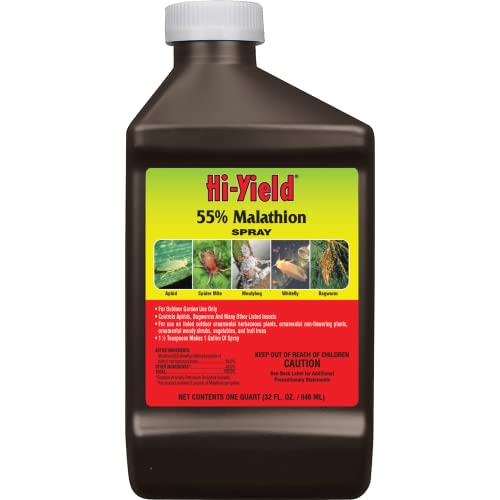
Hi-Yield’s 55% Malathion concentrate is the heavy artillery in this lineup. With one of the highest active ingredient percentages available for residential use, it crushes adult squash bugs, spider mites, and aphids on contact. The 32-ounce bottle stores a long time and mixes at very low rates per gallon, making it extremely cost-effective per treatment.
Owner feedback is consistent: this product works where gentler options failed, especially against scale and red spider mites on ornamentals. The tradeoff is that Malathion is a potent organophosphate that requires full PPE during mixing and application. Users report a strong chemical odor and recommend avoiding drift onto blooming plants where bees forage.
This is not a casual weekly spray. Reserve Hi-Yield Malathion for heavy, established infestations where you need a decisive knockdown. For routine maintenance or organic plots, a lower-toxicity option is safer for your garden ecosystem.
What works
- Extremely high potency against adult squash bugs
- Very economical concentrate for large properties
- Effective on a wide range of insect pests
What doesn’t
- Requires full PPE; strong chemical smell
- High toxicity to bees and aquatic life
- Not suitable for organic gardening
3. Martin’s 32 oz Cyonara Lawn & Garden Concentrate

Martin’s Cyonara delivers 0.5% Lambda-Cyhalothrin, a pyrethroid with strong contact and residual activity on squash bugs, spider mites, and over 130 listed pests. The 32-ounce quart has a low odor profile and mixes cleanly with water for use in hose-end sprayers or tank sprayers. Verified owners specifically call out its effectiveness on squash bugs and spider mites in vegetable gardens.
Several users mention the product works fast — dead squash bugs appear within hours of application. The residual effect holds for about two weeks under dry conditions, though rain before the one-hour dry time reduces efficacy. Gardeners appreciate that it does not harm flowers when applied correctly to the leaf undersides.
The main drawback is that Lambda-Cyhalothrin is non-selective and will kill beneficial insects on contact. Avoid spraying open blossoms and apply during late evening to minimize bee exposure. For the price per quart, this is the most accessible broad-spectrum option for vegetable growers dealing with multiple pest species.
What works
- Fast knockdown on adult squash bugs
- Low odor compared to other pyrethroids
- Excellent residual activity on leaf surfaces
What doesn’t
- Non-selective; kills beneficial insects
- Loses efficacy if rain hits before one hour
- Not OMRI listed for organic production
4. Bonide Captain Jack’s Citrus, Fruit & Nut Orchard Spray, 32 oz

Bonide Captain Jack’s combines insecticidal and fungicidal action in one concentrate, making it a strong fit for squash patches that also battle powdery mildew. The active ingredients target beetles, leafhoppers, and caterpillars while knocking down rust and blight. One 32-ounce bottle makes up to 6.4 gallons of finished spray, covering a substantial area.
Users with fruit trees and vegetable beds report that it eliminated cucumber beetles and white flies in two applications, with noticeable improvement in leaf health over untreated plants. The sulfur-based fungicide component leaves a slight residue, but it washes off produce easily. The label allows use up to the day before harvest, which is convenient for continuous cropping.
The limitation is that it is not a dedicated squash bug killer — its efficacy against adult squash bugs is moderate compared to a pyrethroid or systemic. For a garden facing multiple disease and insect problems simultaneously, this all-in-one tool saves time, but a targeted squash bug spray should sit alongside it for heavy infestations.
What works
- Fungicide and insecticide in one formula
- Safe for use on edibles up to day before harvest
- Effective against cucumber beetles and white flies
What doesn’t
- Moderate effectiveness on adult squash bugs
- Leaves visible sulfur residue on foliage
- Needs reapplication after heavy rain
5. BioAdvanced Tree & Shrub Insect Killer, Ready-to-Spray, 32 oz

BioAdvanced Tree & Shrub is a ready-to-spray formulation that connects directly to a garden hose, making broadcast application effortless. Its long-lasting formula stays active for up to two weeks and becomes rainproof in just one hour — a critical feature for regions with unpredictable afternoon storms. The contact kill works fast on Japanese beetles and tent caterpillars, and multiple users confirm it restored their dogwood and maple trees from bug damage.
While designed for trees and shrubs, the active ingredient is effective on squash bugs when applied to the lower leaves and vine crowns where bugs congregate. The ready-to-spray convenience eliminates mixing and measuring, but the 32-ounce bottle treats a smaller area compared to concentrated options. Users report that a single bottle covers a medium-sized garden perimeter well.
The downside is that it lacks a systemic component, so coverage must be thorough on the leaf undersides where squash bug eggs and nymphs hide. For a low-effort, reliable barrier treatment around the garden edge, this is a solid pick, but interior vine applications require a more targeted concentrate.
What works
- Rainproof in one hour for dependable coverage
- Ready-to-spray; no mixing required
- Visible results within hours on contact
What doesn’t
- Not systemic; misses hidden egg clusters
- Small bottle volume for large gardens
- Labeled primarily for trees and shrubs
6. BioAdvanced 3-in-1 Fruit, Citrus & Nut Tree Spray, 32 oz

BioAdvanced 3-in-1 Fruit, Citrus & Nut Tree Spray delivers triple protection: it kills listed insects, controls listed diseases, and targets mites — all in one ready-to-spray jug. The convenience is unmatched for orchard growers who need to cover multiple issues with a single pass. Verified users report it wiped out white fly and aphid infestations on orange trees after a hurricane and saved blooms on blood orange trees that other products failed to protect.
The spray head attaches to any standard garden hose, but some users note the dial is finicky with low water pressure. When set correctly, the coverage is even and reaches the interior canopy where squash bugs often hide. The label states it can be used up to the day before harvest, which is rare for a product with such broad spectrum activity.
The primary limitation for squash bug control is that it is formulated more for tree crops than ground-level vine crops. The spray pattern from the hose-end applicator can miss the undersides of low-lying squash leaves unless you intentionally angle the wand. Pairing it with a dedicated hand sprayer for the crown area gives the best results.
What works
- Triple action saves time on multiple treatments
- Safe to use up to day before harvest
- Fast relief from aphids, white flies, and mites
What doesn’t
- Spray head is sensitive to water pressure changes
- Better suited for trees than ground-level vines
- Non-organic; not OMRI certified
7. Bonide Systemic Insect Control, 16 oz Concentrate

Bonide Systemic Insect Control uses acephate as its active ingredient, which the plant absorbs and distributes through its tissues. Squash bugs feeding on treated foliage ingest the poison and die, even if the spray missed their hiding spot. A single 16-ounce bottle makes 16 gallons of finished spray, making it one of the most economical systemic options per square foot of coverage.
Gardeners report that it stopped bagworms on arborvitae and eliminated fungus gnats in one application. However, the product label explicitly restricts its use to ornamentals, flower beds, roses, and shrubs — it is not labeled for use on vegetable or fruit plants. This makes it a poor choice for application directly on squash, zucchini, or pumpkin vines.
The smell is a recurring complaint; multiple users describe it as extremely strong and akin to a dumpster. While the odor fades after drying, it is noticeable during mixing and application. For ornamental gardens plagued by squash bugs on decorative gourds or nearby shrubs, this systemic delivers deep, lasting control, but it must stay off edible crops.
What works
- Systemic action kills feeding bugs from inside the plant
- High dilution ratio for large ornamental beds
- Fast-acting on thrips, scale, and spider mites
What doesn’t
- Not labeled for use on edible vegetables
- Very strong odor during and after application
- May cause leaf burn if sprayed in direct sun
Hardware & Specs Guide
Active Ingredient Concentration
The percentage of active ingredient determines the required dilution rate and the potency per gallon. Products like Hi-Yield 55% Malathion deliver high concentration for aggressive knockdown, while Spinosad at 0.5% requires lower dilution but works best on nymphs. Always match the concentration to the life stage of the squash bugs in your garden.
Residual Duration
This number tells you how long the chemical remains effective on leaf surfaces after drying. Lambda-cyhalothrin products like Martin’s Cyonara offer about two weeks of residual control, while Spinosad degrades in under a week. Longer residual means fewer spray passes but higher risk to beneficial insects that land on treated leaves.
FAQ
Should I spray during the day to kill adult squash bugs I see?
Can I use a systemic pesticide on my zucchini plants?
Final Thoughts: The Verdict
For most gardeners, the pesticide for squash bugs winner is the Southern Ag Conserve Naturalyte Insect Control because it combines OMRI-listed organic status with reliable nymph control, making it safe for edible gardens while still effective against juvenile squash bugs. If you want fast knockdown of adults with a long residual, grab the Martin’s Cyonara Lawn & Garden Concentrate. And for a heavy, established infestation where gentler products have failed, nothing beats the Hi-Yield 55% Malathion Spray for raw potency.