
A crisp, defined edge between your lawn and garden bed is the single most impactful upgrade you can make to your yard. It separates the amateur from the meticulous, and it shouldn’t require a gas-powered trimmer or back-breaking labor to achieve. The right manual tool transforms this chore into quick, satisfying work.
I’m Rikta — the co-founder and writer behind Lawn Gear Lab. My approach here focuses on comparing blade steel grades, handle leverage systems, and foot-pedal ergonomics to identify which edgers deliver the cleanest cut with the least effort, based on thousands of aggregated owner experiences.
This guide breaks down the best manual options for every soil type and budget, helping you find a durable, high-leverage garden edging tool that produces professional borders without the noise or fumes of a power tool.
How To Choose The Best Garden Edging Tool
Choosing the right manual edger hinges on understanding the three primary design factors that dictate its cutting power and user comfort. Ignoring these will lead to a tool that either bounces off hard soil or falls apart after a single season.
Blade Material & Design
The blade is everything. Standard carbon steel offers a good balance of sharpness and durability but requires cleaning and oiling to prevent rust. Spring steel is more flexible and resistant to deformation, ideal for rocky or root-heavy soil. Manganese steel offers superior hardness and wear resistance. The blade shape—straight half-moon versus serrated—also matters; serrated teeth grip and cut through dense turf and roots, while a straight blade excels at slicing clean lines in softer, prepared soil.
Handle Length & Leverage System
A handle under 36 inches forces you to stoop, which makes edging a back-pain trigger. Look for handles between 40 and 52 inches to keep your posture upright. The foot step or pedal is equally critical; a wide, stable platform (often called a foot plate) allows you to transfer your full body weight into the cut. Models with raised steps or elevated platforms provide better leverage and balance than flat, flush-to-blade designs. Ergonomic or D-grip handles improve control during angled cuts or when rocking the blade to free it from a trench.
Construction & Weight
A tool that is too light will lack the momentum to cut through compacted soil, while one that is excessively heavy will fatigue you quickly. The sweet spot for an all-steel or steel-and-fiberglass edger is between 4 and 5.5 pounds. Avoid models with plastic or cheap rubber handles that twist under torque—look for full tang construction or one-piece steel frames that won’t separate at the joint. A rust-resistant powder coating or painted finish extends the tool’s life in wet conditions.
Quick Comparison
On smaller screens, swipe sideways to see the full table.
| Model | Category | Best For | Key Spec | Amazon |
|---|---|---|---|---|
| Root Slayer XL Edger | Premium | Heavy Roots & Clay | 10″ x 6″ Serrated Carbon Steel Blade | Amazon |
| Radius Garden Pro-Lite Edger | Premium | Ergonomic Comfort | 9″ x 5″ Carbon Steel Blade | Amazon |
| Bully Tools Manual Edger | Premium | All-Steel Durability | 12 Gauge Steel Edge | Amazon |
| Roamwild Multi-Digger Edger | Premium | Lightweight Digging | 39.5″ Fiberglass Shaft | Amazon |
| CKLT One-Piece Edger | Mid-Range | No-Assembly Setup | 40″ Spring Steel Blade | Amazon |
| Yard Butler Step Edger | Mid-Range | Straight Trenching | Powder Coated Alloy Steel | Amazon |
| Byhagern Professional Edger | Budget | Entry-Level Value | Saw-Tooth Carbon Steel Blade | Amazon |
In‑Depth Reviews
1. Root Slayer 22711 XL Serrated Garden Edger

The Root Slayer XL is the undisputed champion for tackling the toughest lawn edging conditions. Its defining feature is the inverted V-shaped tip paired with aggressive serrated teeth along the 10-by-6-inch tempered mid-carbon steel blade. This design literally bites into compacted soil, dense turf, and shallow roots, making it the best choice for clearing overgrown borders or cutting new lines in hard clay.
The extra-long 52.5-inch reinforced fiberglass shaft is a major ergonomic advantage for taller users, eliminating the need to hunch over. The non-latex grip stays secure even with sweaty hands, and the blade’s powder coating adds a layer of corrosion resistance. Owners consistently note that it creates professional, crisp edges with significantly less effort than cheaper models, though its 5-pound weight is noticeable during prolonged use.
This is not a tool for light, occasional trimming; it is built for the homeowner who wants to redefine their landscape borders once and for all. The trade-off is that some smaller-framed users find it heavy, but for raw cutting power and durability, it earns its premium status.
What works
- Aggressive serrated blade cuts through roots and clay easily.
- Long 52.5-inch shaft reduces back strain for tall users.
- Sturdy fiberglass construction with a comfortable grip.
What doesn’t
- Noticeably heavy at 5 pounds for some users.
- Requires significant effort in bone-dry soil.
2. Radius Garden 25602 Pro-Lite Carbon Steel Edger

Radius Garden’s Pro-Lite Edger solves the leverage equation with an innovative elevated forward step. Instead of a flush foot pedal, this design places a wide platform higher up on the shaft, allowing you to step straight down with your full weight while maintaining balance. The result is a cleaner, deeper cut with less stomping force required.
The heat-treated carbon steel blade measures 9 by 5 inches—a solid size for creating defined edges along flower beds and sidewalks. The bright green fiberglass shaft is lightweight at just 4 pounds, and the unique ergonomic donut handle provides excellent grip and control for twisting or prying the blade loose. Owner feedback highlights its ability to cut clean lines in heavy clay soil without flexing at any joint.
Pairs best with a sharp flat-edge shovel for initial trenching in thick grass. The blade requires a wipe-down after each use to prevent rust, a standard maintenance step for raw carbon steel.
What works
- Elevated foot platform provides superior leverage and balance.
- Lightweight, ergonomic donut handle reduces fatigue.
- Sturdy construction with no flex at joints.
What doesn’t
- Blade could be sharper out of the box for thick grass.
- Carbon steel requires post-use cleaning to prevent rust.
3. Bully Tools Manual Lawn Edger

The Bully Tools Manual Edger is a testament to old-school, overbuilt engineering. Its 12-gauge steel edge is noticeably thicker than competitors, and its 100% American-made all-steel construction (including the T-style handle grip) promises a lifespan measured in decades, not seasons. The round-shaped blade is designed for slicing along sidewalks and driveways, creating a sharp, clean trench.
At 61.5 inches overall length with a detachable 36-inch head, this is one of the longest edgers available, giving tall users exceptional reach without bending. The T-style steel grip provides excellent leverage for precise control, though some users find the rubber handle covers tend to loosen and twist during use—a minor issue that can be fixed with a dab of adhesive. Owners rave about its durability, often replacing less robust edgers from big-box stores.
Best suited for damp soil, as the thick steel edge requires more force in hard, dry ground. It is a commercial-grade tool for those who want one purchase that will outlast every other tool in the shed.
What works
- Extremely durable 12-gauge steel construction.
- Long 61.5-inch shaft is ideal for tall users.
- Limited lifetime warranty backs its build quality.
What doesn’t
- Rubber handle grips can loosen with use.
- Thick steel requires more force in hard, dry soil.
4. Roamwild Multi-Digger Garden Edger

Roamwild takes a different approach with its Multi-Digger Edger, focusing on lightweight efficiency and a unique dual-grip handle system. The tool weighs just over 2 pounds thanks to its fiberglass shaft and innovative AIR light design, making it the lightest premium option in this lineup. The wedge-shaped, non-clumping tines are designed to dig in and then break up soil lumps using integrated cutting blades.
The dual-grip handle features a traditional top grip and a secondary mid-shaft grip for close-up control, which is particularly useful for precise edging around curves or clearing debris. The extra-wide foot plates offer good leverage for a tool this light. Owners appreciate its sharpness out of the box and how much easier it makes edging compared to older, heavier shovels, though some note that cutting through tough bermuda grass still requires substantial physical effort.
Best for gardeners who prioritize lightweight maneuverability over brute-force cutting power. It is a versatile tool that blends edging and digging functions effectively.
What works
- Extremely lightweight design reduces user fatigue.
- Innovative dual-grip handle for versatile control.
- Wedge tines with lump-breaking cutting blades.
What doesn’t
- Less effective for deep, heavy-root cutting compared to heavier models.
- Light weight means less momentum in compact soil.
5. CKLT One-Piece 40in Manual Edger

The CKLT One-Piece Edger delivers premium construction at a mid-range price point. Its one-piece manganese steel tube (1.18 inches in diameter) eliminates the risk of handle separation, a common failure point in budget edgers. The high-quality serrated spring steel blade offers a unique combination of cutting strength and flexibility, resisting deformation even when hitting rocks or thick roots.
Requiring no assembly, this 40-inch tool is ready to use out of the box. The rust-resistant and water-resistant design makes it low-maintenance, and the signature blue rubber handle is comfortable for gloved or bare hands. Owners consistently praise its ability to cut through soil “like butter,” especially in damp conditions, and note that it outperforms more expensive electric models for creating clean edges along sidewalks and flower beds.
The serrated blade is excellent for sawing through tough turf, but users with very hard, compact clay may need to use a jumping motion to drive it in. It includes a protective strip for safe storage.
What works
- One-piece construction eliminates handle joint failure.
- Spring steel blade resists bending and stays sharp.
- Comfortable rubber handle at a good working height.
What doesn’t
- Requires damp soil for easiest cutting performance.
- Some users may prefer a longer handle for less bending.
6. Yard Butler Step Edger

The Yard Butler Step Edger is a no-frills, classic design that excels at creating straight, deep trenches. Its powder-coated alloy steel construction is built to resist rust and withstand repeated stomping, and it comes with a lifetime warranty. The long handle with cushioned grips and a sturdy foot bar make it a safe choice for users who want to avoid back strain.
This tool shines when used for purposes beyond simple edging. User reviews frequently mention using it to bury low-voltage wire, install poundable edging, or dig small trenches to redirect water runoff. Its simple, straight blade design is effective in damp soil and works well for defining borders that don’t have thick root systems. The 4.5-pound weight gives it enough heft to drive into reasonably compact ground.
The primary complaint is that the cutting edge is not very sharp out of the box, making it struggle against thick St. Augustine grass or dry, hard soil. It is best used after rain or sprinklers, and some users find it more effective for trenching than routine lawn edging.
What works
- Sturdy, rust-resistant powder-coated steel build.
- Excellent for digging trenches and burying lines.
- Comfortable cushioned handles and wide foot bar.
What doesn’t
- Blade is not sharp enough for thick or dry grass.
- Cutting edge is relatively short for deep cuts.
7. Byhagern Professional Edge Lawn Tool
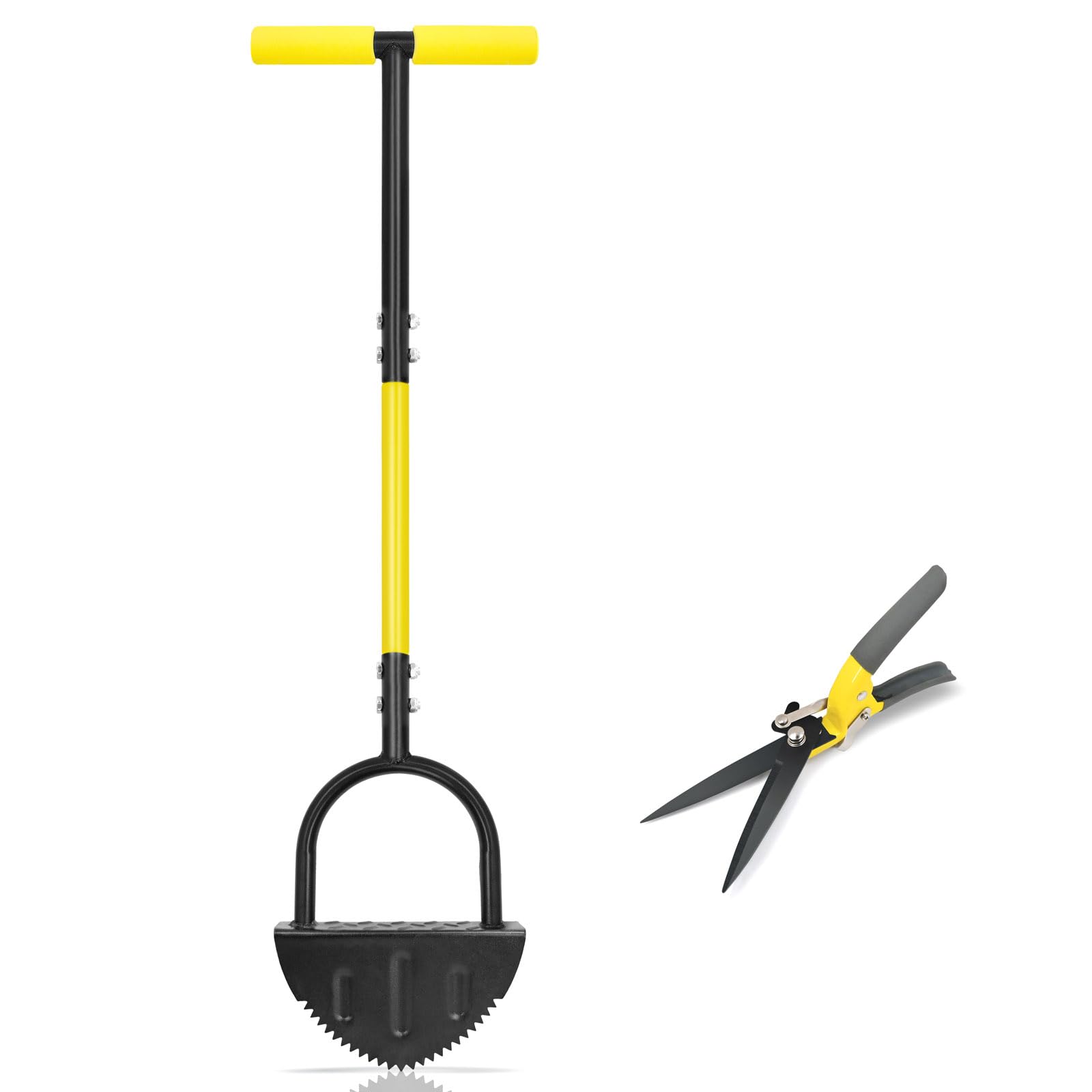
The Byhagern Professional Edge Lawn Tool is the most budget-friendly entry on this list, but it packs a surprising feature set. Its key differentiator is the saw-tooth design along the bottom of the curved half-moon blade, which helps it bite into and cut through grass, roots, and soil rather than just pushing down. This makes it more effective than many straight-blade budget edgers.
The long handle and non-slip grip reduce bending, and the wide footplate provides good leverage and accommodates all shoe sizes. The steel-welded construction with a carbon steel blade is weather and rust-resistant. Owner feedback highlights its ease of assembly and its ability to pull weeds by the roots while edging. Many also appreciate the quiet, eco-friendly operation and the included bonus shears and gloves, which add significant value.
While the steel blade feels solid, several users note that the blade is fairly thick (around 1/8 inch) and could benefit from some initial sharpening with a file or grinder for optimal cutting in heavy turf. It is a fantastic choice for the price-conscious gardener tackling soft to moderately firm soil.
What works
- Saw-tooth blade grips and cuts through turf effectively.
- Includes bonus gardening gloves and shears for added value.
- Quiet, eco-friendly manual operation.
What doesn’t
- Blade is somewhat thick and may need sharpening out of the box.
- Not ideal for heavy, compacted clay soil.
Hardware & Specs Guide
Half-Moon vs. Round Blades
Half-moon blades create a flat, squared-off trench ideal for defining garden beds and flower borders. The flat sides produce clean, vertical walls that prevent grass from creeping back in. Round blades are better suited for slicing along curved paths and sidewalks, and they are often chosen for general trenching tasks like burying low-voltage wire. Your choice should match the primary shape of your lawn’s edges.
Serrated vs. Straight Edges
A serrated edge acts like a saw, using aggressive teeth to grip and tear through dense grass, running roots, and compacted soil. It is the superior choice for overgrown borders or breaking new ground. A straight edge, by contrast, creates a smoother, more precise cut in already-worked or damp soil. Straight blades require less cleanup of the cut line but demand sharper initial steel and more downward force.
Spring Steel vs. Carbon Steel Blades
Spring steel is a high-carbon alloy heat-treated for flexibility. This allows the blade to bend under pressure from rocks or roots without permanently deforming, returning to its original shape. It is less likely to snap but may not hold a razor edge as long. Carbon steel is harder and can be sharpened to a finer edge, making it ideal for clean, effortless cuts, but it is more brittle and requires diligent rust prevention through drying and oiling after each use.
Fiberglass vs. Steel Handles
Fiberglass shafts are lightweight, do not conduct temperature, and resist rust and corrosion. They absorb vibration better than steel, reducing hand fatigue during extended sessions. Steel handles (especially one-piece tubular designs) offer unmatched strength and torque resistance, making them the choice for heavy-duty applications. The trade-off is weight; a steel-handled edger will be noticeably heavier, which aids cutting momentum but increases user fatigue.
FAQ
Should I use a manual edger or a power edger for my lawn?
How do I sharpen my garden edging tool?
What is the ideal handle length for a garden edger?
Final Thoughts: The Verdict
For most gardeners seeking the best combination of cutting power, ergonomics, and durability, the winner as a garden edging tool is the Root Slayer 22711 XL because its aggressive serrated blade and long fiberglass handle tackle heavy roots and clay with unmatched efficiency. If you prioritize comfort and a unique leverage system, grab the Radius Garden Pro-Lite Edger. And for a budget-friendly entry that still delivers solid performance, the Byhagern Professional Edge Lawn Tool offers the best value for light to moderate yard work.