
Vines don’t just grow; they invade. Kudzu, poison ivy, wild blackberry, and English ivy can turn a well-kept property into a tangled, woody nightmare in a single season, choking trees, climbing fences, and smothering shrubs. Unlike broadleaf weeds you can simply pull, these persistent plants require a targeted approach that penetrates deep into woody stems and extensive root systems to stop them from returning.
I’m Rikta — the co-founder and writer behind Lawn Gear Lab. I’ve spent hundreds of hours cross-referencing chemical active ingredients like triclopyr and 2,4-D, studying application methods from ‘cut-stump’ to ‘foliar spray,’ and analyzing real owner feedback to find which formulas deliver truly permanent vine removal.
This guide breaks down seven commercial-grade concentrates to help you finally reclaim your landscape. Whether you are clearing a fenceline or battling poison oak in the woods, find the most effective weed killer for vines that matches your specific infestation.
How To Choose The Best Weed Killer For Vines
Not all herbicides are built alike. A standard lawn weed killer will brush off a woody vine like water off a duck’s back because it lacks the translocation power needed to reach deep roots. You need a specialty product designed for brush, brambles, and climbing species.
Understand the active ingredients
Triclopyr is the gold standard for woody plants and vines. It mimics natural plant hormones causing uncontrolled growth that kills the entire system including roots. Glyphosate works on many annuals but is less effective on mature woody stems; blending it with triclopyr (like in Roundup Poison Ivy Plus) covers more ground. 2,4-D is a selective broadleaf killer often paired with triclopyr in formulas like Crossbow for mixed brush.
Choose your application method
Foliar spraying works best on low-growing ground vines like creeping Charlie or poison ivy patches. For climbing vines wrapped around a tree, the ‘cut-stump’ method — snipping the vine near the base and painting concentrate directly onto the fresh cut — is far more effective and protects the tree. Basal bark spraying (mixing concentrate with oil) is used on woody stems and fence-line brush where cutting every vine is impractical.
Check the concentration and coverage
Concentrates give you more control than ready-to-spray bottles. A 1-gallon jug of 8.8% triclopyr may yield hundreds of gallons of mixed spray, covering over an acre. Check the specific mix rate: a higher triclopyr percentage (like 8.8%) is more powerful per ounce than a 2.5% blend, but it also means less margin for error near desirable plants. For spot spraying small patches, a pint or quart may last you several seasons.
Quick Comparison
On smaller screens, swipe sideways to see the full table.
| Model | Category | Best For | Key Spec | Amazon |
|---|---|---|---|---|
| Southern Ag Crossbow | Premium Blend | Broad brush & tree sprouts | 2,4-D + Triclopyr, 128 oz | Amazon |
| Remedy Specialty | Pasture Grade | Fence lines & rangeland brush | Triclopyr concentrate, 128 oz | Amazon |
| Southern Ag Brush Killer | High Potency | Hard-to-kill ivy & sumac | 8.8% Triclopyr, 128 oz | Amazon |
| Roundup Poison Ivy Plus | Multi-Active Blend | Poison ivy & kudzu patches | Triclopyr + Fluazifop, 32 oz | Amazon |
| Bonide Vine & Stump | Cut-Stump Special | Spot-treating individual vines | Sodium metabisulfite, 8 oz (2-pack) | Amazon |
In‑Depth Reviews
1. Southern Ag Crossbow Specialty Herbicide

Southern Ag Crossbow has earned a reputation as a go-to general brush killer for a reason. Its dual-action formula pairs 2,4-D with triclopyr, delivering the broad-spectrum punch needed to take down aggressive vines, multiflora rose, and woody tree sprouts. A single gallon makes up to 96 gallons of spray solution, making it an incredibly economical choice for larger properties. Users consistently report that it outperforms standard glyphosate-based products on thick, established vine mats that have been left unchecked for years.
The chemistry works by penetrating the leaf cuticle and moving systemically through the phloem to the roots, which means you see top growth curling and dying within 48 hours on a warm, dry day, with full die-off occurring over a week. It is also rainfast in about an hour after application, which is a real advantage in unpredictable weather. Many owners describe it as a ‘safer alternative to Roundup’ for those concerned about glyphosate residues since the active break down relatively quickly in soil.
Where Crossbow truly shines is on mixed brush fence lines and overgrown lots. Its low-volatility formulation reduces the risk of drift onto neighboring gardens — a critical advantage compared to older ester-based formulas. However, it is non-selective to broadleaf plants, so you must use a shield or spot spray near desirable shrubs and flowers. For the sheer volume of weeds it annihilates per dollar, this is the top-tier jug to reach for.
What works
- Superior control of woody vines like blackberry, ivy, and poison oak
- Great value for money considering the acreage covered per gallon
- Rainfast in roughly one hour, reducing application anxiety
What doesn’t
- Strong chemical odor requires gloves and proper ventilation
- Effectiveness can vary significantly based on soil type and moisture
2. Remedy Specialty Herbicide
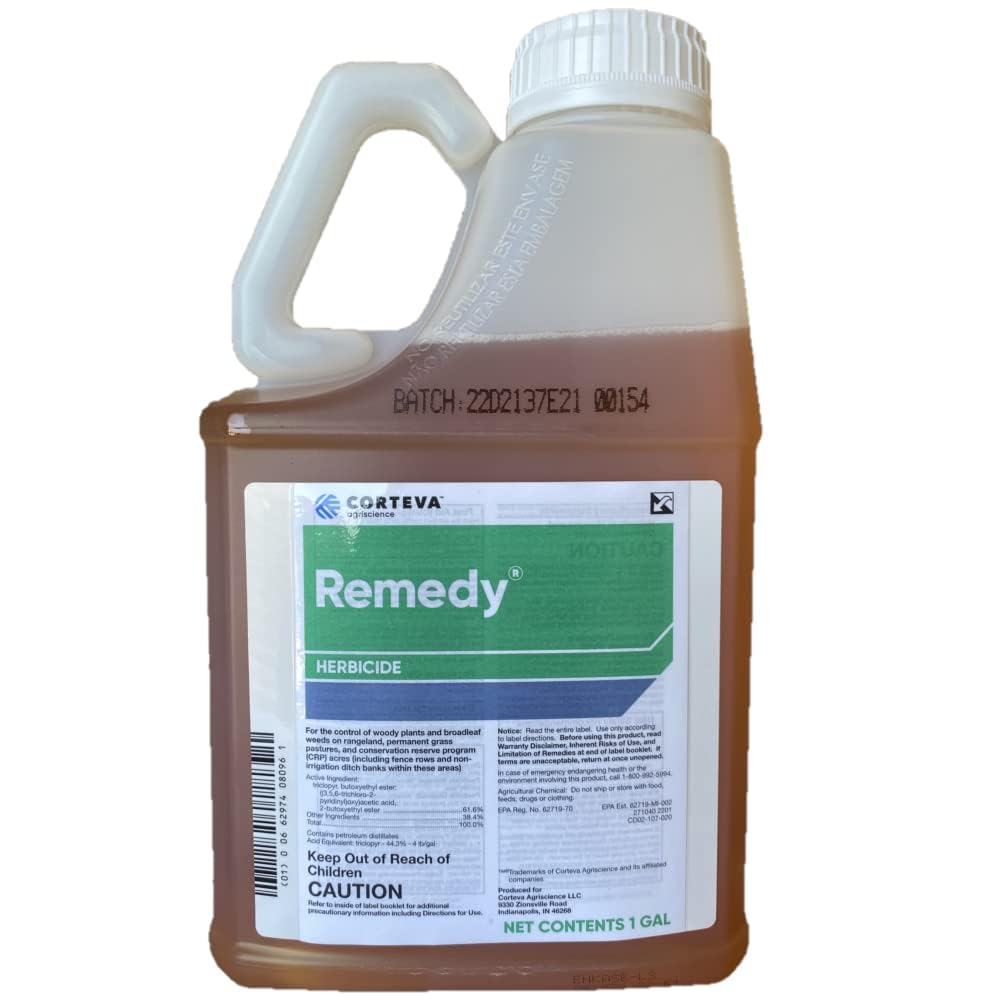
Remedy Specialty is engineered primarily for rangeland and pasture restoration, but its strength is exactly what makes it lethal against fence-line vines. This triclopyr concentrate is designed with a ‘low-odor’ formulation that is still potent enough to kill woody stems, honey locust thorns, and multiflora rose to the root. It is particularly effective when used as a basal bark application mixed with diesel or crop oil, where you spray the lower 12 inches of the stem and let the chemistry do the work without needing to cut every vine.
What sets Remedy apart from consumer-grade products is its residual control. Owners report that it doesn’t just knock the top growth down; it prevents resprouting from the root crown for an extended period. On tough invaders like cogongrass or blackberry thickets, users have called it an ‘absolute annihilation’ after a single treatment. It can also be tank-mixed with GrazonNext or ForeFront HL for a broader spectrum, giving pasture managers a flexible tool.
Because this is a professional-grade specialty herbicide, it comes with a premium cost. You are paying for a highly refined Triclopyr molecule that is gentler on grass species while being devastating to broadleaf brush. Always adhere strictly to the mix rates — overshooting can harm desirable forage. For someone managing large acreage with serious vine encroachment, Remedy represents the highest horsepower you can legally buy without an applicator’s license.
What works
- Excellent for basal bark applications on thick woody vines
- Long residual control prevents regrowth for extended periods
- Low-odor formula is much more pleasant to work with
What doesn’t
- High per-gallon price point that may feel steep for small yards
- Ineffective on grassy weeds; needs a partner herbicide for broad spectrum control
3. Southern Ag Brush Killer (8.8% Triclopyr)

If you are facing the absolute worst vine infestations — think mature poison ivy climbing 40 feet up a tree or an impenetrable wall of Chinese privet — you want the highest concentration of triclopyr available in a consumer-sized jug. That is exactly what Southern Ag delivers with this Brush Killer, clocking in at 8.8% Triclopyr. This is nearly four times the triclopyr concentration found in many blend products, meaning a little goes a very long way. Owners have successfully used a 4 oz per gallon mix for ivy and sumac, bumping up to 8 oz per gallon for the truly stubborn yaupon holly.
The feedback from long-term users is remarkably consistent: it works fantastically on East Texas brush, outperforming other brands on briar bushes and poison oak, with no regrowth reported after 8 months. It acts through both foliar absorption and root uptake, making it devastating on vines that have developed thick, waxy leaves. The gallon jug is a heavy-duty tool; expect to own it for several years unless you are clearing multiple acres of dense brush.
That said, the high concentration demands respect. It can harm or kill grass and desirable plants if applied carelessly, and some buyers have reported issues with missing labeling or product consistency between batches. The chemical is effective within a week or two, but its efficacy depends greatly on applying it during active growth on a hot, dry day. If you want a product that provides concentrated firepower for the worst vine problems, this is the one.
What works
- Extremely high 8.8% Triclopyr concentration for maximum power
- Excellent on hard-to-kill targets like poison ivy, sumac, and yaupon
- Great value for the cost per ounce of active ingredient
What doesn’t
- Some batches have arrived with missing product labels
- Not selective around grass; can cause turf damage if not careful
4. Roundup Poison Ivy Plus Tough Brush Killer₂

Roundup’s Poison Ivy Plus Tough Brush Killer₂ is a concentrated, multi-active formula specifically engineered for the toughest brush species. Its proprietary blend features triclopyr for woody stem penetration, fluazifop for grassy weed control, and diquat dibromide as a fast-acting contact herbicide. This triple threat means you see visible results — yellowing and wilting — within hours of application, not days, which is psychologically satisfying when you are staring down a massive kudzu patch.
The versatility of this product is its primary draw for homeowners. It explicitly targets poison ivy, poison oak, poison sumac, wild blackberry, and kudzu while being rainproof in just 30 minutes. This is the fastest rainfast guarantee on the market, giving you confidence even in showery weather. The 32-ounce concentrate is perfect for spot treatments around the yard and is easy to handle compared to a gallon jug. Many users appreciate the clear labeling for safe use around trees and shrubs when applied as a cut-stump treatment.
Where it falls slightly short of the premium gallons is in the total volume and the cost per ounce of active ingredient. For a sprawling five-acre property, you will need multiple bottles, which adds up quickly. Also, a few users noted that while it works well, it is not quite as potent on very old, thick-stemmed vines as higher-concentration triclopyr-only products. Nonetheless, for a mid-sized residential property battling poison ivy or brambles, this is the most user-friendly and reliably effective option you can grab.
What works
- Visible results in hours thanks to the diquat contact agent
- Rainproof in just 30 minutes, best-in-class for wet conditions
- Excellent for multi-species control including poison ivy and kudzu
What doesn’t
- Smaller bottle size means higher per-application cost for large areas
- May require reapplication on very old, woody infestations
5. Bonide Vine & Stump Killer Concentrate (2-Pack)
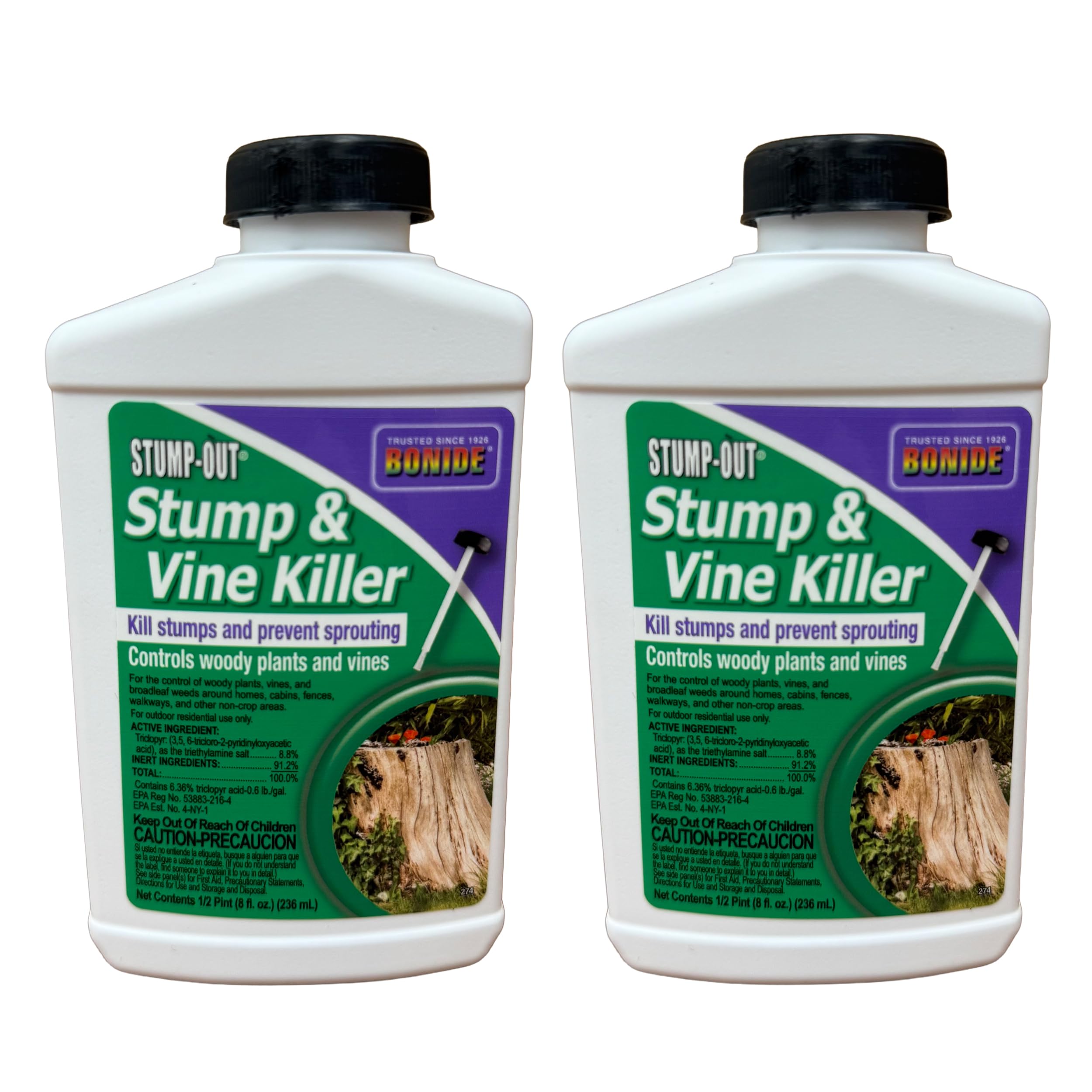
Bonide Vine & Stump Killer is a different beast than the triclopyr-based formulas above. It uses sodium metabisulfite as its active ingredient, which is a desiccant that works by rapidly drying out plant tissue. This makes it an ideal choice for the ‘cut-stump’ method: you saw the vine or tree stump down to fresh wood, then paint or squirt the concentrate directly onto the cut. It quickly penetrates the vascular system and kills the root system, preventing that dreadful resprouting that plagues stump removal efforts.
The two-pack of 8-ounce bottles makes this a very practical, budget-friendly solution for homeowners who only need to tackle a few specific problem areas — like a rogue English ivy vine climbing a maple tree or an old privet stump shooting out new growth. Owners report that it works effectively on tough vines, with weeds not coming back after a single application. It is also extremely easy to use: the built-in applicator tip allows for precise dosage, so you are not spraying chemicals broadly into the air.
On the downside, this is not designed for large-scale foliar spraying of vine patches. Trying to use it as a blanket herbicide on a hillside covered in poison ivy would be both expensive and inefficient, as the desiccant action is best on fresh cuts. Some customers have also received bottles that leaked during shipping, so it is worth inspecting the packaging upon arrival. For precision application on individual stumps and vines, however, Bonide offers a smart, low-waste solution that works.
What works
- Targeted applicator tip is perfect for spot-treating stumps and vines
- Very effective at preventing resprouting from cut stumps
- Low cost entry point for homeowners with limited infestations
What doesn’t
- Not suitable for broad-acre foliar spraying of vine patches
- Small bottles can be pricey per ounce compared to gallons
6. Whitetail Institute Arrest Max Selective Herbicide

While most of this guide focuses on killing woody vines, many readers are actually battling grassy vines and weed grasses in their clover food plots or lawns. The Whitetail Institute Arrest Max is a selective post-emergent grass herbicide specifically formulated to kill grasses — including invasive vine-like grasses — without harming broadleaf forages like clover, alfalfa, and chicory. This is a game-changer for food plot managers who want to suppress Bermuda grass or crabgrass in a clover field.
The active chemistry (Clethodim) is a systemic grass killer that is absorbed through the leaf and translocated to the growing points. Users mixing 1 oz per gallon with a crop oil surfactant have reported visible yellowing in 7 days and complete grass death by day 13, with the clover actually thriving in the extra space. The pint bottle can cover up to 1 acre of active treatment, making it a very efficient solution for a specific, narrow problem. It is also rainfast within just a few hours.
It is crucial to understand what Arrest Max does not do: it will not kill woody broadleaf vines like poison ivy. In fact, it is designed to preserve those broadleaf plants. This makes it an essential complementary tool if you are managing a food plot and want to kill the grass-type vines (like wild grape or grassy smilax) without destroying your plot. It works slowly compared to non-selective herbicides, and multiple applications may be needed for tough perennial grasses like tall fescue. It is the ultimate scalpel for the specific grass-vine problem.
What works
- Highly selective: kills grass weeds without harming clover or alfalfa
- Systemic action provides complete root kill for annual and perennial grasses
- Rainfast within 1-3 hours, fitting into typical spray schedules
What doesn’t
- Expensive per ounce and does not affect broadleaf vines at all
- Works relatively slowly compared to non-selective herbicides
7. Target 6 Plus (MSMA 48.2%) Turf Herbicide

Target 6 Plus is a specialized, high-volume solution for those battling grassy weeds and sedges that act like vines in managed turfgrass. Its active ingredient, MSMA (Monosodium methanearsonate) at 48.2%, is a powerful post-emergent herbicide used extensively on golf courses, sod farms, and highway rights-of-way. For homeowners who are fighting a losing war against dallisgrass, crabgrass, and nutsedge in their Bermuda or zoysia lawns, this 2.5-gallon jug provides an incredible amount of chemistry at a very economical cost per application.
The feedback from users is emphatic: it works extremely fast and is incredibly potent. Owners have noted that a tiny amount—just over a tablespoon per 2 gallons of water—was enough to eliminate a serious weed infestation. It is particularly praised for its effectiveness on dallisgrass and nutsedge, two of the most stubborn weed ‘vines’ that can ruin the look of a manicured lawn. The concentrate is thick and high-quality, and a single purchase can last a homeowner five years or more, according to direct reports.
This product comes with significant caveats. MSMA is a restricted-use pesticide in many states due to arsenic content, and you should check your local regulations before ordering. It is extremely powerful; incorrect mixing rates can easily brown or stress your turfgrass. It is also not designed for broadleaf vine control—it targets specific grassy weeds and sedges. Target 6 Plus is the ultimate specialist for the specific problem of grass-like vines in well-managed turf, but it is not a general vine killer for the backyard.
What works
- Incredibly cost-effective for large turf areas fighting grassy weeds
- Extremely fast and potent on dallisgrass, nutsedge, and crabgrass
- High concentration means a single purchase lasts for years
What doesn’t
- May be restricted in some areas due to MSMA content; verify your state laws
- Powerful formula can easily damage Bermuda grass if over-applied
Hardware & Specs Guide
Understanding Triclopyr Percentage
This is the single most important spec for vine killers. A product like Southern Ag Brush Killer contains 8.8% Triclopyr, while a blend like Roundup Poison Ivy Plus contains around 2.5%. Higher percentages allow you to mix a stronger solution for old, thick-stemmed vines or to use less product per gallon, making your jug last longer. For routine spot spraying, anything above 4% is considered heavy-duty.
Rainfastness and Surfactants
Rainfastness refers to the time a herbicide needs to dry on the leaf before a rainfall event washes it off. Roundup Poison Ivy Plus boasts a 30-minute rainfast window, which is exceptional. Most triclopyr products require 1-3 hours. To improve adherence on waxy vine leaves, consider adding a non-ionic surfactant or a dash of cooking oil (as some Roundup users do) to your spray mix, especially in humid conditions.
Cut-Stump Application
This method is the most effective for killing climbing vines attached to trees without harming the tree. You cut the vine near the base and immediately paint or spray the concentrate onto the fresh cut before it dries. Bonide Vine & Stump Killer is formulated for this exact purpose. The chemical is pulled down into the root system by the plant’s transpiration stream, ensuring the entire network dies.
Selective vs. Non-Selective
A non-selective herbicide (like the Southern Ag Brush Killer) will kill any broadleaf plant it touches, including flowers and shrubs. A selective herbicide (like Whitetail Arrest Max) targets only grasses and leaves broadleaf plants unharmed. Choosing between them depends on whether your vines are growing in a flower bed (where you need non-selective precision) or in a clover food plot (where you need grass-only control).
FAQ
Can I use a regular weed killer for vines?
What is the best way to kill vines growing up a tree?
How much triclopyr do I need to mix to kill poison ivy?
Is it safe to use vine killer around pets and children?
Final Thoughts: The Verdict
For most gardeners, the weed killer for vines winner is the Southern Ag Crossbow because its 2,4-D plus triclopyr blend provides the best balance of power, coverage area, and cost for eradicating mixed brush and vines on residential properties. If you want the highest concentration of pure triclopyr for the toughest poison ivy and sumac infestations, grab the Southern Ag Brush Killer. And for quick results with a rainfast formula that is perfect for spot treating poison ivy patches, nothing beats the Roundup Poison Ivy Plus.