
Solar spot lights promise the magic of free, wire-free landscape illumination, but the reality between models varies wildly. Many deliver a dim, short-lived glow that fades before midnight, leaving your trees, flags, and walkways in darkness when you need them most.
I’m Rikta — the co-founder and writer behind Lawn Gear Lab. I’ve spent many hours dissecting the technical specifications and real-world owner feedback across dozens of solar spot light models to separate genuine performers from disappointing knockoffs.
The specs that matter most—lumen output, battery capacity, solar panel efficiency, and weather sealing—determine whether a unit actually lights your yard or becomes another piece of plastic lawn decor. This guide analyzes the top contenders to help you find the best solar spot lights for your specific landscape needs.
How To Choose The Best Solar Spot Lights
Selecting the right solar spot light goes far beyond picking the cheapest 2-pack on a shelf. You need to consider brightness in lumens, battery capacity for all-night runtime, the solar panel’s real-world charging efficiency, and the physical build quality that survives rain, snow, and frost. Here’s exactly what to evaluate.
Lumen Output and Beam Focus
Lumen output tells you how much total light the fixture emits, but the way that light is focused matters just as much. A spotlight with a tight beam focus excels at uplighting a tall tree or flagpole from a distance, while a wide flood pattern is better for washing a fence or pathway with ambient light. Look for a minimum of 400-500 lumens per head for noticeable tree uplighting; 650-1000 lumens provides a truly dramatic effect.
Solar Panel Efficiency and Battery Capacity
The solar panel is the engine of any solar light. Monocrystalline silicon panels typically offer 20-28% energy conversion efficiency, significantly outperforming polycrystalline alternatives. An oversized panel—around 1.5W or higher—charges faster and keeps the light burning longer during winter months with shorter daylight hours. Battery capacity, measured in mAh (milliampere-hours), directly dictates run time. A 1500mAh to 2000mAh battery is the minimum threshold for all-night operation on high brightness; lower capacities will force a dimmer, shorter evening.
Weather Resistance and Build Quality
IP (Ingress Protection) ratings are non-negotiable for outdoor gear. IP65 offers protection against dust and low-pressure water jets, sufficient for rain in most climates. IP67 provides total dust protection and can survive submersion in up to one meter of water for 30 minutes, ideal for ground-level installations near puddles or sprinklers. IP68 goes further with continuous submersion capability. Beyond the rating, look for ABS or powder-coated aluminum housing to resist UV degradation and physical impact over years of exposure.
Quick Comparison
On smaller screens, swipe sideways to see the full table.
| Model | Category | Best For | Key Spec | Amazon |
|---|---|---|---|---|
| APOMAO 36 LED 2-pack | Mid-Range | High-Brightness Uplighting | 1000 Lumens, 1.5W panel | Amazon |
| NBKLS 21 LED 4-pack | Premium | All-Night Consistent Glow | 28% efficiency panel, 650 lm | Amazon |
| LAMKEEP 60 LED 4-pack | Mid-Range | Extended Runtime (30h Low) | 700 Lumens, IP68, 60 LEDs | Amazon |
| GKGG 76 LED 4-pack | Mid-Range | Wide Coverage Area | 400 Lumens, 76 LEDs | Amazon |
| btfarm Motion Sensor 4-pack | Mid-Range | Security & Motion Detection | 120° sensor, 1500mAh battery | Amazon |
| nipify 53 LED 4-pack | Premium | Versatile Angling & Placement | 800 Lumens, 150°+300° panel | Amazon |
| APONUO 4-in-1 Detached Panel | Premium | Obstructed Sunlight Areas | 2000mAh battery x2, 9.8ft cable | Amazon |
In‑Depth Reviews
1. APOMAO 36 LED 2-Pack

The APOMAO 36 LED delivers a sizzling 1000 lumens per head—a spec that outpaces almost every other mid-range solar spot light on this list. The 1.5W monocrystalline panel charges 25% faster than standard poly panels, and the dual-head design lets you aim light in two directions from a single stake, effectively covering a wider area without extra hardware. Reviewers consistently praise the brightness for uplighting trees and flagpoles, noting the cool white 5000K temperature provides a crisp, modern aesthetic.
The auto on/off sensor works reliably, and two brightness modes (Low at 12 hours, High at 6 hours) give you control over runtime versus intensity. The IP67 rating ensures it withstands heavy rain and snow without water ingress inside the housing. Multiple owners report the lights maintaining full brightness past midnight on the high setting after a full day of sun, a testament to the oversized panel and efficient 36-LED array.
One limitation is the panel’s range of motion—the solar cell rotates up and down but not sideways, which may restrict optimal sun positioning if your mounting location faces an awkward angle. The powder-coated ABS casing feels sturdy but is plastic, not metal, so it won’t handle being stepped on or hit by a lawnmower blade. Still, for raw lumen output at this price, it’s the most impressive performer.
What works
- 1000 lumen output dramatically lights trees and flags.
- Oversized 1.5W monocrystalline panel charges rapidly.
- Dual-head design provides flexible coverage from one stake.
What doesn’t
- Solar panel moves up/down only, lacks horizontal rotation.
- Plastic housing is durable but not impact-proof.
2. LAMKEEP 60 LED 4-Pack
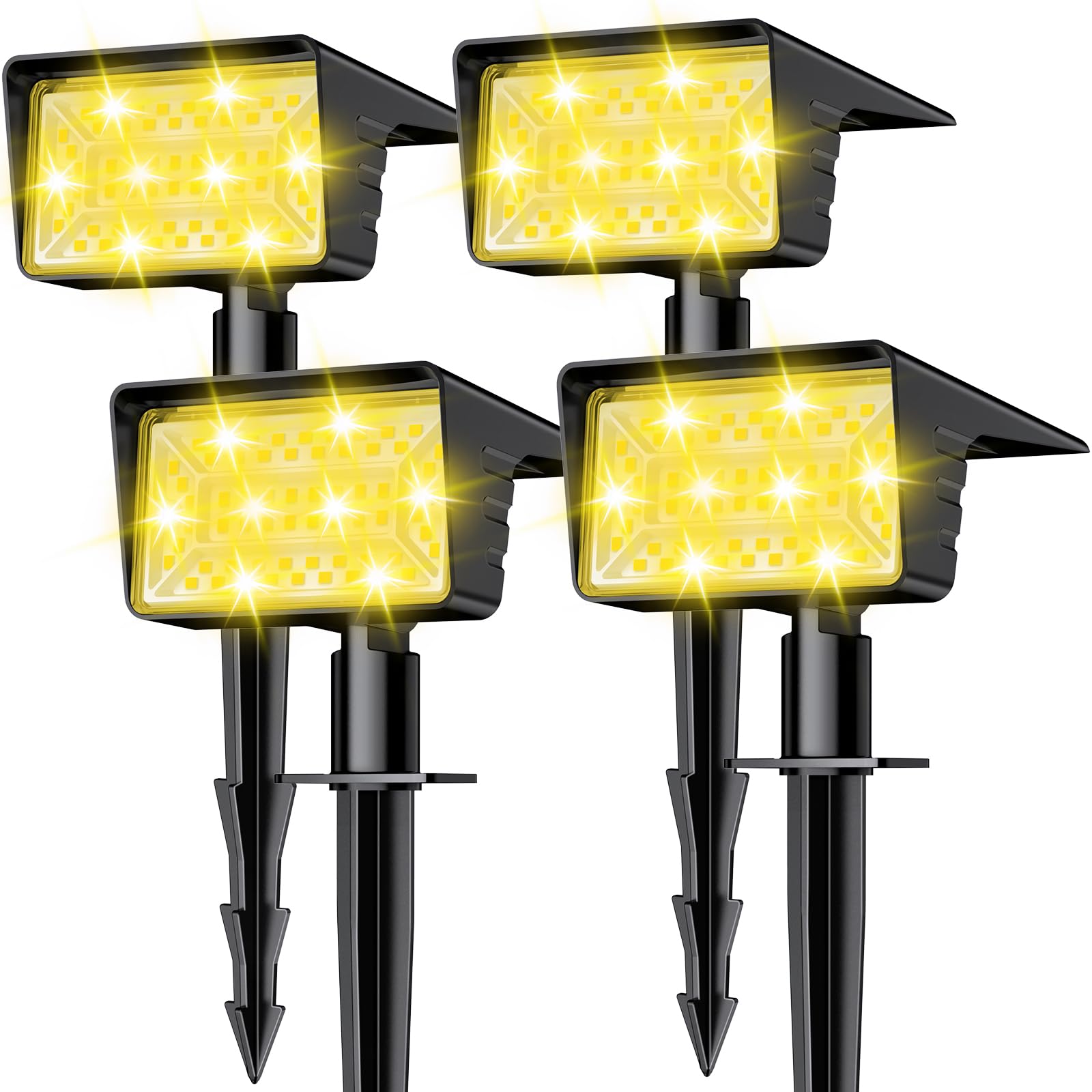
If all-night runtime is your top priority, the LAMKEEP 60 LED stack up impressively. The 60-LED array outputs 700 lumens, which is solid for tree uplighting, but the real story is the three selectable modes delivering up to 30 hours on Low, 20 hours on Medium, and 10 hours on High. That Low mode duration is more than enough to last from sunset to sunrise even during the shortest winter nights, and multiple buyers confirm the lights still shine bright in the morning.
The IP68 waterproof rating is a meaningful step up from the more common IP67 and IP65. Combined with ultrasonic defogging on the lens, these lights resist internal condensation and maintain clear light transmission even during rapid temperature shifts. The 120° adjustable solar panel and 30% higher conversion efficiency claim appear validated by owner reports of reliable performance even on overcast Pacific Northwest days. The 2-in-1 ground spike and wall mount setup adds versatility.
The warm white 3000K color temperature creates a soft, inviting glow rather than a harsh white beam, making it better suited for ambient landscape accenting than security-focused flood lighting. One reviewer noted that out of a 12-pack, one unit was defective, suggesting minor quality control variance. Also, the light on High mode won’t maintain full brightness all night, so you’ll trade intensity for duration based on your preferred setting.
What works
- Low mode lasts up to 30 hours for all-night coverage.
- IP68 rating and defogging lens ensure long-term durability.
- Warm white light creates a pleasant landscape ambiance.
What doesn’t
- High mode does not sustain peak brightness all night.
- Minor quality control variance reported in multi-pack purchases.
3. GKGG 76 LED 4-Pack

The GKGG 76 LED unit offers a low 400 lumens, which on paper seems underwhelming next to 700-1000 lumen competitors. However, the large 76-LED array distributes the light across a wider angle, making it effective for flooding a patio or pathway with even, soft illumination rather than concentrating a single bright spot. The warm white 3500K color temperature is noticeably cozy, and multiple owners describe the light as providing a “nice glow” that dresses up the house without being harsh.
Build quality is a standout here. The powder-coated ABS material feels dense and premium in hand, and reviewers consistently note the “sturdy” stakes and “great quality” plastic. Available three brightness modes across 6, 10, and 20 hours of runtime, combined with an overcharge and overdischarge protection circuit, add safety and battery longevity. The 2-in-1 ground spike and wall mount installation is straightforward, and the touch button control is simple.
The IP65 rating is adequate for rain but not as robust as IP67 or IP68 on direct ground-contact models, so you’ll want to avoid installing it in areas that pool with standing water. Several owners also noted the lack of replaceable battery access, meaning once the internal cell degrades after a few seasons, the entire unit needs replacement. For budget-conscious buyers who prioritize coverage area over pin-point brightness, this is a sound choice.
What works
- 76 LEDs produce wide, even light distribution for pathways.
- Sturdy construction with thick ABS housing and quality stakes.
- Overcharge/overdischarge protection extends battery life.
What doesn’t
- 400 lumens is dimmer than comparable competitors.
- Non-replaceable battery limits long-term usability.
4. btfarm Motion Sensor 4-Pack
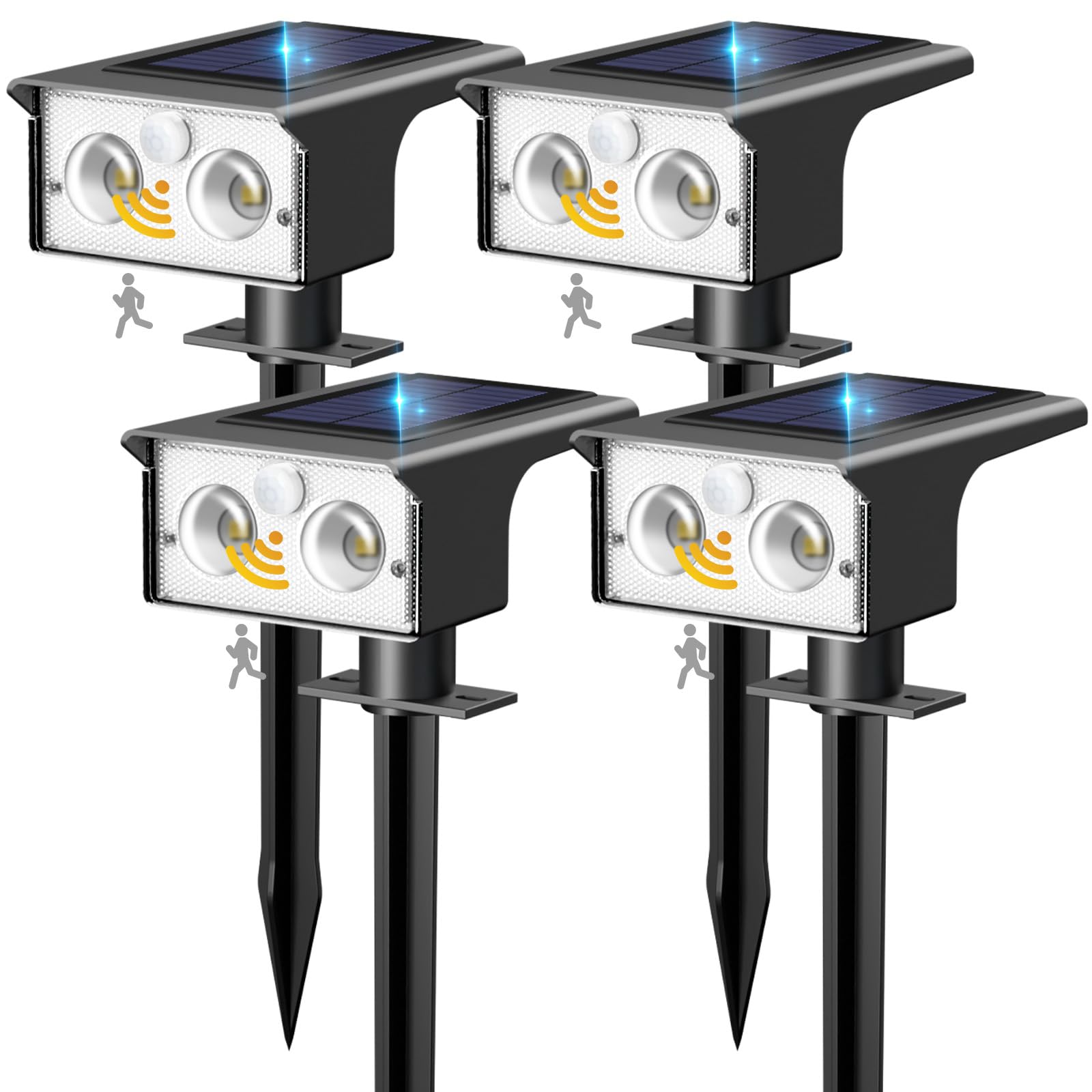
The btfarm solar spot light uniquely integrates a 120° wide-angle motion sensor with a 5-8 meter detection range, turning your landscape lights into a low-key security system. The built-in 1500mAh battery provides up to 30 hours of operation on the Constant-On mode (20% brightness), and the two sensor modes give you options: one shines at 50% brightness until motion triggers full brightness, and the other stays off until triggered. This intelligent battery-saving approach makes a single charge stretch across multiple nights.
Reviewers are emphatic about the brightness, with one reporting that the lights stay at full brightness for 12+ hours when triggered hundreds of times per night near a chicken coop. The cool white 6000K color temperature is bright and crisp, ideal for security and pathway illumination. The IP65 rating handles rain and dust, and the ABS+PC housing is heat-resistant and freeze-proof from -4°F to 140°F.
The major catch is the motion sensor’s programming: the instructions are printed extremely small, and several owners found it difficult to switch between the three modes without a magnifying glass. One reviewer noted that the lights remained on constantly while in motion detector mode because they couldn’t decipher the print to adjust the setting. If you plan to use these strictly as constant-on landscape lights, the motion sensor intelligence is wasted, and you’d be better served by a standard unit.
What works
- 120° motion sensor with 5-8m range activates on trespassers.
- 1500mAh battery delivers 30h runtime on constant-low mode.
- Durable ABS+PC housing rated from -4°F to 140°F.
What doesn’t
- Tiny instruction print makes mode switching very difficult.
- Motion sensor is redundant if used as constant-on lighting.
5. nipify 53 LED 4-Pack

The nipify 53 LED model solves a common frustration: fixed solar panels that cannot adjust for sun angle. The panel offers a 150° pitch plus 300° horizontal rotation, effectively allowing you to track the sun’s arc across the sky for maximum charging. The light head also adjusts 90° independently, so you can point the beam exactly where needed—from low shrubs to high wall sculptures—without moving the entire stake. This independent articulation is genuinely rare in this price bracket.
At 800 lumens, the brightness is well above average, and the 2700K warm white temperature produces a rich, amber-like glow that complements natural landscaping rather than clashing with it. Reviewers report the lights last all night even on the highest brightness setting after a full day’s charge, and one owner is on their second purchase of the same model—a strong durability indicator. The smooth, dust-proof panel design reduces accumulation of debris that can block sunlight over time.
The matte finish ABS housing looks more premium than glossy alternatives, but it is still plastic. The brightness, while very good, is not as eye-poppingly intense as the 1000-lumen APOMAO, so if sheer blinding output is your goal, you might prefer that option. Additionally, while the 3-mode operation adapts well to different scenes, the medium and low settings provide a noticeably dimmer light that may not satisfy those expecting full brilliance all night.
What works
- Panel rotates 150°+300° for optimal sun tracking.
- 800 lumen output with warm 2700K color is highly aesthetic.
- Dust-proof panel design maintains charging efficiency.
What doesn’t
- Brighter than average, but not the absolute brightest available.
- Plastic housing, while quality, is not impact-resistant metal.
6. APONUO 4-in-1 Detached Panel

The APONUO 4-in-1 solves the single biggest problem with solar lights: what if your ideal mounting location sits in deep shade? This system uses a remote solar panel connected to the light heads via a 9.8-foot (3-meter) cable, allowing you to place the panel in full sun while the lights themselves illuminate a shaded patio, under a dense tree canopy, or on a north-facing wall. The panel detaches and mounts independently, opening up installation spots that are impossible for all-in-one units.
Inside the lights are dual 2000mAh batteries—a total of 4000mAh per light head, which is double the capacity of most competitors. This translates to 8-12 hours of runtime on High mode and a full night on Low mode. The warm white 3000K color is soothing, and the 270° adjustable light head allows precise aiming. Multiple reviews note the “small but mighty” performance, with one woman reporting solo installation was easy even in heavy rain, and the lights surviving subsequent storms without issue.
The 9.8-foot cable is barely long enough for many installations. Several owners wish it were at least 15 feet, as the distance between the sunniest spot and the desired light location is often greater than expected. APONUO sells extension cables separately, but this adds cost and complexity. Also, the system only offers two brightness modes rather than the three found on many competitors, and the lights connect in a pair to one panel, limiting individual placement variability.
What works
- Detached solar panel solves shaded installation areas.
- Dual 2000mAh batteries provide massive capacity for all-night operation.
- Simple installation and reliable auto on/off function.
What doesn’t
- 9.8ft cable is too short for many setups.
- Only two brightness modes, not three.
7. NBKLS 21 LED 4-Pack

The NBKLS 21 LED may only pack 21 LEDs per head, but it achieves a respectable 650 lumens with a tightly focused beam that excels at uplighting trees and architectural features from a distance. The secret is the 28% efficient monocrystalline silicon panel—one of the highest conversion rates on this list—which translates to faster charging and better performance on overcast days. Three brightness modes give you 18 hours (Low), 12 hours (Medium), and 6 hours (High) of runtime.
Owner feedback is overwhelmingly positive, with particular praise for the “perfect brightness” and the ability to light trees and walls without washing out the night sky. The IP67 rating means it survives rain and snow without worry, and the adjustable 180° light head plus 180° solar panel rotation provide flexible aiming. Reviewers note the spikes are very sturdy, making installation easy even in compacted soil near plant roots. The sleek, modern design blends into landscaping rather than standing out as an eyesore.
At 650 lumens, it’s not the brightest unit in this comparison; if you’re illuminating a very large tree from a long distance, the APOMAO’s 1000 lumens will cast a more defined silhouette. The 21 LED count is lower than many competitors, and the beam is narrow by design, so it won’t flood a wide garden area with ambient light. For targeted accent lighting with reliable all-night performance, this is an outstanding choice.
What works
- 28% efficient monocrystalline panel charges reliably in low sun.
- 650 lumen narrow beam excels at focusing on specific features.
- IP67 rating and robust build ensure long outdoor life.
What doesn’t
- 650 lumens is not the brightest option for large areas.
- Narrow beam is less effective for broad ambient coverage.
Hardware & Specs Guide
Lumen Output & Beam Angle
Lumen output (measured in lumens, lm) indicates total visible light emitted. For accent uplighting, aim for 650-1000 lm per head for noticeable effect. Beam angle determines spread: a narrow 30-45° spot concentrates light on a single tree, while a wider 120° flood covers a pathway. Spotlights with focusing lenses deliver more distance but less coverage; floodlights do the opposite. Choose based on whether you want dramatic vertical accent lighting or broad horizontal ambient glow.
Solar Panel Type and Wattage
Monocrystalline silicon panels convert 20-28% of sunlight into electricity, outperforming polycrystalline (15-20%) and amorphous silicon panels (6-10%). Panel wattage—typically 1W to 2W in consumer solar spot lights—dictates charging speed. A 1.5W or higher monocrystalline panel charges a depleted battery in 5-7 hours of direct sun, while a 1W poly panel may need 8-10 hours. For northern climates or shaded locations, prioritize higher efficiency and higher wattage panels.
FAQ
How many lumens do I need to uplight a tall tree?
Do solar spot lights work in winter or cloudy weather?
What is the difference between IP65, IP67, and IP68 waterproof ratings?
Can I replace the batteries in my solar spot lights?
Final Thoughts: The Verdict
For most gardeners, the solar spot lights winner is the APOMAO 36 LED 2-Pack because its 1000 lumen output, dual-head design, and fast-charging 1.5W monocrystalline panel deliver the most dramatic landscape lighting effect for the investment. If you want extended all-night runtime with a warm aesthetic, grab the LAMKEEP 60 LED 4-Pack. And for illuminating shaded areas where a detached solar panel is essential, nothing beats the APONUO 4-in-1.