
Growing plump, sweet blueberries, raspberries, or strawberries starts underground — with a fertilizer matched to the acid-loving nature of berry plants, not a generic all-purpose feed that pushes leaves at the expense of fruit. Too much nitrogen yields bushy plants with few berries; the wrong pH locks essential micronutrients away even when the NPK numbers look right. Finding the best berry fertilizer means decoding the ratio, checking the sulfur content, and choosing between fast-acting liquids and slow-release granules that sustain fruiting through the harvest window.
I’m Rikta — the co-founder and writer behind Lawn Gear Lab. I’ve spent dozens of hours comparing NPK ratios, analyzing organic certifications, cross-referencing local soil pH requirements, and studying verified owner feedback to separate the formulas that actually boost berry yield from those that just green up the leaves.
This guide breaks down seven options spanning liquids for quick corrections and granules for season-long feeding, with a focus on the acidifying ingredients and micronutrient profiles that make or break a berry patch. Whether you’re tending mature blueberry bushes or starting a new strawberry bed, this review of best berry fertilizer covers the formulations worth your time and money.
How To Choose The Best Berry Fertilizer
Berry plants require a specific balance of nutrients and a soil pH between 4.5 and 5.5 to thrive. A generic garden fertilizer often pushes vegetative growth at the expense of fruit production or fails to acidify the root zone adequately. Here are the three critical factors to evaluate before buying.
NPK Ratio: The Nitrogen Trap
High-nitrogen formulas (anything above 6 in the first number) trigger leafy growth and can suppress flowering and fruiting. For most berries, a ratio with nitrogen at 4 to 5, phosphorus around 3 to 4, and potassium at 4 to 6 is ideal. The higher potassium supports fruit development and strengthens cell walls. Check the middle number (phosphorus) if your soil already tests high — some regions need less, and excess phosphorus can harm mycorrhizal fungi.
Soil pH and Sulfur Content
Blueberries and other acid-loving fruits cannot absorb iron and manganese if the soil pH rises above 6.0. The best berry fertilizers include elemental sulfur or natural acidifiers (cottonseed meal, peat moss derivatives) to lower pH gradually. Granular options with sulfur work like a slow corrective, while liquid fish fertilizers offer a quick nitrogen boost without significant pH change — useful for balancing pH in neutral soils.
Release Mechanism: Liquid vs. Granular
Liquid fertilizers like fish emulsion work within days and are ideal for correcting deficiencies mid-season or for container berries that need frequent feeding. Granular fertilizers (either organic meals or coated slow-release prills) feed over 4 to 8 weeks and build soil organic matter. If you want to feed once in early spring and once after flowering, a granular formula saves labor. If you need to adjust on the fly during the growing season, a liquid concentrate gives you control.
Quick Comparison
On smaller screens, swipe sideways to see the full table.
| Model | Category | Best For | Key Spec | Amazon |
|---|---|---|---|---|
| Espoma Holly-Tone 36 lb | Granular | Large acid-loving gardens | 4-3-4, 5% sulfur | Amazon |
| Down To Earth Acid Mix 25 lb | Granular | Blueberries & raspberries | 4-3-6 ratio | Amazon |
| True Organic Berry Food 4 lb | Granular | Targeted berry feeding | 5-4-4, sulfur for pH | Amazon |
| Espoma Berry Tone 4 lb | Granular | All berry types | 4-3-4, Bio-tone formula | Amazon |
| Down To Earth Fruit Tree 5 lb | Powder | Fruiting trees & canes | 6-2-4, added calcium | Amazon |
| Alaska Fish Fertilizer | Liquid | Quick organic nitrogen | 5-1-1 OMRI listed | Amazon |
| FoxFarm Happy Frog 4 lb | Granular | General garden feeding | 6-4-5, soil microbes | Amazon |
In‑Depth Reviews
1. Espoma Organic Holly-Tone 4-3-4 — 36 lb Bag

Holly-Tone carries the original reputation for acid-loving plants, and the 36-pound bag delivers enough granular feed to cover a substantial berry patch — up to 180 square feet per application depending on dosage. The 4-3-4 ratio keeps nitrogen moderate while the 5 percent elemental sulfur works over time to lower soil pH, which is critical for blueberries that stall in neutral or alkaline conditions. The exclusive Bio-tone formula includes beneficial microbes that help break down organic matter around the root zone.
Owner reports consistently mention stronger bloom sets on azaleas and hydrangeas, but berry-specific feedback shows marked improvement in strawberry and blueberry fruiting when applied in early spring and again after the first flush of flowers. The granular format requires no mixing — just broadcast around the drip line and water in. For gardeners managing multiple acid-loving shrubs alongside berry canes, this single product replaces several specialized feeds.
The main trade-off is the bag size: at 36 pounds, it’s a commitment best suited to medium or large gardens. Small-space growers may prefer a smaller bag to avoid storage issues, and users with neutral or alkaline clay soil may need to supplement with additional sulfur in the first season to bring pH down to the 4.5–5.0 range for blueberries.
What works
- Large bag offers excellent coverage for beds with multiple acid-loving plants.
- Proven Bio-tone microbes support soil biology and root development.
- 5% sulfur gradually corrects soil pH for blueberries and raspberries.
What doesn’t
- Bulky bag may be inconvenient for small garden storage.
- Heavily alkaline soils may need a separate fast-acting acidifier.
2. Down To Earth Organic Acid Mix 4-3-6 — 25 lb Bag
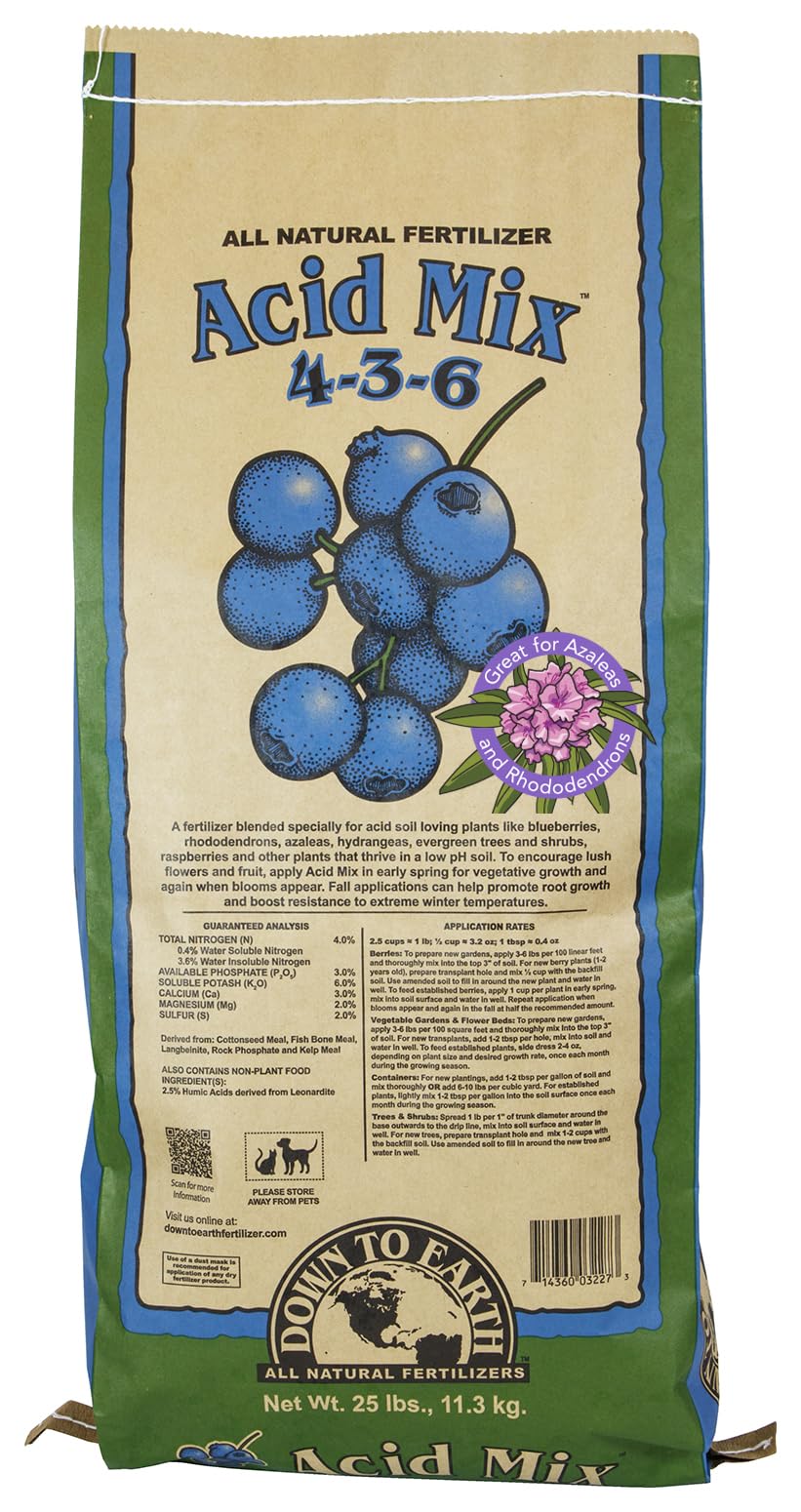
This formulation leans harder on potassium (the third number at 6) than most berry fertilizers, which directly supports fruit size, sugar content, and disease resistance. The 4-3-6 analysis is tailored for acid-loving plants that have already flowered and need energy diverted into berry development rather than new leaves. Ingredients include cottonseed meal, langbeinite (a natural potassium-magnesium source), fish bone meal, rock phosphate, humates, and kelp meal — a broad-spectrum organic profile.
Experienced berry growers report that this mix maintains the acidic soil environment blueberries and raspberries need without the harsh chemical drop that synthetic acidifiers cause. Owners of mature blueberry bushes note consistent yield increases when switching from generic azalea fertilizers to this specific ratio, especially in regions with naturally higher pH water. The 25-pound bag is cost-effective per pound compared to smaller packages and still manageable for annual spring and fall applications.
Because it’s a dry granular meal, it releases nutrients more slowly than coated prills or liquids. If your plants show a sudden deficiency mid-season, you’ll need a faster-acting supplement. Some users also note the bag can clump if exposed to moisture during storage, so keeping it in a sealed container is recommended.
What works
- High potassium (6) supports fruit development and winter hardiness.
- Broad organic ingredient list feeds soil microbes and builds tilth.
- Cost-efficient per pound for large berry patches.
What doesn’t
- Slow-release format doesn’t correct mid-season deficiencies quickly.
- Bag can clump if stored without airtight protection.
3. True Organic Berry Food 5-4-4 — 4 lb Bag

True Organic Berry Food is formulated specifically for berry plants, making it one of the most targeted options on this list. The 5-4-4 ratio is slightly higher in nitrogen than the acid mix but still balanced enough to avoid excessive foliage — and the inclusion of sulfur helps maintain low pH conditions that blueberries demand. The ingredient list features seabird guano (a rich source of phosphorus and trace minerals) alongside shrimp and crab shell meal, which add calcium and chitin to boost soil microbiology.
Reviews from raspberry and blueberry growers highlight dramatic recovery in neglected patches. One owner reported that an older raspberry planting that had stopped producing began fruiting heavily after a few monthly applications. The bag covers roughly 58 square feet, so it’s best suited to small or medium-sized berry beds. The granules are easy to scatter and dissolve fairly quickly when watered in.
The premium ingredients come at a higher cost per pound than the Espoma or Down To Earth options. For large berry farms or multiple long rows, this becomes expensive compared to bulk granular blends. Also, the sulfur content is sufficient for maintenance but may not be enough to drop pH by a full point in heavily alkaline soil.
What works
- Berry-specific formula with seabird guano for micronutrients.
- Shrimp and crab shell meal add calcium and improve disease resistance.
- Sulfur content supports ongoing pH correction for acid lovers.
What doesn’t
- Higher cost per pound compared to general acid-loving fertilizers.
- May need additional acidifier for alkaline starting soil.
4. Espoma Berry Tone 4-3-4 — 4 lb Bag
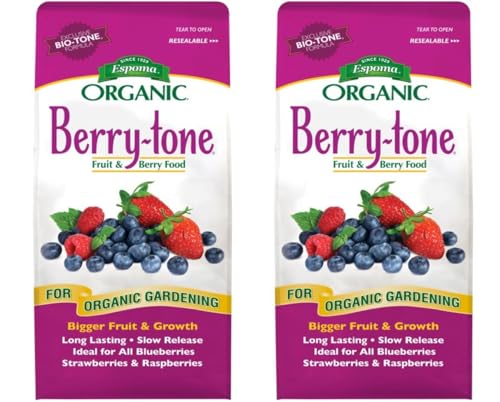
Espoma’s Berry Tone is the dedicated companion to their Holly-Tone line, formulated specifically for blueberry, strawberry, raspberry, and blackberry plants. The 4-3-4 ratio is conservative enough to apply twice per season without risk of nitrogen burn, and the Bio-tone microbial enhancer accelerates root colonization by beneficial fungi. The 5 percent sulfur content mirrors the Holly-Tone approach, ensuring the soil environment stays acidic.
Verified buyers report that this fertilizer turned modest strawberry patches into heavy producers and dramatically increased blackberry yields — one reviewer noted they had “too many blackberries” after using it. The granules are ready to use straight from the bag, making it a simple top-dress application around the base of each plant. The 4-pound bag is a practical size for home gardens with 6 to 12 berry plants.
Because the NPK values are relatively low, very depleted soils may require a supplemental feeding or a soil amendment before seeing maximum results. Additionally, the bag doesn’t cover as much area as the larger Espoma or Down To Earth bags, so larger berry patches will need multiple bags or a switch to the 25- or 36-pound options.
What works
- Formulated specifically for berry plants with a conservative NPK ratio.
- Bio-tone formula supports mycorrhizal fungi and root health.
- Easy to apply — no mixing, just broadcast and water.
What doesn’t
- Low nutrient density may need supplement in poor soil.
- Small bag size requires multiple purchases for larger beds.
5. Down To Earth Fruit Tree 6-2-4 — 5 lb

While labeled primarily for fruit trees, this 6-2-4 formula works well on raspberry canes, blackberry patches, and even large blueberry bushes whose root systems resemble small trees. The higher nitrogen (6) supports the vigorous cane growth that brambles need in spring, while the added calcium from calcium carbonate helps prevent blossom-end rot in developing fruit — an issue strawberries and tomatoes share. It also contains feather meal, fish bone meal, langbeinite, and kelp meal for trace elements.
Reviews from users with crabapple trees and mixed fruit gardens confirm that the formula revives stressed plants and promotes stronger root systems. One owner managed to remove stakes from a storm-damaged tree after two seasons of using this fertilizer. The powder form works well for top-dressing around drip lines and can be lightly scratched into the soil surface.
The nitrogen level is slightly higher than ideal for established blueberry bushes in maintenance mode — you may see more leafy growth and fewer berries if applied too late in the season. The 6-2-4 ratio also lacks the sulfur acidification that blueberries specifically require, meaning you’ll need a separate soil acidifier if your pH drifts above 6.0.
What works
- Calcium content supports fruit development and prevents blossom-end rot.
- Higher nitrogen suits the spring growth phase of cane berries.
- OMRI listed with broad-spectrum organic ingredients.
What doesn’t
- No sulfur for pH correction — blueberries need separate acidifier.
- Nitrogen level may suppress fruiting if applied after flowering.
6. Alaska Fish Fertilizer 5-1-1 — 115 oz
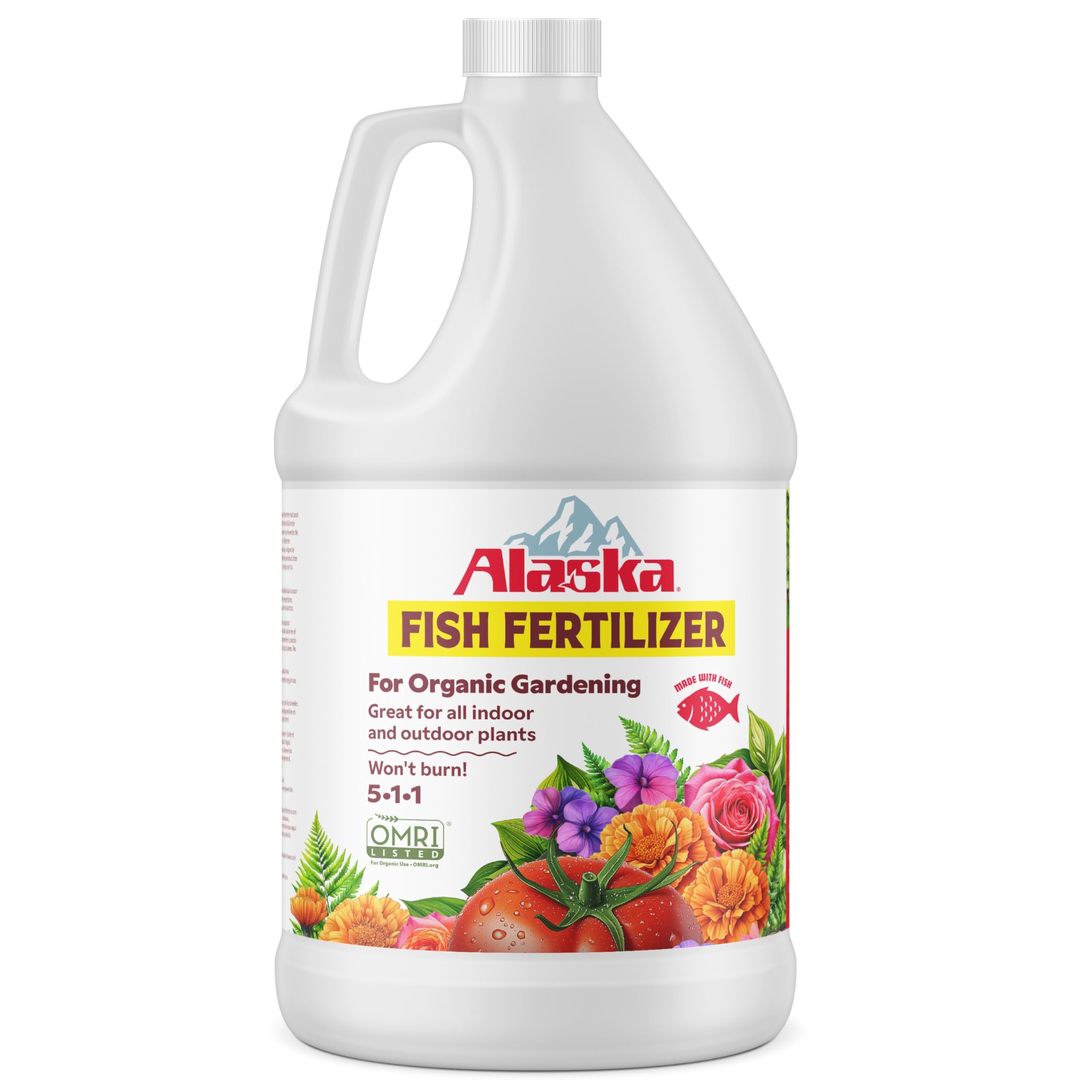
Alaska Fish Fertilizer is a liquid fish emulsion concentrate (5-1-1) that delivers a fast-acting nitrogen boost for berry plants showing pale leaves or slow spring emergence. The low phosphorus and potassium make it unsuitable as a standalone berry fertilizer, but as a supplementary feed every three weeks during the vegetative growth phase, it pushes strong leaf and stem development. The 115-ounce bottle goes a long way — mixing 2 to 3 tablespoons per gallon of water covers a substantial bed.
Long-term users describe it as a “garden staple” for vegetables and berry bushes alike, praising the gentle organic nitrogen source that won’t burn roots even when applied every 2 to 3 weeks. The fishy odor dissipates within a day when applied to soil, and the cold-processed liquid retains amino acids and micronutrients that synthetics lack. It’s also useful for correcting iron chlorosis in blueberries when combined with an acidifying agent.
Because the 5-1-1 ratio is extremely nitrogen-heavy relative to phosphorus and potassium, relying on this alone will result in lush foliage but poor fruit set. You must pair it with a balanced granular feed or a phosphorus-potassium supplement during flowering. The strong smell, while temporary, can attract pests if spilled on foliage rather than soil.
What works
- Fast-acting liquid format corrects nitrogen deficiency within days.
- OMRI listed and safe for use around pets when watered in.
- Excellent value per application — small concentrate goes far.
What doesn’t
- Must be paired with a phosphorus/potassium source for fruit development.
- Strong fish odor can linger for 12–24 hours and attract animals.
7. FoxFarm Happy Frog All Purpose 6-4-5 — 4 lb

FoxFarm Happy Frog All Purpose Fertilizer is a 6-4-5 granular blend that includes beneficial soil microbes and mycorrhizal fungi. While it’s not formulated specifically for berries, its moderate NPK and microbe-rich composition make it a viable entry-level option for mixed garden beds that include both vegetables and berry plants. The microbes improve nutrient cycling and water absorption, which helps all plants in the root zone.
Users report success reviving yellowed tomato and zucchini plants within a week, and the fast-acting nature of the granules (accelerated by the active microbial population) means you see results quickly. The 4-pound bag is inexpensive and easy to store, making it a low-risk try for gardeners who want to experiment with organic granular feeding without investing in a specialized berry product.
The biggest limitation is the absence of sulfur or any pH-lowering mechanism — this fertilizer will not address the acidic soil needs of blueberries or raspberries. It also has a potent manure-like odor that some users find unpleasant, especially if stored indoors. For dedicated berry patches, you’re better off choosing a product with a focused acid-lover formula.
What works
- Beneficial soil microbes and mycorrhizae improve overall soil health.
- Fast-acting granular format shows visible results within days.
- Affordable entry point for organic granular fertilization.
What doesn’t
- No sulfur to lower soil pH for acid-loving berries.
- Strong odor may be off-putting for indoor storage.
Hardware & Specs Guide
NPK Ratio and Fruiting Focus
Berry-specific fertilizers generally keep the first number (nitrogen) at 4 or 5 and push the third number (potassium) to 4 or 6. Potassium is directly tied to sugar transport, fruit firmness, and cold tolerance — the higher the third number relative to the first, the stronger the fruit yield. A 4-3-6 formula like Down To Earth Acid Mix prioritizes fruit over foliage. A 6-4-5 all-purpose mix pushes leaves first, which is fine for cane berries in spring but counterproductive for fruiting once flowers appear.
Sulfur Content and pH Management
Blueberries, cranberries, and lingonberries need soil pH between 4.5 and 5.5. Elemental sulfur in granular fertilizers (typically 4–5% in products like Holly-Tone and Berry Tone) slowly lowers pH over weeks as soil bacteria convert it to sulfuric acid. Liquid fish fertilizers do not contain sulfur — they work best as a nitrogen supplement on already acidic soil. For alkaline soil above 7.0, a dedicated soil acidifier or cottonseed meal may be needed before the maintenance sulfur in these blends can take effect.
FAQ
Can I use a general-purpose fruit tree fertilizer on my blueberry bushes?
Should I use liquid fish fertilizer or granular slow-release for container berry plants?
How do I prevent nitrogen burn when fertilizing strawberries?
Final Thoughts: The Verdict
For most gardeners, the best berry fertilizer winner is the Espoma Holly-Tone 36 lb because its 4-3-4 ratio with 5% sulfur feeds a wide range of acid-loving plants while correcting soil pH over time. If you want a berry-specific formula with a higher potassium push, grab the Down To Earth Acid Mix 4-3-6. And for small-space or container growers who need a quick mid-season boost, nothing beats the Alaska Fish Fertilizer as a nitrogen supplement — just pair it with a balanced granular feed for proper fruiting.