
Clematis vines are heavy feeders with a specific appetite: they crave phosphorus and potassium to set those massive, show-stopping blooms, yet most all-purpose fertilizers deliver too much nitrogen, pushing leaves at the expense of flowers. Choosing the wrong bag means another season of disappointing, sparse blossoms.
I’m Rikta — the co-founder and writer behind Lawn Gear Lab. My approach to this guide involved cross-referencing label NPK ratios, analyzing bloom-stage nutrient demands, and checking thousands of verified owner reports to isolate the formulations that actually tip clematis into peak performance.
This article breaks down the specific numbers and release mechanisms that matter for clematis, helping you match the right formula to your vine’s growth stage. Below are the top-performing options in the clematis fertilizer category, ranked by bloom response and formulation quality.
How To Choose The Best Clematis Fertilizer
Clematis is not a generic feeder. Its nutritional needs shift across the growing season, and applying the wrong balance can stunt flower development or cause weak, leggy growth. Focus on three narrow criteria before buying.
NPK Ratio and Bloom Focus
Clematis vines need a fertilizer with a higher phosphorus (the middle number) and potassium (the last number) relative to nitrogen (the first number). A ratio around 10-30-20 or a bloom-specific formula like 10-54-10 drives flower bud formation and stem strength. A high-nitrogen product, such as 30-10-10, will produce lush foliage but very few blooms, which is the opposite of what a clematis grower wants.
Release Mechanism: Granular vs. Water-Soluble
Slow-release granular fertilizers feed the root zone steadily over weeks, which works well for a single spring application. Water-soluble powders deliver nutrients instantly, making them ideal for a mid-season boost when the vine is actively setting buds. Many clematis growers use a granular slow-release formula at the start of the season and then supplement with a water-soluble bloom booster every two weeks through the flowering window.
Potassium and Phosphorus Supplements
Mature clematis vines deplete potassium and phosphorus from the soil faster than most perennials. Standalone supplements like muriate of potash (0-0-60) or triple super phosphate (0-46-0) let you correct specific deficiencies without throwing off the overall nitrogen balance. A soil test revealing low potassium or phosphorus means a targeted supplement is more effective than another all-in-one mix.
Quick Comparison
On smaller screens, swipe sideways to see the full table.
| Model | Category | Best For | Key Spec | Amazon |
|---|---|---|---|---|
| Schultz Bloom Plus 10-54-10 | Water-Soluble Powder | Maximum bloom production | 10-54-10 NPK | Amazon |
| Schultz Slow-Release 12-24-12 | Slow-Release Granules | Steady season-long feeding | 12-24-12 NPK | Amazon |
| Espoma Potash 0-0-60 | Potassium Supplement | Correcting potassium deficiency | 0-0-60 NPK | Amazon |
| Cz Garden Muriate of Potash 0-0-60 | Potassium Supplement | Targeted K boost for fruit set | 0-0-60 NPK | Amazon |
| Cz Garden Triple Super Phosphate 0-46-0 | Phosphorus Supplement | Bloom initiation support | 0-46-0 NPK | Amazon |
| PowerGrow Langbeinite 0-0-22 | Organic Mineral | Potassium with magnesium | 0-0-22 NPK | Amazon |
| The Grow Co Muriate of Potash 0-0-60 | Potassium Supplement | Correcting severe K deficiency | 0-0-60 NPK | Amazon |
In‑Depth Reviews
1. Schultz Bloom Plus Water Soluble Plant Food 10-54-10

The Schultz Bloom Plus formula uses a 10-54-10 NPK profile, giving clematis an extremely high phosphorus dose that directly supports bud set and flower size. Owners report seeing more blooms within days of application, with the water-soluble powder dissolving evenly and feeding the roots immediately rather than waiting for soil microbes to break down granules.
This product is best used as a mid-season booster when the vine is actively growing and forming flower buds. The high phosphorus content makes it a poor choice for early spring when the plant is putting out leaves, but during the pre-bloom window it outperforms almost any balanced fertilizer on visibility of results.
Users consistently mention that their annuals, perennials, and houseplants show noticeable color and size improvements. The concentrated formula means the 1.5-pound package goes further than most granular bags, though you will need to mix and apply every two weeks during heavy flowering periods.
What works
- Extremely high phosphorus drives heavy bloom production
- Water-soluble formula feeds roots within hours
- Verified results from begonias to clematis within days
What doesn’t
- Requires mixing and frequent reapplication
- Not suitable as a single spring-only feed
2. Schultz 018065 Slow-Release Bloom Fertilizer 12-24-12

The Schultz slow-release granules deliver a 12-24-12 NPK ratio that leans into phosphorus and potassium without the extreme phosphorus spike of a bloom booster. This makes it suitable as a single early-season application for clematis, feeding the vine steadily over weeks as the granules break down with each watering or rainfall.
Owners consistently report more blooms that last longer compared to using a balanced all-purpose feed. The slow-release mechanism reduces the risk of burning roots, which matters for clematis that can be sensitive to salt buildup from synthetic fertilizers.
The 3.5-pound bag covers a moderate number of plants, and users appreciate the simplicity of throwing the granules around the base and watering in. If you want a set-and-forget approach for multiple clematis vines, this granular option saves time compared to mixing weekly liquid feeds.
What works
- Balanced bloom ratio feeds without burning
- Slow-release granules require only one application
- Visible results in plant vigor within days
What doesn’t
- Some users prefer a higher phosphorus booster
- Not as fast-acting as water-soluble formulas
3. Espoma Potash 0-0-60 Potassium Fertilizer

Espoma Potash delivers a straight 0-0-60 potassium source with no nitrogen or phosphorus, allowing clematis growers to correct potassium deficiencies without affecting the leaf-to-bloom balance. This product is essential when a soil test shows low potassium, or when vines show signs of weak stems and reduced flower size.
The granular formula requires no mixing — you apply it around the drip line and water in. Spring and fall applications are recommended, and the 6-pound resealable bag offers good coverage for multiple vines over several seasons. Owners growing tomatoes, peppers, and gourds also report significant improvements in fruiting after using this potash.
Because it is a single-nutrient supplement, you cannot use this as a standalone clematis feed; you must pair it with a phosphorus source or a balanced bloom fertilizer. Users who understand this context get excellent results, while those expecting a complete fertilizer are often disappointed by the lack of noticeable change.
What works
- High-purity potassium corrects deficiency fast
- Easy granular application, no mixing needed
- Resealable bag keeps product dry for storage
What doesn’t
- Not a complete fertilizer — must combine with phosphorus
- Some users saw no difference when soil already had adequate K
4. Cz Garden Muriate of Potash 0-0-60

Cz Garden Supply’s Muriate of Potash offers the same 0-0-60 concentration but in a heavy-duty resealable pouch that prevents moisture clumping during storage. The granules are water-soluble and high-purity, making them effective for custom NPK mixing if you prefer to blend your own complete clematis feed.
Users growing fruit trees and heavy-feeding perennials note that this potassium supplement improved plant health, root development, and fruit production noticeably. For clematis specifically, applying a small amount near the drip line during early bud formation can strengthen stems and increase bloom density.
The 5-pound pouch lasts a long time because only a small amount is needed per application. Some owners pair this with a phosphorus source like triple super phosphate to create a custom bloom formula that matches their specific soil conditions better than any pre-mixed bag.
What works
- High-purity potassium for precise supplementation
- Resealable pouch keeps granules dry and free-flowing
- Excellent value for custom NPK blenders
What doesn’t
- Not a standalone clematis feed
- Requires careful measuring to avoid over-application
5. Cz Garden Triple Super Phosphate 0-46-0

Cz Garden Triple Super Phosphate delivers 0-46-0, the highest phosphorus concentration commonly available for home gardeners. For clematis, this is the go-to supplement when you want to force heavier bloom sets or when your soil is naturally high in nitrogen and potassium but low in phosphorus.
Users report that their orchids bloom twice as fast and that fruit trees produce larger yields after application. For clematis, applying this around the root zone just before bud formation can produce noticeably larger flowers and more buds per stem.
The 5-pound pouch comes in the same resealable format as the potash product, making storage simple. Like the potash, this is a single-nutrient supplement and must be used alongside a balanced feed or combined with potassium for a complete bloom formula. Owners mixing their own NPK blends appreciate the ability to dial in the exact phosphorus level their vines need.
What works
- Extremely high phosphorus for maximum bloom push
- Resealable pouch for long-term storage
- Excellent for custom NPK blending
What doesn’t
- Label confusion about potassium content reported
- Not a standalone fertilizer — needs N and K sources
6. PowerGrow Systems Langbeinite 0-0-22

Langbeinite is a naturally occurring mineral that provides potassium (22) along with magnesium and sulfur, two secondary nutrients clematis needs for chlorophyll production and overall vigor. The 0-0-22 NPK means it adds no nitrogen or phosphorus, making it a safe supplement even when your soil already has adequate levels of those elements.
Users growing heavy-fruiting plants like tomatoes and bananas report that this product turned around years of poor performance. For clematis, the magnesium content can be particularly valuable if your vine shows interveinal chlorosis — yellowing between leaf veins that signals a magnesium deficiency.
The granules are easy on plants and will not burn roots even at slightly higher application rates. The 5-pound bag covers a medium-sized garden well, and the fact that it is OMRI-listed means organic growers can use it without compromising their certification.
What works
- Provides potassium plus magnesium and sulfur
- Won’t burn plants even at generous rates
- Organic-certified mineral source
What doesn’t
- Lower potassium concentration (22) compared to potash (60)
- Shipping damage reported due to thin packaging
7. The Grow Co Muriate of Potash 0-0-60
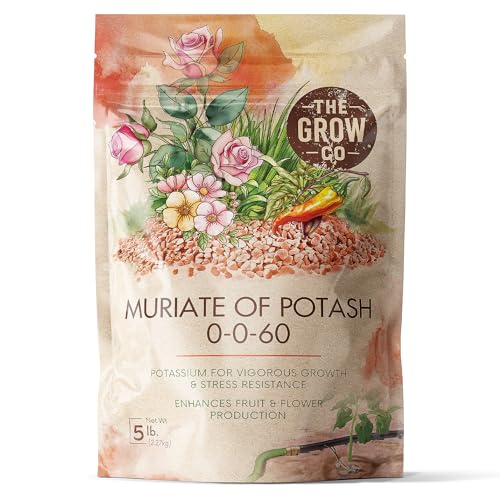
The Grow Co’s Muriate of Potash is a concentrated 0-0-60 potassium supplement designed to correct severe potassium deficiency quickly. For clematis growers dealing with weak stems, poor bud set, or small flowers that drop early, a small application of this product can restore the vine’s ability to transport nutrients and water.
Users report that it stopped fruit drop on mango and avocado trees and helped tomato beds recover from depleted soil. The 5-pound bag covers a large area because the recommended rate is only half a pound per 1,000 square feet, making this a very entry-level option per application.
The main caution with any 0-0-60 product is that overuse can lead to chlorine buildup in the soil, since muriate of potash contains chloride. Use it sparingly and only when a deficiency is suspected. It is not intended as a regular maintenance feed but rather as a corrective tool for specific soil imbalances.
What works
- Highly concentrated formula covers large areas
- Fast correction of potassium deficiency symptoms
- Good value for targeted soil amendment
What doesn’t
- Overuse can cause chloride buildup in soil
- Not a complete feed — requires N and P sources
Hardware & Specs Guide
NPK Ratio: The Three Numbers
The NPK ratio on a fertilizer bag tells you the percentage of nitrogen (N), phosphorus (P), and potassium (K). For clematis, the middle number (phosphorus) and the last number (potassium) should be higher than the first. A ratio like 10-54-10 or 12-24-12 provides the bloom-building and stem-strengthening nutrients the vine needs without pushing excessive leaf growth.
Water-Soluble vs. Slow-Release
Water-soluble powders dissolve instantly and feed the plant within hours, making them ideal for a mid-season bloom boost. Slow-release granules break down over weeks with moisture, providing a steady nutrient supply. Many clematis growers apply a slow-release granular feed in early spring and then switch to a water-soluble bloom booster every two weeks once buds begin forming.
Standalone Supplements: Potash and Phosphate
Single-nutrient products like muriate of potash (0-0-60) and triple super phosphate (0-46-0) let you correct specific soil deficiencies without unbalancing the entire NPK profile. Use these only when a soil test confirms low levels of potassium or phosphorus, or when your clematis shows clear deficiency symptoms such as weak stems or poor flower development.
Organic Mineral Sources
Langbeinite (0-0-22) is a naturally occurring mineral that provides potassium plus magnesium and sulfur. It is gentler on soil biology than synthetically derived potash and carries an OMRI listing for organic production. The trade-off is a lower potassium concentration, meaning you need to apply more volume to reach the same K levels as a 0-0-60 product.
FAQ
Can I use a high-nitrogen lawn fertilizer on my clematis?
How often should I fertilize clematis during the growing season?
What does potassium do for clematis vines specifically?
Final Thoughts: The Verdict
For most gardeners, the clematis fertilizer winner is the Schultz Bloom Plus 10-54-10 because its extreme phosphorus content delivers the most visible bloom improvement when applied during bud formation. If you want a set-and-forget single application, grab the Schultz Slow-Release 12-24-12. And for correcting specific potassium or phosphorus deficiencies in established vines, nothing beats the Espoma Potash 0-0-60 or Cz Garden Triple Super Phosphate 0-46-0.