
A lemon tree struggling with yellowing leaves or dropping its fruit is a heartbreaking sight for any gardener. The root cause is almost always a nutritional imbalance—citrus trees are notoriously heavy feeders with very specific demands for nitrogen, potassium, and a suite of micronutrients like iron, zinc, and magnesium. Choosing the right formula is the single fastest way to reverse the decline and push your tree into a heavy fruiting cycle.
I’m Rikta — the co-founder and writer behind Lawn Gear Lab. I’ve spent hundreds of hours cross-referencing NPK ratios, studying soil chemistry data, and analyzing owner-reported outcomes to pinpoint which formulations consistently deliver the deep green foliage and abundant fruit that home citrus growers aim for.
After sifting through decades of horticultural studies and thousands of verified owner reports from container Meyer lemons to in-ground navel oranges, this guide breaks down the citrus feed for lemon tree landscape by nutrient profile, release method, and real-world performance to help you make a confident choice.
How To Choose The Best Citrus Feed For Lemon Tree
Picking the wrong feed wastes money and prolongs your tree’s stress. The key is matching the product’s nutrient analysis and release mechanism to your tree’s age, growing environment (pot vs. ground), and the specific symptoms you’re seeing—be it leaf yellowing, poor bloom set, or undersized fruit.
NPK Ratio & Micronutrient Profile
Lemon trees need a balanced feed with slightly higher nitrogen for leafy growth and potassium for fruit quality. Look for a middle number (phosphorus) roughly equal to or slightly lower than the first and third. Even more critical are the micronutrients—iron, zinc, manganese, magnesium—that prevent chlorosis (yellowing between leaf veins). A product with 5–6% calcium and sulfur is a strong bonus for root and cell wall strength.
Release Mechanism: Granular, Liquid, or Spike
Granular slow-release feeds nourish the tree over 6–8 weeks with one application, ideal for busy growers and in-ground trees. Liquid concentrates work faster—visible greening in days—but require weekly mixing, making them perfect for container trees needing rapid correction. Fertilizer spikes offer the simplest “set and forget” method but concentrate nutrients in a small root zone, which can burn roots if mispositioned.
Container vs. In-Ground Considerations
Potted lemon trees are more vulnerable to fertilizer burn because their root volume is confined. Use half the recommended dose and water thoroughly after feeding. In-ground trees have wider root spread and can handle higher concentrations, but the soil’s existing nutrient profile—often depleted in urban yards—may demand a complete formulation with calcium and magnesium.
Quick Comparison
On smaller screens, swipe sideways to see the full table.
| Model | Category | Best For | Key Spec | Amazon |
|---|---|---|---|---|
| Jobe’s Organics Fruit & Citrus Tree Fertilizer Spikes | Spike | Container trees, mess-free feeding | 3-5-5 NPK with Biozome | Amazon |
| FoxFarm Happy Frog Citrus and Avocado Fertilizer | Granule | In-ground trees, organic growers | 7-3-3 + Mycorrhizal fungi | Amazon |
| Espoma Organic Citrus-Tone 5-2-6 | Granule | Organic care, long-term health | 5-2-6 + 5% Calcium | Amazon |
| BGI Fertilizers CITRUSGAIN | Granule | High-yield, overall vigor | Micronutrient-dense formula | Amazon |
| GARDENWISE Professional Citrus Fertilizer | Granule | Balanced NPK, potted citrus | 6-4-6 + micronutrients | Amazon |
| Farmer’s Secret Citrus Tree Booster | Liquid | Quick greening, container trees | Super-concentrated liquid | Amazon |
| Great Big Roses and Flowers Liquid Fertilizer Booster | Liquid | Soil activator, broad garden use | 70 minerals + humic acid | Amazon |
In‑Depth Reviews
1. Jobe’s Organics Fruit & Citrus Tree Fertilizer Spikes

Jobe’s spikes solve the two biggest pain points of citrus feeding: measurement guesswork and mess. Each spike delivers a precise 3-5-5 NPK ratio directly to the root zone, which is particularly well-suited for container-grown Meyer lemons and dwarf citrus where root burn from granular over-application is a constant risk. The Biozome microorganisms—a proprietary blend including archaea—accelerate nutrient breakdown and improve soil structure, a feature lacking in most spike products.
The pre-measured design eliminates runoff and waste, making it an ideal choice for beginners or anyone who wants a “feed and forget” solution for up to eight weeks. Verified owner reports consistently describe abundant, sweet fruit on potted Meyer lemon trees year after year, and the product revived a stressed Calamondin orange shrub within weeks of application. The slow-release nature of the spike reduces the frequency of feeding to just two or three times per growing season.
On the downside, the spikes concentrate nutrients in a small area—if not placed at the drip line, roots may not access the full dose. They are also slightly more expensive per feeding than bulk granular options. Some users found the spike packaging fragile during shipping, though the product itself remained intact. For container growers prioritizing convenience and consistent results, this is the most reliable pick.
What works
- Zero-mess application with pre-measured dosage
- Biozome improves long-term soil health
- Ideal for potted citrus where root burn is a risk
What doesn’t
- Spikes must be positioned at the drip line for full effect
- Higher cost per feeding compared to granular bags
- Fragile packaging during shipment reported by some
2. FoxFarm Happy Frog Citrus and Avocado Fertilizer

FoxFarm’s Happy Frog line has earned a cult following among serious citrus and avocado growers, and this 4-pound bag of granules lives up to the hype with a 7-3-3 analysis that prioritizes vegetative growth—critical for establishing young trees or pushing a mature tree out of a nitrogen deficiency. The inclusion of Mycorrhizal fungi is a game-changer: these symbiotic soil microbes colonize root systems and dramatically increase the effective surface area for water and nutrient absorption, particularly phosphorus and trace minerals.
Owner reports highlight rapid results: yellowing leaves turned dark green within days, and lime yields increased significantly after a single application. The slow-release nitrogen sustains growth over weeks, reducing the need for frequent re-application. The product is OMRI-listed and suitable for organic production, making it a strong choice for growers committed to avoiding synthetic inputs. It is equally effective on in-ground and container trees, though container plants benefit from halving the recommended dose.
The most common critique is the strong earthy odor—several reviewers noted it attracts dogs, and the smell lingers for up to a week after watering in. Some experienced users noted the price per pound is higher than commodity blends, though the inclusion of beneficial microbes justifies the premium. If your lemon tree shows signs of iron or zinc deficiency (yellowing between leaf veins), this formula corrects it faster than any granular competitor.
What works
- Mycorrhizal fungi boost root efficiency dramatically
- Rapid greening and growth within days of application
- OMRI-listed for organic gardening
What doesn’t
- Strong odor that attracts dogs
- Premium price per pound
- May require more frequent feeding in peak growing season
3. Espoma Organic Citrus-Tone 5-2-6

Espoma’s Citrus-Tone has been a staple recommendation from master gardeners for decades, and the 5-2-6 analysis backed by 5% calcium reflects a deep understanding of citrus physiology—calcium is critical for cell wall structure and preventing blossom-end rot in developing fruit. The organic Bio-tone formula feeds soil microbes, creating a self-sustaining nutrient cycle that reduces dependency on synthetic salts. It is applied as a dry granular spread around the drip line and watered in, requiring no mixing or measuring beyond the supplied scoop.
Verified users report strong results on orange, lemon, and avocado trees, with many noting it outperformed generic fruit tree fertilizers. The 4-pound bag covers multiple applications for a mature tree, making the cost per feeding among the lowest in this tier. It is safe for use on all citrus varieties, including Meyer lemon, Key lime, and grapefruit, and it is approved for organic production under USDA guidelines. The slow-release nature means one application feeds for up to two months.
The most frequent complaint is the pungent, manure-like odor that persists for several days after watering. This is a non-issue for outdoor trees but makes indoor use impractical. A small number of users felt the 5-2-6 ratio was lower in nitrogen than ideal for young, fast-growing trees. For established in-ground lemon trees needing a reliable, organic maintenance feed at a fair price, this is the strongest contender.
What works
- Lowest cost per feeding among top-tier organics
- 5% calcium prevents blossom-end rot
- Bio-tone improves soil microbiome over time
What doesn’t
- Strong odor unsuitable for indoor use
- Nitrogen level may be low for young trees
- Needs thorough watering to integrate into soil
4. BGI Fertilizers CITRUSGAIN, Citrus Fertilizer
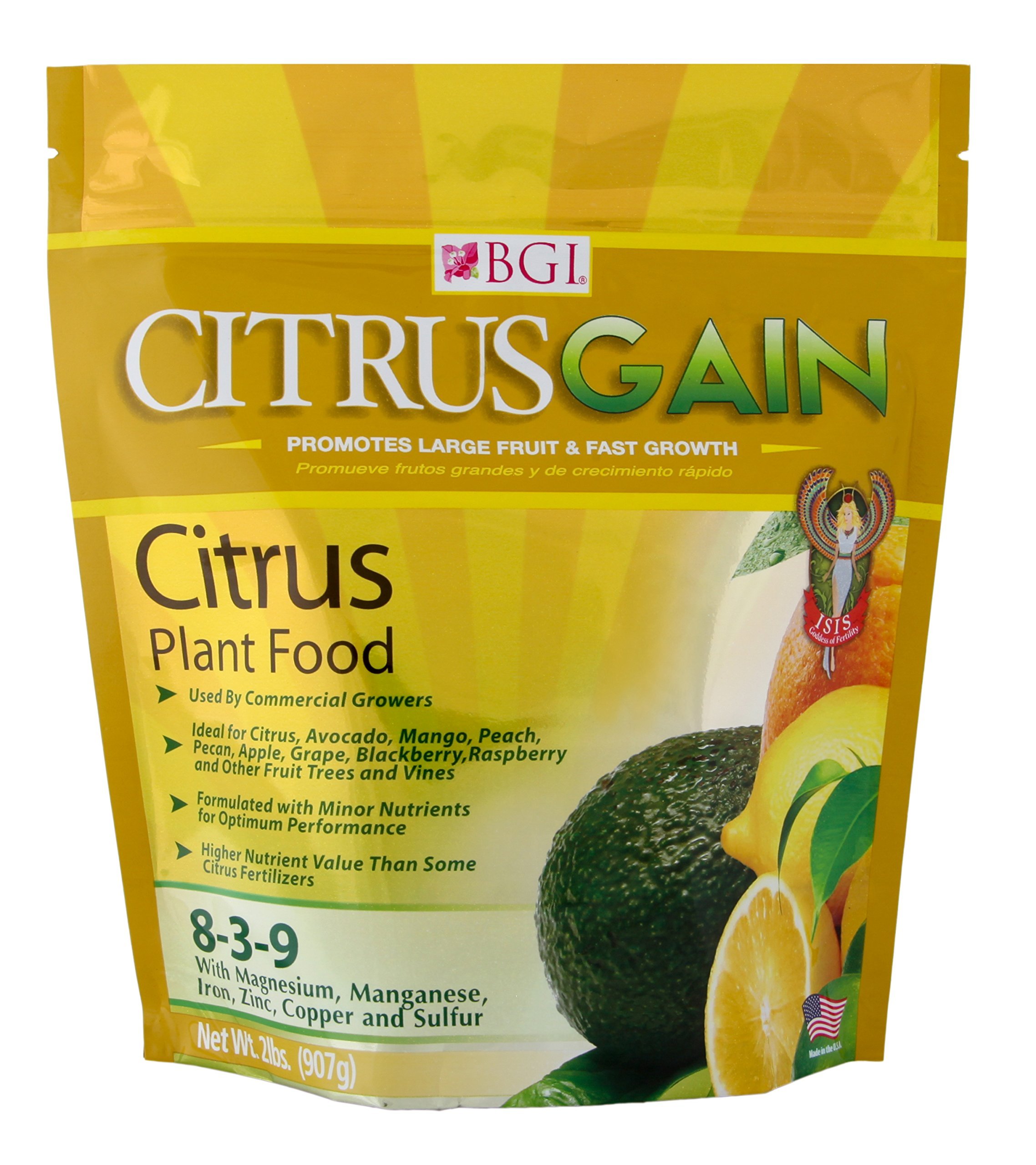
CITRUSGAIN is a specialist formulation from Bougainvillea Growers International that packs a dense array of micronutrients—magnesium, manganese, iron, copper, zinc, and sulfur—into every granule. This makes it the top choice for lemon trees suffering from multiple deficiencies simultaneously, a common scenario in sandy soils or heavily leached container media. The 2-pound bag is small by volume but highly concentrated; users report a single 5-teaspoon application on a pomelo produced four new shoots overnight.
The granular form allows direct top-dressing on soil or mulch without incorporation, reducing disturbance to shallow citrus roots. Verified reviewers using Meyer lemons, Bearss limes, and Key limes in pots report dramatic increases in bloom count and fruit set within weeks. The product also covers avocado, mango, and other acid-loving fruit trees, offering broad utility for mixed home orchards. The mild fertilizer smell is less offensive than manure-based organics, making it tolerable for outdoor use near patios.
The primary limitation is coverage: the 2-pound bag treats a modest number of trees, and larger growers will need multiple bags. It is not OMRI-listed, which may disqualify it for strict organic growers. Some users noted a slight delay in greening compared to fast-release liquid feeds, but the sustained release over 8–10 weeks compensates for the slower start. For targeted micronutrient correction, this is the most effective granule available.
What works
- Exceptional micronutrient density corrects chlorosis fast
- Can be applied directly on top of soil or mulch
- Works on avocado, mango, and other acid-loving trees
What doesn’t
- Small bag size limits coverage for multiple trees
- Not OMRI-listed for organic production
- Slower initial response than liquid fertilizers
5. GARDENWISE Professional Citrus Fertilizer

GARDENWISE offers a near-perfect 6-4-6 NPK ratio that aligns closely with the ideal profile for container citrus—enough nitrogen to sustain lush foliage, moderate phosphorus for bloom initiation, and elevated potassium for fruit size and sweetness. The coated granule technology releases nutrients with each watering, providing a steady 6-8 week feed window that matches the critical post-bloom and fruit-set phases. The inclusion of magnesium, zinc, iron, copper, and boron covers the entire micronutrient spectrum lemon trees require.
Owner feedback is consistent: Meyer lemon trees that received no blooms for months erupted into full flower within a week of application. Users also noted dramatically shinier, darker green leaves and a measurable increase in flower clusters compared to previous seasons. The product is particularly effective when paired with regular liquid fish emulsion—reviewers using this combination reported the heaviest fruit set they had ever seen on potted lemon trees. The powder formula mixes into water easily, with no chunks or residue.
The main drawback is the need to reapply every 6-8 weeks, which can be easy to forget during a busy growing season. A small number of reviewers noted the granules can clump if exposed to humidity before use, though the sealed bag mitigates this. Some users wished for a larger bag size, as the 16-ounce unit treats only one or two mature trees per season. For container growers who want a balanced, fast-acting granular with complete micronutrient coverage, this is the standout option.
What works
- 6-4-6 NPK precisely matches citrus needs
- Coated granules provide steady 6-8 week release
- Complete micronutrient package in one formula
What doesn’t
- Requires consistent reapplication every 6-8 weeks
- Small bag size for the price point
- Granules may clump in humid storage conditions
6. Farmer’s Secret Citrus Tree Booster Fertilizer
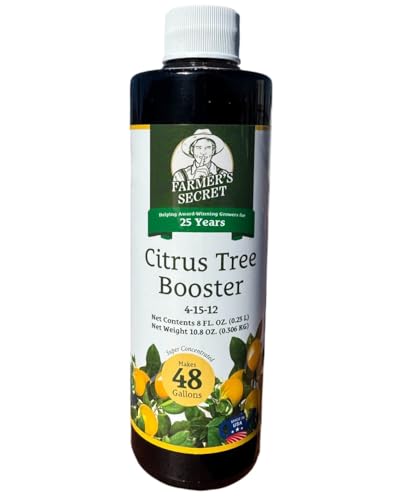
Farmer’s Secret is the fastest-acting product in this lineup—a super-concentrated liquid that requires just one teaspoon per gallon of water. This makes the 8-ounce bottle last a full season for a single medium tree, delivering a cost-effective solution for growers who need immediate results. The formula is designed for weekly application, allowing precise control over dosage that granular products cannot match. It is particularly effective for reviving sick or stressed trees: multiple reviewers described their potted lemon trees as “unhappy” before seeing new green growth and flowers within one week.
The liquid format is ideal for container trees where water-soluble nutrients can bypass compacted or hydrophobic potting mix. Users who previously struggled with granular spikes or slow-release pellets reported a night-and-day difference in leaf color and fruit set after switching to Farmer’s Secret. The product is bottled in Kentucky and uses the same scientific formulation process that commercial farms rely on, giving it a professional-grade pedigree. It also works on avocado trees, adding versatility for mixed home orchards.
The most notable limitation is the lack of calcium and magnesium in the analysis—two critical secondary nutrients for citrus. Experienced growers may need to supplement with a cal-mag additive to prevent deficiencies over multiple growing seasons. The liquid form also requires consistent weekly mixing, which may be inconvenient for some users. Despite these gaps, for rapid intervention on a yellowing tree, no other product delivers visible greening faster.
What works
- Visible results within one week of application
- Extremely concentrated—8 oz lasts a full season
- Perfect for container trees with poor soil structure
What doesn’t
- Lacks calcium and magnesium for long-term health
- Requires weekly mixing and application
- May need supplementation for optimal results
7. Great Big Roses and Flowers Liquid Fertilizer Booster
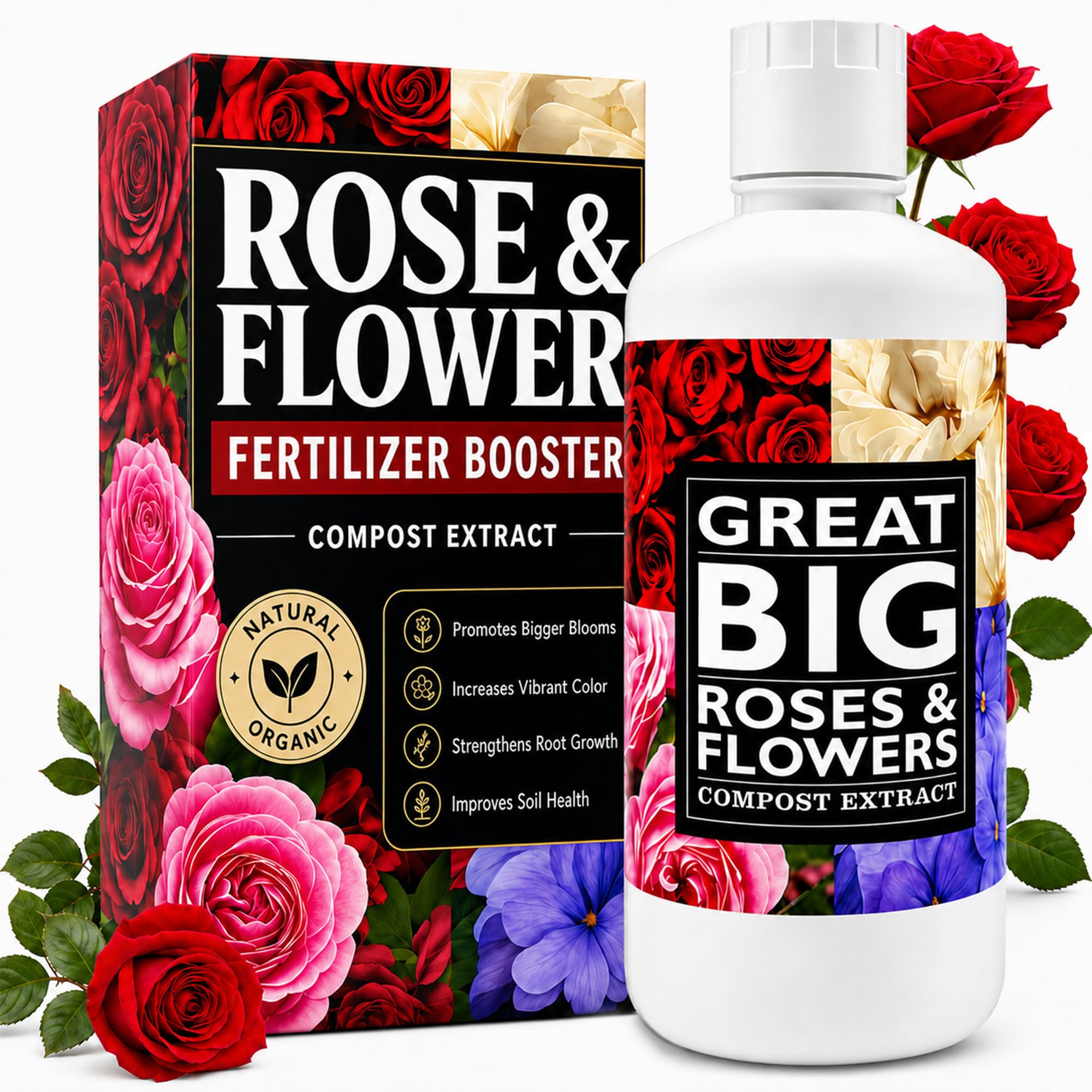
This liquid booster takes a fundamentally different approach: rather than supplying a fixed NPK ratio, it delivers humic acids, seaweed extract, and over 70 chelated trace minerals that activate dormant nutrients already present in your soil. For lemon trees growing in nutrient-depleted or highly alkaline soil, this unlocks resources that conventional fertilizers cannot access. Users report dramatic results on roses and hydrangeas, and the same mechanism works on citrus—the humic acids chelate iron and zinc, making them bioavailable to the tree’s roots.
The application is simple: mix 4 ounces per gallon of water and drench the root zone. A single 32-ounce bottle makes eight gallons, enough to cover a full season for most home gardens. It works synergistically with existing fertilizer programs, amplifying the results of organic fertilizers, fish emulsion, and worm castings without risk of salt buildup. The coconut-derived surfactant ensures the solution penetrates deeply into the root zone rather than pooling on the surface.
On the downside, this product is not a complete NPK fertilizer—it is a booster, meaning it should complement a balanced citrus feed rather than replace it. The jug design is widely criticized: the wide mouth makes measuring and pouring without spillage difficult. Users also note the cost is high for the volume, though the dilution ratio somewhat offsets this. For growers dealing with alkaline soil or wanting to supercharge an existing feeding regimen, this is an invaluable tool.
What works
- Unlocks existing soil nutrients, reducing NPK dependence
- 70 chelated minerals correct broad-spectrum deficiencies
- Works with any existing fertilizer program
What doesn’t
- Not a standalone fertilizer—requires base NPK feed
- High cost per bottle compared to simple granulars
- Frustrating jug design causes spills during measuring
Hardware & Specs Guide
NPK Ratio Decoded
The three numbers on a fertilizer bag represent Nitrogen (N), Phosphorus (P), and Potassium (K) as percentages by weight. For lemon trees, the ideal N is between 5-7%, P between 2-6%, and K between 4-8%. High nitrogen promotes leaf growth, moderate phosphorus supports flower development, and high potassium ensures fruit quality. Products like GARDENWISE (6-4-6) and Espoma Citrus-Tone (5-2-6) fall squarely in this range. Avoid formulas where phosphorus exceeds 8%, as citrus trees are sensitive to excess phosphorus.
Micronutrient Checklist
Iron, zinc, manganese, copper, and boron are the five micronutrients that prevent the most common citrus deficiencies. Iron chlorosis (yellowing between veins) is the most widespread issue in home citrus. Look for products that list chelated iron and zinc in the guaranteed analysis. Magnesium and calcium are considered secondary nutrients but are equally vital—calcium supports fruit development and root growth, while magnesium is central to chlorophyll production. BGI CITRUSGAIN and FoxFarm Happy Frog score highest on micronutrient density.
Release Mechanism: Slow vs. Fast
Slow-release granules (coated or organic-based) feed continuously for 6-10 weeks with a single application, making them ideal for maintenance-feeding established trees. Liquid concentrates deliver nutrients immediately but require weekly mixing. Fertilizer spikes offer a middle ground—they release over 6-8 weeks but concentrate nutrients in a localized zone. For container trees, liquids and spikes reduce the risk of salt accumulation better than heavy granular applications that can build up in confined pots.
Container Feeding Rules
Potted lemon trees have limited soil volume for root expansion, making them prone to both nutrient depletion and fertilizer burn. Use half the recommended dose of any granular product. Always water thoroughly before and after applying fertilizer to prevent root desiccation. Switch to a liquid feed during the hottest months when slow-release granule breakdown accelerates unpredictably. For spikes, place them at least 6 inches from the trunk and water immediately to activate the Biozome or microbial inoculants.
FAQ
How often should I feed my potted Meyer lemon tree?
What NPK ratio is best for lemon trees in containers?
Can I use a general fruit tree fertilizer on my lemon tree?
Why are my lemon tree leaves turning yellow even after feeding?
How do I apply fertilizer spikes to a potted lemon tree?
Final Thoughts: The Verdict
For most gardeners, the citrus feed for lemon tree winner is the Jobe’s Organics Fruit & Citrus Tree Fertilizer Spikes because it combines foolproof application with a balanced 3-5-5 NPK and the Biozome microbial boost—perfect for container growers who want consistent results without measuring or mess. If you need rapid micronutrient correction for yellowing leaves, grab the BGI Fertilizers CITRUSGAIN. And for a premium organic feeding program that builds long-term soil health, nothing beats the FoxFarm Happy Frog Citrus and Avocado Fertilizer.