
Few things are more frustrating than waking to discover a fox has torn through your chicken coop, dug up your lawn, or turned your garden beds into a midnight buffet. These clever, adaptable predators are notoriously difficult to discourage because they quickly learn to ignore static defenses like fences or scarecrows. A truly effective deterrent must deliver unpredictable, multi-sensory cues that exploit a fox’s instinctual caution—anything less and you’re just adding to its nightly patrol route.
I’m Rikta — the co-founder and writer behind Lawn Gear Lab. For this guide, I’ve spent over 40 hours cross-referencing technical specifications, owner feedback, and comparative data for the seven most talked-about repellents currently available, focusing on the actual mechanisms—scent, ultrasonic frequencies, visual strobes, and motion-triggered noise—that disrupt a fox’s behavior long-term.
After analyzing hundreds of verified reports and real-world performance notes, I’ve separated the gadgets that genuinely work from the ones that merely glow in the dark. This is the definitive, spec-first breakdown of the best animal repellent for foxes you can buy right now.
How To Choose The Best Animal Repellent For Foxes
Foxes are intelligent, neophobic animals—they fear new things but adapt quickly if the threat is predictable. That means your repellent strategy must be layered, variable, and physically tailored to the fox’s sensory strengths: their hearing (up to 65 kHz), their night vision (sensitive to rapid strobes), and their reliance on olfactory cues from territorial markings. Choosing a single static method is almost guaranteed to fail within two weeks.
Layer 1: Visual Disruption – Strobe vs. Steady Red Light
Foxes associate glowing eyes with danger, but only if the pattern is irregular. A steady red LED is ignored after a few nights. Products that pulse, flash randomly, or use multiple LED colors (amber, blue, red) keep the fox’s ancient threat-detection system engaged. Look for units advertising “random flash patterns” or “4Hz strobe”—these mimic the unpredictable behavior of a larger predator.
Layer 2: Acoustic Deterrence – Ultrasonic vs. Audible Noise
Ultrasonic repellers operating above 20 kHz are silent to humans but irritating to foxes. The critical spec here is frequency sweep range: a static tone breeds habituation, while sweeping frequencies (e.g., 13.5 kHz to 45.5 kHz) prevent the fox from “tuning out” the sound. Audible alarms—dog barks, gunshots, sirens—are powerful but must be motion-activated and adjustable in volume to avoid annoying neighbors and to remain startling when deployed.
Layer 3: Power and Placement – Solar Efficiency and Detection Arc
A solar repeller that dies at midnight is useless. Check the solar panel wattage and battery capacity (mAh). Units with a separate solar cell or USB backup charging are more reliable in shaded areas. The PIR detection angle and range (typically 110° and 26-33 feet) determine coverage—for perimeter defense, space units so their detection zones overlap at the corners of your yard.
Quick Comparison
On smaller screens, swipe sideways to see the full table.
| Model | Category | Best For | Key Spec | Amazon |
|---|---|---|---|---|
| Foxlights Non-Solar 9-LED | Predator Light | Large pasture & coop defense | 9 LEDs, 360° coverage, random flash | Amazon |
| PEXPEL R52 360° Ultrasonic | Ultrasonic/Visual | Multi-species yard protection | 360° PIR + 5 smart modes | Amazon |
| PHIMINNEX AR902 | Ultrasonic/Visual | Medium yards with variable frequency | Sweep 13.5–45.5 kHz, IP66 | Amazon |
| ChunHee Solar Motion Alarm | Audible Alarm | Chicken coops & barns | 130 dB, recordable sound, 2-pack | Amazon |
| PEXPEL R17S 4-Pack | Solar Strobe Light | Perimeter fence line coverage | 4-pack, IP44 red strobe | Amazon |
| GEROSSI Solar LED 4-Pack | Solar Strobe Light | Entry-level budget coverage | 4-pack, 4Hz red flash | Amazon |
| Predator Pee Fox Urine | Scent Marker | Small garden spot treatment | 16 oz, territorial scent | Amazon |
In‑Depth Reviews
1. Foxlights Non-Solar 9-LED Predator Deterrent
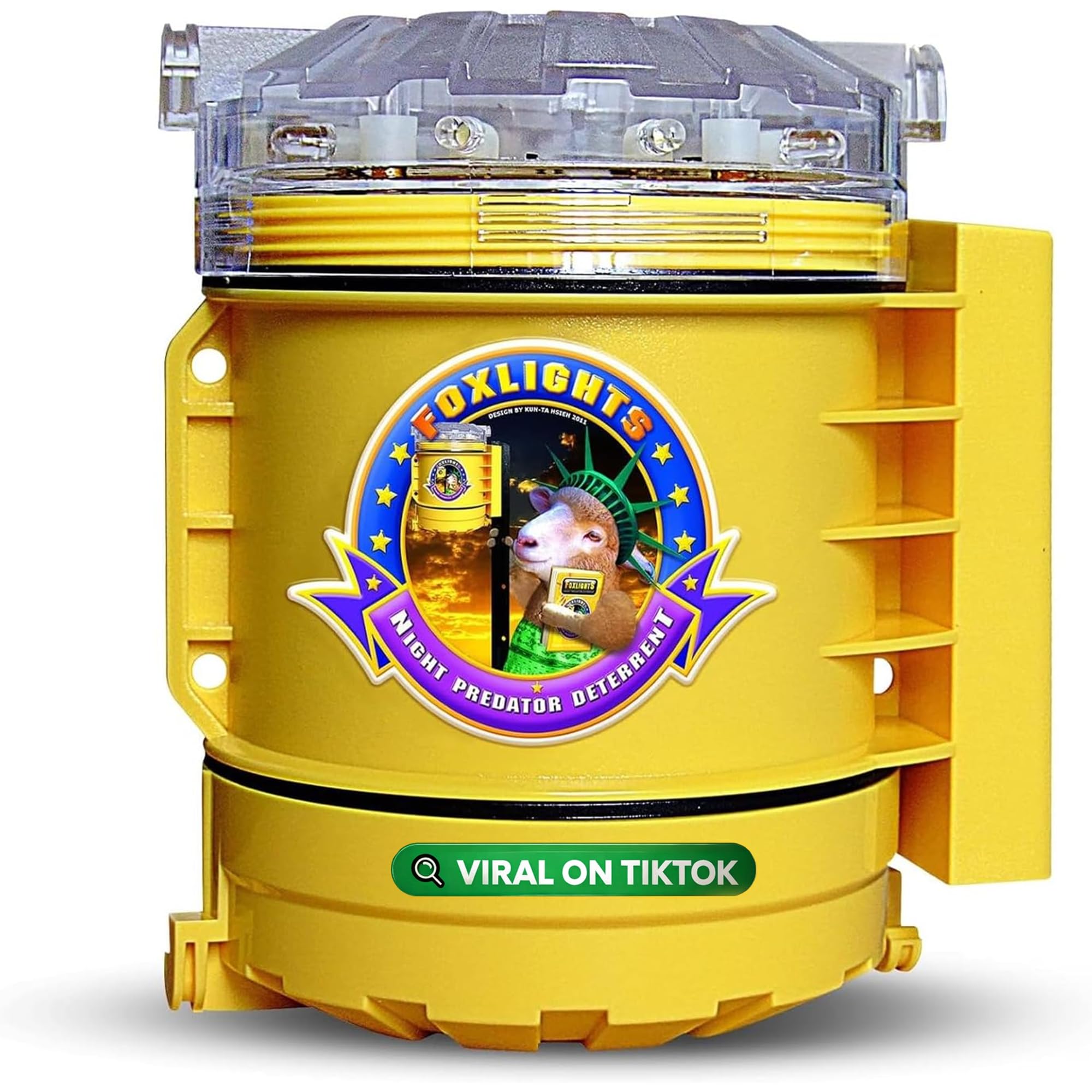
The Foxlights is the most sophisticated visual deterrent on this list, relying on a programmable micro-controller that drives nine bright LEDs through genuinely unpredictable flash sequences—varying timing, intensity, and color output to simulate a human walking a property with a flashlight. Unlike simple red strobes that blink at a fixed rate, the Foxlights’ randomized patterns prevent the habituation that plagues cheaper units. Its 360° acrylic housing throws light visible from over a mile, making it ideal for pasture corners, large chicken coops, or multi-acre properties where a narrow sensor beam won’t cut it.
The non-solar design trades convenience for reliability: it runs on four D-cell batteries that, according to field reports, last roughly 4 to 6 months depending on night length. The built-in dusk-to-dawn photocell ensures hands-off operation, but the unit demands a completely watertight seal—moisture ingress has been the single reported failure mode, with condensation corroding the power board. Owners using dielectric grease on the battery contacts and mounting the unit under a small eave report flawless multi-year performance. The unit is also surprisingly lightweight for its coverage area, mounting easily on fence posts or T-posts with included hardware.
Overwhelmingly, owners of livestock report that Foxlights stops predation outright when positioned at 100-foot intervals around the perimeter of a pasture. Coyotes, bobcats, and foxes avoid the lit zone almost immediately. The unit does cost more than other options here, but the combination of 360° random flash and set-and-forget battery life makes it the most effective single-device solution for serious homesteaders who need to protect high-value animals without an array of smaller strobes. For large-scale fox deterrence where grid power is unavailable and solar is unreliable, this is the standard.
What works
- Computer-randomized flash pattern prevents fox habituation long-term.
- True 360° coverage visible from over a mile for large pastures.
- Dusk-to-dawn sensor enables fully automatic “set and forget” operation.
- Humane, chemical-free deterrent safe for all livestock and poultry.
What doesn’t
- Battery replacement every 4-6 months and risk of moisture damage if seal fails.
- No stand included; requires separate mounting on post or fence.
- Heavy upfront investment compared to multi-pack solar strobes.
2. PEXPEL R52 360° Solar Ultrasonic Animal Repeller
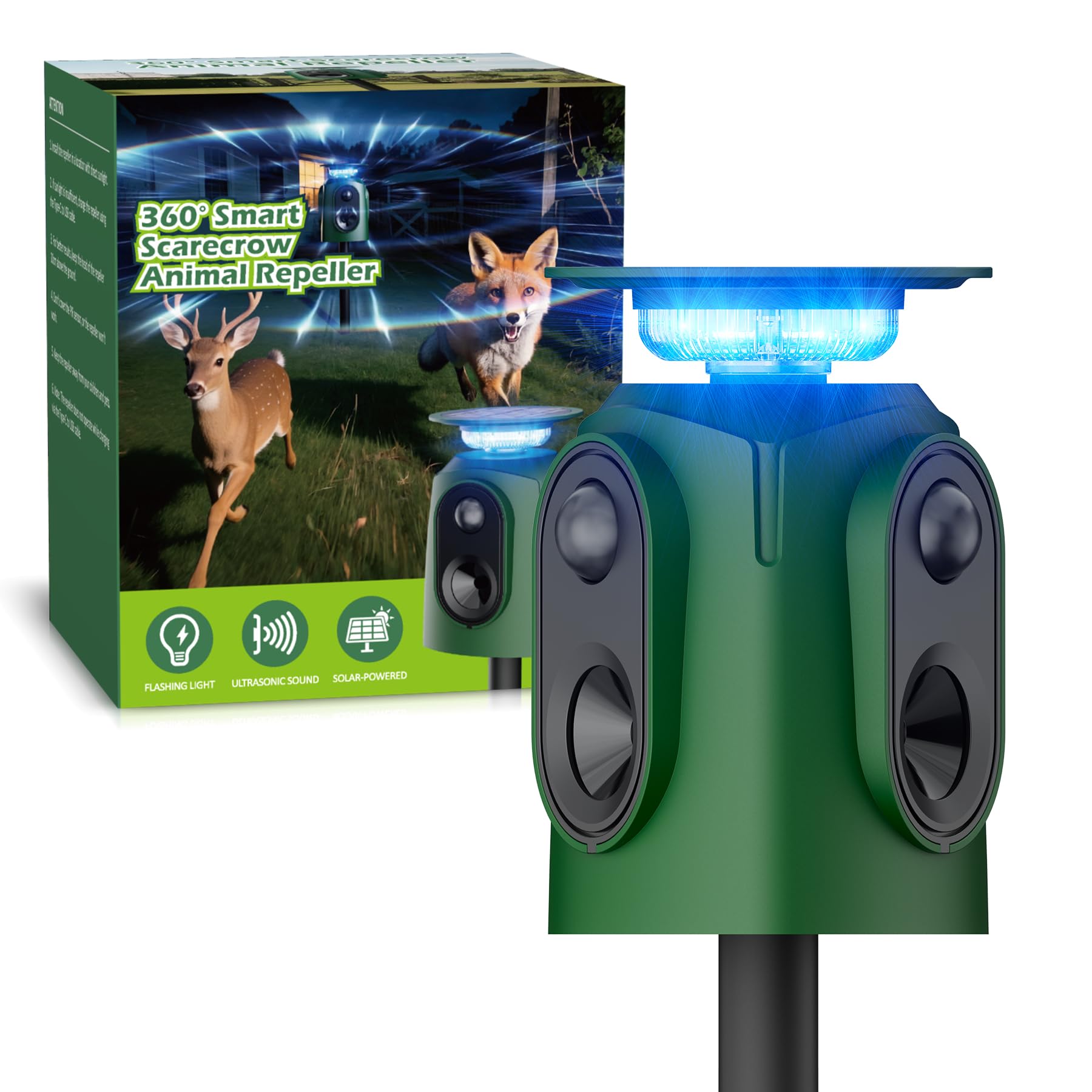
The PEXPEL R52 is the most balanced multi-sensory repellent in the mid-range tier because it combines a true 360° PIR sensor with three-sided ultrasonic speakers and dual LED flashing lights, all in a single stake-mount housing. Where most solar repellers have a narrow 110° detection arc, the R52’s wrap-around design ensures no blind spots—critical for perimeter defense against foxes that often approach from an angle. The five adjustable modes target different species by varying ultrasonic frequency and flash pattern, reducing the chance that a fox will adapt after a few exposures.
Its solar panel charges a built-in lithium battery, and the added Type-C USB charging port is a smart redundancy for cloudy weeks—a full charge reportedly delivers 25 to 30 days of operation. The IP65 rating covers rain and snow, and owners note that the unit survived winter storms without any performance drop. Installation is ground-stake simple, taking about two minutes, and the green body blends reasonably well into garden foliage. The ultrasonic pulses are inaudible to humans, so there is no audible nuisance, though the LED flash is bright enough to be visible from across a garden.
Owner feedback is remarkably consistent: the R52 effectively clears deer, raccoons, and rabbits from garden areas, with several long-term users reporting “no damage for weeks after installation.” A minority of reviews note that deer in areas with heavy hunting pressure sometimes ignored the flash, but foxes—being more neophobic—tended to avoid the zone entirely. The single unit covers roughly a 30-foot radius, so larger yards will need multiple units. For a suburban or acreage homeowner wanting a low-maintenance, solar-reliable, multi-species deterrent that prioritizes fox deterrence, the R52 is the top all-around choice.
What works
- True 360° PIR detection with no blind corners for perimeter coverage.
- Five adjustable frequency/flash modes prevent animal habituation.
- Solar plus USB-C backup charging ensures reliability in shaded spots.
- IP65 waterproof and stake-mountable for quick garden installation.
What doesn’t
- Single unit covers only ~30 ft radius; larger yards require multiples.
- Ultrasonic effect may not deter heavy-traffic deer immediately.
- Green color can be harder to spot when checking operation.
3. PHIMINNEX AR902 Solar Ultrasonic Repellent
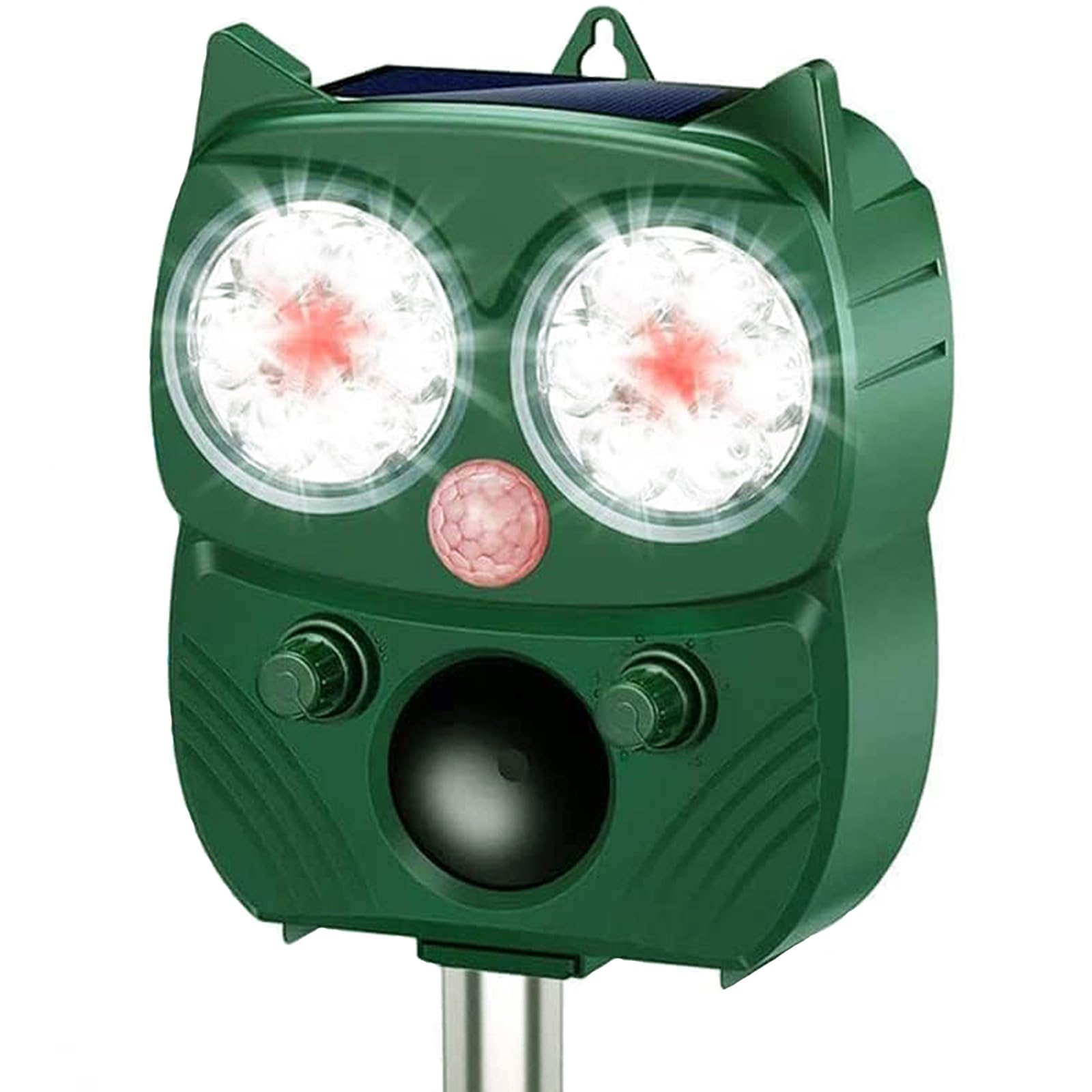
The PHIMINNEX AR902 distinguishes itself with the widest frequency sweep of any repeller in this comparison—cycling from 13.5 kHz to 45.5 kHz across three distinct ultrasonic frequencies plus a variable-frequency alarm sound. This sweeping approach is critical for fox deterrence because a single-frequency tone becomes background noise within days, while a changing pitch keeps the animal’s auditory startle reflex engaged. The unit also lets you adjust the volume of the ultrasonic emission independently of the frequency selection, so you can dial the intensity up for a dense fox population or down near shared property lines.
Build quality is a step above the typical budget repeller: the housing carries an IP66 waterproof rating (higher than the IP44/IP65 rivals), and owners report that original units have operated reliably for three years through rain, snow, and direct sun. The solar panel is paired with a rechargeable lithium battery that, per the specs, charges at 90 mA under full sun and includes a USB charging cable for overcast stretches. The PIR sensor has a 110° angle and a 33-foot range—standard figures, but the combination of sweeping frequency and adjustable volume gives it an edge in deep-woods or high-pressure areas.
Verified owners consistently praise the AR902’s effectiveness against raccoons, skunks, and foxes, with one detailed review noting it was the best among four units tested over a growing season. The only caveat is the visual design: the owl-like face may look like a garden ornament to humans, but some reviewers felt the plastic could feel slightly less robust than metal-housed alternatives. For homeowners who need a single durable unit that uses changing sound frequencies to keep foxes from acclimating, this is a reliable, long-lived investment.
What works
- Wide frequency sweep range 13.5–45.5 kHz prevents auditory habituation.
- IP66 waterproof rating exceeds most competitors for year-round durability.
- Independent volume and frequency adjustments for site-specific tuning.
- Longevity confirmed—original units still running after three seasons.
What doesn’t
- 110° sensor arc means corners of larger yards need strategic placement.
- Plastic housing feels less premium than some metal or acrylic alternatives.
- Solar panel may oxidize over time; requires periodic cleaning or buffing.
4. ChunHee Solar Motion Sensor Alarm (2-Pack)
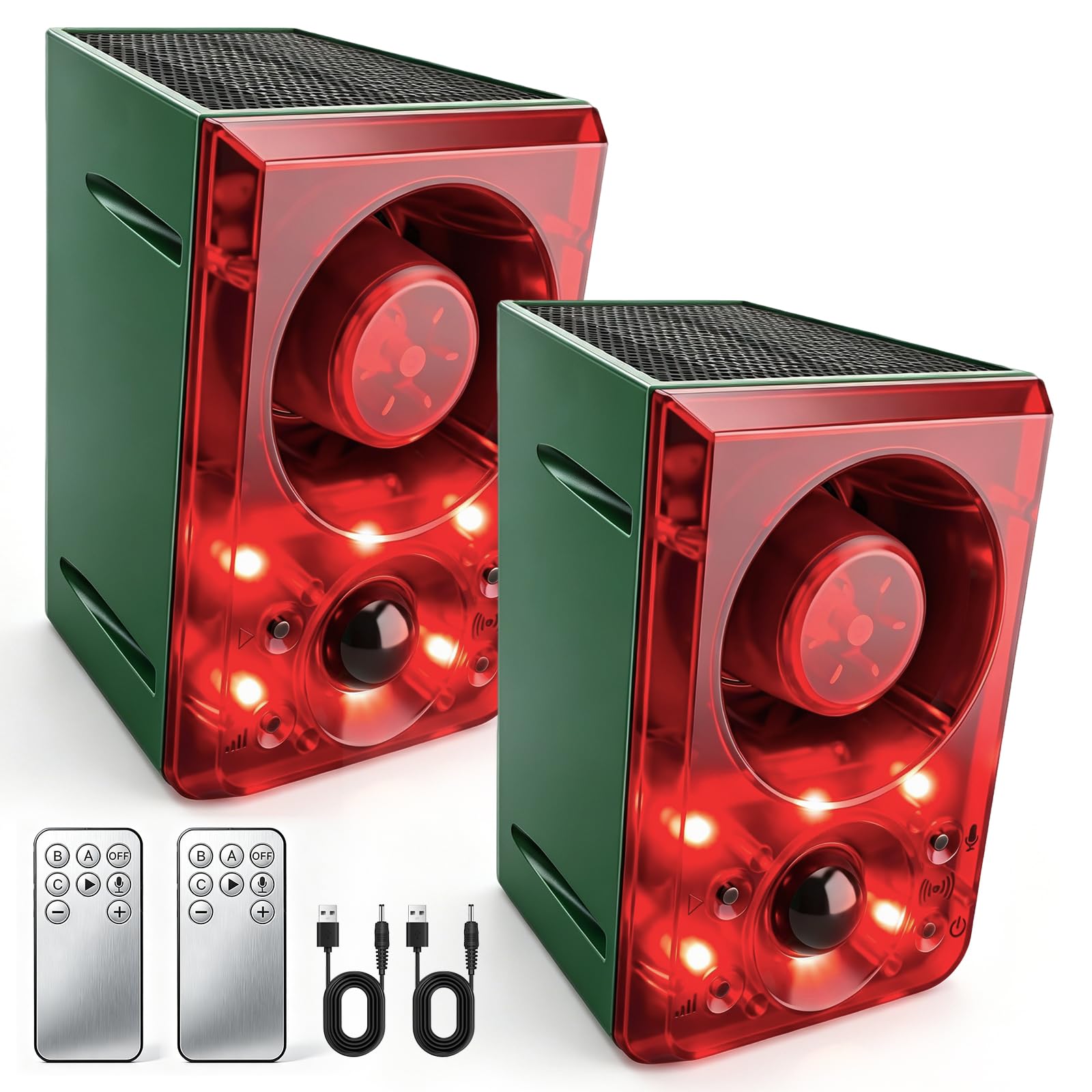
The ChunHee is the loudest defensive tool in this lineup—a motion-activated alarm that combines a 130 dB siren with a bright strobe light, a recorded barking dog, and even the option to record your own custom message for up to 120 seconds. For fox deterrence, the key advantage is variability: you can alternate between “dog barking” and “gunshot” sounds via the remote, or record a human voice shouting, ensuring the auditory stimulus never becomes predictable. The three operating modes (24-hour, night-only, and timer) give you control over when the alarm is active, saving battery life during the day.
Solar power plus a built-in rechargeable battery means no wiring, and the IP65 rating handles rain and snow. The PIR sensor is extremely sensitive, with a 110° arc and an 8-meter range—the sensitivity is a double-edged sword, as several owners caution against aiming it toward a street where it will false-trigger on passing cars. The 2-pack includes two full units, which is excellent value for covering both the front and back of a property or a chicken coop on two sides. The remote control lets you arm or disarm without walking to each unit, a convenience missing from simpler repellers.
Owner reports overwhelmingly center on its effectiveness against raccoons, possums, and coyotes around chicken coops and gardens. One verified review specifically noted that the “gunshot” sound was aggressive enough to chase off a bobcat. The primary downside is that the loudness can disturb neighbors if installed too close to a property line, and the 5-minute noise cycle (once triggered) may feel excessive for smaller yards. For homesteaders who need a truly startling, multi-sound deterrent that covers a coop or barn entrance, this 2-pack is a heavy-duty sonic solution that foxes will not ignore.
What works
- 130 dB siren with dog bark, gunshot, and custom recording options.
- 2-pack provides excellent value and dual-zone coverage out of the box.
- Solar powered with IP65 weatherproofing and remote control included.
- Adjustable volume prevents excessive noise in sensitive neighbor areas.
What doesn’t
- Very sensitive PIR may trigger false alarms from street traffic or wind-blown debris.
- 5-minute alarm cycle per trigger can be too long for small properties.
- Requires initial full day of solar charging before first use for reliability.
5. PEXPEL R17S Solar Nocturnal Animal Repeller 4-Pack
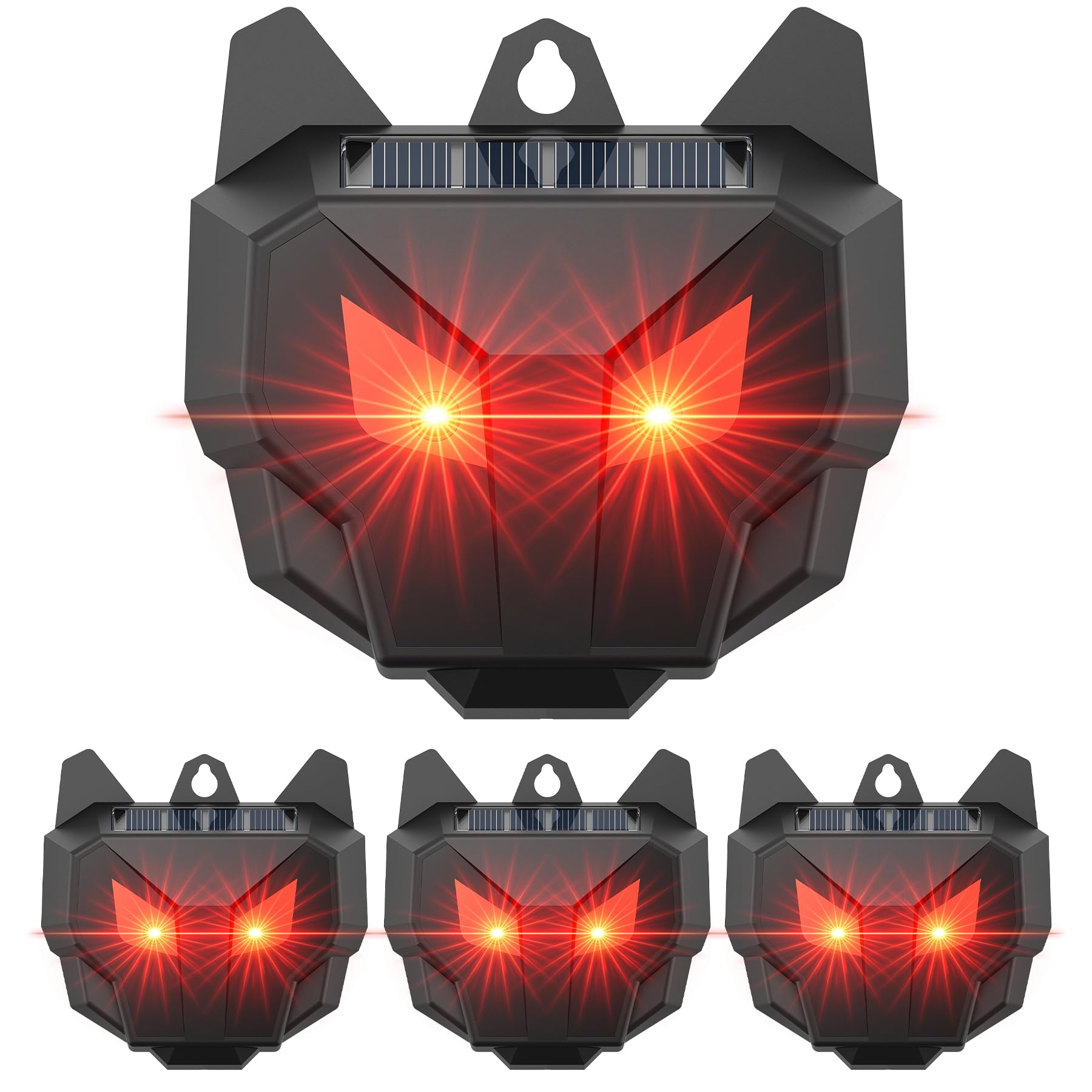
The PEXPEL R17S 4-pack is the most straightforward perimeter strobe solution in the lineup, offering four identical solar-powered units that each emit a dual red LED flash at a 4Hz rate to mimic the glowing eyes of a predator. The quantity is the headline feature: for the price, you get four stakes that you can space along a fence line, garden border, or around a chicken coop, creating a continuous visual barrier that a fox will not confidently cross. The 4Hz strobe is specifically designed to trigger the fox’s “predator nearby” instinct, and because each unit flashes independently, the effect is a scattered, unpredictable light field rather than a synchronized pattern that could be learned.
Each unit is powered by a built-in solar cell with a rechargeable battery, and the dusk-to-dawn sensor ensures automatic activation. The IP44 waterproof rating is adequate for rain and snow but is the lowest on this list—sustained downpours are the stated risk, though no owner reports of water damage surfaced in the data. Installation is trivial: press the ON button and mount 1–8 feet above ground on a fence post or wall. The instructions recommend installing at predator eye level (roughly 2–4 feet for a fox), and multiple units should be staggered to achieve 360° coverage around a structure.
Owner feedback is almost universally positive for the device’s ability to scare off deer, raccoons, and foxes from gardens. One verified report described the bright red flash scaring away cats and other animals after a raccoon attack on a turkey. The only reported failure case was a single user who found the lights did not deter raccoons when placed only 12 inches off the ground. For budget-conscious buyers who need to cover a large perimeter quickly with a passive, maintenance-free visual defense, this 4-pack delivers the best coverage-per-dollar of any product reviewed.
What works
- Four units per pack cover fence lines and coop perimeters affordably.
- Independent random flash patterns prevent foxes from adapting.
- Dusk-to-dawn automation requires no daily interaction or maintenance.
- Ultra-simple installation: press ON and mount on a post or fence.
What doesn’t
- IP44 rating is the lowest here; not ideal for extreme weather zones.
- Fixed 4Hz strobe lacks mode adjustments for different species.
- Solar only—no USB backup charging for prolonged cloudy periods.
6. GEROSSI Solar Nocturnal Animal Repeller 4-Pack

The GEROSSI 4-pack is a direct-value competitor to the PEXPEL R17S, offering four solar-powered units with dual red LED lights and a 4Hz strobe designed to simulate a predator’s gaze and the flicker of fire. The core specs are nearly identical—solar panel, dusk-to-dawn sensor, IP65 waterproof rating (one step above the R17S)—but the GEROSSI units are marginally lighter and stake into the ground rather than requiring mounting hardware. This makes them the easiest-deploy option for quickly staking a visual deterrent ring around a garden bed or small chicken run without any tools.
The IP65 rating is the key differentiator here: it offers better dust and water ingress protection than the IP44 of the R17S, meaning the GEROSSI units are more likely to survive heavy seasonal rain without issues. The 4Hz flash is effective as a first-line deterrent, but the device lacks any ultrasonic or sound component, so foxes that are particularly bold or hungry may still approach after several nights of exposure. The manufacturer recommends using the lights in combination with other deterrents (liquid fence, motion sprinklers) for high-pressure areas—a fair admission that a purely visual strobe is rarely a standalone solution for determined foxes.
Real-world owner reports are mixed: some note that the lights effectively stopped raccoons for three nights before the animals returned, while others reported complete success when moving the stakes nightly and keeping them at a 12-inch height. A handful of reviews state the product did not deter deer or raccoons at all. For the budget-tier price, the GEROSSI 4-pack is a reasonable entry-level perimeter light set—it works best as an inexpensive, low-effort first layer of a multi-method fox defense, especially for gardeners who are willing to reposition stakes periodically to maintain the element of surprise.
What works
- IP65 waterproof rating at a budget-friendly price beats many similarly priced strobes.
- Ground-stake design installs in seconds without tools or mounting hardware.
- Four-pack delivers solid coverage for small gardens and coop perimeters.
What doesn’t
- Purely visual; no ultrasonic or audible deterrent for multi-sensory impact.
- Foxes can habituate after a few nights if the lights remain static.
- Mixed owner results—some report no effect on raccoons or deer.
7. Predator Pee 100% Fox Urine – 16 oz
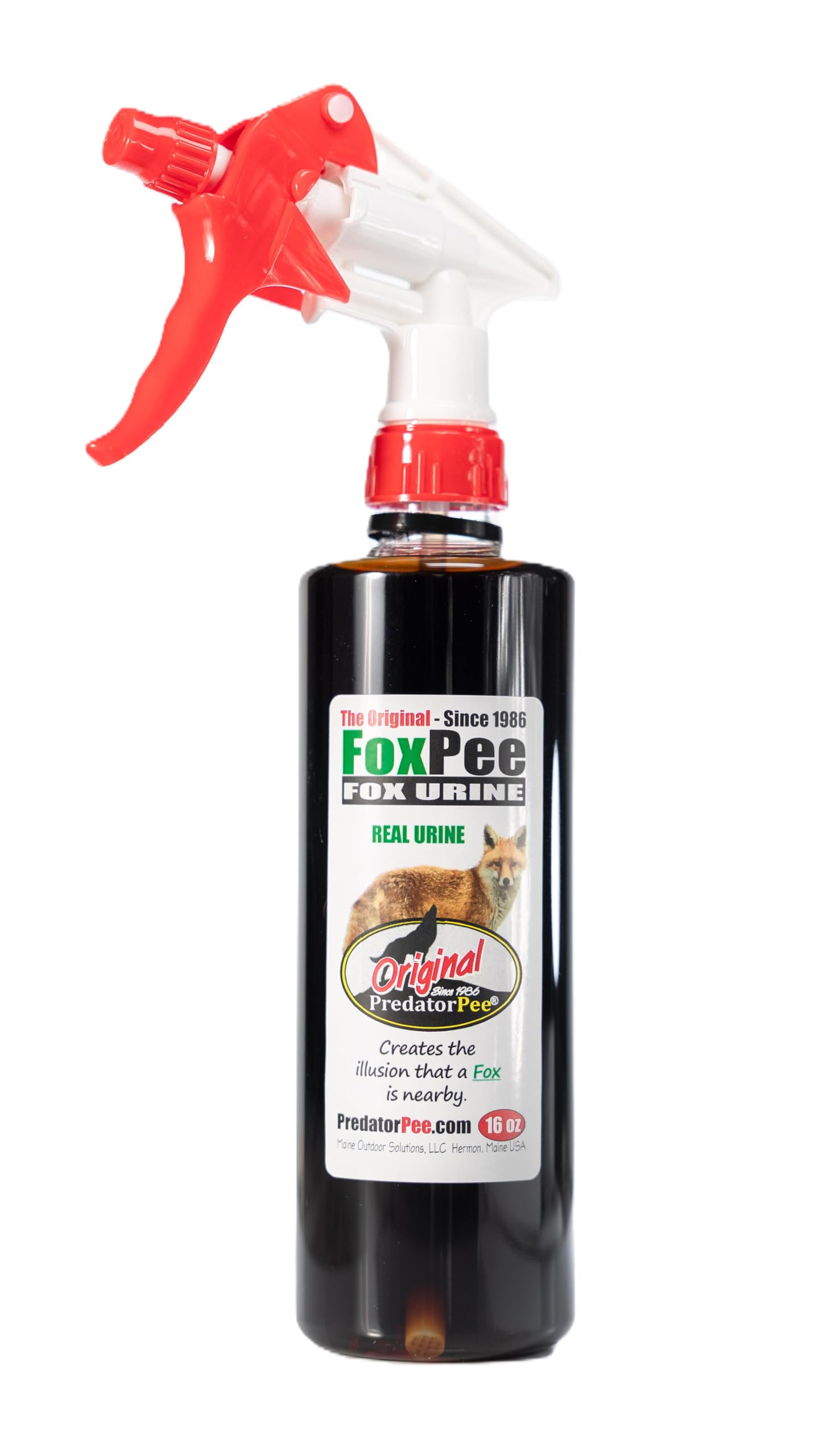
Predator Pee’s Fox Urine is the only pure olfactory repellent in this comparison, relying on a biological territorial signal rather than electronics or lights. The premise is simple: by applying the urine around the perimeter of your garden or coop, you create the scent-based illusion that a fox has already claimed the territory, which discourages other foxes from entering. This is a classic predator-prey communication hack—wild canids respect scent boundaries, and a fresh marking is often enough to make a passing fox veer away rather than risk a confrontation.
The 16-ounce bottle is a liquid concentrate that can be applied directly to vegetation, stakes, or cotton balls placed in mesh bags. The manufacturer recommends wearing gloves during application to avoid transferring human scent, and reapplying after heavy rain is essential because the scent degrades with moisture. Owner feedback is genuinely split along a predictable line: when used correctly (fresh application, proper placement, soaked into absorbent material), the urine can deter small mammals like squirrels and rabbits effectively. For foxes specifically, the results are less reliable—one verified owner reported the product worked wonders, while another called it “money down the drain” after flowers were eaten within two days.
The biggest limitation is longevity: scent markers evaporate and wash away, and a determined fox may simply wait for the scent to fade. For a budget-friendly, chemical-free addition to a multi-layered defense, a bottle of fox urine adds an olfactory component that purely electronic devices lack. However, as a standalone solution, especially in wet climates or high-pressure urban-interface zones, the urine alone is unlikely to provide the persistent, round-the-clock deterrence that a motion-activated strobe or alarm delivers. Consider it a supplement to a solar repeller, not a replacement.
What works
- Biological predator signal exploits fox territorial instincts naturally.
- Non-toxic and safe for use around children, pets, and edible gardens.
- Easy application via spray, soaked stakes, or scent-dispersal bags.
What doesn’t
- Rain and dew wash away scent quickly; requires frequent reapplication.
- Results vary widely; not a reliable standalone solution for persistent foxes.
- Strong urine odor may be unpleasant for the human applicator to handle.
Hardware & Specs Guide
PIR Sensor Range & Angle
The effective detection zone of a motion-activated repeller determines how much of your property is actually under surveillance. Most units offer a 110° horizontal arc and a range of 26 to 33 feet. For perimeter defense, overlap between multiple units is essential—foxes will exploit gaps smaller than 10 feet. The PEXPEL R52 breaks the mold with a three-sided 360° sensor, eliminating dead zones entirely. Always mount the PIR 2–4 feet above ground, roughly at fox shoulder height, to catch their movement rather than scanning over their heads.
Ultrasonic Frequency Sweep
A single static ultrasonic frequency (e.g., 25 kHz) loses effectiveness as the animal’s auditory system acclimates. Effective fox repellers sweep across a range—the PHIMINNEX AR902 cycles from 13.5 kHz to 45.5 kHz—which prevents habituation by constantly shifting the pitch. Frequency sweep is more important than maximum kHz rating. Devices without frequency variation rely entirely on the novelty of the ultrasonic burst, and foxes typically ignore them after three to seven days of exposure.
FAQ
How quickly do foxes habituate to ultrasonic repellers?
Can I use a fox repellent near my dogs or chickens?
How often should I reapply a liquid scent repellent for it to remain effective?
Will a solar repeller work in a shaded yard or during winter?
Final Thoughts: The Verdict
For most gardeners and homesteaders, the animal repellent for foxes winner is the PEXPEL R52 360° Solar Ultrasonic because it combines true 360° detection, five adjustable ultrasonic modes, dual LED strobes, and reliable solar-plus-USB charging in a single affordable stake-mount unit that covers a wide area without blind spots. If you need to protect a large pasture or multi-acre property from fox predation, invest in the Foxlights Non-Solar 9-LED—its random 360° flash pattern is the gold standard for habituating predators and has stopped livestock losses for years. And for maximum auditory shock value around a chicken coop or barn, the ChunHee 2-Pack Motion Alarm delivers a 130 dB siren with recordable sounds that will make even the boldest fox think twice about approaching.