
Compostable plastic bags promise a planet-friendly solution to kitchen waste, but the reality often involves tears, premature leaks, and a bag that disintegrates before it reaches the bin. The challenge is balancing genuine compostability with the everyday toughness needed to hold coffee grounds, vegetable peels, and wet food scraps without springing a leak. You need a bag that holds up for a few days, breaks down in the right conditions, and doesn’t leave you scrubbing the bottom of your trash can.
I’m Rikta — the co-founder and writer behind Lawn Gear Lab. I’ve spent countless hours analyzing material certifications, comparing mil thickness specs, and studying owner feedback to separate the genuinely durable compostable bags from those that fail on the first wet load. This guide cuts through the marketing claims to find the liners that actually work.
Whether you are separating food scraps for an industrial program or simply want to reduce your plastic footprint at home, the right compostable plastic bags must pass real-world testing against tearing, leaking, and premature decomposition.
How To Choose The Best Compostable Plastic Bags
Not all green bags are created equal. The material composition, certification level, and physical construction determine whether a bag will hold your kitchen scraps for a few days or disintegrate into a slimy mess. Focus on these three areas before buying.
Certification Standards: BPI, OK Compost HOME, and ASTM D6400
The term “compostable” is not regulated in the same way everywhere. The gold standard is BPI (Biodegradable Products Institute) certification, which verifies that a bag meets ASTM D6400 for industrial composting. If you compost at home, look for the OK Compost HOME certification from TÜV Austria, which confirms the bag will break down in a backyard bin at lower temperatures. Bags without these certifications may be merely “biodegradable” — a looser claim that does not guarantee full breakdown into non-toxic components.
Material Thickness and Seal Design
Compostable bags are inherently less durable than petroleum-based plastic because they are designed to break down. Mil thickness (1 mil = 0.001 inch) is the primary indicator of tear resistance. For a 13-gallon kitchen bag, aim for at least 0.9 mil, with 1.0 mil or higher offering better protection against wet waste. Star-seal bottoms, where the bag is sealed with a multi-point pattern rather than a single straight line, significantly reduce the chance of leaks at the weakest point of the bag.
Storage and Shelf Life
Compostable bags begin degrading the moment they are manufactured. Direct sunlight, heat, and humidity accelerate this process. Store your bags in a cool, dry cabinet and use them within 9–12 months of purchase. Once filled with organic waste, they should be taken to the compost bin within 2–3 days to avoid the bag breaking down from the inside. This is not a flaw — it is the very property that makes them compostable.
Quick Comparison
On smaller screens, swipe sideways to see the full table.
| Model | Category | Best For | Key Spec | Amazon |
|---|---|---|---|---|
| UNNI 13 Gallon | Premium | Dual-certified home & industrial use | 1.0 mil thickness; BPI & OK Home | Amazon |
| Cleanomic 13 Gallon | Premium | Leak resistance and odor control | Silky-smooth; BPI Certified | Amazon |
| SUPERBIO 13 Gallon | Premium | Industrial compost programs | 1.0 mil; BPI & Seedling Certified | Amazon |
| AYOTEE 13 Gallon | Mid-Range | Value-driven kitchen composters | 1.18 mil; star-seal bottom | Amazon |
| OrangeBio 13 Gallon | Mid-Range | Home composting beginners | 0.9 mil; BPI & OK Home | Amazon |
| AYOTEE 4 Gallon Drawstring | Mid-Range | Bathroom, office, and pet waste | Drawstring; PSM material | Amazon |
| Matter Assorted Kitchen Bags | Budget | Multiple sizes for food storage | 230-count variety; BPI & TUV Home | Amazon |
In‑Depth Reviews
1. UNNI Compostable Drawstring Bags, 13 Gallon

UNNI earns its top spot by holding dual certification from BPI and OK Compost HOME, meaning it passes rigorous industrial composting standards (ASTM D6400) and is also proven to break down in a backyard bin. At 1.0 mil thick, the material strikes a rare balance — heavy enough to resist tearing under a load of wet coffee grounds and vegetable scraps, yet thin enough to compost efficiently. The drawstring closure is a practical upgrade over flat-top bags, allowing a tight cinch that reduces odors and prevents the bag from slipping into the can.
Customer feedback consistently notes that the bags hold up well for the recommended 2–3 day window with organic waste. The star-seal bottom adds an extra layer of leak protection at the most vulnerable seam. The 30-count roll size (vs. smaller 15-count offerings from competitors) means fewer reorders without committing to a bulk pack that may degrade before you finish it.
The only recurring user caution is storage discipline: keep the roll in a cool, dry area and use it within 9 months of purchase. Bags exposed to direct sunlight or heat lose tensile strength noticeably faster. For most households running a dedicated kitchen compost bin, UNNI delivers the most reliable all-around performance.
What works
- Dual home and industrial compost certification ensures flexibility.
- Drawstring closure keeps odors sealed and bags stable in the can.
- 1.0 mil thickness resists tears from wet waste for 2–3 days.
What doesn’t
- Shelf life limited to 9 months; must track purchase date.
- Not recommended for sharp or abrasive items like bones or glass.
2. Cleanomic Compostable Trash Bags, 13 Gallon

Cleanomic differentiates itself through material feel and leak testing. The bags have a noticeably smoother, more flexible surface than the typical matte compostable liner, which helps them conform to the shape of the trash can without cracking along the sides. BPI-certified for industrial composting, these bags are specifically designed to handle heavy, wet loads like coffee grounds and cat litter without tearing at the seams.
The powder-free, fragrance-free construction is a deliberate design choice — many compostable bags add scents to mask odors, but Cleanomic relies on the drawstring seal to contain smells naturally. The 25-count box is smaller than bulk alternatives, but each bag is engineered to withstand a full load for several days without leaking, based on positive user reports from households with daily food scrap collection.
One notable limitation: several users report that the bags do not always cinch tightly around the rim of every 13-gallon can shape. If the bag slips down under a heavy load, it can cause messes. This is a fit issue specific to certain can designs, so check your bin dimensions against the bag’s 23.6″ x 31.5″ sizing before committing.
What works
- Smooth, flexible material reduces cracking and tearing at edges.
- Proven leak resistance with wet organic waste over multiple days.
- No masking fragrances; odor control comes from the seal.
What doesn’t
- Drawstring may not hold securely on all can rims.
- 25-count boxes require more frequent repurchasing.
3. SUPERBIO 13 Gallon Compostable Drawstring Kitchen Waste Bag
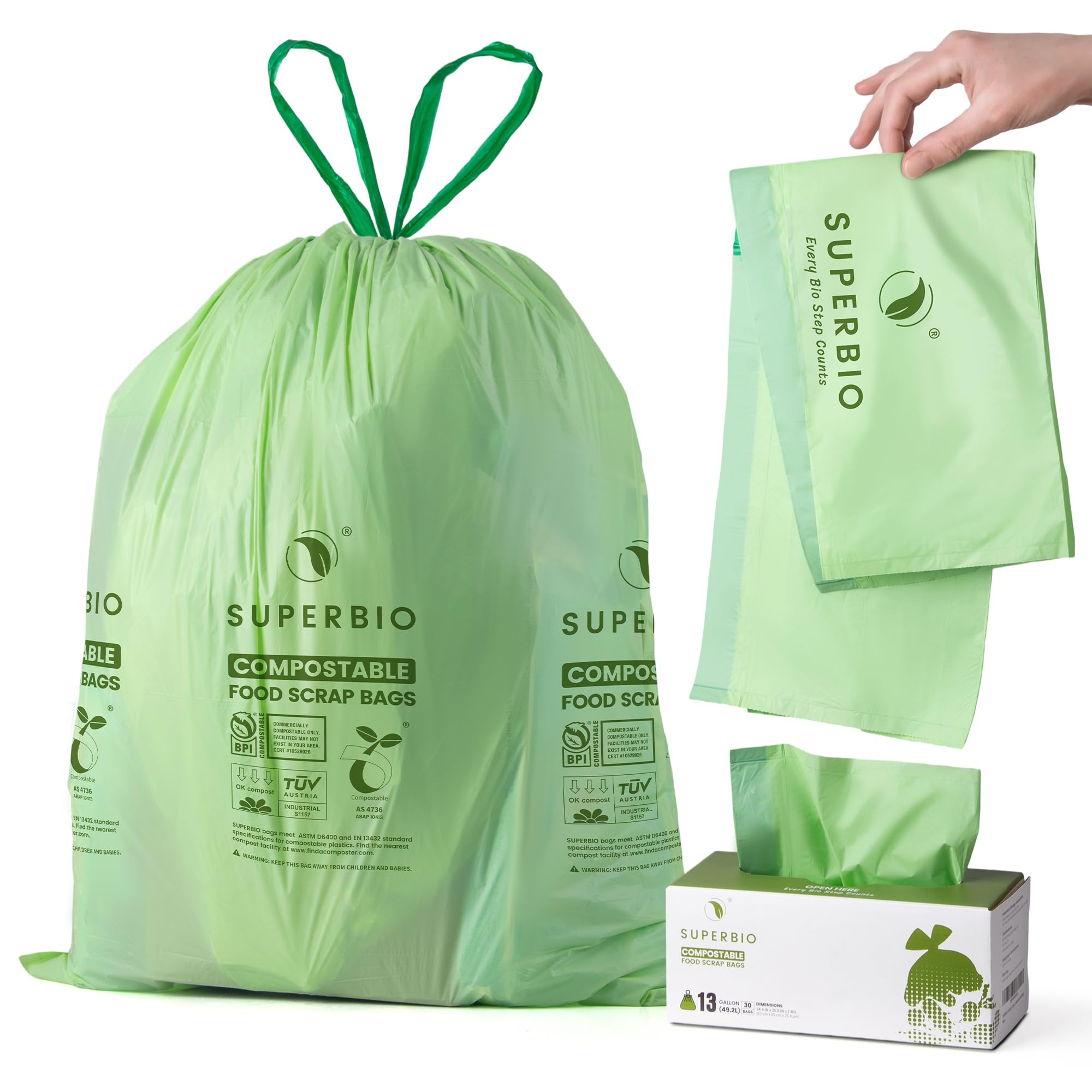
SUPERBIO targets the industrial composting crowd with triple certification: BPI, OK Compost INDUSTRIAL, and the European Seedling logo (EN 13432). The 1.0 mil thickness matches UNNI in raw durability, and the drawstring closure is reinforced to reduce the tear-free design flaws that plague cheaper compostable bags. The 30-count roll is housed in a sturdy carton that doubles as a dispenser, making it easy to grab a bag without unrolling the entire pack.
User feedback emphasizes the bag’s ability to resist leaking when filled with fruit rinds, eggshells, and leftover cooked food. The bag holds together well for the recommended 3-day disposal window, and the drawstring cinches tightly enough to contain smells without tying a separate knot. The plant-based material does not contain polyethylene, so it feels slightly different from standard plastic — slightly more crinkly — but this does not affect its load-bearing capacity.
The main downside is that SUPERBIO is certified for industrial composting only, not home composting. If your municipality does not offer industrial composting, or if you rely on a backyard bin, this bag may not break down reliably in a low-heat environment. Double-check your local facility’s accepted certifications before stocking up.
What works
- Triple-certified for industrial composting programs (BPI, OK, Seedling).
- Reinforced drawstring resists tearing during closure.
- Dispenser box design keeps bags organized and accessible.
What doesn’t
- Not certified for home composting.
- Bag feels slightly crinkly compared to standard plastic liners.
4. AYOTEE Compostable Trash Bags 13 Gallon Tall Kitchen
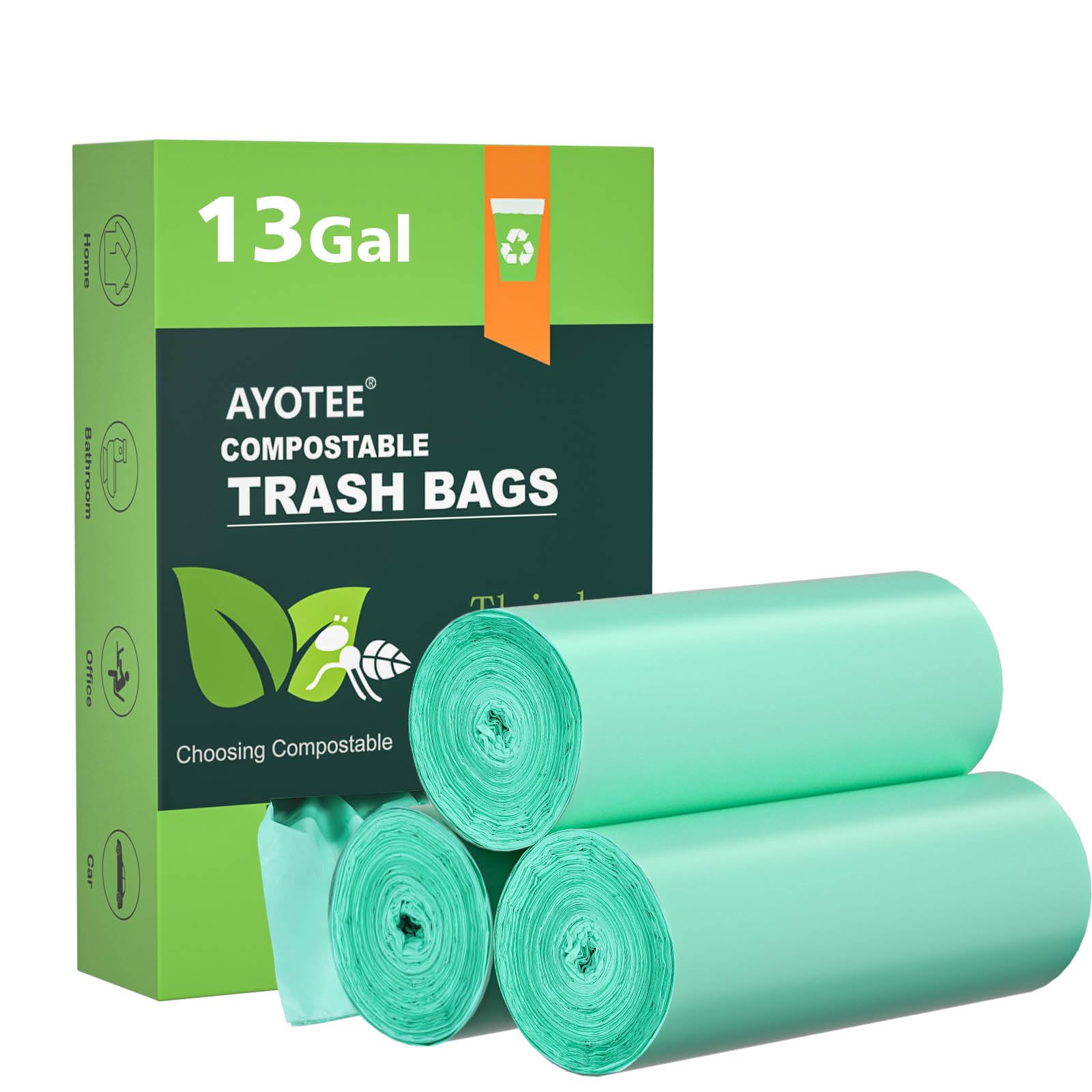
AYOTEE uses Plastarch Material (PSM), a plant-starch-based resin, and meets ASTM compostability standards for industrial facilities. The standout spec here is the 1.18 mil thickness — significantly thicker than the 0.9 mil and 1.0 mil competitors. That extra material translates directly to higher tear resistance and a lower chance of punctures from sharp food scraps like avocado pits or broken shells. The star-seal bottom further reinforces the weakest seam, and the 45-count pack (three rolls of 15) provides a strong value proposition for cost-conscious shoppers.
Customer feedback consistently praises the bag’s “surprisingly strong” feel — several users note they expected a flimsy liner and got something resembling standard plastic in hand feel. The semi-clear material allows you to see the contents, which is useful for separation if you keep a visible compost bucket. The bags fit standard 10-15 gallon tall kitchen cans without sagging or slipping.
The trade-off is that AYOTEE does not carry BPI or OK Compost HOME certification. While the company states it meets ASTM standards, the lack of independent third-party labeling means you are relying on the manufacturer’s claims. If your local composting facility requires BPI certification for acceptance, you may need to verify directly with AYOTEE or choose a certified option.
What works
- 1.18 mil thickness is the thickest in this roundup for better tear resistance.
- Semi-clear material helps identify waste contents quickly.
- Star-seal bottom minimizes leak risk from wet waste.
What doesn’t
- Lacks independent BPI or OK Compost certification.
- Some users report early breakdown with very moist food waste after 3 days.
5. OrangeBio 13 Gallon Compostable Trash Bags
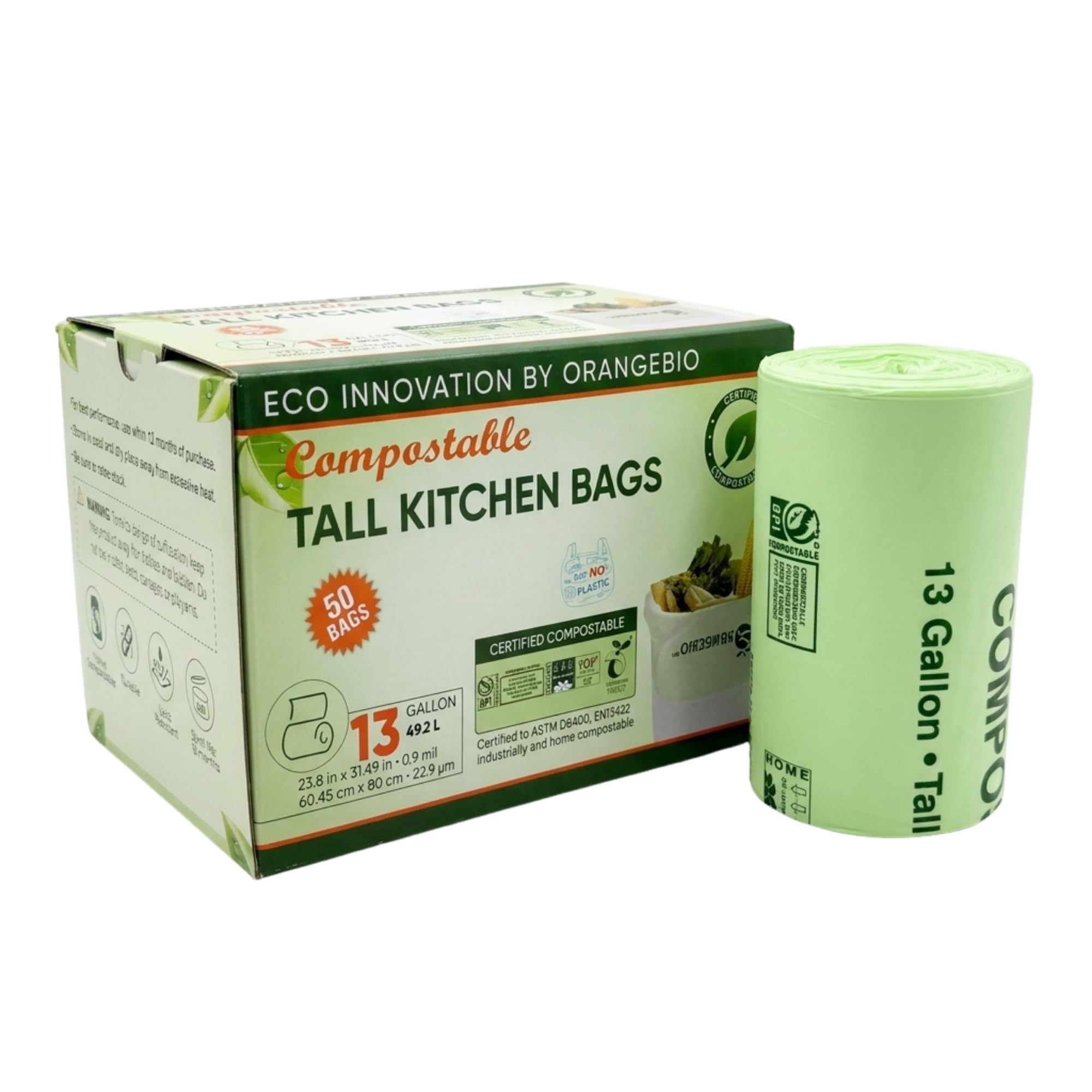
OrangeBio offers one of the few fully certified home-compostable options in this size range, carrying both BPI (industrial) and OK Compost HOME certification. The 0.9 mil thickness is slightly thinner than the premium tier, but the plant-based, plastic-free construction is reinforced by a leak-proof seal design that holds up well for standard household food waste. The 50-count box is generous, and the bags fit most 13-gallon tall cans comfortably.
User reviews are largely positive, with many noting the bags stand up well to daily kitchen scraps when emptied every 2–3 days. The OK Compost HOME certification is the key differentiator here — if you maintain a backyard compost pile and want to toss the bag directly in, OrangeBio is one of the few options that will break down at lower temperatures without pre-soaking or shredding.
The main caution comes from storage: the bags are sensitive to direct sunlight and heat. Multiple users reported that leaving the box on a sunny windowsill for a few months caused the material to become brittle and tear on opening. Keep the box in a dark cabinet, and use the bags within 12 months of purchase for best results.
What works
- Dual BPI and OK Compost HOME certification for all composting setups.
- 50-count box delivers strong per-bag value in the mid-range tier.
- Leak-proof design holds up for 2–3 days of wet waste.
What doesn’t
- 0.9 mil is thinner; punctures more likely with sharp items.
- Heat and sunlight exposure quickly degrade the bag’s tensile strength.
6. AYOTEE Compostable Trash Bags 4 Gallon Drawstring
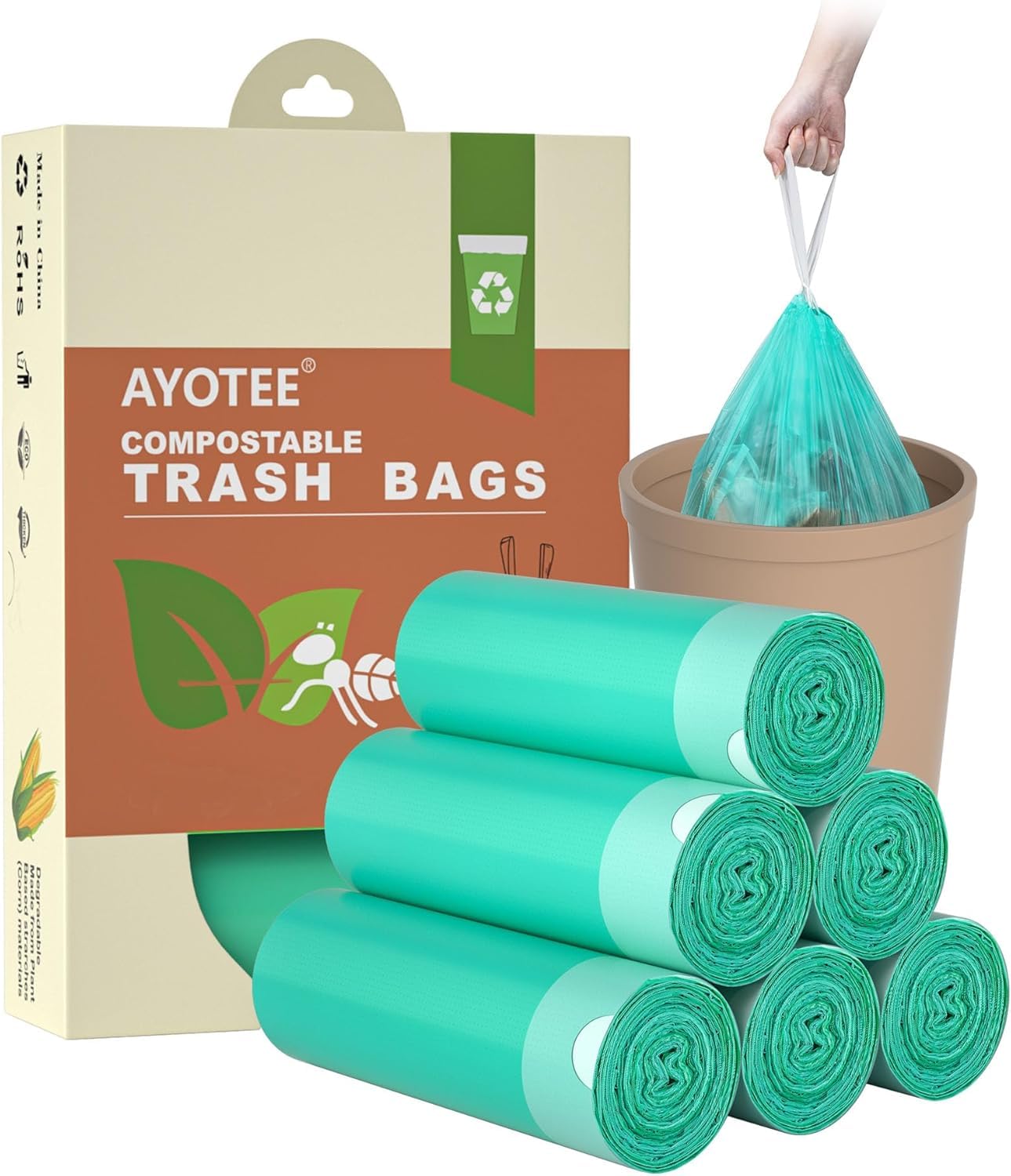
These 4-gallon drawstring bags from AYOTEE fill a specific niche: small bins in bathrooms, offices, or for pet waste collection. The PSM (Plastarch Material) construction meets ASTM composting standards, and the 100-count box with a tissue-box-style dispenser makes grab-and-go use simple. The drawstring closure is a major upgrade over standard small liners, which often lack any tie mechanism, forcing you to knot the top of a poorly filled bag.
The 19.6″ x 17.7″ dimensions are slightly oversized for a 4-gallon can, which means they fit easily without fighting to get the bag over the rim. The semi-clear material helps identify contents, useful for separating bathroom waste from kitchen compost.
Also, some units in the batch arrived without properly punched drawstring notches, making the closure ineffective. Quality control on the drawstring mechanism is inconsistent between rolls.
What works
- Drawstring closure keeps small bins odor-free and easy to empty.
- 100-count box with dispenser is practical for high-turnover areas.
- Oversized fit works with most 4-gallon cans without slipping.
What doesn’t
- Drawstring stretches and can snap under near-full loads.
- Occasional quality issues with missing drawstring notches on some rolls.
7. Matter Compostable Assorted Kitchen Bags, 230 Count
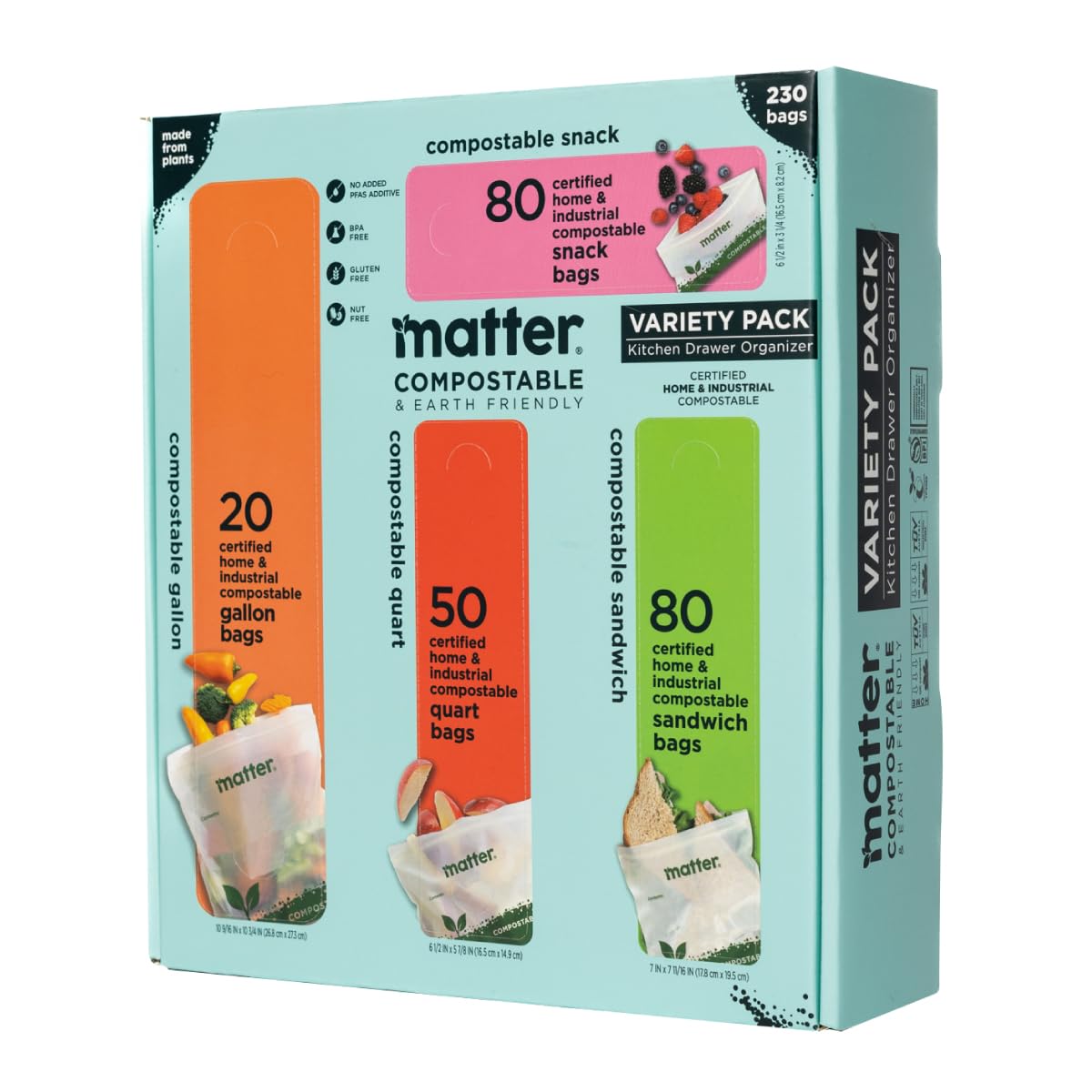
Matter offers a radically different approach: instead of single-purpose trash bags, this variety pack includes 80 snack bags, 80 sandwich bags, 50 quart-sized bags, and 20 gallon-sized bags, all BPI and TUV-certified for industrial and home composting. The biopolymer material is free of added PFAS, is BPA-free, and is safe for refrigerator and freezer use. For households trying to eliminate single-use plastic from both food storage and waste disposal, this is a complete ecosystem.
Users consistently report that the zipper-style closure on the snack and sandwich bags remains functional after multiple washes, making them genuinely reusable — a rare claim for compostable food storage. The quart and gallon bags function well as lightweight trash liners for small bins or as produce storage bags. The clever dispenser box has separate perforated openings for each size, keeping the drawer organized.
The trade-off for the variety and low per-bag cost is that the gallon-sized bags are not as thick or tear-resistant as dedicated 13-gallon compostable trash bags. They work fine for dry waste or light kitchen scraps, but a heavy wet load of food scraps may cause the gallon bags to fail at the seams. This pack is best for someone who wants to replace plastic baggies and small bin liners simultaneously, not as a primary kitchen compost bag.
What works
- 230 bags across four sizes cover food storage and small waste bins.
- Zipper closure is reusable after washing, adding durability.
- Dual BPI and TUV Home certification for versatile composting.
What doesn’t
- Gallon bags are not robust enough for heavy wet waste loads.
- Freezer seal strength is inconsistent; bags may open during storage.
Hardware & Specs Guide
Mil Thickness and Material Composition
Mil thickness (1 mil = 0.001 inch) is the most concrete measurable spec for compostable bag strength. Bags at 0.9 mil (OrangeBio) are acceptable for light, dry waste but risk tearing under wet loads. The 1.0 mil bags (UNNI, SUPERBIO) form the sweet spot for kitchen use, while AYOTEE’s 1.18 mil provides maximum resistance for heavy food scrap collection. Material composition also matters: PSM (Plastarch Material) bags like AYOTEE are starch-based, while others use proprietary plant blends. Neither is inherently better, but PSM bags tend to feel slightly more rigid than biopolymer blends.
Certification Tier System
Not all compostability claims are equal. BPI (ASTM D6400) certification is the baseline for industrial composting. OK Compost HOME certification is the higher bar for backyard bins. SUPERBIO and Cleanomic carry only industrial certifications, meaning they require a 50-60°C facility to break down. OrangeBio is the standout with both BPI and OK Home, making it the most flexible option. AYOTEE meets ASTM standards per the manufacturer but lacks independent labeling — a risk for strict municipal programs. Always check your local facility’s accepted certifications before buying.
FAQ
Can I put compostable bags in my home compost bin?
Why do my compostable bags leak after a few days?
How should I store compostable bags so they don’t fall apart?
Final Thoughts: The Verdict
For most gardeners and home composters, the best compostable plastic bags winner is the UNNI 13 Gallon because it combines dual home and industrial certification with a durable 1.0 mil thickness and a practical drawstring closure that works reliably across different can shapes. If you want the absolute thickest film for the heaviest wet waste loads, grab the AYOTEE 13 Gallon. And for a complete zero-waste kitchen switch covering both food storage and small waste liners, nothing beats the Matter Assorted Pack.