
That first step onto the lawn shouldn’t be a dash-and-swat sprint back inside. A yard overrun by mosquitoes, ticks, fleas, or ants turns your largest living space into a no-go zone. The difference between a usable backyard and a bug buffet comes down to one decision: which granular or spray barrier you put down at the start of the season. This guide breaks down the top contenders that actually stop the swarm without turning your property into a chemical hazard zone.
I’m Rikta — the co-founder and writer behind Lawn Gear Lab. My process involves cross-referencing labeled active ingredients against documented pest life cycles, verifying coverage math against real lot dimensions, and filtering out hype by stacking verified owner reports against manufacturer claims for this specific yard pest category.
For homeowners who want immediate, schedule-free control without drenching the property in synthetic fog, the right bug killer for yard comes down to understanding residual duration, surface-level vs. soil penetration, and how each formula interacts with pets and rain runoff — not just reading the bug list on the bag.
How To Choose The Best Bug Killer For Yard
Picking the wrong granular or liquid mix means wasted time, bare patches from grub damage, or a yard that still swarms an hour after sunset. Focus on four criteria that separate a one-and-done season from a reapply-every-three-weeks cycle.
Residual Duration and Coverage Area
The bag should list both the square footage it treats and the length of protection. Surface sprays often break down in two to four weeks, while premium granules can hold a barrier for up to three months. Match the bag’s coverage to your lot size — a 20-pound bag covering 20,000 square feet is a different product than a 10-pound bag covering 5,000 square feet. Over-application wastes money; under-application leaves gaps that insects exploit within days.
Active Ingredient: Synthetic vs. Natural
Synthetic chemistries like bifenthrin or lambda-cyhalothrin deliver fast knockdown and strong residual on both foliage and soil, but require a dry window after watering in. Natural options like cedar oil or lemongrass oil deter and kill on contact without synthetic residue, though they demand more frequent reapplication and perform best as a preventative barrier rather than a full-blown infestation treatment. Pet owners who let dogs roll in the grass should bias toward natural or short-drying synthetics.
Application Method: Granule vs. Spray
Granules need a spreader and water activation, but they penetrate thatch and reach soil-dwelling grubs, chinch bugs, and sod webworms. Hose-end sprays coat foliage instantly and kill above-ground pests on contact, but they evaporate faster and miss subsurface larvae. For general yard maintenance, granules offer the best longevity; for acute mosquito or fly outbreaks, a spray covers more surface in less time.
Pet and Pollinator Safety Windows
Every product has a labeled drying or watering-in time before people and pets can re-enter. Some natural cedar formulas allow immediate access. Others require a four- to 24-hour window. If you have flowering plants that attract bees, check whether the product is systemic — systemics move into the plant tissue and can harm pollinators feeding on treated blooms.
Quick Comparison
On smaller screens, swipe sideways to see the full table.
| Model | Category | Best For | Key Spec | Amazon |
|---|---|---|---|---|
| Talstar PL Granules | Synthetic Granule | Longest residual control | 2-4 month residual | Amazon |
| Ortho BugClear 20 lb | Synthetic Granule | Large yards up to 20,000 sq ft | Treats 20,000 sq ft | Amazon |
| Ortho Bug B Gon 10 lb | Synthetic Granule | 100+ insect species control | 3-month residual | Amazon |
| Cedarcide YardSafe | Natural Spray | Pet-friendly immediate action | Treats 5,000 sq ft | Amazon |
| GranuCide Cedar Granules | Natural Granule | Natural mulch + repellent | 8 lbs, dual as mulch | Amazon |
| Sevin Lawn Insect Granules 20 lb | Synthetic Granule | Broad-spectrum affordable coverage | 20 lb bag, 320 oz | Amazon |
| Bayer Merit 0.5 Granules 30 lb | Systemic Granule | Grub & tree pest elimination | 30 lb, Imidacloprid 0.5% | Amazon |
In‑Depth Reviews
1. Talstar PL Granules
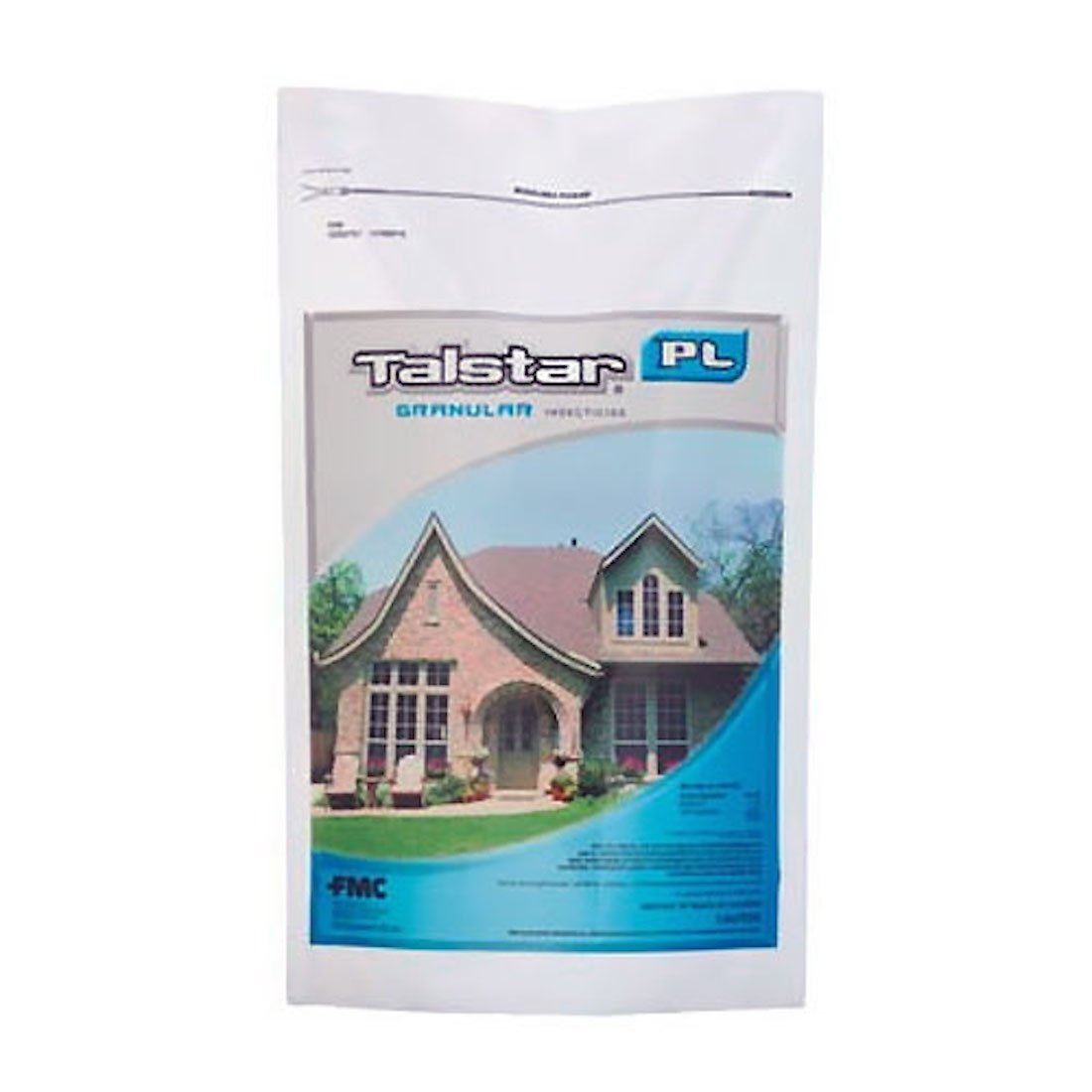
Talstar PL sits at the top because its bifenthrin-loaded sand-core structure delivers the longest residual of any granular insecticide on the market — a guaranteed two- to four-month barrier even through heavy rain and irrigation. The sand core prevents the active ingredient from dissolving too fast, which means one application in early spring can carry the yard into late summer without a second pass. This is the go-to for DIY pest control veterans who treat their own perimeter and want professional-grade staying power.
The broad-spectrum label covers ants, fleas, ticks, chinch bugs, and cutter ants, and the granules penetrate both mulch beds and dense turf without requiring immediate watering. Owners consistently report seeing dead insects within 24 hours of application, with ant colonies collapsing overnight and remaining suppressed for the full season. The lack of watering requirement is a major convenience — just broadcast and let the morning dew activate the particles.
Where Talstar loses a step is its lack of activity against certain slower-moving pests like millipedes and centipedes, which some owners note remain visible even after treatment. The sand core also means the granules are heavy and dense, requiring a rotary spreader set to a higher flow rate than typical lawn fertilizer. Users on small lots may find the 25-pound bag difficult to store and the output too high for a quick spot treatment.
What works
- Longest residual duration of any granule on the market (up to 4 months)
- No watering-in required
- Destroys ant colonies and cutter ants quickly
What doesn’t
- Less effective on millipedes and centipedes
- Heavy sand-core granules need a higher spreader setting
- Large bag size not ideal for small yards
2. Ortho BugClear Lawn Insect Killer 20 lb
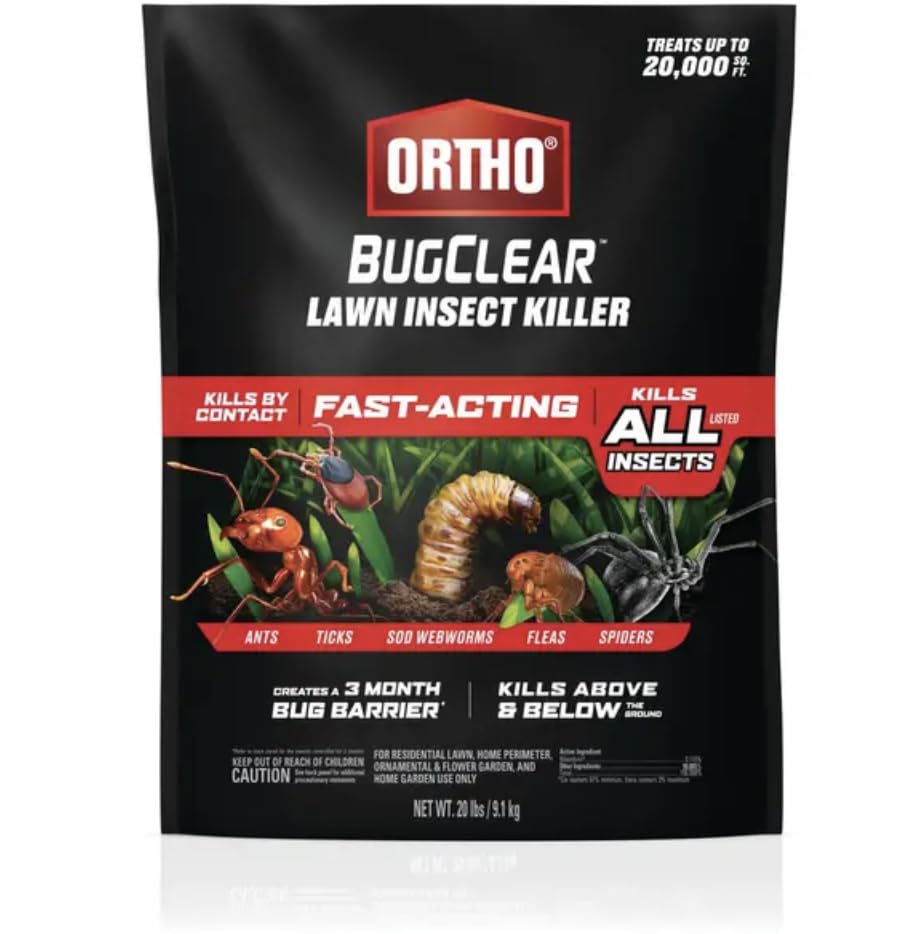
Ortho BugClear 20 lb earns its premium label through sheer coverage — a single bag treats up to 20,000 square feet, which covers a quarter-acre lot with plenty to spare for perimeter barrier applications. The bifenthrin-based formula kills listed pests on contact both above and below the ground line, and it creates a chemical barrier that stops crawling insects from migrating from the lawn to the house foundation. This is the choice for owners with large, open lawns who want a one-bag solution and don’t want to guess at spreader calibration mid-application.
Owner feedback consistently highlights its effectiveness against gnats, mosquitoes, crane flies, and the secondary effect of eliminating mole food sources — several users report mole activity vanishing within weeks because the grub population collapses. The granules flow smoothly through Scotts and SpeedyGreen spreaders without clogging, and the product directions are clear about watering-in requirements for maximum activation. The fast-acting label is no exaggeration; visible mosquito and gnat reduction is reported within 24 hours.
The trade-off is that some users in heavy flea zones report that the product’s efficacy has declined in recent years, possibly due to local flea resistance or formula changes. The three-month residual claim holds best when the product is watered in immediately and not subjected to extreme drought or flooding. Price-conscious buyers may also find that for smaller properties, the 20-pound bag is more than they need in a single season, and the product does not store well if the bag is opened and left in humidity.
What works
- Massive 20,000 sq ft coverage per bag
- Fast knockdown of mosquitoes, gnats, and fleas
- Reduces mole activity by eliminating grubs
What doesn’t
- Some reports of reduced efficacy on fleas in recent years
- Large bag is excessive for small lawns under 5,000 sq ft
- Requires immediate watering-in for best results
3. Ortho Bug B Gon Max Insect Killer 10 lb

Ortho Bug B Gon Max is the industry workhorse for homeowners who want a single product that handles both lawn and garden perimeter pests. The granular formulation kills and prevents over 100 listed insect species including ants, chinch bugs, fleas, ticks, and sod webworms, and the residual lasts a full three months when applied correctly. The 10-pound bag treats up to 10,000 square feet, making it a perfect middle-ground option for the average suburban lot that falls between 5,000 and 10,000 square feet. Users can apply it directly to lawns, flower beds, vegetable gardens, and around the home’s foundation without switching products.
Long-term owners report using this granular for nearly a decade, noting that it suppresses ant colony formation and reduces the number of ticks pulled off pets during the summer. The product works both above and below the surface, meaning it kills surface-feeding insects on contact while the active ingredient, bifenthrin, persists in the soil to stop grubs and underground larvae. The application window is forgiving — users can spread it with a standard rotary spreader and water it in within a few hours without losing efficacy.
The main complaint from owners is that the three-month residual claim sometimes falls short, especially in regions with heavy rainfall that leaches the chemical out of the topsoil. Some users report that ants return after two months, requiring a second application to maintain the barrier. The product also has a noticeable chemical odor during application, which sensitive users should factor in when planning treatment days.
What works
- Covers 10,000 sq ft with a single 10 lb bag
- Effective against over 100 insect species, including ticks
- Works above and below soil surface
What doesn’t
- Heavy rain can shorten the three-month residual
- Chemical odor present during application
- Some users need a second application for ants
4. Cedarcide YardSafe 32 oz
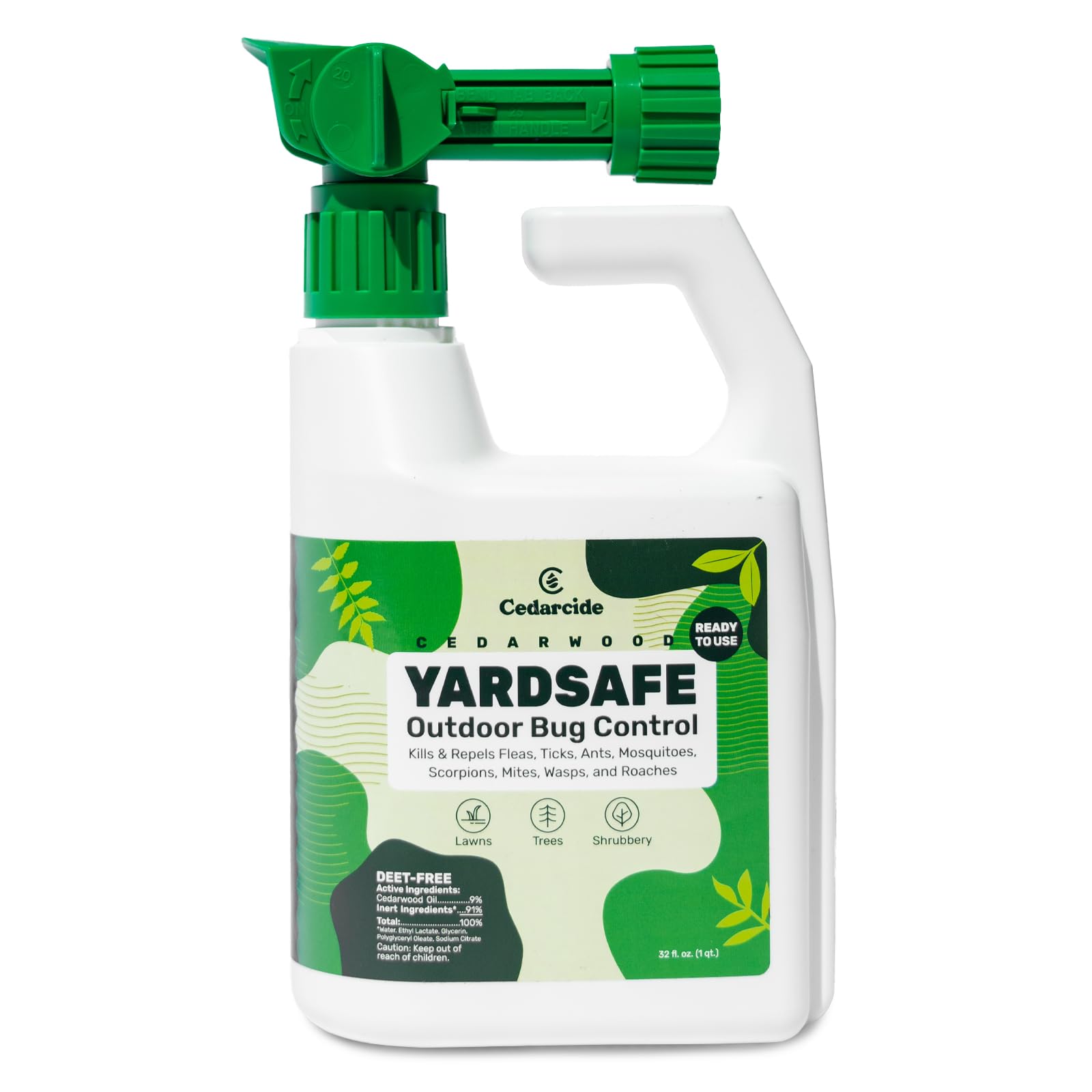
Cedarcide YardSafe breaks the mold as a natural essential oil spray that homeowners can apply without worrying about synthetic residue or re-entry intervals. The active ingredients — cedar oil and lemongrass oil — kill and repel mosquitoes, ticks, fleas, chiggers, and mites on contact while leaving a pleasant botanical scent that dissipates within minutes. The 32-ounce hose-end concentrate treats up to 5,000 square feet, and the label allows pets and children to return immediately after the spray dries, which typically takes two hours or less depending on humidity. This is the strong choice for families with dogs who play in the yard daily or for gardeners who prefer OMRI-compatible pest control around vegetable beds.
Owners consistently praise the product’s safety profile, noting that it works effectively against chiggers and ticks without causing skin irritation or respiratory issues. The cedar scent is described as pleasant and natural, unlike the petroleum-based odor of many synthetic foggers. Users with small to medium yards find that a single bottle covers the entire property and that the formula is easy to apply through a standard hose-end sprayer without clogging or dripping.
The primary limitation is that natural oils degrade faster than synthetic chemicals, requiring more frequent reapplication — every two to three weeks rather than every three months. Several owners report that heavy mosquito infestations require a second pass within a few days, and the product’s performance in wet, swampy conditions is noticeably weaker than bifenthrin-based competitors. There’s also a split in customer experience based on whether the user receives the original white-label concentrate or a blue-label variant with different cedar oil concentration, which has caused confusion about which version actually kills versus just repels.
What works
- Immediate re-entry for kids and pets after drying
- Pleasant natural cedar and lemongrass scent
- Effective against chiggers and ticks
What doesn’t
- Frequent reapplication needed every 2-3 weeks
- Less effective in heavy mosquito infestations
- Variant confusion between different label formulations
5. GranuCide Cedar Granules 8 lb
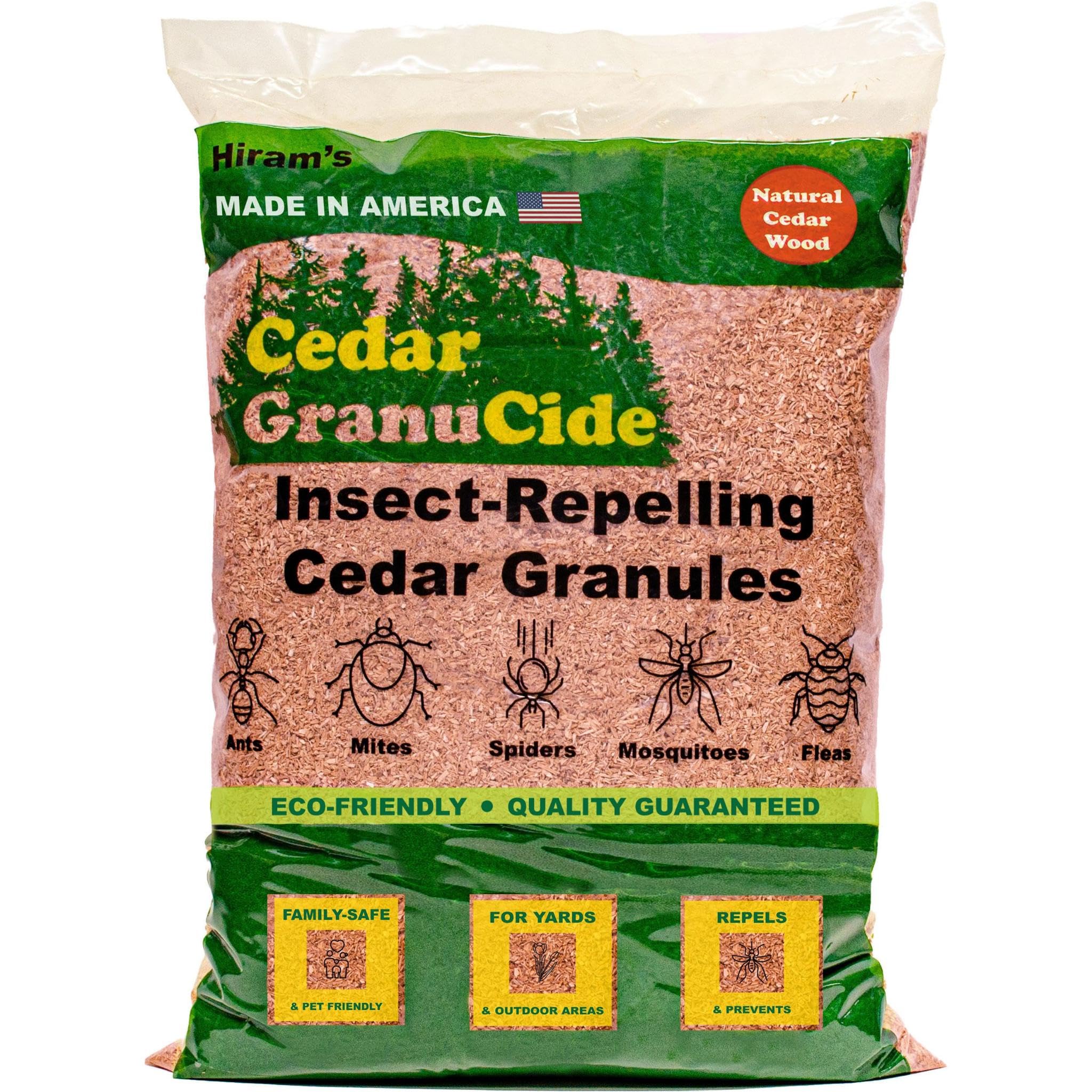
GranuCide Cedar Granules offer a completely different approach to yard pest control — instead of synthetic chemicals, these 100 percent untreated cedar wood chips repel insects through the volatile aromatic compounds naturally found in the cedar heartwood. The granules work as both a pest repellent and a decorative mulch layer, so they serve double duty in flower beds, around tree bases, and along the perimeter of the home. The 8-pound bag covers a moderate area, and the scent is strong enough to deter ants, spiders, mosquitoes, and garden pests without any toxicity to humans or animals.
Owners who switch to cedar granules appreciate the safety profile — children and pets can walk on the treated area immediately without any drying time or watering-in process. The granules spread easily by hand or with a seed spreader, and they integrate seamlessly into garden beds without looking artificial. Users report a noticeable reduction in ant trails and spider webs around the house foundation within the first week, and the cedar scent persists for several weeks, especially in dry conditions. The product also adds aesthetic value as a natural mulch that suppresses weeds and retains soil moisture.
The downside is that cedar granules are a repellent, not a killer. They work best as a preventative barrier rather than a treatment for existing infestations. Heavy infestations of mosquitoes or fleas may require a secondary knockdown product before the barrier becomes effective. Moisture is also a concern — the granules clump together in high humidity or after rain, which reduces their spreadability and may require breaking up the clumps by hand. And at 8 pounds, this bag is better suited for targeted perimeter application than full-lawn coverage.
What works
- 100% natural, pet and child safe immediately after application
- Dual function as pest repellent and decorative mulch
- Pleasant, non-overpowering cedar scent
What doesn’t
- Repellent only, does not kill existing infestations
- Clumps in high humidity and rain
- Small bag limited to perimeter or garden beds
6. Sevin Lawn Insect Granules 20 lb

Sevin Lawn Insect Granules have been a staple in the yard pest category for decades because they deliver reliable broad-spectrum control at a price point that makes sense for covering large properties without breaking the budget. The 20-pound bag treats a significant area and targets over 30 listed pests, including ants, ticks, fleas, worms, and a wide range of lawn and ornamental insects. The active ingredient, zeta-cypermethrin, provides fast knockdown on contact and leaves a residual barrier that lasts for several weeks, making it a workhorse product for seasonal maintenance.
Users consistently report success against ants that are actively damaging trees and shrubs, noting that the granules are easy to spread around tree bases and along the foundation line. The product is also labeled for use on vegetable gardens, which expands its utility beyond just lawn care. The granular form flows well through most broadcast spreaders, and the instructions are straightforward for homeowners who are new to granular insecticide application. Many users also report positive results against fire ants and carpenter ants with a single application.
The most significant drawback is that the residual is shorter than premium competitors — several owners note that efficacy drops off after three to four weeks, especially in warm, wet weather. The product also has a strong chemical odor during and immediately after application, and some users report that it does not eliminate heavy infestations of chinch bugs or grubs in a single pass. Customer reviews include a small but notable number of one-star reports claiming the product simply didn’t work for their specific pest or conditions, suggesting that effectiveness varies by region and pest pressure.
What works
- Affordable price for a 20 lb bag
- Effective against ants damaging trees and foundation
- Labeled for use on vegetable gardens
What doesn’t
- Residual shorter than premium granules (3-4 weeks)
- Strong chemical odor during application
- Inconsistent results against heavy chinch bug and grub pressure
7. Bayer Merit 0.5 Granules 30 lb

Bayer Merit 0.5 Granular Systemic Insecticide is the heavy artillery for yards battling grubs, emerald ash borers, and other root-feeding pests that standard contact insecticides cannot reach. The active ingredient, imidacloprid, is a systemic neonicotinoid that travels through the plant’s vascular system, killing chewing and sucking insects from the inside out. The 30-pound bag is a commercial-scale purchase designed for users who want a full-season solution for turf grubs, tree borers, and mole-inducing soil insects. It’s the go-to choice for property owners who have lost trees or large lawn patches to underground feeding damage.
Owners who apply Merit consistently report that it eliminates grub populations within two to three weeks, which in turn causes moles to vacate the property because their food source disappears. The granules are easy to apply by hand or with a spreader, and the systemic action means that even new growth on treated trees and shrubs carries the active ingredient, protecting them from borers and leaf beetles. The 30-pound bag covers a substantial area, and the application rate is forgiving enough that minor calibration errors don’t ruin the effectiveness.
There are two major considerations. First, Merit is expensive relative to other options on this list, and the high price tag is a barrier for single-season use on small lots. Second, as a neonicotinoid, it is harmful to bees and other pollinators if applied to flowering plants or lawns with active clover blooms — timing the application to avoid flowering periods is critical. The product also requires proper watering-in to move the imidacloprid into the root zone, and dry conditions can leave the granules sitting on the surface where they degrade before reaching the target pests.
What works
- Systemic action protects trees and turf from internal pests
- Eliminates grubs and drives away moles
- Single application lasts the entire season
What doesn’t
- High price tag for a single bag
- Harmful to pollinators if applied during bloom
- Requires watering-in and dry conditions reduce efficacy
Hardware & Specs Guide
Residual Duration
The length of time a product remains active after application determines your reapplication schedule. Contact sprays like Cedarcide degrade within 2-3 weeks. Standard synthetic granules like Sevin hold a barrier for 3-4 weeks. Premium and professional products like Ortho Bug B Gon (3 months) and Talstar PL (2-4 months) allow a single spring treatment to carry through the entire warm season. Shorter residual products work best for spot treatments or properties with very low pest pressure, while longer residual is essential for large lots that would be impractical to treat monthly.
Coverage Area Per Bag
Granule coverage is typically listed in square feet per pound. A 10 lb bag treating 10,000 sq ft (e.g., Ortho Bug B Gon) delivers 1,000 sq ft per pound. Larger bags like the 20 lb BugClear or 30 lb Merit offer lower cost per square foot but require proper storage. Spray concentrates like Cedarcide list coverage per bottle (5,000 sq ft for 32 oz). Match the coverage to your lot’s square footage — buying a 20 lb bag for a 2,000 sq ft yard is wasteful, while buying a 32 oz spray for a half-acre lot means buying multiple bottles per application.
FAQ
How long should I wait before letting pets onto the treated yard?
What kills grubs better: a contact granule or a systemic granule?
Can I use yard bug killer granules around my vegetable garden?
Why do I still see bugs after applying granules?
Final Thoughts: The Verdict
For most homeowners, the bug killer for yard winner is the Talstar PL Granules because the four-month residual and sand-core delivery system eliminate reapplication guesswork for the entire season. If you want immediate, pet-safe coverage right after drying, grab the Cedarcide YardSafe for a natural spray that works on contact without synthetic chemicals. And for grub and tree pest elimination that stops moles and borer damage at the root level, nothing beats the Bayer Merit 0.5 Granules for professional-grade systemic control.