
For any serious gardener or property manager, a manual pump sprayer is a bottleneck. Each trigger pull sacrifices pressure, forcing a constant cycle of pumping that fatigues your hand and slows your progress. The switch to a battery-powered, electric power sprayer eliminates this friction entirely — delivering consistent, adjustable pressure at the push of a button and cutting treatment time by half or more.
I’m Rikta — the co-founder and writer behind Lawn Gear Lab. I’ve spent countless hours studying motor output curves, tank material durability, battery chemistry, and owner-reported failure points to understand exactly which power sprayers deliver on their promise and which leave users stranded mid-job.
This guide breaks down the best models on the market — from compact handheld units to high-capacity backpack rigs — to help you find the ideal best power sprayer for your property size, chemical application, and budget.
How To Choose The Best Power Sprayer
Selecting a power sprayer is less about brand hype and more about matching the motor, battery, tank, and wand to the scale of your work. Understanding these four pillars ensures you don’t end up with an underpowered unit or an oversized tank you can’t comfortably carry.
Pressure and Flow Rate: Consistency Over Peak PSI
The max PSI number on the box matters less than whether the pump maintains steady pressure throughout the entire tank. Cheap sprayers often lose pressure as the battery drains. Look for reviews that mention “consistent output” or “no drop-off” — that’s the real indicator of a quality pump. Flow rate (GPM or L/min) is equally critical: a high flow rate covers ground fast but may waste chemical on targeted spot treatments.
Battery Capacity and Chemistry
Battery capacity determines how many gallons you can spray before recharging. A 2000mAh battery may last 2-3 hours in a small handheld unit, while a 4000mAh pack in a 1-gallon sprayer can push through 4-5 hours. For backpack units, lead-acid batteries (like VEVOR’s 7.2Ah) offer great runtime but are heavy; lithium packs are lighter and maintain voltage better through the discharge cycle. Always check if the battery is removable/replaceable — sealed units turn the whole sprayer into e-waste when the battery dies.
Tank Capacity and Material: HDPE vs Polypropylene
HDPE (high-density polyethylene) resists a wider range of chemicals including harsh herbicides and strong acids. Polypropylene (PP) is lighter but less chemically resistant. Tank size relates directly to ergonomics: a 4-gallon backpack full of liquid weighs over 33 pounds, so padded straps and a wide mouth for easy refills become mandatory. For spot treatments under half an acre, a 1- to 2-gallon handheld unit is far more agile.
Wand, Nozzles, and Seal Quality
A telescoping stainless steel wand provides adjustable reach and resists corrosion from chemicals, while brass fittings at the nozzle hold up better than plastic over repeated tightening. The number of nozzles (fan, cone, stream, dual-head) determines spray pattern versatility. Leak-prone fittings — especially around the wand connection and trigger assembly — are the top failure point reported in owner reviews. Units that include replacement gaskets or use brass connectors typically score higher for long-term reliability.
Quick Comparison
On smaller screens, swipe sideways to see the full table.
| Model | Category | Best For | Key Spec | Amazon |
|---|---|---|---|---|
| PetraTools HD1000-S | Premium Handheld | Heavy-Duty Durability | 80 PSI / 4-ft brass hose | Amazon |
| VEVOR 4 Gal with Cart | Premium Backpack/Cart | Large Areas, Low Fatigue | 94 PSI / 13-ft hose / 7.2Ah | Amazon |
| SideKing 4 Gal Backpack | Mid-Range Backpack | Makita Battery Compatibility | 100 PSI / 2.6Ah Li-ion | Amazon |
| NPGLOBAL Backpack 4.2 Gal | Mid-Range Backpack | Value & Lifetime Warranty | 100 PSI / 8 nozzles | Amazon |
| PetraTools EZ1 1 Gal | Entry-Level Handheld | Quick Spot Spraying | 3-hour runtime / 3 nozzles | Amazon |
| HIFAY ES4 1 Gal | Value Handheld | Lightweight Portability | 4000mAh / 28-in wand | Amazon |
| SideKing 2 Gal Handheld | Budget Handheld | Price-Sensitive Buyers | 60 PSI / 3 pressure settings | Amazon |
In‑Depth Reviews
1. PetraTools HD1000-S 1 Gallon
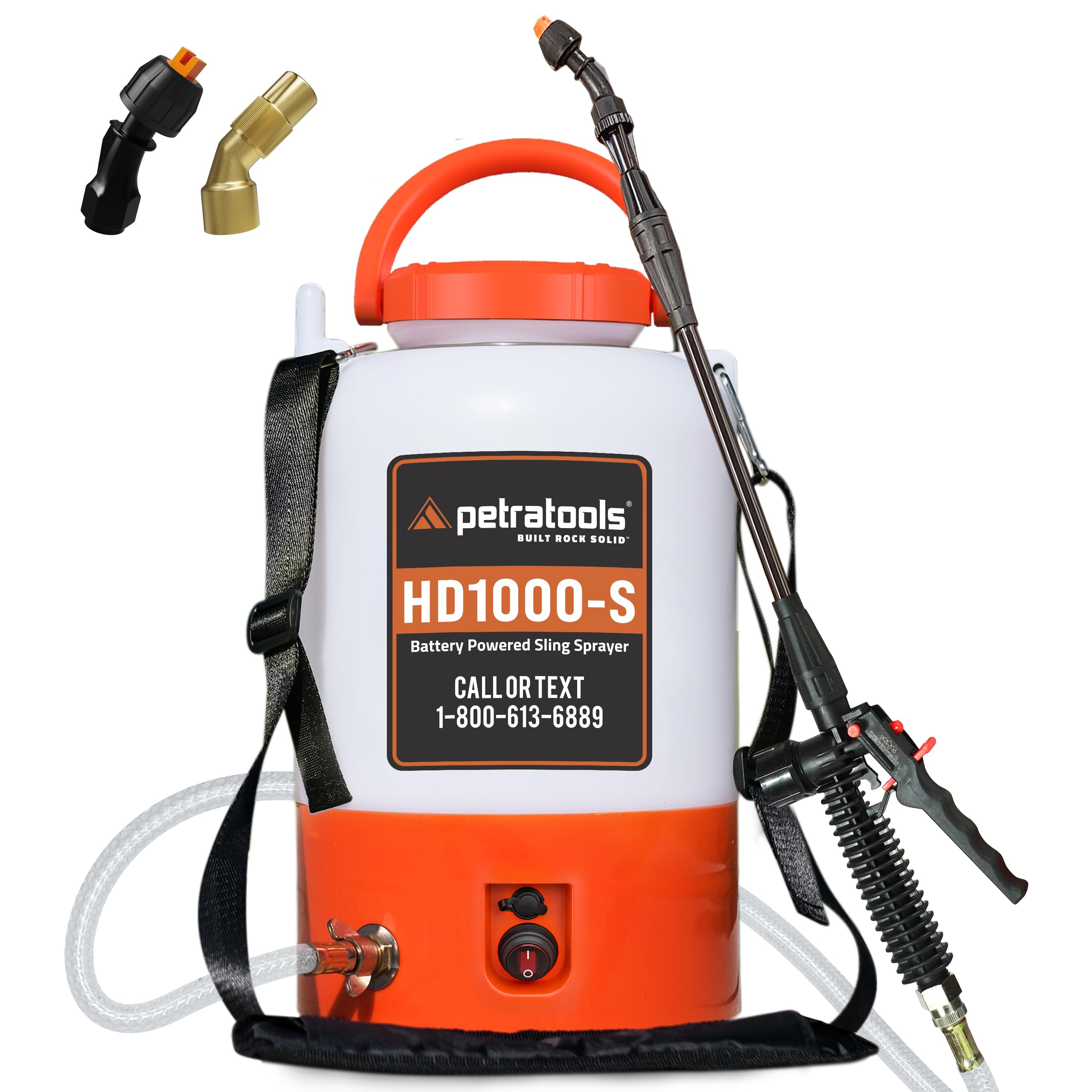
The HD1000-S is built around a philosophy of over-engineering at a reasonable cost. Where most handheld sprayers use plastic hose fittings that crack over time, PetraTools specifies brass connectors and a brass adjustable nozzle — a detail that directly translates to leak-free operation and longevity. The 4-foot hose is a significant upgrade over the 18-inch whips found on many competitors, giving you real reach without needing to carry the tank in your hand while spraying.
The 12V rechargeable battery delivers roughly 2 hours of runtime, which translates to multiple tankfuls of herbicide or fertilizer. Owner feedback consistently highlights the constant pressure output — the pump doesn’t fade as the battery drains, a hallmark of a quality motor controller. The wide-mouth opening accepts a standard garden hose fill, and the HDPE tank stands up to aggressive chemicals like glyphosate and triclopyr without degrading.
The trade-off is a premium price that places it above most handheld competitors. You also get only two nozzles (brass adjustable and fan tip), which is adequate but less versatile than kits with five or more. Still, for anyone who has thrown away a cheap sprayer because the pump seized or the fittings leaked, the HD1000-S represents a genuine long-term investment.
What works
- Brass fittings eliminate the common leak failure point
- Constant 80 PSI pressure throughout the entire tank
- 4-foot hose provides excellent reach without moving the tank
- Exceptional manufacturer customer support (fast replacement parts)
What doesn’t
- Premium price compared to entry-level handheld sprayers
- Only two nozzles included — no cone or dual-head options
- Battery is not swappable; the whole unit must be charged
2. VEVOR 4 Gallon Backpack Sprayer with Wheeled Cart

The VEVOR combo is the most flexible power sprayer in this lineup. The 4-gallon tank works as a backpack with padded straps, but also mounts on a wheeled cart — a killer feature for people with back issues or large properties where carrying 33+ pounds of liquid is not feasible. The 13-foot hose is the longest in this guide, allowing you to keep the cart stationary and walk a wide radius, covering massive areas without repositioning.
The 7.2Ah lead-acid battery provides 3-4 hours of continuous runtime, and the adjustable pressure knob lets you dial from a fine mist (for delicate plants) up to 94 PSI (for stripping dirt from hard surfaces). The kit includes six nozzles and two wands — a metal wand for general use and a plastic wand for corrosive bleach solutions — giving you exceptional application versatility. The translucent tank with gallon markers removes the guesswork from measuring concentrates.
The major downside is weight: at 20.7 pounds empty, this is a heavy unit even before adding water or chemicals. Lead-acid batteries are also less durable over charge cycles than lithium-ion packs — expect replacement after a few seasons of heavy use. Several owners report that careful assembly with Teflon tape on all threaded connections is required to prevent leaks. The unit demands assembly diligence, but delivers industrial-grade coverage when set up correctly.
What works
- 13-foot hose is best-in-class for coverage without moving the unit
- Wheeled cart converts between backpack and rolling modes
- Adjustable 0-94 PSI pressure knob for precision spraying
- Plastic wand included for corrosive bleach and acid applications
What doesn’t
- Lead-acid battery is heavy and has shorter overall lifespan than lithium
- All threaded joints require Teflon tape to prevent leaks
- Poor assembly manual can lead to fitment issues if rushed
3. SideKing 4 Gallon Backpack (Makita Compatible)

This backpack sprayer stands out for its Makita 18V battery compatibility — a massive advantage for users who already own Makita power tools. Instead of maintaining a separate battery ecosystem, you can swap from your drill to the sprayer instantly. The included 2.6Ah lithium battery and charger provide around 2 hours of runtime, and the digital voltage display lets you monitor remaining charge without guesswork.
The pump pushes up to 100 PSI with an adjustable pressure knob, and the stainless steel telescopic wand extends for overhead spraying without a ladder. The 4.2-gallon semi-transparent tank has gallon markings for precise mixing, and the double-layer padded shoulder straps are genuinely comfortable for extended wear. The kit includes five nozzles (fan, cone, windproof, dual-head, stream) covering almost any spray pattern you would need.
Quality control is somewhat inconsistent. A minority of buyers report leaks at the wand connection or difficulty removing the battery from its housing. The hose is 64 inches, which is shorter than the VEVOR and NPGLOBAL options — you will have the tank on your back at all times. For Makita ecosystem users, this is the most seamless integration available; for everyone else, the NPGLOBAL offers comparable specs with a better warranty history.
What works
- Compatible with existing Makita 18V batteries — no separate charger ecosystem
- 100 PSI maximum pressure with adjustable knob for fine control
- Digital voltage display for accurate battery monitoring
- Five-nozzle kit covers every common spray pattern
What doesn’t
- Some units arrive with leaks at hose connections
- Battery compartment can be very tight — difficult to remove
- Hose length is shorter than backpack competitors
4. NPGLOBAL 4.2 Gallon Backpack
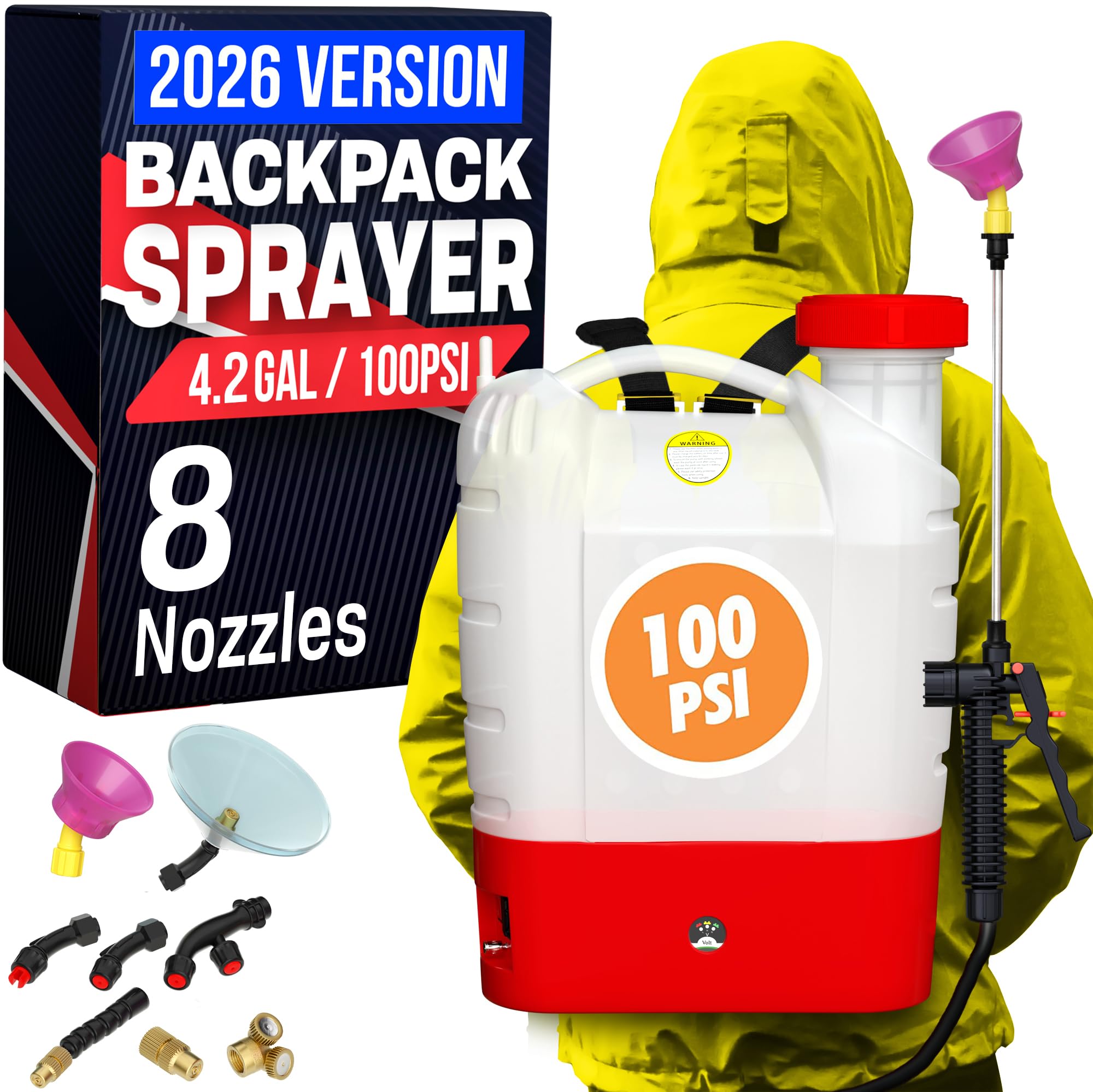
The NPGLOBAL backpack is the value king of the mid-range segment, pairing a 100 PSI maximum pressure with an extremely generous accessory kit — eight nozzles, a measuring bottle, a mouth lid strainer, and a stainless steel telescopic lance. The pressure is adjustable from 21.8 PSI up to the full 100 PSI, and the flow rate of 4.0 liters per minute means you can cover a 1-acre lawn in well under 30 minutes.
The translucent tank makes liquid level visible at a glance, and the padded shoulder straps are comfortable for extended carry. A standout feature is the lifetime warranty — rare at this price point — and owner reviews consistently praise the company’s willingness to ship replacement parts or entire units quickly when something fails. That warranty support, more than any specific hardware detail, makes this a low-risk purchase.
The main compromise is build quality relative to the PetraTools HD1000-S. The hose is only 4.26 feet, shorter than ideal, and the plastic wand components feel less robust than full-metal alternatives. The pressure cutoff at 100 PSI is effective but the pump can audibly struggle at the top end. For the price, the feature-to-cost ratio is unrivaled, but expect to rely on that warranty support eventually.
What works
- Eight nozzles provide unmatched spray pattern flexibility
- Lifetime warranty with responsive customer service
- 100 PSI maximum pressure with good flow rate (4.0 L/min)
- Stainless steel telescopic lance included
What doesn’t
- Short hose (4.26 feet) limits reach without carrying the backpack
- Some plastic components feel less durable than metal alternatives
- Pump audibly labors at higher pressure settings
5. PetraTools EZ1 1 Gallon
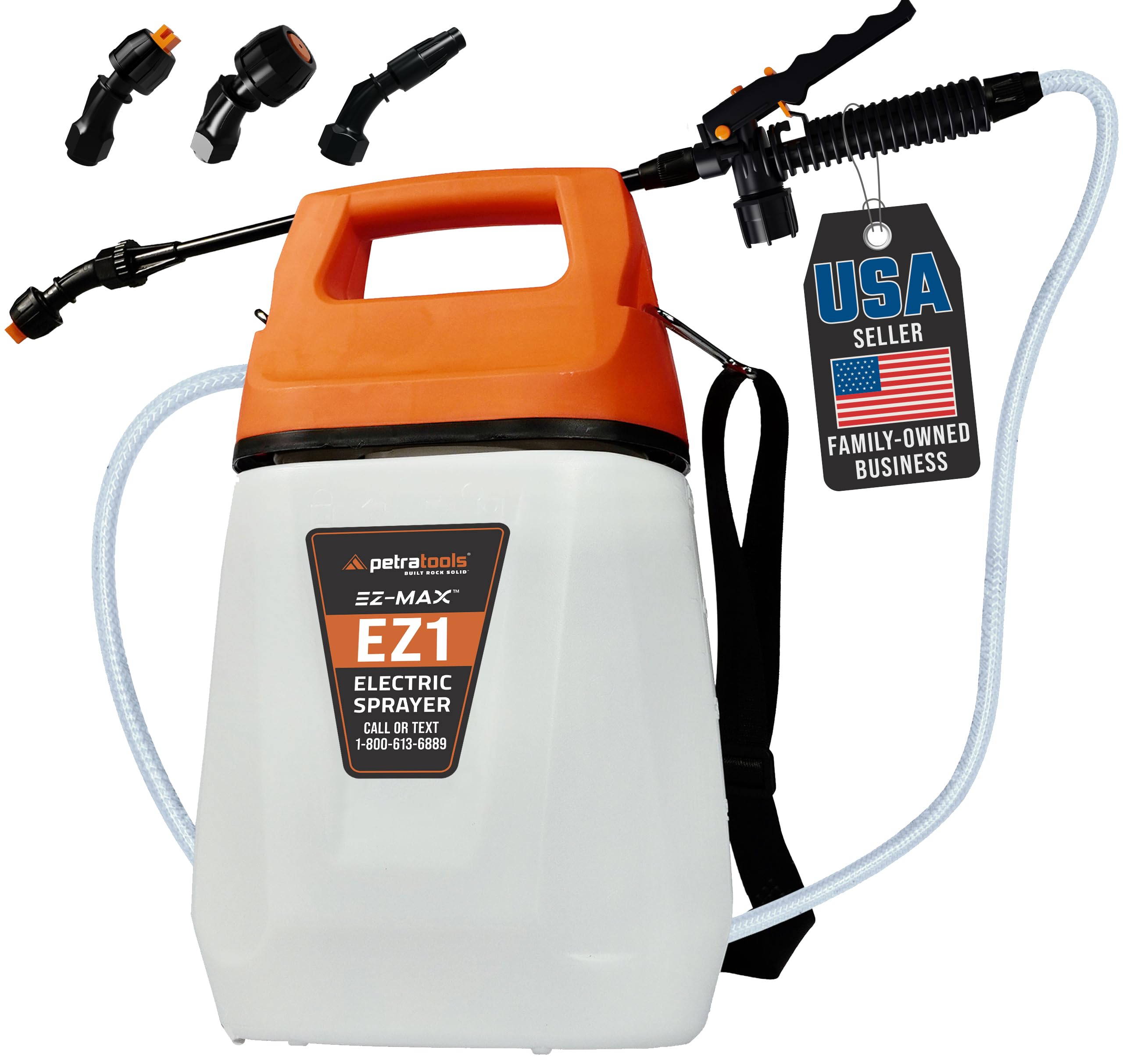
The EZ1 is PetraTools’ entry-level offering that brings the brand’s signature customer support and dependable pump design to a smaller, lighter form factor. The 1-gallon tank is ideal for quick spot treatments — spot-spraying weeds in a driveway crack, treating a patch of poison ivy, or watering container plants — without hauling a larger backpack unit. The high-capacity rechargeable battery provides up to 3 hours of runtime, and a full recharge takes only 1-2 hours.
The kit includes three nozzles: an adjustable jet-to-mist nozzle for precision, a round mist nozzle for delicate foliage, and a fan flat nozzle for broad coverage. The ergonomic handle and padded shoulder strap make one-handed operation comfortable, and the easy-fill lid doubles as a carrying handle. Owners consistently report excellent assembly instructions and immediate responsiveness from the USA-based support team.
The main limitation is pressure: the EZ1 produces less force than a traditional pump-up sprayer, so it is not ideal for penetrating dense weed growth or cleaning hard surfaces. The wand is non-telescoping, which limits reach. For gentle, consistent spraying of pre-mixed herbicides or foliar feeding, the EZ1 excels. For high-pressure stripping of dirt or killing mature brush, you will want a higher PSI unit.
What works
- Excellent USA-based customer support with fast parts replacement
- 3-hour runtime from a single charge is generous for the size
- Lightweight and ergonomic; reduces arm fatigue significantly
- Three nozzles cover most common residential spray patterns
What doesn’t
- Spray pressure is lower than manual pump sprayers
- Non-telescoping wand limits reach for tall plants
- 1-gallon capacity requires frequent refills for large areas
6. HIFAY ES4 1 Gallon

The HIFAY ES4 packs a 4000mAh lithium battery — the largest capacity in the handheld category — into a compact 1-gallon form factor. That translates to approximately 4-5 hours of run time or roughly 30 gallons of liquid sprayed per charge. For a small handheld unit, this is exceptional endurance, making it a strong choice for gardeners with multiple zones who do not want to stop mid-project.
The telescoping wand extends to 28 inches, giving you height without requiring a ladder, and the rotatable brass nozzle adjusts from a fine mist to a straight stream. The PP construction is lightweight (only 2 pounds empty) and the transparent side strip lets you check liquid level quickly. The pump runs only when you press the trigger, which conserves battery and reduces wear on the motor.
Durability concerns are the main caveat. A non-trivial number of buyers report pump failures after 2-6 months, and the charger is not included (USB-C cable only, you supply the 5V/1A block). The company’s customer support is responsive but some owners still ended up with dead units. For the price, the feature set is impressive, but the long-term reliability does not match the PetraTools line.
What works
- 4000mAh battery provides the most runtime in the handheld category
- Telescoping 28-inch wand reaches high or deep targets
- Rotatable brass nozzle delivers fine mist through straight stream
- Lightweight 2-pound design reduces fatigue
What doesn’t
- Charger block not included — must supply your own 5V/1A adapter
- Pump durability inconsistent; some units fail within months
- PP tank is less chemically resistant than HDPE
7. SideKing 2 Gallon Handheld
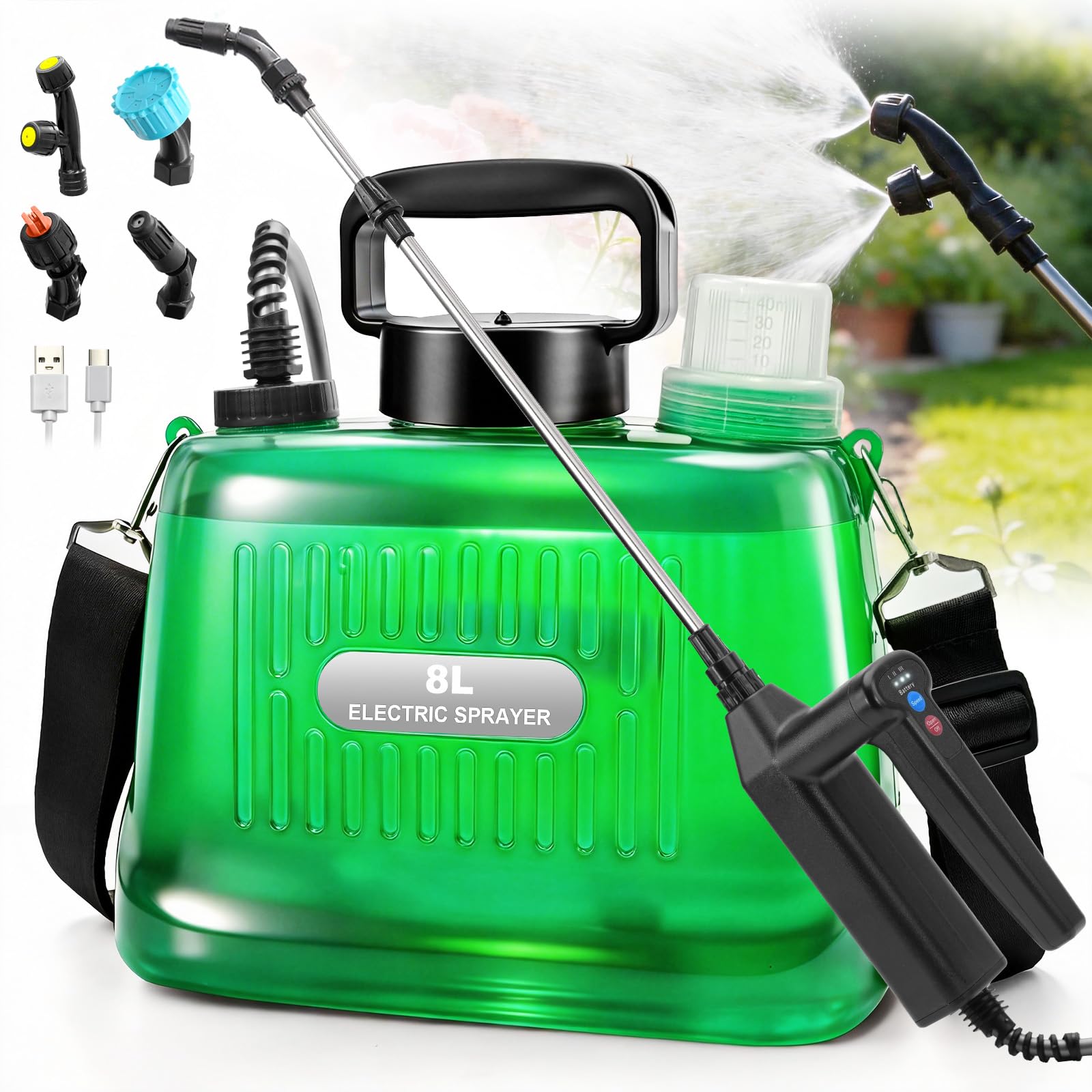
At the entry-level end of the power sprayer spectrum, the SideKing 2-gallon offers the simplest path to eliminating manual pumping. The self-priming motor delivers three selectable pressure levels — low (gentle misting), medium (fertilizing), and high (weed kill) — and the 2000mAh lithium battery provides up to 3 hours of runtime. The tank is made from chemical-resistant HDPE and includes a wide mouth for easy filling without a funnel.
The kit is notably generous for the price: a telescoping stainless steel wand (extends to 23.6 inches), four nozzles (fan, cone, windproof, and dual-head), a shoulder strap, and a USB charging cable. The charging electronics are integrated into the spray gun handle, which means you can detach the battery unit and use it on other containers — a clever workaround if the original tank ever cracks. Owners consistently praise the ease of use and the elimination of pumping fatigue.
The obvious trade-off is build quality relative to the premium units. The plastic trigger mechanism and hose fittings are less robust than the brass components on the PetraTools HD1000-S, and the maximum 60 PSI pressure is noticeably lower than the 80-100 PSI units in this guide. For occasional use on smaller lots (under half an acre), the value proposition is undeniable. For daily or commercial use, the plastic fittings will likely become a wear point.
What works
- Exceptional price-to-feature ratio for budget-conscious buyers
- Three adjustable pressure settings cover misting through spraying
- HDPE tank resists chemical degradation well at this price point
- Telescoping stainless steel wand adds reach without extra cost
What doesn’t
- Maximum 60 PSI limits effectiveness on tough weeds and cleaning
- Plastic fittings and trigger feel less durable than brass alternatives
- Battery indicator blinking pattern during charging is not self-explanatory
Hardware & Specs Guide
Pressure (PSI) and Flow Rate
Pressure determines how deeply the spray penetrates foliage and how effectively it strips dirt or kills established weeds. A 60 PSI pump is adequate for pre-emergent herbicides and foliar feeding, while 80-100 PSI is necessary for post-emergent weed control on mature plants and cleaning hard surfaces. Flow rate (measured in L/min or GPM) affects coverage speed: higher flow covers more area per minute but uses more chemical. For targeted spot spraying, a lower flow rate with adjustable pressure is more efficient than high flow at full blast.
Battery Chemistry and Capacity
Lithium-ion (Li-ion) batteries dominate the handheld segment because they are lightweight, maintain voltage through the discharge cycle, and handle hundreds of charge cycles without significant degradation. Lead-acid batteries, found in some backpack units like the VEVOR, offer high amp-hour ratings at lower cost but weigh significantly more and degrade faster when deep-cycled. Capacity is measured in mAh (milliamp-hours) or Ah (amp-hours): a 2000mAh pack typically runs a handheld sprayer for 2-3 hours, while a 4000mAh pack can push to 5 hours. Always verify whether the battery is user-replaceable — sealed batteries turn the entire sprayer into e-waste when the cells eventually fail.
Wand Material and Construction
Wands are commonly made from plastic, stainless steel, or brass. Plastic wands are lightweight and corrosion-proof but brittle under torque. Stainless steel wands resist corrosion from most chemicals and withstand accidental drops. Brass wands and tips are the gold standard — they seal better, resist galling, and maintain spray pattern integrity over years of use. Telescoping wands (typically 23-39 inches extended) are valuable for reaching high branches or deep into shrubs without a ladder. The connection between hose and wand is the most common leak point; brass-threaded connectors with replaceable O-rings are a strong indicator of durability.
Chemical Compatibility: HDPE vs. PP
High-density polyethylene (HDPE) is the preferred tank material for serious herbicide and pesticide use. It resists a broad range of solvents, acids, and alkalis, including glyphosate, 2,4-D, triclopyr, and strong surfactants. Polypropylene (PP) is lighter and cheaper but has lower chemical resistance — repeated exposure to concentrated acids or aromatic solvents can cause cracking or swelling. The tank’s lid seal and the pump’s internal seals are equally important: Viton or EPDM gaskets resist chemical degradation much better than standard rubber. A wide-mouth opening (2-4 inches in diameter) simplifies filling and cleaning, which extends the life of the sprayer by preventing sediment buildup in the tank.
FAQ
How do I clean my power sprayer after using chemicals?
Can I use bleach or acid in a battery-powered sprayer?
Why does my power sprayer lose pressure halfway through the tank?
What is the difference between a diaphragm pump and a piston pump in a power sprayer?
Final Thoughts: The Verdict
For most gardeners, the best power sprayer winner is the PetraTools HD1000-S because it combines brass fittings, constant 80 PSI pressure, and proven long-term reliability in a compact handheld package. If you need to cover large acreage with minimal refilling, grab the VEVOR 4 Gallon with Wheeled Cart for its 13-foot hose and rolling/backpack flexibility. And for the best value — all the pressure you need with a lifetime warranty — nothing beats the NPGLOBAL 4.2 Gallon Backpack.