
Japanese beetles skeletonizing your blooms overnight. Aphids curling your new growth. Black spot spreading through the leaves. Rose pests are relentless, and choosing the wrong spray means wasted time and continued damage. The right insecticide for roses needs to tackle the specific insects that target roses—aphids, thrips, sawfly larvae, spider mites, and Japanese beetles—without burning the foliage or harming the delicate blossoms.
I’m Rikta — the co-founder and writer behind Lawn Gear Lab. I’ve spent countless hours cross-referencing active ingredients, studying application methods, and analyzing aggregated owner reports from rose growers to identify which formulas actually deliver on their label claims for Rosa spp.
Whether you want a contact killer for immediate beetle control or a systemic drench that protects from the roots up, the right solution saves your prize blooms. This guide breaks down the best options to help you find the ideal insecticide for roses tailored to your specific pest problem and growing style.
How To Choose The Best Insecticide For Roses
Not all rose insecticides are equal. A spray that annihilates aphids might be useless against powdery mildew, and a powerful systemic drench that protects for six weeks can kill bees if applied during flowering. Understanding the categories and active ingredients ensures you select the right weapon for your rose garden.
Contact vs. Systemic: Speed vs. Duration
Contact insecticides kill insects on direct contact but offer no residual protection for new growth. They are ideal for an active infestation of Japanese beetles or caterpillars that you can see. Systemic drenches, on the other hand, are absorbed by the roots and move through the plant’s vascular system. They protect every leaf and stem from the inside out for weeks, making them excellent for sap-sucking pests like aphids and thrips that hide in buds. Choose contact for instant knockdown; choose systemic for season-long prevention.
Active Ingredients and Their Target Pests
Spinosad, derived from a naturally occurring soil bacterium, is highly effective against caterpillars, thrips, and leafminers and is OMRI-listed for organic use. Neem oil extract works as a fungicide, insecticide, and miticide, controlling black spot, rust, aphids, and spider mites. Systemic formulas containing imidacloprid or acephate deliver powerful, long-lasting protection against a broad spectrum of pests but require careful handling around pollinators. Match the active ingredient to your primary pest—don’t use a caterpillar killer on spider mites.
Formulation: Concentrate vs. Ready-to-Use
Concentrates require mixing with water but offer far better value per application and allow you to adjust the dose. A 32-ounce concentrate can make 6 to 16 gallons of finished spray, depending on the dilution rate. Ready-to-use (RTU) spray bottles are convenient for spot-treating a few bushes without measuring, but the cost per ounce is significantly higher, and you cannot increase the concentration for heavy infestations. For a rose garden with more than five bushes, a concentrate is almost always the smarter investment.
Quick Comparison
On smaller screens, swipe sideways to see the full table.
| Model | Category | Best For | Key Spec | Amazon |
|---|---|---|---|---|
| Bonide Rose Rx Systemic Drench | Systemic Drench | All-season prevention & disease control | 6-week systemic protection | Amazon |
| Fertilome 2-N-1 Systemic | Systemic Combo | Insect & fungus control in one pour | 6-week dual protection | Amazon |
| Monterey Spinosad Concentrate | Organic Contact | Caterpillars, thrips & leafminers | OMRI-listed Spinosad 0.5% | Amazon |
| Bonide Captain Jack’s Orchard Spray | Multi-Purpose | Bugs, fungus & mites on edibles | Makes 6.4 gallons per pint | Amazon |
| Garden Safe Fungicide3 | Neem Oil Spray | Black spot, mildew & spider mites | 1-gallon RTU with Neem Oil | Amazon |
| Ortho Rose & Flower Insect Killer | Contact Systemic | Quick knockdown of Japanese beetles | 24-oz RTU dual action | Amazon |
| Fertilome Spinosad Soap RTU | Organic RTU | Immediate contact kill for soft-bodied pests | 32-oz RTU with Spinosad & soap | Amazon |
In‑Depth Reviews
1. Bonide Rose Rx Systemic Drench, 32 oz Concentrate

This is the closest thing to a set-and-forget solution for rose pests. Bonide Rose Rx is a systemic drench concentrate that you mix with water and pour around the base of the plant. Once absorbed through the roots, it travels through the vascular system to protect every leaf, stem, and bloom from Japanese beetles, borers, aphids, black spot, powdery mildew, and rust for a full six weeks.
Rose growers with 20 or more bushes consistently report seeing reduced sawfly damage and healthier foliage within a month of the first application. The dual-action formula handles both insects and fungal diseases simultaneously, which saves you from buying separate products. Users note that combining it with a separate fungicide and fertilizer yields the best-looking roses they have ever grown.
The main limitation is pollinator safety. Because the active ingredient moves systemically, it can kill bees that forage on treated blooms. You must avoid applying this when bees are active. Additionally, the concentrate requires careful measuring—user reports emphasize that “less is more” when mixing, and over-dosing can stress plants.
What works
- Long-lasting systemic protection against both insects and diseases
- No spraying required—simple root drenching saves time
- Highly effective against severe black spot and aphids
What doesn’t
- Hazardous to bees; must avoid application during bloom
- Not suitable for edible crops near roses
- Requires measuring precisely to avoid over-application
2. Fertilome 2-N-1 Systemic, 32 oz Concentrate

Fertilome 2-N-1 Systemic delivers the same six-week residual protection as Bonide Rose Rx but combines both a fungicide and an insecticide into a single concentrate. This is a major advantage for rose growers in humid climates like Florida, where black spot, rust, and powdery mildew are chronic problems alongside aphids, thrips, and borers.
Users report that a single jug covers roughly 16 rose bushes, making it economical for medium to large gardens. The root-drench application method eliminates drift and avoids washing off in rain, which is a common frustration with foliar sprays. The systemic protection ensures that new growth emerging weeks after application remains defended against sap-sucking pests.
The formula is chemically robust, not organic, and cannot be used on food gardens. Some users prefer to supplement with compost to offset the harshness of the chemicals. Also, as a systemic, it carries the same bee-toxicity risk as any root-absorbed pesticide—avoid application during flowering periods when bees are foraging heavily.
What works
- One product controls both insects and fungal diseases
- Root drench application is rainfast and drift-free
- Excellent value-per-bush for large plantings
What doesn’t
- Not organic and not safe for vegetable gardens
- Systemic formula kills bees if applied during bloom
- Chemical strength may require supplemental compost
3. Monterey Spinosad Insecticide Concentrate, 8 oz
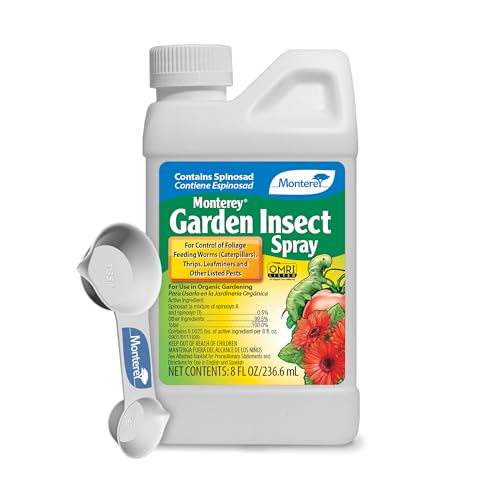
Monterey Spinosad Concentrate is the premier organic choice for rose growers battling caterpillars, thrips, leafminers, and sawfly larvae. Spinosad is a naturally occurring bacteria byproduct that causes rapid paralysis and death in targeted insects upon ingestion or contact. It is OMRI-listed and certified for use in organic gardening, which means it breaks down quickly in sunlight and has minimal impact on beneficial insects once dry.
Rose growers specifically praise this product for eliminating sawfly caterpillars that skeletonize leaves overnight. Users also report success against harvester ants and leafminers that resist other treatments. The concentrate dilutes significantly—the 8-ounce bottle goes a long way—and the spray has virtually no odor, making it pleasant to apply on warm mornings.
Because Spinosad degrades rapidly, you need to reapply about once a week during active infestations. It also does not control fungal diseases or mites, so you may need a second product for black spot or spider mites. Some users recommend rotating with a horticultural oil to prevent insect resistance from developing over multiple seasons.
What works
- Fast-acting organic control for caterpillars and thrips
- Odorless and pleasant to apply
- OMRI listed for certified organic gardens
What doesn’t
- Short residual; requires weekly reapplication
- Does not control fungal diseases or mites
- Resistance can develop; rotation with other products is advised
4. Bonide Captain Jack’s Citrus, Fruit & Nut Orchard Spray, 32 oz

Captain Jack’s Orchard Spray is a rare multi-purpose formula that functions as an insecticide, fungicide, and miticide in a single concentrate. It controls beetles, caterpillars, mealybugs, spider mites, thrips, and scale, plus fungal diseases like powdery mildew, rust, blight, and brown rot. This broad-spectrum approach makes it a powerful all-in-one for rose gardens that also contain fruit trees or vegetables.
Users report that Japanese beetles die within about an hour of contact, and the formula reduces overall pest activity in days. The concentrate is economical—one pint makes up to 6.4 gallons of finished spray—so it works out to pennies per application. It can be used up to the day before harvest on edible plants, which is a major convenience for gardeners who grow roses alongside tomatoes or citrus.
The spray leaves a slight powdery residue on leaves, which some growers find unsightly. It is not a systemic, so thorough coverage of all leaf surfaces, including the undersides, is critical for success. Because it is non-persistent, you must reapply after heavy rain to maintain protection.
What works
- Triple-action formula covers insects, fungi, and mites
- Safe for edible plants up to day of harvest
- Very cost-effective per gallon of mixed spray
What doesn’t
- Non-systemic; requires thorough leaf coverage
- Leaves a visible powdery residue on foliage
- Needs reapplication after heavy rainfall
5. Garden Safe Fungicide3, 1 Gallon RTU
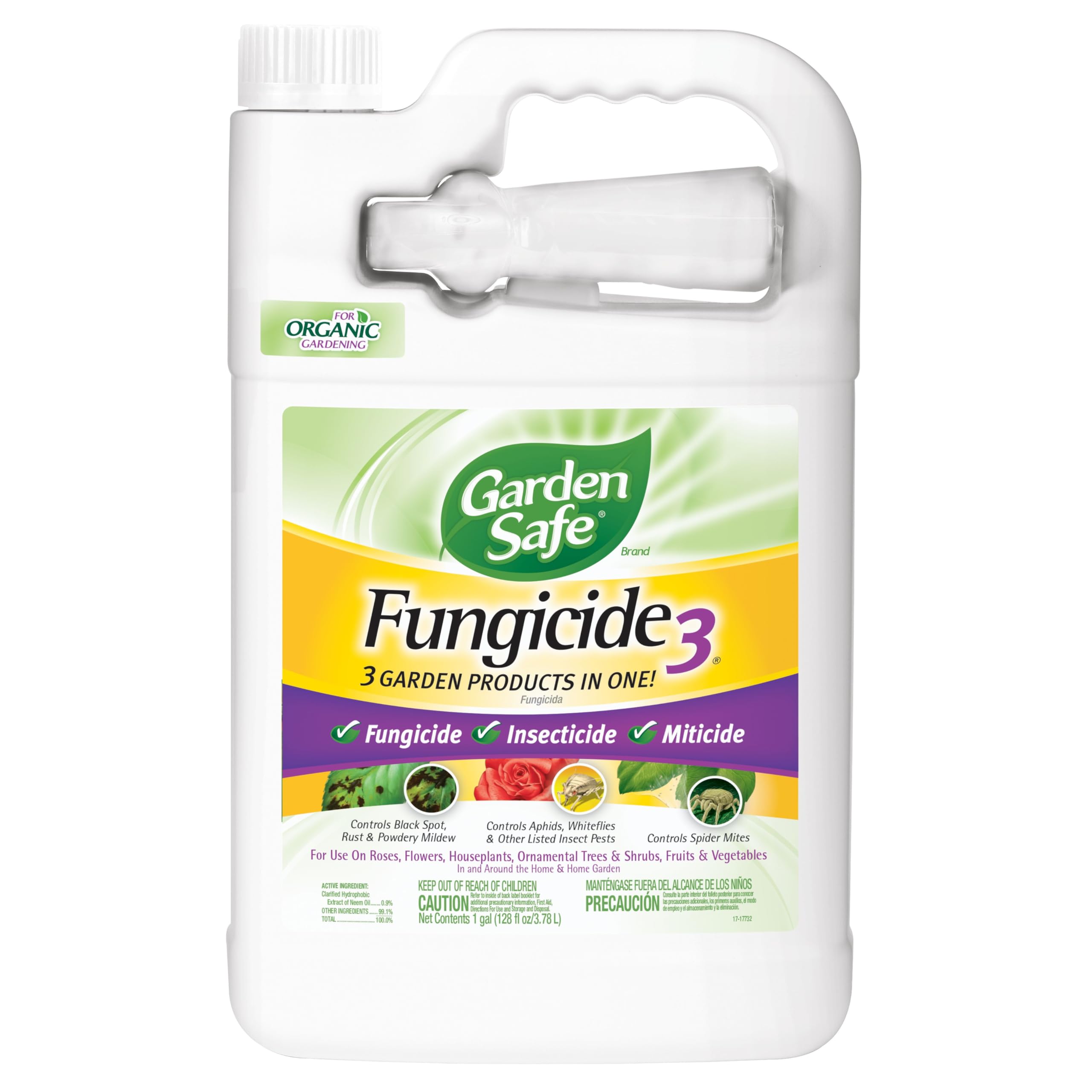
Garden Safe Fungicide3 is a ready-to-use spray that relies on clarified hydrophobic extract of neem oil as its active ingredient. Neem oil is a time-tested organic tool that works as a fungicide, insecticide, and miticide. It controls black spot, rust, and powdery mildew on the fungal side, while suppressing aphids, whiteflies, and spider mites on the pest side.
Rose growers report this product as “life-changing” for persistent mildew problems. Weekly applications throughout the growing season eliminate powdery mildew on new growth, and users observe greener foliage and increased blooms. The 1-gallon size with an attached sprayer is convenient for spot-treating 5-10 bushes without mixing or hauling heavy equipment.
The attached sprayer has a notoriously short range—about 4 inches of reach from the bottle—making it difficult to coat tall or dense bushes. Users recommend decanting into a better sprayer for full coverage. Neem oil can also burn foliage if applied during hot, sunny hours; apply in the evening to avoid leaf scorch.
What works
- Effective organic control of black spot, rust, and mildew
- Convenient ready-to-use format with built-in sprayer
- Safe for use on vegetables and around pets when dry
What doesn’t
- Built-in sprayer has very limited reach
- Can burn foliage if applied in direct sunlight
- Requires weekly applications for best results
6. Ortho Rose and Flower Insect Killer, 24-Ounce RTU

Ortho Rose and Flower Insect Killer is a dual-action ready-to-use spray that kills over 100 listed insects by both contact and systemic action. The formula works fast—users report Japanese beetles dying within hours of spraying—and the systemic component provides up to four weeks of residual protection against reinfestation.
This is the most popular entry-level option for rose owners who want a simple trigger spray that does not require measuring or mixing. It effectively eliminates aphids, leafhoppers, and beetles without damaging blooms or foliage. The 24-ounce bottle is small enough to store in a garden caddy but covers several medium bushes per application.
The systemic action is relatively weak compared to root-drench products. Users dealing with heavy mealybug or scale infestations note that this spray provides temporary knockdown rather than long-term eradication. It requires reapplication every other week during peak pest pressure, and thorough coverage of leaf undersides is essential for good results.
What works
- Immediate contact kill of Japanese beetles and aphids
- No mixing required; simple trigger-spray application
- Up to 4 weeks of residual protection from new pests
What doesn’t
- Weak systemic action struggles with heavy infestations
- Requires frequent reapplication for ongoing control
- Small bottle size may not be economical for many bushes
7. Fertilome Spinosad Soap Insecticide RTU, 32 oz

Fertilome Spinosad Soap combines Spinosad with potassium salts of fatty acids (insecticidal soap) to create a fast-acting contact killer that works on contact. The soap component breaks down the waxy coating of soft-bodied insects like aphids and thrips, while the Spinosad provides neurological knockdown for caterpillars, beetles, and leafminers.
Users report that this spray eliminates thrips on roses almost immediately, and it works “like a charm” on a wide range of pests including armyworms, borers, and lace bugs. The OMRI listing makes it suitable for organic gardens, and the ready-to-use format removes any mixing guesswork. It is an excellent spot-treatment tool for rose growers who need to respond quickly to a sudden infestation.
Because this is purely a contact product, it offers zero residual protection. New insects arriving the day after spraying are untouched. Users recommend alternating with a horticultural oil to prevent Spinosad resistance, and thorough coverage—especially the undersides of leaves—is absolutely mandatory for effective results.
What works
- Immediate contact kill of thrips, aphids, and caterpillars
- OMRI listed and suitable for organic gardens
- Convenient ready-to-use bottle for quick response
What doesn’t
- No systemic action; requires thorough leaf coverage
- Zero residual protection; reinfestation happens quickly
- Should be rotated with other products to avoid resistance
Hardware & Specs Guide
Systemic vs. Contact Action
Systemic drenches (Bonide Rose Rx, Fertilome 2-N-1) are absorbed by the roots and travel upward through the xylem, protecting the entire plant for 4-6 weeks. They are ideal for prevention and for hidden pests like thrips in buds. Contact sprays (Fertilome Spinosad Soap, Ortho RTU) kill only what they touch and provide zero residual protection, making them best for visible, active infestations that you can fully coat.
Active Ingredient Stability
Spinosad degrades rapidly in direct sunlight, with a half-life of 1-3 days on leaf surfaces. Neem oil breaks down within 2-4 days, requiring weekly reapplication. Systemic chemicals like imidacloprid remain active in plant tissue for weeks regardless of weather. For rainy climates, systemic drenches offer superior persistence over foliar sprays that wash off.
Concentrate Dilution Ratios
Understanding dilution is critical for cost and efficacy. The Bonide Captain Jack’s makes 6.4 gallons from a single pint at 2.5 oz per gallon. Monterey Spinosad concentrate is typically mixed at 1-2 oz per gallon. Over-diluting reduces kill rates; under-diluting wastes product and may burn leaves. Always measure using the provided cap or a dedicated measuring spoon.
Pollinator Safety Window
Systemic insecticides remain in nectar and pollen for weeks, making them highly toxic to bees. Contact Spinosad sprays are dangerous to bees only while wet; once dry (1-2 hours), they are safe. Neem oil has low acute toxicity to bees but should still be applied at dawn or dusk when pollinators are not foraging. Never spray open blooms with any insecticide.
FAQ
How often should I apply systemic insecticide to my roses?
Can I use Spinosad on roses that have black spot?
Will neem oil burn my rose leaves in summer?
Final Thoughts: The Verdict
For most gardeners, the insecticide for roses winner is the Bonide Rose Rx Systemic Drench because its 6-week systemic protection covers both insects and fungal diseases with a simple root-drench application. If you want an organic contact killer for caterpillars and thrips, grab the Monterey Spinosad Concentrate. And for rose growers who need broad-spectrum protection that is safe for edible gardens, nothing beats the Bonide Captain Jack’s Orchard Spray.