
The difference between a weekend push mower and a commercial robotic lawn mower is measured in acres, not inches. When your property demands daily cuts across 2 to 6 acres of undulating terrain with zero tolerance for downtime, you stop shopping for a gadget and start selecting a machine that earns its keep. The confusion starts when brands slap “commercial” on a residential bot, hiding specs like battery chemistry, motor wattage, and track vs wheel traction. This guide breaks down the real engineering—LiDAR, RTK, all-wheel drive, blade torque—that separates a year-round workhorse from an overpriced toy.
I’m Rikta — the co-founder and writer behind Lawn Gear Lab. My analysis here is driven by weeks of cross-referencing technical specifications, dissecting owner feedback across large-property scenarios, and comparing the core navigation and cutting systems that define true commercial-grade performance in this category.
Whether you manage a luxury estate, a golf course, or a fleet of rental properties, the right commercial robotic lawn mower eliminates the single biggest recurring expense on your property: manual labor and fuel costs.
How To Choose The Best Commercial Robotic Lawn Mower
Before you invest several thousand dollars, understand that this category demands you evaluate terrain grade, property size, satellite coverage, and blade motor power as a single system—not as independent features. A LiDAR mower on a perfectly flat lawn under full sky exposure is overkill; a GPS mower under a dense oak canopy is useless.
Slope Climbing & Traction System
The single most limiting spec on a commercial property is slope tolerance. Most residential bots cap out at 25% to 35% grade. A true commercial unit should handle 45% minimum, with premium models climbing 80% to 100% grade (roughly 38 to 45 degrees). Look for all-wheel drive (AWD) with independent hub motors or heavy-duty track drive systems. Tracks provide superior grip on wet, loose, or muddy terrain compared to wheels, even with aggressive tread patterns. If your property has any hill you currently dread mowing, validate this spec first.
Positioning & Navigation: RTK vs LiDAR vs Vision
Three technologies dominate this space. RTK (Real-Time Kinematic) GPS offers centimeter-level accuracy but requires a clear view of the sky—tall buildings, dense tree cover, or narrow side yards can cause signal drop. LiDAR (Light Detection and Ranging) builds a 3D map of the property using laser scans. It works under tree canopies and near fences but struggles in heavy dust or snow. Binocular AI vision cameras recognize obstacles like pets and toys but need good lighting. The best commercial mowers combine two or three of these into a tri-fusion system that switches sensors automatically when one fails.
Cutting System: Power, Width & Blade Type
Commercial mowers need to cut fast and cleanly through tall, damp, or overgrown grass without clogging. Key specs are the cutting width (9 to 21 inches), the number of blades per disc, and blade motor wattage—look for dual-motor systems producing 1600W peak or more. Adjustable cutting height from 1 inch to 4 inches lets you handle different grass types and seasons. A floating deck or terrain-sensing suspension prevents the mower from scalping bumps and uneven ground, which is critical for maintaining a professional-looking turf.
Battery Life & Chemistry
Runtime per charge dictates whether one mower can cover your property in a single cycle. Small units with 2.1 Ah batteries might handle 0.5 acres; premium models with 12 Ah to 15 Ah LiFePO4 batteries can cover 1 to 6 acres per day across multiple cycles. Lithium Iron Phosphate (LiFePO4) is superior to standard Lithium-Ion for commercial duty because it tolerates more charge cycles (2,000+ vs 500-800) and operates safely in wider temperature ranges. Fast charging (189W to 600W) reduces downtime between sessions.
Security & Software
At this price point, theft protection is non-negotiable. GPS tracking, PIN code locks, anti-theft alarms, and geofence alerts are essential for an asset left unattended on a property. The app ecosystem matters too—commercial operators need multiple zone management (30 to 100 zones), schedule customization per zone, and real-time notifications. Some units now offer 4G tracking and remote camera access for full property monitoring.
Quick Comparison
On smaller screens, swipe sideways to see the full table.
| Model | Category | Best For | Key Spec | Amazon |
|---|---|---|---|---|
| Mammotion LUBA 3 AWD 5000H | Mid-Range | 1.25 Acre Performance | 360° LiDAR+NetRTK | Amazon |
| Lymow One Plus | Premium | 45° Slope Master | Track Drive System | Amazon |
| Segway Navimow X430 | Premium | Zero-Turn Maneuver | 2×180W Dual Motor | Amazon |
| ECOVACS Goat A3000 LiDAR PRO | Mid-Range | Wire-Free Mapping | 7500 mAh / 189W Charging | Amazon |
| DREAME LiDAR 3500 A3 AWD Pro | Mid-Range | AI Obstacle Detection | OmniSense 3.0 LiDAR | Amazon |
| Husqvarna Automower 410iQ | Premium | Wire-Free EPOS System | 4″ Max Cut Height | Amazon |
| Mowrator S1 4WD | Premium | All-Season Utility | 21″ Cutting Width | Amazon |
| Husqvarna Automower 430X | Mid-Range | 0.8 Acre Wired Setup | GPS Assisted Nav | Amazon |
| Sunseeker X7 | Mid-Range | 70% Slope Climber | Binocular 3D Vision | Amazon |
| Mammotion LUBA 3 AWD 3000H | Mid-Range | 0.75 Acre with Garage | Tri-Fusion Nav | Amazon |
| McCulloch ROB R1000 | Budget | Entry-Level Commercial | 65 Min Runtime | Amazon |
| AIWEIYA RC Crawler Mower | Budget | 100% Slope by Remote | 286 Lbs / 1600W Motor | Amazon |
| YARBO Lawn Mower Pro | Premium | 6-Acre Modular System | 200 Lbs / All-Steel Skids | Amazon |
In‑Depth Reviews
1. Mammotion LUBA 3 AWD 5000H
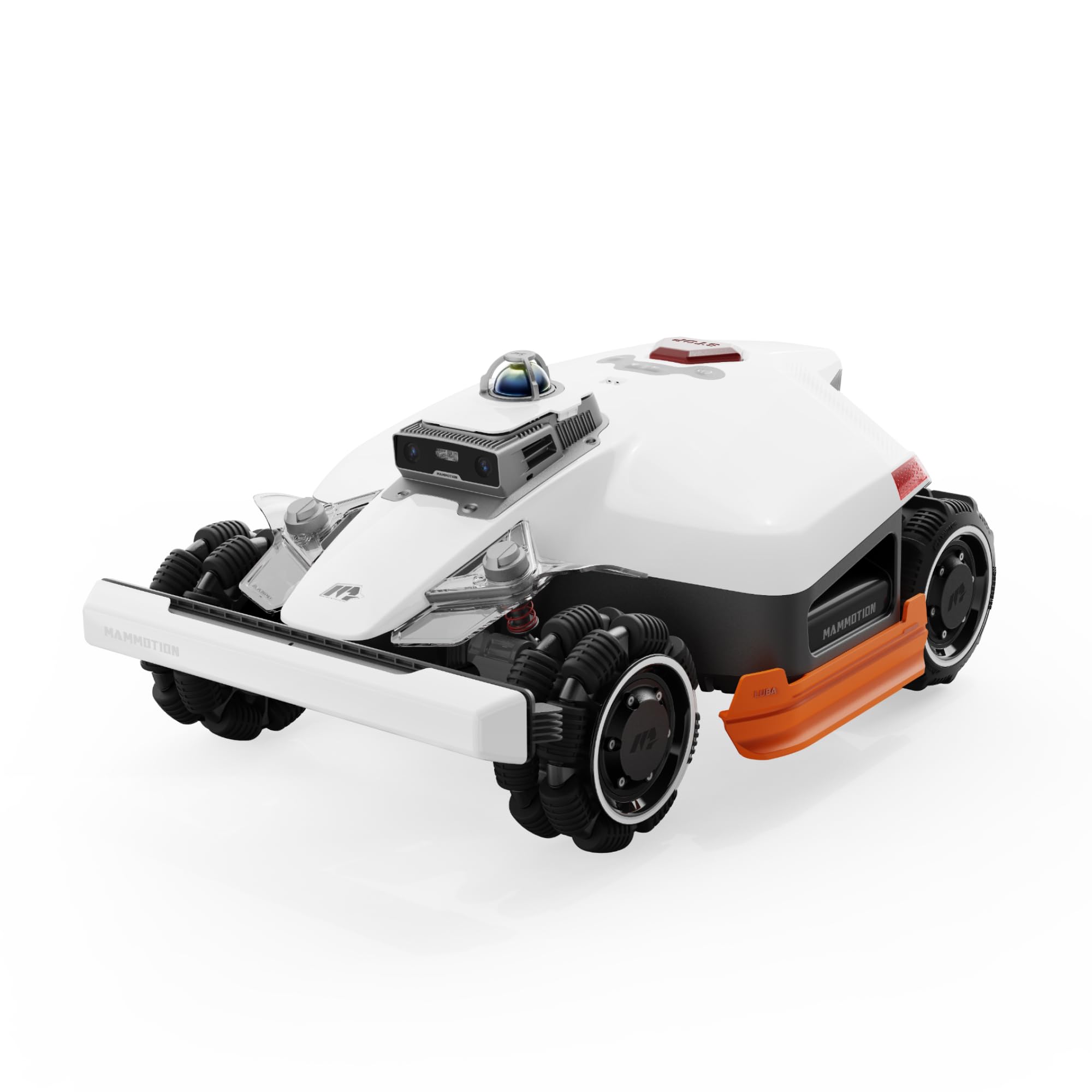
Mammotion’s LUBA 3 AWD 5000H anchors this list as the benchmark for commercial-grade navigation. The Tri-Fusion system—360° LiDAR, NetRTK corrections, and dual-camera AI vision—creates a millimeter-accurate point cloud of your property that works under trees, along fences, and on slopes up to 80% (38.6°). This is not a budget compromise; it’s a deliberate hardware stack designed to eliminate the GPS dropouts that plague single-sensor mowers. The 230 ft LiDAR sweep captures ground contours and overhead canopy simultaneously, so the mower knows exactly where it is even when satellite signals bounce off structures.
Cutting performance comes from two 165W high-torque motors spinning 6-blade discs. The 15 Ah lithium battery delivers a 215-minute runtime, translating to about 1.25 acres of real-world coverage per day. Owners report that the adaptive suspension system steps over curbs and roots up to 50 mm without jamming, while the omni wheel allows pivot turns that avoid turf tear. The 50 multi-zone management is critical for commercial operators who need separate schedules for front lawns, rear slopes, and rough cut areas. The 4.0-inch maximum cutting height handles overgrown grass that would bog down lesser mowers.
The real-world feedback is overwhelmingly positive on cut quality and navigation stability. Multiple verified owners mention that the AI vision backup prevents the unit from losing its position even when the RTK signal is obstructed by buildings. The only consistent note is that real-world battery coverage lands around 60% of the marketing figure—still enough for most large properties, but plan for a midday recharge cycle if you’re covering the top end of the 1.25-acre spec. For the combination of navigation redundancy, slope climbing, and clean cut pattern, this is the current high-water mark in the category.
What works
- Tri-Fusion navigation never loses signal under tree cover
- AWD with adaptive suspension climbs 80% slopes without slipping
- Very quiet operation with visible striped mowing pattern
What doesn’t
- Real-world battery runtime is lower than advertised yardage
- Replacement batteries not user-swappable without disassembly
- No integrated garage included in the package
2. Lymow One Plus
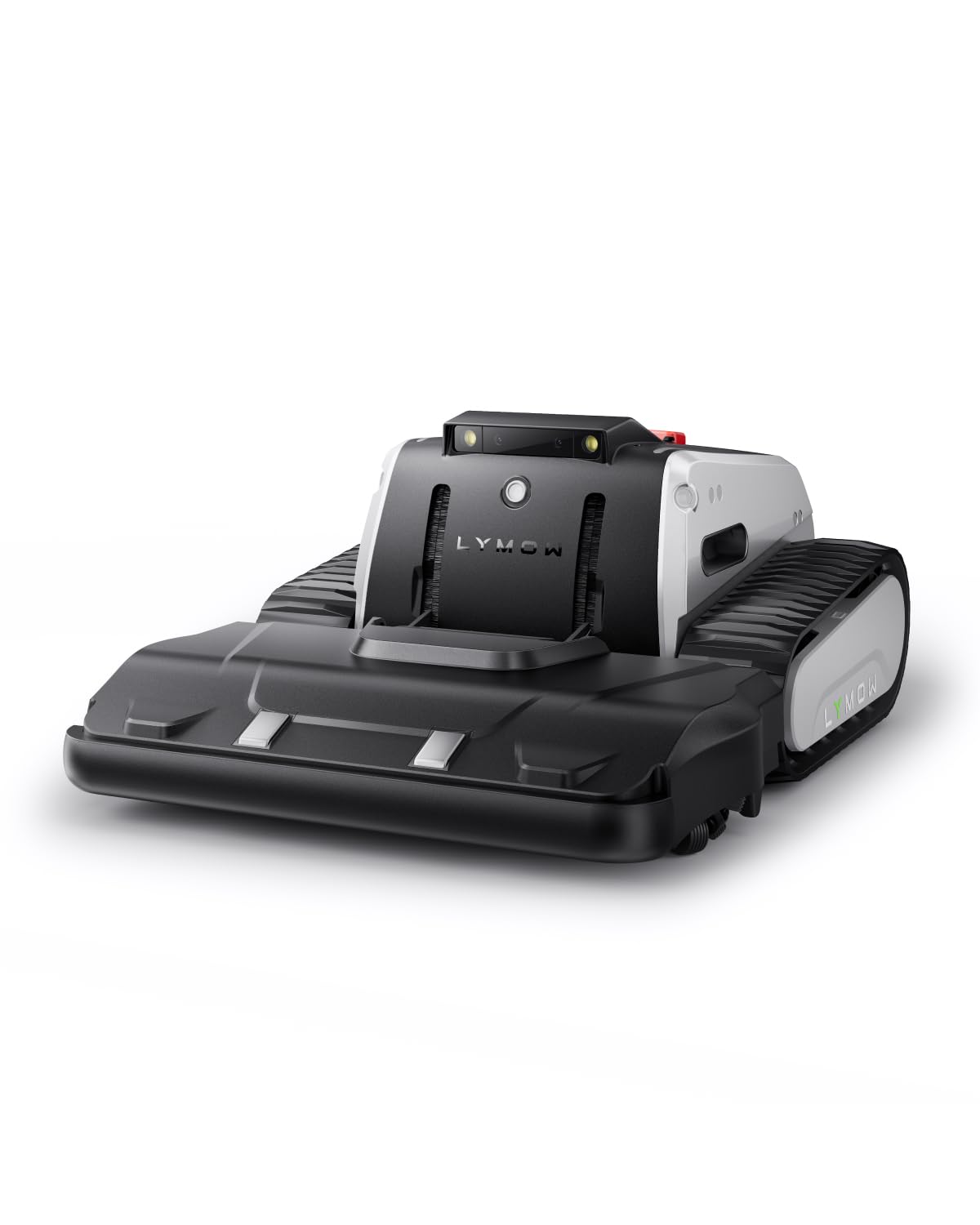
The Lymow One Plus enters the conversation with a track drive system that physically changes what a robotic mower can do on steep terrain. Where wheeled units spin out on damp slopes or soft soil, Lymow’s heavy-duty rubber tracks provide consistent traction across 45-degree (100% grade) inclines. This is not a marketing exaggeration—the track geometry and the 200% stiffer hub motor deliver genuine climbing ability that owners confirm with 3 to 4 acre daily runs. The 1785W peak Lycut System 2.0 motor, paired with dual SK5 tool steel blades at 6,000 RPM, lifts flattened grass before cutting it, which eliminates the common problem of wispy missed strips on densely matted lawns.
RTK positioning combined with VSLAM visual mapping creates a wire-free installation that takes minutes. The 15,000 mAh LiFePO4 battery is rated for 2,000+ charging cycles—far beyond standard lithium-ion packs. This is the mower’s hidden advantage for commercial buyers: the battery cost is amortizing into the long-term ownership, not degrading after 2 seasons. The A380 automotive-grade frame and IPX6 waterproofing mean this thing can sit through a rainstorm without electrical issues. Setup requires careful RTK placement with a 120-degree unobstructed sky view, but once configured, the 80-zone management handles complex multi-lot properties.
Owner responses are a mix of outright enthusiasm and honest beta-tester frustration. The charging contacts suffer from grass buildup that can cause error cycles unless manually wiped—a 3D-printed shield fixes it, but it should come from the factory. The RTK connection is sensitive to fence proximity and heavy gear tree coverage. When it works—which is most of the time for most users—the cut quality, slope handling, and battery endurance are exceptional. For anyone managing extreme hills or soaking wet properties, the track drive alone justifies the premium over wheeled competitors.
What works
- Track drive climbs 45-degree slopes consistently where wheels fail
- LiFePO4 battery rated for 2,000+ cycles saves long-term cost
- Cyclone airflow lifts flattened grass for even cuts
What doesn’t
- Charging contacts require frequent cleaning to avoid errors
- RTK setup is sensitive; requires clear sky for stable signal
- Customer support is slow, making it feel like beta hardware
3. Segway Navimow X430
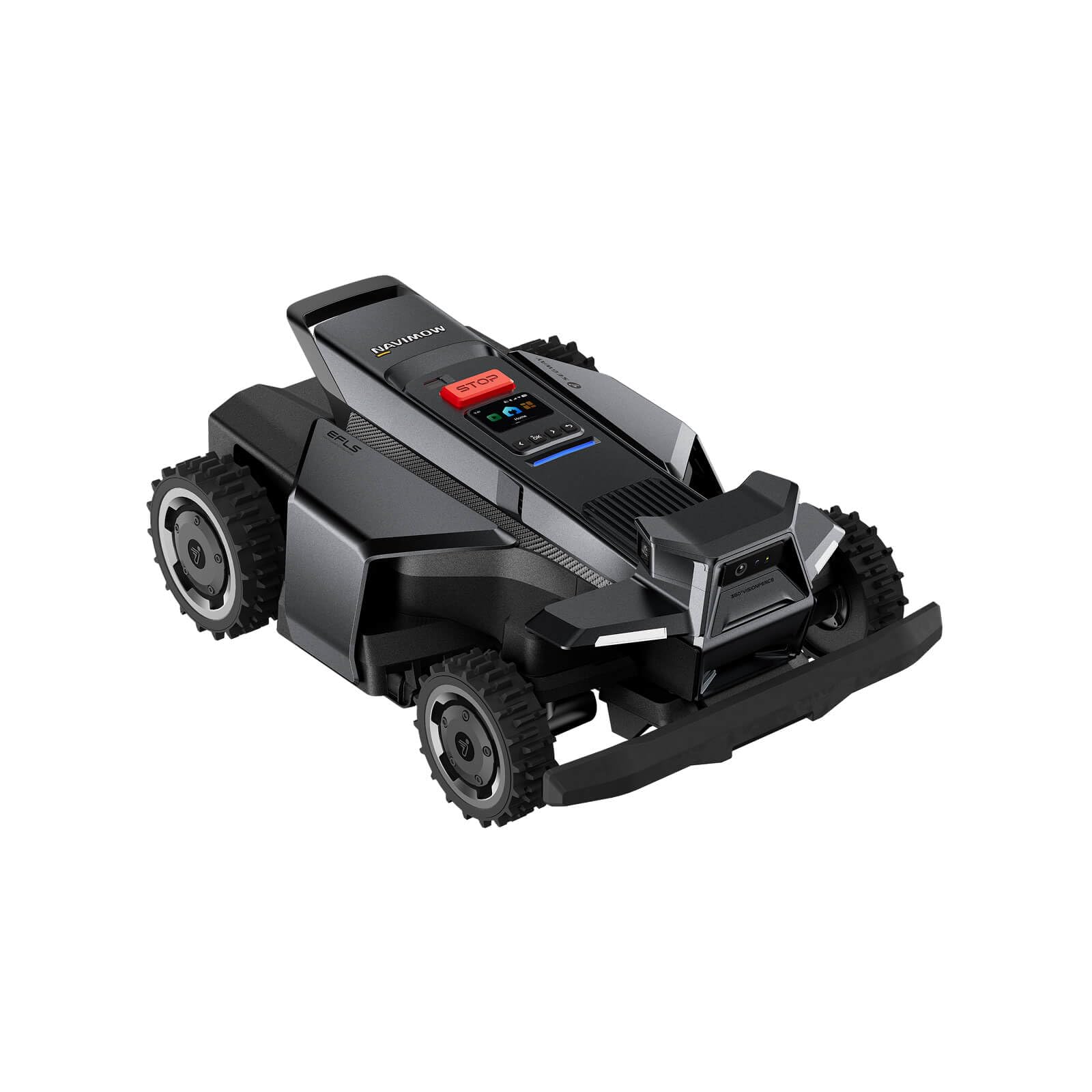
Segway’s Navimow X430 brings a mature engineering perspective to the commercial market. The Xero-Turn AWD system with eccentric front-wheel steering eliminates the scuff marks that standard differential turns leave on sensitive turf. This is a critical spec for golf course fairways, luxury estates, or any property where brown drag marks are unacceptable. The 180W dual-motor MowMentum cutting system drives two discs with 12 blades across a 17-inch cutting width—the widest in this tier—covering ground faster than narrower decks. EdgeSense technology reduces trimming margins to under 2 inches, which means fewer manual passes with a string trimmer after the robot finishes.
Navigation reliability comes from EFLS tri-frequency Network RTK combined with 360° Vision and VIO (Visual Inertial Odometry). In practice, this means the X430 holds centimeter-level accuracy under heavy tree canopy where single-frequency RTK units drift. The 40-degree (84% grade) slope rating with ORV-tuned dual suspension makes it a true all-terrain companion. The auto-mapping process is one-tap: walk the perimeter, press start, and the mower builds its map in about 20 minutes. GeoSketch lets you edit no-go zones and mowing paths directly in the app without re-mapping.
Early adopters praise the smooth patterned cutting and clear UI, but report a difficult first run with a defective charging setup that needed replacement parts. The unit is heavy at 64 pounds, which makes carrying it over stairs or loading into a truck less convenient than lighter models. The AI vision system requires pruning low-hanging branches to avoid camera confusion. For property managers who demand perfect zero-turn turf protection and the widest single-pass cutting swath, the Navimow X430 is a solid pick—assuming you budget for potential early hardware issues.
What works
- Widest cutting width at 17 inches reduces mowing time
- Zero-turn steering prevents turf scuff damage
- Tri-frequency RTK holds signal under trees
What doesn’t
- Defective charging hardware reported by early buyers
- Heavy at 64 pounds; difficult to transport
- Vision system confused by low-hanging branches
4. ECOVACS Goat A3000 LiDAR PRO
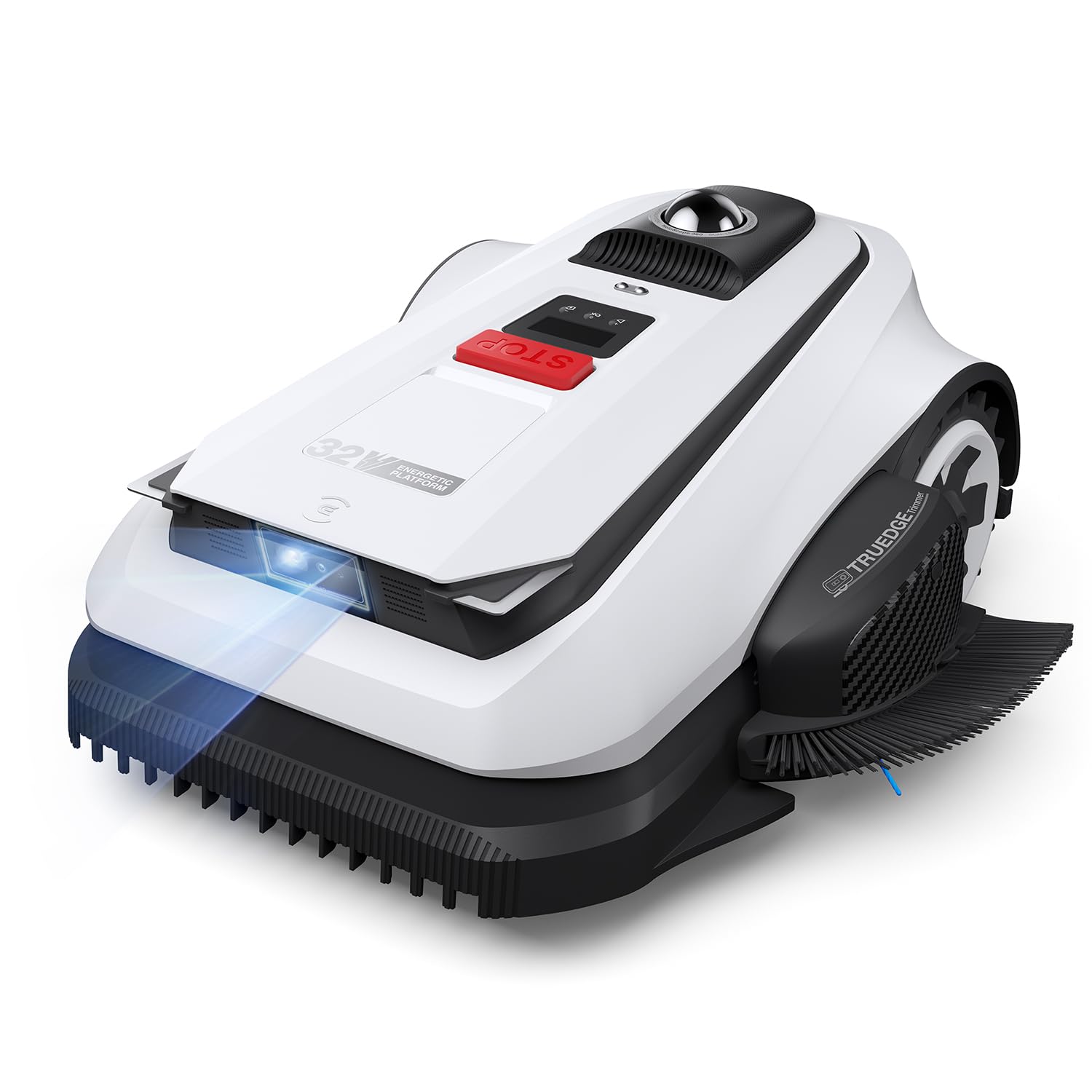
The ECOVACS Goat A3000 LiDAR PRO eliminates the two biggest headaches of commercial installation: running boundary wire and mounting an RTK antenna. Its HoloScope 360° Dual-LiDAR system maps the yard in 20 minutes with centimeter-level accuracy and maintains that precision under tree cover, along fences, and in shaded corners where GPS-based units lose signal. The 32V high-power system with dual-blade disc delivers strong cutting torque for thick warm-season grasses like Bermuda and St. Augustine. The integrated TruEdge trimmer cuts borders cleanly, reducing the manual string trimming after the main mowing cycle.
The 7500 mAh battery combined with 189W fast charging recharges in 70 minutes, keeping downtime minimal. The edge trimming function is genuinely useful for sidewalks and flower beds—this is one of the few units where you can truly skip the post-mow trim on straight borders. Owners consistently report a consistent even cut and solid battery performance on quarter-acre to three-quarter-acre yards. The app allows multi-zone mapping, height adjustment, and no-go area creation from your phone.
The downside is that the A3000 struggles with tight corners and obstacles. The vision system occasionally loses signal near the charging station and fails to map properties with irregular landscaping. A small percentage of owners report a 3.5-hour mapping failure that required support intervention and a two-week replacement wait. For flat or gently sloped yards with open layouts, the A3000 delivers premium features at a mid-range price. For complex terrain with many trees and tight passages, verify the mapping success on your specific layout before committing.
What works
- Wire-free LiDAR mapping with 2 cm accuracy under trees
- Integrated edge trimmer reduces manual trimming work
- Fast 189W charging with 70-minute recharge cycle
What doesn’t
- Mapping fails near charger and on irregular layouts
- Struggles with tight corners and obstacle clusters
- Customer support replacement wait is 2 weeks
5. DREAME LiDAR 3500 A3 AWD Pro
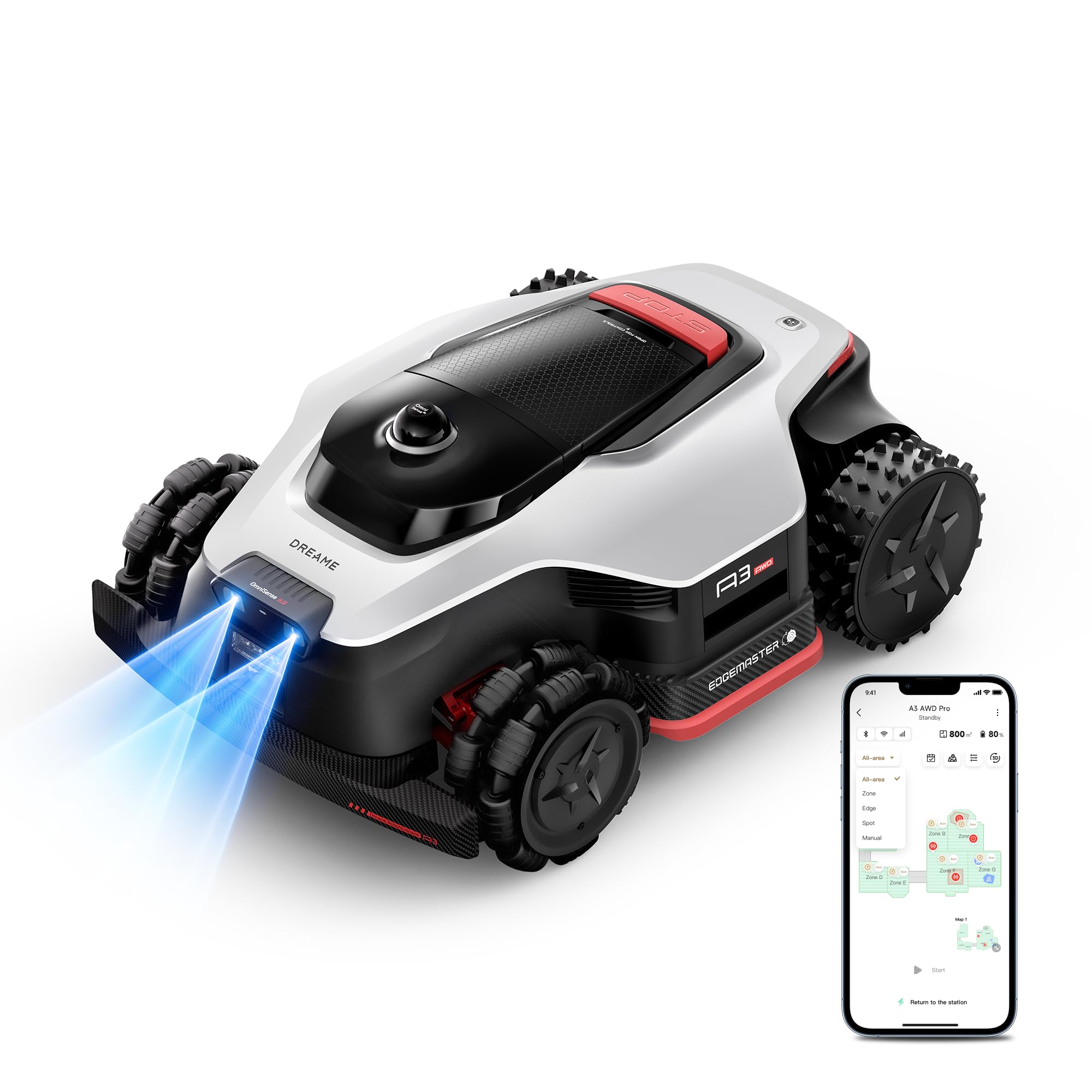
DREAME brings its vacuum robot LiDAR heritage into the lawn space with the A3 AWD Pro, and the navigation DNA is immediately visible. The OmniSense 3.0 system combines 360° 3D LiDAR with binocular AI vision to detect and avoid over 300 obstacle types without needing perimeter wire or RTK satellite correction. The elimination of RTK dependence is a real advantage for properties surrounded by tall tree lines or buildings where GPS signals bounce unpredictably. The 240 ft detection range creates a safety buffer that prevents the mower from wandering into unknown zones. The 4WD hub motors handle 80% (38.7°) slopes with no slipping reported by owners.
The dual floating cutting discs give a 15.8-inch cutting width with EdgeMaster 2.0 border technology that leaves less than 2 inches of uncut edge. Rush mode covers up to 8,611 sq ft per hour for large open areas. The suspension system glides over obstacles up to 2.2 inches high—roots, curbs, gravel patches—without jamming. One-tap cutting height adjustment from 1 to 4 inches accommodates both warm-season and cool-season grass types. The app supports 100 mowing zones and 100 no-go areas, which is category-leading for complex property segmentation.
Owner feedback lands in two distinct camps. Experienced robotics users report excellent results on moderately complex yards with consistent cutting and reliable obstacle monitoring. New users on unkempt lawns with weeds, bumps, and irregular shapes find the setup nightmarish and the mowing performance uneven—the mower rolls over tall weeds and spews clippings in unacceptable furrows until the lawn is leveled. This is not a mower for neglected properties; it requires a baseline of lawn maintenance to perform well. For maintained turf with moderate complexity, the DREAME A3 combines serious hardware with genuinely thoughtful software.
What works
- LiDAR+vision navigation works without RTK or boundary wire
- 100 mowing zones for complex property segmentation
- Suspension system glides over 2.2-inch obstacles
What doesn’t
- Struggles on neglected lawns with weeds and bumps
- Nightmarish app setup for users with imperfect terrain
- Clipping furrows on uneven or overgrown sections
6. Husqvarna Automower 410iQ
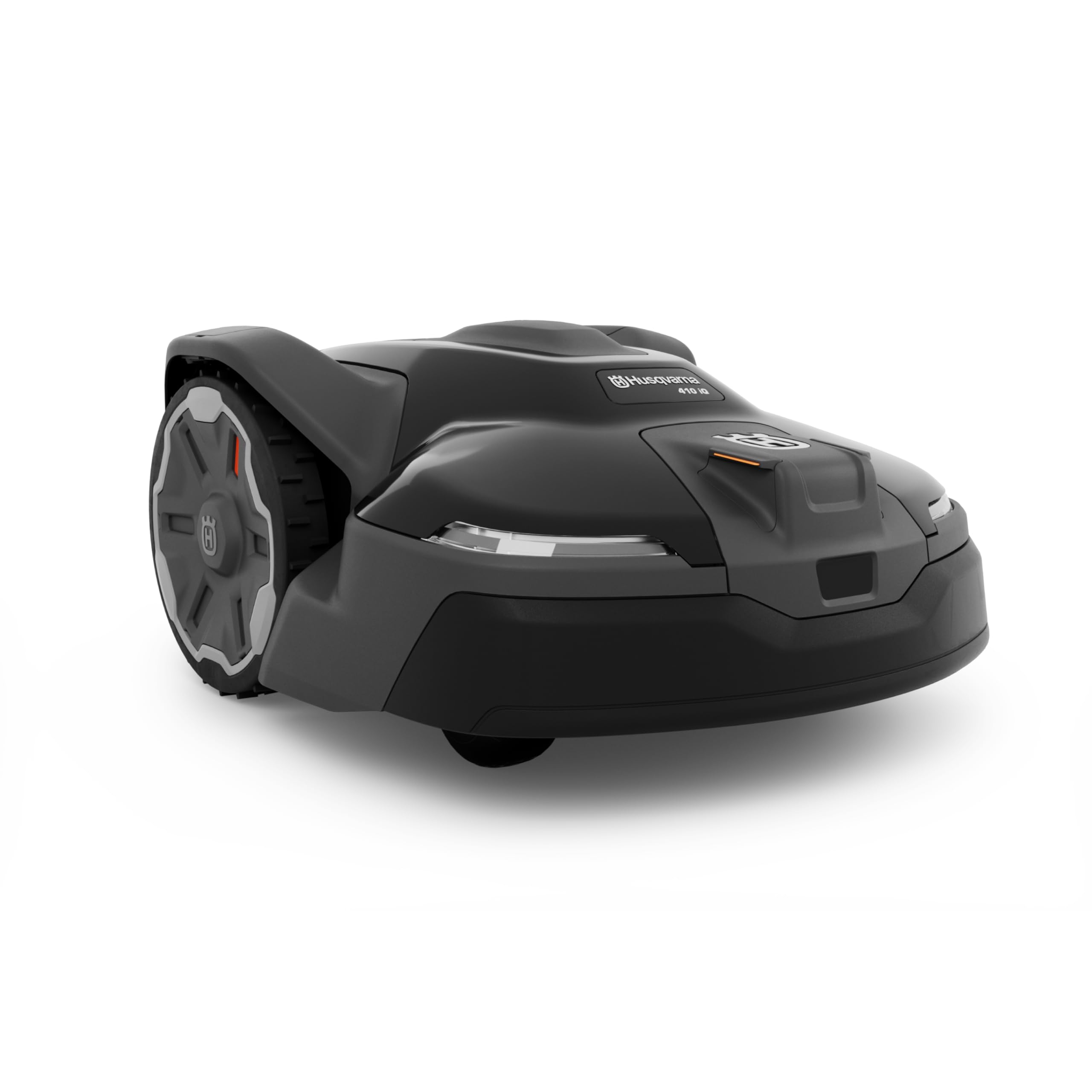
Husqvarna enters the wire-free market with the 410iQ, leveraging their Exact Positioning Operating System (EPOS) that uses a dedicated reference station for centimeter-accurate real-time location data. Unlike GPS-only units that drift under tree cover, EPOS maintains stable positioning through a combination of satellite corrections and onboard radar that detects obstacles. The wire-free setup is genuinely liberating: you walk the perimeter with your smartphone to create a virtual map with mowing areas and stay-out zones. The 1-to-4-inch adjustable cutting height range is the widest in the Husqvarna commercial line, handling everything from golf green lows to rough pasture.
The hardware is intelligently engineered for American lawns. The larger wheels handle driveways and paths without getting stuck, and the hose-washable body makes cleanup trivial after wet cuts. The 0.5-acre mowing capacity per charge covers most suburban lots, and the 45% slope rating handles standard hills. The app controls cutting height, mowing schedule, and pattern selection—striped, checkerboard, random—with over-the-air software updates included. The 4-year warranty and 1 year of free blades make it the most factory-supported option on this list.
The 410iQ’s fatal flaw is GPS dependency in suburban lots with close neighbors. Multiple verified owners report that the mower loses satellite lock when navigating to the side or back yard, leaving it stuck searching for signal for extended periods. Documentation is sparse, and some support links return 404 errors. In open suburban yards with clear sky views, it performs exceptionally. In dense subdivisions, it’s a frustrating investment. If your property has wide open skylines, this is a premium pick. If you’re in a standard suburb with houses on all sides, test the GPS signal during the return window.
What works
- EPOS centimeter accuracy with dedicated reference station
- Widest cutting height range: 1 to 4 inches
- 4-year warranty with 1 year of free blades included
What doesn’t
- GPS signal loss in suburban yards with close neighbors
- Poor documentation with 404 support links
- Cannot travel between front and back yards reliably
7. Mowrator S1 4WD
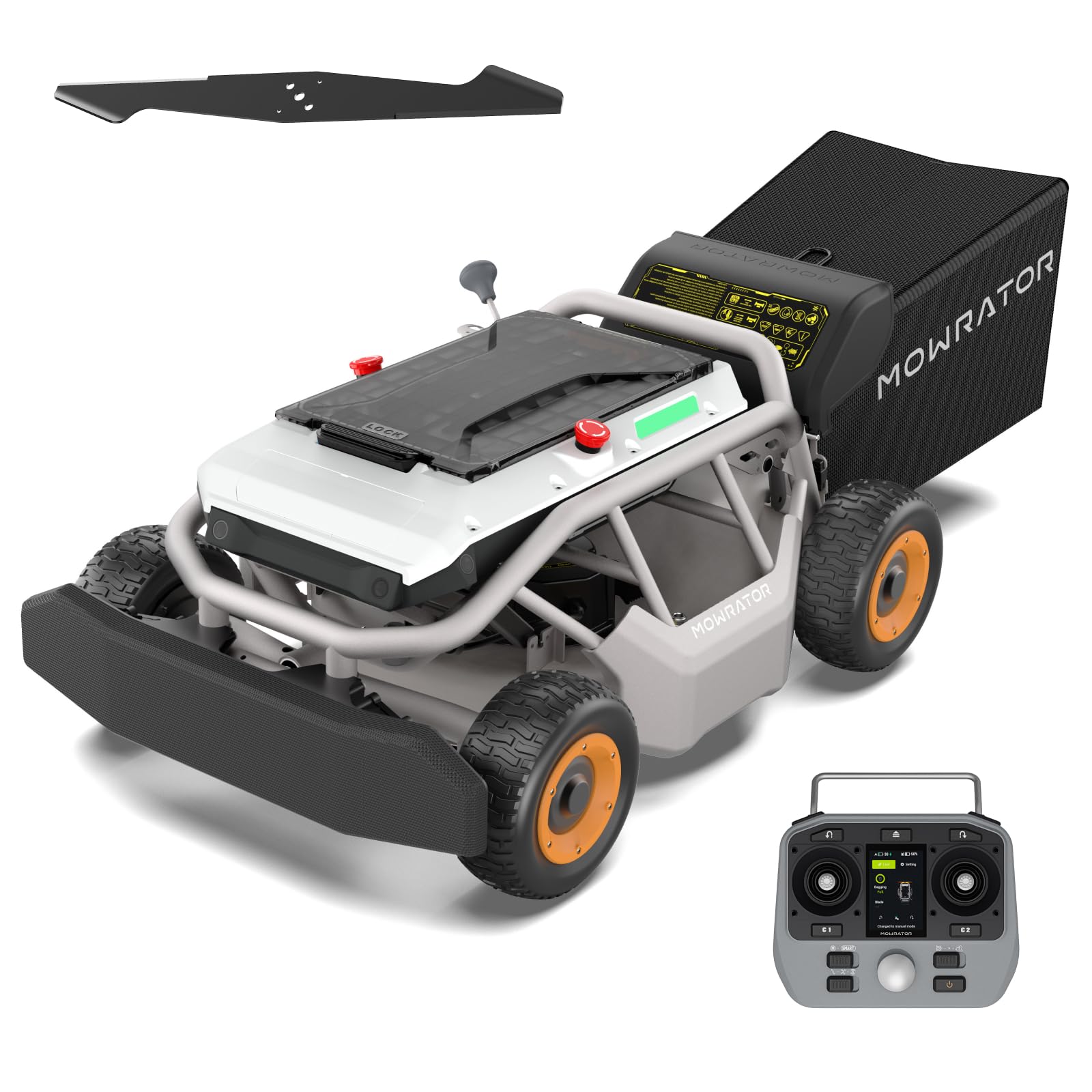
The Mowrator S1 4WD is a remote-control (not autonomous) mower that occupies a unique slot on this list: it’s for properties where autonomous navigation fails—extreme slopes, dense obstacles, irregular boundaries—but a human with a radio controller can achieve faster, more precise coverage than a robot. The 1000W 4WD drive system provides aggressive traction across 75% (37°) slopes, while the blade motor peaks at 1600W with 3200 RPM and 6 ft·lb of torque. The 21-inch cutting width is the widest on this list, covering ground per pass faster than any autonomous competitor. The three-mode cutting system—mulching, rear discharge, and bagging—adapts to seasonal needs.
The 12 Ah LiFePO4 battery powers up to 1.5 hours of runtime covering 0.75 acres with a 70-minute recharge. The 5-layer safety system includes ultrasonic sensors, emergency stop, blade auto-stop upon lift, and an impact-absorbing bumper. The low-latency remote (5 ms response) eliminates any perceptible delay between stick movement and mower response. Optional accessories include a snow plow, tow hitch for hauling, mulching blade for leaf management, and an FPV monitoring camera for indoor supervision. This is the only unit that transitions from summer mowing to fall mulching to winter snow clearing.
The core limitation is that it is not autonomous—someone must be present with the remote. This makes it unsuitable for daily unattended cutting across large properties. The tilt sensor on the remote cannot be disabled, causing nuisance stops on uneven terrain. The collision sensor stops the blades on vines and minor obstructions, requiring manual override. Owners consistently praise the build quality and raw power, but note that the machine demands active supervision rather than the set-and-forget promise of autonomous mowers. For professional landscapers managing the most difficult terrain, this trade-off is worthwhile.
What works
- Widest 21-inch cutting width for fastest pass coverage
- Multi-season utility with plow, hitch, and leaf kit
- LiFePO4 battery with 70-minute fast recharge
What doesn’t
- Requires active remote operation—not autonomous
- Tilt sensor cannot be disabled, stops on uneven sections
- Collision sensor triggers on vines, requiring manual reset
8. Husqvarna Automower 430X

The Husqvarna Automower 430X represents the wired alternative to the wire-free units above. For property owners who prefer absolute signal reliability over installation convenience, the physical boundary wire provides a consistent magnetic signal that never drops out—no GPS interference from trees, no RTK drift from buildings, no LiDAR occlusion from dust. The 430X navigates 45-degree slopes and narrow passages with a 9.45-inch cutting deck, covering 0.8 acres per charge cycle. The GPS theft tracking, built-in alarm, and PIN code lock provide security for an asset that may sit unattended. The app integrates with Amazon Alexa and Google Home for voice control.
Installation requires burying or stapling 600+ feet of boundary wire, which owners consistently describe as time-consuming but worthwhile. The mower becomes more efficient over time as it learns your lawn’s shape. The mulching system returns micro-clippings as fertilizer, keeping the lawn healthy without bagging. The 2-year warranty provides reasonable coverage. Owners praise the quiet operation that allows nighttime mowing schedules—you wake up to a perfectly trimmed lawn without the noise pollution of a gas mower.
The wire itself is the product’s biggest vulnerability. Multiple owners report the mower cutting its own boundary wire when the sensor misfires, requiring 4-5 repairs per season. The wire connectors are cheap and need occasional tightening. The GPS functionality is largely unused by most owners, making this essentially a boundary-wire mower with a GPS tracking accessory. For properties with open layouts and owners willing to bury the wire properly, the 430X delivers proven reliability. For anyone avoiding wire installation, this is not the right choice.
What works
- Boundary wire provides consistent signal with no GPS drop
- Quiet overnight mowing schedule available
- GPS theft tracking and PIN code security
What doesn’t
- Mower occasionally cuts its own boundary wire
- Wire connectors are cheap and need periodic tightening
- Time-consuming installation requires burying 600+ feet
9. Sunseeker X7
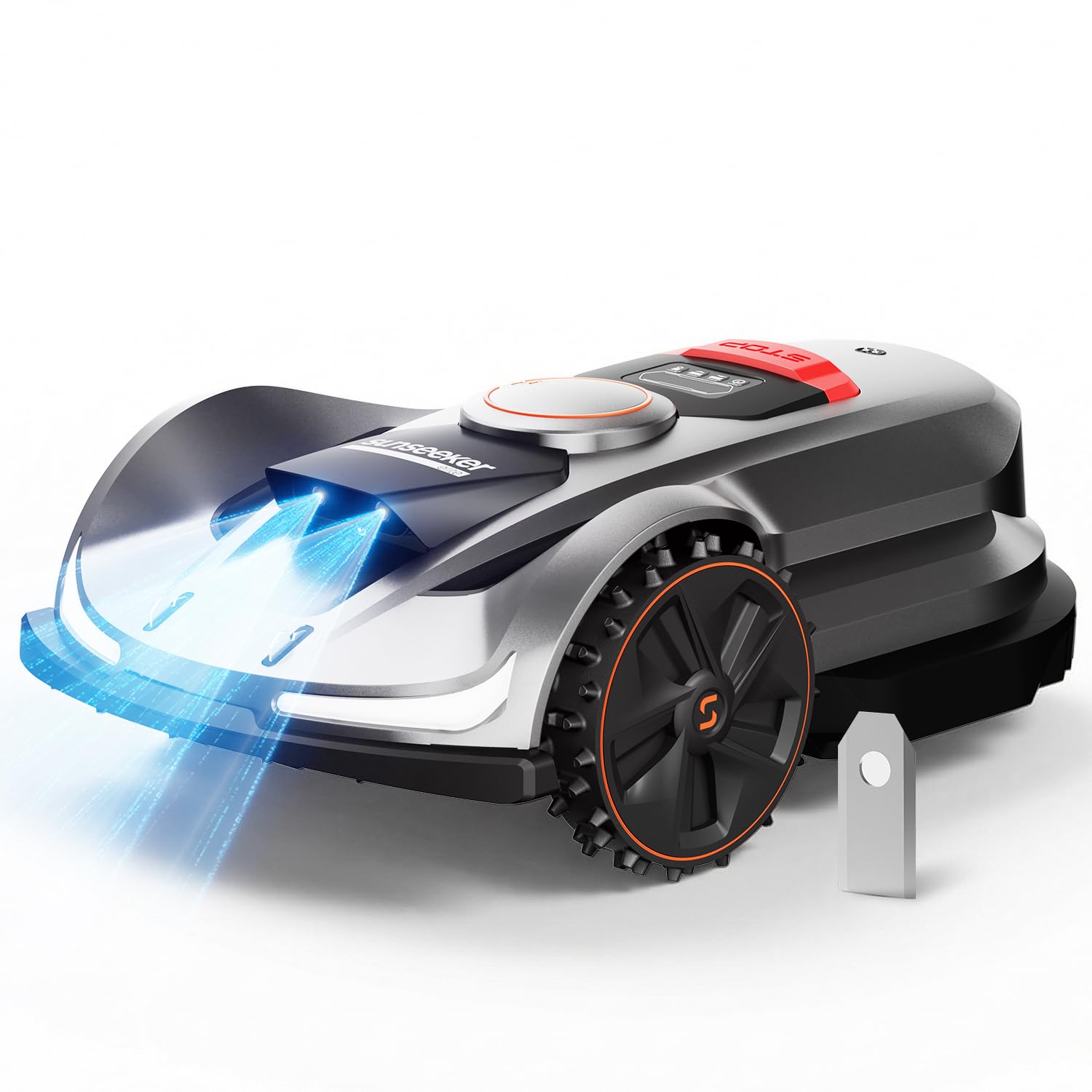
The Sunseeker X7 uses binocular 3D AI vision for depth perception that single-camera systems cannot match. The two forward-facing cameras work like human eyes, measuring the precise size and distance of every obstacle before navigating around it. This prevents the turf-tearing collisions common with cheaper ultrasonic-only mowers. The all-wheel drive chassis with deep-tread off-road tires delivers 35° (70% slope) climbing ability that handles steep, muddy, and uneven ground reliably. The floating deck adjusts to ground contours, preventing scalping on bumps and returning micro-clippings as natural fertilizer. The 0.8 to 4 inch cutting height range with 11 positions gives fine control over grass length.
The security package is bank-grade: 4G+GPS real-time tracking, anti-theft alarm, and geofence lockout. If the mower leaves the designated property, you receive an immediate notification with its GPS coordinates. The 0.75-acre coverage suits medium to large yards. Owners report consistent satellite navigation without dropouts and reliable self-recovery from tricky spots—the mower rarely needs manual rescue. The app is smooth and responsive, and the quiet operation allows flexible scheduling.
The primary concern with the X7 is its networking dependency. Multiple owners report that the mower fails to map or blocks daily operations when the cellular connection is unstable. One user specifically noted the unit tries to connect to Chinese servers, which caused mapping failures when their network blocked those connections. Signal reliability varies by time of day and geographic location. The setup is not intuitive, and some owners returned the unit due to connection issues. For properties with strong cellular coverage and a willingness to work through the initial setup, the X7 combines serious hardware with capable vision processing. For cellular dead zones, avoid this model.
What works
- Binocular vision eliminates turf-tearing collisions
- AWD with deep-tread tires climbs 70% slopes reliably
- Bank-grade 4G+GPS anti-theft tracking
What doesn’t
- Requires stable cellular connection for mapping
- Setup is not intuitive; returns due to connection issues
- Signal drop varies by time of day and location
10. Mammotion LUBA 3 AWD 3000H
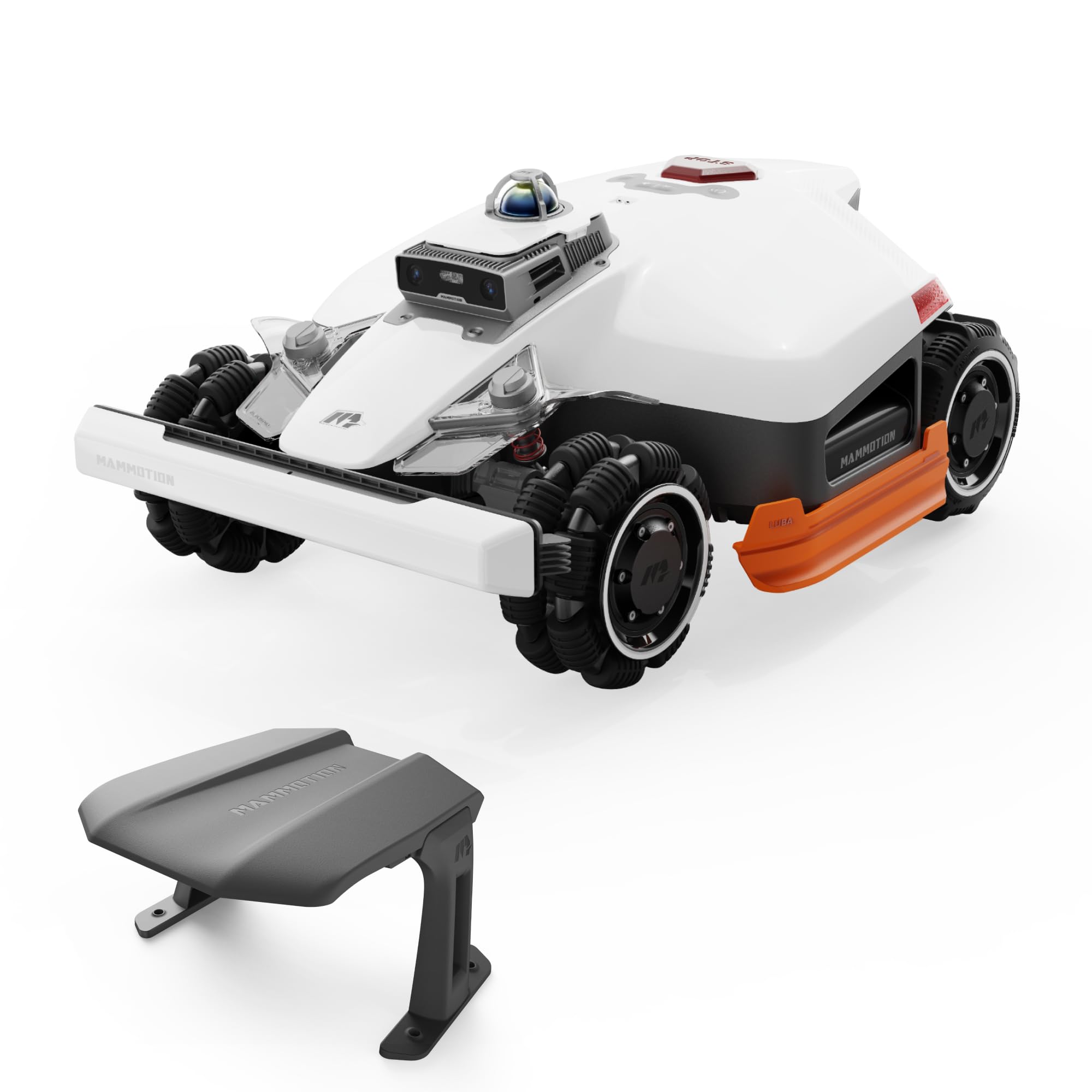
The Mammotion LUBA 3 AWD 3000H is the smaller acreage sibling of the 5000H, and it comes with a significant advantage for many buyers: the package includes a weatherproof garage shipped separately. The Tri-Fusion navigation system is identical to the 5000H—360° LiDAR, NetRTK, dual-camera AI vision—meaning you get the same centimeter-accurate navigation and 300+ obstacle detection in a compact package. The 0.75-acre coverage fits most professional residential lots, and the 80% slope climbing matches the larger model. The 12 Ah battery delivers 175 minutes of runtime with the 165W dual-motor cutting system.
The off-road performance is identical to the 5000H: four independent motors, adaptive suspension stepping over 50-mm obstacles, and omni wheel precision turning. The cutting height range of 2.2 to 4 inches is narrower than some competitors—it cannot cut below 2.2 inches, which rules out very short golf-style fairway cuts. The intelligent path planning offers perimeter-only, zigzag, checkerboard, and adaptive zigzag patterns with real-time speed and power adjustment based on grass density.
Owner feedback mirrors the 5000H experience: excellent cut quality on tall fescue, stable navigation with no RTK dropout due to AI vision backup, and smooth operation on bumpy terrain. The garage inclusion is a real value-add that saves – in third-party shelters. The inch-and-a-half missing from the low end of the cut height range may matter if you maintain aggressive turf—the mower bottoms out at 2.2 inches, which is too high for some golf course or athletic field standards. For general estate maintenance, this is the best value proposition in the Mammotion lineup.
What works
- Identical Tri-Fusion navigation to the premium 5000H model
- Weatherproof garage included in the package
- AWD climbs 80% slopes without getting stuck
What doesn’t
- Minimum cutting height is 2.2 inches—no short fairway cut
- Real-world battery coverage lower than marketing claims
- No user-replaceable battery option
11. McCulloch ROB R1000

The McCulloch ROB R1000 is the budget entry point for commercial-adjacent robotic mowing. With a 2.1 Ah battery providing 65 minutes of runtime on a 50-minute charge, it covers up to 1,076 square meters (roughly 0.25 acres) per cycle. The 5-stage cutting height adjustment from 20 to 50 mm (0.8 to 2 inches) is limited compared to premium units, and the 200-meter boundary wire with 400 hooks requires a full weekend of installation. The anti-theft PIN code system prevents unauthorized use, and the alarm sounds if the mower is lifted. The 50-minute charge time is impressively fast for the battery size.
The unit is lightweight at 15.4 pounds, making it easy to carry across the yard or up stairs. Owners running the R1000 on 1,000 square meter lawns report reliable performance on slopes and uneven ground. The mower handles rain operation, finds its way back to the charging station via search cable, and is quiet enough for nighttime operation. The metal and plastic construction feels robust for the price tier. The blades are easily replaced with official McCulloch accessories.
The primary limitation is scale. The 65-minute runtime means it will spend more time charging than mowing on any property larger than a quarter acre. The 20 mm minimum cut height is too low for some grass types. The lack of WiFi or app connectivity means you cannot schedule remotely or receive notifications. The included power cable may not match your regional plug—multiple owners report receiving units with EU-type plugs sold as UK or US models. For small to medium flat lots with a patient owner, the R1000 is a functional starter. For commercial workloads, it will frustrate with constant recharge cycles.
What works
- Fast 50-minute charge cycle for quick turnaround
- Lightweight at 15.4 pounds for easy manual transport
- Handles rain and steep slopes reliably
What doesn’t
- Only 65 minutes runtime—charges more than it mows
- No WiFi or app control for remote scheduling
- Regional plug compatibility issues reported
12. AIWEIYA RC Crawler Mower
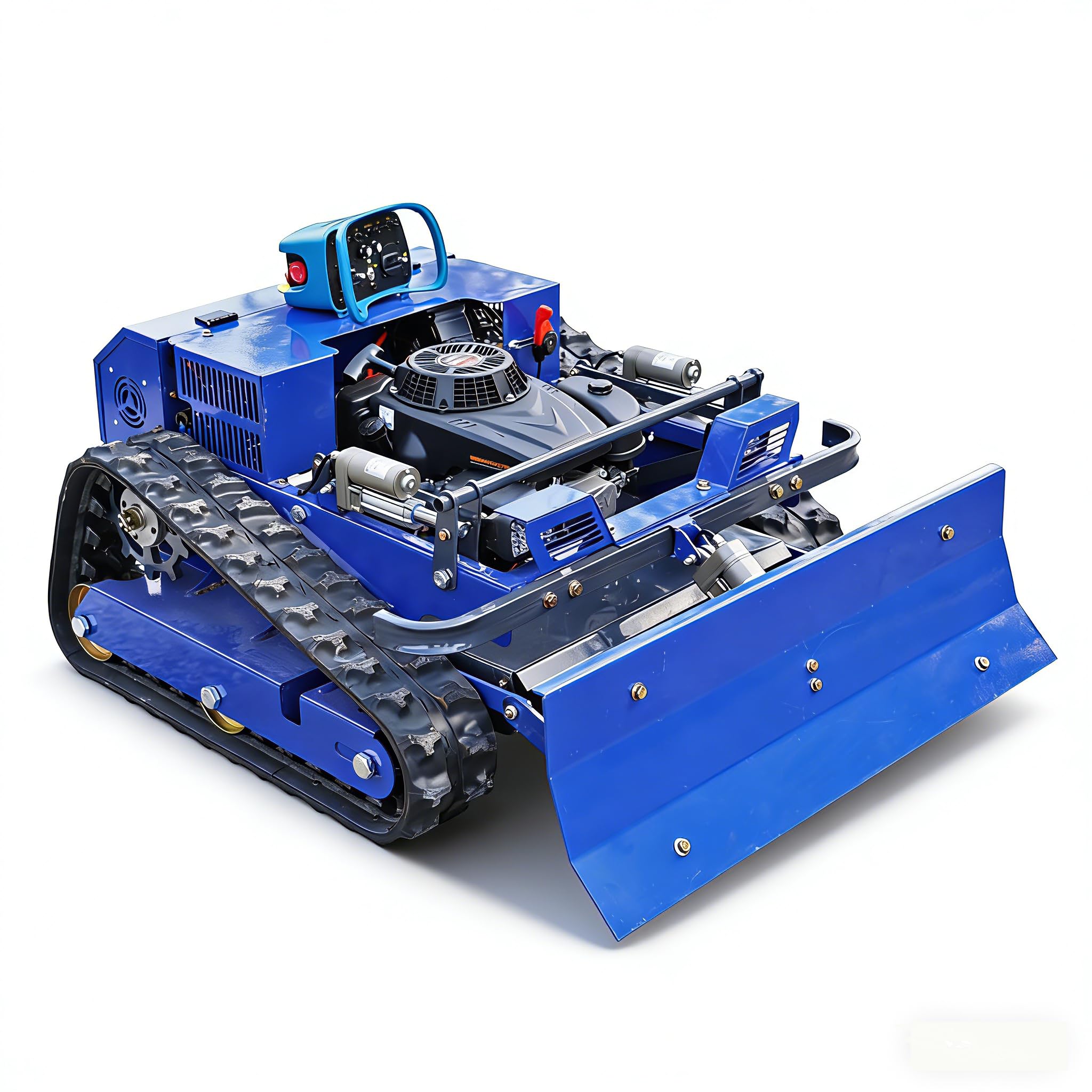
The AIWEIYA remote control crawler mower is a heavy-duty brute aimed at 100% (45°) slope terrain that defeats any autonomous mower. The 286-pound all-steel chassis with rubber crawler tracks provides traction on loose soil, wet mud, and steep angles where wheeled machines spin helplessly. The 1600W 24V brushless permanent magnet drive motor powers the tracks and blade system through a gearbox that prioritizes torque over speed. The 21.6-inch cutting width is among the widest on this list, and the 1.1- to 5.9-inch cutting height range accommodates everything from manicured turf to tall weed patches. The two-piece manganese blade delivers a fine mulching cut that fertilizes the lawn.
The remote control provides 360-degree turning and climbing actions at the operator’s command. The RC range covers the property, and the lack of GPS dependency means zero setup time—unpack, fuel, and mow. The oil-electric hybrid power system combines a gasoline engine with electric blade drive for extended runtime. The unit handles parks, gardens, wetlands, orchards, and brush areas. The chassis height adjusts via remote control, so you can lift the deck for tall grass and drop it for finishing passes. The intuitive remote eliminates the learning curve of smartphone apps.
The downsides are severe for commercial reliability. The gas tank is miniature—verified owners report 15 to 20 minutes of runtime before refueling, which makes this machine impractical for properties larger than 0.5 acres. The package ships with zero instructions, and the linear actuator that controls deck height has a failure rate out of the box. Customer service response is slow, with replacement parts taking 1 to 2 weeks to arrive. The engine starts easily and runs smoothly, but the overall experience feels like unfinished hardware with high potential and poor execution. For extreme slope owners willing to modify and maintain, this mower performs. For turnkey operation, look elsewhere.
What works
- Crawler tracks provide traction on 45° slopes and mud
- 21.6-inch cutting width with 1.1 to 5.9 inch height range
- Remote control eliminates GPS setup and app complexity
What doesn’t
- Gas tank only runs 15-20 minutes before refueling needed
- No instructions included; linear actuator failure common
- Slow customer service and 1-2 week part replacement
13. YARBO Lawn Mower Pro
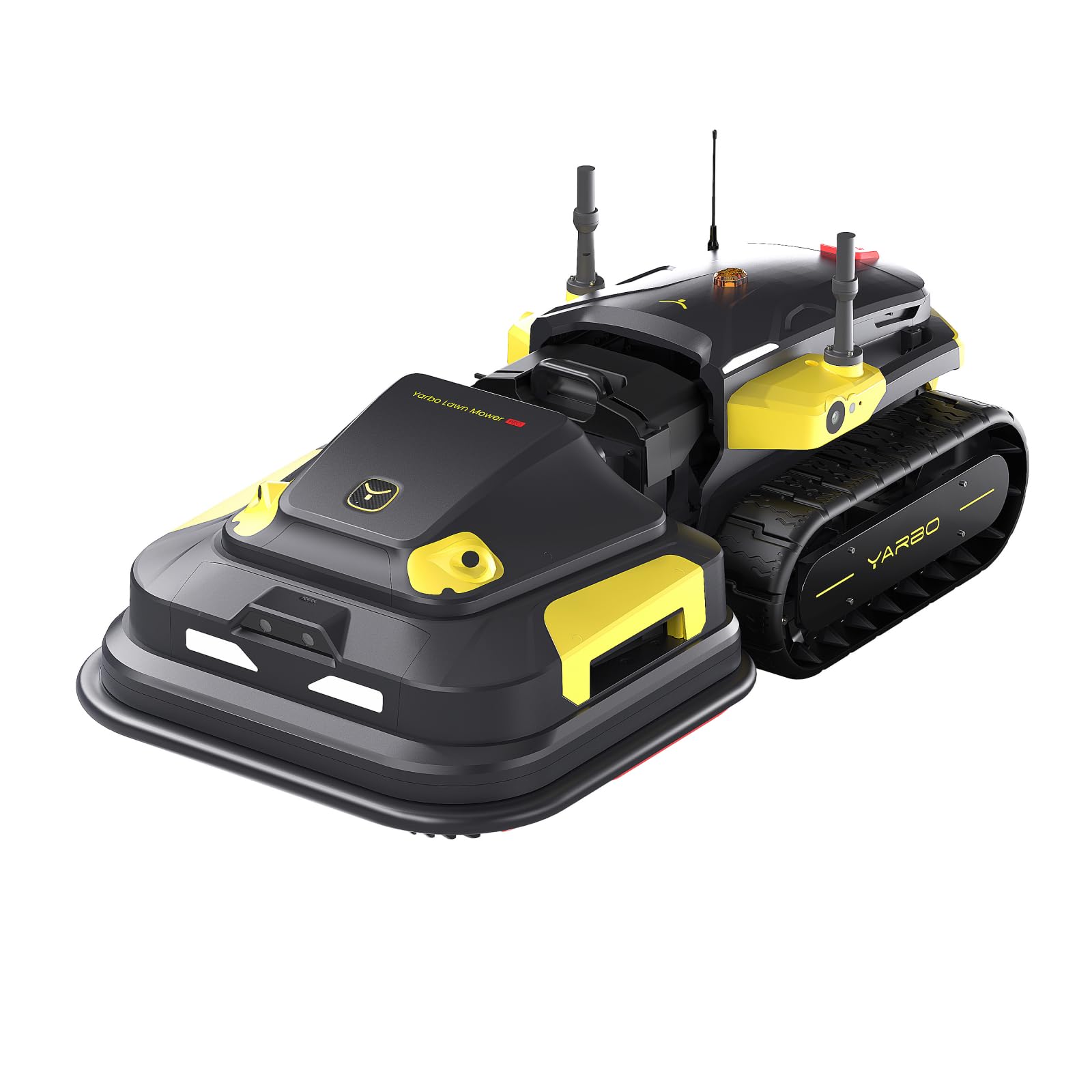
The YARBO Lawn Mower Pro is the only unit on this list with a modular design that allows component swaps and upgrades over time. The 300W dual-motor cutting system with optimized ejection prevents clogging even on wet, thick warm-season grasses. The 20-inch cutting width with razor and straight blade options handles both cool-season lawns and damp tropical turf. The triple-fusion navigation (RTK-GPS, binocular vision, PPVS multi-sensor) provides centimeter-level positioning with suspended obstacle detection from the binocular cameras. The multi-terrain tracks and all-steel skid shoes handle uneven, muddy, and stony yards with maximum 70% (35°) climbing gradient.
At 365 pounds and 200 lbs each across four boxes, this is a heavy-duty machine that requires a two-person assembly. The 120-minute battery runtime covers professional estate (6 acres with multiple recharge cycles) and golf course maintenance. The adjustable cutting height from 0.8 to 4.0 inches provides the widest range on this list, handling everything from golf green heights to rough pasture. The data center requires a 120-degree unobstructed sky view for satellite lock. The app provides full mapping, scheduling, and zone management with optional remote control sold separately.
Owner experiences reflect a machine that is powerful but not consumer-friendly. The assembly is complex and heavy—the unit ships in four separate packages that may arrive on different days. The RTK setup under heavy tree cover causes frequent map drift and signal loss. The support team is responsive but slow to resolve complex issues. When properly installed with a clear sky view and adequate research, the YARBO produces a professional-quality cut on very large properties. For owners who understand that this is a semi-permanent infrastructure investment requiring technical setup, the modularity and raw acreage coverage are unmatched. For casual buyers, the complexity will be overwhelming.
What works
- Modular design enables component upgrades over time
- 6-acre daily capacity for large commercial properties
- Triple-fusion navigation with suspended obstacle detection
What doesn’t
- Complex setup with heavy 365-pound multi-box shipping
- RTK signal drift under dense tree cover
- Customer support is slow for complex issues
Hardware & Specs Guide
Motor Wattage and Torque
The blade motor’s peak wattage determines whether a mower can power through thick, wet, or overgrown grass without stalling. Units in this category range from 1600W peak (Sunseeker X7, AIWEIYA) to dual 180W systems (Segway Navimow X430) and 300W dual motors (YARBO Pro). The critical spec is not just peak wattage but sustained torque delivery—the Segway’s 12 blades across two discs distribute cutting force more effectively than a single high-wattage motor spinning fewer blades. For properties with dense Bermuda or St. Augustine, prioritize dual-motor or multi-blade disc configurations over single-motor high-wattage claims.
Slope Grade and Traction Design
Slope rating is the most commonly exaggerated spec in this category. A mower rated for 70% slope (35 degrees) may handle it only on dry, compacted soil with new tires. Track-driven units (Lymow, AIWEIYA, YARBO) maintain traction on loose or wet slopes better than all-wheel-drive wheeled units. The key differentiator is independent hub motors versus single differential—independent motors (Mammotion, Segway) can spin opposite wheels in different directions for zero-turn pivot, while differential systems require wider turning radius and lose traction on uneven terrain. Always test the mower on your property’s steepest section during the return window.
LiFePO4 vs Lithium-Ion Chemistry
Battery chemistry is the most overlooked long-term cost factor in commercial robotic mowers. Standard lithium-ion batteries degrade after 500 to 800 charge cycles—about 2 to 3 seasons for a daily-mowing commercial unit. Lithium Iron Phosphate (LiFePO4) batteries, found in the Lymow, Mowrator, and YARBO, are rated for 2,000+ cycles with stable voltage output across the entire discharge curve. The trade-off is weight: LiFePO4 packs are heavier. For commercial operators planning 5+ years of service, the upfront premium for LiFePO4 pays for itself in avoided battery replacement costs of to per replacement.
Cutting Width and Deck Configuration
Wider cutting decks reduce mowing time but introduce two engineering challenges: deck flex on uneven ground and mulching quality at 17 to 21 inches. Floating decks (Sunseeker X7) adjust to ground contours across the full width, preventing scalping. Dual-disc designs (DREAME, Mammotion, Segway) split the cutting load across two independently suspended discs, reducing vibration and improving blade tip speed consistency. The best commercial decks use SK5 tool steel (Lymow) or manganese alloy blades that hold an edge longer than standard stamped steel—expect 3 to 4 times longer between blade changes with premium steel alloys.
FAQ
Can a commercial robotic mower handle a property with large trees that block GPS?
How much boundary wire do I need for a 1-acre lot with a wired robotic mower?
How do I prevent theft of a robotic mower left unattended?
Final Thoughts: The Verdict
For most commercial property owners, the commercial robotic lawn mower winner is the Mammotion LUBA 3 AWD 5000H because its tri-fusion navigation combines the reliability of LiDAR under trees with the centimeter precision of NetRTK in open areas. If you need extreme slope climbing on a 45-degree hill, grab the Lymow One Plus with its track drive system. And for all-season versatility that transitions from mowing to snow clearing, nothing beats the Mowrator S1 4WD.