
Finding chewed wires under the hood or droppings in the attic is a signal that rodents have decided your property is their shelter. A proper deterrent system uses sound, light, or a combination of both to make these spaces unappealing without relying on poisons or snap traps. The challenge is matching the right device type to the specific location and rodent pressure you are facing.
I’m Rikta — the co-founder and writer behind Lawn Gear Lab. I’ve spent hundreds of hours comparing ultrasonic frequencies, battery-life claims, and multi-mode logic in rodent repellers, cross-referencing published owner feedback to find the units that actually deliver measurable results.
After reviewing seven different models for coverage area, power-source flexibility, and real-world user outcomes, the model that rises to the top as the most versatile rat deterrent is the Loraffe Under Hood Animal Repeller for its smart vibration-sensing standby mode and dual-action ultrasonic and strobe approach.
How To Choose The Best Rat Deterrent
Choosing a rat deterrent requires understanding where the rodents are active, what power sources are available in that location, and how persistent the infestation is. The three pillars of selection are the sound frequency profile, the power-delivery method, and whether visual deterrence through strobe lights is necessary to overcome rodent habituation.
Frequency Range & Mode Switching
Rodents hear ultrasonic sound well above human hearing, typically 20 kHz to 60 kHz. Devices with a single fixed frequency allow rodents to acclimate over time. A deterrent that sweeps across frequencies or offers multiple operating modes — such as separate settings for insects versus heavy rodent pressure — forces the pests to keep reassessing the threat. Look for models that list their kHz range and offer at least two modes if your target is rats or squirrels.
Power Source & Placement
Plug-in units are ideal for indoor rooms, garages, and attics where an outlet is reachable. Battery-operated models are mandatory for engine compartments, sheds without electricity, and RVs in storage. Some premium units combine both options, accepting AA/C alkaline batteries alongside a USB or DC hardwire kit. For under-hood vehicle use, vibration-sensing standby is critical so the device pauses when the engine runs and reactivates only when the vehicle is parked.
Strobe Light Integration & Coverage
Ultrasonic sound alone can lose effectiveness if rodents burrow behind barriers. Adding a bright white strobe exploits their natural aversion to flashing light. The flash interval should be irregular to prevent habituation. Coverage area claims (typically 300 to 1600 square feet) are based on open space — real-world coverage in a cluttered attic or crowded engine bay will be lower. Positioning multiple units facing suspected entry points beats relying on a single high-power device.
Quick Comparison
On smaller screens, swipe sideways to see the full table.
| Model | Category | Best For | Key Spec | Amazon |
|---|---|---|---|---|
| Loraffe Under Hood Repeller | Battery + Strobe | Engine bay protection | 3x AA; 60-day runtime; auto standby | Amazon |
| BORHOOD 2-Pack | Multi-Source Power | Vehicle + indoor flexibility | 18-36 kHz; 3 power modes; 4-AA | Amazon |
| Jahy2Tech 2-Pack | 12V Hardwire | Permanent vehicle installation | 3 power methods; vibration detect | Amazon |
| Cvtayn 6-Pack | Plug-In Multi-Mode | Whole-home indoor coverage | 10-65 kHz; 3 modes; 1600 sq ft each | Amazon |
| TERMX UR02S | Plug-In 4 Mode | Attic and garage infestations | 4 modes; 360° cover; 9 LED array | Amazon |
| Ever Pest 2-Pack | Plug-In Basic | Entry-level indoor use | 1600 sq ft; EPA est; silent operation | Amazon |
| Angveirt Battery Unit | Battery-Powered Portable | Places without electricity | 25-55 kHz; 2-C; 65-day run; 300 sq ft | Amazon |
In‑Depth Reviews
1. Loraffe Under Hood Animal Repeller

The Loraffe combines fluctuating ultrasonic waves between 25 kHz and 55 kHz with twin LED strobe lights to target rats, squirrels, and chipmunks. Its defining advantage is the built-in vibration sensor that automatically puts the unit into standby when the engine starts, preserving battery life for the 60-day continuous runtime on three AA alkaline cells. The heat-resistant housing withstands engine-bay temperatures without degrading the electronics.
Installation requires no tools — the included heavy-duty zip ties secure the repeller to any harness or bracket under the hood. The strobe flash pattern is irregular, which reduces the risk of rodents becoming desensitized. Owners report that combining this device with Irish Spring soap chips creates a multi-sensory barrier that even persistent squirrels avoid.
The 300-square-foot coverage rating per unit is realistic for an engine compartment, and the low-battery warning beep is a practical touch that prevents silent failure. The main trade-off is that a single unit may not cover a large SUV engine bay fully — two units provide more reliable protection for larger vehicles.
What works
- Auto-standby vibration sensor saves batteries
- Heat-resistant construction survives engine bay
- Irregular strobe pattern deters habituation
What doesn’t
- Single unit may require supplement for large SUVs
- Batteries not included in the package
2. BORHOOD Ultrasonic Rodent Repellent 2-Pack

The BORHOOD stands out for its three-way power flexibility: it runs on four AA batteries, connects via USB to any 5V–12V adapter, or wires directly to a 12V vehicle power source with the included DC cable. This makes it equally viable for permanent under-hood installation and indoor room protection. The frequency sweep from 18 kHz to 36 kHz targets rats and squirrels while staying above the hearing range of most household pets.
Each unit in the pack combines ultrasonic output with a bright LED strobe, and the intelligent vibration sensor ensures the device pauses during driving and reactivates 90 seconds after the vehicle stops. Owners have reported zero rodent activity in garages and engine compartments for months after installation, with no traps or poisons needed as supplements.
The 0.35-pound weight and compact 4.5-inch height simplify mounting in tight engine bays. The 90-second reactivation delay prevents rapid cycling that could drain the batteries. Some users note that the strobe is visible from outside the hood, which may attract attention, though it does not affect performance.
What works
- Three power-source options for versatile placement
- Dual-action sound plus strobe for multi-sensory deterrence
- Sturdy build with reliable vibration detection
What doesn’t
- Strobe visible through grille on some vehicles
- AA batteries not included for battery mode
3. Jahy2Tech 2-Pack Under Hood Rodent Repeller

The Jahy2Tech delivers professional-grade deterrence with three distinct power-delivery methods: four AA batteries, a DC-to-USB cable, and a direct 12V vehicle power cable. This unit is designed for permanent installation in cars, trucks, and RVs that are used regularly. The variable-frequency ultrasound and high-intensity white strobe work together to create an environment that rodents find consistently uncomfortable.
A mechanical on/off switch with a power-on self-test gives confidence that the device is operational after installation. The vibration sensor shuts down the ultrasound when the engine starts, preventing battery drain. Owners report that these units eliminated rodent presence in the truck engine bay and garage after years of recurring damage, with one user repairing a failed capacitor by swapping to a 25V-rated replacement.
The 2-pack configuration covers two vehicles or a vehicle plus garage simultaneously. The strobe flash interval is roughly 110 seconds, which some users find too infrequent for rapid deterrence. A small number of reviews note that one unit in the pair arrived without audible output, though the strobe still functioned.
What works
- Three power sources (AA, USB, 12V) for permanent install
- Mechanical on/off switch with self-test
- Two-pack provides redundant coverage
What doesn’t
- Strobe flash interval may be too slow for some users
- Inconsistent audio output on isolated units
4. Cvtayn Upgraded Ultrasonic Pest Repellent 6-Pack

The Cvtayn 6-pack is built around a three-mode frequency logic: Blue Mode (10-15 kHz) targets mosquitoes and gnats, Yellow Mode (15-35 kHz) handles ants, cockroaches, and spiders, and Red Mode (35-65 kHz) is specifically tuned for heavy rat, mouse, and large bug infestations. Each plug-in unit covers up to 1600 square feet in open space, making the pack suitable for a whole-home deployment — one per room, placed 10–50 inches from the floor to target wall-dwelling rodents.
The absence of chemicals and silent operation make it safe for homes with children and pets, though the Red Mode produces an audible whine that owners should only activate when the house is empty. Power consumption is a modest 3–5 watts per unit, cheaper to run than a desk lamp. Owner reports confirm significant pest reduction within two to three weeks, with many noting that cockroach and mouse activity disappeared entirely after the initial adjustment period.
Each unit is compact at 2.05 by 1.38 by 3.23 inches and plugs directly into a standard wall outlet without occupying adjacent sockets. The primary limitation is that Red Mode is impractical for occupied rooms, and the device relies entirely on sound — there is no strobe light for visual deterrence.
What works
- Three distinct frequency bands for different pest types
- Six units cover an entire house at once
- Ultra-low power consumption (3-5W each)
What doesn’t
- Red Mode too loud for occupied rooms
- No strobe light for visual deterrence
5. TERMX UR02S Ultrasonic Pest Repeller Indoor

The TERMX UR02S packs four operating modes — Ultra, Trans, Duo, and a Sound Test mode — into a small 3.62-inch cube that sits flush against an outlet. Nine built-in LED lights create a 360-degree visual barrier that intensifies the ultrasonic output, especially effective in dark attics and garages where rodents feel secure. The 1290-square-foot coverage claim is reasonable for open indoor areas.
The Ultrasonic frequency disrupts rodent nervous systems without affecting cats or small dogs, and the absence of any refillable cartridges or traps makes it a set-and-forget solution. The Sound Test mode lets users verify the device is operational without straining to hear the ultrasound.
The plug-in nature limits placement to rooms with accessible outlets, and the 9-LED array draws slightly more power than a standard repellent. Some users report that heavy infestations require two units placed in opposite corners to achieve full attic coverage, but for single-room rodent problems, this device delivers fast results with minimal effort.
What works
- Four-mode logic adapts to different pest pressures
- 9-LED array provides visual deterrence in darkness
- Sound Test mode confirms operation
What doesn’t
- Requires wall outlet proximity
- Larger rooms may need two units
6. Ever Pest Ultrasonic Pest Repeller 2-Pack
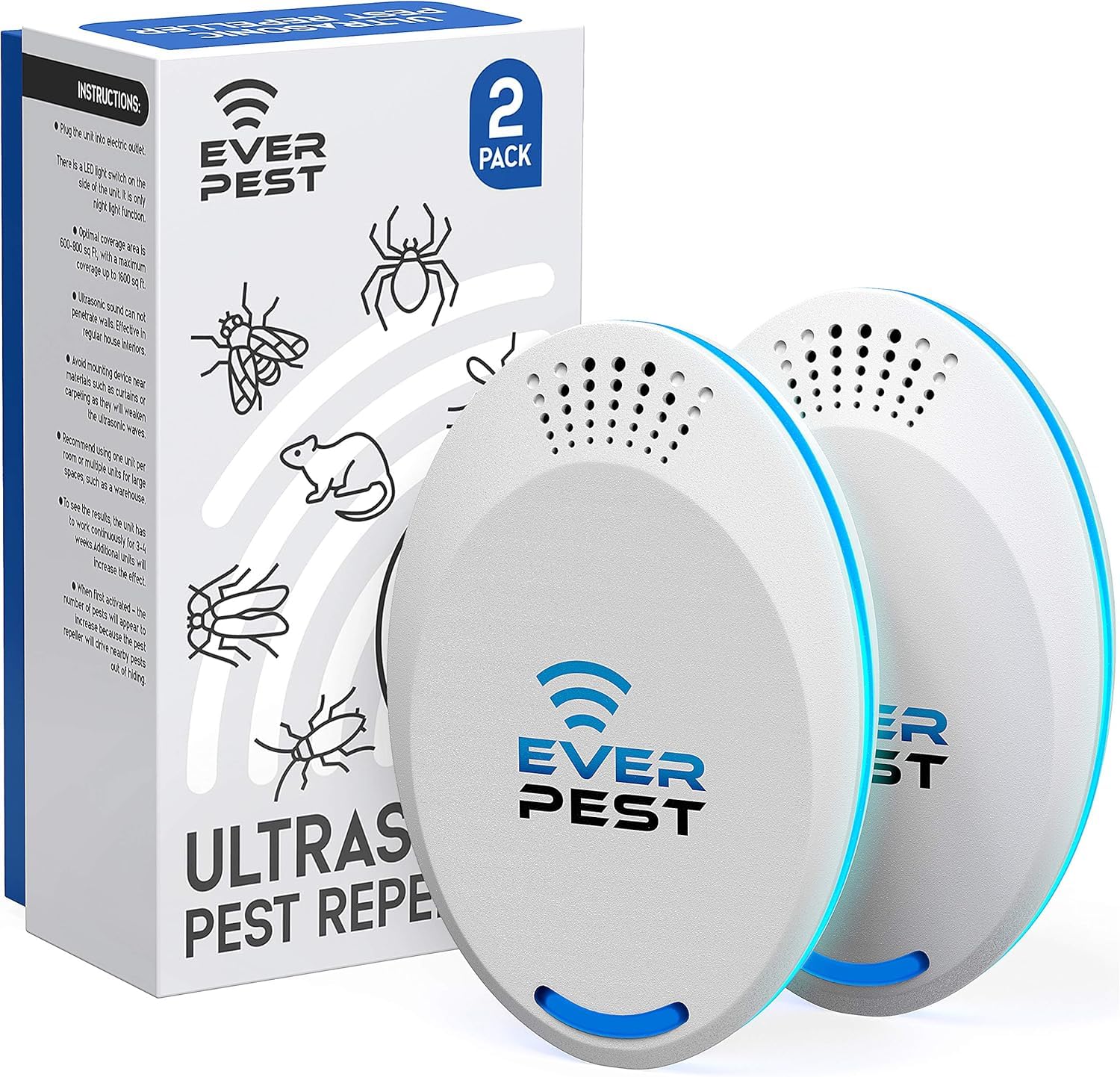
The Ever Pest 2-pack is a straightforward plug-in repellent that covers up to 1600 square feet per unit with a fixed ultrasonic output. The EPA establishment number (94950-chn-1) confirms regulatory compliance for a non-toxic device, and the lack of any refillable components means zero ongoing cost after purchase. Each unit operates silently and works with both 110V and 220V power, making it usable internationally.
Users report that placing these in laundry rooms and near washer-dryer setups eliminated the usual beetle and spider activity, and the discreet size means they do not attract attention. The primary appeal is simplicity — there are no modes to toggle, no batteries to replace, and no strobe lights that might annoy residents. It is a pure ultrasonic solution designed for entry-level prevention rather than heavy infestation.
Because the frequency is fixed, rodents can potentially acclimate over time, and the lack of a strobe means it relies entirely on sound to create discomfort. Owners with persistent rat problems may find the Ever Pest works best as a supplementary layer alongside traps or other deterrents rather than as a standalone solution.
What works
- Simple plug-and-forget operation with no refills
- EPA listed for verified non-toxic compliance
- Works on 110V and 220V for global use
What doesn’t
- Fixed frequency risks rodent acclimation
- No strobe light for visual deterrence
7. Angveirt Ultrasonic Rodent Repellent Battery Operated

The Angveirt is a battery-powered ultrasonic unit designed specifically for locations without electricity — attics, barns, RVs in storage, and car engine compartments. It runs on two C alkaline batteries for up to 65 days of continuous 24-hour operation, and the frequency sweeps from 25 kHz to 55 kHz to reduce acclimation. A white strobe light adds a visual component that works even in dark engine bays or unlit sheds.
With a coverage radius of 10 feet (roughly 300 square feet), this unit is best suited for targeted placement near suspected nesting areas rather than whole-room coverage. Owners who deployed four units in a stored trailer report zero rodent evidence after a full year of storage. The strobe and ultrasound combination proved effective where traditional snap traps had failed to clear an attic infestation within three days.
The main durability concern is that some units stop producing sound after about six months of continuous operation, though the strobe may continue to function. The plastic housing is adequate for indoor storage spaces but may degrade faster in direct engine-bay heat compared to heat-rated competitors. For seasonal use in a garage or RV, the battery life and portability make it a solid secondary deterrent.
What works
- Truly portable with 65-day battery runtime
- Sweeping frequency range reduces habituation
- Strobe adds visual deterrence for dark spaces
What doesn’t
- Some units lose ultrasonic output after 6 months
- Limited 300 sq ft coverage per unit
Hardware & Specs Guide
Frequency Range (kHz)
This is the single most important technical specification in any ultrasonic deterrent. A narrow fixed frequency (e.g., 25 kHz only) allows rodents to habituate — they learn the sound is harmless and ignore it. Sweeping-frequency devices that cycle between 20 kHz and 60 kHz force the rodent to constantly reassess the threat. For heavy rat or squirrel infestations, look for a model that offers at least a 20 kHz span within its sweep range.
Power Delivery & Standby Logic
How the device receives power determines where it can be used. Plug-in units (110V–240V AC) are best for indoor rooms and garages with accessible outlets. Battery units (AA, C, or D alkaline) are necessary for engine bays, sheds, and RVs. Premium models add a third option — a DC hardwire cable that connects directly to a 12V vehicle system. Vibration-sensing standby is critical for vehicle use: the device must pause when the engine runs to preserve batteries and resume automatically when the car is parked.
FAQ
Will an ultrasonic rat deterrent work through walls or solid barriers?
How long does it take for a rat deterrent to show results?
Final Thoughts: The Verdict
For most gardeners, the rat deterrent winner is the Loraffe Under Hood Animal Repeller because its auto-standby vibration sensing and dual ultrasonic-strobe action deliver reliable engine-bay protection without draining batteries. If you need whole-home coverage at a low operating cost, grab the Cvtayn 6-Pack for its three-mode frequency system that adapts to different pest types room by room. And for permanent 12V installation inside a truck or RV, nothing beats the BORHOOD 2-Pack with its triple power-source flexibility.