
A tired, weedy lawn doesn’t need more water—it needs the right chemistry. Whether you’re fighting broadleaf invaders, yellow patches from nitrogen deficiency, or fungal pressure during humid summers, the difference between a so-so yard and a thick green carpet comes down to the specific active ingredients and release technology you choose. This guide breaks down the seven most effective formulas available now, each chosen for a distinct real-world scenario.
I’m Rikta — the co-founder and writer behind Lawn Gear Lab. I’ve spent hundreds of hours cross-referencing NPK ratios, active herbicide compounds, slow-release mechanisms, and coverage claims across dozens of grass types to build this comparison.
If you need a single formula that knocks out weeds, feeds the turf, and won’t keep the family off the grass for days, you need the best grass treatment tailored to your specific lawn stress — and this guide walks you through every major option available today.
How To Choose The Best Grass Treatment
Choosing the wrong formula wastes money and can set your lawn back weeks. The three most critical factors are the active chemistry, the nitrogen release timing, and the coverage area per bag or bottle. Here is exactly what to check before you pour a single granule.
Active Ingredients: Herbicides vs. Fungicides vs. Straight Feed
A combination product like Scotts Turf Builder Weed and Feed uses 2,4-D and Mecoprop to kill broadleaf weeds while feeding the grass. A straight nitrogen booster like the Petramax 28-0-0 delivers zero weed control but fixes yellowing fast. A fungicide formula like the Scotts Healthy Plus adds disease prevention for brown patch and red thread. Match the chemistry to your lawn’s current problem — don’t use a weed killer on a lawn that only needs nitrogen.
Nitrogen Release: Quick, Slow, or Blended
Quick-release nitrogen greens the lawn within days but can cause a growth surge and burns if misapplied. Slow-release nitrogen (63% in the GreenView Fairway Formula, for example) feeds steadily over 8–12 weeks with no surge patterns. Blended formulas — 70% quick plus 30% slow, as in the Petramax — give you fast visible results plus sustained feeding. Hot-climate lawns with Bermuda or Zoysia benefit more from slow-release to avoid stress during peak heat.
Coverage Math and Application Method
A 33-lb bag covering 10,000 sq ft versus a 14-lb bag covering 5,000 sq ft changes your cost per square foot dramatically. Liquid concentrates require a sprayer and careful mixing ratios (5 oz per gallon for maintenance, 10 oz for deficiency correction). Granular formulas work with a broadcast spreader and need immediate light watering to activate. Choose based on your yard size and whether you already own a sprayer or spreader.
Quick Comparison
On smaller screens, swipe sideways to see the full table.
| Model | Category | Best For | Key Spec | Amazon |
|---|---|---|---|---|
| Petramax 28-0-0 | Nitrogen Feed | Deep greening | 70/30 quick/slow release | Amazon |
| Scotts Healthy Plus | Fungicide + Feed | Disease management | Controls 27 diseases | Amazon |
| GreenView Fairway | Slow-Release Granules | 12-week steady feed | 63% slow release nitrogen | Amazon |
| Scotts Weed & Feed | Weed + Feed Combo | Dandelion & clover control | Weedgrip Technology | Amazon |
| Spectracide Weed Stop | Broadleaf Herbicide | Large plot weed control | Covers 32,000 sq ft | Amazon |
| Bonide Chickweed Killer | Targeted Herbicide | Chickweed & clover elimination | Dicamba + Triclopyr | Amazon |
| Purely Organic Lawn Food | Organic Granules | Pet- and family-safe feed | 10-0-2 no phosphorus | Amazon |
In‑Depth Reviews
1. Petramax Liquid Nitrogen Fertilizer 28-0-0

This 32-ounce liquid concentrate delivers a 28-0-0 NPK ratio that is nearly pure nitrogen with zero phosphorus or potassium, making it the fastest path to deep green color on any grass type including Bermuda, Fescue, and Zoysia. The 70/30 split between quick-release and slow-release nitrogen means you see results in about three days while the slow portion keeps feeding for several weeks between applications. It treats up to 12,800 sq ft at maintenance rates or 6,400 sq ft for corrective applications, which is excellent value for a concentrated liquid.
The mixing ratio is straightforward — 5 oz per gallon for maintenance, 10 oz per gallon for nitrogen-deficient lawns. Users report that yellow turf turns a dark emerald green within a week of the first application, and the slow-release component prevents the dramatic growth surge that pure quick-release formulas cause. It works across warm- and cool-season grasses without risking the burn that high-nitrogen granular formulas sometimes produce when applied unevenly.
The only real drawback is that it offers zero weed control or disease prevention — this is a straight greening agent, not a multi-purpose treatment. You will need a separate herbicide or fungicide if your lawn has broadleaf weeds or fungal pressure. It also requires a sprayer, so if you don’t already own one, factor that into your total cost.
What works
- Fast visible greening within 3–5 days
- Dual-release technology prevents surge growth
- Generous coverage for the bottle size
What doesn’t
- No herbicide or fungicide built in
- Requires a sprayer for application
- Must measure carefully to avoid over-application
2. Scotts Turf Builder Healthy Plus Lawn Food

This 13.7-lb bag combines a broad-spectrum systemic fungicide with a lawn food formula, controlling 27 different turf diseases including brown patch, leaf spot, powdery mildew, and red thread while simultaneously feeding the grass. The fungicide component works preventatively and curatively, meaning you can apply it before disease symptoms appear during hot, humid weather or treat existing infections. It is designed specifically to help grass withstand summer stress when used as directed.
Application is simple with a standard broadcast spreader, and the granules require light watering to activate. Users in high-humidity zones report that a single application stopped spreading brown patch within a week while the grass visibly greened up. The dual-action approach eliminates the need for separate fungicide and fertilizer passes, saving time during the busy growing season. It works on all grass types, though sensitive varieties like St. Augustine should be monitored for any reaction.
The main limitation is the relatively small coverage area — 4,000 sq ft per bag — which means larger lawns will need multiple bags. The price per square foot is higher than a straight fertilizer, but that premium is justified if your lawn has a known disease history. Over-application can cause burn, as several users noted, so following the spreader settings precisely is critical.
What works
- Controls 27 fungal diseases in one pass
- Fertilizer component greens grass simultaneously
- Preventative and curative action
What doesn’t
- Only covers 4,000 sq ft per bag
- Higher cost per square foot than straight fertilizer
- Risk of burn if over-applied
3. GreenView Fairway Formula Lawn Fertilizer 33 lb

This 33-lb granular fertilizer uses a 27-0-5 NPK ratio with 63 percent of the nitrogen in slow-release form, continuously feeding the lawn for up to 12 weeks without the surge-and-dip pattern typical of cheaper fertilizers. The small blue granules make it easy to see where you’ve spread, reducing the risk of overlapping and burning. It covers a full 10,000 sq ft, making it a strong choice for medium to large lawns where weekly fertilizing would be impractical.
The slow-release technology is the star here — it provides steady nutrition that produces dark green color without forcing the rapid leaf growth that requires frequent mowing. Users consistently report that the lawn looks healthy and dark within a week of application and stays that way for two to three months. It contains no phosphate, which is beneficial for waterways and complies with phosphate-restricted regions. It works on all grass types, including Bermuda, Centipede, and Fescue.
Because this is a straight fertilizer with no herbicide, it won’t control existing weeds. The granules also need to be watered in thoroughly after application, which can be a challenge during dry spells. The 33-lb bag is heavy, so handling and storing it requires some physical effort.
What works
- 12-week feeding with no growth surge
- Visible blue granules prevent overlapping
- No phosphate protects waterways
What doesn’t
- No weed control built in
- Requires thorough watering to activate
- Heavy bag is hard to maneuver
4. Scotts Turf Builder Weed and Feed 3
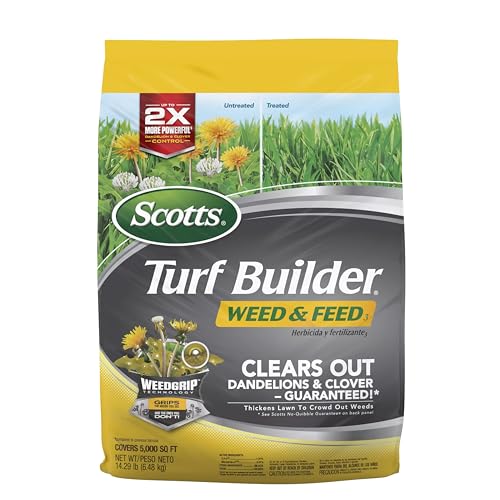
This 14.3-lb granular formula combines the herbicides 2,4-D and Mecoprop with a balanced fertilizer to kill broadleaf weeds like dandelions and clover while feeding the surrounding grass. Scotts claims this is their most powerful weed-and-feed formula, with Weedgrip Technology that helps the granules stick to weed leaves even when they are slightly dry. It covers 5,000 sq ft per bag, which is appropriate for standard suburban lots.
Users consistently report that dandelions wilt within a few days and the grass greens up noticeably within a week. The dual action is convenient — one pass with a spreader handles both weed control and fertilization, saving a weekend chore. The granules need to land on wet weeds for the herbicide to stick, so timing the application after a rain shower or morning dew is important. Many users highlight that it is more effective on dandelions than on clover or crabgrass.
The biggest complaint is that it does not control crabgrass or nutsedge, so weed types beyond broadleaf require a separate product. Over-application can cause burn spots, particularly if granules accumulate in low areas or if you water too soon after spreading. The 5,000 sq ft bag means larger lawns will need multiple units, raising the total cost.
What works
- Powerful dandelion and clover control
- Fertilizer component greens the lawn
- Weedgrip Technology improves adherence
What doesn’t
- Ineffective on crabgrass and nutsedge
- Risk of burn if over-applied
- Requires wet leaves for best results
5. Spectracide Large Plot Weed Stop for Lawns

This 1-gallon liquid concentrate from Spectracide is engineered for large properties, treating up to 32,000 sq ft of northern grasses or 42,500 sq ft of southern grasses per bottle. It kills more than 200 types of broadleaf weeds including dandelion, chickweed, and clover while leaving the lawn unharmed when used as directed. The formula is rainproof in just six hours, so you don’t have to stress about unexpected showers washing away the active ingredients.
Users praise the fast-acting results — visible wilting often appears within 24 hours on sensitive weeds like dandelion and dollar weed. The large coverage area makes it particularly cost-effective for owners of one-acre or larger lots who would otherwise go through multiple small bottles. It requires a tank sprayer and careful mixing, but the instruction label is clear with specific oz-per-gallon ratios for different weed types.
The primary limitation is that some tough weeds like fox tail and bull head sticker weed require increased dosage or multiple applications. A few users noted that the “results in hours” claim is optimistic; most see visible effects in 24–48 hours, with full kill taking up to a week. The concentrate is also heavy at 8.99 lbs for a gallon bottle, so maneuvering it during mixing takes some effort.
What works
- Massive coverage for large properties
- Rainproof in 6 hours
- Fast visible results on soft weeds
What doesn’t
- Requires tank sprayer for application
- Tough weeds may need multiple treatments
- Heavy bottle is cumbersome to pour
6. Bonide Chickweed, Clover & Oxalis Killer 128 oz

This ready-to-use 128-oz spray targets chickweed, clover, and oxalis specifically with a combination of Dicamba and Triclopyr, two systemic herbicides that travel to the root system for complete kill. The 10,000 sq ft coverage per bottle makes it a practical choice for medium-sized yards where clover and chickweed are the primary invaders. Users report that the product is nearly odorless and clear, making application more pleasant than sulfur-based weed killers.
Effectiveness on chickweed and dandelions is consistently rated highly, with visible wilting seen within 24 hours on small weeds. The systemic action means the weed doesn’t just burn top growth — it dies from the root, reducing regrowth. The ready-to-use format eliminates mixing guesswork and is ideal for spot-treatment rather than full-lawn broadcasting. Users recommend using a pump sprayer for large areas, as the included hand sprayer is adequate for small patches but tiring for full coverage.
The major failure point reported is inconsistent results on clover. Several users found that heavy clover patches only showed minor leaf discoloration without complete kill, requiring additional applications or a different product. It also does not control crabgrass or nutsedge. The price per square foot is higher than concentrate options, so large-lot owners may find it cost-prohibitive.
What works
- Systemic root-kill on chickweed
- Ready-to-use with no mixing
- Nearly odorless formula
What doesn’t
- Inconsistent results on heavy clover
- Hand sprayer is poor for large areas
- Higher per-square-foot cost than concentrate
7. Purely Organic Products Lawn Food 10-0-2

This 15-lb bag of granular lawn food uses a plant-based formula built from distillers grains and soy, with a 10-0-2 NPK ratio that contains no phosphorus and no harsh chemicals. It is designed for homeowners who want a lush lawn without exposing pets, children, or local waterways to synthetic inputs. The manufacturer states there are no restrictions on re-entry time after application — meaning kids and dogs can walk on the lawn immediately.
Users in Florida and other hot climates report that this organic fertilizer turned yellow, stressed grass dark green within four days without any burning. The lack of manure or biosolids means there is no unpleasant smell, which is a common complaint with other organic fertilizers. It is safe for pets including dogs, horses, and chickens, and it complies with municipal phosphate restrictions that limit runoff into local water sources. It covers 3,000 sq ft per bag.
The primary trade-off is the lower nitrogen content compared to synthetic options — 10 percent versus 28 or 27 percent. This means the greening effect is gentler but also slower, and you will need more frequent applications to maintain the same deep color. The 3,000 sq ft coverage is also relatively small, so owners of large lawns will need multiple bags to achieve full coverage.
What works
- Safe for pets and children immediately after application
- No smell from manure or biosolids
- Plant-based formula with no phosphorus
What doesn’t
- Lower nitrogen content than synthetics
- Only covers 3,000 sq ft per bag
- Slower greening effect
Hardware & Specs Guide
Nitrogen Release Technology
The speed at which nitrogen becomes available to grass roots determines both how fast the lawn greens and how long the effect lasts. Quick-release nitrogen (ammonium nitrate, urea) shows results in 2–3 days but can burn turf and causes growth surges. Slow-release nitrogen (sulfur-coated urea, polymer-coated) feeds evenly over 8–12 weeks. Blended products like the Petramax offer a middle ground with 70% quick and 30% slow, giving you speed without the surge. For warm-season grasses in hot climates, higher slow-release percentages reduce stress during peak summer heat.
Herbicide Active Ingredients
The specific chemical compounds in a weed-control formula determine which weeds die and whether the grass survives. 2,4-D is a selective broadleaf herbicide effective on dandelions, clover, and chickweed — it is the most common active ingredient in consumer weed-and-feed products. Dicamba travels deeper into the root system and handles tougher perennial broadleaf weeds. Triclopyr is more effective on woody vines and brush but also works on clover and oxalis. Products with a single active ingredient may miss certain weed types, while combination formulas (2,4-D + Mecoprop, for example) provide broader spectrum control.
FAQ
How long does grass treatment take to show visible results?
Can I use a grass treatment with high nitrogen on St. Augustine grass?
What does NPK ratio mean on a grass treatment bag?
Final Thoughts: The Verdict
For most gardeners, the best grass treatment winner is the Petramax Liquid Nitrogen 28-0-0 because its 70/30 dual-release technology delivers fast visible greening without the growth surge or burn risk of pure quick-release formulas. If you need disease control in humid climates, grab the Scotts Healthy Plus for its 27-disease fungicide built into a lawn feed. And for a pet-safe, family-friendly option with no smell, nothing beats the Purely Organic Lawn Food 10-0-2.