
Nothing signals defeat like watching an evergreen turn brown from the inside out, its needles stripped by bagworms you never saw coming. These camouflaged caterpillars build protective silk cases and feed relentlessly, often killing trees before the homeowner even notices the infestation. The right spray, applied at the correct larval stage, is the only reliable defense.
I’m Rikta — the co-founder and writer behind Lawn Gear Lab. I’ve spent countless hours cross-referencing active ingredient concentrations, application guidelines, and verified owner reports to build a clear, spec-first comparison of the most effective bagworm sprays on the market.
Understanding which formulation — B.t., spinosad, or bifenthrin — works best for your tree size and infestation level is the core mission of this guide to the bagworm spray landscape.
How To Choose The Best Bagworm Spray
Selecting a bagworm spray isn’t about picking the strongest chemical — it’s about matching the active ingredient to the infestation stage and your garden’s ecosystem. Early instar larvae are vulnerable to biological controls, while mature bagworms require synthetic pyrethroids. Here are the key factors to consider.
Active Ingredient: Biological vs. Synthetic
Bacillus thuringiensis (B.t.) is a soil bacterium that targets only leaf-feeding caterpillars. It paralyzes the gut of young bagworms within hours but degrades in sunlight within days. Spinosad, also OMRI-listed, works through contact and ingestion on a broader pest spectrum. Bifenthrin, a synthetic pyrethroid, provides residual protection lasting weeks and kills mature bagworms on contact but also affects beneficial insects.
Concentration and Coverage Volume
A 8-ounce concentrate mixed at 4 tablespoons per gallon may cover only a few small ornamentals, while a 32-ounce hose-end formula can treat multiple mature evergreens in a single session. Match the bottle size to your tree canopy — one large Colorado blue spruce may require several gallons of mixed solution to achieve thorough wetting.
Application Method and Timing
Hose-end sprayers are ideal for tall trees because they mix automatically and provide pressure to reach upper branches. Trigger or pump sprayers work for smaller shrubs but require pre-mixing and a ladder. Regardless of method, apply when larvae are actively feeding in late spring to early summer — waiting until bags are over an inch long drastically reduces efficacy.
Quick Comparison
On smaller screens, swipe sideways to see the full table.
| Model | Category | Best For | Key Spec | Amazon |
|---|---|---|---|---|
| BioAdvanced Tree & Shrub | Synthetic | Mature trees, fast knockdown | Rainproof in 1 hour | Amazon |
| Fertilome Spinosad | Biological | Organic orchards, bagworms + tent caterpillars | 4 Tbsp per gallon mix rate | Amazon |
| Monterey B.t. | Biological | Targeted caterpillar control, bee safety | OMRI Listed, 8 oz concentrate | Amazon |
| Monterey Spinosad | Biological | Broad-spectrum on vegetables + ornamentals | Odorless, OMRI Listed | Amazon |
| Wisdom Pro Bifenthrin | Synthetic | Heavy infestation, long residual | 7.9% bifenthrin concentrate | Amazon |
| Summit Caterpillar Control | Biological | Large areas via hose-end, early instar larvae | 32 oz hose-end concentrate | Amazon |
In‑Depth Reviews
1. BioAdvanced Tree & Shrub Insect Killer

BioAdvanced’s ready-to-spray formula hits the sweet spot for homeowners who need fast knockdown on mature trees without spending an afternoon mixing concentrates. The 32-ounce bottle connects directly to a garden hose, automatically diluting as you spray, and covers substantial canopy height thanks to the hose pressure. Owners report seeing a dramatic reduction in beetle and caterpillar activity within 48 hours, and the 2-week residual protection means you don’t need to reapply after every rain shower.
The active ingredient works by contact and ingestion, making it effective against bagworms that have already sealed themselves into their silk cases. Users with dogwood trees and red maples noted leaves returned to full, undamaged growth after a single application in late spring. The rainfast claim holds up well — one hour of dry time is enough to lock the chemical onto foliage through moderate precipitation.
Where this product separates itself is convenience and coverage density. The hose-end delivery ensures penetration into dense inner branches where bagworms hide, and the long-lasting barrier reduces the treatment window pressure. It is a synthetic formulation, so it will impact non-target insects upon direct contact, but targeted spraying on affected trees limits collateral damage.
What works
- Hose-end application reaches tall evergreens easily
- Kills bagworms on contact and provides 2-week residual
- Rainproof after just 60 minutes
What doesn’t
- Synthetic chemistry affects beneficial insects on contact
- Bottle is single-use; no mixing for spot treating
2. Fertilome Spinosad Insecticide

Fertilome’s spinosad concentrate is engineered for growers who need organic compliance without sacrificing spectrum — it labels bagworms, tent caterpillars, leafminers, and even Colorado potato beetles under a single OMRI-listed product. The 16-ounce bottle offers more total active ingredient than smaller 8-ounce spinosad competitors, translating into more mixed gallons per purchase. Owners with apple orchards report a direct correlation between application and increased fruit yield due to reduced caterpillar pressure.
The mixing ratio of 4 tablespoons per gallon of water creates a solution that works through both contact and ingestion. Spinosad is a bacterial fermentation byproduct that degrades in 24 to 48 hours under direct sunlight, but users found that weekly reapplication during the bagworm hatch window kept trees completely clean. The product excels on evergreens where bagworms first appear, and several owners verified its effectiveness on arborvitae and juniper specifically.
Homeowners spraying around the perimeter of their house and yard also noted secondary suppression of crickets and ants. The concentrate form means you can tailor the volume to exactly match your tree size — mix a single gallon for a small ornamental or batch five gallons for a row of mature spruce. The included measuring spoon removes guesswork from the dilution process.
What works
- OMRI-listed for organic production
- Controls bagworms plus a wide range of chewing pests
- Concentrate dilution lets you match volume to tree size
What doesn’t
- Sunlight degrades residue quickly; needs weekly reapplication
- Must be mixed and applied with a pump or backpack sprayer
3. Monterey B.t. Caterpillar & Worm Killer
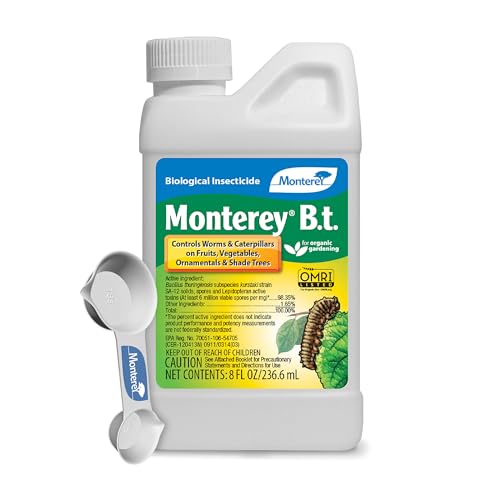
Monterey B.t. is the go-to choice when preserving pollinator populations is non-negotiable. The active ingredient, Bacillus thuringiensis kurstaki, produces a protein crystal that only breaks down in the alkaline gut of caterpillars — it leaves honeybees, ladybugs, and earthworms completely unharmed. Owners with vegetable gardens and flowering ornamentals consistently report that this product cleared cabbage loopers and bagworms while bees continued foraging on treated plants the same day.
The 8-ounce concentrate mixes instantly with water and is best applied with a trigger or pressure-tank sprayer. It is most effective when sprayed during the early instar stage, when bagworms are less than half an inch long and actively feeding. Users with Texas Mountain Laurel noticed a rapid cessation of leaf damage within 48 hours. The product washes off easily, so rainfall within 24 hours necessitates reapplication, but the safety profile makes up for the shorter residual window.
Owners using B.t. for consecutive seasons observed a gradual decline in native caterpillar populations, which is a factor to weigh if you support specific butterfly species. However, for targeted bagworm control on shade trees and ornamentals, Monterey B.t. delivers surgical precision with zero chemical aftertaste on edible crops.
What works
- Zero impact on honeybees, earthworms, and birds
- Safe to spray on vegetables up to harvest day
- OMRI-listed for certified organic gardens
What doesn’t
- Only effective on very young, actively feeding larvae
- Washes off easily; requires dry weather for 24 hours
4. Monterey Spinosad Insecticide
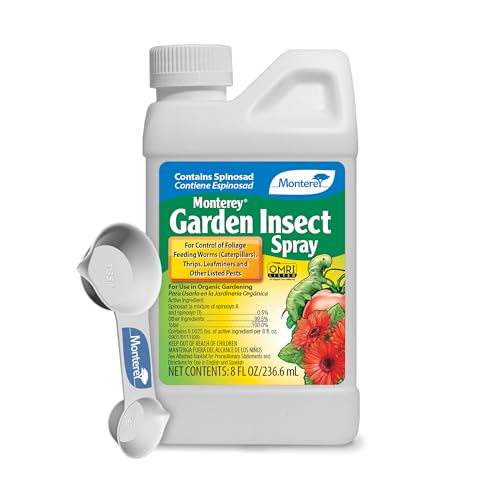
Monterey’s spinosad formulation provides organic gardeners with a broader target range than B.t. alone. While B.t. only affects caterpillars, spinosad kills thrips, leafminers, borers, codling moths, and fire ants alongside bagworms. Owners with rose bushes plagued by sawfly caterpillars found complete control after a single application, and vegetable growers praised its ability to stop leafminer tunnels that other sprays missed.
The 8-ounce concentrate mixes at a lower rate than some competitors — roughly 2 to 4 tablespoons per gallon depending on pest pressure — making the bottle last several treatment cycles. The odorless formula is a practical advantage when spraying near patios or windows. Users noted that weekly reapplication was necessary to break the life cycle of persistent pests like leafminers, but after two months of consistent use, new damage stopped entirely.
One trade-off is that spinosad is toxic to bees while wet, so evening application after flowers have closed is mandatory. Owners also observed that it did not eliminate mature bagworm cases as quickly as a synthetic pyrethroid, but for early-season preventive sprays in an organic system, it offers a strong balance of efficacy and environmental profile.
What works
- Controls a wider pest range than B.t. including leafminers and thrips
- Odorless and OMRI-listed for organic gardens
- Effective on contact for fast knockdown of soft-bodied larvae
What doesn’t
- Toxic to bees while wet; must spray at dusk
- Requires weekly reapplication during heavy infestations
5. Wisdom Pro L&H 7.9% Bifenthrin Concentrate

Wisdom Pro is the heavy artillery in this lineup, designed for situations where bagworm populations have exploded and biological controls aren’t cutting it. The 7.9% bifenthrin concentration is significantly higher than consumer-grade home defense sprays, and the quart-sized concentrate yields dozens of gallons of finished solution. Owners with large properties reported that a single quart lasted an entire season, even with monthly perimeter treatments against ants, mosquitoes, and bagworms.
The sodium channel modulator mode of action paralyzes insects on contact, and the residual activity on foliage extends past two weeks. Users verified that mature bagworms stopped feeding and dropped from trees within 24 hours of spraying. The product is labeled for use on ornamentals and lawns, making it versatile for treating both the tree canopy and the ground below where falling larvae may crawl. Owners also noted dramatic suppression of fire ants and spiders around the home foundation.
Because bifenthrin is a broad-spectrum synthetic pyrethroid, it does not discriminate between pests and beneficials. Spraying flowering plants during bloom will kill foraging bees. However, for a late-season rescue treatment when bagworms have already caused visible defoliation, Wisdom Pro delivers the fastest knockdown and longest protection of any product reviewed here.
What works
- Fast knockdown of mature bagworms within 24 hours
- Residual activity lasts weeks on foliage
- Quart concentrate provides high value per mixed gallon
What doesn’t
- Broad-spectrum toxicity kills beneficial insects and bees
- Professional-grade concentration requires careful measuring
6. Summit Caterpillar and Webworm Control

Summit’s hose-end concentrate delivers the largest volume in this roundup — a full 32 ounces — at a price point that undercuts most 8-ounce biological competitors. The B.t.-based formula connects directly to a garden hose and automatically dilutes as you spray, covering acres of canopy in a single session. Owners battling gypsy moth and bagworm outbreaks over several seasons confirmed that consistent application during the critical instar window led to complete tree recovery.
The liquid is safe for use on vegetables up to harvest day, with several owners reporting effective control of tomato hornworms and cabbage loopers alongside bagworms on adjacent trees. The 2.2-pound bottle has significant heft, and the hose-end mechanism provides enough pressure to reach 20-foot-tall branches without a ladder. Users noted that the product requires patience — B.t. does not kill overnight — but after 4 to 7 days, feeding damage stops completely.
One ecological consideration raised by a long-term user was a noted decline in native butterfly and moth species after two consecutive years of heavy B.t. application. While the product is caterpillar-specific, overspray on host plants does reduce non-target lepidoptera populations. For targeted, short-duration bagworm suppression, however, Summit offers unmatched coverage value.
What works
- Largest concentrate volume (32 oz) at the lowest cost
- Hose-end system covers tall trees without a sprayer
- Safe for vegetables and harmless to birds/earthworms
What doesn’t
- Slow action — takes days to see feeding stop
- May impact non-target caterpillars like butterfly larvae
Hardware & Specs Guide
Bacillus thuringiensis (B.t.)
B.t. produces a protein crystal that dissolves only in the alkaline midgut of caterpillars. Once ingested, it paralyzes the gut, stopping feeding within hours. Larvae die within 2 to 5 days. B.t. degrades rapidly in UV light, so apply in the evening and expect a residual window of only 24 to 48 hours. It is completely harmless to mammals, birds, bees, and earthworms.
Spinosad
Derived from the fermentation of Saccharopolyspora spinosa, spinosad excites the nervous system of insects, causing involuntary muscle contractions, paralysis, and death. It works via contact and ingestion and breaks down in sunlight within 24 to 48 hours. OMRI-listed spinosad is toxic to bees while wet but safe for organic vegetable production up to harvest day.
Bifenthrin
A synthetic pyrethroid that modulates sodium channels in insect nerve axons, causing rapid paralysis. Bifenthrin provides 2 to 4 weeks of residual protection on foliage and is rainfast after one hour. It is non-selective — kills all insects on contact — so use only on infested trees and avoid spraying flowers in bloom. Labeled for outdoor ornamentals, lawns, and building perimeters.
Hose-End vs. Pump Sprayer Application
Hose-end sprayers (like Summit and BioAdvanced) automatically mix concentrate with water using siphon action, delivering high volume under pressure — ideal for trees over 15 feet tall. Pump sprayers require pre-mixing in a tank and manual pressurization, giving you precise control over droplet size and coverage concentration, but limited reach without a ladder. Choose hose-end for canopy coverage; choose pump for spot-treating individual branches.
FAQ
Can bagworm spray penetrate the silk bags?
How many gallons of mixed spray do I need per tree?
Is spinosad or B.t. better for bagworms?
Final Thoughts: The Verdict
For most gardeners, the bagworm spray winner is the BioAdvanced Tree & Shrub Insect Killer because its hose-end application and rainproof residual make it the most practical choice for homeowners with multiple tall evergreens. If you need an OMRI-listed organic option that covers bagworms plus a broader pest range, grab the Fertilome Spinosad. And for a fast-working rescue treatment when bagworms have already reached damaging size, nothing beats the Wisdom Pro Bifenthrin.