
Succulents stretch, fade, and lose their compact rosette form when denied the right light spectrum indoors. Standard household bulbs lack the photosynthetic photon flux density (PPFD) needed to keep Echeveria, Haworthia, and Crassula species from becoming leggy. A purpose-built LED array delivering the correct Kelvin temperature and daily light integral (DLI) is not a luxury — it is the only way to replicate the high-irradiance conditions succulents evolved under.
I’m Rikta — the co-founder and writer behind Lawn Gear Lab. I’ve spent many hours cross-referencing spectral output charts, PPFD zonation data, and timer-cycle reliability across dozens of models to isolate the fixtures that actually prevent etiolation in common indoor succulent collections.
This guide covers seven distinct options, from clamp-on units to freestanding towers, each evaluated on the specific metrics that matter to succulent growers: manageable heat emission, adjustable mounting, and adequate DLI for compact growth across the grow light for succulents category.
How To Choose The Best Grow Light For Succulents
Succulents demand high PPFD at close proximity — typically 300–600 µmol/m²/s at a 6–12 inch distance — to maintain compact internodal spacing and vibrant leaf pigmentation. Choosing the wrong fixture leads to either etiolation from insufficient light or leaf scorch from excessive heat. Focus on three decision points: spectral composition, timer flexibility, and fixture form factor relative to your shelf depth.
Spectral Composition — Full Spectrum vs. Blurple
White full-spectrum LEDs (3000K–5000K) with supplementary red (660nm) and far-red diodes support both photosynthesis and color rendering, making it easier to spot pest issues or nutrient deficiencies on succulent leaves. Blurple panels (red+blue only) can drive growth but make visual inspection difficult and are less pleasant in living spaces. For succulents, a natural white spectrum at 4000K–5000K with a CRI above 80 is the practical sweet spot.
Heat Output and Canopy Distance
Succulent leaves are fleshy and prone to thermal damage when a fixture runs hot. LEDs that dissipate heat through aluminum heat sinks or ceramic bodies allow placement as close as 4–6 inches without burning the apex. Fixtures that exceed 40°C at the lens surface require a wider gap, reducing PPFD at the canopy. Check the fixture’s actual power draw versus equivalent wattage — a 20W real-draw LED running cool will outperform a 50W equivalent that runs hot.
Timer and Duty Cycle Reliability
Succulents need a consistent photoperiod — typically 12–16 hours daily — to maintain their CAM-cycle metabolism. Fixtures with mechanical or digital auto timers that remember the cycle after a power outage prevent erratic dark periods. Look for models offering 4/8/12-hour preset cycles or a memory function that retains the last schedule; resetting timers daily defeats the purpose of automation.
Quick Comparison
On smaller screens, swipe sideways to see the full table.
| Model | Category | Best For | Key Spec | Amazon |
|---|---|---|---|---|
| Barrina Standing | Standing / Hanging | Tall shelves & side illumination | 20W, 660nm red chips, CRI 89 | Amazon |
| FECiDA Gamechanger 4‑Head | Clip Desk | High PPFD for compact succulents | 36W draw, 168 LEDs, 20H timer | Amazon |
| Orchbloom Desk 4‑Head | Desk / Tabletop | Adjustable height bench use | 36W draw, 16–24″ height, gooseneck | Amazon |
| Wiaxulay 78 LED 2‑Pack | Desk / Tabletop | Dual‑unit setups, dark corners | 78 LEDs, 5 dimmable levels, metal base | Amazon |
| SANSI Dual Gooseneck Clip | Clip / Gooseneck | Lifetime free bulb replacement | 20W total, 2000LM, PAR20 replaceable bulb | Amazon |
| FECiDA Desk Tabletop | Desk / Tabletop | Daisy‑chain multiple units | 25W draw, 2000LM, daisy chain 4 units | Amazon |
| SANSI Pot Clip 2‑Pack | Pot Clip | Small single‑pot succulents | 5W each, 4 dim levels, ceramic tech | Amazon |
In‑Depth Reviews
1. Barrina Standing Grow Light

The Barrina Standing Grow Light differentiates itself with a vertical standing design that casts side illumination across a 2‑ft span, covering multiple succulent pots without the harsh spotlight effect common in downward‑facing heads. The 75‑LED array includes dedicated 660nm red chips — a wavelength that drives compact internodal spacing — wrapped in a warm‑white spectrum with a CRI of 89, making it easy to monitor leaf color for early signs of overwatering or pest stress.
At a 20W actual power draw, the fixture runs cool enough to place within 6 inches of Echeveria rosettes without scorching the leaf tips. The ultra‑thin base with non‑slip pads holds steady on standard plant stands, and the fixture also ships with hanging clips for suspending above a shelf. Owners consistently report that Monstera and succulents alike show visibly tighter growth within two weeks under this unit, and the lack of a built‑in timer is the only workflow friction — easily solved by pairing the light with an external smart plug for 12‑hour photoperiods.
For a single‑fixture setup that delivers uniform PPFD across a 2‑ft by 1‑ft footprint, the Barrina stands as the most versatile option in this guide. The 2‑year manufacturer warranty adds security for a fixture that runs 14–16 hours daily. If you need a timer integrated into the light itself, consider the Orchbloom or FECiDA Gamechanger instead.
What works
- Excellent CRI 89 for accurate color monitoring
- Cool operation allows 6″ canopy distance
- Vertical side aim prevents hot‑spot burn
What doesn’t
- No integrated auto timer
- Not dimmable for low‑light transitions
2. FECiDA Gamechanger 4‑Head Clip
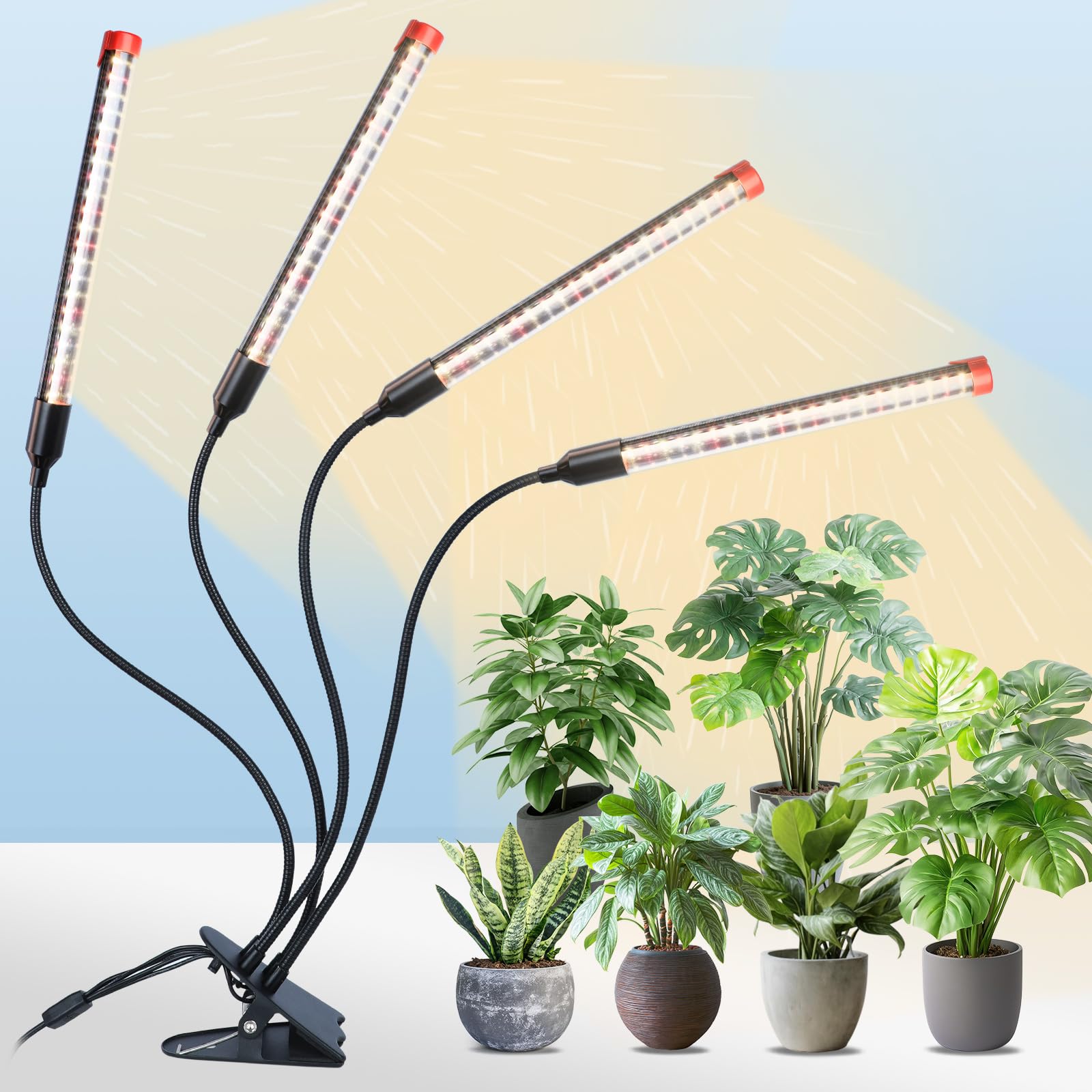
FECiDA’s Gamechanger lives up to its name by delivering a 36W actual draw from 168 high‑efficacy LEDs through a 4‑head clip design — no external adapter required, which eliminates a common point of failure in competing units. Each head articulates independently via 360° goosenecks, allowing the grower to aim individual beams at specific succulent groupings across a wide shelf without moving the central clamp.
The timer system offers five presets — 4, 8, 12, 16, and 20 hours — by pressing combination buttons (4+12 for 16H, 8+12 for 20H), a clever mechanical approach that avoids drifting digital clocks. Real‑world owners report that this fixture dramatically reduces etiolation in Haworthia and Echeveria within three weeks, with no adapter‑related failures over months of daily use. The full‑spectrum light appears natural white to the eye, making it suitable for open shelving in living spaces.
One trade‑off: the clamp’s grip strength is built for thin desktops and shelf edges up to about 2 inches, so mounting on thick wooden plant stands may require a different solution. The fixed height of the gooseneck means you cannot raise the whole fixture — you must angle the heads individually. For a high‑output, no‑adapter clip light with an extensive timer range, this is the strongest contender for dense succulent propagation.
What works
- 36W true draw with 168 LEDs
- 20‑hour max timer for long photoperiods
- No separate AC adapter to fail
What doesn’t
- Clamp thickness limit around 2″
- Fixed overall height via gooseneck only
3. Orchbloom Desk 4‑Head
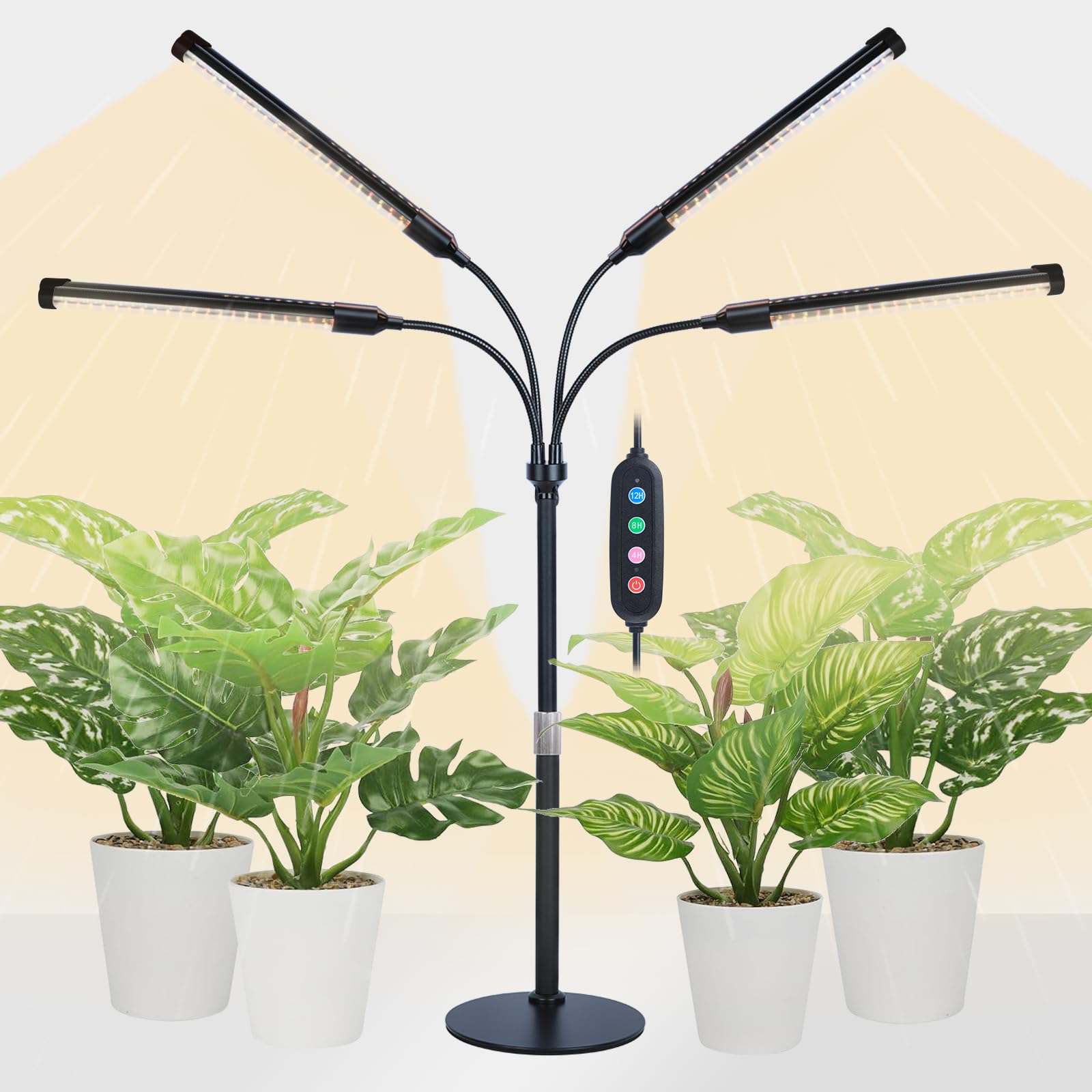
The Orchbloom Desk 4‑Head Grow Light solves a common desk‑growing problem: accommodating both short echeveria pots and taller snake plants on the same surface. The telescoping metal pole adjusts from 16 to 24 inches, while the four independent heads — each on a flexible gooseneck — can be splayed outward or focused into a tight beam. The 168‑LED array draws a genuine 36W and outputs a full spectrum that includes 660nm red and 5000K white, matching the PPFD requirements for compact succulent growth.
The 5‑mode timer (4/8/12/16/20 hours) uses the same combination push‑button logic found on the FECiDA Gamechanger, and owners report the timer kept accurate time even after a year of continuous use. One long‑term reviewer noted that a peace lily bloomed year‑round under this fixture — a strong indicator that the DLI output is sufficient for high‑light succulents like Crassula ovata and Sedum. The stable aluminum base prevents tipping, though the tripod spreads wider than some narrow shelves can accommodate.
The heads themselves lack independent rotation on a swivel — they bend at the neck but do not pivot left‑right from the base. Some users found the goosenecks slightly stiff to reposition, but once set, they hold position without sagging. For a desk‑mounted solution that adjusts to different plant heights without losing light intensity, the Orchbloom earns its place for succulent collectors with mixed‑height displays.
What works
- Telescoping pole from 16 to 24″
- 4 independently aimable heads
- Durable timer accurate after 1 year
What doesn’t
- Tripod base unstable at max height
- Heads lack horizontal swivel pivot
4. Wiaxulay 78 LED 2‑Pack

The Wiaxulay 2‑Pack gives succulent growers a matched pair of desk lamps with a 78‑LED full‑spectrum array (47 white, 25 warm white, 4 red, 2 blue) that covers 380–800nm. Each lamp extends from 7.8 to 26 inches tall via a lift pole and rotates 180 degrees at the head, providing good coverage for two separate dark corners or a single long shelf. The 5.2‑inch metal base with anti‑slip pads keeps the fixture stable even when the gooseneck is fully extended.
What elevates this kit is the controller: three lighting modes (white, warm white, red+blue mixed), five dimmable levels from 20% to 100%, and a timer offering 6, 12, and 16‑hour settings. Owners successfully use these for terrariums, aloe collections, and rosemary pots, citing the ability to dial in intensity for shade‑adapted succulents versus high‑light species. The included PC cover and protective sleeve at the board interface add a layer of safety against accidental water splash.
The 78‑LED density is adequate for a single 12‑inch by 8‑inch tray at 8‑inch distance, but the light panel itself is relatively small — only 11 inches across. For larger succulent arrangements, you will need both units or aim them close. The timer resets after a full power cut, which can interrupt consistent photoperiods if your outlet is switch‑controlled. For the price of a single premium fixture, you get two functional lamps that suit dual‑shelf setups nicely.
What works
- Two lamps in one box for multi‑zone
- 5 dimmable levels and 3 spectra
- IP‑rated PC cover for splash resistance
What doesn’t
- Timer resets after power loss
- Light panel small for wide shelves
5. SANSI Dual Gooseneck Clip

SANSI’s Dual Gooseneck Clip Light stands out for its serviceability: the PAR20 grow bulbs screw into standard E26 bases, and the manufacturer offers a lifetime free replacement for the bulb itself — not the whole fixture — meaning a burned‑out diode does not send the entire light to a landfill. The two‑head clamp delivers a combined 2000 lumen output from a 20W total draw (10W per head), with a 4000K neutral‑white spectrum that covers 380–800nm.
The built‑in auto timer offers 4, 8, and 12‑hour cycles based on a rolling 24‑hour clock, and the goosenecks are stiff enough to hold position even when extended horizontally over a 10‑inch pot. Owners have kept outdoor‑hardy plants alive through dark Pacific Northwest winters under these lights, and the ETL listing provides confidence in the safety of the ceramic‑based LED chips. The clamps are substantial — strong enough to grip a 1‑inch shelf edge without slipping — but the heads are individually lightweight, so aggressive cable management is needed to prevent the clamp from tilting.
The main drawbacks are heat and timer rigidity. The bulbs run hot enough to burn skin on contact and can scorch succulent leaves if placed closer than 8 inches. The timer logic resets to zero after any power interruption, requiring manual re‑selection. For a grower who wants a repairable, high‑lumen option with replaceable bulbs and a lifetime warranty on the light engine, this SANSI model is a worthy mid‑range investment.
What works
- Lifetime free bulb replacement
- 2000LM output from only 20W
- ETL listed for electrical safety
What doesn’t
- Bulbs run very hot, burn risk at <8″
- Timer resets after power loss
6. FECiDA Desk Tabletop
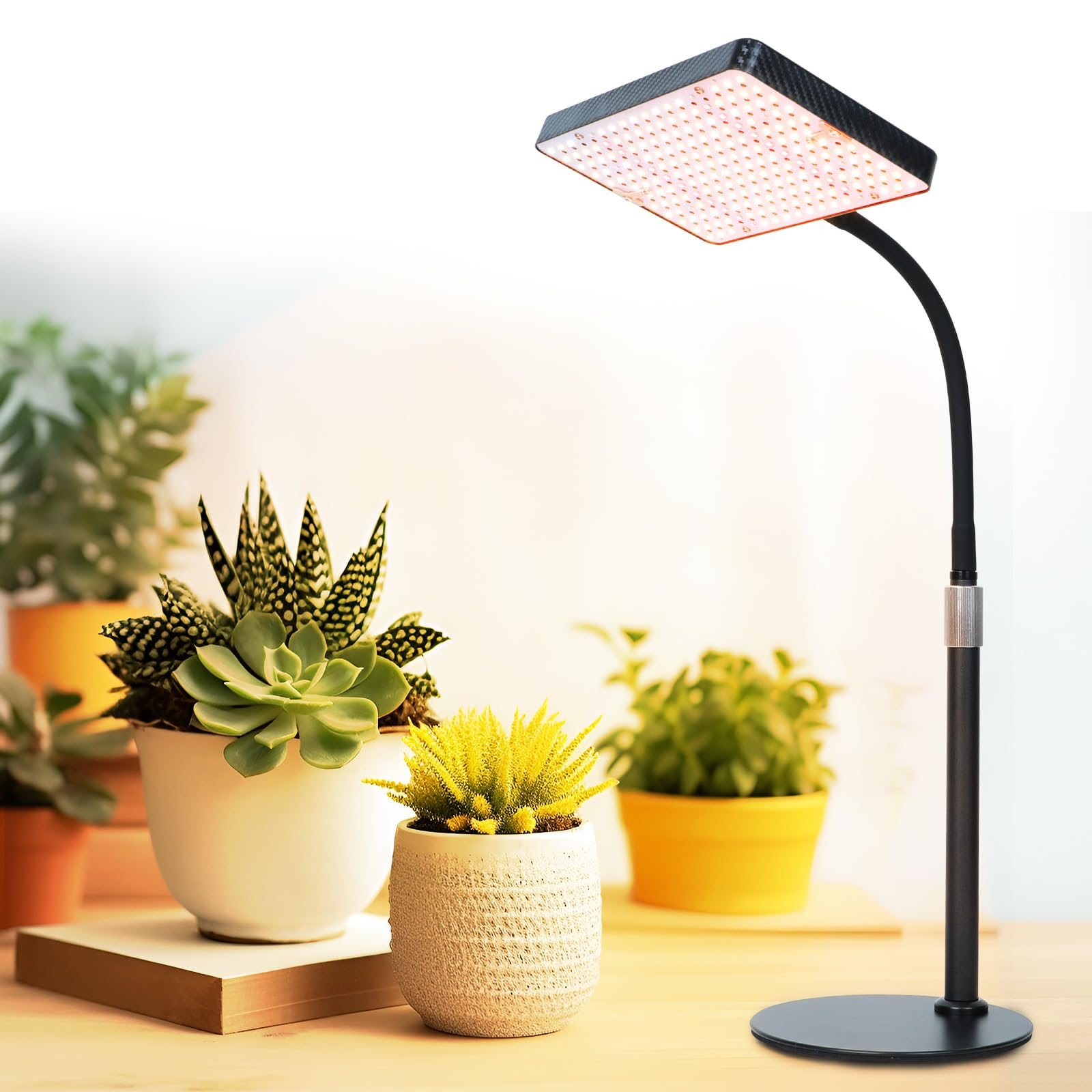
The FECiDA Desk Tabletop Grow Light packs 208 high‑quality LEDs into a compact freestanding unit that draws 25W while emitting 2000 lumen — equivalent to a 200W incandescent in terms of perceived brightness. The spectrum includes 3000K, 5000K, 660nm red, plus UV and IR diodes, making this one of the few sub‑30‑dollar fixtures to include far‑red for detecting shade‑avoidance signals in succulents. The 16‑to‑24‑inch height‑adjustable stand and stable aluminum base keep the light planted on a desk without wobble.
The standout feature is the daisy‑chain function: an input plug plus an output outlet lets you connect up to four units using one wall outlet and a single smart timer. For succulent collectors running multiple shelves, this drastically simplifies wiring. The physical on/off switch — no capacitive touchpad — means fewer electronic failure points. Owners have used these for aroids, seedlings, and even jumping spider enclosures, praising the natural‑white color temperature that makes the room feel like a well‑lit study rather than a grow op.
The trade‑off: the fixture lacks a built‑in auto timer, so a daisy‑chain setup relies entirely on an external smart plug or outlet timer. The base, while stable, occupies a 6‑inch diameter footprint, which may crowd a small desk. The lamp head is fixed at a slight downward angle and does not articulate horizontally. For a daisy‑chain‑ready unit that delivers UV‑IR supplementation for under , this FECiDA desk light is the logical foundation for a modular grow system.
What works
- Daisy‑chain up to 4 units on one outlet
- UV + IR diodes for full spectrum
- Physical on/off switch is low‑failure
What doesn’t
- No built‑in timer
- Lamp head lacks horizontal angle adjustment
7. SANSI Pot Clip 2‑Pack

The SANSI Pot Clip 2‑Pack is designed explicitly for individuals who want to spotlight a single succulent without committing to a full shelf fixture. Each unit draws only 5W via USB‑A (adapter included) and delivers 35.78 µmol/s/m² PPFD at 6 inches — sufficient to maintain compact growth in a 4‑inch pot of Haworthia or Lithops. The 4000K natural‑white light is easy on the eyes, and the ceramic ceramic‑based chip runs cool enough to clip directly onto the pot rim without heat damage to the plant or container.
The flexible 360° gooseneck holds its position reliably after adjustment, and the 4‑level dimming (25/50/75/100%) allows you to acclimate newly acquired succulents to higher light gradually. The timer offers 3, 6, and 12‑hour auto off cycles, and the 5V low‑voltage input means you can power it from a phone charger, laptop, or power bank — convenient for greenhouse cabinets or tent setups where standard outlets are scarce.
The weak point is the clip itself: multiple owners report that the plastic clip is flimsy and struggles to grip thicker pot rims, sometimes requiring tape or a rubber band to secure. The USB‑A cable is also relatively short at about 4 feet, which may necessitate an extension cord or USB hub. For a low‑profile, safe‑voltage light that can travel with your plant collection, the SANSI Pot Clip is the most portable option in this guide.
What works
- 5V USB‑A safe for kids and pets
- 4 dimming levels for acclimation
- Compact, portable single‑pot use
What doesn’t
- Clip is weak on thick pot rims
- Short USB cable limits placement
Hardware & Specs Guide
PPFD — Photosynthetic Photon Flux Density
PPFD measures how many photons (in micromoles) arrive on a square meter of leaf surface each second. Succulents require at least 300 µmol/m²/s at the canopy to prevent etiolation; 400–600 µmol/m²/s is ideal for compact Echeveria and Crassula. A fixture’s PPFD drops rapidly with distance — every 2 inches away from the LEDs can cut PPFD by roughly 40 percent. Always check manufacturer PPFD maps at 6, 12, and 18 inches rather than trusting equivalent wattage claims.
DLI — Daily Light Integral
DLI is the total PPFD accumulated over a 24‑hour period, expressed in mol/m²/day. High‑light succulents need a DLI of 18–28 mol/m²/day, achievable with a 400 µmol/m²/s fixture running for 12–16 hours. The timer’s consistency is critical: an auto‑reset timer that drops the photoperiod to zero after a power flicker can set back CAM‑cycle metabolism by several days. Choose fixtures with memory‑retaining timers or pair any light with a dedicated mechanical outlet timer.
Kelvin Temperature & CRI
Kelvin (K) describes the apparent color temperature. Succulents respond best to 4000–6500K (cool white to daylight), which mimics the high‑angle sun of their native arid habitats. The Color Rendering Index (CRI) — ideally above 85 — lets you see true leaf colors: a bluish farina on Pachyphytum or red stress margins on Echeveria ‘Perle von Nürnberg’ are visual cues that the light intensity is adequate. Low‑CRI blurple lights hide these color shifts.
Heat Management & Canopy Distance
LED efficiency is measured in efficacy (µmol/J). Fixtures with aluminum heat sinks or ceramic substrates run cooler, allowing the lamp to sit 4–6 inches from the top of a succulent without burning. If the lens surface exceeds 40°C (104°F), push the fixture back to 10‑12 inches, but expect PPFD to drop by half. Infrared thermometers are a cheap way to map the thermal profile of your grow light before placing prized rosettes underneath.
FAQ
Can a standard desk lamp prevent succulent etiolation?
How many hours per day should a succulent grow light run?
How close should I position the grow light to my succulents?
Are blurple (red‑blue) grow lights better for succulents than white full‑spectrum?
Final Thoughts: The Verdict
For most gardeners, the grow light for succulents winner is the Barrina Standing Grow Light because its vertical side‑illumination design and cool 20W real draw deliver uniform PPFD across an entire shelf without hot spots. If you want high‑intensity multi‑head targeting for a propagation bench, grab the FECiDA Gamechanger 4‑Head. And for flexible desk use with height adjustment and four independent necks, nothing beats the Orchbloom Desk 4‑Head.