
A shattered gravel driveway after a storm, a lumpy horse arena that ruins your ride, or a newly seeded lawn that looks more like a moonscape than a putting green—these are the specific frustrations that separate homeowners from their weekend. A dedicated landscape rake transforms these problems into a single afternoon of work, pulling behind an ATV, tractor, or mower to mechanically grade, level, and clear debris where a standard bow rake would take days.
I’m Rikta — the co-founder and writer behind Lawn Gear Lab. I’ve spent hundreds of hours cross-referencing steel gauges, tine spacing, chain thicknesses, and real owner feedback across tow-behind and 3-point landscape rakes to build this spec-level comparison.
Whether you need to break up compacted topsoil, spread fresh gravel across a 600-foot lane, or collect pine straw from an acre of trees, this guide isolates the measurable specs and real-world durability data you need to choose the right best landscape rake for your property.
How To Choose The Best Landscape Rake
A landscape rake isn’t a handheld tool you buy on a whim—it’s a tow-behind or 3-point attachment engineered for a specific vehicle and a specific terrain. Choosing incorrectly means either a rake that skims the surface without grading, or one so heavy your compact tractor can’t lift it. Focus on three decision points.
Towing configuration: drag harrow vs. 3-point hitch
Drag harrows connect via a chain loop to a trailer hitch, ball hitch, or drawbar. They are the most versatile option, working behind ATVs, UTVs, riding mowers, and trucks. The chain allows the rake to float over uneven ground, but depth control is limited to the weight you add (cinder blocks, sandbags). Three-point hitch rakes attach rigidly to a tractor’s lift arms, giving you precise hydraulic control over tine depth. These are superior for serious grading, rock removal, and seedbed preparation—but they require a tractor with a Category 0 or Category 1 hitch.
Tine design and material
Spring-coil tines (found on pine straw rakes) flex to follow contours and are gentle on established turf, but they lack the rigidity to break up compacted clay or move gravel. Steel tines or forged teeth (found on drag harrows and rock rakes) offer the bite needed for driveway grading, leveling soil, and pulling rocks. Measurable specs matter here: 0.33-inch spring tines are standard for leaf collection; 0.5-inch hardened steel teeth are the minimum for soil disruption. The spacing between tines also dictates what size debris passes through—2-inch spacing is ideal for pine needles and small stones, while wider gaps allow larger rocks to fall through without jamming.
Working width and weight capacity
Wider rakes (72 to 96 inches) cover ground faster but demand more horsepower from your tow vehicle. A 4-foot rake behind a riding mower is a comfortable match; an 8-foot drag behind a side-by-side or compact tractor is much more efficient for large pastures or long driveways. The unit’s empty weight dictates how aggressively it bites into the surface without added ballast. Light rakes (40-50 lbs) often require cinder blocks to achieve usable grading depth, while heavy units (80-120 lbs) can dig in with just their own mass. If you plan to level gravel regularly, prioritize a model with a weight tray or a frame designed to hold ballast securely.
Quick Comparison
On smaller screens, swipe sideways to see the full table.
| Model | Category | Best For | Key Spec | Amazon |
|---|---|---|---|---|
| YITAMOTOR 8FT Drag Harrow | Tow-Behind | Dual-sided grading (aggressive/finish) | 54 lbs, reversible mesh, 6-ft chain | Amazon |
| Field Tuff 60-Inch 3-Point | 3-Point Hitch | Pine straw and leaf collection on turf | 0.33-inch spring tines, 26 tine reels | Amazon |
| Iron Forge Tools 4-Foot Drag | Tow-Behind | Horse arena and gravel driveway leveling | Weight tray, expandable to 96 in | Amazon |
| Landzie 4-Foot Drag Harrow | Tow-Behind | Lawn leveling and driveway drag | 46 lbs, powder-coated steel, 4-ft chain | Amazon |
| Titan Attachments 5-Foot 3-Point | 3-Point Hitch | Heavy pine needle and thatch removal | 120 lbs, 34 heat-treated tines, 2-in spacing | Amazon |
| YITAMOTOR 5-Foot 3-Point Rock Rake | 3-Point Hitch | Rock removal and seedbed prep | 360° rotation, replaceable heat-treated teeth | Amazon |
| Hipicute 72-Inch 3-Point Rake | 3-Point Hitch | Broad-acreage debris collection | 84 lbs, 32 spring steel tines, 72-in width | Amazon |
| Vlaeng 6-Foot Drag Harrow | Tow-Behind | General soil and gravel leveling | Carbon steel frame, adjustable width bar | Amazon |
| VEVOR 96-Inch Drag Harrow | Tow-Behind | Wide-area driveway grading | 74.7 lbs, galvanized steel, 50-lb load capacity | Amazon |
In‑Depth Reviews
1. YITAMOTOR 8FT Heavy Duty Drag Harrow

The YITAMOTOR 8FT drag harrow earns the top spot because of its dual-sided design: one side uses aggressive spikes to break up compacted soil and gravel, and flipping the unit over reveals a flat mesh surface for final smoothing and seed coverage. At 54 pounds, it’s heavy enough to bite into hard-packed sand without requiring cinder blocks, yet light enough that a 60-pound operator can drag it into position. The 6-foot heavy-duty chain ensures universal compatibility with ATVs, UTVs, tractors, and trucks.
The Q235 steel frame and rust-resistant green coating address the two most common failure points on budget drag harrows: bent mesh and surface corrosion. Owners consistently report effective grading on base roads, pastures, and gravel driveways, with the aggressive side pulling up turf and the finish side leaving a nearly professional-grade surface. The 8-foot working width covers ground fast—significantly reducing passes compared to 4-foot or 5-foot competitors.
The main trade-off is physical: flipping the unit to switch between aggressive and finish modes is genuinely demanding. The spikes dig deep enough that the rear corners can bounce or flip on uneven terrain if the chain isn’t properly shortened. Some reports of powder-coating wear after extended use are not unusual for this price tier, but the underlying steel holds up well. For property owners who need one tool for heavy grading and fine finishing, the YITAMOTOR is the most versatile mid-range option available.
What works
- Dual-sided aggressive/finish design eliminates the need for two separate tools
- Rust-resistant coating and heavy Q235 steel frame withstand repeated use
- Universal 6-foot chain hooks to nearly any tow vehicle
What doesn’t
- Flipping the unit between modes requires significant physical effort
- Rear corners can bounce or flip on uneven terrain without chain adjustment
- Powder-coating durability is average and may show wear in high-contact areas
2. Titan Attachments 5 FT Pine Straw Needle Rake
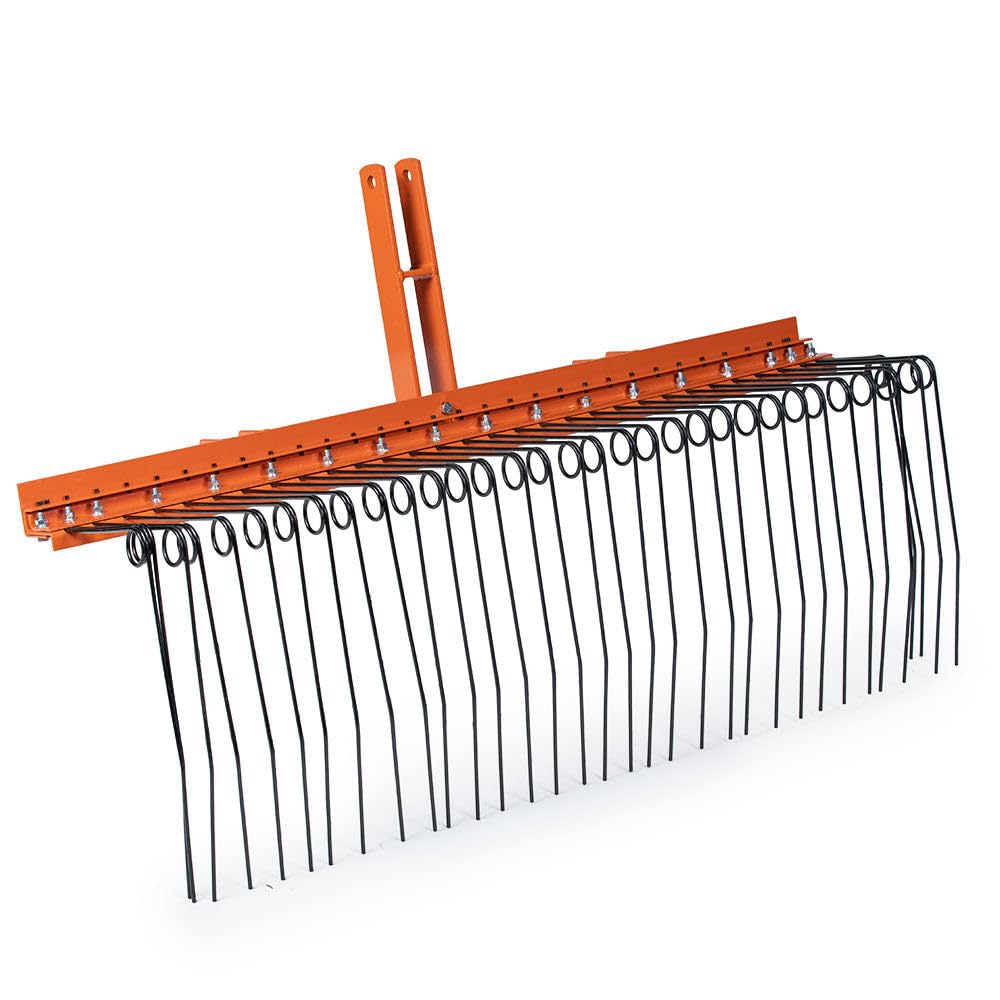
The Titan Attachments 5-foot pine straw rake is a Category 1, 3-point implement built with heavy-gauge 0.25-inch steel and an orange powder-coated finish. At 120 pounds, it is one of the heaviest dedicated landscape rakes in its class, and that mass translates directly into aggressive ground engagement. The 34 heat-treated spring coil tines stand 20.5 inches tall and are spaced 2 inches apart—a configuration that grabs pine needles, cones, and thatch while allowing smaller debris and soil to fall through without clogging.
The tines are individually replaceable, a critical long-term feature for anyone raking over stumps or rocky ground where a single bent tine can ruin the evenness of the entire pass. Owners report that the rake clears leaves and pine straw in hours instead of an entire weekend, and the spring action prevents the tines from digging into established turf—making this an excellent choice for maintaining manicured lawns under pine canopies. The 5-foot width is a practical match for subcompact tractors like the Kubota BX series and John Deere 1 Series.
The biggest headache is assembly and packaging. The rake ships in a cardboard box that routinely arrives damaged, and some units have arrived with missing bolts or tines. Assembly is time-consuming and requires thread locker; multiple re-tightenings during the first use are necessary as the tines seat into the frame. Customer service responsiveness has been inconsistent, and replacement tines are not always easy to source. If you’re willing to invest the setup time, the Titan delivers premium raking performance that lighter spring rakes cannot match.
What works
- 120-pound all-steel construction provides exceptional ground bite without ballast
- 34 replaceable heat-treated spring tines flex over turf without damaging roots
- 2-inch tine spacing effectively collects needles, cones, thatch, and small sticks
What doesn’t
- Assembly is time-consuming and often requires sourcing missing hardware
- Shipping packaging is inadequate for the weight—damage in transit is common
- Customer service response times and parts availability have been inconsistent
3. YITAMOTOR 3 Point Landscape Rock Rake, 5 FT
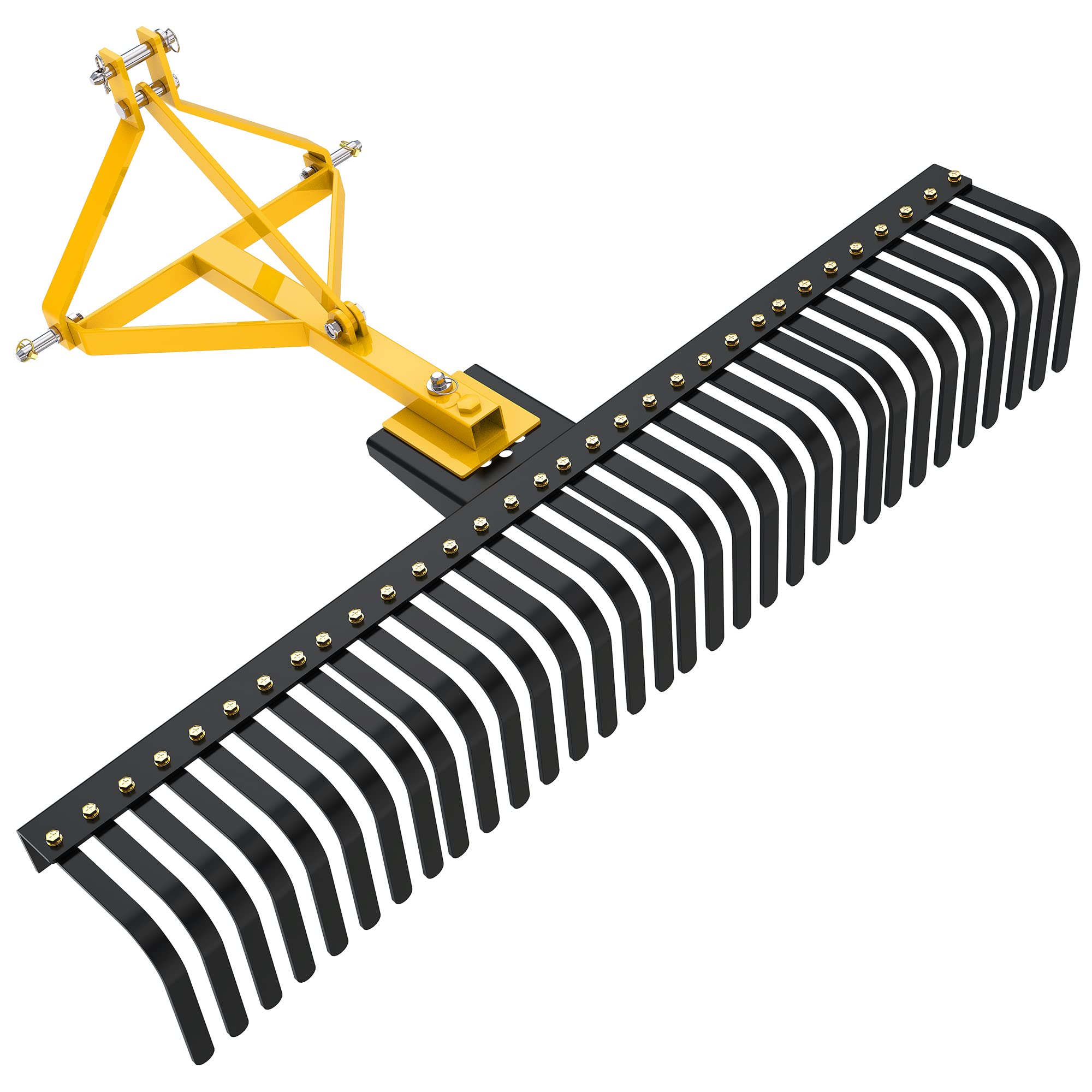
The YITAMOTOR 5-foot 3-point rock rake distinguishes itself with a full 360-degree rotation capability—an uncommon feature at this price point. The three-point articulation system allows the rake to follow tractor movement without binding, and the teeth are forged using heat-treatment technology that resists bending even when dragging rocks and roots. The rake is designed for Category 1 hitches and weighs a manageable 44.8 pounds, making it easy for one person to mount on a subcompact tractor.
The 60-inch working width is ideal for food plot cleanup, lawn renovation, and fall leaf and branch collection. Owners report that the rake performs well behind tractors like the John Deere 855 and 1025R, scarring compacted soil for seeding while efficiently gathering debris. The replaceable teeth are a practical touch—if a tine bends on a buried rock, you replace only that tooth rather than the entire rake assembly. The 360-degree rotation also allows the rake to operate at various angles for pushing debris into piles rather than just pulling it.
Assembly is the primary friction point. The unit ships in two packages, and some owners have reported delayed delivery of the second box. The instructions are minimal and the bolt orientation (longer bolts face up on the center section) is not clearly indicated. The rake body is relatively light for a 3-point implement, so it may not penetrate hard-packed gravel as aggressively as heavier rock rakes. For the price, however, it offers exceptional flexibility for owners who need both a landscape rake and a light rock rake in one attachment.
What works
- 360-degree rotation provides excellent maneuverability and debris piling
- Heat-treated replaceable teeth resist bending and extend service life
- Light enough for easy mounting on subcompact tractors
What doesn’t
- Assembly instructions are unclear and bolt orientation can be confusing
- Shipped in two packages—delays and missing components are reported
- Relatively light weight limits aggressive penetration in hard-packed surfaces
4. Field Tuff Steel Spring Coil Tine Tow Behind Landscape Rake, 60 Inches

The Field Tuff FTF-60PSR3PT is a dedicated 3-point hitch pine straw rake built around 26 reel-style spring coil tines, each featuring 0.33-inch wire. This design is laser-focused on one job: clearing pine needles, leaves, and light surface debris without damaging the turf underneath. The spring-loaded tines flex over bumps and follow the ground contour, making this rake exceptionally gentle on established lawns compared to rigid-tine alternatives. The 60-inch working width covers substantial ground for a Category 1 tractor attachment.
The powder-coated heavy-duty steel frame holds up well under regular seasonal use, and the rake attaches to any Category 1 3-point hitch without adapters. Owners consistently report that the Field Tuff is faster and less physically demanding than hand-raking large properties, with many noting it clears an acre of debris in a couple of hours. The tines can also scratch the soil surface enough to prepare a seedbed without the aggressive digging of a drag harrow. The detachable design allows for compact storage when not in use.
Assembly is the most frequently mentioned downside—the 26 tines must be bolted individually, which takes significant time. The rake does not include the three hitch pins required for mounting, an oversight that frustrates first-time buyers. The three-piece main beam uses bolts that occasionally lack locking nuts, so periodic re-tightening is required. The outer tines can be angled outward for wider coverage or inward for more concentrated collection, but this adjustment is not well documented in the instructions. For light debris collection on manicured turf, the Field Tuff is a strong mid-range performer.
What works
- Spring coil tines flex over uneven ground without damaging grass roots
- 60-inch width clears large areas significantly faster than manual raking
- Powder-coated steel frame resists corrosion through multiple seasons
What doesn’t
- Assembly requires individually bolting all 26 tines—very time-consuming
- No hitch pins are included in the package
- Bolts on the three-piece beam may loosen and require periodic re-tightening
5. Iron Forge Tools 4-Foot Drag Harrow

The Iron Forge Tools 4-foot drag harrow is built around a heavy-gauge welded steel frame with an adjustable weight tray that accepts standard cinder blocks or bricks. This weight-tray design is the defining feature: it allows the operator to increase downforce for deep gravel grading or remove ballast for lighter surface smoothing, all without strapping blocks to the frame with bungee cords. The base 4-foot width is practical for maneuverability, and additional sections can be purchased and linked to expand coverage up to 96 inches.
The powder-coated black finish is durable, and the American veteran-owned company stands behind the build quality. Owners report excellent results on gravel driveways, smoothing ruts and refreshing loose stone to a uniform appearance. When used on wood chips or soft soil, the drag operates effectively without ballast. On compacted stone driveways, adding two cinder blocks provides enough bite to level material without needing a heavier tractor. The 43-pound base weight is moderate, making it easy to handle during setup and storage.
The primary limitation is that the 4-foot base width is narrow compared to many competitors—you will make more passes to cover the same area. The weight tray, while useful, does not have a locking mechanism to prevent blocks from shifting during aggressive turns. Some owners with larger projects found that even with six cinder blocks, the drag did not dig deeply enough into severely compacted surfaces. For standard driveway maintenance and arena grooming, however, the Iron Forge offers a thoughtful design at a fair price.
What works
- Integrated weight tray allows precise ballast adjustment without strap modifications
- Expandable design grows from 4 feet to 8 feet with additional sections
- Heavy-gauge welded steel frame holds up well under repeated use
What doesn’t
- Base 4-foot width requires many passes for large driveways or pastures
- Weight tray lacks a secure lock—blocks can shift during tight turns
- Even with heavy ballast, may not penetrate severely compacted surfaces
6. Landzie 4-Foot Drag Harrow

The Landzie 4-foot drag harrow is a straight-forward, no-frills tow-behind rake that prioritizes ease of assembly and broad vehicle compatibility. At 46 pounds, it falls into the lighter end of the drag harrow spectrum, but the powder-coated alloy steel frame and heavy-duty 4-foot chain provide a solid foundation for gravel driveway maintenance, lawn leveling, and light pasture grading. The unit attaches to ATVs, UTVs, trucks, riding mowers, and lawn tractors, and disassembles into two halves for compact storage.
Owners consistently report that the Landzie is easy to assemble—the pre-installed bolts and chains mean it’s ready to use within minutes of unboxing. When used behind an ATV on a long gravel driveway, it effectively flattens ruts and furrows caused by rain, though some users note that it tends to spill gravel to the sides rather than pulling material back toward the center. Adding three to five cinder blocks dramatically improves performance on compacted stone, and most owners find this necessary for effective grading.
The main complaint is that the Landzie is not aggressive enough out of the box for seriously compacted surfaces. Multiple reviews note that without added weight, the drag essentially skims the top of the rock without stirring it up. The bracket hardware is adequate but some units have arrived with minor bends that require straightening during assembly. For routine maintenance rather than heavy renovation, the Landzie represents a strong value—but plan on buying cinder blocks at the same time you order the rake.
What works
- Quick assembly with pre-installed bolts and chains—ready in minutes
- Disassembles into two halves for compact garage or shed storage
- Compatible with a wide range of tow vehicles from lawn tractors to trucks
What doesn’t
- Requires significant added weight (3+ cinder blocks) for effective gravel grading
- Tends to push gravel to the sides instead of pulling it toward the center
- Lightweight frame may not penetrate compacted rock without extensive ballast
7. Hipicute 72 Inch 3 Point Tractor Rake

The Hipicute 72-inch 3-point rake is a purpose-built pine straw and debris collection tool designed for Category 0 and Category 1 hitches. Its defining spec is the 72-inch working width—one of the widest in its price class—combined with 32 spring steel tines that flex to follow ground contours without gouging turf. The carbon steel head and yellow rust-resistant powder coating make this a long-term implement for properties with large open areas covered in pine needles, leaves, or grass clippings.
At 84 pounds, the Hipicute is heavy enough to maintain consistent ground contact without needing additional ballast. Owners report that it cleared two large areas of undeveloped land in about 45 minutes, a task that would have taken multiple days with handheld tools. The spring tines are effective at collecting surface debris while allowing soil and small stones to pass through. The 72-inch span means fewer passes across a field, and the 3-point connection provides the hydraulic depth control that chain-drag designs lack.
The tine spacing is approximately 2 inches apart, which is ideal for needles and leaves but means smaller twigs tend to pass through without being collected. Assembly is straightforward but the rake ships without instructions—a minor issue for experienced tractor owners but a frustration for first-time buyers. Some units have arrived with slightly misaligned bolt holes that require persuasion to fit. For large-property owners who need a wide, turf-safe debris rake, the Hipicute delivers exceptional coverage per dollar.
What works
- 72-inch working width dramatically reduces the number of passes required
- Spring steel tines flex over bumps without tearing up established grass
- Rust-resistant powder coating protects the frame through wet seasons
What doesn’t
- No assembly instructions included in the package
- Tine spacing allows smaller twigs and debris to pass through uncollected
- Bolt holes may be slightly misaligned, requiring effort during assembly
8. Vlaeng 6 Ft Drag Harrow
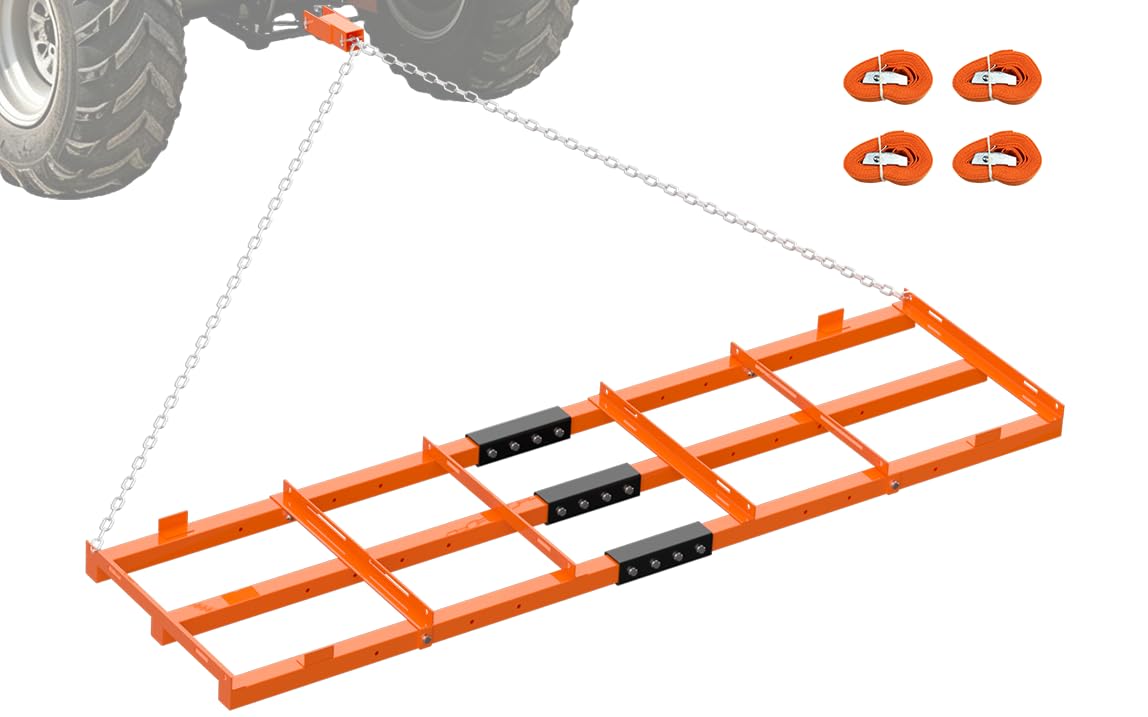
The Vlaeng 6-foot drag harrow is a lightweight tow-behind grader constructed from carbon steel with an orange powder-coated finish. Its most practical feature is the adjustable center bar, which allows the operator to customize the rake width to accommodate different block sizes or terrain conditions. The 6-foot width hits a sweet spot between maneuverability and coverage, making it suitable for ATV owners who need to level soil, spread gravel, or drag hay fields without the bulk of an 8-foot unit.
Safety is addressed with four included safety belts that secure added weight to the frame, and the 5-foot heavy-duty chains feature galvanized reinforcement for rust resistance. Owners report that the drag works effectively for pulling soil across plots and leveling yard areas when pulled behind a riding lawn mower. The assembly is genuinely quick—most users report being ready to work within minutes. The lightweight nature (the frame itself is not heavy) makes it easy to handle and store in a garage or shed.
The trade-off for the light weight is reduced grading aggression. Multiple owners note that soft soil builds up on the drag and requires stopping to dump accumulated material. The powder coating is the primary rust defense and will wear through in high-contact areas over time. The adjustable width is a nice feature but the mechanism is not as sturdy as a fixed welded frame. For light-duty leveling on relatively loose soil, the Vlaeng is a budget-friendly entry point into tow-behind grading.
What works
- Adjustable center bar provides width flexibility for different ballast sizes
- Quick assembly—ready to use within minutes of unboxing
- Compatible with riding mowers, ATVs, UTVs, and small tractors
What doesn’t
- Lightweight construction allows soil to build up and requires frequent stops to clear
- Powder coating wears through on high-contact edges over time
- No depth control mechanism—relies entirely on vehicle speed and added weight
9. VEVOR 96-Inch Drag Harrow
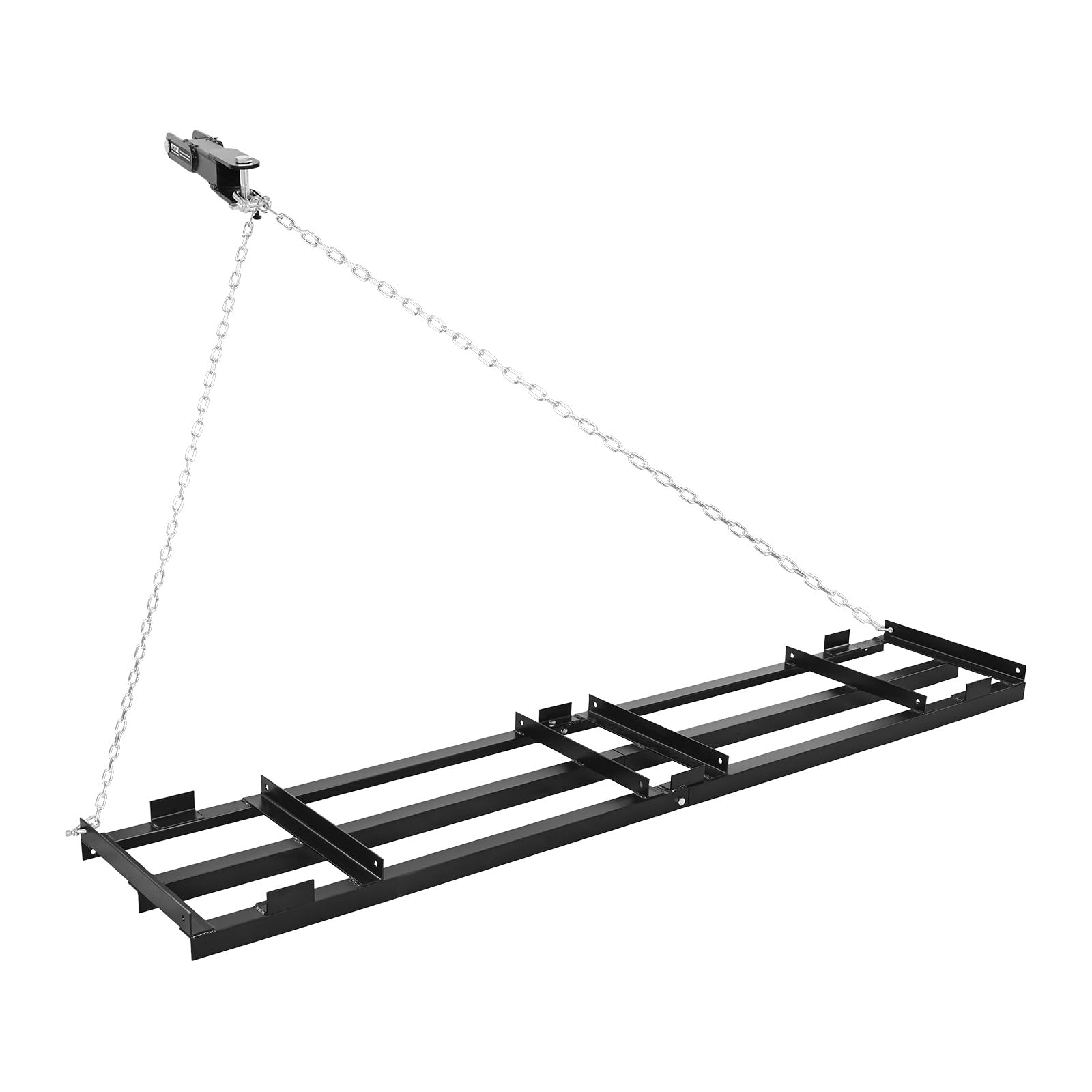
The VEVOR 96-inch drag harrow stands out for its 8-foot working width paired with a 74.7-pound frame made from galvanized steel. The galvanized finish is a distinct advantage at this price tier—unlike powder-coated competitors, galvanized steel resists rust even when the surface is scratched or worn, which is inevitable when dragging over gravel and rocks. The 96-inch width is ideal for covering large driveways, horse arenas, or pastures in minimal passes, and the 50-pound load capacity rating gives a clear ballast ceiling for safe operation.
The chain-drawn design with reinforced load-bearing steel delivers stable pulling across uneven ground. Owners report easy assembly and effective smoothing of ruts and washboard surfaces when pulled behind a side-by-side or compact tractor. The galvanized construction has held up well in wet conditions where painted alternatives quickly show rust. The wide coverage and reasonable weight make it a practical choice for property owners who prioritize speed over aggressive digging.
The primary issue is packaging and hardware. The 74.7-pound unit ships in a cardboard box that frequently arrives broken or damaged, with missing bolts and nuts reported in multiple cases. The weld quality is solid for the price, but the paint durability on non-galvanized components is poor and prone to wear. The unit does not float—on severely uneven terrain, the rigid frame can cause the corners to dig or bounce unpredictably. For owners with a large area and a moderate budget, the VEVOR offers the best width-to-dollar ratio available.
What works
- Galvanized steel construction provides superior rust resistance compared to painted models
- 96-inch width covers large areas with significantly fewer passes than narrower rakes
- Clear 50-pound load capacity rating helps operators avoid overloading the frame
What doesn’t
- Cardboard packaging is inadequate—boxes frequently arrive damaged with missing hardware
- Non-floating rigid frame can dig or bounce on uneven terrain
- Paint on non-galvanized components wears quickly in high-contact areas
Hardware & Specs Guide
Tine gauge and material
The thickness and composition of the tines determine what a landscape rake can handle without bending. Spring-coil tines (typically 0.33-inch wire) flex over turf and are ideal for pine straw and leaves. Rigid steel tines (0.5-inch or thicker forged teeth) are necessary for penetrating compacted soil, moving gravel, or prying rocks. Heat-treated tines resist bending longer than untreated steel. Tine spacing is equally critical: 2-inch spacing catches pine needles and small debris, while wider gaps allow rocks to pass through without jamming the rake.
Hitch type and vehicle compatibility
Landscape rakes connect via either a chain loop (drag harrow) or a 3-point hitch (tractor implement). Chain-drag rakes work behind any vehicle with a hitch receiver, ball hitch, or drawbar—including ATVs, UTVs, riding mowers, and trucks. Three-point rakes require a tractor with Category 0 or Category 1 lift arms and provide precise hydraulic depth control. Always verify your vehicle’s hitch category and drawbar height before purchasing. A 3-point rake on a subcompact tractor (e.g., Kubota BX) must have the correct pin size and spacing.
FAQ
Can I pull a landscape rake behind a standard riding lawn mower?
How much weight should I add to a drag harrow for gravel driveway leveling?
What is the difference between a landscape rake and a pine straw rake?
Final Thoughts: The Verdict
For most property owners balancing coverage and versatility, the best landscape rake winner is the YITAMOTOR 8FT Drag Harrow because its dual-sided aggressive/finish design eliminates the need for two separate tools while covering ground quickly with an 8-foot width. If you need a dedicated turf-safe pine straw collector for a tractor, grab the Titan Attachments 5-Foot Pine Straw Rake. And for heavy rock removal and seedbed preparation with precise 3-point depth control, nothing beats the YITAMOTOR 5-Foot 3-Point Rock Rake.