
A lawn mower blade that spins out of balance doesn’t just produce a ragged cut — it sends constant vibration through the spindle, deck bearings, and engine crankshaft, accelerating wear on every rotating component. A dedicated blade balancer is the only reliable way to confirm that both edges remove equal material, preventing that destructive wobble before it costs you a mower rebuild.
I’m Rikta — the co-founder and writer behind Lawn Gear Lab. I’ve spent hundreds of hours cross-referencing manufacturer specs, metallurgy data, and owner feedback across dozens of balancer models to isolate the designs that deliver repeatable, friction-free results versus the ones that introduce false readings.
Whether you maintain a single push mower or a fleet of zero-turn commercial decks, the best lawn mower blade balancer eliminates the guesswork of freehand balancing and protects your equipment investment with every sharpening session.
How To Choose The Best Lawn Mower Blade Balancer
A blade balancer that provides inconsistent readings is worse than no balancer at all — it encourages you to remove metal where none is needed. Three factors determine whether a balancer earns its spot in your workshop.
Bearing Quality and Spindle Smoothness
The balancer’s spindle rides on bearings that must rotate with near-zero stiction. Cheap units often use unshielded bushings or rough ball bearings that create enough drag to mask a light blade imbalance. A premium balancer spins freely for multiple revolutions and stops at a different random position each time — not parked at the same heavy spot that its own manufacturing imperfections create.
Magnetic Base vs. Cone-Style Design
Magnetic wall-mount balancers secure the blade to a central spindle with rare-earth magnets, allowing the blade to self-center. Cone-style balancers rely on a tapered post and the blade’s center hole; any burr or tolerance mismatch shifts the balance point. For repeatable results across multiple blade types — especially blades with oblong or asymmetrical center holes — a magnetic spindle provides a more consistent pivot.
Build Material and Weight Capacity
A steel or thick-aluminum spindle resists flex under heavier commercial blades (2–3 pounds each). Plastic components introduce deflection that corrupts the reading. Verify the balancer’s physical dimensions: the spindle shaft should be long enough to accommodate stacked blades, and the base must remain stable when the blade rotates freely without tipping.
Quick Comparison
On smaller screens, swipe sideways to see the full table.
| Model | Category | Best For | Key Spec | Amazon |
|---|---|---|---|---|
| DPHXF Balancer & Sharpener | Combo Jig | DIY sharpener & balancer in one | 6.38 lbs, 15–45° angle | Amazon |
| SporGain Combo Kit | Combo Jig | Precise angle sharpening + balance | 3.23 lbs, zinc-alloy balancer | Amazon |
| Kimgsoak Sharpener & Balancer | Combo Jig | High-density aluminum jig set | 3.27 lbs, 15–45° angle | Amazon |
| SporGain Indigo Combo | Combo Jig | Precision hidden-magnet balancer | Metal spindle, stepless adjustment | Amazon |
| Tecomec Magnetic Wall Mount | Magnetic Dedicated | Accurate Italian-made spindle | 6.3 oz, smooth precision bearings | Amazon |
| Maxpower 339075B | Magnetic Dedicated | Six-magnet stability for pros | 2.77 lbs, wall-mount design | Amazon |
| Oregon Precision 42-047 | Magnetic Dedicated | Commercial-grade repeatability | 2.71 lbs, Italian-made steel | Amazon |
In‑Depth Reviews
1. Tecomec Magnetic Wall Mount Blade Balancer
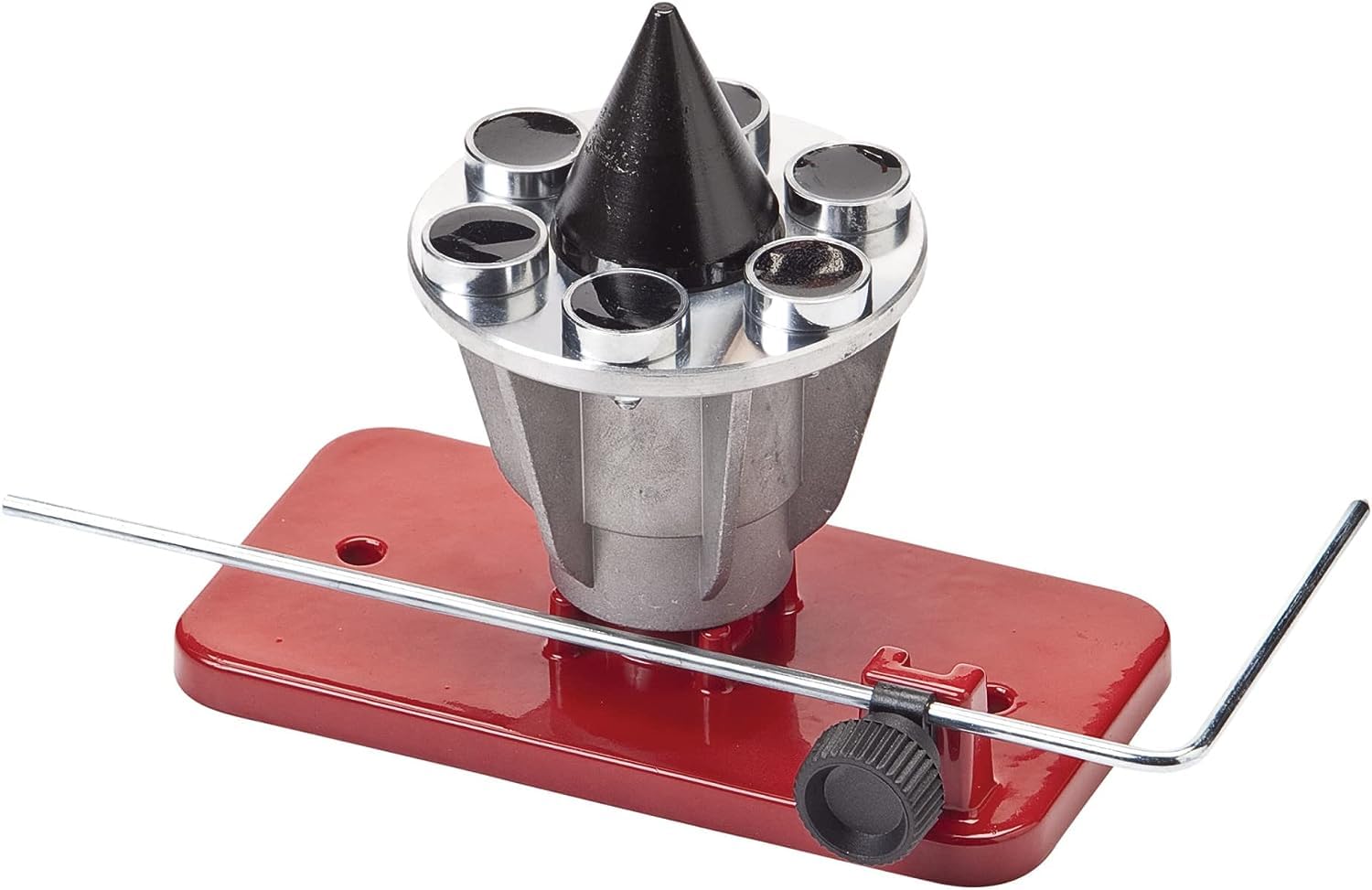
The Tecomec distinguishes itself through machining tolerances that inexpensive clones cannot match. Its spindle rotates on smooth, shielded bearings with zero detectable side-play, allowing the blade to settle at its true heavy spot without the stiction that causes false readings. Multiple owner reports confirm the bare spindle arrives approximately 90% balanced — close enough that any remaining imperfection is negligible for mower applications. The strong neodymium magnets hold the blade firmly centered, though removing a blade afterward requires deliberate effort to avoid pinching a finger.
At 6.3 ounces, this is the lightest dedicated balancer in the comparison, yet its steel construction provides the rigidity needed for blades up to roughly 24 inches. The compact footprint makes it easy to mount on a workshop wall or store in a toolbox. Owners who upgraded from plastic cone-style balancers consistently note the Tecomec reveals imbalances their previous unit completely missed, directly reducing deck vibration on their zero-turn and tractor mowers.
The only practical limitation is the need for an adapter when balancing blades with S-shaped center holes — a minor accommodation for what is otherwise a reference-grade tool. The bearings require occasional cleaning if mounted near grinding dust, but the performance justifies the care for anyone who sharpens multiple sets per season.
What works
- Machined spindle with near-zero bearing drag reveals even light imbalances accurately
- Strong magnets hold blade securely without shifting during spin test
- Compact, lightweight design mounts conveniently in any shop space
What doesn’t
- High magnet strength makes blade removal slightly difficult; thumb shield recommended
- S-shaped blade holes require purchasing a separate adapter
2. DPHXF Improved Version Blade Sharpener & Balancer
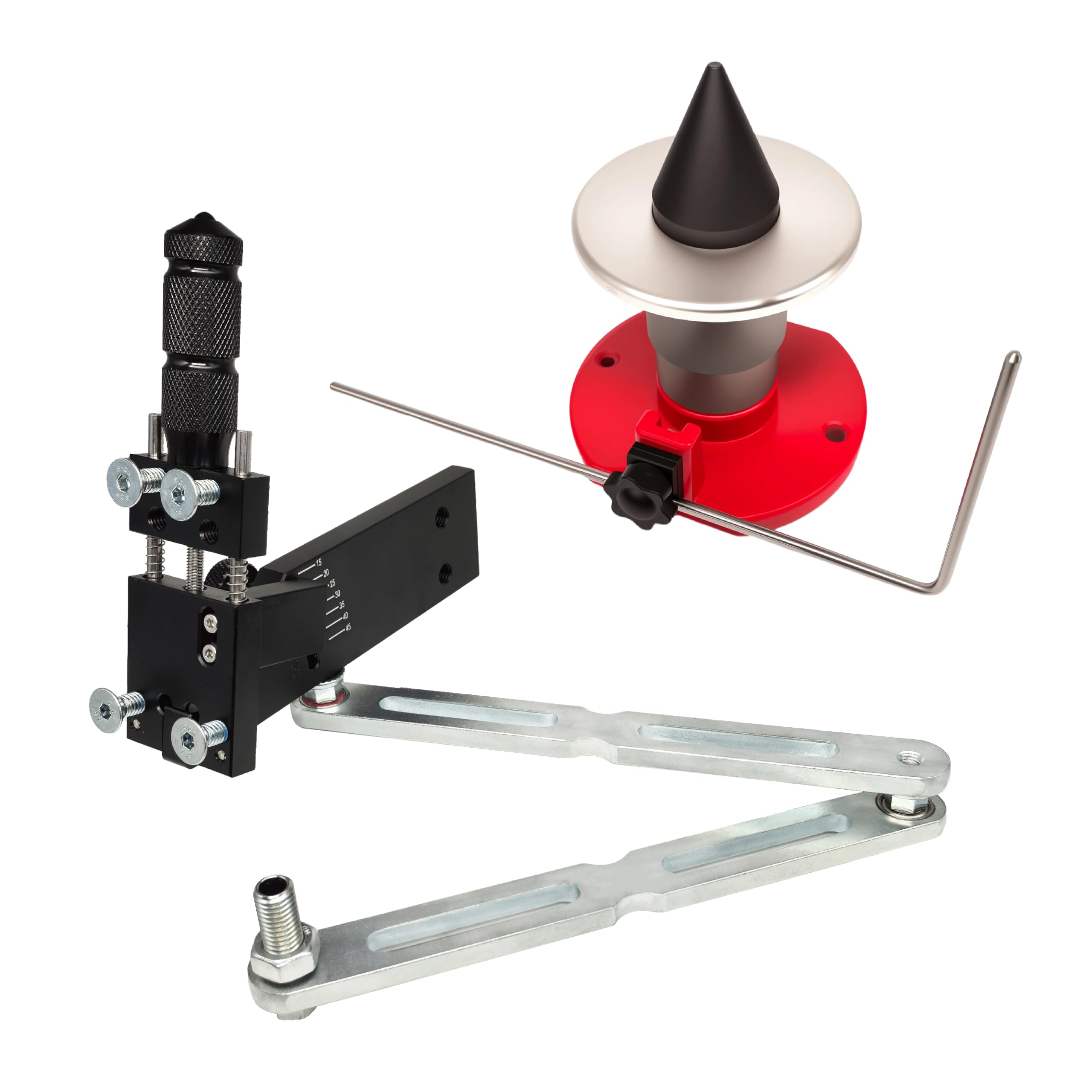
This combo unit addresses the two most common blade maintenance tasks — angle-guided sharpening and post-sharpening balance verification — in a single heavy-duty jig that weighs 6.38 pounds. The sharpening component accepts a 15 to 45-degree adjustment range, accommodating standard residential blades up to commercial high-lift profiles. The magnetic base on the balancer side holds blades securely during the spin test, and the weight of the unit provides enough stability to operate on a benchtop or sawhorse without clamping.
Owner experiences highlight the tool’s ability to expose slightly bent blades that a cone balancer would mask. One user sharpened fifteen blades in about forty minutes including setup and takedown, which reflects the practical time savings over manual methods. The solid metal construction earns consistent praise for durability, though a small number of users noted that flipping the blade over produced slightly different balance positions — an indication that either the mounting surface or the spindle itself may have a minor tolerance variation.
For the owner who wants a single tool to handle both sharpening angle and balance checking, this jig delivers a strong price-to-function ratio. The main caveat is that the balancer portion, while functional, does not match the bearing sensitivity of a dedicated precision unit. Expect it to catch gross imbalances reliably but miss the final ounce-level tweak that a pro-grade spindle would detect.
What works
- Dual function saves workshop space and eliminates tool switching between sharpening and balancing
- Heavy steel construction stays planted during aggressive grinding passes
- Wide angle range fits both standard and high-lift blade profiles
What doesn’t
- Balancer spindle lacks the ultra-low bearing drag needed for detecting very fine imbalances
- Flipping blade over can yield inconsistent balance readings, suggesting minor spindle tolerance
3. Maxpower 339075B Magnetic Wall Mount Blade Balancer

The Maxpower 339075B employs six separate magnets arranged radially around the spindle base to distribute clamping force evenly across the blade. This multi-magnet layout improves stability compared to single-magnet designs, particularly when handling longer blades that extend past the base perimeter. The unit converts to a magnetic wall mount, which keeps it accessible and frees bench space. Owners who upgraded from bubble-level cone balancers report a significant improvement in real-world vibration reduction on zero-turn mowers and garden tractors.
Construction quality is robust, with a steel spindle and base that weigh 2.77 pounds — heavy enough to stay put on a workbench without sliding. The central arbor accepts a wide range of blade center-hole sizes, and the spindle rotates freely enough to reveal imbalances that cheaper units miss. One experienced owner noted that the design inherently identifies bent blades: if the blade rocks on the spindle rather than spinning evenly, the blade steel is warped and needs straightening or replacement, not more grinding.
The primary safety concern is the sharp center tip of the spindle, which protrudes above the mounted blade. Several owners recommend covering the tip with a rubber cap when not in use to avoid accidental cuts. At this price point, the Maxpower competes directly with lower-priced combo jigs, but its dedicated-balancer architecture provides a purer balance test without the compromises of a multi-tool design.
What works
- Six-magnet array provides exceptional blade stability during rotation
- Sturdy steel construction and wall-mount versatility suit permanent shop installation
- Spindle sensitivity adequate for detecting both imbalances and bent blades
What doesn’t
- Sharp center spindle tip poses a cut hazard when blade is removed
- Premium pricing compared to combo jig alternatives with similar functionality
4. SporGain Lawn Mower Blade Sharpener & Balancer (Indigo)
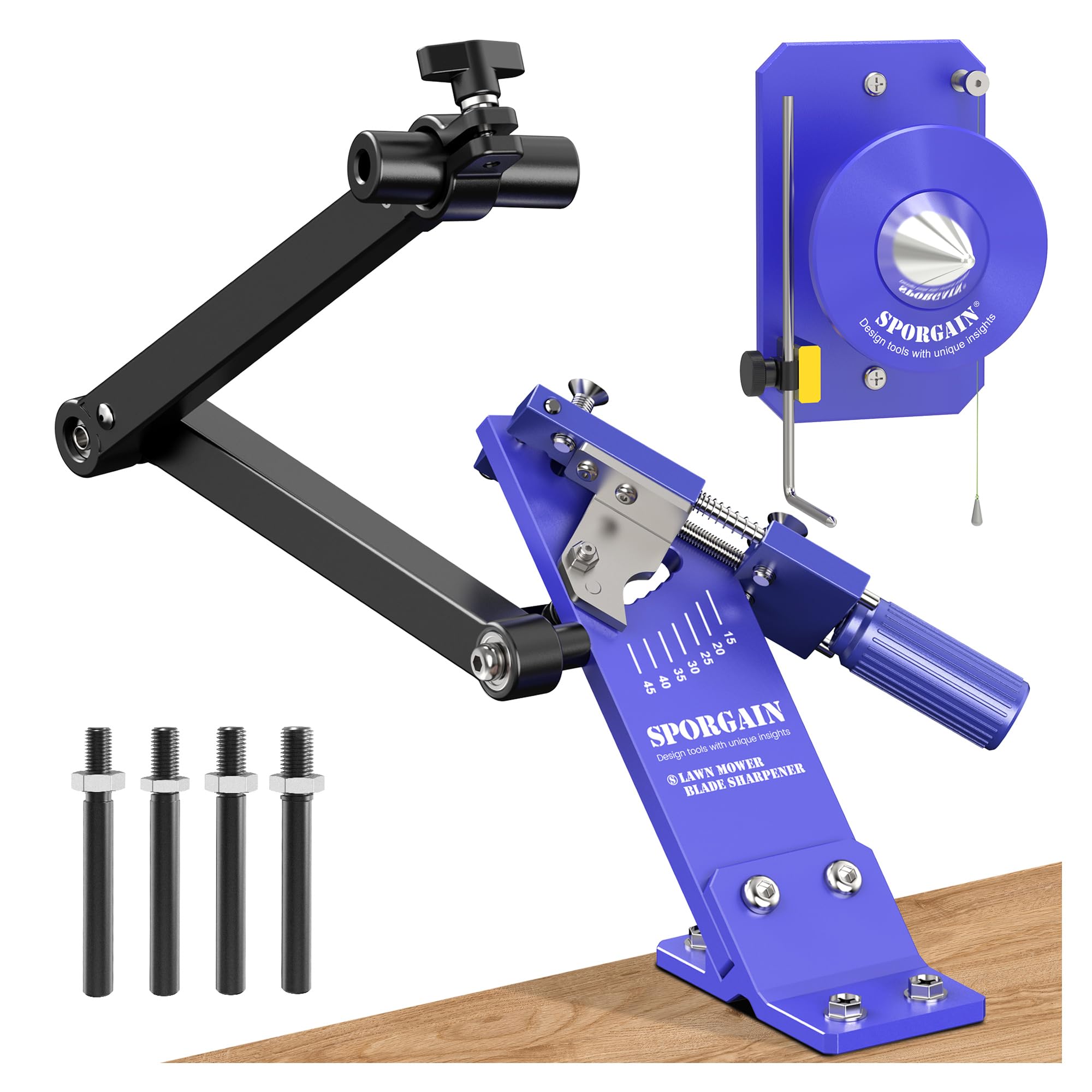
The SporGain Indigo set pairs a thick-metal sharpening jig with a balancer that uses a hidden magnetic design — rare-earth magnets recessed into the spindle rather than exposed as separate discs. This configuration centers the blade more consistently because the magnetic field acts directly through the spindle face instead of pulling from offset points. The sharpener side features a 25mm enlarged handle with ball bearings and a stepless 15–45 degree angle adjustment that locks firmly without slipping during grinding passes.
Initial owner reports confirm the sharpener delivers consistent edges on straight blades, with the angle guide eliminating the uneven bevels that freehand grinding produces. The balancer, however, drew mixed feedback: some users found the bearing slightly stiff out of the box, requiring a small amount of grease to free up rotation for detecting minor imbalances. Another user noted that the balancer works well for standard straight blades but cannot handle curved or high-lift profiles without leaving uneven spots on the edge.
The kit’s material selection is a combination of durable metal components and some plastic parts that feel less confidence-inspiring during heavy use. For a home owner who sharpens one or two mowers per season, the overall value is solid. For a shop that balances ten-plus blades weekly, the balancer bearing may demand early maintenance to maintain its sensitivity.
What works
- Hidden magnetic spindle centers blades accurately for repeatable balance checks
- Sharpener’s ball-bearing handle and stepless angle lock provide smooth, consistent grinding
- Cost-effective dual function for residential mower maintenance
What doesn’t
- Balancer bearing can arrive stiff, limiting sensitivity until lubricated
- Not suitable for sharpening curved or high-lift blades without edge distortion
- Plastic components may wear faster than all-metal alternatives
5. Oregon Precision Blade Balancer 42-047

The Oregon 42-047, manufactured in Italy alongside the Tecomec, represents the top tier of consumer-accessible blade balancers. Its steel spindle rides on bearings that are smooth enough to rotate from the weight of a single paint stroke — a sensitivity benchmark that few competitors approach. The magnetic wall-mount base secures blades up to approximately 24 inches, and the included straightness rod lets you verify that the blade steel itself is not bent before you even attempt to balance it. Professional owners appreciate that the spindle continues spinning multiple revolutions and stops at random positions, confirming that its own components introduce no bias.
Multiple long-term owners report that this balancer allows them to zero in blade balance to within 2–4 degrees of rotation, far exceeding the 15-degree tolerance that most mower manufacturers specify. One owner discovered that two of his six commercial blades had off-center center-punch holes — a manufacturing defect that no cone balancer would have revealed. The sensitivity is so high that the bare spindle itself may require a minor balancing tweak (adding washers to the magnet bolts) to achieve laboratory-grade perfection, though the out-of-box accuracy is already sufficient for any practical mowing application.
The investment is considerable, but for a lawn care professional or an enthusiast with multiple mowers, the Oregon pays for itself by extending spindle bearing life and preventing uneven deck wear. The only maintenance requirement is periodic cleaning of the bearings if the balancer is mounted near grinding dust; a set of wing nuts on the mounting bolts allows quick removal for storage away from contaminants.
What works
- Ultra-smooth bearings detect imbalance from the weight of a single paint stroke
- Included straightness rod verifies blade is not bent before balancing
- Italian manufacturing yields consistent spindle concentricity and long service life
What doesn’t
- Premium price may exceed what casual home owners need
- Bare spindle may require minor user tuning for absolute zero-imbalance measurement
6. SporGain Lawn Mower Blade Sharpener & Balancer Set
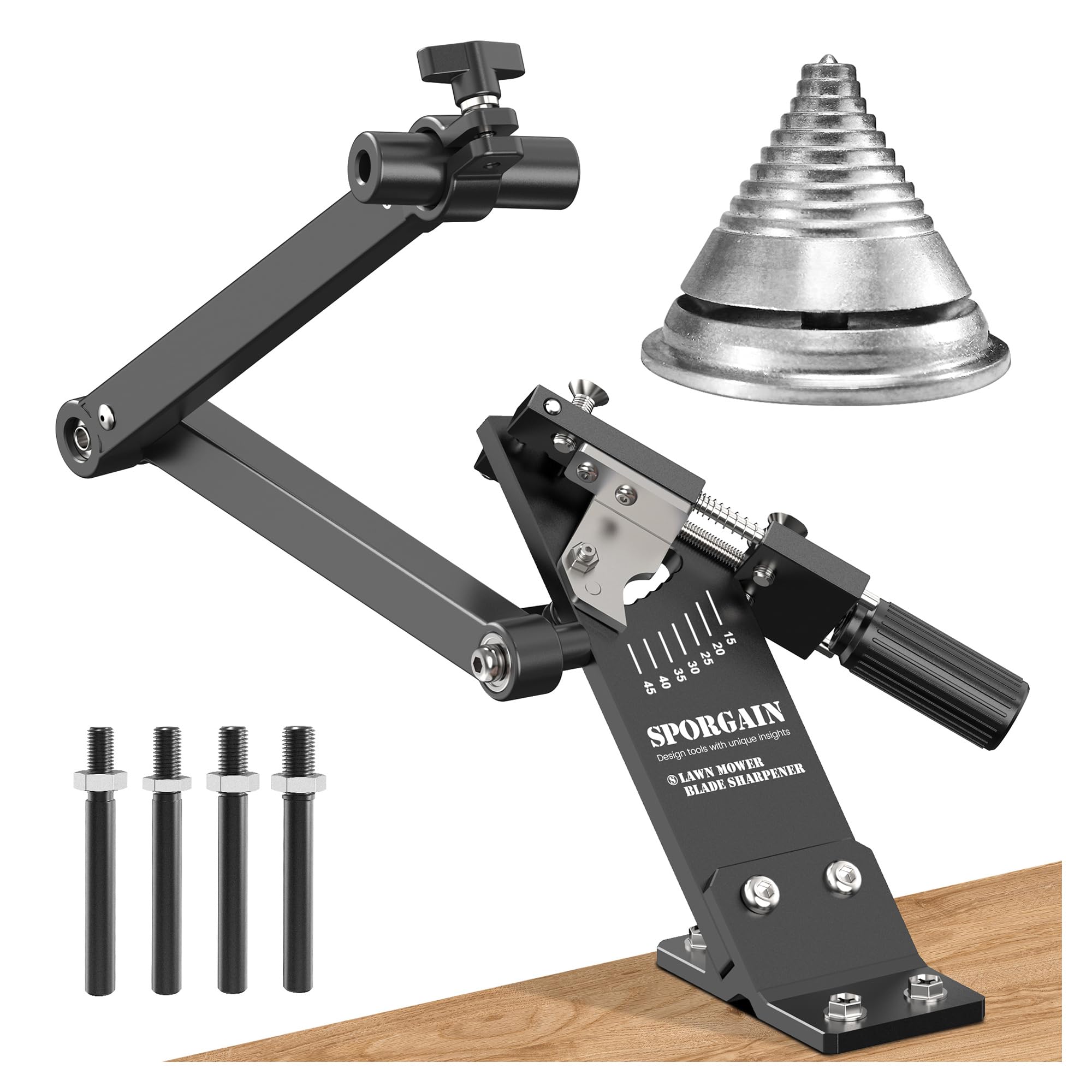
The SporGain combo delivers a sharpening jig and a separate zinc-alloy balancer in a single package, targeting the home owner who wants both functions without buying two standalone tools. The sharpener uses thick metal construction with ball bearings in the pivot and a 25mm handle that provides a secure grip during grinding. Four different guide pins accommodate most angle-grinder models, and the 15–45 degree range covers the majority of residential and commercial blade profiles. The balancer, while less sophisticated than a dedicated magnetic spindle unit, provides a functional pass-fail check on whether the blade is close to balanced.
Owner feedback highlights the ease of setup and the immediate improvement in sharpening consistency compared to freehand methods. Multiple users noted that their blades stayed sharper longer after using the angle jig, because the symmetrical bevel removed distortion that previously caused edge micro-chipping. A small number of owners found the balancer slightly wobbly on the first use, though it remained functional for the intended purpose of catching major imbalances.
The main trade-off is the less-refined bearing feel of the balancer compared to the dedicated units from Tecomec or Oregon. It will prevent you from reinstalling a blade that is dramatically out of balance, but it may not detect the fine ounce-level differences that matter to a commercial operator running a high-speed zero-turn deck.
What works
- Complete sharpening and balancing solution at a combined price that beats buying separately
- Thick metal sharpening jig with ball bearings delivers consistent angle guidance
- Zinc-alloy balancer catches major imbalances effectively
What doesn’t
- Balancer bearing lacks the sensitivity to detect very light imbalances
- Some units exhibit wobble in the balancer spindle out of the box
7. Kimgsoak Blade Sharpener & Zinc-Alloy Balancer Kit

The Kimgsoak kit pairs a high-density aluminum alloy sharpening jig with a separate zinc-alloy balancer, focusing on material rigidity at an entry-level price point. The sharpener uses precisely fitted bushings around its guide pins to minimize wobble during grinding — a design detail that reduces the chance of introducing a crooked edge. Four guide pins match the most common angle-grinder arbor sizes, eliminating the need for adapters. The balancer, while simple in construction, provides a clear visual indication when a blade is significantly heavy on one side.
Owner reports consistently praise the ease of setup and the time savings: several users sharpened three blades in approximately fifteen minutes on their first attempt. One owner noted that the 40-degree setting removes more metal than the factory edge, so taking light passes and allowing the blade to cool between strokes is essential to avoid overheating the steel and ruining the heat treat. The balancer received fewer complaints than some comparable combo kits, though it is clearly a secondary feature rather than a precision instrument.
The kit’s limitation is the same as other combo units — the balancer does not offer the bearing smoothness of a dedicated magnetic spindle. For a home owner who sharpens blades once or twice per season and needs a simple pass-fail balance check, this kit provides sufficient functionality. A commercial operator or frequent sharpener will eventually want to add a dedicated balancer with finer sensitivity.
What works
- High-density aluminum sharpening jig with tight bushings reduces grinding wobble
- Simple setup allows first-time users to sharpen and balance blades quickly
- Affordable entry point for home owners starting blade maintenance
What doesn’t
- Zinc-alloy balancer lacks the bearing sensitivity for fine imbalance detection
- 40-degree angle setting removes metal aggressively; overheating the blade is a risk
Hardware & Specs Guide
Bearing Type and Spindle Tolerance
Dedicated balancers use shielded ball bearings that must spin with minimal radial play. The critical spec is bearing tolerance class (ABEC 3 or higher). A spindle with excessive runout (above 0.002 inches) will cause the blade to stop at the same heavy spot every time, falsely indicating imbalance. Test this by spinning the bare spindle: it should stop at a random position each time. If it consistently parks at the same spot, the balancer itself is out of balance and cannot provide reliable readings.
Magnetic Pull Strength and Blade Capacity
Magnetic balancers rely on neodymium magnets with a pull force typically rated between 10 and 30 pounds. The magnet must be strong enough to hold the blade centered during rotation but not so strong that it prevents the blade from finding its natural heavy side. A good rule: the blade should slide onto the spindle with moderate resistance and rotate freely once seated. Units with six magnets (like the Maxpower) distribute force more evenly than single-magnet designs, reducing the risk of the blade tilting off-center.
FAQ
Can I use a cone-style balancer instead of a magnetic spindle balancer?
How do I know if my blade is bent versus out of balance?
What is the acceptable balance tolerance for a lawn mower blade?
Does a blade balancer work with all blade sizes and hole patterns?
Final Thoughts: The Verdict
For most gardeners, the best lawn mower blade balancer winner is the DPHXF Improved Version because it combines angle-guided sharpening with a functional balance check in one heavy-duty jig that suits the home owner’s workflow. If you want the highest bearing sensitivity and precision Italian machining, grab the Tecomec Magnetic Wall Mount. And for a professional who balances multiple blade sets every week and needs repeatable sub-5-degree accuracy, nothing beats the Oregon Precision 42-047.