
The wrong mulch around perennials doesn’t just look bad—it robs the soil of oxygen, locks out water, and can even introduce weed seeds that compete with your established plants. A proper perennial mulch layer does the opposite: it moderates soil temperature swings, retains critical spring moisture through dry spells, and slowly feeds the soil microbial life your perennials depend on for long-term vigor. Getting this choice right means years of healthier growth with less watering and weeding.
I’m Rikta — the co-founder and writer behind Lawn Gear Lab. I’ve spent over forty hours comparing bag volumes, organic certifications, expansion ratios, and real-world owner reports to determine which mulches actually perform for perennial beds rather than just sitting on top of the soil.
This guide focuses on materials, texture, and decomposition behavior so you can confidently choose the right mulch for perennials without wasting money on products that wash away or fail to suppress weeds.
How To Choose The Best Mulch For Perennials
Perennials live in the same spot for years, so your mulch choice affects root zone conditions season after season. A material that decomposes too quickly requires annual reapplication; one that mats or repels water starves roots. Focus on four factors below.
Volume vs. Expanded Coverage
Compressed coco chip blocks advertise a dry weight but expand dramatically when hydrated—anywhere from 2 to 18 gallons per block. Bark and wood chip bags list a fixed volume (quarts or cubic feet). Compare the final loose volume, not the dry brick size, to know how many square feet at a 2-inch depth each bag actually covers.
Texture and Decomposition Rate
Fine-textured mulches like cocoa hulls break down fastest, adding organic matter quickly but needing more frequent top-ups. Coarse bark chips and chunky coco husk pieces last longer (12–18 months before significant breakdown) and allow better air exchange for perennial root systems. Avoid dust-heavy products that form a crust.
Certifications and Safety for Pets
If you grow edibles or use the same beds for ornamentals, OMRI-listed organic mulch confirms no synthetic additives or pesticides were used during processing. Cocoa bean shells contain theobromine and theophylline—toxic to dogs if ingested in quantity. Cedar naturally repels insects but can be too aromatic for some sensitive plants.
Quick Comparison
On smaller screens, swipe sideways to see the full table.
| Model | Category | Best For | Key Spec | Amazon |
|---|---|---|---|---|
| Brut Organic Aspen Mulch | Organic Bark | Nutrient-rich top dressing | 30% natural carbon content | Amazon |
| MODELLOR Coco Chips | Compressed Coco | Large area coverage | Yields 2 cu ft (18 gal) per block | Amazon |
| Double Tree Incense Cedar | Aromatic Cedar | Odor control and pest deterrence | 8 Quart pre-sized chips | Amazon |
| Plantonix Coco Chips | Compressed Coco | Soil aeration and moisture retention | Absorbs 10x its weight in water | Amazon |
| Back to the Roots Coco Mulch | Compressed Coco | OMRI organic raised beds | Expands to 2 cu ft (58 qt) | Amazon |
| Avalution Orchid Bark | Pine Bark | Fine-root perennials and orchids | 0.8–1.3 inch bark pieces | Amazon |
| Hull Farm Cocoa Shell | Cocoa Hull | Chocolate scent and moisture retention | Fertilizer value 2.5-1-3 | Amazon |
In‑Depth Reviews
1. Back to the Roots 100% Organic Mulch, 58 Quart
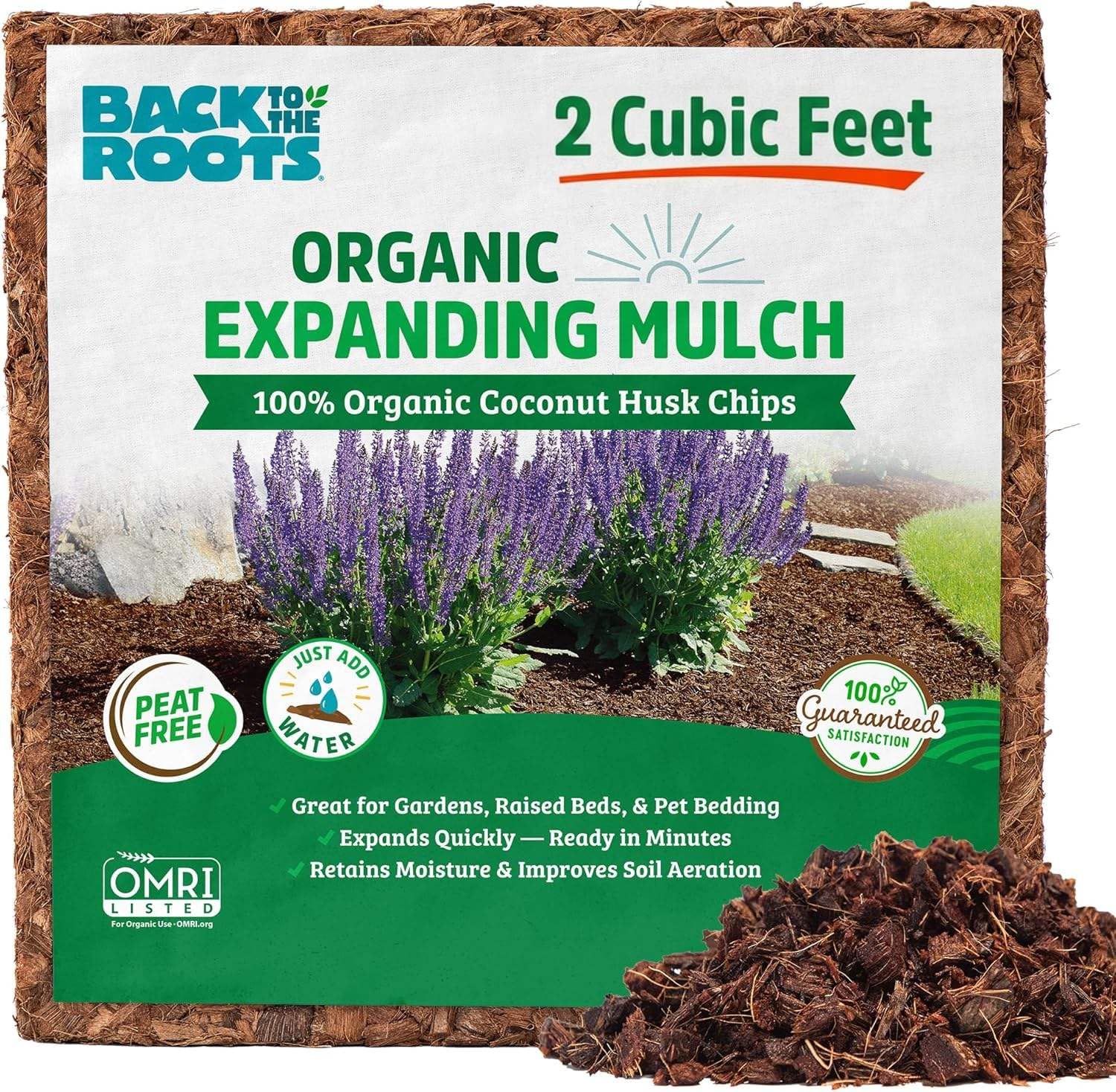
Back to the Roots delivers a compressed 10 lb coco husk block that hydrates to a full 2 cubic feet—enough to cover roughly 12 square feet at a 2-inch depth. The expansion is dramatic; owner reports confirm it fills a wheelbarrow three-quarters full after soaking. As an OMRI-listed organic material, it carries the certification necessary for organic vegetable gardens and perennial beds where soil purity matters over multiple seasons.
The coco husk texture is chunky enough to resist compaction but fine enough to spread evenly. It retains moisture without becoming waterlogged, and when tilled into the top layer at the end of the season, it improves soil fluffiness for the following year. Users consistently note how much easier it is to handle than wet bark bags—no heavy lifting, just add water on site.
Performance across raised beds and in-ground perennial borders is reliably strong. The only catch is that the dry block requires a large container (kiddie pool or wheelbarrow) to hydrate fully, and you need to plan ahead by about 30 minutes for complete expansion. For gardeners who prioritize certified organic material and large coverage from a single lightweight package, this is the top performer.
What works
- Expands to 2 cubic feet from a 10 lb block
- OMRI-listed for organic gardening confidence
- Lightweight before hydration—easy to transport
What doesn’t
- Requires a large container and time to hydrate fully
- Expanded volume may seem smaller than expected if not soaked properly
2. Plantonix Organic Coco Chips 10 lbs

Plantonix takes the compressed coco chip concept and adds a high cation exchange capacity (CEC) that helps hold nutrients in the perennial root zone longer than straight bark. The brick breaks down into chunky pieces, not dusty fines, which means better airflow and less surface crusting. Owners report that the chips absorb up to ten times their weight, visibly reducing watering frequency during hot spells.
The neutral pH of this coco medium prevents nutrient lock-up—a real advantage for perennials that stay in the same soil for years and risk pH drift from repeated fertilizing. The chips are large enough to stay in place during rain but fine enough to mix into potting soil for container perennials. A single block yields roughly 15 gallons of loose mulch after hydration.
Sources note that buffered coco coir is safer than unbuffered versions because it resists bacterial issues and nutrient absorption. Plantonix chips appear to be well-processed, with no unpleasant smell and minimal dust. For gardeners who want a soil-building mulch that improves drainage while retaining moisture, this is a versatile mid-range workhorse.
What works
- High CEC holds nutrients in the root zone
- Absorbs 10x its weight in water—reduces watering frequency
- Neutral pH prevents nutrient lock-up over seasons
What doesn’t
- Some users prefer larger chip sizes for heavy mulching
- Must be fully hydrated to judge true coverage volume
3. Brut Organic Aspen Mulch 10 QT
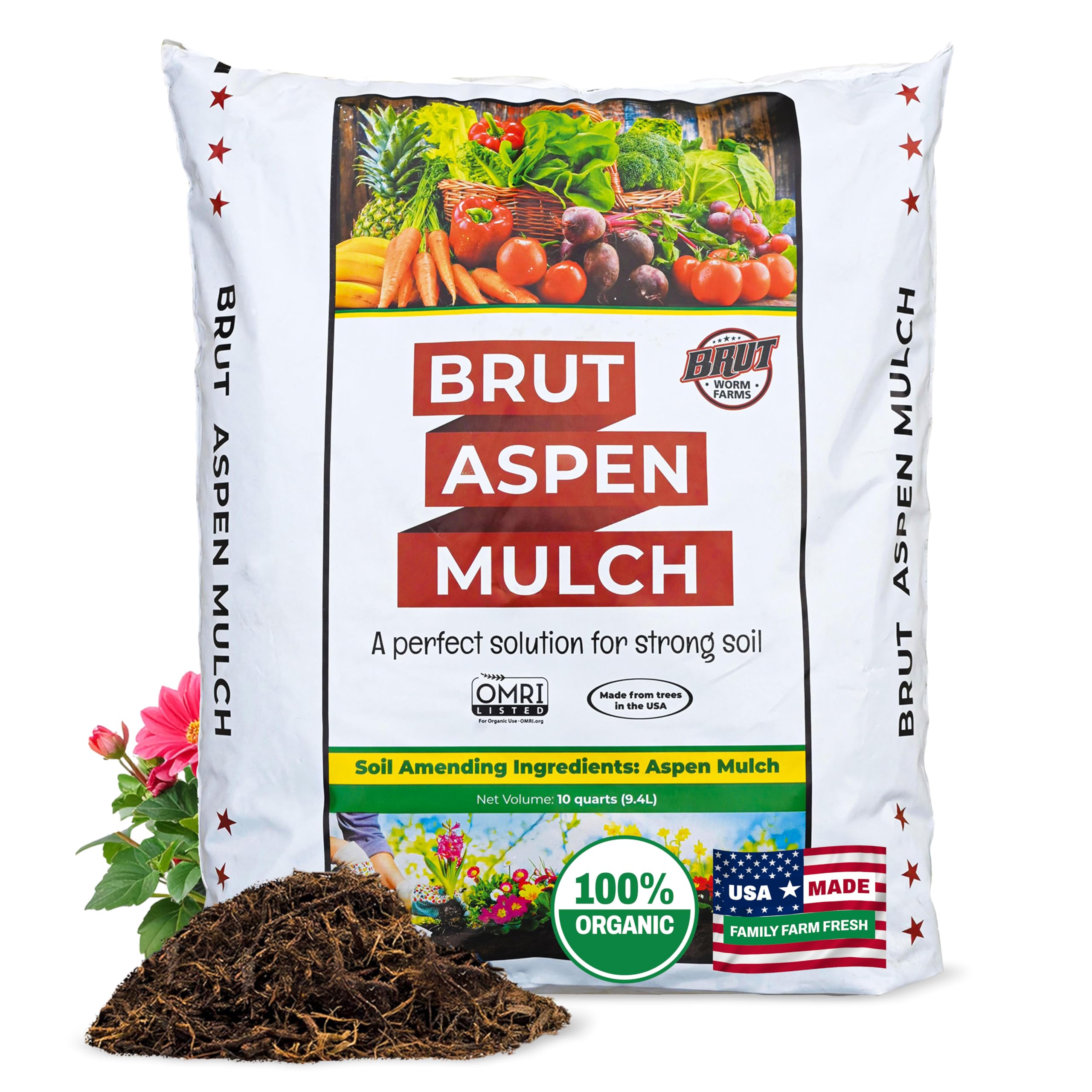
Brut Worm Farms brings an OMRI-listed aspen bark mulch that stands out for its high carbon content—30% natural carbon—which feeds beneficial soil microbes in perennial beds. The texture is a fine bark rather than coarse wood chips, making it ideal for potted perennials, container herbs, and small garden beds where you want a clean, polished look without large chunks floating away during rain.
Owner experiences are overwhelmingly positive about its moisture retention properties, noting that it cuts watering needs roughly in half for container plants. The aspen material is odor-free, lightweight, and easy to spread. A 10-quart bag covers a moderate area, and the fine texture settles into a uniform layer that discourages weed germination effectively.
The main consideration is cost per quart relative to compressed coco options—some buyers feel the bag is smaller than expected for the price. However, the organic certification and the specific aspen formulation (which resists mold better than some other barks) make it a strong candidate for gardeners who value purity and soil health over raw volume.
What works
- OMRI-listed organic aspen bark with 30% carbon
- Odor-free and lightweight—easy to handle
- Significantly reduces watering frequency for containers
What doesn’t
- Higher cost per quart compared to coco block alternatives
- 10-quart volume may not cover large beds sufficiently
4. MODELLOR Premium Super Washed Coco Chips 10 lb

MODELLOR offers a triple-washed 10 lb coco chip block that expands to 2 cubic feet (roughly 18 gallons) of loose chips—impressive coverage from a compact package. The manufacturing process reduces salt content, which is important for sensitive perennial root systems that can accumulate sodium over multiple growing seasons. Users describe the chips as clean, large, and dense, with no debris or fines mixed in.
The chunky husk pieces are ideal for improving aeration in heavy clay soils or dense perennial beds. They resist compaction better than finely ground mulches, maintaining air channels around roots for longer. The block is bone dry, so it stores indefinitely without mold risk, and requires a sturdy tool to break apart before hydration.
Some feedback notes that the chips can be smaller than expected depending on the batch, but overall quality is rated high for the price. For gardeners covering large areas—grapes, roses, tree rings—this product delivers the best volume-to-cost ratio in the list, especially when you factor in the low shipping weight of the dry block.
What works
- Triple-washed for low salt content—safe for perennials
- Expands to 2 cubic feet from a compact 10 lb block
- Large, chunky pieces improve aeration and resist compaction
What doesn’t
- Requires metal tool to break the dense dry block
- Batch variation may affect chip size consistency
5. Hull Farm Cocoa Bean Shell Mulch 2 cu ft

Hull Farm’s cocoa bean shell mulch delivers a unique combination: a natural fertilizer value of 2.5-1-3 (N-P-K) plus a rich chocolate aroma that gardeners love. The shells are lightweight, mat together after watering to resist wind blow, and retain moisture noticeably better than bark mulches. A 2-cubic-foot bag covers roughly 12 square feet at a 2-inch depth.
The drawback is serious: cocoa hulls contain theobromine and theophylline, which are toxic to dogs. If you have pets that roam the garden, this is unsafe. Additionally, the strong chocolate scent attracts some wildlife (raccoons, dogs) and fades after about a week. Owners also caution against using it around flowers sensitive to the slight acidity as the hulls break down.
The price has risen significantly compared to historical averages, but for dog-free households that want a fast-decomposing, nutrient-boosting mulch that looks rich and dark, the cocoa shell remains a cult favorite. It’s best for ornamental perennial beds where pets don’t have access and where you’re willing to reapply annually.
What works
- Natural fertilizer value 2.5-1-3 feeds soil as it decomposes
- Pleasant chocolate scent and rich dark appearance
- Mats together to resist wind displacement after watering
What doesn’t
- Toxic to dogs—unsafe for pet-accessible gardens
- Strong scent attracts wildlife and fades within a week
- High cost per bag relative to bark or coco alternatives
6. Avalution Orchid Potting Bark 18 QT

Avalution’s pine bark is precision-sized to 0.8–1.3 inches, making it an excellent top-dressing mulch for fine-rooted perennials like hostas, heucheras, and ferns, as well as epiphytic plants like orchids and monstera. The uniform particle size means no huge chunks that look messy and no dust that crusts over. It’s pre-sterilized for safety and pH neutral to avoid shocking sensitive plants.
The bark floats when first watered, which can be a minor annoyance, but once it settles, it provides superior aeration and drainage compared to finer mulches. Users repotting orchids note that their plants adjusted quickly with no signs of root rot, thanks to the air pockets the bark creates. The bag is heavy—2.37 kg—but the volume (18 quarts) covers several medium containers.
This product is not ideal for covering large in-ground perennial beds because the pieces are relatively small and may wash away in heavy rain. But for container perennials, raised orchid beds, or as a decorative top layer for indoor plants, the Avalution bark is a clean, consistent option that outperforms generic bagged bark.
What works
- Uniform 0.8–1.3 inch pieces for consistent coverage
- Pre-sterilized and pH neutral—safe for sensitive roots
- Excellent drainage and aeration for container perennials
What doesn’t
- Small pieces may wash away in heavy rain on in-ground beds
- Bark floats initially until fully waterlogged
7. Double Tree Incense Cedar Wood Chips 8 Quart

Double Tree’s incense cedar chips offer a potent natural cedar aroma that repels moths, beetles, and other pests—a real benefit for perennials susceptible to root-feeding insects. The chips are uniformly sized (not the coarse shredded cedar often found in pet bedding) and have a light hue that brightens garden beds. At 8 quarts, the bag is modest in volume, suited for medium planters or targeted applications around valuable perennials.
Owner reviews emphasize the strong, pleasant scent that persists even after rain. The chips are effective for bug control in closets and garden beds alike, and they don’t leach colors onto surfaces. Users growing citrus trees appreciate that the fine grind stays put and doesn’t float away during irrigation.
The main issue is cost—at 8 quarts, the per-quart price is significantly higher than coco or bark alternatives. For large perennial beds, this becomes prohibitive. However, for gardeners who need a pest-deterring, aromatic mulch for a small, high-value perennial border or container display, the cedar chips provide a sensory and functional advantage that other materials can’t match.
What works
- Strong natural cedar scent repels moths and beetles
- Fine grind stays in place during rain and irrigation
- Does not leach color onto paths or patios
What doesn’t
- 8-quart bag is small—high per-quart cost for large beds
- Some users find the scent too strong for indoor use
Hardware & Specs Guide
Organic Certification (OMRI)
OMRI (Organic Materials Review Institute) listing confirms the mulch contains no synthetic pesticides, herbicides, or GMOs. For perennial beds where you may interplant edibles or want to build long-term soil health, OMRI-listed mulches like Brut Aspen and Back to the Roots guarantee a clean input. Non-certified “natural” claims have no third-party verification.
Expansion Ratio for Compressed Blocks
Coco chip blocks (Plantonix, MODELLOR, Back to the Roots) typically expand 15–18 times their compressed volume. A 10 lb dry block yields 2 cubic feet of loose mulch—enough for roughly 12 sq ft at 2 inches deep. Always hydrate fully before applying to avoid underestimating coverage. Bark and wood chip bags are pre-expanded but heavier to ship.
FAQ
How deep should I apply mulch around perennials?
Can I mix different mulch types for perennials?
Is cedar mulch safe for all perennial plants?
How often should I replace organic perennial mulch?
Final Thoughts: The Verdict
For most gardeners, the mulch for perennials winner is the Back to the Roots Organic Coco Mulch because it combines certified organic purity with the best coverage-to-weight ratio and a texture that improves soil aeration year after year. If you want a nutrient-boosting, fast-decomposing option with that unmistakable chocolate scent, grab the Hull Farm Cocoa Shell. And for fine-rooted perennials in containers or small beds where precision matters, nothing beats the consistency of the Avalution Pine Bark.