
Getting water exactly to the root zone of your flower beds without drowning the foliage or wasting half of it on the pathway is the difference between a blooming border and a muddy mess. A soaker hose weeps along its length, a drip system delivers droplets to individual plants, and a grid covers an entire raised bed in a uniform sheet of gentle streams. Each approach solves a specific watering geometry problem that standard sprinklers cannot touch.
I’m Rikta — the co-founder and writer behind Lawn Gear Lab. To build this guide, I cross-referenced flow rates, tubing diameters, emitter types, and material specs across seven distinct kits, then weighed them against real-world owner feedback on leak resistance, setup time, and coverage consistency for flower bed layouts.
Whether you need a simple soaker to snake through dense perennials or a complete customizable drip network, this breakdown of the best irrigation system for flower beds helps you match the right hardware to your bed shape and watering frequency.
How To Choose The Best Irrigation System For Flower Beds
Before you buy, match the watering method to your bed’s shape, plant spacing, and your tolerance for assembly. A long, narrow border benefits from a weeping soaker, while a dense raised bed full of annuals performs best with a grid or adjustable emitters. The three decisions below will guide you.
Soaker Hose vs Drip Emitters vs Grid: Coverage Pattern
A soaker hose weeps along its entire porous length, making it ideal for tight, irregularly shaped beds where you need to water a continuous strip. Drip emitters deliver a discrete droplet at each outlet, perfect for widely spaced perennials and shrubs where you want to avoid wetting the pathways between plants. A rigid grid, like the Garden Grid unit, covers a rectangular raised bed with 16 gentle streams per square foot, eliminating dry spots entirely. Measure your bed’s shape first: a grid only fits rectangle or square frames, while soaker and drip lines can be snaked almost anywhere.
Tubing Diameter and Run Length
Most kits use a 1/2″ mainline that splits into 1/4″ distribution tubing. The 1/2″ line carries water farther with less pressure drop — a key spec if you need to reach 40 feet or more from the faucet. Shorter runs or single-zone beds can get by with 1/4″ throughout, but if you plan to daisy-chain multiple rows or attach many emitters, a 1/2″ backbone ensures every outlet gets consistent flow. Look for kits that include a generous length of 1/2″ main tubing if your flower bed is long or if you want to build two separate zones.
Connector Type: Quick-Connect vs Push-to-Connect
Traditional barbed fittings require you to heat or soak tubing to soften it before pushing the fitting in. Quick-connect and push-to-connect fittings eliminate that hassle: you insert the tube and it locks automatically with an internal O-ring that resists leaks and pop-offs during pressure changes. If you plan to expand or reconfigure your layout over multiple seasons, push-to-connect systems save significant time and frustration. The tradeoff is that these connectors are slightly larger and may cost a bit more, but for any flower bed larger than a single container, the convenience is worth it.
Quick Comparison
On smaller screens, swipe sideways to see the full table.
| Model | Category | Best For | Key Spec | Amazon |
|---|---|---|---|---|
| Garden In Minutes 3×6 Grid | Grid | Raised beds, uniform coverage | 16 streams per sq ft | Amazon |
| Secbulk Flat Soaker Hose 100ft | Soaker | Long border beds, continuous rows | 90 PSI max, dual-layer | Amazon |
| Spalolen Push-to-Connect Kit | Drip | DIY expansion, leak resistance | 50ft 1/2″ mainline | Amazon |
| Bonviee Quick-Connect 230FT | Drip | First-time drip users | 3 emitter spray types | Amazon |
| Maotong 240FT Quick-Connect | Drip | Large area, two zones | 270 pieces in kit | Amazon |
| GGAQHLK Copper Nozzle Kit | Drip | Precision watering, potted plants | 38 adj. nozzles incl. copper | Amazon |
| MHMHM Brass Soaker Hose 50ft | Soaker | Entry-level, straight rows | Solid brass fitting | Amazon |
In‑Depth Reviews
1. Garden In Minutes 3×6 Garden Grid
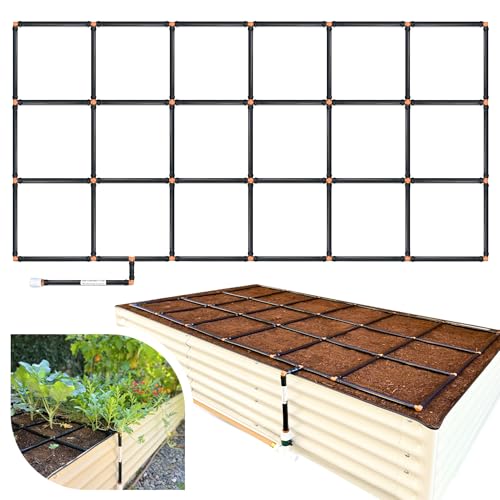
The Garden Grid delivers 16 gentle streams per square foot across a 3×6 raised bed, eliminating dry spots and overspray simultaneously. It arrives in pre-assembled sections and connects to a standard garden hose in about two minutes — no tubing cutting, no emitter placement, and no pressure regulator is required. The rigid polypropylene frame doubles as a square-foot gardening guide, making spacing consistent for densely planted flower borders.
Built-in UV-resistant materials and a fine mesh filter at the inlet prevent debris from clogging the internal channels, and the manufacturer reports original units from 2013 still in use. Pairing it with an automatic timer turns it into a fully hands-off system. The 50 PSI maximum pressure rating is standard for residential supply, and the built-in streams direct water to the soil surface rather than wetting foliage, reducing fungal risk on ornamentals.
One quirk: on a non-standard 4×4 bed the grid overhangs slightly at the corners, though coverage remains solid. The price reflects the premium of a pre-engineered, US-manufactured product versus a DIY bag of parts. For any gardener with a rectangular raised bed who wants the fastest, most even watering solution available, this grid is the undisputed winner.
What works
- Two-minute tool-free setup
- Perfectly even watering across every square foot
- US-made and extremely durable
What doesn’t
- Only fits rectangular raised beds
- Premium price compared to DIY kits
2. Secbulk Flat Soaker Hose 100ft (50ft x 2)

The Secbulk Flat Soaker Hose uses a dual-layer PVC-and-fabric construction that weeps water along its entire 100-foot length, eliminating the targeted emitter placement required by drip systems. Its flat design resists kinking and rolls up easily for off-season storage, a significant convenience over traditional round soaker hoses that tangle. The maximum pressure rating of 90 PSI gives you leeway if your household water pressure runs high.
Because it comes as two 50-foot hoses with rust-resistant end caps, you can link them end-to-end for a single 100-foot run or use them separately on opposite sides of a yard. Owners report pairing the hose with a timer and running it for about 17 minutes per cycle to achieve deep saturation along bushy flower borders. The recycled vinyl material passes CA65 safety testing, making it safe for edible ornamentals like herbs interplanted among flowers.
The tradeoff with any soaker hose is that the weeping action is pressure-dependent: at very low pressure the water may not reach the far end evenly. The fabric cover resists sun damage but, like all soaker hoses, buried lines can still clog from mineral deposits over multiple seasons. For long, continuous flower beds where you want a simple, low-maintenance connection to a timer, this set offers excellent coverage.
What works
- Kink-resistant flat design stores easily
- Linkable for runs up to 100 feet
- Safe for edible ornamentals
What doesn’t
- Pressure-dependent evenness
- Can clog over time with hard water
3. Spalolen Push-to-Connect Drip Irrigation Kit
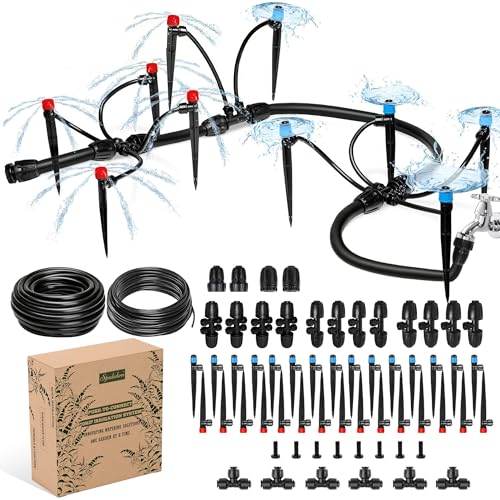
The Spalolen kit distinguishes itself with a 50-foot 1/2″ mainline, significantly longer than the standard 33-foot mains found in most budget kits. That extra run length delivers more stable water pressure to distant emitters, making this kit suitable for larger raised beds, greenhouse layouts, and multi-row flower borders. The push-to-connect fittings use internal locking clips and O-rings that resist leaks and accidental pop-offs under pressure changes.
It includes 30 emitters — both stream and vortex types — plus 100 feet of 1/4″ distribution tubing, giving you room to design a custom layout for container flowers, in-ground beds, and hanging pots. Owners report installing the entire system across four raised beds and four pots in under an hour. The UV-resistant materials hold up through full sun exposure, and the kit’s modular nature allows easy expansion with Spalolen’s compatible extension fittings.
A small percentage of owners experienced faulty blue emitters that only leaked instead of spraying. While that’s a minor quality-control miss, the rest of the kit’s components — including the 1/2″ hose, tees, and adapters — earned high marks for build and pressure retention. For DIY-oriented gardeners who want a robust platform to expand over time, this is the best mid-range drip system on the market.
What works
- Extra-long 1/2″ mainline for better pressure
- Push-to-connect fittings save installation time
- Expandable with compatible parts
What doesn’t
- Occasional faulty emitters out of box
4. Bonviee Drip Irrigation System 230FT

The Bonviee kit is built around quick-connect fittings that push-and-lock onto the tubing without any tools or heating. It includes 230 feet total of tubing — 33 feet of 5/16″ mainline plus 197 feet of 1/4″ drip line — along with adjustable stake sprayers that offer gentle drip, vortex, or full spray patterns. This versatility makes it a strong choice for a mixed flower bed that includes both delicate annuals and tougher perennials.
Setup can be completed in about 30 minutes for a six-bed layout, and the system is compatible with any standard hose timer for automation. Owners highlight that the kit includes every component needed to get started, from tees and elbows to end caps and stakes. The adjustable emitters let you fine-tune each zone’s output, so you can give a thirsty hydrangea section more flow while dialing back water for succulents nearby.
On the downside, some users noted that the vortex-style stakes produce less spread at lower water pressure, while the multi-stream stakes perform better across pressure ranges. A few also wished for more stakes to secure the tubing in complex garden layouts. For a first-time drip irrigation buyer who wants an all-in-one solution with zero learning curve, the Bonviee kit is a reliable entry point.
What works
- Tool-free quick-connect setup
- Three emitter types for different plants
- Timer-compatible for automation
What doesn’t
- Vortex stakes lose coverage at low pressure
- Could use more stakes for complex layouts
5. Maotong 240FT Drip Irrigation Kit

The Maotong kit provides 240 feet of total tubing (40 feet of 1/2″ main and 200 feet of 1/4″ distribution) with 270 total pieces, making it one of the most complete kits for covering large, two-zone flower bed layouts. The kit includes two faucet adapters, allowing you to split the mainline into two independent systems — ideal for front-yard and backyard flower beds running from the same hose bib. The upgraded 1/2″ mainline handles higher water pressure without expansion or bursting.
It comes with 15 vortex and 15 stream emitters, plus a full set of tees, elbows, 4-way connectors, and end caps. Owners praise the instruction illustrations for clarity and note that the entire system can cover approximately 250 square feet when configured as a single network. The polyethylene tubing is flexible even in cooler weather, reducing the risk of kinking during installation. Several reviewers bought additional kits after successfully setting up their first one.
The most common complaint is a strong plastic smell from the tubing when first unboxed, which dissipates after a few days of sun exposure. Also, because the kit uses traditional barbed-style fittings rather than push-to-connect, assembly requires slightly more hand force. For gardeners who need maximum coverage length and the ability to run two zones from a single purchase, the Maotong kit delivers unbeatable value per foot of tubing.
What works
- Two faucet adapters for separate zones
- Large 270-piece set reduces extra purchases
- Flexible PE tubing resists kinking
What doesn’t
- Strong plastic smell out of box
- Barbed fittings require more hand force
6. GGAQHLK Copper Nozzle Drip Kit 230FT
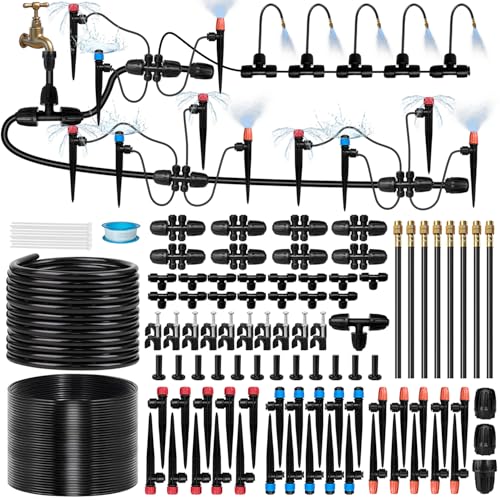
The GGAQHLK kit stands out for its 38 adjustable nozzles, which include 10 vortex, 10 stream, 10 misting, and — uniquely — 8 copper nozzles that can be bent 360 degrees to aim water exactly where needed. The copper nozzles are particularly useful for flower beds with irregular plant heights or trailing varieties that need directed root watering. The kit includes 33 feet of 1/2″ mainline and 197 feet of 1/4″ drip tubing, with a 1/2″ tee connector that allows seamless splitting into two zones.
Owners consistently report that installation is tool-free and leak-free, with the push-fit connectors creating a tight seal under normal household pressure. The misting nozzles are excellent for seed-starting flats or delicate seedlings in the flower bed, while the vortex heads cover a wider root zone for established shrubs. The kit’s copper nozzles hold their shape well and add a durable, corrosion-resistant option that plastic spray tips cannot match.
The main downside is that the 1/2″ mainline is on the shorter side at 33 feet, limiting how far you can reach from the faucet without splitters. Additionally, the variety of emitter types can be overwhelming for a first-time user who just wants uniform watering. For experienced gardeners who want the ability to fine-tune water placement for each plant — and especially for those with mixed flower and potted plant layouts — this kit provides the highest level of control.
What works
- Bendable copper nozzles for precise aiming
- Four nozzle types cover all watering needs
- Tool-free, leak-resistant connections
What doesn’t
- Short mainline limits reach
- Many nozzle options can confuse beginners
7. MHMHM 5/8″ Brass Soaker Hose 50ft
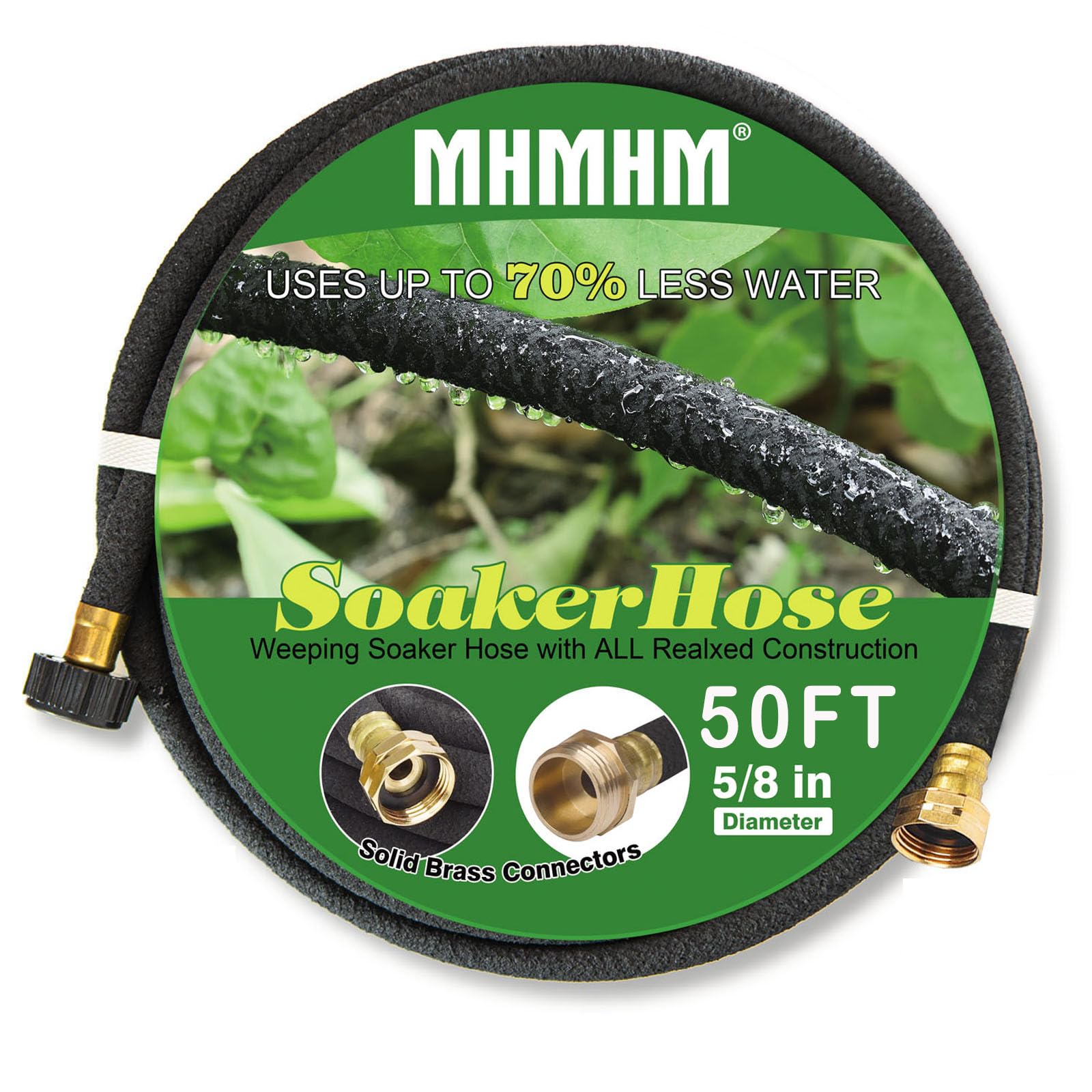
The MHMHM 5/8″ soaker hose is the simplest entry point: a single 50-foot length of recycled rubber tubing with solid brass fittings at both ends. Its 5/8″ inside diameter matches standard garden hose connections and allows better water flow than the narrower 1/2″ soaker hoses. The recycled rubber construction withstands extreme temperatures from -40°F to 140°F, making it suitable for year-round use in climates with harsh winters or intense summers.
Water seeps evenly along the entire length when operated at typical residential pressure, and a removable green restrictor at the inlet lets you adjust flow. The round profile bends easily into loops around shrubs and trees without kinking, and the brass fittings resist corrosion far better than the plastic or chrome-plated alternatives found on budget soaker hoses. Owners consistently mention more uniform water distribution compared to previous soaker hoses they’ve owned.
Because it’s a plain weeping hose without emitters, you cannot target water to specific plants — the entire length weeps continuously. That means pathways or gaps in the bed get water too, which could encourage weeds. For a straight run down a densely planted flower border or around foundation shrubs, however, this is the most affordable and durable soaker hose option on the list.
What works
- Strong brass fittings resist corrosion
- Extreme temperature tolerance (-40°F to 140°F)
- Even weeping along full 50ft length
What doesn’t
- Waters pathways and gaps between plants
- No flow adjustment for individual areas
Hardware & Specs Guide
Emitter Types and Watering Patterns
Vortex emitters create a wide, circular spray pattern that covers the entire root zone of established perennials. Stream emitters deliver targeted drips directly to the base of a single plant, reducing runoff and evaporation. Misting nozzles produce a fine fog, excellent for seed-starting flats and humidity-loving foliage but wasteful in windy conditions. Soaker hoses weep along their entire length, making them best for tightly spaced, continuous plantings like flower bed borders or ground cover mats.
Pressure Tolerance and Flow Rate
Most drip systems operate optimally between 20 and 50 PSI. If your household pressure exceeds 50 PSI, you should install a pressure regulator to prevent fitting blow-offs and uneven emitter flow. Soaker hoses generally tolerate up to 90 PSI but deliver more consistent seepage at lower pressures. The 1/2″ mainline tubing carries water with less friction loss than 1/4″, so longer runs should always use a 1/2″ backbone to maintain pressure at the final emitter.
Material Durability and UV Resistance
Polyethylene (PE) and polypropylene (PP) are the standard plastics for drip irrigation tubing. PE is flexible in cold weather and resistant to UV degradation if treated. Rubber soaker hoses offer extreme temperature tolerance but can degrade faster in direct sunlight if not covered by mulch. The best kits use UV-stabilized materials that remain pliable and leak-free after multiple seasons. Metal components — especially brass and copper fittings — resist corrosion from constant moisture far better than zinc alloy or plated steel.
Component Count and Expansion Flexibility
Kits that include 200+ pieces offer the most layout flexibility, with extra tees, elbows, and 4-way connectors for splitting into multiple zones. The number of faucet adapters included determines whether you can run independent systems from separate hose bibs. Push-to-connect fittings allow easier reconfiguration than barbed fittings, which require cutting and heating to modify. If you plan to expand your flower beds in future seasons, prioritize a kit from a brand that sells standalone extension parts.
FAQ
How long should I run my drip irrigation for flower beds each session?
Can I bury soaker hoses under mulch in flower beds?
What size tubing should I use for a flower bed that is 40 feet from the faucet?
Final Thoughts: The Verdict
For most gardeners, the irrigation system for flower beds winner is the Garden In Minutes 3×6 Garden Grid because it eliminates the guesswork of emitter placement and delivers flawlessly even coverage in a two-minute setup. If you need flexibility across irregular, multi-zone flower beds, the Spalolen Push-to-Connect Kit offers the best expandable drip platform with its extra-long 50-foot mainline. And for long, narrow border strips where a soaker hose can snake between plants with zero assembly, the Secbulk Flat Soaker Hose provides exceptional value and simple timer-based automation.