
Boxwoods are the backbone of formal landscapes, yet they are notoriously finicky about soil pH and nutrient balance. One wrong feeding can trigger leaf bronzing, stunted growth, or a yellow cast that takes months to reverse.
I’m Rikta — the co-founder and writer behind Lawn Gear Lab. I’ve spent hundreds of hours cross-referencing NPK ratios, micronutrient profiles, and soil acidification data to isolate the fertilizers that actually meet a boxwood’s specific physiological needs.
After digging through owner experiences and lab-grade formulations, I’ve found the five feeds that consistently deliver dark green foliage and dense branching. This is my definitive guide to finding the best boxwood fertilizer for your hedge or foundation planting.
How To Choose The Best Boxwood Fertilizer
Boxwoods are shallow-rooted evergreens that thrive in slightly acidic soil. A fertilizer that spikes the pH or delivers too much fast-release nitrogen can scorch roots and yellow leaves. Here’s what to check before you buy.
NPK Ratio and Nitrogen Source
Boxwoods perform best with a ratio where nitrogen is the highest number, but the source matters more. Slow-release or controlled-release nitrogen (from natural organics or coated urea) provides steady color without forcing weak, floppy growth. Avoid ratios above 20 on nitrogen unless the source is predominantly slow-release.
Acidifying vs. Neutral Formulas
Boxwoods prefer soil pH between 6.0 and 7.0. If your soil test reads above 7.0, an acidifying fertilizer with elemental sulfur (like Espoma Holly-tone) helps lower pH naturally. If your soil is already acidic, a balanced feed like Jobe’s spikes or a boxwood-specific granular works without over-acidifying.
Micronutrient Profile
Beyond NPK, boxwoods suffer from magnesium deficiency (yellowing between leaf veins) and iron chlorosis. Look for added magnesium sulfate or chelated iron in the guaranteed analysis. Products with sulfur also support protein synthesis and disease resistance.
Quick Comparison
On smaller screens, swipe sideways to see the full table.
| Model | Category | Best For | Key Spec | Amazon |
|---|---|---|---|---|
| TOPBUXUS Boxwood Turbo Grow | Granular | Targeted boxwood feeding | 13-3-13 NPK + 2.5% Mg | Amazon |
| Espoma Organic Holly-Tone | Granular | Acid-soil feeding | 36 lb bag, 4-3-4 NPK | Amazon |
| Espoma Organic Evergreen-Tone | Granular | Broadleaf evergreens | 18 lb bag, 4-3-4 + 5% S | Amazon |
| Jobe’s Slow Release Spikes | Spike | Mess-free feeding | 16-4-4 NPK, 15 spikes | Amazon |
| TPS Nutrients Boxwood Fertilizer | Liquid | Quick green-up | 32 oz liquid concentrate | Amazon |
| FoxFarm Happy Frog Japanese Maple | Powder | Low-pH feeders | 4-3-4 + mycorrhizae | Amazon |
| Old Farmer’s Almanac Spikes | Spike | Long-duration feeding | 13-3-3, 24 spikes | Amazon |
In‑Depth Reviews
1. TOPBUXUS Boxwood Turbo Grow

TOPBUXUS is one of the few brands that formulates exclusively for boxwoods, and the 13-3-13 ratio with 2.5 percent magnesium, 9 percent sulfur, and 2 percent calcium reflects a deep understanding of what Buxus needs. The high potassium content (13) supports root density and stress tolerance, while the sulfur drives chlorophyll production. Owners consistently report that bronzed or yellowing leaves green up within three to four days after application, which is unusually fast for a granular feed.
The 1-pound bag covers 100 square feet, making it a targeted solution rather than a general-purpose spread. Users note that the granules are fine enough to work into the soil surface around the drip line without damaging shallow roots. Several reviews highlight that switching from standard shrub food to this formula stopped ongoing leaf browning, suggesting the magnesium-calcium-sulfur complex corrects deficiencies common in boxwood-heavy landscapes.
The main drawback is the cost per square foot relative to bulk granular options. But for the grower who wants measurable results and understands that boxwoods are not ordinary shrubs, the concentrated micronutrient profile justifies the premium.
What works
- Fast visible green-up in 3-4 days
- Magnesium and sulfur address boxwood-specific deficiencies
- Easy to apply around shallow roots
What doesn’t
- Small bag size requires multiple purchases for large plantings
- Higher cost per square foot than all-purpose feeds
2. Espoma Organic Holly-Tone

Holly-Tone is a decades-old standard for acid-loving plants, and boxwoods benefit from its 4-3-4 ratio and 5 percent sulfur content. The 36-pound bag gives serious value for anyone managing a hedge row or multiple foundation beds. The Bio-tone microbes break down slowly, feeding the soil food web and releasing nutrients across a full growing season without burning shallow boxwood roots.
Because boxwoods prefer a pH between 6.0 and 7.0, Holly-Tone’s gentle acidification is ideal for gardens with alkaline or neutral tap water. Owners report that spring-fed boxwoods show deeper green color and tighter internodal spacing compared to plants fed with standard 10-10-10 blends. The bulk format makes it easy to store and use over two to three full feeding cycles.
The only limitation is the lack of boxwood-specific micronutrient enhancement. While the sulfur is present, there is no added magnesium or chelated iron, so growers with confirmed magnesium deficiency may still need a supplemental dose. Also, the large bag size may overwhelm gardeners with only one or two shrubs.
What works
- Enormous bag for low per-shrub cost
- Gentle acidification suits alkaline soils
- Bio-tone microbes support long-term soil health
What doesn’t
- No added magnesium or chelated iron
- Overkill for single-container boxwoods
3. Espoma Organic Evergreen-Tone

Evergreen-Tone targets both needle-leaf and broadleaf evergreens, making it a strong fit for boxwood hedges that share borders with pines, junipers, or arborvitae. The 4-3-4 analysis with 5 percent sulfur provides steady foliage color and root support without overstimulating tender new growth before winter dormancy.
The chicken-manure base gives a mild barnyard scent that fades after watering, and the granules are uniformly sized for even hand-spreading. Owners report measurable green-up within two weeks of early-spring application, and the organic certification means no synthetic salts accumulate in the root zone — an important consideration for boxwoods planted close to foundations or walkways where runoff is limited.
The 18-pound bag is a middle ground between the large Holly-Tone sack and the small boxwood-specific packs, but the lack of added magnesium means growers with yellow interveinal tissue should pair this feed with a separate magnesium sulfate supplement.
What works
- Organic formula with low salt index
- Sulfur content supports foliage density
- Works across mixed evergreen borders
What doesn’t
- No added magnesium for deficiency correction
- Slightly slower green-up than synthetic blends
4. Jobe’s Slow Release Tree and Shrub Spikes

For the gardener who wants zero measuring, mixing, or spreading, Jobe’s pre-measured spikes simplify feeding to two steps per year: hammer them in around the drip line, then water. The 16-4-4 ratio delivers a nitrogen burst that pushes deep green color, but the slow-release coating prevents the root burn that often accompanies high-N synthetic fertilizers on sensitive broadleaf evergreens.
The plastic cap protects the spike from crumbling during installation, and the 15-count box covers a line of five to seven medium boxwoods when spaced per the package directions. Owners who have used these for multiple seasons report that their boxwood hedges maintain consistent height and density compared to untreated neighbors. The spikes are particularly useful for shrubs planted in heavy clay where granular fertilizers can run off the surface before penetrating.
The nitrogen source is primarily synthetic, so organic-only growers may prefer a different option. Additionally, the 16-4-4 ratio is higher in nitrogen than some boxwood specialists recommend, so in very sandy or fast-draining soils, a portion of the nitrogen may leach before the roots can use it.
What works
- No mixing, measuring, or mess
- Prevents runoff on clay soil
- Consistent two-season schedule
What doesn’t
- Synthetic nitrogen base not organic
- Higher N ratio can leach in sandy soil
5. TPS Nutrients Boxwood Fertilizer
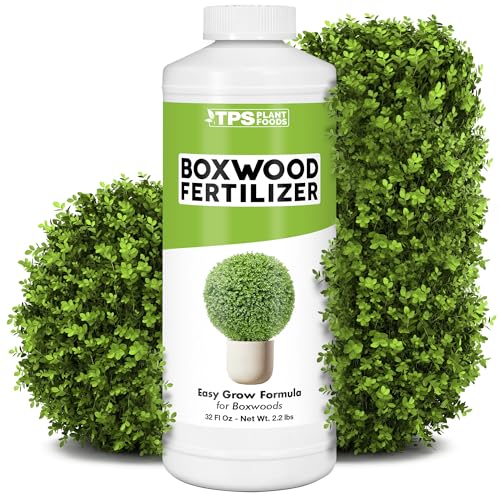
When boxwoods look stressed mid-season and granular feeding feels too slow, TPS Nutrients offers a liquid concentrate designed specifically for Buxus. The 32-ounce bottle mixes with water for immediate root uptake, and owners report dramatic revival of dying or yellowed plants within two to three weeks of first application.
The liquid formulation allows precise dosing around the root zone without disturbing the shallow root system. It works well for container-grown boxwoods on patios or for small foundation plantings where granular spread would scatter onto pavement. Users also appreciate that the ready-to-mix formula reduces the guesswork compared to general-purpose liquid fertilizers that may not have the correct micronutrient balance for acid-loving evergreens.
Several experienced owners note that the formula appears identical to the brand’s juniper and arborvitae fertilizers, suggesting it is a single balanced blend repackaged for different target species. While the results are still excellent, the lack of truly boxwood-specific chemistry means the price per ounce is higher than multipurpose liquids that can achieve similar green-up.
What works
- Visible results in two to three weeks
- Ideal for container and patio boxwoods
- Precise liquid dosing avoids root disturbance
What doesn’t
- Formula may be same as other species blends
- Higher per-dose cost than granular options
6. FoxFarm Happy Frog Japanese Maple Fertilizer

FoxFarm Happy Frog is formulated for Japanese maples and other low-pH feeders, but its 4-3-4 ratio with added mycorrhizal fungi and beneficial soil microbes makes it a strong ally for boxwoods grown in compacted or nutrient-poor soils. The mycorrhizae extend the root’s reach, helping the shrub access water and nutrients that standard granular feeds cannot unlock.
The 4-pound powder bag is small but concentrated; at two tablespoons per gallon, it stretches further than liquid concentrates. Owners note that boxwoods fed with Happy Frog develop denser branching and richer green color compared to plants fed only synthetic spikes. The organic base also avoids the salt buildup that can stress boxwoods in pots or sandy ground.
The main caveat is that this fertilizer is not marketed specifically for boxwoods, so the micronutrient profile (phosphorus and potassium balanced for flowering trees) may not perfectly match a boxwood’s vegetative growth focus. For pure foliar density, a higher-nitrogen formula may work faster. Additionally, the powder requires mixing, which adds a step versus spikes or liquids.
What works
- Mycorrhizae improve root efficiency
- Organic formula prevents salt buildup
- Low pH suits boxwood preference
What doesn’t
- Not specifically optimized for boxwood growth
- Requires mixing before application
7. The Old Farmer’s Almanac Tree & Shrub Spikes
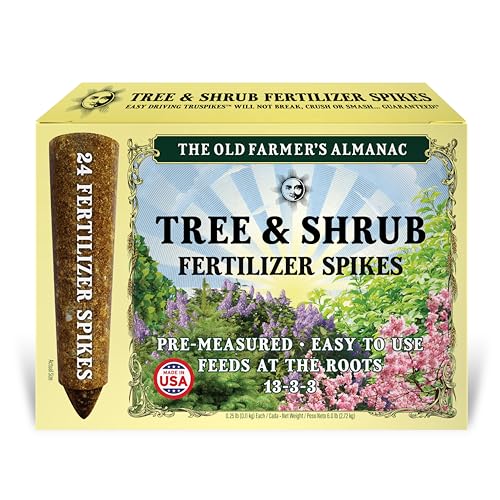
The Old Farmer’s Almanac spikes pack a 13-3-3 formula with molasses-based slow-release technology into 5-inch TruSpikes that resist cracking when hammered into hard soil. The 24-count box covers a substantial hedge or a small row of specimen trees, and the natural ingredients appeal to growers who want organic inputs without the bulk of a 36-pound bag.
Users report that boxwoods green up within weeks of spring application, and the slow-release mechanism provides a steady nutrient drip that lasts through the growing season. The spikes are easy to install even in clay-heavy soil because they hold together under mallet strikes — a distinct advantage over crumbly competitor spikes that shatter mid-installation.
The 13-3-3 ratio is high in nitrogen compared to the other organic options on this list, which may cause lush growth that requires more frequent pruning to maintain formal shapes. Additionally, the cost per spike is higher than bulk granular equivalents, making long-term use on very large hedges expensive.
What works
- Spikes do not shatter during installation
- Molasses-based slow release lasts full season
- 24-count covers large hedges
What doesn’t
- High nitrogen may push excess growth
- Higher per-spike cost than bulk granular
Hardware & Specs Guide
NPK Ratio
The NPK numbers on a boxwood fertilizer bag represent the percentages of nitrogen (N), phosphorus (P₂O₅), and potassium (K₂O). Boxwoods favor a higher first number for foliage color, but the nitrogen source material (slow-release organic vs. fast-release synthetic) determines whether that nitrogen feeds leaves or burns roots. A ratio around 13-3-13 or 4-3-4 with slow-release carriers is ideal.
Micronutrients (Mg, S, Ca)
Magnesium is the central atom in the chlorophyll molecule; without it, boxwoods cannot photosynthesize fully, leading to interveinal chlorosis. Sulfur helps lower soil pH and improves protein synthesis, while calcium strengthens cell walls. Look for at least 2 percent magnesium and 5 percent sulfur in the guaranteed analysis for fast correction of yellowing.
FAQ
Can I use a general-purpose 10-10-10 fertilizer on boxwoods?
How often should I fertilize my boxwood shrubs each year?
Final Thoughts: The Verdict
For most gardeners, the boxwood fertilizer winner is the TOPBUXUS Boxwood Turbo Grow because its 13-3-13 ratio with built-in magnesium and sulfur directly addresses the nutritional deficiencies that cause yellowing and bronzing in Buxus. If you want long-lasting bulk value for a large hedge, grab the Espoma Organic Holly-Tone. And for mess-free convenience on a small foundation planting, nothing beats the Jobe’s Slow Release Spikes.