
Seed starting success depends on a tray that won’t twist, crack, or leak under the weight of saturated soil. Thin trays that flex under a full cell flat or warp on a heat mat introduce drainage problems and root disturbance — a bad start that compounds through transplant. The material thickness and overall rigidity of your sprouting tray directly affect germination consistency and seedling root health from day one.
I’m Rikta — the co-founder and writer behind Lawn Gear Lab. I’ve spent dozens of hours comparing polymer PS/PP thickness measurements, drainage configurations, stack compatibility, and real-world owner feedback across the most popular sprouting tray models to identify which trays deliver lasting structural integrity.
Whether you are outfitting a home seed-starting station or scaling microgreens production, the right flat makes the difference between shifting fragile pots and carrying a stable unit. This guide breaks down the top-tier options to help you select the best sprouting trays for repeated use without sag or breakage.
How To Choose The Best Sprouting Trays
A sprouting tray is a simple container, but material grade, thickness, drainage configuration, and dimensional accuracy determine how many seasons it will serve. Narrow these factors and you’ll avoid the most common sources of frustration.
Material Thickness & Gauge
The single most important durability spec is the plastic wall thickness. Entry-level trays hover around 0.4 mm, flexing under a full flat of 72-cell inserts. Mid-range and premium trays start at 1.2 mm and go up to 1.8 mm, resisting twist when lifted with one hand. Thicker plastic also withstands heat mat exposure without warping and survives winter storage stacking.
Drainage Configuration
Solid-bottom trays (no holes) are essential for bottom-watering setups and hydroponic microgreen production—they hold a reservoir without leaking onto shelves. Trays with drainage holes allow passive airflow at the root zone but require a secondary solid tray underneath for runoff collection. Some premium trays feature cross-channel bottoms that improve water distribution while maintaining structural rigidity.
Dimensions & Stack Compatibility
The “1020” standard refers to approximate outer dimensions of 10 x 20 inches. However, actual external measurements vary between brands by up to 0.5 inches, which can prevent one brand’s tray from nesting inside another’s or fitting into a dedicated greenhouse rack. Verify compatibility with your existing inserts, humidity domes, and shelving before committing to a set.
Quick Comparison
On smaller screens, swipe sideways to see the full table.
| Model | Category | Best For | Key Spec | Amazon |
|---|---|---|---|---|
| RooTrimmer 10-Pack (TX550) | Mid-Range | Heavy 10-pack, microgreens & transplants | 1.8 mm wall thickness | Amazon |
| Hemlock Home Brewing 5-Pack | Mid-Range | Deep, durable all-purpose flats | 1.2 mm PP, 2.5-inch depth | Amazon |
| Bootstrap Farmer 5-Pack | Premium | Professional microgreen harvest | Shallow 1.25-inch depth | Amazon |
| Handy Pantry 10-Pack | Premium | Vented bottom watering | Drain holes + 2.375-inch depth | Amazon |
| SOLIGT Stackable Steel Kit | Premium | Countertop sprout & microgreen production | 304 stainless steel, 2-tier mesh | Amazon |
| RooTrimmer 10-Pack (TD538) | Mid-Range | Budget-friendly 10-pack for plug trays | 1.6-inch depth, no holes | Amazon |
| Gardzen 10-Pack | Budget | Entry-level 10-pack with tools | PS material, 2.4-inch depth | Amazon |
In‑Depth Reviews
1. RooTrimmer 10 Pack 1020 Trays (TX550)

The RooTrimmer TX550 trays lead the list with a measured 1.8 mm wall thickness — nearly three times the density of budget flats. The bottom features deep concave-convex stripes that improve water retention capacity while reinforcing the structure against sagging when loaded with saturated cell packs or microgreen soil beds. At 2.52 inches deep, they accommodate taller nursery pots without crowding the root zone.
Owner reports consistently highlight zero cracking after repeated heat mat exposure and rigid one-handed carrying even with full soil mass. The 10-count configuration suits both home operations and small commercial growers who need uniform trays across multiple benches. The no-hole design makes them ideal for bottom-watering reservoirs and hydroponic propagation.
The only compromise involves compatibility: the slightly oversized rim (21.6 x 11.2 inches top) may not nest flush with older 1020 trays from other brands. Users with existing rack systems should verify fit before purchasing a full set. Outside that concern, these represent the thickest, most durable flat we evaluated.
What works
- Exceptional 1.8 mm thickness resists twist and bend even under heavy soil loads
- Reinforced bottom channels hold extra water for prolonged bottom-up absorption
- 10-pack delivers consistent quality across large propagation setups
What doesn’t
- Non-standard outer dimensions may not stack inside older 1020 tray brands
- Weight per tray is higher than PS-based alternatives at 1.1 pounds each
2. Hemlock Home Brewing 1020 5-Pack

Hemlock Home Brewing offers a 5-pack of green 1020 flats with caliper-verified 1.2 mm polypropylene walls — a significant upgrade over the 0.4 mm Jiffy trays reviewers commonly compare against. The BPA-free, food-safe construction handles multiple growing seasons without cracking or leaking, and the 2.5-inch internal depth provides ample room for deep-rooted seedlings and tall wheatgrass beds.
Multiple owners confirm these trays do not flex when lifted with one hand while full, and the solid bottom makes them suitable for bottom-watering, hydroponic use, or as drip trays under potted plants. The green color offers a visual cue that these are the heavy-duty units when stored alongside thinner black alternatives. The outer dimensions (21 x 10.75 x 2.5 inches) follow the standard 1020 footprint for broad compatibility.
These trays lack drainage holes, so users who require bottom aeration for root development or plan to sow directly into the flat will need to drill or select a holed option. The 5-pack is also less economical per tray than bulk 10-packs, though the quality justifies the unit cost for growers who prioritize longevity over quantity.
What works
- BPA-free polypropylene with 1.2 mm thickness outlasts standard flimsy trays
- Standard 1020 dimensions fit most inserts, domes, and greenhouse racks
- Deep 2.5-inch interior handles tall seedlings and deep soil beds
What doesn’t
- Solid bottom limits airflow at root zone without DIY drainage holes
- 5-pack count may require multiple orders for large batch starts
3. Bootstrap Farmer Extra Strength 5-Pack
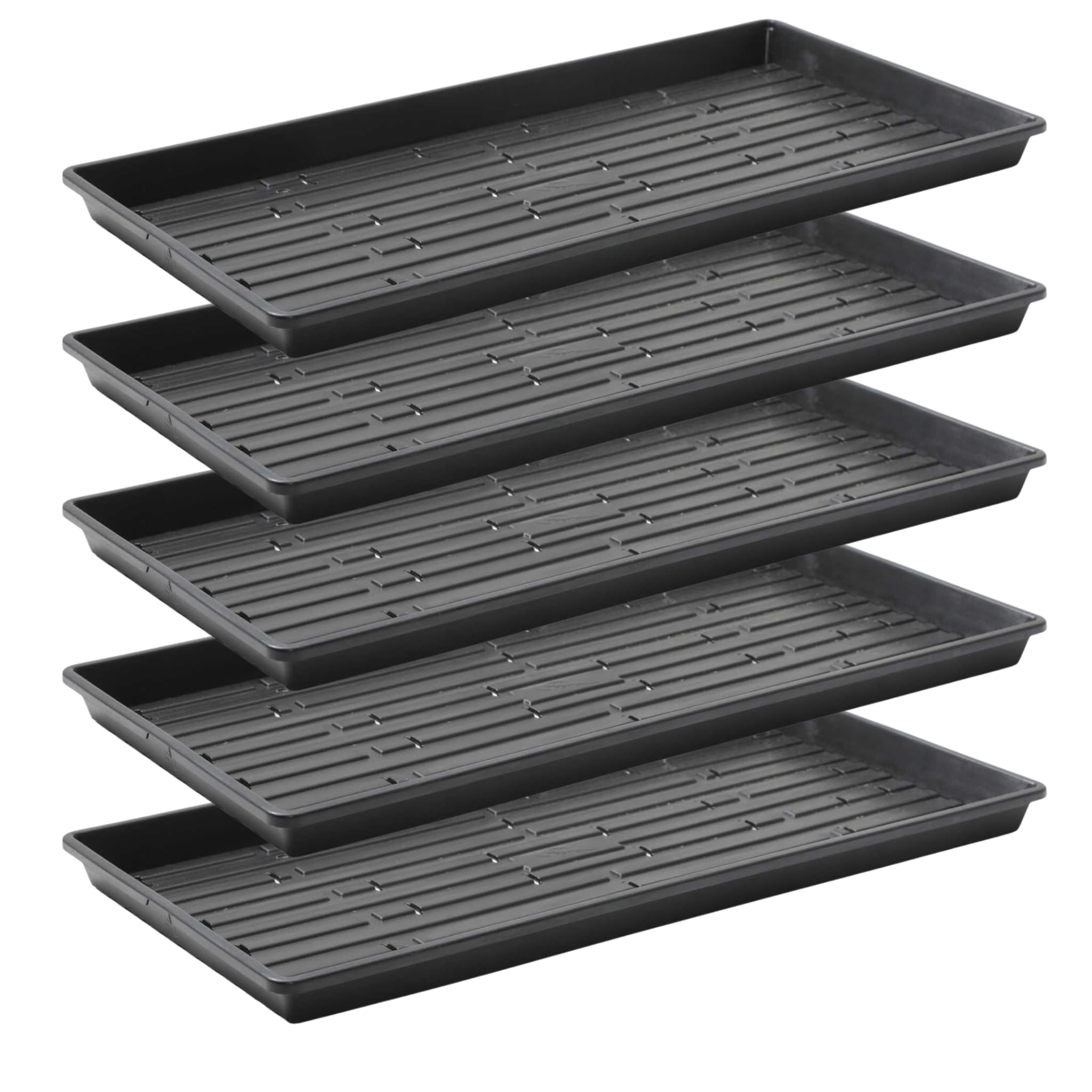
Bootstrap Farmer’s shallow 1.25-inch deep trays are engineered specifically for microgreen and wheatgrass production where minimal soil depth accelerates harvest and reduces media waste. The polypropylene construction includes cross-channel drainage that distributes water evenly while preventing the tray from twisting or folding during transport. Owner accounts describe these as the sturdiest flats used in years, with thick sidewalls that resist cracking even under heat mat and humidity dome exposure.
The key trade-off is depth. At 1.25 inches, these trays are too shallow for standard 72-cell or 128-cell plug inserts, which require a minimum of 1.5 inches of interior height. They excel as bottom trays for runoff collection or as direct-sow microgreen beds where the entire surface is seeded. The dishwasher-safe rating adds convenience for sanitizing between crop cycles.
Some reviewers noted arrival damage due to insufficient packing from the seller — the thin profile is more susceptible to shipping pressure than deeper alternatives. Despite that, multiple long-term users report these trays lasting over three years of continuous greenhouse use without degradation.
What works
- Cross-channel bottom design improves water distribution and prevents root rot
- Shallow depth allows easy microgreen harvest and reduces soil media costs
- Dishwasher-safe polypropylene simplifies sanitation between grows
What doesn’t
- Too shallow for standard 1.5-inch+ plug trays and nursery pots
- Arrival damage reported due to insufficient seller packaging
4. Handy Pantry 10-Pack with Drain Holes

Handy Pantry produces a USA-molded 10-pack of 1020 trays with precision-spaced drainage holes that facilitate bottom-watering without risking waterlogged roots. The 2.375-inch depth provides a practical balance between being deep enough for nursery pots while remaining easy to handle under bench lighting. The polystyrene material is FDA-listed as food-safe, supporting direct-contact growing for microgreens and sprouts.
Users report the trays are flexible enough to avoid cracking during handling but maintain enough rigidity to hold shape when filled. The built-in drain holes eliminate the tedious process of drilling flats and work well when nested over solid-bottom trays for a complete wicking system. The 10-pack quantity suits greenhouse operations that need a large inventory of identical vented flats.
A notable issue is tray-to-tray fit with companion solid-bottom trays — the outer dimensions are 20.5 x 10.125 inches, which does not always nest perfectly inside standard solid 1020 trays from other brands. Buyers should match these with Handy Pantry’s own solid flats for guaranteed compatibility. Additionally, heavy-use growers note the PS material, while food-safe, is slightly less impact-resistant than polypropylene over several years of handling.
What works
- Precision-molded drainage holes promote healthy root airflow and bottom watering
- FDA food-safe polystyrene suitable for direct-contact microgreen production
- USA-made consistent quality across all 10 units
What doesn’t
- Polystyrene less durable long-term than polypropylene in commercial use
- Outer dimensions may not sit flush inside standard solid 1020 trays from other brands
5. SOLIGT Stackable Stainless Steel Kit

The SOLIGT kit breaks the flat-tray mold entirely with a circular, stackable 2-tier design made entirely from 304 stainless steel. The 8-inch diameter mesh trays feature fine openings that retain small seeds (alfalfa, broccoli, mung bean) while allowing rapid drainage after rinsing. The vertical stacking system saves counter space and enables staggered sprout production by starting a new batch on the second tier while the first matures.
The rust-resistant steel construction eliminates the plastic degradation problem — no cracking, warping, or UV damage, even with daily rinsing and sunlight exposure. The included lid maintains warmth and humidity during initial germination without requiring a separate dome. Users consistently mention the simple soak-rinse-drain workflow that works for sprouting beginners and experienced growers alike.
Cleaning is the primary critique: fine mesh screens trap sprout rootlets that require firm scraping or a dedicated brush to remove between batches. The kit also produces a lower yield per cycle compared to a full 1020 flat, making it better suited for continuous household sprout consumption than bulk microgreen production.
What works
- Food-grade 304 stainless steel will never crack or degrade with use
- Fine mesh retains small seeds while providing rapid drainage and aeration
- Stackable 2-tier design optimizes countertop space for continuous sprouting
What doesn’t
- Small mesh holes are challenging to clean thoroughly after sprout removal
- Lower total growing area compared to a 1020 flat tray
6. RooTrimmer 10-Pack (TD538)

The TD538 variant from RooTrimmer is a 10-pack of solid-bottom 1020 trays engineered with a 1.6-inch depth — a height specifically matched to the company’s own 72- and 128-cell plug trays. The bottom measures 19.1 x 9 inches, creating a tight fit that prevents inserts from shifting during transport. The BPA-free plastic is thicker than entry-level alternatives, providing enough rigidity to carry a full flat of soil without bending.
Owners highlight the crack-free performance after multiple seasons and describe the trays as heavy-duty enough for permanent greenhouse installation. The solid bottom makes them suitable for hydroponic reservoirs and microgreen production where soil-free solutions are used. The 10-pack at this price point offers the best tray-to-dollar value among the thicker options reviewed here.
Potential buyers should note that the 1.6-inch depth is shallower than standard deep flats (2.5 inches), which may limit use for tall nursery pots or deep-rooted seedlings that require a larger soil column. They also lack drainage holes, so growers who want bottom aeration will need to pair them with the holed version.
What works
- Depth optimized for 72/128 plug tray inserts with secure friction fit
- Solid bottom supports bottom-watering and hydroponic reservoirs
- Great bulk value with consistent build quality across 10 trays
What doesn’t
- 1.6-inch depth limits use with taller nursery pots or deep-root crops
- No drainage holes for passive bottom aeration
7. Gardzen 10-Pack Seed Trays

Gardzen’s 10-pack provides an economical entry point with a generous 2.4-inch depth and the added bonus of a dibber and widger tool. The polystyrene trays feature no drainage holes and include internal watering channels designed to guide moisture evenly across the root zone during bottom irrigation. The 21 x 11 inch outer footprint fits most standard shelving and greenhouse benching.
These trays appeal to the price-conscious gardener starting a large seed-starting operation without committing to the higher per-tray cost of premium polypropylene flats. The included tools reduce the initial accessory investment needed for transplanting and seed placement. Reviewers confirm the trays hold up through multiple seasons of home use when handled carefully.
The material is less impact-resistant than thicker PP alternatives. Several users report that trays can flex noticeably when fully loaded with wet soil, and isolated crack reports exist for trays stored under heavy stacking pressure during winter. For the home gardener who does not move full trays aggressively, these provide a functional solution at a competitive price per unit.
What works
- Includes dibber and widger tools for immediate transplanting
- Generous 2.4-inch depth accommodates tall pots and deep soil beds
- Low cost per tray for large quantity setups
What doesn’t
- Polystyrene material is prone to flexing under heavy wet soil loads
- Some units arrive cracked due to thinner plastic gauge
Hardware & Specs Guide
Wall Thickness & Material
Tray thickness directly correlates with lifespan and load-bearing ability. Entry-level polystyrene or thin PP trays measure 0.4–0.8 mm and may flex or crack within one season. Premium polypropylene flats measure 1.2–1.8 mm, resisting sag when carrying soaked soil blocks. Stainless steel kits circumvent plastic degradation entirely but trade total surface area for vertical stack capability. Always check the actual material — PS vs. PP — since polypropylene offers greater impact strength and heat resistance under germination mats.
1020 Footprint & Stack Compatibility
The “1020” standard suggests approximate dimensions of 10 x 20 inches, but actual measurements range from 21 x 10.75 inches to 21.6 x 11.2 inches depending on brand. This non-uniformity affects whether trays can nest for storage, whether inserts (plug trays) fit securely, and whether humidity domes create a proper seal. Measure your existing rack or tray dimensions before ordering a new brand to ensure inter-operability. Material type also affects stack weight — heavy 1.8 mm PP trays weigh 1–1.5 pounds each, requiring sturdier shelving compared to lighter PS flats.
FAQ
How many growing seasons can I expect from a thick 1.2 mm sprouting tray?
Should I choose trays with holes or without for starting seeds?
Final Thoughts: The Verdict
For most gardeners, the sprouting trays winner is the RooTrimmer TX550 10-Pack because its 1.8 mm wall thickness and reinforced bottom channels deliver unmatched durability for both microgreen beds and standard seed-starting. If you prefer a deeper flat with a standard 1020 footprint, grab the Hemlock Home Brewing 5-Pack. And for countertop sprout enthusiasts who value a non-degradable system, nothing beats the SOLIGT Stainless Steel Kit.