
Yellowing leaves, flower drop, and bland fruit are the clearest signals that your citrus trees are starving for precise nutrition. A generic 10-10-10 lawn fertilizer pushes leafy growth at the expense of blossoms, while a formula high in potash and micronutrients like zinc and iron targets the exact needs of acid-loving fruit trees. The difference between a tree that survives and one that thrives comes down to the specific NPK ratio and secondary elements in the bag.
I’m Rikta — the co-founder and writer behind Lawn Gear Lab. I’ve spent dozens of hours cross-referencing soil science data, comparing guaranteed analysis sheets, and analyzing verified owner feedback to rank the most effective formulations for citrus, avocado, and nut trees on the market today.
From slow-release organics to fast-acting liquids tailored for container plants, this guide breaks down the key specs and application strategies that separate premium results from wasted money when choosing a fertilizer for citrus trees.
How To Choose The Best Fertilizer For Citrus Trees
Citrus trees are heavy feeders that demand a specific balance of nitrogen for leaf growth, phosphorus for root and flower development, and potassium for fruit quality and cold hardiness. The wrong ratios can cause blossom drop, nutrient lockout, or salt buildup in containers. Focus on three key factors to match the right product to your tree’s stage and growing environment.
NPK Ratio and Micronutrient Profile
A fertilizer with an NPK ratio around 2-1-1 (like 6-4-6 or 5-2-6) delivers the higher potassium that citrus craves for fruit sweetness and peel thickness. Nitrogen should be lower than potassium to avoid pushing excessive foliage at the cost of flowers. Secondary nutrients — calcium for cell wall strength, magnesium for chlorophyll production, zinc and iron for leaf color — separate a complete formula from a bare-minimum mix. Check the guaranteed analysis for sulfur and boron, which support essential oil development in the fruit rind.
Granular vs. Liquid Delivery
Slow-release granules coated with a semi-permeable membrane provide steady nutrition over 6 to 8 weeks and reduce the risk of root burn, making them ideal for in-ground trees and busy schedules. Liquid concentrates deliver nutrients immediately on contact, which is valuable for correcting acute deficiencies in container trees or rejuvenating stressed plants. Liquids require more frequent applications — typically every one to two weeks during the growing season — and the dosage must be halved for potted trees to prevent salt accumulation.
Soil Biology and Organic Certification
Organic fertilizers build long-term soil health through microbial activity and humic content, releasing nutrients as microbes break down the material. Mycorrhizal fungi and proprietary microorganisms like Biozome archaea increase root efficiency and water absorption, which directly benefits citrus trees that struggle with compacted or alkaline soils. OMRI-listed products guarantee no synthetic chemicals or sewage sludge, a critical factor if you want to maintain organic garden standards or avoid introducing harmful residues into your fruit.
Quick Comparison
On smaller screens, swipe sideways to see the full table.
| Model | Category | Best For | Key Spec | Amazon |
|---|---|---|---|---|
| GardenWise Professional Citrus Fertilizer | Granular | Balanced NPK with micronutrients | 6-4-6 NPK + Mg, Zn, Fe | Amazon |
| FoxFarm Happy Frog Citrus & Avocado | Granular | Organic with mycorrhizae | 7-3-3 NPK + microbes | Amazon |
| Jobe’s Organics Fruit & Citrus Spikes | Spike | Mess-free potted trees | 3-5-5 NPK, 6 spikes | Amazon |
| Nelson NutriStar 12-10-10 | Granular | High-potassium cold hardiness | 12-10-10 NPK + calcium | Amazon |
| Farmer’s Secret Citrus Booster | Liquid | Super-concentrated recovery | 1 tsp/gal dilution | Amazon |
| Espoma Organic Citrus-tone | Granular | Bulk organic feeding | 5-2-6 NPK + 5% Ca | Amazon |
| TPS Nutrients Citrus Fertilizer | Liquid | Fast absorption for deficiencies | Mg, Ca, Fe included | Amazon |
In‑Depth Reviews
1. GardenWise Professional Citrus Fertilizer

The GardenWise Professional Citrus Fertilizer delivers a 6-4-6 NPK ratio that mirrors the ideal potassium-heavy profile citrus trees require for fruit development. Each granule is coated for slow release over 8 weeks, feeding the tree steadily without the spikes in nitrogen that cause explosive leaf growth at the expense of blossoms. The inclusion of magnesium triggers chlorophyll production in yellowing leaves, while zinc and copper strengthen the tree’s cellular defenses against pests and disease.
Users report visible new growth within a week of the first application and a dramatic reduction in blossom drop on established lemon and orange trees. The 4-pound bag covers multiple mature trees for a full season, making the per-ounce cost noticeably lower than boutique organic blends. The formula works equally well on potted Meyer lemons and in-ground grapefruit trees, provided you stick to the 6-8 week schedule and avoid over-applying to containers.
Customer reviews frequently mention the product’s ability to revive winter-weary foliage and push out fragrant flowers within days. One reviewer with a Meyer lemon tree noted a full bloom accompanied by an intense lemon blossom scent after one week of use. The manufacturer also backs the product with responsive customer support, a detail that surfaces repeatedly in positive feedback.
What works
- Visible foliage greening and flower set within one to two weeks
- Slow-release coating prevents salt burn on container trees
- Broad micronutrient package covers zinc, iron, and magnesium
What doesn’t
- Bag size is modest for orchard-scale feeding
- Granules can clump if stored in humid conditions
2. FoxFarm Happy Frog Citrus & Avocado Fertilizer

FoxFarm’s Happy Frog formulation uses a 7-3-3 NPK base that supplies higher nitrogen for vigorous vegetative growth, making it particularly effective for young trees you want to establish quickly or for avocado trees with heavy foliar demands. The real differentiator is the inclusion of mycorrhizal fungi and beneficial soil microbes that colonize the root zone, increasing the tree’s ability to extract water and nutrients from the surrounding soil.
The OMRI-listed organic certification means no synthetic chemicals enter the soil, and the 4-pound bag is sufficient for a small grove or several containers. A few users note that the product smells similar to alfalfa meal, which attracts dogs, so watering it in immediately after application is essential.
The blend works across all growth stages: it supports newly planted trees with root-building microbes while sustaining mature fruiting specimens through the harvest season. One long-term reviewer with ten citrus trees and four avocados reported that the fertilizer was difficult to find locally, making the Amazon availability a major convenience factor. The only trade-off is the 7-3-3 ratio’s lower potassium relative to other citrus-specific formulas, which may require supplemental feeding for trees prone to potassium deficiency.
What works
- Mycorrhizal fungi improve root efficiency and drought tolerance
- OMRI-listed organic with no synthetic additives
- Proven track record with both citrus and avocado trees
What doesn’t
- Odor attracts dogs — must be watered in immediately
- Lower potassium may need supplementation for heavy fruiting
3. Espoma Organic Citrus-tone 5-2-6

Espoma’s Citrus-tone 5-2-6 is the gold standard for organic citrus feeding, built on a high-potassium base that drives fruit sweetness and cold hardiness in mature trees. The 5% calcium content strengthens cell walls in trunks and limbs, reducing the risk of splitting under heavy fruit loads, while the Bio-tone microbial blend accelerates nutrient cycling in the root zone. The 18-pound bag in this two-pack stretches across a full orchard for an entire season when applied at the manufacturer’s recommended rate.
Growers in Florida and California report that switching from synthetic granular blends to Citrus-tone transformed their orange and tangerine trees, with one user noting that trees that had struggled for years finally produced heavy flower sets after a single season of application. The formula is approved for organic gardening and registered as an Organic Input Material, so it meets the strictest production standards. Application is straightforward — sprinkle the granules around the drip line and water in — with no mixing required.
Long-term users appreciate that the product works on non-citrus fruit trees as well, including stone fruits and nut trees, making it a versatile addition to the garden shed. The bulk packaging reduces the per-pound cost significantly compared to smaller bags, but the upfront investment is higher than competitive options. Several reviews highlight that mature trees require a larger quantity per feeding, so the 18-pound bag is best suited for growers with at least three to four established trees.
What works
- High potassium and calcium directly improve fruit quality and wood strength
- OMRI-listed organic with Bio-tone microbial enhancers
- Bulk bag provides excellent per-ounce value for multiple trees
What doesn’t
- High upfront cost for the two-pack
- Requires manual distribution around drip line — no easy spike option
4. Jobe’s Organics Fruit & Citrus Tree Fertilizer Spikes

Jobe’s Organics spikes deliver a 3-5-5 NPK ratio that prioritizes phosphorus for root and flower development, making this a strong choice for citrus trees grown in containers where root room is limited. The pre-measured spikes eliminate measuring, mixing, and spill risks — simply drive them into the soil around the drip zone and the Biozome archaea microbes go to work breaking down the material for root absorption. Each package contains six spikes, and the organic formulation is OMRI-listed with no synthetic chemicals.
Potted Meyer lemon owners consistently praise the spikes for producing an abundance of juicy, sweet lemons year after year without the mess of granular fertilizer. The time-release mechanism prevents nutrient runoff and reduces the risk of over-fertilizing, which is especially important in containers where salt buildup can burn roots rapidly. A few users reported initial issues when placing the spikes too close to the trunk, but following the spacing guidelines resolved the problem and led to visible growth improvement in heritage apple and citrus trees.
The Biozome archaea component is a proprietary microorganism that aggressively breaks down organic matter, accelerating the release of nutrients compared to standard organic spikes. This means the spikes can show results faster than many granular organics while maintaining the safety profile of an OMRI-approved product. The main limitation is the small count per package — six spikes cover one to two trees depending on size, so a growing season may require multiple refills for larger groves.
What works
- Zero mess — no measuring, mixing, or dust
- Time-release prevents salt burn in container trees
- Biozome archaea deliver faster nutrient cycling than standard organics
What doesn’t
- Six spikes per pack — insufficient for large groves
- Must be placed at correct distance from trunk to avoid root damage
5. Farmer’s Secret Citrus Tree Booster Fertilizer

Farmer’s Secret Citrus Tree Booster is a super-concentrated liquid formula that packs a full spectrum of nutrients into a 32-ounce bottle, requiring just one teaspoon per gallon of water for weekly feeding. The 1:128 dilution ratio means a single bottle yields up to 384 gallons of ready-to-use fertilizer, making it one of the most cost-effective liquid options despite its premium price point. The formula is designed for all citrus varieties including lemons, limes, and oranges, and also works on avocado trees.
Users with sad, yellowing lemon trees in Phoenix and other hot, alkaline-soil regions reported complete recovery within weeks, with fresh lemons appearing and leaves turning lush green. The liquid delivery allows immediate absorption through the roots and leaves, making it ideal for correcting acute deficiencies. Reviewers noted that the product lacks calcium and magnesium in the primary analysis, but the manufacturer recommends it as part of a broader feeding program — trees showing deficiency signs may need a separate supplement for those elements.
The bottle is bottled in Kentucky and marketed as the same formulation used by commercial farmers, which adds credibility for growers who want professional-grade results. For indoor or container trees, the label advises cutting the dosage in half or applying bi-weekly to prevent over-concentration.
What works
- Extremely concentrated — one bottle makes hundreds of gallons
- Fast-acting liquid corrects yellowing in weeks
- Works for all citrus and avocado varieties
What doesn’t
- Lacks calcium and magnesium — may need separate supplement
- Over-application risk if dilution is not measured precisely
6. Nelson NutriStar Citrus Fruit & Avocado Tree Plant Food
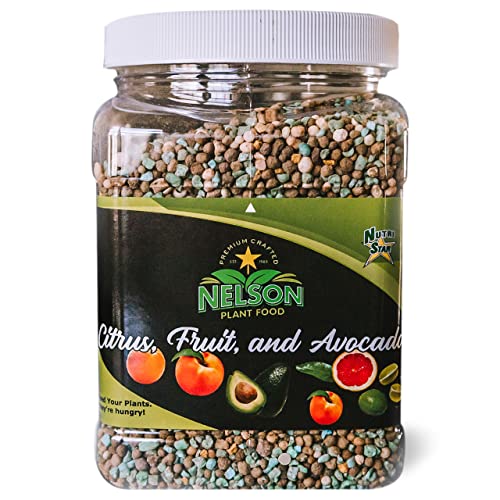
Nelson NutriStar’s 12-10-10 formulation delivers a higher NPK concentration than most competitors, with a 12% nitrogen content that fuels rapid canopy expansion and deep green coloration. The 10% potassium helps trees survive colder winter temperatures by strengthening cell structure and improving overall stress tolerance. Calcium is also included in the formula to increase trunk and limb girth, providing the structural support needed for heavy fruit loads on mature trees.
Indoor and container growers report seeing a full set of new leaves on orange trees within two months of switching to NutriStar, even when the trees were moved indoors for the winter. The granular format works with the soil’s natural biology to release nutrients on demand, and the manufacturer recommends monthly application during the growing season for optimal results. The 2-pound bag is compact but covers multiple feedings for medium-sized trees when applied at the label’s rate.
The high analysis ratio means a little goes a long way, but it also increases the risk of burning if over-applied. Users who followed the 30-day schedule saw consistent growth without leaf tip burn, while those who increased frequency or skipped the soil watering step sometimes reported salt accumulation. The product is made in the USA by a company with over three decades of experience in plant nutrition, which shows in the precise balance of macro and micro elements.
What works
- High NPK concentration provides rapid greening and growth
- Potassium content improves cold hardiness for vulnerable climates
- Calcium strengthens trunk and limb structure
What doesn’t
- Over-application can cause salt burn — must follow monthly schedule
- 2-pound bag is small for large in-ground trees
7. TPS Nutrients Citrus Fertilizer Liquid
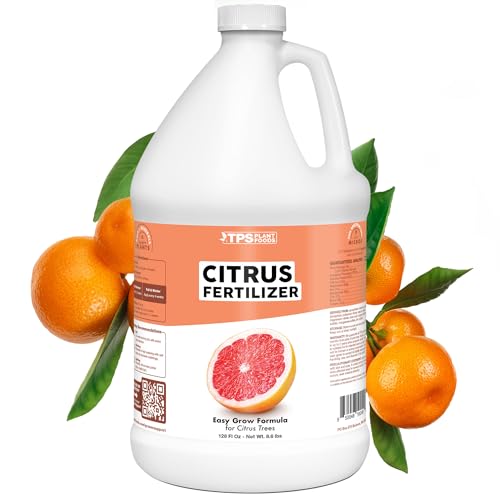
TPS Nutrients Citrus Fertilizer is a 1-gallon liquid concentrate formulated specifically for citrus, nut, avocado, and fruiting trees, with an emphasis on secondary macronutrients like magnesium, calcium, and iron. These elements target the most common deficiency symptoms in citrus — interveinal chlorosis (yellowing between leaf veins) and weak fruit set — by delivering them in a fast-absorbing liquid form. The recommended dosage is 1 to 2 teaspoons per gallon of water, applied weekly or bi-weekly during the growing season.
Growers with potted lime trees experiencing yellow leaves and stalled fruit growth reported visible turnaround within two weeks of switching to TPS. Leaves returned to a healthy green, limes increased noticeably in size, and new growth emerged from multiple nodes. The liquid format makes it easy to adjust dosage for individual trees, and it can be applied as a soil drench or foliar spray for even faster correction of leaf symptoms.
Some experienced users note that the formula is somewhat low in nitrogen for citrus’s overall needs, recommending that it be paired with a higher-nitrogen supplement for trees in the active growing phase. The 1-gallon bottle is a large volume that lasts multiple seasons for small groves, but the price is higher than granular alternatives of similar coverage. For growers who prioritize correcting micronutrient deficiencies and want a clean, dissolved solution that mixes instantly, this is a strong emergency and maintenance option.
What works
- Fast liquid absorption corrects yellowing leaves in two weeks
- Includes calcium, magnesium, and iron for citrus-specific deficiencies
- 1-gallon bottle provides long-term supply for small groves
What doesn’t
- Low nitrogen content may require a separate N supplement
- Higher price per feeding compared to granular options
Hardware & Specs Guide
NPK Ratio — The Foundation
The three numbers on the bag represent nitrogen (N), phosphorus (P), and potassium (K) percentages. Citrus trees perform best with a ratio around 2-1-2, where nitrogen and potassium are roughly equal and higher than phosphorus. This supports steady leaf growth without sacrificing flower and fruit development. Products like Espoma’s 5-2-6 and GardenWise’s 6-4-6 align closely with this ideal profile, while higher-nitrogen blends like 12-10-10 work better for young trees or those recovering from severe deficiency.
Micronutrient Checklist — Beyond NPK
Magnesium, zinc, iron, manganese, and boron are critical for citrus health. Magnesium prevents interveinal chlorosis in older leaves, zinc corrects leaf mottling and rosetting, and iron keeps new growth green. Boron supports flower development and fruit set. Always check the guaranteed analysis for these elements — products that only list NPK without secondary nutrients will leave your trees deficient over time, especially in sandy or alkaline soils where micronutrients leach quickly.
FAQ
How often should I fertilize a potted citrus tree compared to an in-ground one?
What does yellowing between leaf veins on my citrus tree mean?
Can I use a general-purpose fruit tree fertilizer on citrus trees?
Final Thoughts: The Verdict
For most gardeners, the fertilizer for citrus trees winner is the GardenWise Professional Citrus Fertilizer because its balanced 6-4-6 NPK combined with zinc, iron, and magnesium covers the full nutrient spectrum without requiring additional supplements. If you want a no-mess organic solution for potted trees, grab the Jobe’s Organics Citrus Spikes. And for large-scale organic feeding across multiple in-ground citrus and avocado trees, nothing beats the Espoma Organic Citrus-tone for long-term soil health and bulk value.