
Winter takes a toll on your lawn, leaving it pale, weak, and hungry. The right spring application delivers the nitrogen it craves to kickstart root recovery and build dense, dark-green turf before the summer stress cycle begins.
I’m Rikta — the co-founder and writer behind Lawn Gear Lab. I’ve spent countless hours analyzing NPK ratios, slow-release technologies, and real owner feedback to separate marketing fluff from agronomic truths in this category.
This guide breaks down the best performers, from quick-green liquid boosters to long-feeding granular programs, so you can confidently choose the best spring grass fertilizer for your turf type and soil conditions.
How To Choose The Best Spring Grass Fertilizer
Spring feeding is about waking the lawn up, not forcing a growth explosion. Picking the wrong formulation leads to top-heavy blades, wasted nutrients, or outright burn. Here are the three criteria that define a smart spring application.
Nitrogen Source and Release Rate
Check whether the nitrogen is quick-release (urea, ammonium sulfate for fast green-up) or slow-release (polymer-coated, methylene urea, or natural organics for steady feeding over 6–12 weeks). Spring applications benefit from a blend: a fast fraction for immediate color and a slow fraction to carry the lawn through the heavy growing weeks ahead.
Phosphorus and Potassium Balance
Many soils already have sufficient phosphorus from previous seasons. A phosphorus-free formula (the middle number is 0) prevents runoff pollution and works perfectly unless a soil test shows a deficiency. Potassium — the third number — strengthens roots and drought tolerance, which becomes critical as summer heat arrives.
Iron and Micronutrient Content
Iron delivers a deep, rich green color without stimulating excess leaf growth. Lawns with an iron supplement green up noticeably faster and stay darker longer. Micronutrients like humic acid improve soil biology and nutrient uptake, making the fertilizer work harder per pound.
Quick Comparison
On smaller screens, swipe sideways to see the full table.
| Model | Category | Best For | Key Spec | Amazon |
|---|---|---|---|---|
| Yard Mastery 24-0-6 Flagship | Granular | All-season high-feed program | 24% slow release N, 3% iron | Amazon |
| Andersons PGF 16-0-8 | Granular | Phosphorus-sensitive lawns | Humic DG, 8-week N feed | Amazon |
| Petramax Liquid 28-0-0 | Liquid | Rapid green correction | 70% quick, 30% slow N | Amazon |
| GreenView Fairway Formula 27-0-5 | Granular | Medium-to-large lawns | 63% slow N, 10K sq ft | Amazon |
| Lawnbox Grass Genie 10-0-6 | Organic | Pet-safe, organic feeding | Humic acid, no animal waste | Amazon |
| Yard Mastery 16-0-0 Double Dark | Granular | Deep color without excess growth | 6% iron, low flush growth | Amazon |
| Syngenta Primo Maxx | Liquid PGR | Reducing mowing frequency | Trinexapac-ethyl, 20-40K sq ft | Amazon |
In‑Depth Reviews
1. Yard Mastery 24-0-6 Flagship Granular Lawn Fertilizer

The Yard Mastery Flagship delivers a 24-0-6 NPK with a 24% slow-release nitrogen component, creating a steady, surge-free feed window that sustains color and density for weeks. The 3% iron content drives a rapid, visible darkening of the turf without forcing excessive leaf elongation — exactly what spring lawns need after winter dormancy. Covering 15,000 square feet per 45-pound bag, this formulation suits homeowners managing half-acre lots who want professional-grade results without frequent reapplication.
Bio-Nite technology enhances nutrient availability in cooler spring soils where microbial activity is still waking up. The 6% potassium supports root structure and drought resilience, preparing the grass for the seasonal shift to summer stress. Multiple verified reports note that neighbors assumed a commercial lawn service had been hired after a single application, which speaks directly to the visual payoff of this blend.
Downsides are predictable: the growth kick may require mowing twice per week during peak spring push, and the premium pricing reflects the agronomic engineering inside the bag. If your priority is one-and-done spring feeding with deep color, this is the head of the class.
What works
- Visible dark-green greening within days of watering
- Large bag covers 15,000 sq ft efficiently
What doesn’t
- Strong growth stimulus may require increased mowing frequency
- Premium price bracket among granular fertilizers
2. The Andersons Professional PGF 16-0-8 with Humic DG
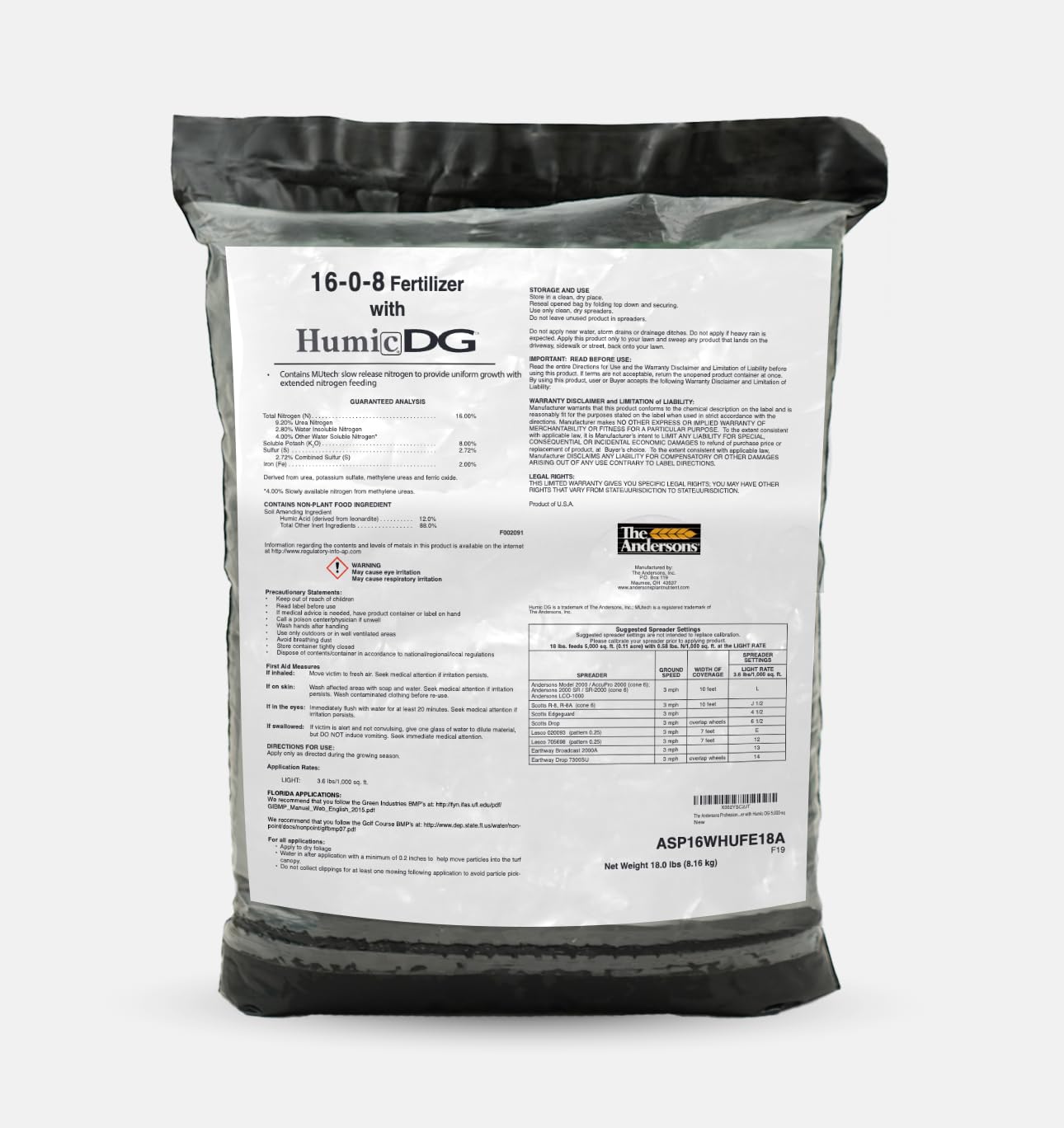
The Andersons PGF 16-0-8 is engineered for lawns where soil phosphorus is already sufficient — a common scenario after years of standard 10-10-10 applications. The super-fine DG (Dispersion Granule) particles break down quickly on contact with moisture, delivering twice the particle count per square foot compared to conventional prills, which translates to more uniform feeding and fewer striping or burn patterns.
The quick- and slow-release nitrogen blend feeds immediately while extending the nutrition window to roughly 8 weeks. The added iron and humic acid improve soil cation exchange capacity, making existing nutrients more available to the root zone. This matters in spring because cold soils lock up phosphorus even when it is present — humic DG helps unlock what is already there.
The price is higher per pound than commodity fertilizers, but the distribution quality and the phosphorus-free formulation justify it for serious lawn managers. One caveat: the super-fine particles can drift in wind during application, so calm-day spreading is recommended. Not available in California or Oregon due to state phosphorus regulations.
What works
- Exceptionally even distribution reduces striping risk
- Ideal for lawns with tested-high phosphorus levels
What doesn’t
- Not for sale in CA or OR
- Fine particles can drift in windy conditions
3. Petramax Liquid Nitrogen 28-0-0

Petramax 28-0-0 is a liquid nitrogen powerhouse built for rapid color correction. Its 70/30 split — 70% quick-release urea for immediate green response and 30% slow-release for sustained feeding — bridges the gap between an instant rescue and a maintained program. At the maintenance mix rate of 5 ounces per gallon, a single gallon treats up to 25,600 square feet, making it one of the highest-coverage liquid products in this lineup.
Liquid formulations are especially useful in spring when soil temperatures are still marginal for granular activation. The nitrogen solution moves directly into the root zone upon watering, bypassing the microbial breakdown delay that granular products rely on. Verified users consistently describe going from pale turf to deep green within days, with several calling out the ease of mixing and spraying via backpack or tow-behind units.
Because liquids lack the residual potassium and iron of a balanced granular feed, this is best used as a booster between granular applications or for spot-treating nitrogen-deficient patches. Over-application at the 10-ounce correction rate will push soft, lush growth that is more susceptible to disease, so precise measuring matters.
What works
- Fastest visible green-up in this guide
- Huge coverage per gallon at maintenance rate
What doesn’t
- Lacks potassium and micronutrients for balanced feeding
- Precise mixing required to avoid nitrogen burn
4. GreenView Fairway Formula 27-0-5

GreenView Fairway Formula hits a sweet spot for value-conscious homeowners who want serious nitrogen delivery without the price tag of boutique brands. The 27-0-5 ratio provides a heavy nitrogen punch with 63% of it in slow-release form, which means consistent feeding for up to 12 weeks from a single spring application. The 33-pound bag covers 10,000 square feet — right-sized for a quarter-acre lot with room to spare.
The phosphorus-free composition protects local waterways while still delivering the nitrogen centipede grass, Bermuda, and fescue require after winter dormancy. Owner reports consistently mention dark green color appearing within days of a good rain, and several long-term users note that this product has remained their go-to spring feed for multiple seasons. The granular consistency spreads cleanly through broadcast spreaders without clumping or bridging in the hopper.
Some users report that the 27% nitrogen can scorch if applied during unseasonably warm spring days or if the spreader overlaps too heavily. Following the label’s spreader settings precisely solves this. For the price per pound of nitrogen, this is one of the most cost-effective options available.
What works
- 63% slow-release nitrogen feeds for up to 12 weeks
- Excellent price-to-performance ratio
What doesn’t
- High nitrogen content can burn if applied carelessly
- No added iron or humic acid for extra color depth
5. Lawnbox Grass Genie 10-0-6 Organic
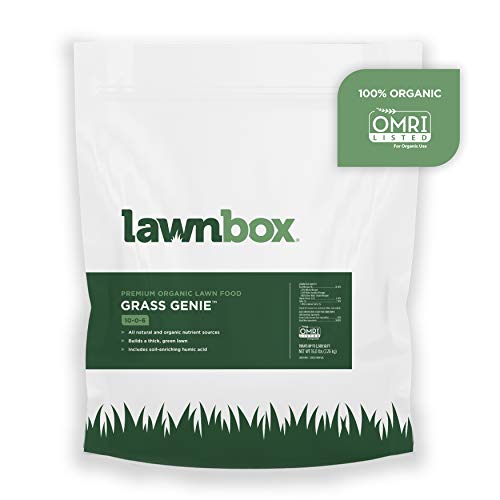
Lawnbox Grass Genie is certified 100% organic, meaning zero animal byproducts, manures, biosolids, or synthetic carriers. The 10-0-6 analysis is lower in nitrogen than conventional spring fertilizers, but the organic nitrogen sources release slowly as soil microbes break them down, feeding the lawn steadily over roughly 6 weeks without the risk of chemical burn. It contains humic acid to support soil biology — a critical factor for long-term lawn health that synthetic-only programs neglect.
This formulation is ideal for pet owners and families who use the yard immediately after application. The manufacturer explicitly states the yard is safe for kids and pets with no waiting period, which is rare in the fertilizer category. Verified reviews from owners with dogs on autoimmune diets confirm zero adverse reactions, a reassurance that synthetic products cannot match.
The trade-off is coverage: a 16-pound bag covers only 2,500 square feet, so owners of larger lawns will need multiple bags. The organic granules also require consistent soil moisture for activation — a dry spring will delay results. For small urban lawns or anyone prioritizing clean ingredients over maximum nitrogen output, this is the top organic choice.
What works
- Immediately pet- and kid-safe after application
- No animal waste or biosolids in the formula
What doesn’t
- Small bag size limits value on large lawns
- Needs consistent moisture for organic nitrogen to activate
6. Yard Mastery 16-0-0 Double Dark with 6% Iron
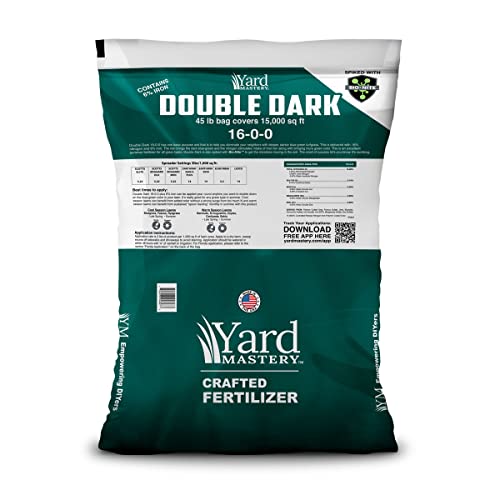
Yard Mastery Double Dark is a specialized color-enhancer that delivers a rich, dark-green appearance without triggering runaway vertical growth. The 16-0-0 NPK provides a moderate nitrogen dose, but the star feature is the 6% iron concentration — one of the highest in the granular spring market. Iron catalyzes chlorophyll production, which darkens turf visibly within about a week while keeping leaf extension in check.
This product is perfect for spring lawns that are already healthy but lack the deep color homeowners want. Because it does not push excessive growth, mowing frequency stays manageable — a relief for anyone who dreads twice-weekly cuts during the spring flush. The 45-pound bag covers 15,000 square feet, matching the coverage footprint of the Yard Mastery Flagship but with a completely different growth profile.
The downside is the limited nutrient profile: this is essentially a color-only feed, not a complete lawn food. Lawns that need a full nutritional reboot will still require a balanced main feed, with Double Dark used as a mid-program color enhancer. Some users also note that the price feels steep for what is primarily an iron supplement rather than a full NPK program.
What works
- Deepens color dramatically without excess top growth
- Large bag delivers good coverage for the price
What doesn’t
- Limited to color enhancement — not a complete fertilizer
- Premium price for a single-purpose product
7. Syngenta Primo Maxx Plant Growth Regulator
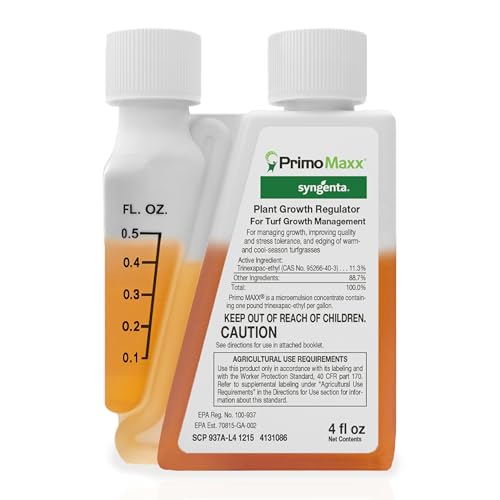
Syngenta Primo Maxx is not a fertilizer — it is a plant growth regulator (PGR) containing trinexapac-ethyl that slows vertical grass growth and redirects energy into lateral spread, root density, and canopy thickness. For spring management of aggressive Bermuda or zoysia lawns, this is a game-changer: it reduces mowing frequency by 30–50% while creating a tighter, more uniform playing surface.
The 4-ounce bottle covers 20,000 to 40,000 square feet depending on target rate, making it extremely concentrated. Users report that it is the only product that keeps a Bermuda lawn from needing mowing every four days during the spring growth explosion. When combined with a standard spring fertilizer program, the PGR synergy produces a dense, dark turf with significantly less clippings volume.
Primo Maxx is an advanced tool and carries a premium price per bottle. It requires careful mixing and a proper sprayer setup — a tow-behind or backpack sprayer is ideal. Some users report a temporary yellowing after application as the grass adjusts, which resolves within a few days after watering. This is best paired with a full spring nitrogen program, not used as a standalone product.
What works
- Dramatically cuts mowing frequency for fast-growing turf
- Encourages lateral spread and deeper root development
What doesn’t
- Not a fertilizer — must be used alongside a nitrogen program
- Temporary yellowing can occur during adjustment period
Hardware & Specs Guide
NPK Ratio
The three-number sequence on every bag tells you the percentage of nitrogen, phosphorus (P₂O₅), and potassium (K₂O) by weight. In spring, the first number (nitrogen) should be highest — usually in the 20–28 range — to drive green growth. The second number (phosphorus) should be 0 unless a soil test says otherwise, because most soils hold adequate phosphorus from past seasons and adding more only risks runoff.
Slow-Release Percentage
Not all nitrogen in a bag is available immediately. Slow-release nitrogen (polymer-coated sulfur-coated urea, or natural organics) breaks down gradually, feeding the lawn for weeks without a growth surge. A product with 50% or more slow-release nitrogen is ideal for spring: you get a quick green kick from the fast fraction and a steady tail of nutrition that lasts 6–12 weeks, meaning fewer applications needed before summer.
Iron Concentration
Iron (Fe) is listed as a percentage or sometimes not listed at all on standard bags. Products with 2–6% iron provide a deep, dark-green coloring effect without stimulating extra leaf growth. This is especially useful in early spring when soil temperatures are cold and nitrogen uptake is limited — iron can green up the lawn even when nitrogen alone would produce only a mediocre response.
Coverage Rate
Coverage is always listed per bag at the label broadcast rate. Standard granular products range from 2,500 sq ft (small organic bags) to 15,000 sq ft (large synthetic bags). Measure your lawn area with a tape or satellite tool before buying — buying a bag that covers 5,000 sq ft for a 12,000 sq ft lawn means either under-feeding or buying three bags, which changes the effective cost per treatment.
FAQ
Can I apply spring fertilizer too early?
What does the middle number 0 mean in a fertilizer like 27-0-5?
Should I use granular or liquid fertilizer for spring feeding?
How do I prevent fertilizer burn on my spring lawn?
Final Thoughts: The Verdict
For most gardeners, the best spring grass fertilizer winner is the Yard Mastery 24-0-6 Flagship because it delivers the ideal nitrogen-iron blend for deep color and sustained feeding without forcing excessive growth. If you need a rapid green correction for a pale lawn, grab the Petramax Liquid 28-0-0. And for pet-safe organic feeding with zero synthetic chemicals, nothing beats the Lawnbox Grass Genie 10-0-6.