
Blueberries demand soil that is acidic, well-drained, and rich in organic matter — a combination that most backyard dirt simply does not provide. The wrong mulch neutralizes the soil, locks out essential nutrients, and turns a promising blueberry bush into a yellowing, low-yield disappointment. Choosing a mulch that actively maintains a low pH while suppressing weeds and conserving moisture is the single most important soil management decision a blueberry grower makes.
I’m Rikta — the co-founder and writer behind Lawn Gear Lab. My research compares dozens of mulch products for their acidifying capacity, moisture retention, breakdown rate, and long-term impact on soil biology to separate what actually works for blueberries from the generic landscaping fillers.
Whether you are planting a new row of bushes or rejuvenating an established bed, finding the right mulch for blueberries determines whether you harvest tart, full-flavored berries or struggle with stunted, chlorotic plants year after year.
How To Choose The Best Mulch For Blueberries
Blueberry bushes have shallow, fibrous root systems that despise compacted, alkaline soil. The right mulch layer does three things: keeps the root zone cool and moist, slowly acidifies the soil as it breaks down, and smothers competing weeds. The wrong mulch — fresh wood chips, manures with high pH, or dyed bark — can undo years of careful soil amendment in a single season.
Prioritize Low pH Materials
Blueberries thrive in soil with a pH between 4.5 and 5.5. Mulches like Canadian sphagnum peat moss (pH 3.5–4.5) and aged pine bark (pH 4.0–5.0) naturally lower or maintain acidity as they decompose. Avoid mulches derived from hardwood, mushroom compost, or lime-treated manure, all of which push pH upward and lock iron and manganese away from the bush.
Texture and Decomposition Rate
A coarse, chunky texture — common with pine bark nuggets or pine straw — allows water and air to reach shallow roots while slowly breaking down over 12–24 months. Fine materials like peat moss create a denser mat that retains moisture longer but can form a crust if applied too thick. Straw offers a middle ground: light, airy, and easy to replenish, though its near-neutral pH means it provides no acidifying benefit.
Nutrient Interaction
Mulch interacts directly with the soil food web. Nitrogen tie-up happens when fresh, high-carbon material (raw wood chips) decomposes, temporarily stealing nitrogen from blueberry roots. Aged bark, peat, and straw have a stable carbon-to-nitrogen ratio that avoids this problem. Pair your mulch with an acid-loving plant fertilizer containing sulfur to reinforce the low-pH environment without risking root burn.
Quick Comparison
On smaller screens, swipe sideways to see the full table.
| Model | Category | Best For | Key Spec | Amazon |
|---|---|---|---|---|
| Espoma Organic Holly-Tone 4-3-4 | Fertilizer / Soil Acidifier | Long-term pH maintenance | 4-3-4 analysis + 5% sulfur | Amazon |
| HealthiStraw GardenStraw | Wheat Straw Mulch | Water conservation + weed suppression | 3 cu ft compressed bale | Amazon |
| Coast of Maine Acid-Loving Planting Soil | Organic Soil / Mulch Blend | Direct planting + top dressing | Low pH peat + compost blend | Amazon |
| Hoffman Canadian Sphagnum Peat Moss | Sphagnum Peat Moss | Acidifying top dress + moisture hold | 18 qt. coarse grade | Amazon |
| AVALUTION Orchid Potting Bark | Pine Bark Mulch | Pine bark top dress for acidity | 18 qt. 0.3-0.6 in. bark | Amazon |
| Berry Tone Plant Food 4-3-4 | Granular Fertilizer | Feeding + mild soil acidification | 4-3-4 with 5% sulfur | Amazon |
| Longleaf Pine Straw Roll | Pine Straw Mulch | Large-area erosion + acidity | Covers up to 125 sq ft | Amazon |
In‑Depth Reviews
1. Espoma Organic Holly-Tone 4-3-4

Espoma’s Holly-Tone is the gold-standard fertilizer for acid-loving plants, and its 4-3-4 analysis paired with 5% sulfur makes it an ideal companion for a blueberry mulch program. The sulfur content works to gradually lower pH as the granules break down, creating exactly the root-zone chemistry blueberries demand. This 36-pound bag covers an impressive area for both spring and fall applications, reducing how frequently you need to re-amend the soil.
Users report dramatic improvements in leaf color and berry production after switching to Holly-Tone, with many noting that their azaleas, rhododendrons, and blueberries all show deeper green foliage and more abundant fruit. The slow-release organic formula feeds the soil microbes rather than forcing a quick green-up, which aligns perfectly with the long-term soil-building mindset required for productive blueberry beds.
While strictly a fertilizer rather than a physical mulch, Holly-Tone is best used as a soil amendment beneath your chosen mulch layer — sprinkle it around the drip line, top with peat or pine bark, and water in thoroughly. For established bushes that need a pH reset without replacing all the existing mulch, this is the most effective product available.
What works
- 5% sulfur actively lowers soil pH
- Organic, OMRI-listed ingredients
- Large bag provides excellent coverage
What doesn’t
- Not a physical mulch — must be paired with a top layer
- Strong odor initially after application
2. HealthiStraw GardenStraw
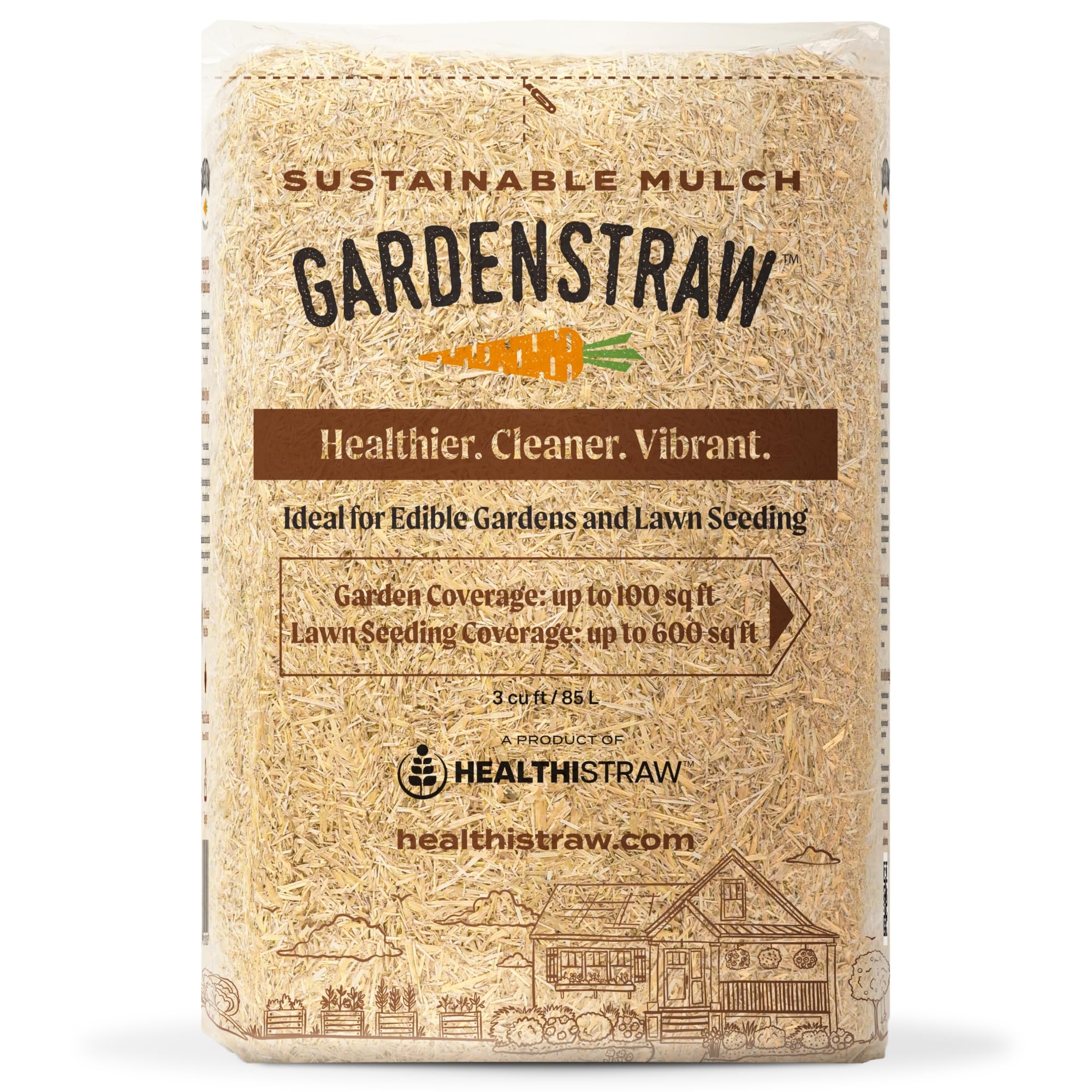
HealthiStraw GardenStraw stands out for gardeners who need a clean, seed-free mulch that conserves water without adding anything to the soil chemistry. This bale is naturally filtered to remove dust, dirt, and most weed seeds, producing a consistent tan layer that stays in place when watered thanks to the interlocking fiber structure. The compressed bale expands significantly — a single package covers up to 100 square feet at the recommended 2- to 3-inch depth.
The straw is not an acidifier itself — its pH is neutral — but it works beautifully as a top dress over a layer of peat moss or pine bark. The straw insulates the root zone, reduces soil evaporation by up to 50%, and breaks down into organic matter that feeds the soil food web. Reviewers consistently mention that it keeps the soil cool during hot summers and that errant weed seeds are virtually nonexistent compared to hay or unprocessed straw.
For blueberry growers, the best approach is to spread an inch of acidifying peat or bark first, then top with 2 inches of GardenStraw. The straw prevents the finer peat from blowing away or crusting, while the peat maintains the low pH the blueberries need. This two-layer system also minimizes fungus gnat issues since the straw stays dry on top.
What works
- Minimal weed seeds compared to standard straw
- Interlocks when watered to resist wind
- Breaks down into quality compost
What doesn’t
- Neutral pH — no acidifying benefit
- Spread bale can be bulky to handle
3. Coast of Maine Acid-Loving Planting Soil

Coast of Maine has engineered a ready-to-use organic blend specifically for acid lovers — blueberries, rhododendrons, azaleas, and hollies. The formulation combines sphagnum peat moss, composted manure, and aged bark to create a low-pH growing medium that also provides balanced drainage and moisture retention. For blueberry growers, this means you can use it as both a planting mix and a top-dress mulch in a single product.
At 20 quarts, the bag is compact enough for container blueberries and small raised beds, but the real value is in the ingredient quality. The peat moss provides the acidifying power, the compost adds slow-release nutrients, and the bark creates air pockets for shallow blueberry roots. Users report that plants perk up noticeably within a week of top-dressing, with greener leaves and more vigorous shoot growth.
The only limitation is that the bag is smaller than dedicated mulch bales, making it less economical for large in-ground blueberry patches. For those with 2–4 mature bushes in a dedicated bed, however, this is the most convenient single-bag solution. It is OMRI-listed and built on sustainable, regenerative sourcing from a company that has been doing it since 1996.
What works
- Ready-to-use low pH formula
- Triple blend of peat, compost, bark
- OMRI organic certified
What doesn’t
- Small volume for large beds
- Higher cost per cubic foot than raw peat
4. Hoffman Canadian Sphagnum Peat Moss

Canadian sphagnum peat moss is the go-to acidifier for blueberry beds, and Hoffman’s New Brunswick-sourced product delivers the coarse, fibrous texture that improves aeration while holding many times its weight in water. This 18-quart bag contains minimal fines or root debris — a common complaint with cheaper peat brands — making it suitable for both mixing into the soil and applying as a top-dress mulch layer.
When used as mulch, a 1–2 inch layer of peat moss suppresses weeds effectively, maintains a root-zone pH around 4.0–4.5, and prevents the rapid evaporation that stresses shallow-rooted plants. The coarse grade ensures water penetrates rather than beading up on the surface, a frequent problem with overly fine peat. Users growing carnivorous plants and blueberries alike praise the negligible amount of woody junk in this bag.
Peat moss alone can crust if applied too thick and left undisturbed through a dry spell. Mixing it with perlite, bark, or straw improves long-term structure. For pure acidifying power in a small footprint, this bag is tough to beat — especially for container blueberries or newly propagated cuttings that need the most consistent acidity.
What works
- High acidity (pH 3.5–4.5)
- Very few sticks or root chunks
- Retains moisture exceptionally well
What doesn’t
- Can form a crust when dry
- Not a complete soil — needs amending with other materials
5. AVALUTION Orchid Potting Bark
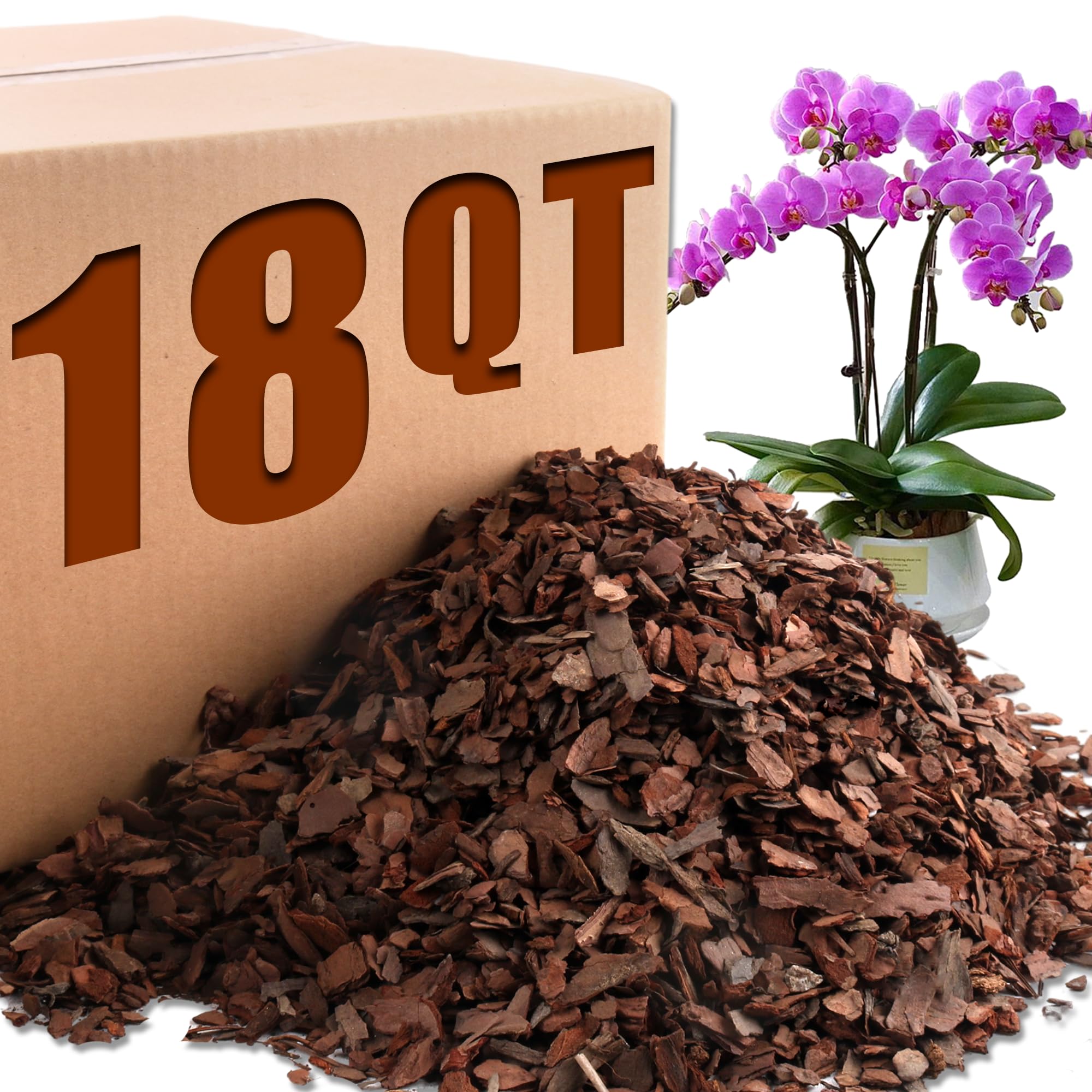
Pine bark is one of the most effective natural acidifiers for blueberry mulch, and AVALUTION’s orchid-grade bark offers an unusually consistent particle size between 0.3 and 0.6 inches. This uniformity matters because it creates consistent air pockets and prevents waterlogged spots that can foster root rot in shallow blueberry roots. The bark is pre-sterilized and pH neutral, but as it slowly decomposes, it releases organic acids that gently lower the surrounding soil pH.
Though marketed for orchids, this bark works equally well as a top-dress around blueberries. The pieces interlock loosely, allowing rainwater to reach the soil while suppressing weed germination by blocking light. Reviewers highlight the absence of dust and the clean, pleasant smell compared to pine bark fines. It also makes an excellent barrier layer beneath straw or wood chip mulches to add acidifying power without the rapid nitrogen tie-up of fresh chips.
The bag is compact at 18 quarts, and the bark is finer than traditional landscaping pine bark nuggets. This means it breaks down faster — typically within 12 months — requiring a replenishment top-off every spring. For container blueberries or raised beds where you want a precise, clean-looking mulch that actively acidifies, this is an excellent choice.
What works
- Consistent small particle size
- Slowly acidifies as it decomposes
- Pre-sterilized with no dust
What doesn’t
- Small bag for large in-ground beds
- Breaks down faster than larger nuggets
6. Berry Tone Plant Food 4-3-4
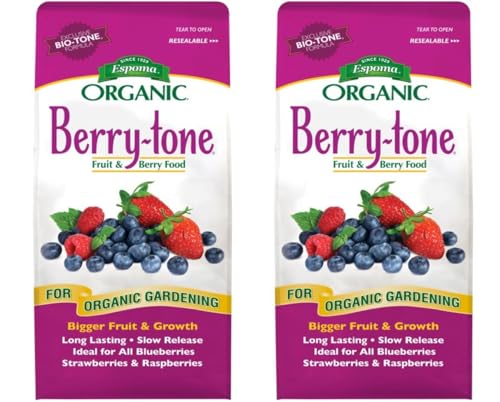
Berry Tone is Espoma’s targeted fertilizer for all berry-producing plants, formulated with a 4-3-4 analysis and 5% sulfur to support both nutrition and mild soil acidification. Unlike Holly-Tone, which is broader for all acid lovers, Berry Tone is tailored to the specific nutrient demands of blueberries, strawberries, raspberries, and blackberries. The granules require no mixing — just sprinkle around the drip line and water in.
Users who apply Berry Tone in early and late spring report significantly larger yields, with one reviewer noting that skipping the application one year resulted in almost no flowers. The Bio-tone beneficial microbes in the formula help break down organic matter in the soil, making locked-up nutrients available to the roots. For blueberry growers using a neutral mulch like straw, this is an essential counterbalance that keeps pH in check.
The 4-pound bag is ideal for small to medium berry patches — roughly enough for 6–8 mature bushes per application. The main consideration is that the bag contains two individually packaged 4-pound units, which can be excessive for container growers. Pair it with a pine bark or peat moss mulch layer for the most consistent low-pH root environment.
What works
- Specifically formulated for berry plants
- Contains Bio-tone beneficial microbes
- No mixing required
What doesn’t
- Two 4-lb bags may be too much for small batches
- Not a standalone mulch — must be used beneath a top layer
7. Longleaf Pine Straw Roll

Pine straw is an often-overlooked but highly effective mulch for acid-loving crops, and this Longleaf roll delivers one of the cleanest, most consistent applications available. The non-colored needles are naturally acidic as they break down, adding organic acids to the root zone while providing exceptional erosion control on slopes. A single roll covers up to 125 square feet, making it the most coverage-efficient product on this list.
The needles interlock naturally when layered, creating a mat that resists heavy rain and strong wind without the need for chemical binders. Users consistently praise the cleanliness — very few sticks, thorns, or filler debris compared to loose pine straw sold by the bale. For large blueberry patches, spreading a 3–4 inch layer of pine straw creates a stable, self-renewing mulch that only needs topping off every 18–24 months as the needles settle and decompose.
The main trade-off is packaging: the roll is bulky and may require two people to maneuver for large installations. Also, because the pH drop from pine straw is gradual, you should combine it with an initial acidifying layer of peat moss or a sulfur-based fertilizer like Holly-Tone for the first season. Once established, this is one of the lowest-maintenance long-term mulch systems for blueberries.
What works
- Large coverage area per roll
- Excellent erosion and wind resistance
- Very clean with minimal debris
What doesn’t
- Bulky packaging is difficult to handle alone
- Gradual acidification — needs initial pH boost
Hardware & Specs Guide
pH Range and Longevity
The most critical metric for any blueberry mulch is its starting pH and how that changes over time. Sphagnum peat moss starts around pH 3.5–4.5 and maintains acidity for 6–12 months before decomposing. Pine bark and pine straw are mildly acidic at pH 4.0–5.0 but acidify more slowly as fungi break down the lignin. Straw is neutral (pH 6.5–7.0) and provides no acidifying benefit — it must be paired with an acidic base layer or fertilizer to avoid pH drift.
Moisture Retention and Aeration
Blueberry roots are shallow and require consistent moisture but cannot tolerate standing water. Peat moss excels at moisture retention, holding up to 20 times its weight in water, but can compact. Pine bark and pine straw create open air channels that promote drainage while still reducing evaporation. Straw strikes the best balance for most climates — it breathes well, reduces water loss by up to half, and breaks down into humus that improves soil structure over time.
FAQ
What is the best pH range for blueberry mulch to maintain?
Can I use regular wood chips as mulch for blueberries?
How thick should I apply mulch around my blueberry bushes?
Do I need to reapply berry-specific fertilizer every year with my mulch?
Final Thoughts: The Verdict
For most gardeners, the mulch for blueberries winner is the Espoma Organic Holly-Tone 4-3-4 because its sulfur-based, slow-release formula creates the precise nutrient and pH environment that blueberries demand, regardless of your underlying mulch layer. If you want the moisture retention and weed suppression of a physical top dress, grab the HealthiStraw GardenStraw and pair it with a peat moss base. And for the most coverage and longest-lasting natural acidification, nothing beats the Longleaf Pine Straw Roll for large in-ground blueberry patches.