
Microgreens are harvested in a matter of days, which means every hour of light intensity dictates how thick the stem, how rich the flavor, and how high the yield. A fixture that scatters too much spectrum or runs too hot will stretch your trays into weak, leggy shoots. Choosing a proper light isn’t about mimicking the sun — it’s about delivering the exact photon density a cotyledon leaf can absorb before you cut the tray.
I’m Rikta — the co-founder and writer behind Lawn Gear Lab. My approach to this guide involved cross-referencing PPFD maps against microgreen germination times, verifying whether timer memory functions actually hold after power cuts, and filtering owner feedback for specific comments about heat stress on shallow tray roots. Every recommendation here is anchored to concrete spectral and thermal specs, not marketing bullet points.
Whether you run a single shelf in a kitchen or a multi-tier operation in a garage, the grow lights for microgreens below break down into clear tiers that match your space, your budget, and your harvest expectations.
How To Choose The Best Grow Lights For Microgreens
Microgreens demand a higher photon density than most houseplants because you are packing an entire life cycle into 7 to 14 days. Three critical specs determine whether a light will push rapid stem growth or leave you with pale, stunted trays: spectrum composition, PPFD uniformity, and thermal output.
Full Spectrum Versus Bi-Color Panels
Full spectrum lights that combine cool white, warm white, and deep red (660nm) deliver a balanced PAR that keeps microgreens compact and green without the sickly pink glare that makes visual inspection difficult. Bi-color red/blue panels may boost anthocyanin color in certain varieties, but they reduce your ability to spot mold or uneven germination. For daily tray rotation, a sunlike white spectrum with a 5000K base is the safer bet.
PPFD and Coverage Density
Microgreens need 150 to 300 µmol/m²/s at the canopy level. Lights that list lumen output rather than PPFD or PPF often under-deliver on usable photons. Look for fixtures that provide a PPFD map or at least a PPF micromole-per-second figure. A 20W panel may be sufficient for a single 1020 tray at 6-inch distance, while a 100W-plus fixture can cover four shelves when daisy-chained.
Heat Dissipation at Close Distance
Because microgreen lights are mounted only 4 to 8 inches above the tray, any fixture that runs hot can dry out the growing medium and stunt root development. Vented aluminum housings or PCB-on-aluminum designs dissipate heat without needing a fan. Avoid enclosed plastic housings for dense shelf setups — the trapped heat raises the microclimate temperature and encourages damping off.
Timer and Memory Reliability
A 16-hour on, 8-hour off cycle is standard for most microgreen varieties. Timers that reset after a power loss force you to recalibrate every day, which compromises consistency. Fixtures with built-in memory that holds the last setting across power interruptions save significant daily hassle, especially in multi-tray operations where you manage multiple plug timers.
Quick Comparison
On smaller screens, swipe sideways to see the full table.
| Model | Category | Best For | Key Spec | Amazon |
|---|---|---|---|---|
| GE LED Grow Light 24in | Premium Strip | Consistent single-shelf yields | 72 PPF output | Amazon |
| VIPARSPECTRA XS1500 Pro | Panel Dimming | Intensity control for dense canopies | 150W / Dimmable | Amazon |
| VIVOSUN LumaLight 200W | Tent Panel | Enclosed tent grows with smart app | 200W / IP65 | Amazon |
| SANSI 4-Gooseneck Clip | Desktop Clip | Targeted desk or shelf microgreens | 40W / 4000LM | Amazon |
| TYAGMAM T8 2ft 4-Pack | Strip Array | Wide rack coverage on a budget | 100W total / Linkable 8 | Amazon |
| SDOVUERC 768 LED Panel | Panel Array | Modular shelf setups with timer memory | 36W per panel / 6‑timer | Amazon |
| Hlite 16in 4-Pack | Mini Strip | Seed starting and small trays | 20W per 16in strip | Amazon |
In‑Depth Reviews
1. GE LED Grow Light 24in

The GE fixture delivers a measured 72 micromoles per second of photosynthetically active photons, which translates directly to dense microgreen stems when hung 6 to 8 inches above the tray. Unlike budget panels that push a narrow red/blue spectrum, this lamp emits a natural white light that makes it easy to spot early signs of mold or uneven germination without lifting the tray.
Owners consistently report that succulents and full-sun plants maintain their color and stop stretching under this light, which mirrors the performance needed for microgreens that need high daily light integral in a short window. The 24-inch length covers a standard 1020 tray end-to-end, and the included chains and S-hooks make height adjustment trivial.
The unit operates cool enough to avoid drying the top layer of the growing medium, a critical advantage for shallow-rooted microgreens. The short 3-foot power cord is a limitation, but daisy-chaining up to eight fixtures solves coverage for multi-shelf setups. Price has increased notably in recent years, but the consistent PPF output and 25,000-hour rated lifespan justify the investment for a primary shelf.
What works
- Accurate 72 PPF output drives fast, compact germination on a single 1020 tray.
- White light spectrum allows visual inspection without color distortion.
- Runs cool enough to mount 6 inches above medium without drying it out.
- Daisy-chain capability expands to eight units for multi-tier operations.
What doesn’t
- Short 3-foot cord limits placement distance from the outlet.
- No built-in timer — requires an external outlet timer for photoperiod control.
- Significant price increase in recent years reduces value per fixture.
2. VIPARSPECTRA XS1500 Pro

The XS1500 Pro uses optical lenses to focus the 150W output into an even PPFD distribution across a 2×2 foot canopy, which is excellent for microgreens growers who want to maximize density on a single shelf without hotspots. The dimming wheel allows you to reduce output to 50% for the first two days of germination and then ramp up, preventing the bleaching some high-power panels cause at close distances.
The spectrum includes 3000K, 5000K, deep red 660nm, and far-red 730nm wavelengths, covering the full range that microgreens use for photomorphogenesis. Owners have used this light successfully for seeds ranging from tomatoes to super-hot peppers, confirming its ability to handle the short, intense growth cycle of microgreens. The aluminum heatsink keeps the driver and diodes cool even during 18-hour cycles.
Daisy-chain capability extends to twenty units, making this panel viable for those scaling from a single tray to a full rack system. The unit lacks a built-in on/off switch, so an external timer is mandatory. The 120-degree beam angle requires hanging 12 to 18 inches above the canopy for even coverage, which may be too high for very shallow shelf clearances.
What works
- Lens-based optics deliver uniform PPFD across the entire tray footprint.
- Dimmable from 25% to 100% to dial in intensity for the germination phase.
- Full spectrum with 660nm and 730nm for compact stem and leaf development.
- Daisy-chain up to 20 units for a unified commercial or rack-based setup.
What doesn’t
- No built-in timer — relies on external scheduling.
- Requires 12-18 inches clearance; too tall for shelves with limited headroom.
- Powerful enough to scorch seedlings if used at full intensity at close range.
3. VIVOSUN LumaLight 200W
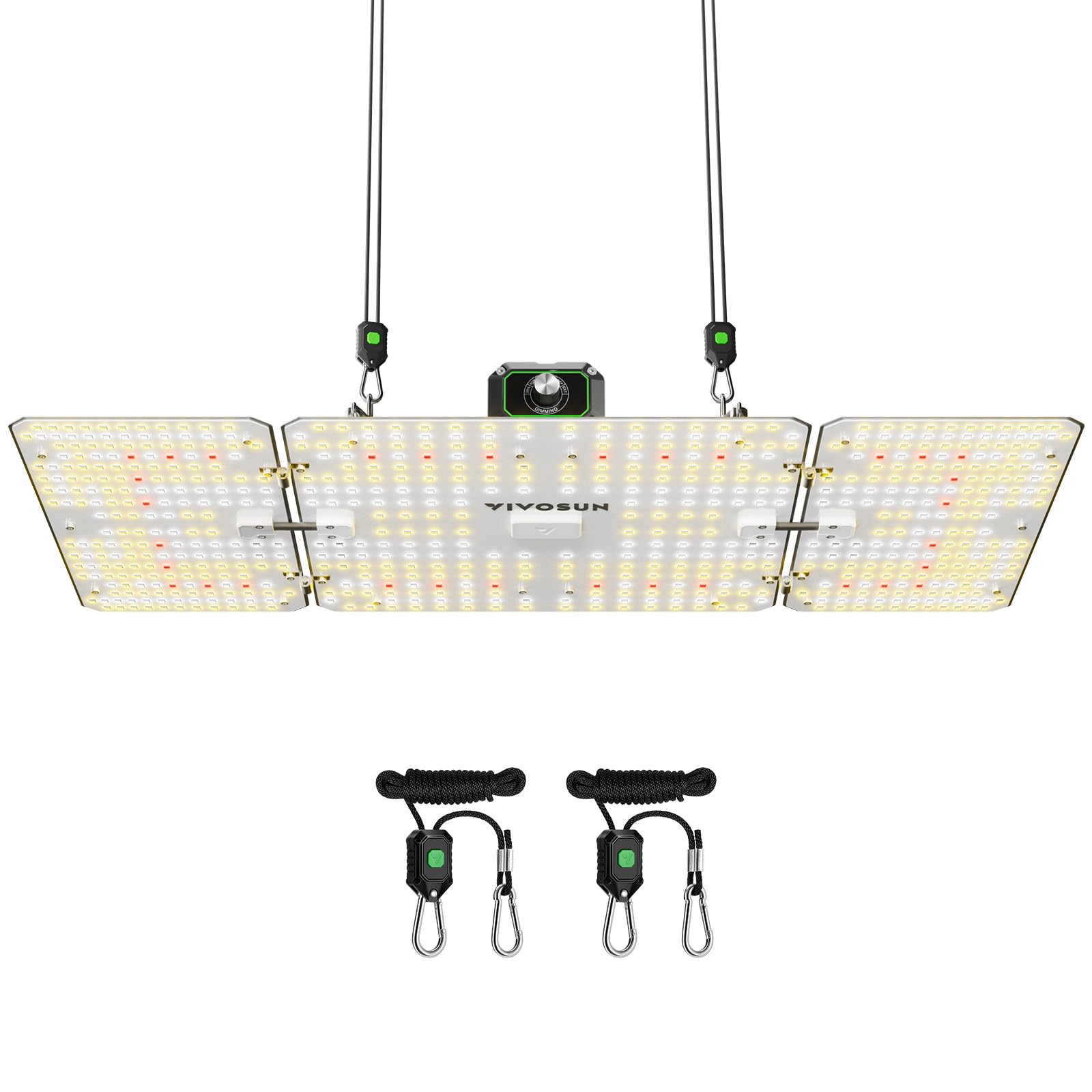
The LumaLight 200W is built for controlled environments — its IP65 rating allows it to withstand the high humidity and occasional water spray common in microgreen propagation tents without degrading the diodes. The 4-level dimming knob (25%, 50%, 75%, 100%) lets you start seeds at low intensity and push full power once the first true leaves appear, and the optional GrowHub integration adds smartphone scheduling.
At 200W actual draw, this fixture delivers the highest photon output in this comparison, suitable for a 2×4 foot tent or a single 1020 tray at high density. The strategic diode layout with 3000K, 5000K, 660nm, and 730nm ensures balanced spectrum across the full coverage area, so edge trays receive the same intensity as center trays.
Owner feedback highlights that the light is extremely bright — even at 25%, it requires eye protection for anyone working underneath it. The unit raises ambient tent temperature by 8-10 degrees, which can be beneficial in cold basements but may stress seedlings in a small, sealed tent. The power connector to the driver is reported as slightly flimsy, requiring careful handling to avoid intermittent shutdowns.
What works
- IP65 waterproof/dustproof rating handles high humidity and nutrient spray.
- 4-level dimmer with optional app control automates photoperiod transitions.
- High PPFD output drives dense microgreen growth in a 2×4 footprint.
- Long 36,000-hour Q90 rating for consistent output over years.
What doesn’t
- Extremely bright at minimum setting — uncomfortable to work under without protection.
- Raises tent temperature significantly; may require ventilation management.
- Power connector to driver feels fragile; some users report intermittent power loss.
4. SANSI 4-Gooseneck Clip

The SANSI clip light uses four independent gooseneck arms, each fitted with a 10W replaceable PAR20 bulb, allowing you to target specific sections of a microgreen tray. Each head outputs a wide 380-800nm spectrum that mimics natural sunlight, and the 4000K color temperature keeps the light neutral enough for daily visual inspection. The 4/8/12-hour timer eliminates the need for an external outlet timer, though it resets after a power interruption.
This fixture is ideal for a desk, a small shelf, or a countertop where you want to start one or two trays without running striplights across the whole area. The clamp is substantial enough to hold the four heads without slipping, and the goosenecks maintain their angle over time. Owners have used these successfully for overwintering plants and starting seeds, confirming their suitability for a microgreen cycle.
The bulbs run very hot — the company explicitly warns against foliage contact to avoid burning. At 4 to 6 inches above the tray, the heat can dry the growing medium faster than a panel light, requiring more frequent misting. The heads produce a narrow beam that does not spread uniformly across a 1020 tray; you need all four heads positioned to cover the entire surface.
What works
- Four independent goosenecks let you focus light on specific tray areas.
- Replaceable bulbs save the cost of a full fixture if a diode fails.
- Built-in 4/8/12-hour timer simplifies photoperiod management.
- Strong clamp holds the fixture securely on shelves or desk edges.
What doesn’t
- Bulbs run hot; direct leaf contact causes burns and soil drying.
- Narrow beam angle requires all four heads to cover a single 1020 tray.
- Timer resets after power loss — must be reset daily if unplugged.
5. TYAGMAM T8 2ft 4-Pack

The TYAGMAM 4-pack consists of four 2-foot T8 strips that together consume 100W while replacing up to 600W worth of traditional lighting. Each strip is built with a 100% aluminum housing that acts as a heat sink, allowing you to mount the lights 4 to 6 inches above the tray without overheating. The included reflector clips boost usable light by about 20%, which is a meaningful gain for microgreens.
These strips are specifically designed for greenhouse shelving and grow tents. Owners report using one strip per 2-foot shelf with excellent results. The ability to link up to eight strips in a series means you can cover a tall wire rack without running separate cords to each shelf. The sunlight-white output (similar to 5000K) provides a neutral spectrum that works across all microgreen varieties.
The actual fixture length is approximately 23.6 inches, which fits standard 2-foot shelving. The included mounting clips and zip ties simplify installation. The lack of a dimmer or built-in timer means you must rely on an external plug timer, and the pinkish light output can be slightly harder on the eyes during long tray inspections compared to a neutral white panel.
What works
- Aluminum housing dissipates heat efficiently, allowing close tray mounting.
- Reflector clips increase light utilization at the canopy level.
- Linkable up to 8 strips for a clean daisy-chained rack setup.
- 2-foot length matches standard wire shelving widths perfectly.
What doesn’t
- No built-in timer — requires an external outlet timer.
- Not dimmable; intensity is fixed at full output.
- Pink light can be visually unpleasant for extended inspection under the fixture.
6. SDOVUERC 768 LED Panel 4-Pack
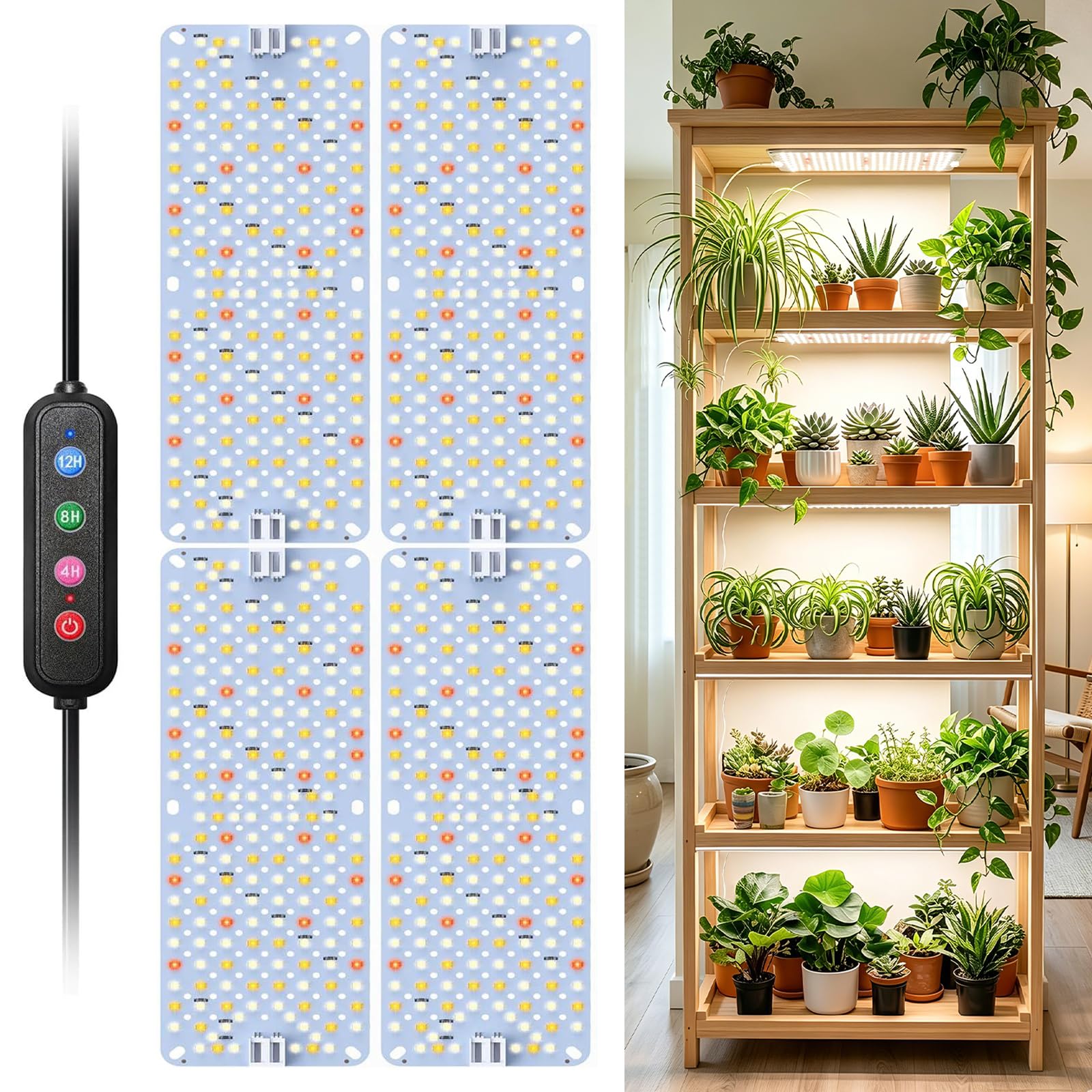
Each SDOVUERC panel pulls 36W (144W total for the 4-pack) and combines 3000K warm white, 5000K cool white, and 660nm deep red into a balanced full spectrum that closely mimics natural sunlight. The standout feature here is the upgraded 6-setting timer (4, 8, 12, 16, 20, and 24 hours) with built-in memory — once you set it, the panels automatically follow the same schedule even after a power loss, a rare convenience at this price tier.
The 11.8×3.7-inch panels are compact enough to mount under cabinets or on narrow shelves, and the included zip ties and 3M adhesive tape make installation tool-free. Owners report prompt germination — sometimes within 24 hours when paired with a heat mat — and strong growth for tropicals and houseplants. The daisy-chain function supports linking up to 10 panels without brightness drop, ideal for a multi-shelf microgreen station.
The vented aluminum design keeps the panels cool during extended 16-hour cycles, but the output is not as high as a dedicated 150W panel. For serious commercial microgreen growers, the PPFD per panel may be insufficient for dense trays beyond the 6-inch mark. The 0.8-inch thickness is a plus for low-clearance shelves, but the panels are not dimmable.
What works
- Timer with memory holds the schedule across power interruptions — no daily reset needed.
- Six timer settings (4-24 hours) give flexibility for different growth stages.
- Vented aluminum body stays cool at close tray distance.
- Daisy-chain up to 10 panels for scalable shelf coverage.
What doesn’t
- PPFD per panel is moderate; best for shallow trays at 4-6 inches.
- No dimming function — can only cycle on/off at full brightness.
- Adhesive tape mounting may weaken in humid environments over time.
7. Hlite 16in 4-Pack
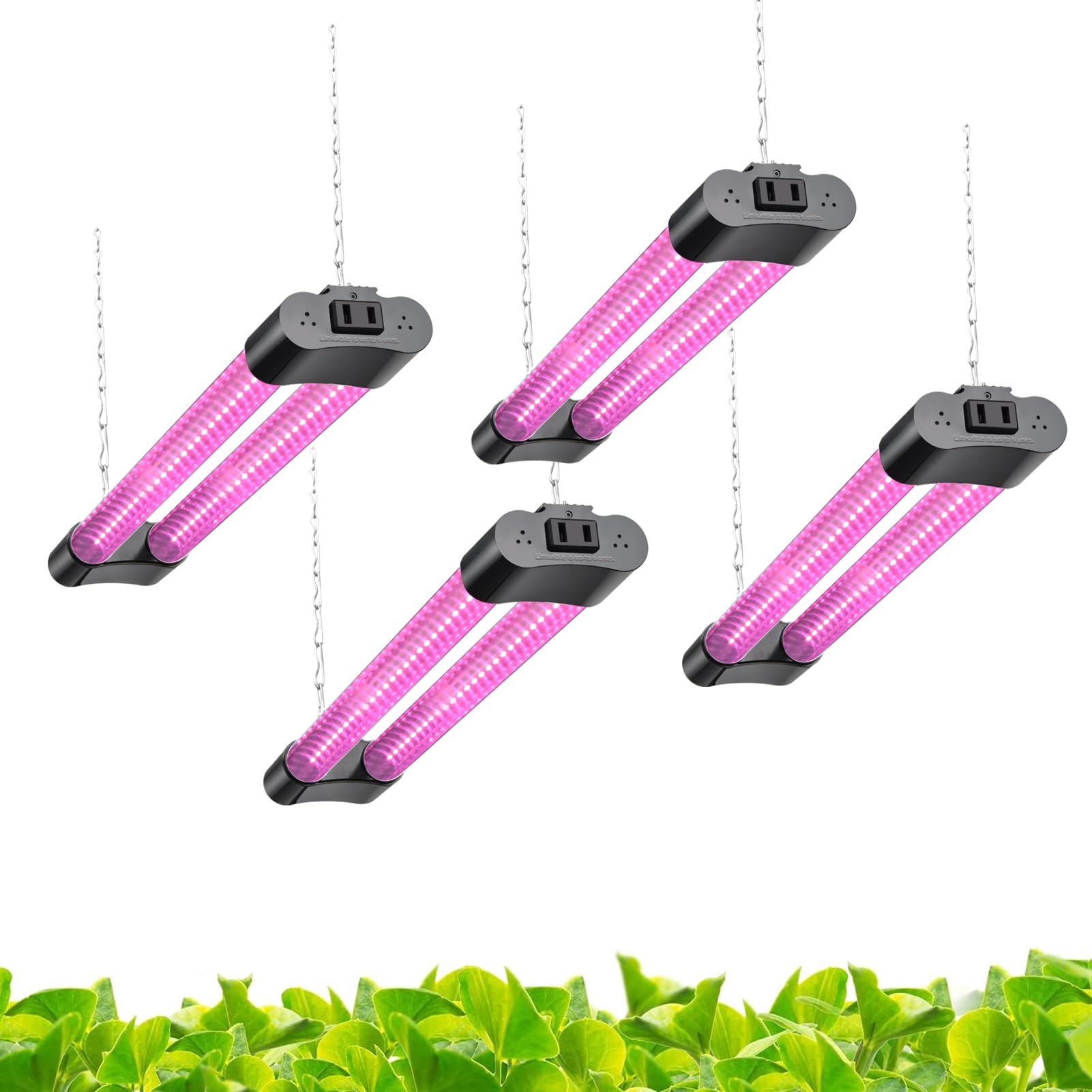
The Hlite 4-pack delivers 20W per 16-inch strip at a price point that makes it the most accessible entry point for a first microgreen setup. Each strip provides a full spectrum that mimics natural sunlight, and the pink light output is particularly beneficial for small- to medium-sized plants like begonias and philodendrons. Multiple mounting options (screws, hooks, chains, zip ties) mean you can attach these to just about any shelf or tent frame.
Owners report that the lights are light enough to store easily when not in use and that the 5-foot power cord gives enough reach for most shelf arrangements. The linkable design connects up to six units, so you can cover a 4-foot wide rack with two 2-strip chains. Reviews note that these are excellent for seed starting and germination but are not powerful enough to be the sole light source for long-term plant growth to maturity.
The lack of a built-in timer and non-dimmable output means you must manage photoperiod manually or with an external timer. The deep pink hue can make the room feel like a disco grow room, which may bother those who want a neutral aesthetic. For microgreens specifically, the 20W per strip provides enough PPFD for one 1010 tray per strip when hung 4 inches above the canopy.
What works
- Very affordable entry point for a basic 4-strip microgreen setup.
- Multiple mounting accessories included for flexible shelf attachment.
- Lightweight and easy to store when rotating trays.
- Linkable up to 6 units for broad coverage.
What doesn’t
- No built-in timer — must be paired with an external outlet timer.
- Deep pink light is visually intense and may be unappealing in a living area.
- 20W per strip limits usable PPFD; only suitable for 4-inch close mounting.
Hardware & Specs Guide
PPFD and Daily Light Integral
PPFD (Photosynthetic Photon Flux Density) measures the number of photosynthetically active photons reaching one square meter per second, expressed in µmol/m²/s. For microgreens, a target of 200 to 300 µmol/m²/s for 16 hours results in a DLI of 11.5 to 17.3 mol/m²/day. Fixtures below 20W per 12×12 inch area often fail to reach this threshold unless mounted implausibly close. Always check the manufacturer’s PPFD map for your intended hanging height before buying.
Heat Management and Canopy Distance
LED efficiency reduces heat output compared to HPS or T5 fluorescent fixtures, but no LED is 100% efficient — the remainder produces radiant heat that accumulates at the canopy. Microgreens are sensitive to soil drying, so fixtures with aluminum heatsinks or PCB-on-aluminum designs are preferred. Measure the temperature at tray level after one hour of operation. If the surface exceeds 85°F, raise the light or add a small fan to prevent damping off.
FAQ
How far above microgreens should I hang the grow light?
Can I use a regular white LED shop light for microgreens?
How many watts do I need per 1020 microgreen tray?
Final Thoughts: The Verdict
For most gardeners, the grow lights for microgreens winner is the GE LED Grow Light 24in because it delivers a verified 72 PPF in a cool-running, white-spectrum package that covers a single 1020 tray end-to-end with no guesswork. If you want intensity control for dense canopy management, grab the VIPARSPECTRA XS1500 Pro. And for a budget-friendly multi-shelf setup with automatic timer memory, nothing beats the SDOVUERC 768 LED 4-Pack.