
Manually removing weeds from a lawn or garden bed is often a lesson in endurance—endless bending, kneeling, and back strain that turns a simple chore into a dreaded task. The right tool changes that entirely, using leverage and a long handle to extract taproots from soil while you remain standing upright.
I’m Rikta — the co-founder and writer behind Lawn Gear Lab. I’ve spent months researching the mechanical advantages of different rake heads, comparing tine materials from manganese steel to 10-gauge American steel, and analyzing hundreds of verified owner reports to determine which designs actually pull roots cleanly without snapping or rusting.
Whether you need a wide thatch rake to rip out dead grass or a claw-style tool to pluck dandelions, this guide breaks down the seven best models to help you find the perfect best weed rake for your lawn and your body.
How To Choose The Best Weed Rake
Picking the right weed rake comes down to matching the tool’s head design, handle length, and steel quality to the specific weeds and soil type in your yard. A one-size-fits-all approach often leaves you fighting the tool instead of the weeds.
Head Type: Bow Rake vs. Thatch Rake vs. Stand-Up Weeder
Bow rakes with heavy steel tines are built for breaking up compacted soil, leveling gravel, and prying out stubborn roots. Thatch rakes use curved, blade-like tines to slice through dead grass and lift thatch from the lawn surface. Stand-up weeders use a claw-and-lever mechanism to extract individual taproots without bending. Choose a bow rake for heavy soil prep, a thatch rake for lawn renovation, and a stand-up weeder for spot-removing dandelions or thistles.
Tine Material and Gauge
The thickness of the steel determines whether the tines bend under pressure or hold their shape for years. Look for heat-treated manganese steel or 10-gauge American steel for heavy-duty tasks. Cheaper stamped-steel tines may flex or snap when working in rocky or clay-heavy soil. Tine count also matters—17 to 25 tines offer wide coverage, while 4-claw designs focus leverage on a single root.
Handle Length and Ergonomics
Stand-up weeding tools typically run 45 to 55 inches, keeping your spine straight during use. Bow and thatch rakes often offer adjustable sections, letting you extend the handle from around 40 inches to over 70 inches to suit your height. A padded or rubber grip prevents the handle from slipping in wet conditions and reduces hand fatigue when you’re working through a large patch of weeds.
Quick Comparison
On smaller screens, swipe sideways to see the full table.
| Model | Category | Best For | Key Spec | Amazon |
|---|---|---|---|---|
| Bully Tools Bow Rake | Bow Rake | Heavy soil & gravel work | 10-gauge steel head | Amazon |
| Walensee Thatch Rake | Thatch Rake | Dethatching lawns | Manganese steel tines | Amazon |
| Grampa’s Weeder | Stand-Up Weeder | Individual taproot weeds | 4-claw steel head | Amazon |
| Landzie Weeder | Stand-Up Weeder | Heavy clay extraction | Lever-actuated claw | Amazon |
| BlumeTrec Bow Rake | Bow Rake | Versatile soil & mulch tasks | Dual-sided manganese head | Amazon |
| Coopvivi Leaf Rake | Leaf Rake | Light debris & leaves | 25 tines, 72″ handle | Amazon |
| LLARGUEST Bow Rake | Bow Rake | Small area rock removal | 17 prongs, 16 oz weight | Amazon |
In‑Depth Reviews
1. Bully Tools Bow Rake 16″
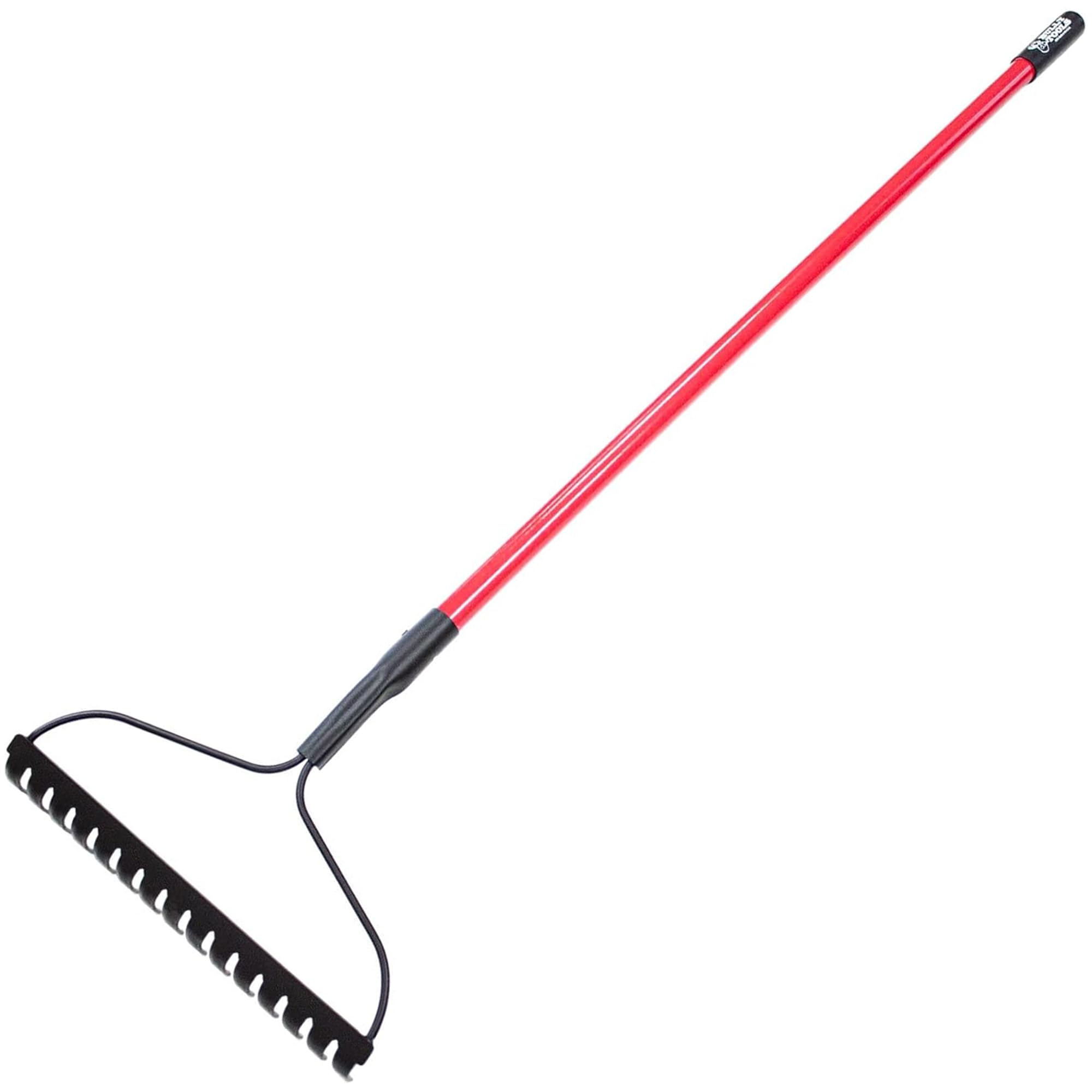
The Bully Tools Bow Rake is constructed from 10-gauge American steel that is up to 30% thicker than many imported competitors, with robotically overwelded joints that keep the 16 tines firmly attached even when breaking up compacted clay or spreading gravel. The 58-inch fiberglass handle has a polyester veil coating to prevent splintering, and the rubber grip reduces hand fatigue during extended use.
<
Owner feedback consistently highlights the tines’ resistance to bending—even after repeated abuse in rocky soil—and the way the ribbed teeth dig into hard ground without flexing. The head measures 16 inches wide, and the total weight sits at 3.5 pounds, giving it substantial heft for driving through tough debris without being unmanageable for a full afternoon of yard work.
For anyone who needs a single rake that handles soil leveling, mulch spreading, leaf collection, and weed root disruption, this all-steel American-made design offers the durability that budget-priced rakes simply cannot match. It assembles in under a minute with a Phillips head screwdriver.
What works
- 10-gauge steel head resists bending in hard clay and rocky soil
- Fiberglass handle is lighter than wood but more durable
- Rubber grip stays comfortable during long sessions
What doesn’t
- Heavier than some users prefer at 3.5 pounds
- Tines are closely spaced so wet leaves may clog
2. Walensee Thatch Rake

The Walensee Thatch Rake uses a dual-sided 19-tine head made from quenched manganese steel with a powder-coated finish to resist rust. One side lifts and removes dead grass and surface thatch, while the opposite side loosens topsoil and cultivates the lawn—giving you two tools in one for turf renovation. The 15-inch wide head covers more ground per pass than narrower rakes.
The sectional stainless steel handle adjusts to three lengths—roughly 40, 55, or 70 inches—which lets you dial in the reach for your height and the specific task. A cushioned non-slip grip keeps control comfortable during aggressive raking motions. Owners report that the curved tines grab and cut through St. Augustine and Bermuda grass thatch effectively, filling 96-gallon debris cans after a single session.
This rake excels at clearing thatch that smothers grass roots, improving water penetration and airflow to the soil. For seasonal dethatching and spring lawn cleanup, the Walensee provides a manual alternative to power rakes that saves money and gives you precise control over how much material you remove.
What works
- Dual-sided head switches between dethatching and cultivating
- Adjustable handle accommodates different user heights
- Manganese steel tines maintain shape through heavy use
What doesn’t
- Twist-lock connections can loosen during aggressive work
- Not ideal for very large lawns due to manual effort required
3. Grampa’s Weeder

Grampa’s Weeder has been in continuous production since 1913, and the design remains nearly unchanged: a 45-inch bamboo handle topped with a 4-claw alloy steel head. The user centers the claws over the weed, pushes down, and twists slightly to engage the taproot, then pulls upward to extract the entire plant without bending or kneeling.
Owners consistently praise how the 2.3-pound tool eliminates back strain, especially for seniors or anyone with mobility concerns. The bamboo handle provides a natural, warm grip that doesn’t slip in wet conditions, and the alloy steel claws resist bending when used on softer soil types. It works best after a rain or watering, when the ground is moist enough to release the root cleanly.
For dandelions, thistles, and other broadleaf weeds with deep taproots, the Grampa’s Weeder is a time-tested solution that requires no batteries, no assembly beyond attaching the head, and no special technique beyond centering the tool over the weed. The trade-off is that it struggles in hard, dry clay or with thin-stemmed weeds that slip between the claws.
What works
- Proven century-old design removes taproots completely
- Bamboo handle is lightweight and comfortable
- Minimal assembly required, no tools needed
What doesn’t
- Struggles in hard clay or dry, compacted soil
- Thin or spindly weeds may not engage all four claws
4. Landzie Weeder Weed Puller
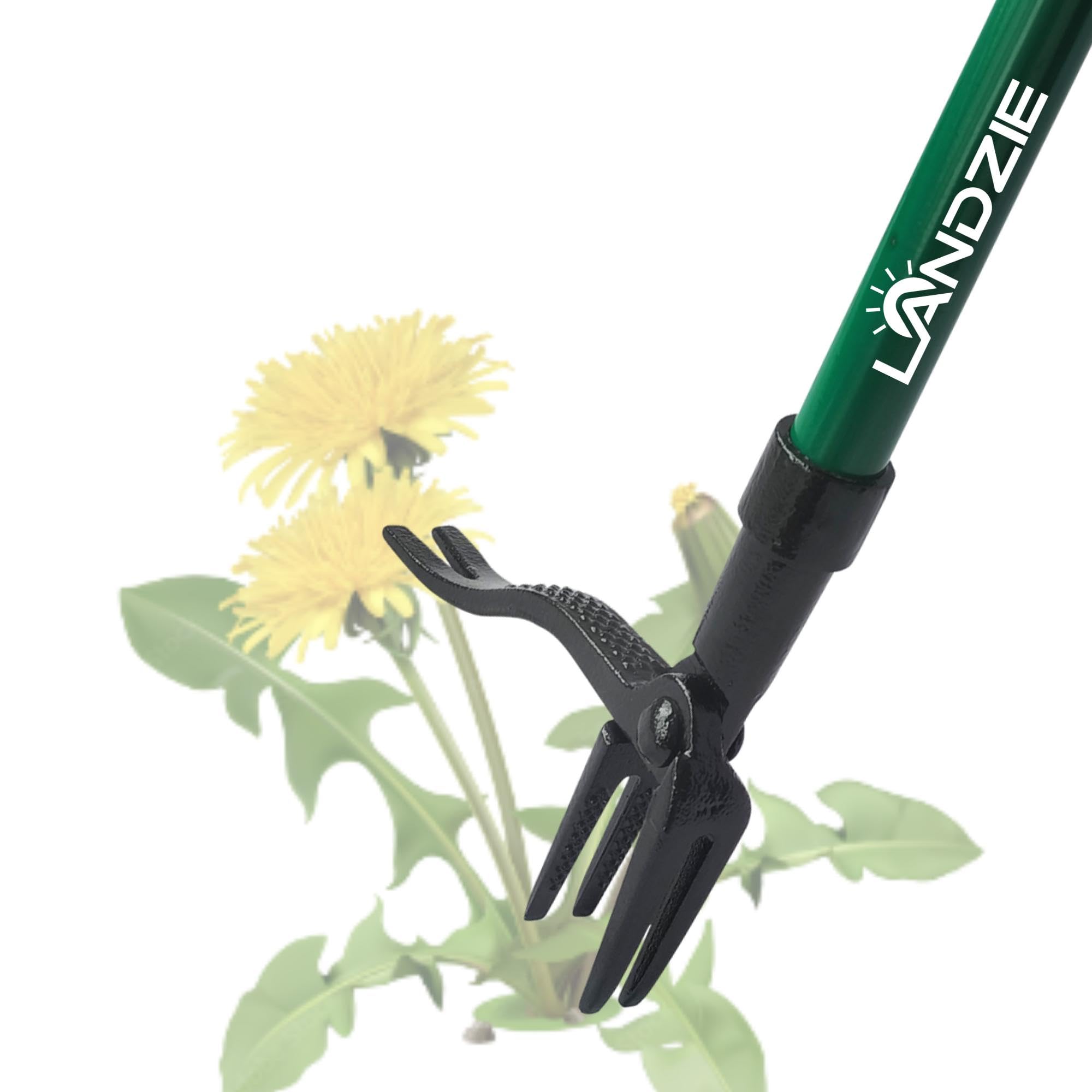
The Landzie Weeder uses a lever-actuated claw mechanism that you engage by stepping on a foot plate after centering the tool over the weed. This design applies mechanical advantage through a 55-inch steel handle, letting you extract taproots from heavy clay soil without bending or excessive downward force on your arms.
Owner feedback highlights that the tool pulls crabgrass and dandelions with their roots intact, leaving small divots that can be easily filled with soil. The all-steel construction gives it a 4-pound weight that provides stability during the extraction stroke, and the lever system allows controlled upward pull rather than an abrupt yank that might break the root.
For users dealing with tough clay or compacted soil, the Landzie’s lever design delivers more extraction power than a simple claw-on-a-stick. It requires a short learning curve to position the claw directly over the weed’s crown, but once mastered, it dramatically reduces the physical effort of manual weeding.
What works
- Lever mechanism provides extra pulling force in clay soil
- 55-inch handle keeps back straight during weeding
- Durable all-steel construction handles heavy use
What doesn’t
- Weighs 4 pounds, which feels heavy over long sessions
- Quality control issues reported on early thread connections
5. BlumeTrec Bow Rake
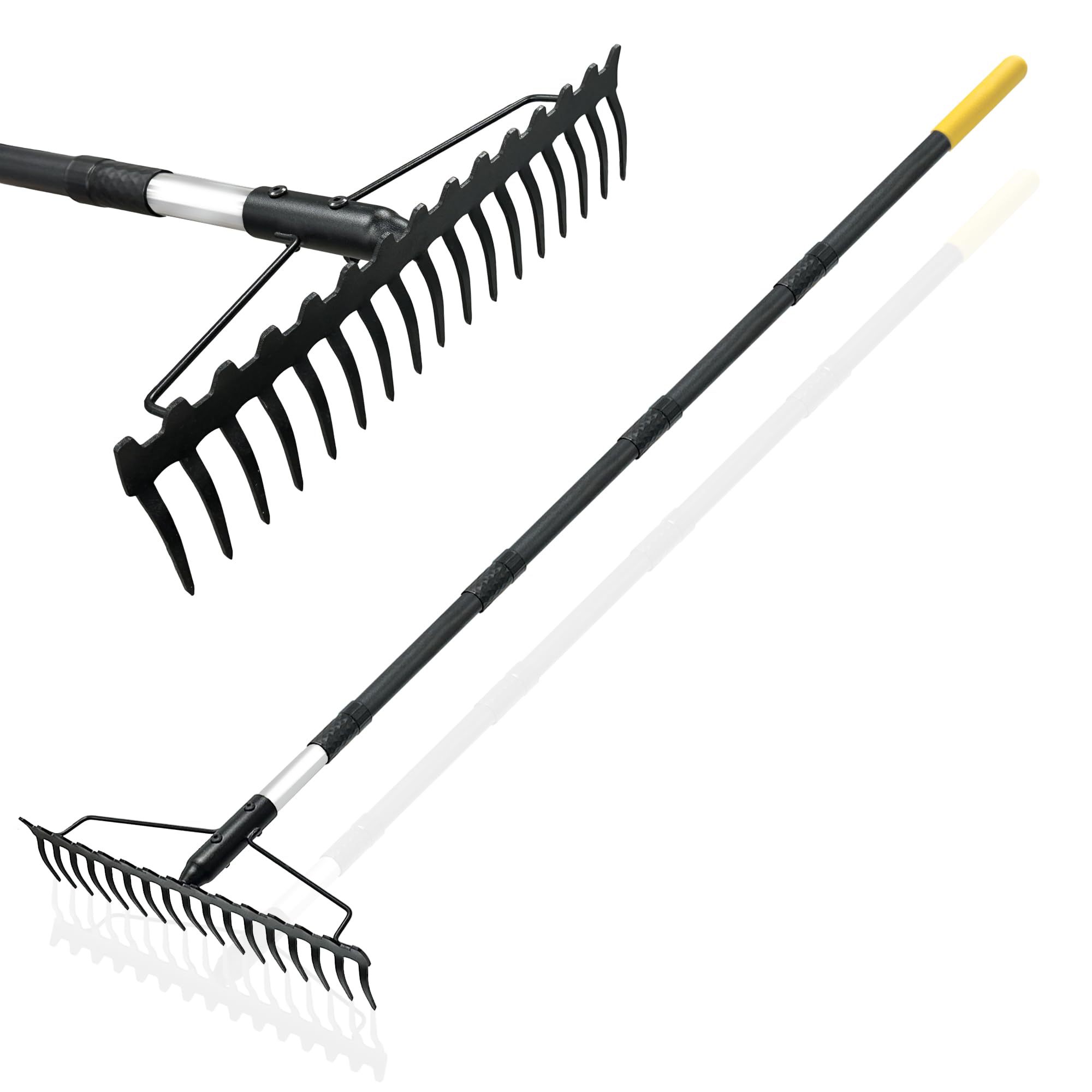
The BlumeTrec Bow Rake features a dual-sided manganese steel head that offers two functional tine types: long tines for loosening compact soil and dethatching grass, and short tines for leveling soil, gravel, or mulch. Rotating the head switches tasks in seconds, eliminating the need to switch tools mid-project. The 17-inch wide head has 17 evenly spaced tines that penetrate 4 inches into the ground.
The 68-inch handle is made from stainless steel and detaches into multiple sections for compact storage. A soft non-slip grip adds comfort, and the modular design lets you adjust the length or break it down for transport in a car trunk. Owners report that the tines resist bending even when used to pry out rocks and that the top side works well for smoothing soil after tilling.
For gardeners who want one rake that handles both heavy digging and fine leveling, the BlumeTrec’s dual-sided design saves tool changes. It is not a leaf rake, so it is best suited for soil prep, mulch spreading, and weed root disruption in garden beds rather than collecting light debris.
What works
- Dual-sided head switches between digging and leveling
- Manganese steel tines hold up against rocks and clay
- Adjustable stainless steel handle suits tall users
What doesn’t
- Not effective for loose leaf collection
- Threaded connections may require occasional tightening
6. Coopvivi Heavy Duty Leaf Rake

The Coopvivi Leaf Rake combines a wide 25-tine metal head with a stainless steel handle that adjusts from 35 to 72 inches, letting you cover more ground with each sweep while keeping your back upright. The sponge grip reduces hand fatigue, and the quick-release mechanism allows the handle to be broken down for easy storage in a shed or garage.
Owner reviews emphasize that one swipe collects a surprising amount of debris, and the adjustable height makes it usable by multiple family members of different statures. The tines are springy enough to gather leaves and grass clippings but may flex if used aggressively on heavy rocks or thick root mats.
This is not a bow rake for digging, but it is an excellent entry-level option for clearing weeds, leaves, and light debris from lawns and flower beds. For the price, the build quality and ergonomic features make it a strong value pick for general yard maintenance.
What works
- Wide 25-tine head covers ground quickly
- Adjustable handle reduces back strain
- Easy assembly and disassembly for storage
What doesn’t
- Tines are not designed for heavy soil disruption
- Sponge grip may wear faster than rubber
7. LLARGUEST Bow Rake

The LLARGUEST Bow Rake uses a metal head with 17 evenly spaced prongs and a 63-inch adjustable handle. It is designed for loosening soil, leveling lawns, and collecting leaves and rocks. The rubber grip provides a non-slip hold, and the head comes with a clear plastic safety guard for transport and storage.
Owners describe the rake as heavy-duty for its weight class, with tines that resist bending when used on small rocks and compacted soil. The modular handle breaks into sections for compact storage, and the ability to adjust length makes it adaptable for different users. Some feedback notes that the head could be wider for larger areas, but for precise garden bed work, the 16-inch width allows good control.
This is a budget-friendly bow rake that performs adequately for light to medium garden tasks. It works well for removing small rocks from soil, leveling seed beds, and pulling up surface weeds, but it may not have the heft needed for breaking through heavy clay or large root systems.
What works
- Lightweight at 16 ounces, easy for extended use
- Adjustable length fits different user heights
- Safety guard protects tines during storage
What doesn’t
- Not heavy enough for serious clay or rock breaking
- Handle threads may loosen during aggressive use
Hardware & Specs Guide
Steel Gauge and Tine Hardness
The gauge of steel in a rake head directly determines how much force the tines can withstand before bending. A 10-gauge steel head, like on the Bully Tools rake, is approximately 0.135 inches thick—roughly 30% thicker than 14-gauge heads found on many entry-level rakes. Manganese steel goes through heat treatment to increase surface hardness, making it resistant to wear from abrasive soil and rocks. For heavy weeding and soil disruption, prioritize 10-gauge or manganese steel over thinner stamped metal.
Handle Material and Modularity
Fiberglass handles are lighter than wood, resist splintering, and do not rot when left in damp conditions. Bamboo handles offer a natural feel and reduce weight but can crack if exposed to prolonged dryness or impact. Stainless steel handles are the heaviest but provide the best corrosion resistance and allow for threaded modular sections that adjust length. A cushioned grip material—rubber or foam—reduces vibration transfer and prevents blisters during repetitive raking motions over a large weeding area.
FAQ
What is the difference between a bow rake and a thatch rake for weeds?
How long should the handle be for weeding without bending?
Can I use a leaf rake to remove weeds from soil?
Final Thoughts: The Verdict
For most gardeners, the best weed rake winner is the Bully Tools Bow Rake because its 10-gauge American steel head and fiberglass handle deliver unmatched durability for breaking up soil and prying out roots year after year. If you need to dethatch an entire lawn, grab the Walensee Thatch Rake with its dual-sided manganese steel head. And for spot-removing dandelions without bending, nothing beats the simple, time-tested Grampa’s Weeder.