
Trumpet vine doesn’t just grow — it invades. That relentless root system can travel dozens of feet from the original plant, sending up suckers through your lawn, under your foundation, and into your prized flower beds. A general-purpose weed killer mostly annoys it. To truly eliminate trumpet vine, you need a systemic brush herbicide that penetrates the woody tissue and moves deep into the rhizomes.
I’m Rikta — the co-founder and writer behind Lawn Gear Lab. I’ve spent weeks comparing the chemical profiles, reviewing application methods, and analyzing owner experiences to find which herbicides actually stop trumpet vine’s aggressive regrowth cycle.
This guide breaks down the top chemical solutions to help you find the best herbicide to kill trumpet vine permanently.
How To Choose The Best Herbicide To Kill Trumpet Vine
Trumpet vine’s root system stores massive energy reserves. The wrong herbicide merely burns back the leaves, and the plant bounces back in weeks. The right choice must be systemic, woody-plant specific, and applied to the vascular tissue.
Active Ingredient: Triclopyr vs. Glyphosate
Triclopyr is the gold standard for woody brush and vines. It is formulated to penetrate bark and travel through the phloem directly to the roots. Glyphosate works but is weaker on woody species — it often requires higher concentrations and multiple applications to fully kill a mature trumpet vine.
Application Method: Foliar Spray vs. Cut-Stump
For trumpet vine, the cut-stump method is dramatically more effective. You sever the main stem near the ground and immediately paint or spray the herbicide onto the fresh cut. This delivers a lethal dose directly into the root system without harming surrounding plants. Foliar spraying works on young, accessible growth but risks overspray drift onto desirable plants.
Quick Comparison
On smaller screens, swipe sideways to see the full table.
| Model | Category | Best For | Key Spec | Amazon |
|---|---|---|---|---|
| ALLIGARE Triclopyr 4E | Concentrate | Heavy-duty, large infestations | 61.6% Triclopyr | Amazon |
| Southern Ag Crossbow | Concentrate | Broad brush and bramble control | Triclopyr + 2,4-D | Amazon |
| Ortho MAX Poison Ivy & Tough Brush Killer | Concentrate | Big-box triclopyr option | 8.0% Triclopyr | Amazon |
| Roundup Poison Ivy Plus | Concentrate | Foliar spray on vines | Triclopyr + Diquat | Amazon |
| Ferti-lome Brush Killer Stump Killer | Concentrate | Lawn-safe brush control | 8.8% Triclopyr | Amazon |
| Bonide Vine & Stump Killer | Concentrate | No-mess applicator, small jobs | 8.8% Triclopyr | Amazon |
| Monterey Brush & Vine Control | Concentrate | Spot-treating stumps | 8.8% Triclopyr | Amazon |
In‑Depth Reviews
1. ALLIGARE Agri Star Triclopyr 4E
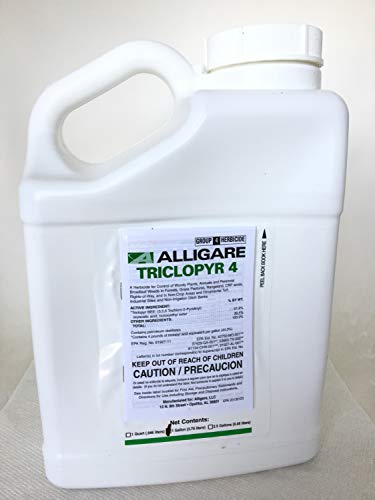
This is the professional-grade triclopyr concentrate that serious land managers reach for. At 61.6% active ingredient — the same formula as the branded Garlon 4 — this 1-gallon jug provides enough chemical to treat acres of woody brush for a fraction of the retail price of ready-to-use bottles. Trumpet Creeper is named directly in the product’s EPA-approved control table, but with an important caveat: the label restricts it to basal-bark or dormant-stem stump applications, not general foliar spraying.
The ester formulation has an advantage: it penetrates bark more aggressively than the amine salt versions found in most box-store brands, which is exactly why the label calls for a basal-bark or cut-stump approach on trumpet vine rather than a foliar mix. Cut the main stem near the base and apply the concentrate undiluted directly to the fresh-cut surface, or use it as a diluted basal-bark treatment per the label. The strong petroleum odor confirms the ester base is working, but it demands careful handling with nitrile gloves and a respirator.
User feedback highlights its cost efficiency for large-scale invasions. Several owners comparing this directly to smaller bottles of Ortho or BioAdvanced found the per-ounce savings substantial, while noting identical or superior results on difficult woody weeds like black locust and multiflora rose. The main criticism involves the smell and the need for a separate surfactant, which adds a small step for casual users.
What works
- Highest triclopyr concentration on this list
- Excellent for cut-stump application on thick stems
- Cost-effective compared to ready-to-use alternatives
What doesn’t
- Strong petroleum odor requires ventilation
- Requires separate surfactant purchase
2. Southern Ag Crossbow Specialty Herbicide

Crossbow combines triclopyr with 2,4-D, giving it a broader spectrum against broadleaf weeds while retaining the woody-vine-killing power needed for trumpet vine. This one-gallon jug makes up to 96 gallons of spray solution, covering up to 2.23 acres. Users consistently praise it for annihilating overgrown ivy, brambles, and trumpet vine within a week when applied as a foliar spray at a 1-2% dilution.
The 2,4-D component accelerates knockdown on the leafy canopy, while the triclopyr does the deep root work. For the cut-stump method, applying it undiluted to the cambium layer stops the trumpet vine from resprouting. The formulation has a 3-day soil half-life, which makes it a safer choice around livestock and wells compared to some persistent herbicides, though overspray on desirable plants still causes damage.
Owner experiences show consistent success on creeping Charlie, jewelweed, and pokeweed in addition to trumpet vine. A few users noted that very rainy conditions or rich soil with high organic matter reduced its efficacy, requiring a second application. The product smells strongly of chemicals during mixing — a proper respirator is non-negotiable.
What works
- Broad-spectrum formula handles multiple weed types
- Excellent cost-per-acre value
- Short soil half-life reduces environmental persistence
What doesn’t
- Strong odor during mixing and spraying
- Heavy rain within 3 days can reduce effectiveness
3. Ortho MAX Poison Ivy and Tough Brush Killer Concentrate
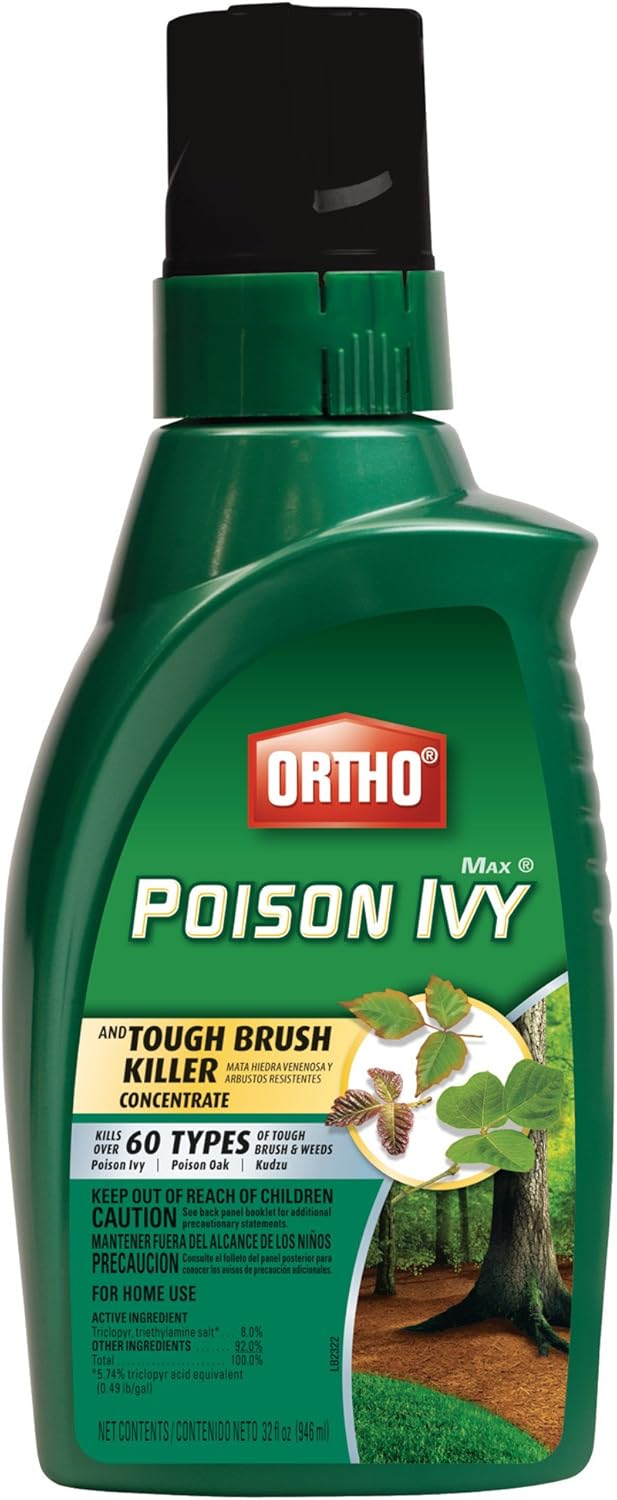
Ortho MAX Poison Ivy and Tough Brush Killer Concentrate is the easy-to-find triclopyr option, stocked at most home centers as well as on Amazon. Its EPA label names Trumpet Creeper directly among the woody vines this 8.0% triclopyr (triethylamine salt) formula controls, alongside honeysuckle, kudzu, Virginia creeper, and wild grape, so it is a genuine on-label match for this job rather than a repurposed lawn product.
For a foliar application, mix the concentrate per the label’s dilution rate and thoroughly wet the leaves and stems of actively growing vine; for an established trumpet vine with heavy woody stems, cut the main stem near the base and treat the fresh cut instead. The product is rated rainproof in about 2 hours, which is a helpful cushion if a spray day turns showery.
Because this is a triethylamine (amine) salt rather than an oil-based ester like the professional concentrates, it is less aggressive at penetrating thick bark and waxy cuticles, so an older, well-established trumpet vine may take more than one treatment to fully knock back the root system. It covers roughly 1,000 square feet per gallon of mixed solution and kills over 60 listed types of brush and tough weeds, including poison ivy, poison oak, kudzu, and wild blackberries.
What works
- Trumpet Creeper is explicitly named on the EPA label
- Rainproof in about 2 hours
- Sold everywhere, so restocking is easy
What doesn’t
- Amine formulation penetrates bark less aggressively than ester concentrates
- Established vines may need a repeat treatment
4. Roundup Poison Ivy Plus Tough Brush Killer₂

This Roundup formulation combines triclopyr with diquat dibromide and fluazifop-P-butyl, creating a tri-active stack that kills the trumpet vine canopy quickly while the triclopyr translocates to the roots. The diquat provides the “visible results in hours” claim — it burns the leaf tissue rapidly — but the triclopyr does the real systemic work over the following days. This concentrate treats 1,500 square feet per gallon of mixed solution.
Users report excellent results on poison ivy, kudzu, and woody brush. The hack-and-squirt method with a 50% dilution applied to multiple stems is the most common successful approach for trumpet vine. Several owners with acre-plus properties combined this with a surfactant and cooking oil mixture to improve adhesion on the waxy vine leaves. The rainproof window of 30 minutes is identical to Promax and very forgiving.
The main downside is that the diquat can make the user think the plant is dead too quickly, leading them to stop treatment early. The canopy wilts fast, but the roots may still be alive if the triclopyr did not fully translocate. The label requires waiting at least 28 days before a repeat application, so plan on a longer follow-up window than you might expect for larger trumpet vine root systems. The concentrate size also runs out quickly for extensive infestations — buying multiple bottles gets expensive compared to a gallon jug of pure triclopyr.
What works
- Triple-active formula for fast visual results
- Rainfast in 30 minutes
- Good for hack-and-squirt on stems
What doesn’t
- Fast burn can mask incomplete root kill
- Small bottle size is costly for big jobs
5. Ferti-lome Brush Killer Stump Killer

Ferti-lome’s Brush Killer Stump Killer is an 8.8% triclopyr (triethylamine salt) concentrate, and its EPA label lists Trumpet Creeper by name under “Woody Plants and Vines Controlled,” alongside Virginia creeper, honeysuckle, kudzu, and sumac. That makes it a legitimately on-label pick rather than a guess based on marketing copy.
For vine control, the label’s instructions are straightforward: cut the vine first, then treat the fresh-cut surface the same way you would treat a stump — brush on the undiluted concentrate to fully cover the cut. For younger, still-leafy growth, it can also be mixed 8 to 16 tablespoons per gallon of water and applied as a foliar spray over up to 500 square feet. The product is formulated to spare lawn grasses when used as directed, which matters if the vine is climbing through a fence line next to turf.
The main tradeoff is size: at 16 ounces, this bottle is meant for a handful of vines or stumps rather than a whole property’s worth of brush. For anything larger in scale, step up to a full-gallon triclopyr concentrate like the ALLIGARE listed above.
What works
- Trumpet Creeper is named on the EPA label
- Simple cut-and-treat stump method
- Won’t harm lawn grasses when used as directed
What doesn’t
- Small bottle size for larger infestations
- May need a second treatment on older, thick-barked vines
6. Bonide Vine & Stump Killer

Bonide’s Vine & Stump Killer (sold as Stump-Out on Bonide’s own site) uses the same 8.8% triclopyr triethylamine salt chemistry found across most of this list, and its EPA label names Trumpet Creeper directly in the “Woody Plants and Vines” control section, right alongside Virginia creeper, sumac, and wild grape.
What sets this bottle apart is the built-in applicator cap — it comes with a brush applicator so you can cut the vine at the base and paint the concentrate directly onto the fresh cut without breaking out a sprayer. That makes it a genuinely convenient option for a homeowner dealing with one or two trumpet vine stems climbing a fence or tree rather than a whole yard of brush.
Each 8-ounce bottle covers roughly 1,000 square feet as a foliar mix, so this two-pack is sized for a handful of spot treatments, not a large-scale clearing job. For bigger infestations, a full-gallon concentrate will be far more economical per ounce.
What works
- Trumpet Creeper is named on the EPA label
- Built-in brush applicator for no-mess stump treatment
- Same proven 8.8% triclopyr chemistry as pricier options
What doesn’t
- Small bottle size, best for spot treatments
- Higher cost per ounce than gallon-size concentrates
7. Monterey Brush and Vine Control

Monterey Brush & Vine Control is another 8.8% triclopyr triethylamine salt concentrate, and its EPA label specifically lists trumpet creeper among the woody plants and vines it controls, right next to Virginia creeper and tulip poplar. It is a straightforward, on-label choice rather than a product borrowed from an unrelated use case.
For an actively growing trumpet vine, apply it as a full-coverage foliar spray once the plant is fully leafed out, following the label’s mixing rate. For a mature vine with a thick, woody base, cut the stem and apply the concentrate undiluted directly to the fresh cut — no dilution needed for stump treatment. Expect wilting within days, but full root death can take one to six weeks depending on the size of the root mass.
This is a 1-quart concentrate, not a true ready-to-use product, so you will need a small sprayer or a paintbrush on hand — but it is inexpensive enough per ounce to make it a sensible choice for spot-treating a few resistant vine stems rather than buying a full gallon you will not use.
What works
- Trumpet creeper is named on the EPA label
- Works for both foliar spray and stump treatment
- Reasonably priced for a quart-size concentrate
What doesn’t
- Requires mixing for foliar use, unlike true RTU products
- Quart size limits large-area coverage
Hardware & Specs Guide
Triclopyr Concentration
Triclopyr is the active ingredient proven to kill woody vines like trumpet vine by moving systemically through the phloem. Higher percentages (60%+) in professional products like ALLIGARE Triclopyr 4E deliver more active chemical per ounce, allowing lower dilution rates and stronger cut-stump applications. Consumer-grade concentrates like Ferti-lome, Bonide, or Monterey typically contain around 8.8% triclopyr and require larger volumes for the same result.
Cut-Stump Application
This is the most effective technique for trumpet vine. Cut the main stem 2-4 inches above the soil line and immediately apply herbicide to the fresh-cut surface within 30 minutes. The xylem and phloem are still open and will pull the chemical directly down into the root system. Use undiluted concentrate for the strongest effect. A foam brush or squeeze bottle gives better control than a sprayer for this method.
FAQ
Will glyphosate-only herbicide kill trumpet vine roots?
How long does it take for triclopyr to kill trumpet vine?
Final Thoughts: The Verdict
For most gardeners, the herbicide to kill trumpet vine winner is the ALLIGARE Agri Star Triclopyr 4E because the 61.6% triclopyr concentration provides the deepest, most reliable root kill per dollar. If you want a balanced formula that also knocks down broadleaf weeds, grab the Southern Ag Crossbow. And for a quick, convenient spot treatment on a single vine, nothing beats the Bonide Vine & Stump Killer, thanks to its built-in brush applicator.