
A broadcast spreader that leaves fertilizer stripes or clumps on your lawn is worse than no spreader at all. The difference between a perfect, even green carpet and a patchy mess often comes down to the spreader’s impeller speed, gearbox quality, and hopper design—not the fertilizer itself. Finding the right tool for the job means understanding how these mechanical details translate to real-world distribution.
I’m Rikta — the co-founder and writer behind Lawn Gear Lab. I analyze dozens of owner experiences, cross-reference technical specifications, and study horticultural application data to find which models deliver consistent, accurate coverage without the guesswork.
After comparing the construction, capacity, and real-world reliability of seven models, the best broadcast spreader for fertilizer is the one that balances durable hardware with a predictable, adjustable spread pattern that you can trust season after season.
How To Choose The Best Broadcast Spreader For Fertilizer
A broadcast spreader is a simple machine with a huge impact on your lawn’s health. The key difference between a good model and a frustrating one lies in three areas: the delivery mechanism, the chassis durability, and the ease of calibration. Here’s what you need to know before you buy.
Impeller Speed and Gearbox Quality
The impeller is the spinning disc that slings fertilizer outward. A higher impeller speed—driven by a quality sealed gearbox—produces a wider, more uniform pattern. Cheap spreaders use open gears that clog with debris and rust, slowing the impeller and leaving uneven stripes. Look for a fully enclosed, rust-resistant gearbox. Models with stainless steel shafts and agitators resist corrosion from fertilizer salts far longer than painted steel.
Pneumatic Tires vs. Solid Wheels
Solid plastic wheels bounce over uneven turf, causing the spreader to shake and the fertilizer to drop inconsistently. Pneumatic (air-filled) tires absorb terrain bumps, keeping the spreader stable and the pattern predictable. For lawns with any slope, dips, or rough patches, pneumatic tires are a non-negotiable upgrade that directly pays for itself in fewer missed spots and wasted product.
Calibration and Flow Control
Most high-quality spreaders come with a calibration chart, but not all charts are accurate for every material. The best models offer a fine-adjustment dial or a multi-position lever that lets you dial in the exact rate. An integrated shut-off lever—one that stops material flow immediately when you stop pushing—prevents fertilizer burns at the ends of your rows. An edge guard or side deflector also saves product and keeps chemical off sidewalks and flower beds.
Quick Comparison
On smaller screens, swipe sideways to see the full table.
| Model | Category | Best For | Key Spec | Amazon |
|---|---|---|---|---|
| EarthWay 2150 | Commercial | Even pattern on rough terrain | 13″ pneumatic stud tires | Amazon |
| Titan 50 lb | Mid-Range | Heavy-duty value build | 50 lb hopper / 3-position flow | Amazon |
| Agri-Fab 45-0614 130 lb | Push | Tall users / large flat lawns | 130 lb / 13″ x 4″ tires | Amazon |
| Scotts EdgeGuard DLX | Consumer | Ease of use & smaller yards | 15,000 sq ft / pre-calibrated | Amazon |
| Brinly P20-500BHDF-A | Push | Rust-proof hardware longevity | 50 lb / 12″ pneumatic tires | Amazon |
| Agri-Fab 45-0547 Tow | Tow | Large acreage / riding mowers | 185 lb / 12 ft spread width | Amazon |
| Brinly BS26BH-A Tow | Tow | Autoflow technology / burn prevention | 125 lb / stainless shaft | Amazon |
In‑Depth Reviews
1. EarthWay 2150 Commercial Broadcast Spreader

The EarthWay 2150 stands apart because of its dedicated ground-drive impeller gearbox, which maintains a consistent high RPM even when pushing over wet grass or uphill. While most consumer spreaders rely on wheel friction that slips on damp turf, this commercial-grade unit uses a drive wheel with a cotter pin to transfer power directly, producing a predictable 10-12 foot spread every pass. The 13-inch pneumatic stud tires with rust-proof poly rims glide over bumpy terrain where smaller wheels skid and bounce.
Its “3-hole drop system” with side-spread control creates a feathered edge pattern that prevents the harsh over-concentration lines that plague many broadcast designs. The fully enclosed gearbox resists moisture and fertilizer dust, a feature that directly addresses the corrosion failures common in less expensive units. A clog-free sliding grate breaks up caked material before it reaches the impeller, saving you from stopping to clear jams mid-application.
Assembly is the one clear drawback—the included instruction sheet is nearly useless, and most owners report a 1-2 hour build time using online video guides. The flow adjustment dial is also imprecise; finding the right setting for a specific fertilizer requires deliberate trial and error. Despite these quirks, the frame and drivetrain are built to outlast multiple seasons of heavy use, making it the most reliable choice for consistent coverage.
What works
- Ground-drive gearbox prevents wheel slip on wet grass or slopes.
- 13-inch pneumatic stud tires roll smoothly over uneven turf.
- Clog-free sliding grate breaks up caked fertilizer before jamming.
- Fully enclosed gearbox resists corrosion from fertilizer salts.
What doesn’t
- Assembly instructions are extremely poor; plan to use online video guides.
- Flow adjustment dial requires significant trial and error for accurate calibration.
2. Agri-Fab 45-0614 130 lb Push Broadcast Spreader

The Agri-Fab 45-0614 is built around a 130-pound hopper that, when fully loaded, demands serious leg power on any incline. Most users quickly learn to carry 50-75 pounds to keep the push effort manageable, but that half-load still covers about 25,000 square feet in a single pass. The 13 x 4-inch pneumatic tires are substantially larger than the typical 10- or 11-inch wheels found on mid-range models, providing noticeably smoother rolling over dips and bumps.
The direct rod flow control is a simple, durable mechanism, but the adjustment limiter lacks a positive lock. Several owners reported that the lever can vibrate loose during operation, causing an unintended full-rate dump that burns the lawn with excess nitrogen. The 10-12 foot spread width is consistent when the gate remains stable, and the impeller throws material farther than smaller units. The build quality—alloy steel frame, polypropylene hopper, and chip-resistant finish—feels a tier above typical big-box store spreaders.
Assembly is the weakest point here as well; the manual is poorly organized and some steps are out of sequence. The applicator lever also feels backward to many users—pushing forward opens the gate, which is the opposite of some competing designs. Once assembled and dialed in, this is a solid, adult-sized machine, but it demands patience during setup and a careful eye on the rate control during operation.
What works
- Large 13 x 4-inch pneumatic tires roll smoothly over uneven ground.
- Alloy steel frame and poly hopper provide professional-grade durability.
- 130-pound capacity reduces refill stops for medium to large lawns.
What doesn’t
- Requires half-load on hills; full 130 pounds is very difficult to push uphill.
- Flow control lever lacks a positive lock and can vibrate loose.
- Assembly instructions are poorly sequenced and time-consuming.
3. Titan Attachments 50 lb Professional Push Broadcast Spreader
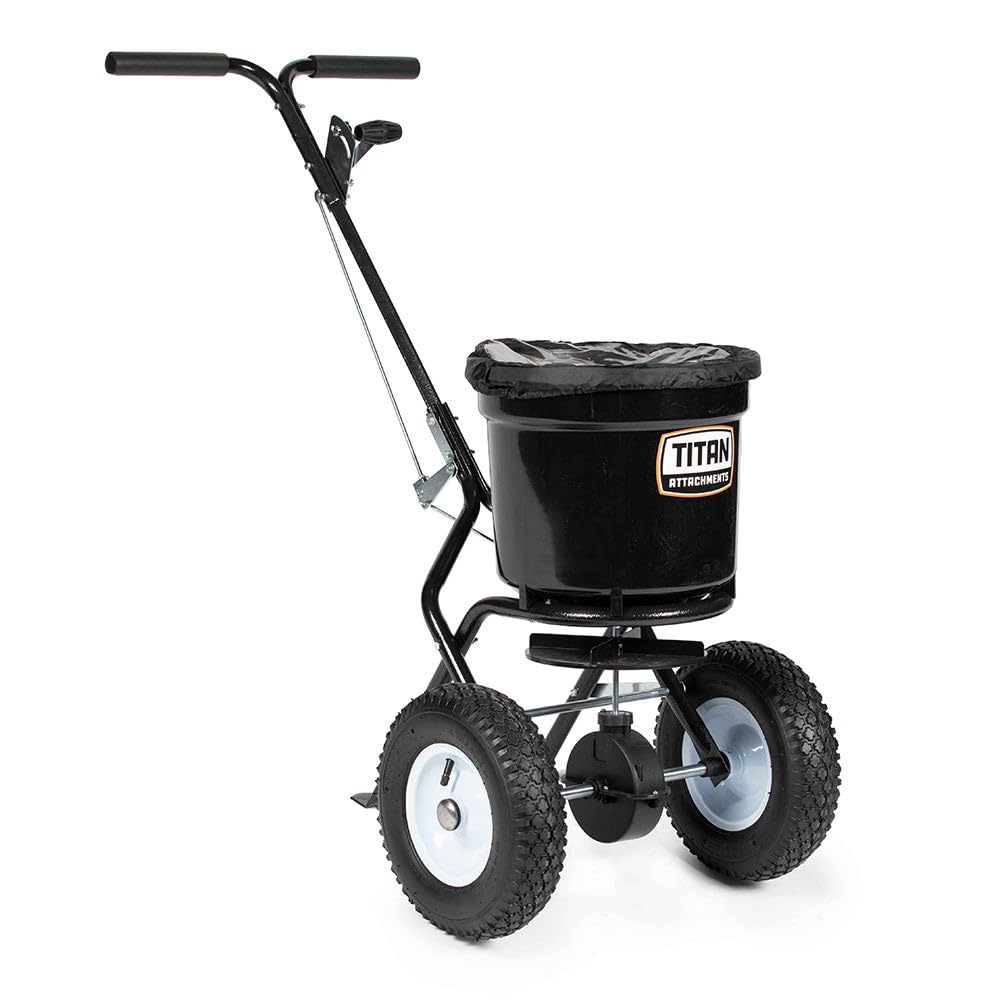
The Titan 50 lb spreader directly addresses a common complaint about the lightweight consumer spreaders—its frame is built with a heavy axle, stainless steel flow control plate, and a durable gearbox that feels substantially sturdier than the flimsy plastic units sold at the same price point. The 50-pound hopper is a practical size for most 1/4 to 1/2 acre lots, and the 3-position flow control handle offers coarse adjustment that is easy to understand without a manual.
The pneumatic tires provide a noticeable upgrade in stability over solid wheels, though the 1/4-inch control rod and pivot rivet are potential long-term wear points if the spreader is used heavily with abrasive materials like sand or rock salt. The included hopper screen and rain cover are thoughtful additions that help keep material dry and free of clumps. A few owners reported that the spreader initially seemed stiff, but the mechanism smoothed out after lubrication and a few passes.
Assembly is the most challenging part of owning this spreader. The manual is unclear, several parts are not labeled, and it can take 3-4 hours for someone without mechanical experience. Missing or wrong parts have been reported, and the customer return process through third-party warranty is not seamless. For buyers who are handy with tools and patient with assembly, this is a value-packed choice that genuinely outperforms its price tier in every measurable way.
What works
- Sturdy frame with heavy axle and stainless steel flow plate resists corrosion.
- Pneumatic tires improve stability and push ease on uneven lawns.
- 50-pound hopper capacity is practical for most residential lots.
- Includes hopper screen and rain cover for material protection.
What doesn’t
- Assembly instructions are poor; can take 3-4 hours without experience.
- Thin control rod and pivot rivet are potential early-wear points.
4. Scotts Turf Builder EdgeGuard DLX Broadcast Spreader

The Scotts Turf Builder EdgeGuard DLX is the undisputed champion of “no assembly required”—it arrives fully assembled and pre-calibrated for Scotts lawn products, so you can start spreading immediately. The 15,000 square foot hopper capacity is calibrated for Scotts Turf Builder fertilizers, which simplifies the process for homeowners who use the same product line. The integrated EdgeGuard side shield flips down to keep product off driveways and flower beds, which is genuinely useful for edging along hardscapes.
The trade-off for this convenience is build quality. The hollow plastic wheels collect product, especially in morning dew, which creates clumps that drop unevenly. The axle has a slight lateral play of about 1 inch, and the wheel caps can pop off if the spreader is banged against a rock or curb. For a 6-foot-tall user, the handle is short enough to cause back fatigue on a 1/4-acre lawn, and users over 6’2″ will find it uncomfortable for extended work.
This spreader also requires deliberate attention to the EdgeGuard lever—if you leave it engaged on one side, the pattern becomes heavily uneven because the shield redirects material to the opposite side. The 20-pound fill limit is lower than the hopper’s physical capacity, which means more frequent trips to the bag. For small lawns and homeowners who prioritize quick, no-fuss jobs over long-term durability, this is a competent tool, but serious landscapers will quickly outgrow its limitations.
What works
- Arrives fully assembled and pre-calibrated for immediate use.
- EdgeGuard side shield effectively prevents overspray on sidewalks and beds.
- Smooth rolling and easy to push on flat lawns up to 15,000 sq ft.
What doesn’t
- Hollow plastic wheels collect product and create uneven clumps in dew.
- Handle is too short for users over 6 feet, causing back fatigue.
- Axle has lateral play and wheel caps can pop off during use.
5. Brinly P20-500BHDF-A Push Spreader with Side Deflector

The Brinly P20-500BHDF-A is engineered for longevity in the face of corrosive fertilizers. Every contact surface—the shaft, the agitator, and all hardware—is stainless steel, and the gearbox is fully enclosed and rust-resistant. The 50-pound capacity hopper is made from a heavy-duty, rust-proof polyethylene that will not dent or flake like painted metal, and the large 12 x 3-inch pneumatic turf-tread tires roll easily over bumpy terrain.
The side deflector kit is one of the most thoughtfully designed on this list. It flips up and out of the way when not needed and adjusts the angle to control how far material is thrown, which is far more useful than a simple on/off shield. The easy-to-reach controls and simple calibration settings help you dial in the rate without the guesswork that plagues many competitors, though the spreader setting chart is based on Brinly’s own testing and may not perfectly match every fertilizer brand.
Assembly is straightforward—most users finish in about 20 minutes with two 10 mm wrenches. The main drawback is the hopper gate: when you stop pushing, material continues to drop from the impeller unless you remember to close the lever immediately. This can create burn spots at the end of each row. The spreader also does not fold for storage, requiring a permanent floor footprint of roughly 3 square feet.
What works
- Stainless steel shaft, agitator, and all hardware resist fertilizer corrosion.
- Fully enclosed rust-resistant gearbox reduces maintenance.
- 12-inch pneumatic turf-tread tires provide easy rolling on uneven terrain.
- Side deflector kit is adjustable for precise edge control.
- Quick 20-minute assembly time with basic tools.
What doesn’t
- Material continues to drop from impeller when stopped; must close lever manually.
- Does not fold for storage; requires a dedicated floor area.
6. Agri-Fab 45-0547 Tow Behind Broadcast Spreader (185 lb)

The Agri-Fab 45-0547 tow-behind spreader is designed specifically for owners of riding mowers or ATVs who need to cover an acre or more without reloading. The 185-pound poly hopper holds enough material to cover roughly 40,000 square feet at a 12-foot spread width, and the on/off flow control is cable-operated from the tractor seat so you can start and stop spreading without dismounting. The 13 x 5-inch turf-tread pneumatic tires handle the weight and roll smoothly across open lawns.
The heat-treated steel gears inside the rust-proof hopper are built for longevity, and the poly spreader plate resists the wear that metal plates suffer from abrasive materials like sand. The build quality from Agri-Fab’s Sullivan, Illinois facility is generally good, but the hardware suffers from cost-cutting in some areas. Multiple owners report that the cotter pins on the axle are too soft and shear off within the first 15 minutes of use, causing a wheel to detach. Replacing them with stronger hardware from a local hardware store solves the issue permanently, but it is an immediate hassle.
The hopper gate design also has a persistent problem: the trap door opening is slightly larger than the gate slide, meaning even when fully closed, a small trickle of material leaks out. This creates a visible fertilizer line in the center of the lawn where the spreader was towed to the starting point. The calibration chart is also inaccurate for many materials, requiring deliberate experimentation to avoid over-application. For owners willing to make a few upgrades and accept some quirks, this remains the most cost-effective way to cover acreage from a tractor seat.
What works
- 185-pound hopper covers up to 1 acre or 40,000 sq ft per fill.
- Seat-mounted flow control lever allows on/off operation without dismounting.
- 13 x 5-inch pneumatic tires provide smooth rolling over large lawns.
- Rust-proof poly hopper and heat-treated steel gears offer good durability.
What doesn’t
- Stock cotter pins are too soft and shear off; must be replaced immediately.
- Hopper gate does not close fully, causing a small material leak when towing.
- Calibration chart is inaccurate for many materials; requires trial and error.
7. Brinly BS26BH-A Tow Behind Broadcast Spreader (125 lb)

The Brinly BS26BH-A addresses the single biggest frustration with tow-behind spreaders—product waste at stops—with its patented Autoflow technology, which automatically stops material from flowing when the towing vehicle stops. This prevents the fertilizer burn spots that often appear at the end of each row with non-autoflow models. The 125-pound capacity poly hopper is rust- and dent-proof, and all fertilizer-contact parts—shaft, agitator, and hardware—are stainless steel to resist corrosion.
The directional spread pattern control allows you to center and balance the distribution for different materials, which is a professional-grade feature rarely seen at this price point. Brinly provides hundreds of pre-calibrated settings to help you get the rate right for specific fertilizers without guesswork. The 30-minute assembly claim is realistic if the instructions are followed step by step, and the pictorial manual with a fastener skin pack makes part identification straightforward.
The build quality has some inconsistencies. Some units arrive with broken plastic components due to inadequate packaging, and the wheel assembly lacks enough washers to eliminate axle side-play, which can cause wobble on uneven ground. The hopper also has a noticeable dead zone: approximately 5 pounds of material remain trapped at the bottom corners and will not flow out, meaning you either waste that product or have to manually dump it. For yards over 1/2 acre, the Autoflow feature alone justifies the higher price point, but the packaging and minor design flaws keep it from being a perfect out-of-box experience.
What works
- Patented Autoflow technology stops material when the tractor stops, preventing burns.
- Stainless steel shaft and agitator resist corrosion from fertilizer salts.
- Directional spread pattern control balances distribution for different materials.
- Hundreds of pre-calibrated settings reduce guesswork for specific fertilizers.
What doesn’t
- Hopper design traps approximately 5 pounds of material that won’t flow out.
- Some units arrive with broken plastic parts due to insufficient packaging.
- Wheel axle lacks sufficient washers, causing side-play wobble on uneven ground.
Hardware & Specs Guide
Pneumatic Tires and Lawn Contact
The diameter and width of the tires directly affect how much terrain variation the spreader can absorb. A 13-inch tire with a 4- or 5-inch width provides a smoother ride over dips and bumps compared to a 10-inch solid wheel. Pneumatic tires also maintain better ground contact on slopes, preventing the wheel slip that causes inconsistent impeller speed. If your lawn has any uneven patches or mild inclines, prioritize models with pneumatic tires over solid plastic wheels.
Gearbox Enclosure and Material Compatibility
An enclosed gearbox keeps fertilizer dust and moisture away from the gears, which is critical because granular fertilizers are hygroscopic and will cake onto exposed lubricants. Spreaders with open gears require frequent cleaning and regreasing. Models that use a direct ground-drive system rather than wheel-friction transfer maintain consistent impeller speed regardless of surface moisture, producing a more predictable spread pattern across varying conditions.
FAQ
How do I calibrate a broadcast spreader for a specific fertilizer?
Why does my fertilizer turn brown or yellow after using a broadcast spreader?
Can I use a broadcast spreader to apply granular weed killer or insect control?
Final Thoughts: The Verdict
For most gardeners, the best broadcast spreader for fertilizer winner is the EarthWay 2150 because its ground-drive gearbox produces a consistent, predictable spread pattern even on damp grass and rough terrain. If you want professional-grade build quality with rust-proof hardware and simple assembly, grab the Brinly P20-500BHDF-A. And for covering an acre or more from the seat of your riding mower without stopping to refill, nothing beats the Agri-Fab 45-0547.