
An 18-0-4 fertilizer delivers the heavy nitrogen load your lawn craves for deep greening while keeping phosphorus out of the equation—a critical move for established turf where phosphorous runoff is both wasteful and environmentally questionable. The 4 percent potassium rounds out the mix to strengthen cell walls and improve drought tolerance, making this ratio a favorite for cool-season grasses in transition zones.
I’m Rikta — the co-founder and writer behind Lawn Gear Lab. I’ve spent hundreds of hours analyzing NPK ratios, pre-emergent chemistries, and slow-release nitrogen profiles to help you cut through the marketing and pick the right bag for your turf type and calendar.
After comparing coverage rates, nitrogen sources, and weed-control add-ons across multiple brands, I’ve narrowed the field to the very best 18-0-4 fertilizer options that balance feeding power with practical application windows.
How To Choose The Best 18-0-4 Fertilizer
The 18-0-4 ratio is a workhorse blend for spring and fall feeding, but the real differences hide in the nitrogen source, particle size, and any pre-emergent hitchhikers. Here’s what to check before you buy.
Nitrogen Delivery: Quick vs. Slow Release
An 18-0-4 bag can use fast-acting ammonium sulfate for a three-day green-up or a coated slow-release urea that feeds over six to eight weeks. Quick-release is great for a rapid color boost before an event, but it demands watering and can cause surge growth that requires mowing twice a week. Slow-release nitrogen—often labeled as polymer-coated sulfur-coated urea (PCSCU)—gives you steady color without the mowing penalty and lowers the risk of nitrogen burn on slopes or sandy soil.
Pre-Emergent Integration
Some 18-0-4 products include prodiamine or dithiopyr to stop crabgrass and poa annua before they germinate. A “weed-and-feed” 18-0-4 saves you a separate spreader pass but locks you into a timing window: you must apply before soil temperatures hit 55°F for crabgrass prevention. If you miss that window, a straight fertilizer without the herbicide is a better bet.
Particle Consistency and Spreader Fit
Granule size determines how evenly the product lands on your turf. Dispersible granule (DG) technology from brands like The Andersons breaks down on contact with water, reducing the risk of skips and streaks. Standard prilled granules require precise spreader calibration—always test on a driveway first to avoid pinstripes of dark green and yellow across your lawn.
Quick Comparison
On smaller screens, swipe sideways to see the full table.
| Model | Category | Best For | Key Spec | Amazon |
|---|---|---|---|---|
| The Andersons 18-0-4 Barricade | Weed & Feed | Crabgrass prevention | 0.426% Prodiamine | Amazon |
| Ferti-lome Lawn Food Plus Iron 24-0-4 | Premium Granular | Iron-driven color | 24-0-4 with Iron | Amazon |
| Jonathan Green Green-Up 29-0-3 | Mid-Range Granular | Lush color in transitions | 29-0-3 Granules | Amazon |
| The Andersons Pure Nitrogen 32-0-0 | High-Nitrogen | Nitrogen deficiency fix | 32-0-0 Dual Release | Amazon |
| Ferti-lome Centipede 15-0-15 | Specialty Granular | Centipede grass health | 15-0-15 Slow N | Amazon |
| Scotts Liquid Green Max | Liquid Concentrate | Hose-end quick green | Iron Supplement | Amazon |
| Scotts Turf Builder 38-0-4 | Budget Granular | Quick all-purpose green | 38-0-4 Granules | Amazon |
In‑Depth Reviews
1. The Andersons 18-0-4 Barricade Fertilizer with Pre Emergent
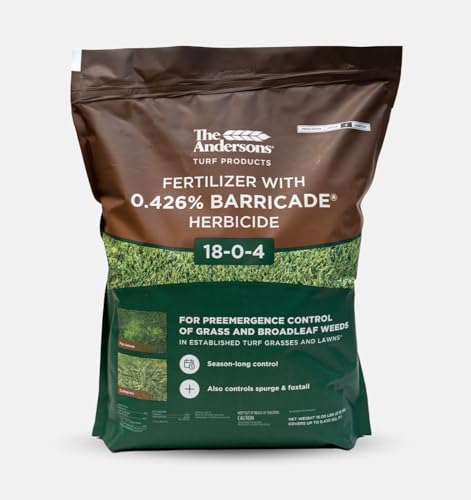
This 18-pound bag of 18-0-4 fertilizer marries a precise NPK ratio with 0.426 percent prodiamine, giving you a single-pass solution for feeding and preventing thirty different grass and broadleaf weeds including crabgrass, poa annua, and goosegrass. The patented dispersible granule (DG) technology means the particles dissolve quickly on contact with water, driving the prodiamine into the soil profile where it halts germination before weeds ever break the surface.
Zoysia and Bermuda lawn owners in warm-season zones report that a single spring application keeps the yard weed-free through early summer while delivering the deep green color that comes from balanced 18-0-4 nutrition. The 5,000-square-foot coverage per bag matches typical lot sizes, and the fine particle size spreads uniformly through a standard Scotts broadcast spreader without clogging or bridging in the hopper.
The primary trade-off is the price point, which runs higher than commodity fertilizers without pre-emergent, but users consistently note that the combination of feeding and prevention removes the need for a separate spray treatment later in the season—saving both time and money for most homeowners.
What works
- Pre-emergent and fertilizer in one bag saves a spreader pass
- DG granules dissolve fast for immediate soil penetration
- Controls crabgrass and poa annua before they start
- Even spread pattern with no streaking
What doesn’t
- Will not kill existing weeds—timing is everything
- Premium cost compared to straight fertilizer blends
2. Fertilome Lawn Food Plus Iron 24-0-4
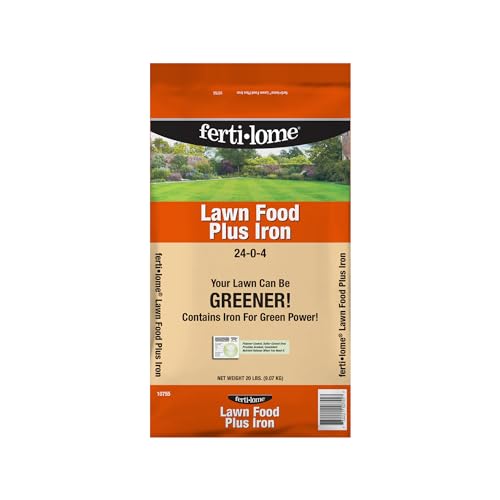
Ferti-lome pushes the nitrogen content to 24 percent while keeping phosphate at zero and potassium at 4 percent—a ratio optimized for lawns that need a rapid color rebound without the risk of phosphorous runoff. The included iron acts as a catalyst for chlorophyll production, turning yellow or pale turf into a deep, dark green within days rather than weeks.
The 20-pound bag covers 5,000 square feet at the recommended 4-pound-per-thousand rate, and the dual-nitrogen formulation delivers both quick-release ammonium sulfate for immediate results and slow-release coated urea for sustained feeding over four to six weeks. Users in arid climates like Arizona report that this product keeps winter rye grass thick and vibrant even during drought periods when other fertilizers fail to hold color.
Application precision matters here: because of the high nitrogen content, spreading this product on wet grass or during temperatures above 90°F increases the risk of leaf burn. Users who follow the label and water in within 24 hours consistently get the “best lawn on the block” results described in dozens of five-star reviews.
What works
- High nitrogen plus iron produces dramatic greening
- Dual-release nitrogen extends feeding window
- Zero phosphate is watershed-friendly
- Long track record with consistent owner satisfaction
What doesn’t
- Requires careful watering timing to avoid burn
- Iron can stain concrete if not swept immediately
3. Jonathan Green Green-Up Lawn Food 29-0-3

Jonathan Green’s Green-Up formula deviates slightly from the classic 18-0-4 ratio, offering 29-0-3 with a higher nitrogen punch and a reduced potassium level—a configuration that works exceptionally well for lawns in the spring green-up window when nitrogen demand peaks and potassium requirements are lower. The 15-pound bag covers the standard 5,000-square-foot area, and the granular consistency allows for uniform distribution through rotary spreaders.
Cool-season grasses such as Kentucky bluegrass and tall fescue respond vigorously to this blend, producing the kind of thick, emerald carpet that draws compliments from neighbors. However, the high nitrogen content demands careful timing: applying this product during hot, dry weather or without adequate rainfall can lead to burn, which several long-time users have confirmed from experience.
Reviews consistently highlight the dramatic color improvement, with many owners describing their lawns as “never greener” after a single application. The trade-off is the narrower application window—this is not a set-and-forget summer fertilizer—but for early spring and fall feeding cycles, Green-Up delivers reliable and striking results.
What works
- Powerful greening effect on cool-season turf
- Easy flow through broadcast spreaders
- Good value for the coverage area
What doesn’t
- High burn risk if applied without rain or watering
- Potassium is lower than the 18-0-4 standard
4. The Andersons Professional Pure Nitrogen 32-0-0

This 18-pound bag of 32-0-0 from The Andersons is a pure nitrogen supplement rather than a balanced NPK fertilizer, making it a targeted tool for lawns showing clear nitrogen deficiency—pale color, slow growth, and thinning stands. The dual-release technology blends quick-available urea with polymer-coated slow-release granules, delivering an immediate green boost while stretching the feeding window to roughly six weeks for sustained results.
The 6,000-square-foot coverage per bag is generous, and the fine particle size ensures uniform distribution even with a drop spreader. St. Augustine and Bermuda grass owners report dark green color and noticeably thicker turf within two weeks, with many users describing their lawn as “the envy of the neighborhood” after a single application.
Because this product contains zero phosphate and very low potassium—just nitrogen—it is not a complete lawn food. It works best as a mid-season supplement when your soil test confirms adequate P and K levels but the grass needs a nitrogen push. Using it as a standalone fertilizer without checking existing soil nutrition can lead to nutrient imbalance over time.
What works
- Dual-release nitrogen for quick and lasting color
- Fine granules spread evenly without clogging
- Good option for nitrogen-deficient soil
What doesn’t
- Not a complete fertilizer—no P or meaningful K
- Requires soil test before responsible use
5. Fertilome Centipede Lawn Fertilizer 15-0-15
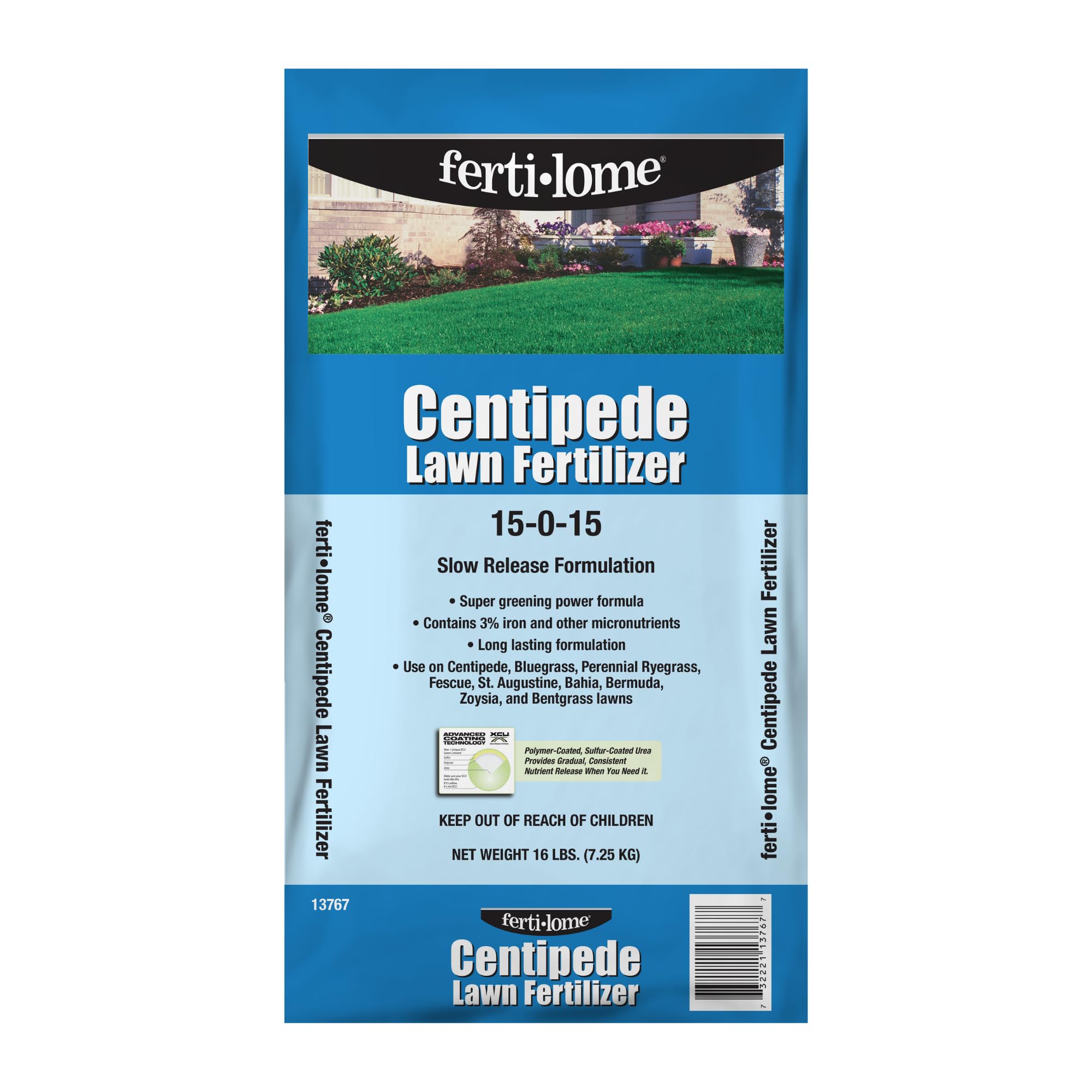
Designed specifically for centipede grass, this Ferti-lome formula drops the nitrogen to 15 percent while raising the potassium to 15 percent—a 1-to-1 ratio that matches centipede’s low fertility requirements and helps prevent the yellowing that high-nitrogen blends cause on this grass type. The slow-release nitrogen source reduces the risk of burn and keeps growth steady rather than explosive, which is exactly what centipede needs to stay healthy without excessive mowing.
The 16-pound bag covers 5,000 square feet at the 4-pound-per-thousand rate, and users in the Southeast report that their centipede lawns turn thick and dark green after two applications—one in early spring and one in early fall. Reviews from North Carolina owners describe bare spots filling in and runners spreading vigorously, transforming patchy lawns into uniform carpets during hot July weather.
This is a niche product that works brilliantly on centipede but is not ideal for fescue, Bermuda, or St. Augustine lawns that need higher nitrogen. If you have centipede turf and want a phosphate-free formula that won’t push weed growth, this is one of the most effective options available.
What works
- Perfect N-K balance for centipede grass health
- Slow-release nitrogen prevents burn and surge growth
- Corrects yellow foliage without overfeeding
What doesn’t
- Not suitable for high-nitrogen grass types
- Coverage area smaller than some competitors
6. Scotts Liquid Green Max Lawn Food

For homeowners who prefer hose-end application over pushing a spreader, Scotts Liquid Green Max delivers a 2-in-1 liquid fertilizer plus iron supplement that covers up to 2,000 square feet per 32-ounce bottle. The dual-action formula feeds the grass while the iron deepens green color without the surge growth that granular nitrogen can cause—a major advantage if your mowing schedule is already tight.
St. Augustine and Bermuda owners report visible greening in about a week, with some users in Texas seeing results even during 104°F heat when granular fertilizers would burn the turf. The hose-end sprayer provides consistent coverage without streaks, and the liquid formulation moves into the soil profile quickly without needing to be watered in—ideal for homeowners who don’t have an irrigation system.
The main limitation is coverage: 2,000 square feet per bottle means larger lawns will need multiple bottles, and the per-treatment cost adds up compared to granular options. Additionally, liquid fertilizers require more frequent application—roughly every two to three weeks during the growing season—to maintain color, whereas a single granular feeding can last four to six weeks.
What works
- Hose-end sprayer for fast, even application
- Works well in high heat without burning
- Iron supplement gives deep color without excess growth
What doesn’t
- Small coverage area—multiple bottles per large lawn
- Requires more frequent reapplication than granules
7. Scotts Turf Builder Lawn Food 38-0-4
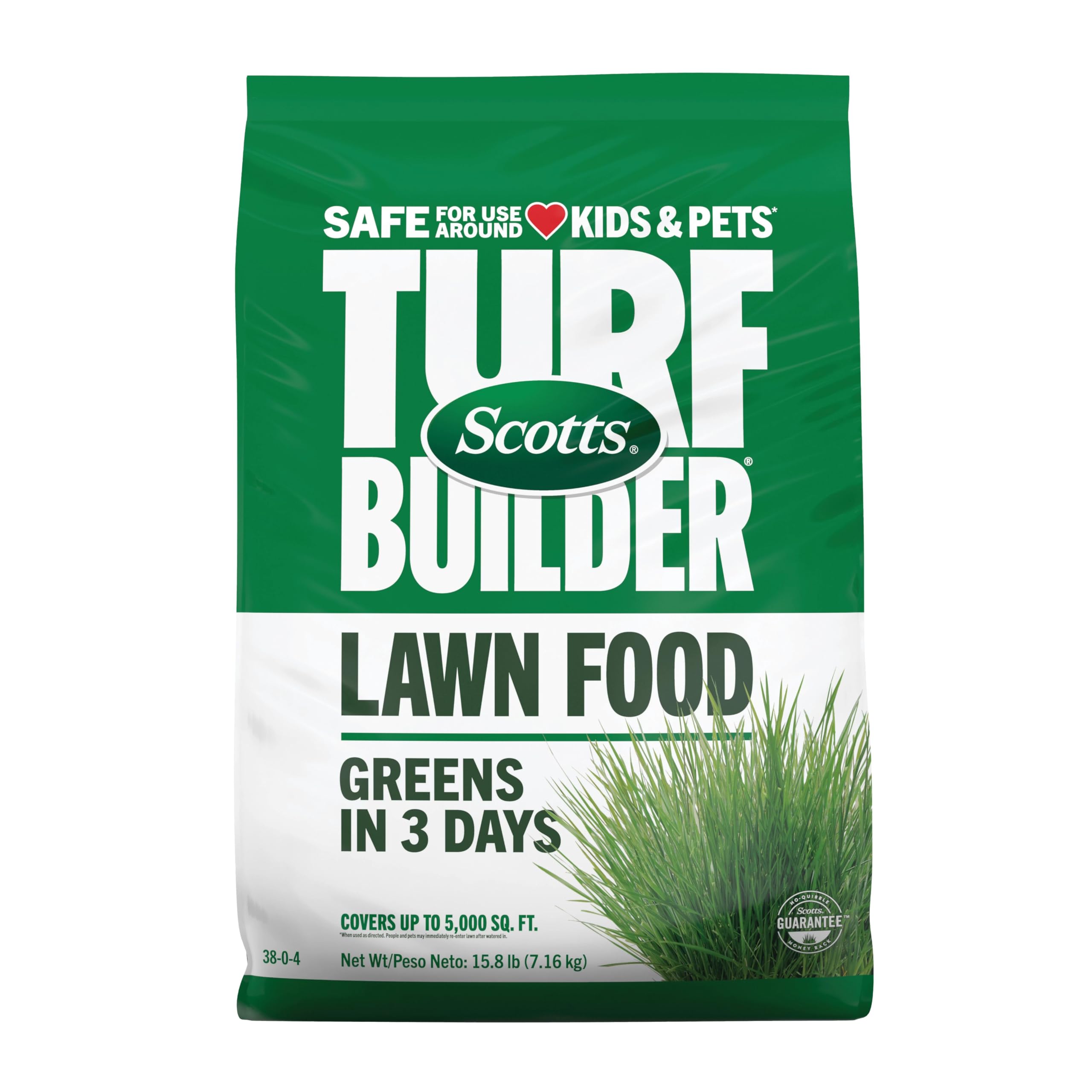
Scotts Turf Builder Lawn Food uses a 38-0-4 ratio that pushes nitrogen to the highest level in this roundup, making it a fast-acting green-up solution for all grass types including fescue, Bermuda, and St. Augustine. The 15.8-pound bag covers up to 5,000 square feet, and the product is labeled as safe for kids and pets once watered in—a practical consideration for families with outdoor activity.
The dual spreader setting lets you choose between the standard Turf Builder rate for moderate greening or the “Max Greening” setting for deeper color, giving you control over the intensity of the response. Users consistently report visible results in three days, with the lawn reaching peak color within a week. The formula is designed for applications when temperatures are between 60°F and 90°F, which covers most of the spring and fall feeding windows.
Some owners report inconsistent results, with a small subset finding the product expensive relative to the results achieved. The high nitrogen concentration means precise spreader calibration is essential—streaking is possible if you overlap or misdial the setting. For the price, this is a solid entry-level granular option that covers the basics of quick greening without the pre-emergent or slow-release features of mid-range and premium competitors.
What works
- Very fast greening—results in 3 days
- Safe for kids and pets after watering
- Works on all common grass types
What doesn’t
- No slow-release component—shorter feeding window
- Some users report poor results despite careful application
Hardware & Specs Guide
NPK Ratio Interpretation
The three numbers on any fertilizer bag represent Nitrogen (N), Phosphate (P2O5), and Potash (K2O) in that order. An 18-0-4 formula delivers 18 percent nitrogen for leaf and stem growth, zero percent phosphate, and 4 percent potassium for root strength and disease resistance. Zero phosphate is ideal for established lawns where soil tests already show adequate phosphorus levels—adding more can contribute to algae blooms in local waterways.
Nitrogen Release Types
Fertilizers use either quick-release water-soluble nitrogen (ammonium sulfate, ammonium nitrate) for rapid greening or slow-release coated urea (sulfur-coated, polymer-coated) for extended feeding. Slow-release nitrogen reduces the risk of burn, mowing surge, and nutrient leaching, but costs more per pound. Many premium 18-0-4 products blend both types to give you the best of immediate color and sustained nutrition over six to eight weeks.
FAQ
Can I use an 18-0-4 fertilizer on new grass seed?
How often should I apply an 18-0-4 fertilizer during the growing season?
Final Thoughts: The Verdict
For most gardeners, the 18-0-4 fertilizer winner is the The Andersons 18-0-4 Barricade because it combines precision feeding with a proven pre-emergent, saving you time and preventing the most common lawn weeds before they appear. If you want rapid iron-driven color without the mowing surge, grab the Ferti-lome Lawn Food Plus Iron 24-0-4. And for centipede grass owners who need a phosphate-free formula matched to their turf type, nothing beats the Ferti-lome Centipede 15-0-15.