
Breaking new ground with a battery-powered tiller means trading the tangle of extension cords and the fumes of a gas engine for nimble, one-handed soil prep in your raised beds and flower borders. But the shift from gas to battery brings its own set of trade-offs: runtime measured in minutes rather than gallons, torque curves that differ from a roaring ICE, and tine designs that must work harder to chew through compacted clay without the weight of a traditional machine. Choosing the wrong voltage or tine width here leads to frustrating half-dug rows and a battery that dies before the bed is finished.
I’m Rikta — the co-founder and writer behind Lawn Gear Lab. This guide is built on comparing motor RPM, tine counts, tilling widths, and battery capacities across dozens of models, cross-referencing spec sheets with real owner feedback to pinpoint exactly where each battery-powered tiller delivers or falls short.
Whether you’re turning over a vegetable patch or mixing compost into an established flower bed, finding the best battery powered tiller for your yard means first understanding how voltage, tine design, and battery amp-hours translate into actual digging performance.
How To Choose The Best Battery Powered Tiller
Battery-powered tillers live in a different world than their corded or gas cousins. The three decisions that matter most — voltage, tine configuration, and battery capacity — directly dictate whether a model will chew through a new garden bed or stall on the first hard clod. Here is what to look for before you buy.
Voltage Class: 20V vs 40V vs 80V
The voltage rating of a battery tiller is the single biggest indicator of sustained torque. Entry-level 20V models (often paired with 2.0Ah packs) are fine for loose, already-tilled soil and light weeding but struggle in compacted clay or sod. Jumping to a 40V system roughly doubles the available power, letting the motor maintain speed under load without bogging down. Premium 80V platforms, such as the Greenworks Pro line, offer the highest torque ceiling but come with heavier batteries and a higher entry cost, making them best for owners with multiple large beds or tougher soil conditions.
Tine Design: Count, Width, and Depth
Steel tines do the actual cutting, but not all tine setups work the same. A 4-tine tiller with a 7.5-inch to 9-inch width is ideal for small flower beds and tight rows, where maneuverability matters more than coverage. Models with 12 to 16 tines spread over a 12-inch to 14-inch width cover ground faster and penetrate deeper (up to 8.6 inches in the MZK 40V). Tines that are removable or adjustable let you clean wrapped weeds quickly — a feature that saves significant time when dealing with viney growth. Depth-adjustable wheels or skids allow you to dial in shallow cultivation versus deep soil turning without swapping hardware.
Battery Capacity and Ecosystem
Amp-hours (Ah) determine how long the tiller runs between charges. A 2.0Ah battery on a 20V platform typically delivers 15-30 minutes of real tilling — enough for a single small bed. Dual-battery kits (2 × 4.0Ah or 2 × 5.0Ah) extend runtime to 45-60 minutes of continuous work, which covers most residential gardens in one session. Also consider the battery ecosystem: if you already own 40V or 80V tools from a brand like Greenworks, buying the tool-only version drops the upfront cost. Universal battery interfaces on some models (like the EVEAGE) accept common 18V/20V packs, giving flexibility if your tool collection spans multiple brands.
Weight and Ergonomics
Battery tillers range from under 13 pounds (Earthwise, TaskStar) to nearly 20 pounds (Seesii, TaskStar 40V). Lighter models reduce arm fatigue during extended sessions but may bounce off hard ground rather than digging in. Heavier models stay planted but require more muscle to lift over obstacles. Adjustable handles and foldable frames help match the tool to your height and storage space. Dual-safety switches (button plus trigger) prevent accidental starts and are now standard across all price tiers, but check that the trigger is within easy reach of your dominant hand — poorly placed controls cause hand cramping after 20 minutes.
Quick Comparison
On smaller screens, swipe sideways to see the full table.
| Model | Category | Best For | Key Spec | Amazon |
|---|---|---|---|---|
| MZK 40V 12-inch | Mid-Range | Medium beds & deep tilling | 40V / 16 tines / 8.6″ depth | Amazon |
| TaskStar 40V (TT12 Air) | Mid-Range | All-day raised bed work | 40V / 2×5.0Ah / 12″ width | Amazon |
| Seesii 40V | Mid-Range | Heavy clay & roots | 320W motor / 4-position depth | Amazon |
| Greenworks Pro 80V | Premium | Large gardens, high torque | 80V / 10″ width / 40 min runtime | Amazon |
| EVEAGE 21V | Mid-Range | Rocky soil & DIY projects | 48 tines / 9.7″ width / 7″ depth | Amazon |
| Saker 22V | Entry-Level | Light weeding & sandy soil | 22V / 2×2.0Ah / 9″ width | Amazon |
| TaskStar TH4000 | Entry-Level | Raised beds & light soil | 360 RPM / 48 tines / 9″ width | Amazon |
| Earthwise 20V | Entry-Level | Small flower beds, weeding | 20V / 2.0Ah / 7.5″ width | Amazon |
In‑Depth Reviews
1. MZK 40V 12-inch Cordless Garden Tiller
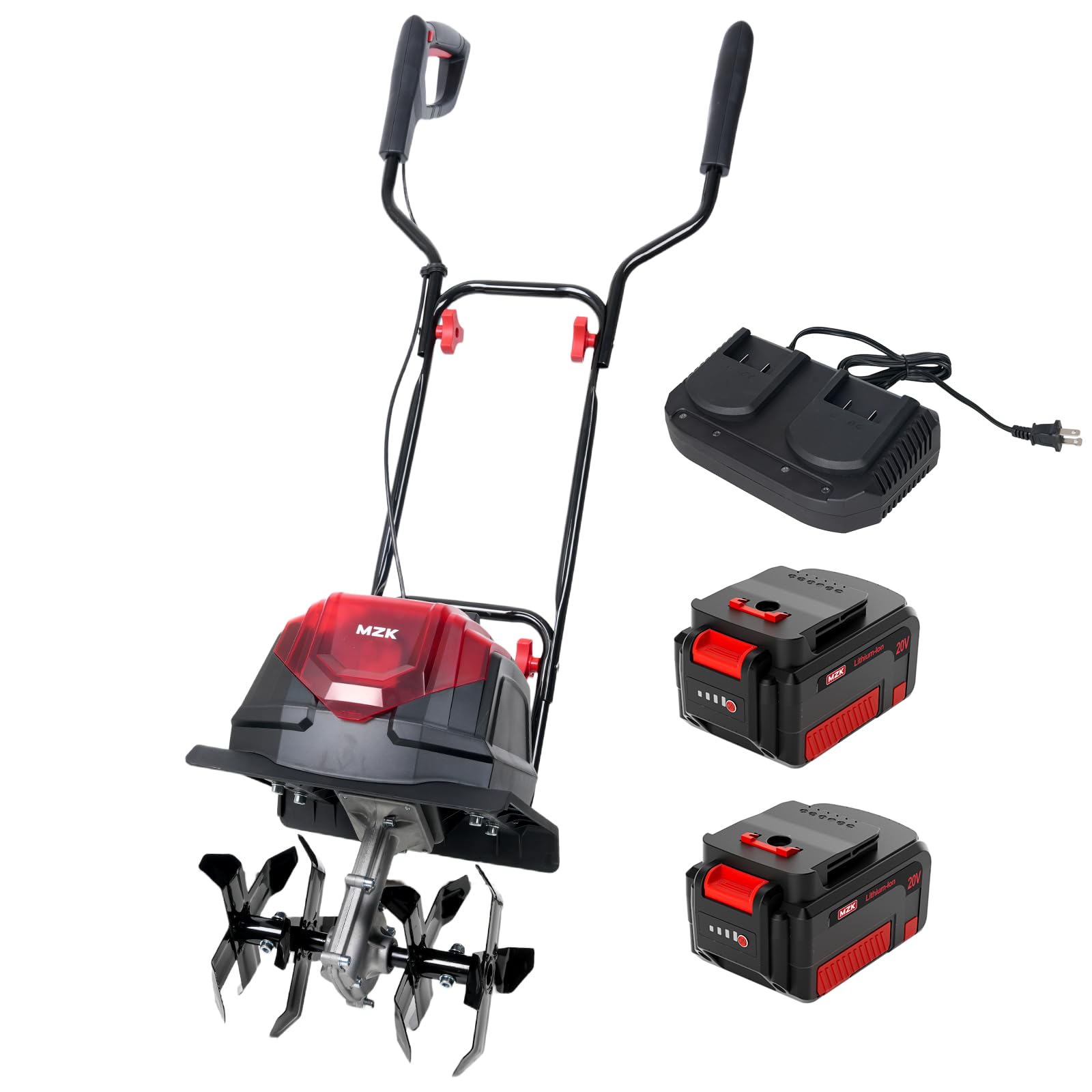
The MZK 40V tiller hits the sweet spot between power and practicality. Its 16 robust steel tines carve out a 14-inch tilling width at up to 8.6 inches deep — enough to turn over compacted garden beds without leaving half-dug strips. The dual 4.0Ah batteries deliver roughly 35 minutes of runtime per pair, which translates to tilling three standard raised beds in a single session based on owner reports. At 180 RPM the tine speed is deliberate rather than frantic, giving the user control to pull back and let the tiller dig in without bouncing across the soil surface.
Adjustable wheels allow you to set the tilling depth precisely, and the double-handle design with an auto-lock trigger reduces thumb fatigue during extended use. The tiller weighs enough (around 14-15 pounds) to stay planted in loose-to-moderate soil without being a burden to lift over garden edging. Owners consistently note that it replaces a gas tiller for small-to-medium beds, eliminating pull-start frustration and the smell of exhaust. The 40V platform also positions this model well above the 20V competition for sustained torque in harder ground.
The main trade-off is that hard, dry clay still requires multiple passes and some downward pressure — the MZK is not a replacement for a heavy-duty gas unit on unbroken sod. Also, the 180 RPM speed means slower progress on very large plots compared to 360 RPM models, though the deeper tine penetration often compensates. For most home gardeners managing multiple beds and flower borders, this tiller offers the best balance of depth, runtime, and ease of use.
What works
- 8.6-inch depth handles most residential soil prep
- Dual 4.0Ah batteries provide adequate runtime for multiple beds
- Adjustable wheels give precise depth control
- Auto-lock trigger reduces hand fatigue
What doesn’t
- Requires downward pressure in hard, dry clay
- 180 RPM slower than high-speed competitors
- Not designed for breaking unbroken sod
2. TaskStar 40V Cordless Tiller (TT12 Air)
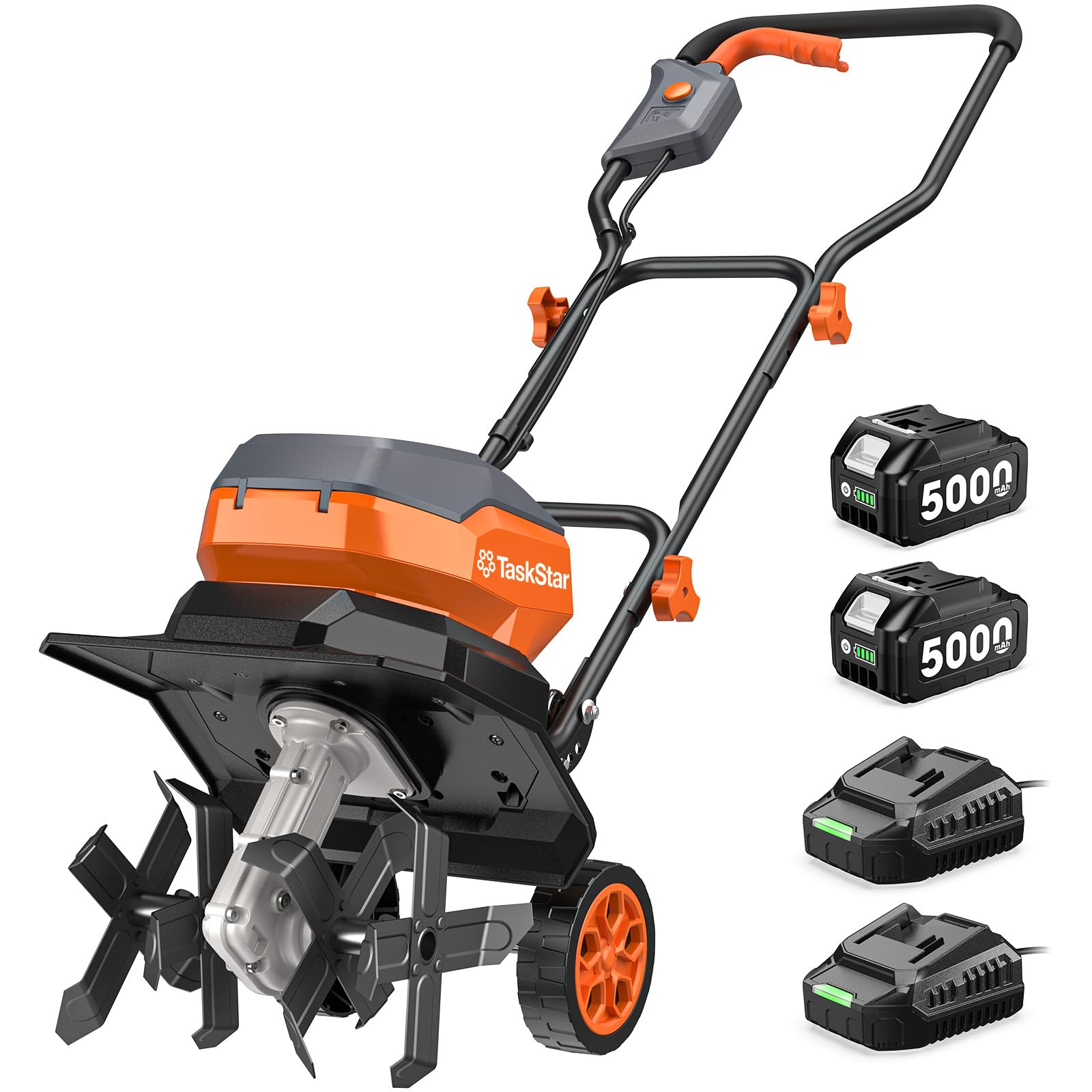
The TaskStar TT12 Air distinguishes itself with the largest battery capacity in the mid-range class — two 5.0Ah packs that together provide enough amp-hours to work continuously for around 45-60 minutes of actual tilling. That extra capacity matters when you have multiple raised beds, a vegetable patch, and flower borders to cover in one go without stopping to swap packs. The 40V motor drives a 12-inch tilling width to an 8-inch depth, which covers ground efficiently while remaining narrow enough to fit between existing rows.
The wheeled design with four adjustable depth settings gives granular control from shallow weeding to full-depth soil turning. Owners report that the tiller handles uneven, previously worked ground well, with the dual-safety lock preventing accidental engagement during transport. The lightweight construction (under 15 pounds) makes it manageable for older gardeners and those with limited upper-body strength — several owner reviews from users in their sixties and seventies note that the tiller is easy to handle without strain. The quiet electric motor also means less disturbance in suburban neighborhoods.
The primary drawback is that the tines tangle noticeably in viney weeds and tall grass, requiring stops to clear wrapped material. Some owners also note that the plastic housing components feel less durable than the all-steel construction of competing models, though no structural failures have been widely reported. For gardeners who prioritize long runtime and ease of use over brute-force tilling of virgin soil, this TaskStar is a strong contender.
What works
- Dual 5.0Ah batteries offer class-leading runtime
- Four depth settings for versatile cultivation
- Light enough for seniors to operate comfortably
- Wheeled design simplifies transport
What doesn’t
- Tines tangle in viney weeds and tall grass
- Plastic housing less rugged than steel frames
- Not ideal for breaking dense, unworked clay
3. Seesii 40V Cordless Tiller

The Seesii 40V tiller packs a 320W motor that delivers noticeably more torque than the typical 20V or 21V models, making it one of the best choices for yards with clay-heavy or root-filled soil. The 12-inch tilling width and 8-inch depth are paired with four adjustable wheel positions that let you fine-tune the dig depth without tools. Owners report that pulling the tiller backward (rather than pushing) allows the tines to dig in aggressively, churning up compacted ground that stalls lower-voltage competitors.
The dual 5.0Ah batteries charge simultaneously via included dual chargers, meaning you can top up both packs at once and minimize downtime. The adjustable three-position handle accommodates different user heights, and the right-side controls — safety lock plus power switch — are thumb-accessible while the left hand grips the bar for balance. Removable steel tines rinse clean easily, which is a practical advantage when working in wet or sticky soil. The 3-year warranty is also reassuring for a mid-range investment.
The downsides are mostly weight-related: at 19 pounds, this tiller is heavier than most competitors, which can lead to fatigue during longer sessions. Some owners also note that the cotter pins securing the tines can work loose during use and recommend adding split pins for security. For gardeners with tough soil who need a tiller that stays planted and digs deep, the Seesii delivers premium-level performance at a mid-range price point.
What works
- 320W motor handles clay and roots better than 20V models
- Dual 5.0Ah batteries and dual chargers reduce downtime
- Four-position depth control for precise tilling
- Removable steel tines clean easily
What doesn’t
- 19-pound weight is heavier than most competitors
- Tine cotter pins may loosen during use
- Not ideal for very narrow spaces
4. Greenworks Pro 80V Cordless Tiller (Tool Only)

The Greenworks Pro 80V tiller represents the highest voltage tier available in the battery-powered category, and that voltage advantage translates directly into sustained torque. The four forward-rotating steel tines cut a 10-inch width to a depth of 5 inches, which is shallower than some 40V competitors but adequate for mixing soil amendments, weeding between established plants, and prepping flower beds. The real differentiator is the 80V battery platform: if you already own Greenworks 60V or 80V tools (mowers, trimmers, chainsaws), buying the tool-only version avoids the cost of a new battery and charger.
Owners consistently praise the lightweight design (around 12-13 pounds with battery), which makes the tiller easy to maneuver around raised beds and tight corners. The tines are removable and adjustable, letting you configure the width for narrow rows or wider coverage. The 80V battery delivers up to 40 minutes of runtime at full speed, and the motor maintains consistent power as the charge level drops — unlike some lower-voltage models that fade noticeably when the battery dips below 50 percent. The 3-year warranty is solid for a premium tool.
The shallow 5-inch depth is the biggest limitation — this tiller cannot handle deep soil turning or breaking new sod. It is designed for maintenance work in already-cultivated beds rather than primary tillage. Also, the bare tool format means a significant upfront investment if you do not already own Greenworks 80V batteries. For existing Greenworks users or gardeners who prioritize a lightweight, high-torque unit for ongoing bed maintenance, this is a refined option.
What works
- 80V voltage delivers consistent torque under load
- Lightweight at 12-13 pounds for easy handling
- Removable and adjustable tines for flexible width
- 40-minute runtime with full battery platform
What doesn’t
- 5-inch depth is too shallow for primary tillage
- Tool-only format requires existing 80V battery
- Not suitable for breaking unbroken sod or clay
5. EVEAGE 21V Cordless Tiller
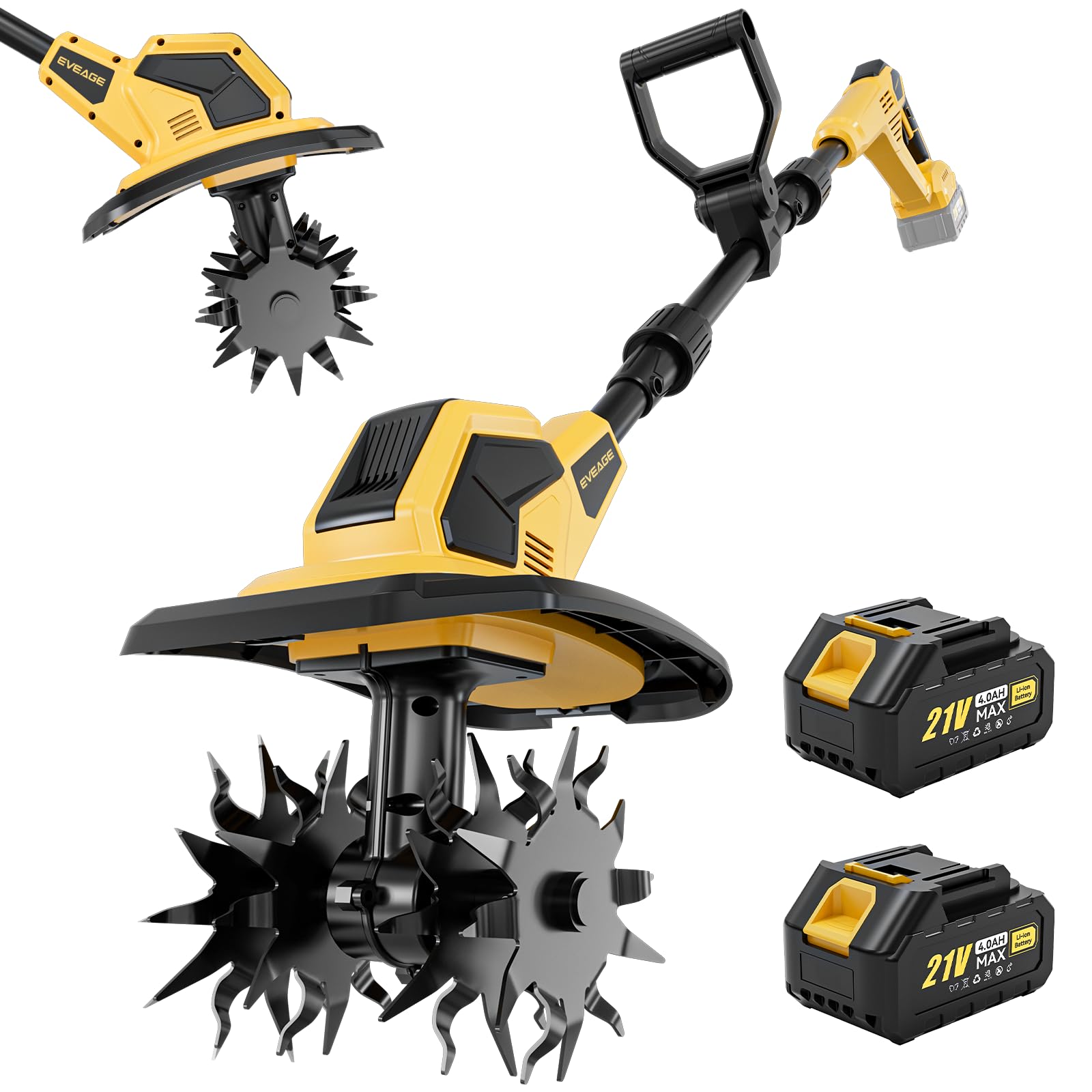
The EVEAGE 21V tiller punches above its voltage class thanks to 48 individual steel tines that multiply the cutting surface across a 9.7-inch width. At 360 RPM, the tine speed is high enough to chew through soil quickly, and the 7-inch tilling depth rivals many 40V competitors. The dual 4.0Ah batteries provide roughly 60 minutes of total runtime, which is generous for a 21V platform. The universal battery interface also accepts standard 18V/20V packs from other brands, giving you backup options if your primary battery dies mid-job.
Owner feedback highlights the tiller’s ability to handle rocky mountain soil — it bounces off larger rocks and spits out smaller ones without damaging the tines or motor. The adjustable handle reduces back strain, and the detachable gear design makes cleaning tangled weeds straightforward. The dual-safety switch (button plus trigger) prevents accidental starts, and at 14.7 pounds the tiller is manageable for most users without causing excessive fatigue.
The main catch is that 21V is still noticeably less torquey than 40V platforms when pushing through heavy clay or thick sod — you will need multiple passes and some body weight to get the full 7-inch depth in tough conditions. Some owners also note that the included charger is slow compared to premium models, taking several hours to fully replenish both batteries. For gardeners on a budget who need a well-tined, versatile tiller for established beds, the EVEAGE offers impressive specs per dollar.
What works
- 48 tines provide excellent soil coverage at 360 RPM
- Universal battery interface accepts other 18V/20V packs
- 7-inch depth suitable for established beds
- Adjustable handle and detachable gears for cleaning
What doesn’t
- 21V system lacks torque for heavy clay and sod
- Charger is slower than premium alternatives
- Multiple passes needed to reach full depth in hard soil
6. Saker 22V Cordless Tiller
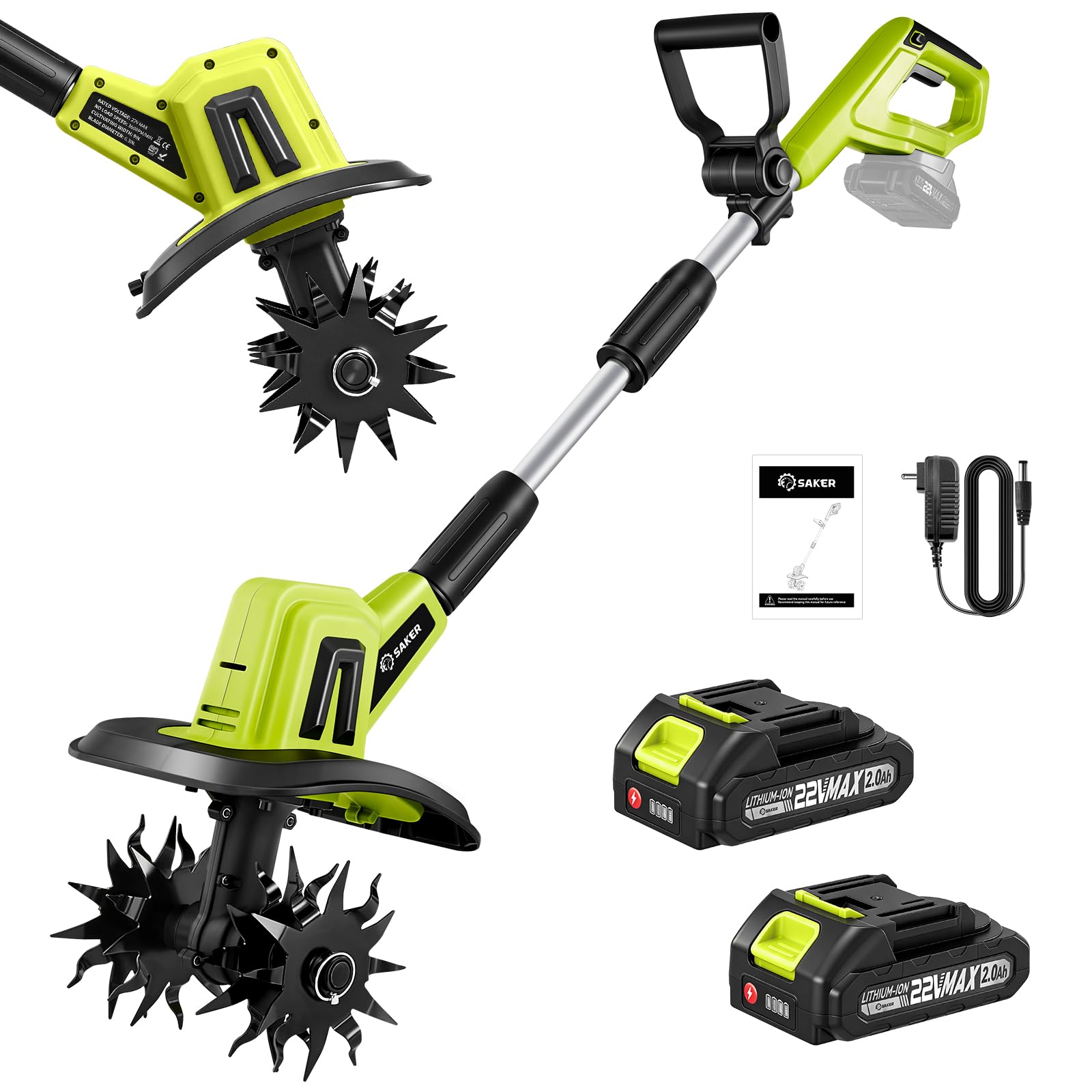
The Saker 22V tiller is built around maneuverability: at roughly 15 pounds with an adjustable auxiliary handle and ergonomic main grip, it is among the easiest battery tillers to handle for extended periods. The 360 RPM motor drives four steel tines to a 9-inch width and 6.3-inch depth, which is adequate for routine weeding, mixing in soil amendments, and prepping previously turned beds. The dual 2.0Ah batteries each deliver about 30 minutes of runtime, which means swapping packs mid-session for larger gardens.
Owner reviews consistently mention how easy the Saker is to assemble (tool-free in under five minutes) and how well it handles sandy or loamy soil. Several users successfully trenched around flower beds and churned up 4-5 inch rocks without stalling the motor. The dual-safety switch (button plus trigger) prevents accidental activation, and the compact dimensions make storage simple. For older gardeners or those with limited strength, the lightweight design significantly reduces fatigue compared to 40V units.
The limitations are clear: 22V lacks the torque to break through hard, dry clay without multiple passes, and the 2.0Ah batteries drain noticeably faster under continuous load. Owners also note the absence of a rear guard, which leaves the lower legs vulnerable to contact with the spinning tines if the tiller kicks back. This tiller is best matched to gardeners with sandy or loose soil who prioritize weight and comfort over raw digging power.
What works
- Lightweight design reduces arm fatigue
- Adjustable handle fits different user heights
- 360 RPM provides fast soil turnover in loose ground
- Simple tool-free assembly
What doesn’t
- 22V system struggles with hard clay and sod
- 2.0Ah batteries drain quickly under load
- No rear guard leaves legs exposed to tines
7. TaskStar TH4000 Cordless Tiller
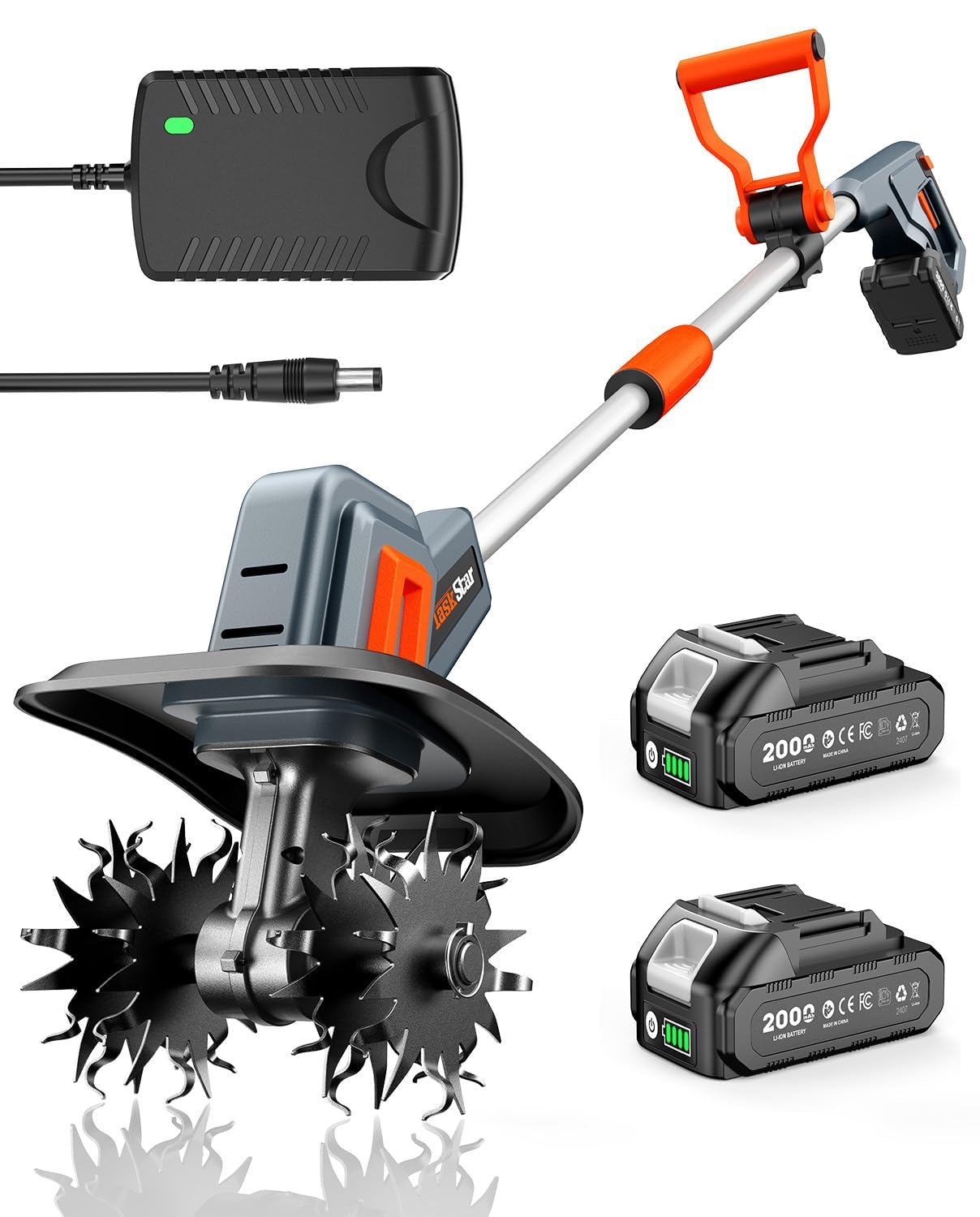
The TaskStar TH4000 packs 48 steel tines into a 21V platform, giving it a high tine count that compensates somewhat for the lower voltage by distributing the cutting load across more points of contact. The 9-inch tilling width and 7-inch depth are in line with other entry-level models, and the 360 RPM motor speed helps the tiller chew through loose and moderately compacted soil quickly. The dual 2.0Ah batteries provide roughly 20-30 minutes of runtime each, which is sufficient for small raised bed gardens and flower borders.
Owner feedback highlights surprisingly strong performance for the voltage class — one reviewer noted that the tiller converted a 2-stroke gas fan by completing a 30×40-foot garden in an hour with no back pain. The lightweight construction (12.8 pounds) makes it easy to lift over garden edges and store in tight spaces. Assembly is simple (rated at five minutes by multiple owners), and the low-maintenance electric design means no fuel mixing or carburetor cleaning.
The main trade-offs are plastic construction that feels less durable than metal-bodied units and tines that tangle easily in tall grass and weeds. The battery life is also a limiting factor for larger gardens — you will need to swap packs midway through anything bigger than 200 square feet. For first-time tiller buyers with small, established beds who want a no-fuss introduction to battery power, the TH4000 delivers functional performance at a friendly entry price.
What works
- 48 tines provide good soil contact at 360 RPM
- Lightweight 12.8-pound design is easy to handle
- Simple assembly in under five minutes
- Surprisingly effective on loose and moderately compacted soil
What doesn’t
- Plastic construction feels less durable than metal
- Tines tangle in tall grass and weeds
- Battery life insufficient for gardens over 200 sq ft
8. Earthwise 20V Cordless Tiller TC70020IT

The Earthwise TC70020IT is the lightest tiller in this guide at under 13 pounds, making it the go-to choice for gardeners who prioritize maneuverability and ease of use above all else. The 20V motor drives four steel tines through a 7.5-inch cutting width at a 6-inch depth — modest specs that match the tool’s intended role as a light cultivator for flower beds, small vegetable patches, and weeding along garden edges. The included 2.0Ah battery and fast charger get you up and running right out of the box.
Owner reviews are overwhelmingly positive for the target use case: small spaces, loose soil, and routine maintenance. Multiple users describe the tiller as “perfect” for their small gardens, noting that it turns over soil effortlessly and pulls weeds up by the roots. The cordless design eliminates the hassle of extension cords, and the lightweight frame means even users with limited strength can manage the tiller one-handed for short stretches. The 2-year manufacturer warranty provides basic peace of mind.
The limitations are inherent to the 20V class: battery life is the most common complaint, with owners noting the tiller drains the single 2.0Ah battery before finishing a medium-sized bed. The 7.5-inch width and 6-inch depth also mean it takes longer to cover ground than wider models, and compacted or clay soil will require multiple passes. For gardeners with loose, sandy soil and small beds who want the absolute lightest option available, the Earthwise delivers exactly what its specs suggest.
What works
- Lightest tiller in class at under 13 pounds
- Effortless operation in loose soil and flower beds
- Included battery and charger for immediate use
- Effective weed removal along garden edges
What doesn’t
- Single 2.0Ah battery runs out quickly
- 7.5-inch width covers ground slowly
- Struggles in compacted or clay-heavy soil
Hardware & Specs Guide
Voltage and Motor Torque
Voltage is the most reliable indicator of sustained tilling power in a battery tiller. 20V and 21V systems (Earthwise, Saker, TaskStar TH4000) deliver enough torque for loose soil, light weeding, and mixing amendments in already-turned beds. 40V systems (MZK, Seesii, TaskStar TT12) roughly double the available torque, letting the motor maintain speed through compacted clay and roots without stalling. 80V systems (Greenworks Pro) offer the highest torque ceiling but come with heavier batteries and shallow depth limitations — they excel at maintenance tilling rather than primary soil breaking. Motor wattage (the Seesii’s 320W rating is a good benchmark) provides a secondary measure: anything above 300W in the 40V class indicates genuine digging capability, while sub-200W motors are best reserved for cultivation in loose ground.
Tine Configuration and Soil Penetration
Tine count, width, and depth are the three variables that determine how effectively a tiller breaks soil. Four-tine designs (Earthwise, Saker, Greenworks Pro) are simplest to maintain and clean but cover less ground per pass — typically 7.5 to 10 inches wide. Multi-tine designs with 16 to 48 tines (MZK, EVEAGE, TaskStar TH4000) distribute the cutting load across more points of contact, reducing the chance of the tiller bouncing off hard soil. For depth, 6 inches is the minimum for mixing compost into existing beds, while 8 to 8.6 inches (MZK, Seesii) allows for deeper soil turning. Removable or adjustable tines (Greenworks Pro, Seesii) simplify cleaning when working in wet or root-filled soil — a practical feature that saves significant time during extended sessions.
FAQ
Can a battery tiller break new ground or only maintain existing beds?
How long does a fully charged battery typically last while tilling?
What is the best way to prevent weeds from tangling around the tines?
Final Thoughts: The Verdict
For most gardeners, the best battery powered tiller winner is the MZK 40V 12-inch Cordless Tiller because it combines 40V torque, 16 tines, an 8.6-inch depth, and dual 4.0Ah batteries into a package that handles both established beds and moderately compacted ground without breaking the bank. If you want the longest runtime for large gardens, grab the TaskStar 40V TT12 Air with its dual 5.0Ah packs. And for tough clay soil and root-filled beds, nothing beats the Seesii 40V with its 320W motor and aggressive tine setup.