
Bagworms are masters of disguise, weaving cone-shaped silk bags covered in plant debris that make them nearly invisible until the damage is done. By the time you notice browning patches on your arborvitae, juniper, or spruce, a single female can have laid hundreds of eggs, ensuring the cycle of defoliation continues next season.
I’m Rikta — the co-founder and writer behind Lawn Gear Lab. I spend my time dissecting the chemical formulations behind pest control products, cross-referencing active ingredients like Spinosad and B.t. against pest life cycles, and analyzing hundreds of verified owner reports to separate the sprays that actually stop bagworm outbreaks from those that just make a mess.
This guide breaks down the most effective solutions, from microbial insecticides that target only the larvae to broad-spectrum concentrates for heavy infestations, so you can confidently choose the right pesticide for bagworms to protect your trees and shrubs this season.
How To Choose The Best Pesticide For Bagworms
Bagworms are caterpillars that construct protective silk bags and feed on the foliage of evergreen and deciduous trees. The key to stopping them is timing and active ingredient selection. Spraying too late — once the bags are large and the larvae have pupated — renders most contact sprays useless because the bag shields the insect.
Match the Active Ingredient to the Infestation Stage
Early-stage larvae (late spring to early summer) are most vulnerable to Bacillus thuringiensis (B.t.), a microbial insecticide that paralyzes the gut of young caterpillars within hours. Mid-to-late season infestations with larger bags demand Spinosad or Permethrin, which penetrate silk barriers more effectively. Systemic options containing Acephate move through the plant’s vascular system, delivering lethal doses when bagworms feed on treated foliage.
Consider Residual Activity and Rainfastness
A pesticide that washes off after the first rain provides zero protection against hatchlings emerging over weeks. Look for products labeled “rainproof in one hour” or with residual control lasting up to four weeks. Concentrates that you mix yourself often provide better coverage and cost-per-gallon value than ready-to-spray bottles.
Evaluate Safety for Beneficial Insects and Ornamentals
If you treat flowering ornamentals or vegetable borders, avoid broad-spectrum pyrethroids that indiscriminately kill bees and ladybugs. OMRI-listed Spinosad and B.t. formulations break down quickly in sunlight and have minimal impact on non-target insects when applied according to the label. Always check whether a product is safe for your specific tree species — some systemic insecticides are not labeled for edible crops.
Quick Comparison
On smaller screens, swipe sideways to see the full table.
| Model | Category | Best For | Key Spec | Amazon |
|---|---|---|---|---|
| Ferti-lome Spinosad | Concentrate | Overall bagworm control | OMRI Listed Spinosad | Amazon |
| Monterey B.t. | Microbial | Early-stage larvae | B.t. Kurstaki concentrate | Amazon |
| Bonide Systemic | Systemic | Deep foliar feeding | Acephate systemic concentrate | Amazon |
| Southern Ag Conserve | Organic | General caterpillar control | Spinosad concentrate 16 oz | Amazon |
| BioAdvanced Tree & Shrub | Ready-to-Spray | Quick hose-end coverage | Rainproof in 1 hour | Amazon |
| Hi-Yield Malathion | Broad-spectrum | Heavy mixed infestations | 55% Malathion concentrate | Amazon |
| Martin’s Permethrin | Residual | Long-term perimeter control | 13.3% Permethrin, 4-week residual | Amazon |
In‑Depth Reviews
1. Ferti-lome Spinosad Insecticide

Ferti-lome’s Spinosad concentrate is tailor-made for bagworm warfare, directly listing bagworms and tent caterpillars on its label. The 16-ounce bottle mixes at a rate of 4 tablespoons per gallon of water, giving you enough treated volume to cover several mature evergreens. Spinosad works by disrupting the nervous system of chewing insects after ingestion, making it lethal to bagworm larvae that have already constructed small silk bags.
User reports confirm it stops bagworm proliferation on apple trees and ornamentals without the harsh odor of organophosphates. Being OMRI listed, it fits into an organic gardening program while still delivering the knockdown power needed for mid-season infestations. The concentrate format lets you adjust dilution strength for heavier pressure — simply follow the label rate for tree and shrub application.
One thing to note: Spinosad degrades rapidly in direct sunlight, so apply during late afternoon or evening to maximize residual activity against hatching larvae. Reapply every 7 to 10 days if new bags continue appearing, especially during wet weather that accelerates breakdown on leaf surfaces.
What works
- Specifically labeled for bagworms and tent caterpillars
- OMRI listed for organic use with strong knockdown
- Concentrate stretches to cover large trees affordably
What doesn’t
- Requires mixing and a separate sprayer
- Sunlight degrades the active ingredient quickly
2. Monterey B.t. Bundled with Measuring Spoon
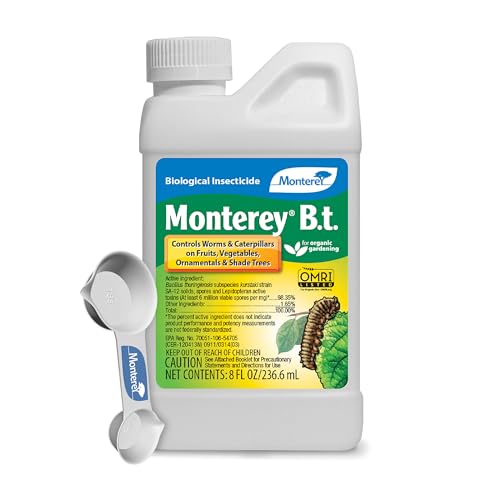
Monterey B.t. uses Bacillus thuringiensis kurstaki, a soil-borne bacterium that produces proteins toxic exclusively to lepidopteran larvae — bagworms, cabbage loopers, gypsy moths, and fall cankerworms. When young bagworm larvae ingest treated foliage, the bacterial toxin paralyzes their digestive system, causing them to stop feeding within hours and die within a few days. This 8-ounce bottle includes a measuring spoon for accurate mixing.
Because B.t. has zero effect on birds, earthworms, honeybees, or ladybugs when applied per the label, it is the safest choice for treating ornamental trees near flowering gardens. Users report it stopped bagworms on Texas Mountain Laurel and eliminated cabbage loopers that had destroyed flower seedlings the previous year. The powder mixes instantly with water — no clumping or settling issues.
The catch is timing: B.t. only works on small, actively feeding larvae, typically during the first 4 to 6 weeks after egg hatch. Once bagworms exceed half an inch and construct thick silk bags, B.t. penetration drops dramatically.
What works
- Safe for pollinators and beneficial insects
- OMRI listed — fully organic control method
- Includes measuring spoon for accurate mixing
What doesn’t
- Only effective against very young bagworm larvae
- Requires precise timing within the hatch window
3. Bonide Systemic Insect Control Concentrate

Bonide Systemic Insect Control delivers acephate, an organophosphate that plants absorb through roots and foliage and transport internally to every leaf and stem. This makes it exceptionally effective against bagworms that feed deep inside dense arborvitae or juniper canopies where contact sprays rarely reach. One 16-ounce concentrate bottle makes 16 gallons of finished spray — enough for multiple large trees.
Multiple users specifically mention using Bonide on arborvitae trees to stop active bagworm damage after local nurseries recommended the product. The systemic action means that even if you miss a bag hidden in the interior foliage, the plant tissue itself becomes lethal to feeding larvae. Apply every 7 to 10 days as long as bagworms are active, and you should see feeding damage halt within the first week.
The biggest downside is the odor — acephate produces a strong, lingering smell that several users describe as akin to a dumpster or fecal matter. The smell dissipates within a day or two, but it is noticeable during and immediately after application. Also note that Bonide Systemic is not labeled for vegetable or fruit plants, so restrict use to ornamental trees, shrubs, and flowers.
What works
- Systemic action reaches bagworms inside dense foliage
- Effective immediately after application
- High dilution ratio — great value per gallon
What doesn’t
- Strong, unpleasant chemical odor during application
- Not labeled for use on edible plants or vegetables
4. Southern Ag Conserve Naturalyte Insect Control

Southern Ag Conserve uses the same Spinosad active ingredient as the Ferti-lome product, but in a smaller 16-ounce bottle that makes up to 8 gallons of spray. This is an ideal size for homeowners treating a few specimen trees rather than a whole property. Spinosad targets foliage-feeding worms, caterpillars, and citrus leafminers, and it handles light to moderate bagworm pressure effectively.
Verified buyers report that this product eliminated spider mites on houseplants, wiped out potato bugs in garden beds, and controlled scale where neem oil had failed. The OMRI listing means it passes organic gardening standards, and the liquid concentrate mixes easily without the sticky residue some oil-based sprays leave behind. Users appreciate that it is practically odorless compared to synthetic chemical alternatives.
The main limitation is residual duration — Spinosad typically provides effective control for about 5 to 7 days before needing reapplication. If you forget to respray after a week, bagworm populations can resurge, as one potato bug user discovered when re-infestation occurred at the two-week mark. For best results, set a weekly calendar reminder during the bagworm hatch window.
What works
- Odorless formulation — pleasant to apply
- OMRI listed for organic gardening
- Works on caterpillars, worms, citrus leafminers, and scale
What doesn’t
- Short residual — reapplication needed weekly
- Bottle size limited to 16 ounces
5. BioAdvanced Tree & Shrub Insect Killer

BioAdvanced Tree & Shrub Insect Killer takes the guesswork out of mixing: attach the 32-ounce bottle to a standard hose-end sprayer and treat trees and shrubs in minutes. The formula kills bagworms and other listed insects on contact and remains active on foliage for up to 2 weeks. Once dry, the treatment becomes rainproof in one hour, meaning a passing shower won’t wash away your protection.
Users report dramatic improvement on dogwood trees that had been losing leaves to insect damage, with new growth returning green and robust after a single season of treatment. The long-lasting formula is particularly helpful for bagworm control because new larvae can continue hatching from overwintered eggs for several weeks. One application covers that emergence window without needing to remix spray every few days.
The downside is that hose-end sprayers can be less precise than tank sprayers — overspray and drift are more likely, especially in windy conditions. Additionally, the ready-to-spray format costs more per ounce of active ingredient compared to buying concentrate and mixing your own. If you have a large number of trees to treat, a concentrate product may prove more economical.
What works
- Rainproof in just one hour after drying
- Hose-end applicator — no mixing required
- Provides up to 2 weeks of residual control
What doesn’t
- Hose-end sprayer less precise than tank sprayers
- Higher cost per treatment compared to concentrates
6. Hi-Yield 55% Malathion Spray

Hi-Yield Malathion brings 55% malathion concentration — one of the strongest organophosphate sprays available to homeowners. It kills a massive range of pests including aphids, thrips, spider mites, lace bugs, and bagworms on contact. This 32-ounce bottle is designed for hose-end or tank sprayer use and treats herbaceous plants, ornamental shrubs, vegetables, and fruit trees alike.
Users consider it a last-resort solution that works when gentler products fail — one reviewer specifically praises its ability to eliminate stubborn scale and red spider mites that resisted other approaches. Mosquito control is another reported benefit, with applications around the home perimeter providing season-long suppression. The liquid mixes easily and the concentrate stretches a long way.
Malathion is a suspected carcinogen, and the label requires protective clothing, gloves, and a respirator during mixing and application. The odor is strong and chemical-leaning, so this is not a product you want drifting into neighboring yards or near children’s play areas. It is also non-selective — beneficial insects like bees and ladybugs will die on contact, so never spray flowering plants during bloom.
What works
- Extremely broad-spectrum — kills nearly all listed pests
- 55% malathion concentration for heavy infestations
- Works on vegetables, fruit trees, and ornamentals
What doesn’t
- Requires full protective gear during application
- Kills beneficial insects indiscriminately
7. Martin’s Permethrin 13.3% Concentrate
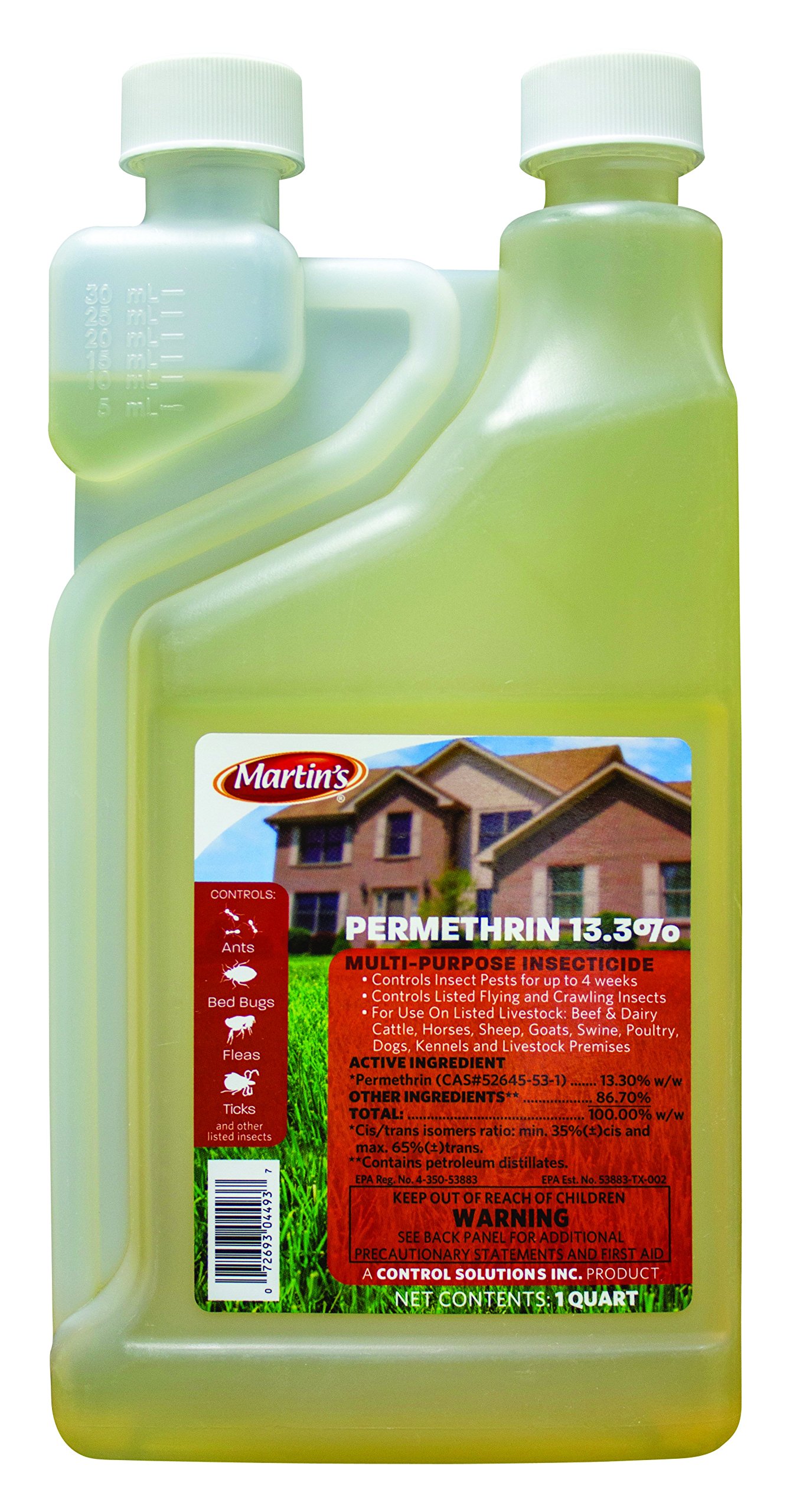
Martin’s Permethrin 13.3% is a synthetic pyrethroid concentrate engineered for long residual activity — up to 4 weeks on treated surfaces. This makes it an excellent choice for preventive perimeter spraying on evergreens and ornamentals where bagworms have been a recurring problem. The 32-ounce bottle dilutes at 1.5 ounces per gallon for general pest control, yielding a massive volume of finished spray.
For bagworms specifically, the extended residual means you can time a single application to coincide with egg hatch and trust the barrier to remain active through the entire larval emergence window. The product works indoors and outdoors.
The synthetic permethrin smell is strong — users describe it as paint thinner or industrial chemicals — and it lingers for hours after application. While Martin’s is considered low-toxicity for mammals compared to older pyrethroids, it remains highly toxic to bees and aquatic life. Avoid spraying near open water or flowering plants, and never apply under windy conditions that could cause drift into non-target areas.
What works
- Up to 4 weeks of residual control
- High concentration — excellent value per gallon
- Effective on ticks, mosquitoes, and bagworms
What doesn’t
- Strong chemical odor during and after spraying
- Highly toxic to bees and aquatic life
Hardware & Specs Guide
Bacillus thuringiensis (B.t.)
This microbial insecticide produces a protein that crystallizes in the alkaline gut of bagworm larvae, causing paralysis and death within 1 to 3 days. B.t. is strain-specific — the kurstaki strain targets leaf-feeding caterpillars without affecting beetle larvae, earthworms, or beneficial insects. It degrades in UV light within 3 to 5 days, so apply in the evening and reapply after heavy rain.
Spinosad
A fermentation-derived compound from the soil bacterium Saccharopolyspora spinosa. Spinosad causes hyperexcitation of the insect nervous system through nicotinic acetylcholine receptor activation. It provides contact and ingestion activity against bagworms, with a half-life on foliage of roughly 2 to 3 days. OMRI-listed formulations allow use in certified organic operations.
Systemics (Acephate & Imidacloprid)
Systemic insecticides are absorbed by plant roots or foliage and translocated throughout the vascular system. Acephate, the active ingredient in Bonide Systemic, converts to methamidophos inside the plant, providing weeks of protection against chewing insects like bagworms. These products are most effective when applied in early spring before bagworms reach the fourth instar stage.
Residual Activity
The length of time a pesticide remains lethal after application. Permethrin-based products like Martin’s offer the longest residual — up to 4 weeks on protected surfaces. Malathion and Spinosad have shorter residuals of 5 to 10 days, requiring weekly reapplication during bagworm hatch periods. Rainfastness (how soon after application the product withstands rain) varies from 1 hour (BioAdvanced) to 24 hours for most concentrates.
FAQ
When should I spray for bagworms to get the best results?
Can I use the same pesticide on bagworms and other garden pests?
Will rain wash away my bagworm spray application?
Final Thoughts: The Verdict
For most gardeners, the pesticide for bagworms winner is the Ferti-lome Spinosad Insecticide because it combines OMRI-listed organic status, direct bagworm labeling, and effective knockdown of early-to-mid stage larvae in an affordable concentrate format. If you want a targeted microbial option safe for pollinators, grab the Monterey B.t.. And for heavy, recurring infestations that demand systemic penetration through dense arborvitae canopies, nothing beats the Bonide Systemic Insect Control.