
Houseplants shouldn’t need a daily caretaker. The difference between a thriving indoor jungle and a sad collection of brown tips often comes down to consistent moisture—something a busy schedule rarely provides. An automated watering system delivers water directly to the root zone on a reliable schedule, eliminating the guesswork and the guilt.
I’m Rikta — the co-founder and writer behind Lawn Gear Lab.
Whether you travel weekly, work long hours, or just want healthier plants with less effort, finding the right best indoor plant watering system means matching the delivery method to your specific pot sizes and plant thirst levels.
How To Choose The Best Indoor Plant Watering System
The ideal system depends entirely on your plant count, pot sizes, and how long you’ll be away. A single fiddle-leaf fig needs different hardware than a shelf of twenty succulents. Here are the critical specs to evaluate before buying.
Delivery Method: Wick vs. Drip vs. Spike
Wick-based systems (like self-watering pots) use capillary action to draw water from a reservoir into the soil. These are passive, silent, and ideal for low-maintenance setups. Drip irrigation uses a pump and timer to push water through tubing to individual drippers—better for larger collections or plants with varying needs. Terracotta spikes rely on porosity; water seeps through the unglazed clay into the surrounding soil at a rate determined by the soil’s dryness.
Reservoir Capacity and Refill Interval
A small 1-liter reservoir might keep a single pothos happy for 4-5 days. A 13-gallon tank can sustain multiple pots for weeks. Match capacity to your typical absence: weekend trips need only a few days of buffer, but a two-week vacation demands a larger tank or a gravity-fed system that doesn’t depend on electricity.
Pump Reliability and Anti-Siphon Protection
Electric pumps introduce the risk of siphon effect—water continuing to flow after the pump stops, which floods pots. Quality systems include anti-backflow valves or require the water source to be below the plants. Check whether the pump has a low-water auto-shutoff to prevent running dry, which can burn out the motor in a few hours.
Quick Comparison
On smaller screens, swipe sideways to see the full table.
| Model | Category | Best For | Key Spec | Amazon |
|---|---|---|---|---|
| Moistenland 15-Pot Kit | Drip Timer | Medium indoor collections | 33-ft hose, digital programmable timer | Amazon |
| LetPot LP-D3-GN | Smart Drip | Wi-Fi/app-controlled watering | 10m hose, IPX66, silent pump | Amazon |
| Spider Farmer 13-Gallon Drip Kit | Pump+Drip | Grow tents & large collections | 25W pump, 12 L/min, 13-gal bucket | Amazon |
| Spider Farmer Gravity-Fed 4-Pack | Gravity Wick | No-power, long-term watering | 13-gal reservoir, 100-lb capacity | Amazon |
| MNKXL 4-Pack Self-Watering Pots | Wick Pot | Single-plant reservoirs | 12/10/9/8-in pots, water window | Amazon |
| Soilagua Terracotta Spikes 6-Pack | Clay Spike | Vacation backup for individual pots | 7.1-in spike, wine-bottle compatible | Amazon |
| Cozy Chrysalis Terracotta Ollas 4-Pack | Clay Olla | Small indoor pots & decorative use | 15-oz capacity, glazed top, 6-in height | Amazon |
In‑Depth Reviews
1. Moistenland 15-Pot Automatic Watering System
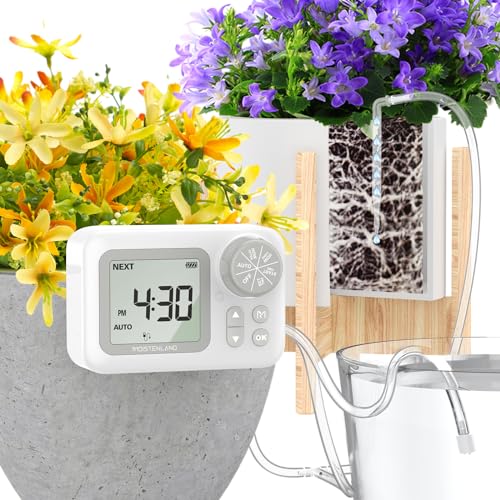
This kit hits the sweet spot for a mid-sized indoor collection, supporting up to 15 plants with a single 33-foot hose and a programmable digital timer. The timer runs on 4 AA batteries or USB-C, making placement flexible—you can set it up on a kitchen counter or a living room shelf without worrying about a nearby outlet. The internal clock lets you schedule exact start times, which matters for plants that prefer morning hydration.
Owner reports confirm the pump delivers consistent pressure across all 15 drippers, though the instruction manual’s siphon-effect warning is critical: the water source must sit lower than every plant to prevent continuous leaking. Several users noted the intuitive knob-and-LCD interface required no app pairing, which simplifies setup for anyone who dislikes smartphone dependency. The kit includes enough T-connectors and spare tubing to customize layouts for odd-shaped pot groupings.
The main trade-off is the lack of anti-siphon hardware built into the pump. If you cannot position the water bucket below all pots, you may experience gravity-fed drips. Owners who followed the placement rule report three-week vacations with zero issues. For the price, this is the most versatile all-in-one drip system for average households.
What works
- Digital timer with precise scheduling and battery backup
- 33-foot hose reaches pots across large rooms
- USB-C and battery dual power options
What doesn’t
- No anti-siphon valve; water source must be below plants
- LCD screen segments prone to fading over time
- Dripper flow rates not individually adjustable on the line
2. LetPot Automatic Watering System (LP-D3-GN)

LetPot brings full Wi-Fi control into the indoor watering space with a dedicated app that supports up to five simultaneous watering schedules. The pump is German-imported and rated IPX66, meaning it can sit on a damp balcony or near a sink without concern. The upgraded 2.0 chip provides faster connectivity, and the anti-backflow valve addresses the siphon issue that plagues simpler systems. Eighteen months of owner feedback show the pump remains whisper-quiet compared to typical submersible units.
The 10-meter PE hose fits 10-20 pots, and the adjustable drippers let you dial flow from a slow trickle to a steady stream. The app includes a plant diary and low-water alerts, which are genuinely useful for tracking which plants need more or less over time. One reviewer ran nutrients through a 24-hour continuous drip cycle without clogging, indicating the pump can handle thicker liquids as well.
Assembly requires warming the hose ends in hot water to ease connector insertion—a minor annoyance that becomes easier on the second setup. The main criticism revolves around customer service response times for warranty claims. If the anti-backflow valve leaks (rare but reported), replacement can take two weeks. Still, for app-driven precision and near-silent operation, this is the premium pick for the connected home.
What works
- Quiet German-imported pump rated IPX66
- App schedules up to 5 watering tasks remotely
- Anti-backflow valve prevents siphon leaks
What doesn’t
- Hose connectors require hot water to install
- Customer service response can lag by days
- App UI for frequency adjustments could be more intuitive
3. Spider Farmer 13-Gallon Auto Drip Irrigation Kit

Spider Farmer builds this system for serious indoor growers—the 25W pump pushes 12 liters per minute through eight adjustable 360° drip emitters, making it suitable for grow tents, greenhouses, or large collections of heavy-drinking plants like monsteras and citrus. The 13-gallon nylon-reinforced PVC bucket drastically reduces refill frequency; typical users report 2-3 weeks between fills even with a dozen thirsty plants. A low-water level sensor automatically stops the pump to prevent dry running.
The emitter kit is the weak link: the included tubing is short and uses small-diameter barb fittings. Several owners replaced the drip lines with their own 1/4-inch tubing for better flow distribution. The pump is strong enough to supply 8 emitters simultaneously, but pushing beyond 12 emitters requires a splitter or booster. The check valve works well to prevent siphoning, a crucial feature that many budget kits skip.
Setup is straightforward—connect the pump to the bucket, run the main 8mm line, and branch off with the 4/6mm tubing. The lack of a built-in timer means you’ll need an external outlet timer or the button control panel, which has no scheduling memory. For those already using grow-tent timers, this integration is seamless. The pump is the standout component: durable, replaceable, and powerful enough for serious irrigation tasks.
What works
- Powerful 25W pump with 12 L/min flow rate
- 13-gallon reservoir reduces refill frequency dramatically
- Low-water auto-shutoff protects the pump
What doesn’t
- Emitter tubing is short and uses fragile barb fittings
- No internal timer; requires external controller for scheduling
- Some pumps arrive defective—quality control inconsistency
4. Spider Farmer Gravity-Fed Self-Watering System (4-Pack)
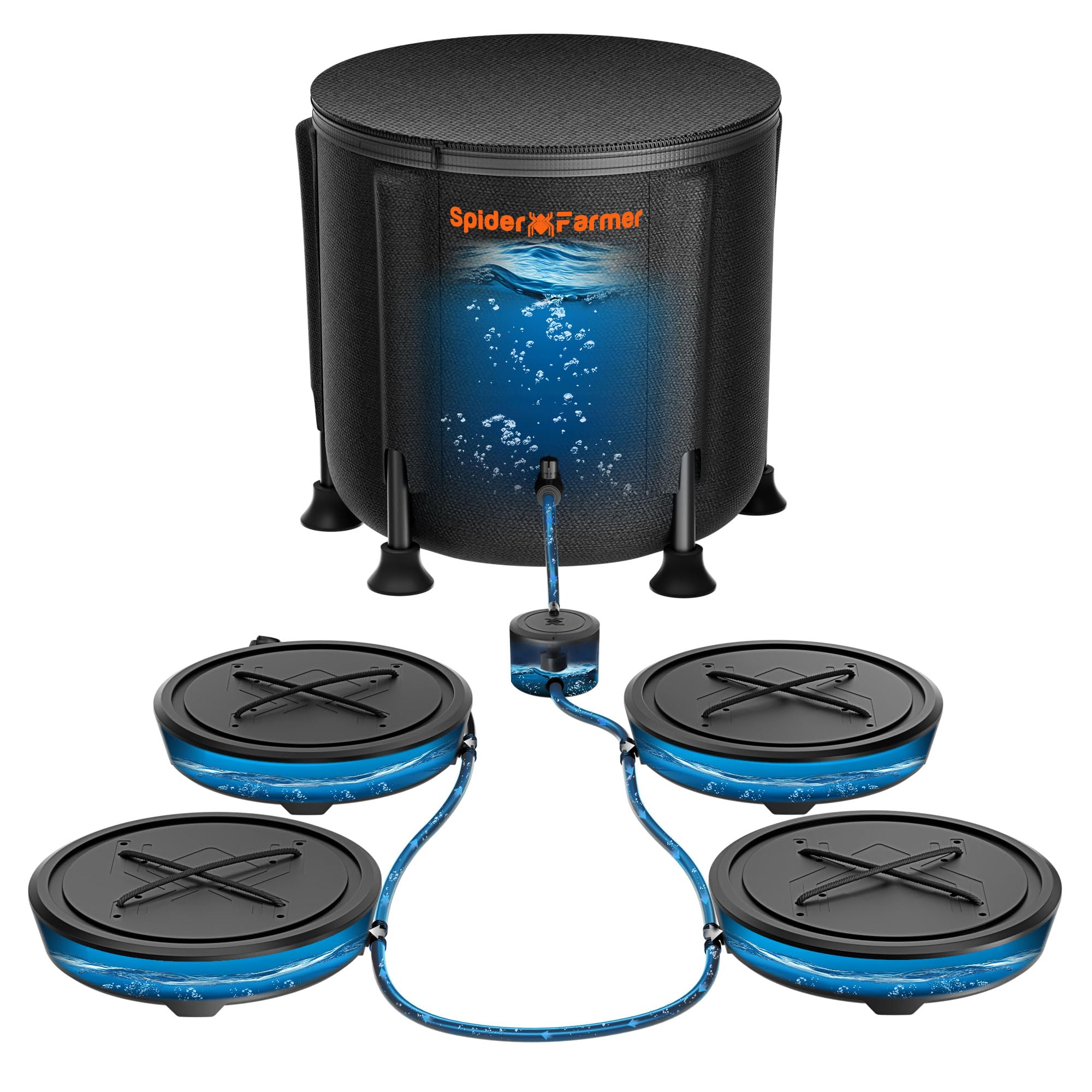
This system eliminates electricity entirely: gravity drives water from a 13-gallon reservoir through wick lines into four fabric-pot bases. Ideal for grow tents, bedrooms, or offices where pump noise or cord management is an issue. The design supports up to 100 pounds per base, meaning you can run full-sized 5-gallon fabric pots with heavy soil loads. Users report 3-4 weeks between refills, making it the strongest candidate for extended absences.
The upgraded outlet sits 4 cm lower than the previous version, reducing residual water in the tank to just 5 liters—a meaningful improvement for water utilization. The shut-off valve box lets you isolate individual bases for maintenance. Wicks deliver water based purely on soil dryness, preventing the overwatering common with timer-based drip systems. Roots develop strongly because they chase the moisture gradient, mimicking natural soil conditions.
Assembly requires running the water tubes from the reservoir to each base and placing the wick lines correctly through the fabric pot bottoms. A few owners reported missing parts (a grommet for the tank top hole), but Spider Farmer’s customer service resolved those quickly. The main limitation is that pot placement is fixed by the tube lengths; you cannot rearrange pots without extending or rerouting tubing. For a zero-power, low-maintenance setup that outperforms many electric systems, this is the ultimate analog solution.
What works
- Zero electricity—completely silent operation
- 13-gallon tank supports 4 weeks between fills
- Wick system prevents overwatering naturally
What doesn’t
- Fixed tube lengths restrict pot placement
- Occasional missing parts reported
- Not expandable beyond 4 bases without additional kits
5. MNKXL 4-Pack Self-Watering Pots (12/10/9/8 Inch)
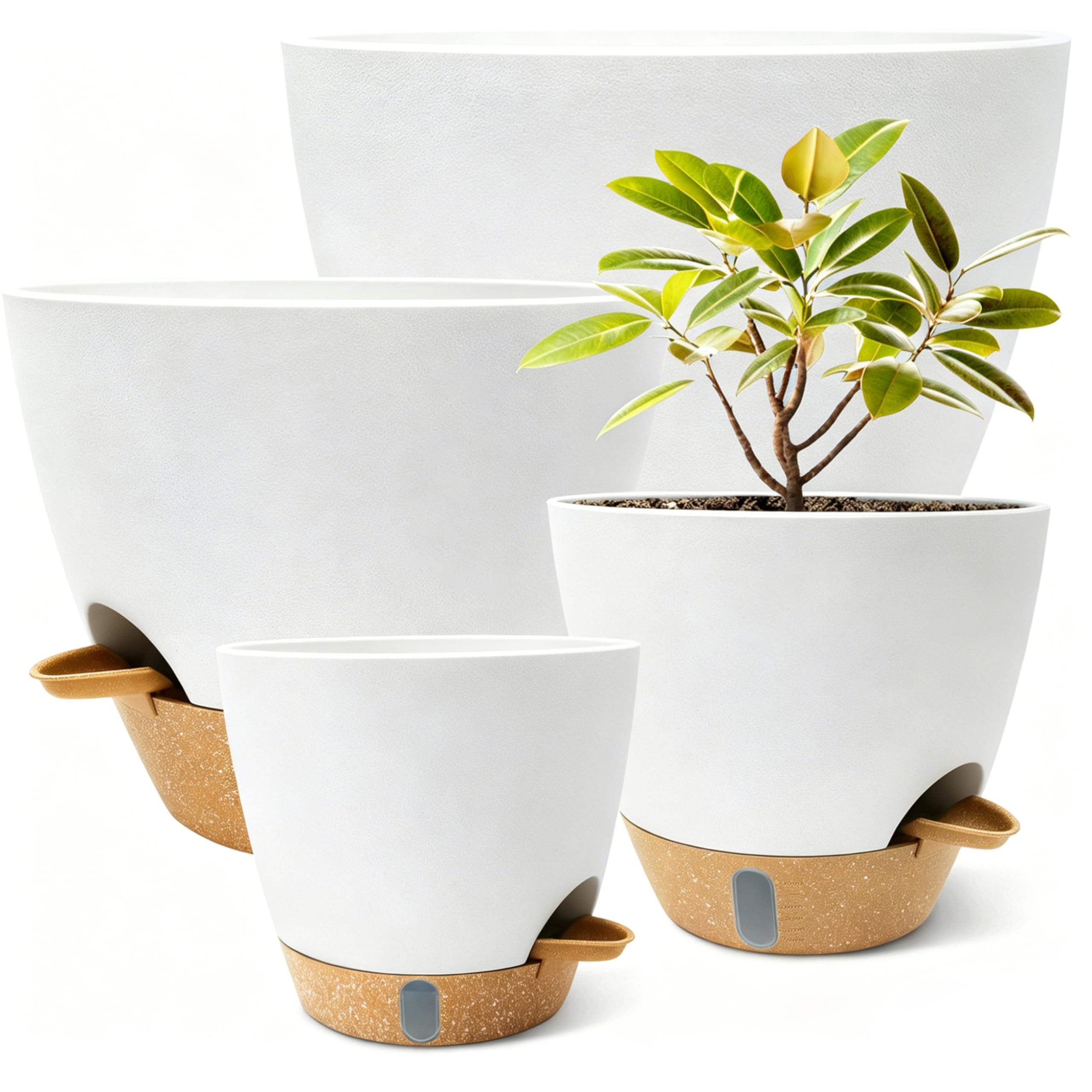
This four-pack covers the most common pot sizes for indoor tropicals and herbs: a 12-inch for floor plants like monstera or fiddle-leaf figs, 10-inch for medium shrubs, 9-inch for kitchen herbs, and 8-inch for succulents or desktop plants. Each pot uses a cotton wick to draw water from a bottom reservoir into the soil. The transparent water level window on each pot eliminates the guessing game—just glance to see if refill is needed.
The polypropylene construction is lightweight but sturdy, and the integrated saucer prevents spills. Owners consistently praise the clean, minimal white finish that fits modern decor. The wick system provides 2-3 weeks of steady moisture, depending on plant thirst and room temperature. For beginners, this is the most forgiving entry point: fill the reservoir, insert the wick into the soil, and the plant self-regulates.
There are a few quirks. The 8-inch pot’s reservoir is relatively small, requiring more frequent refills during summer. The cotton wick can degrade over time if the water contains high dissolved solids, though replacement is simple. Also, the pots lack drainage holes in the traditional sense—the reservoir catches excess, but heavy overfilling can lead to stagnant water if the wick channel gets blocked. Despite these minor trade-offs, the set offers unmatched value per pot and consistent results for everyday indoor plants.
What works
- Four useful sizes in one affordable set
- Visible water window for quick refill checks
- Wick system maintains consistent moisture for weeks
What doesn’t
- Small 8-inch pot reservoir needs more frequent top-ups
- Cotton wicks may require replacement over months
- No traditional drainage—potential for stagnant water if overfilled
6. Soilagua Large Terracotta Watering Spikes with Lids (6-Pack)
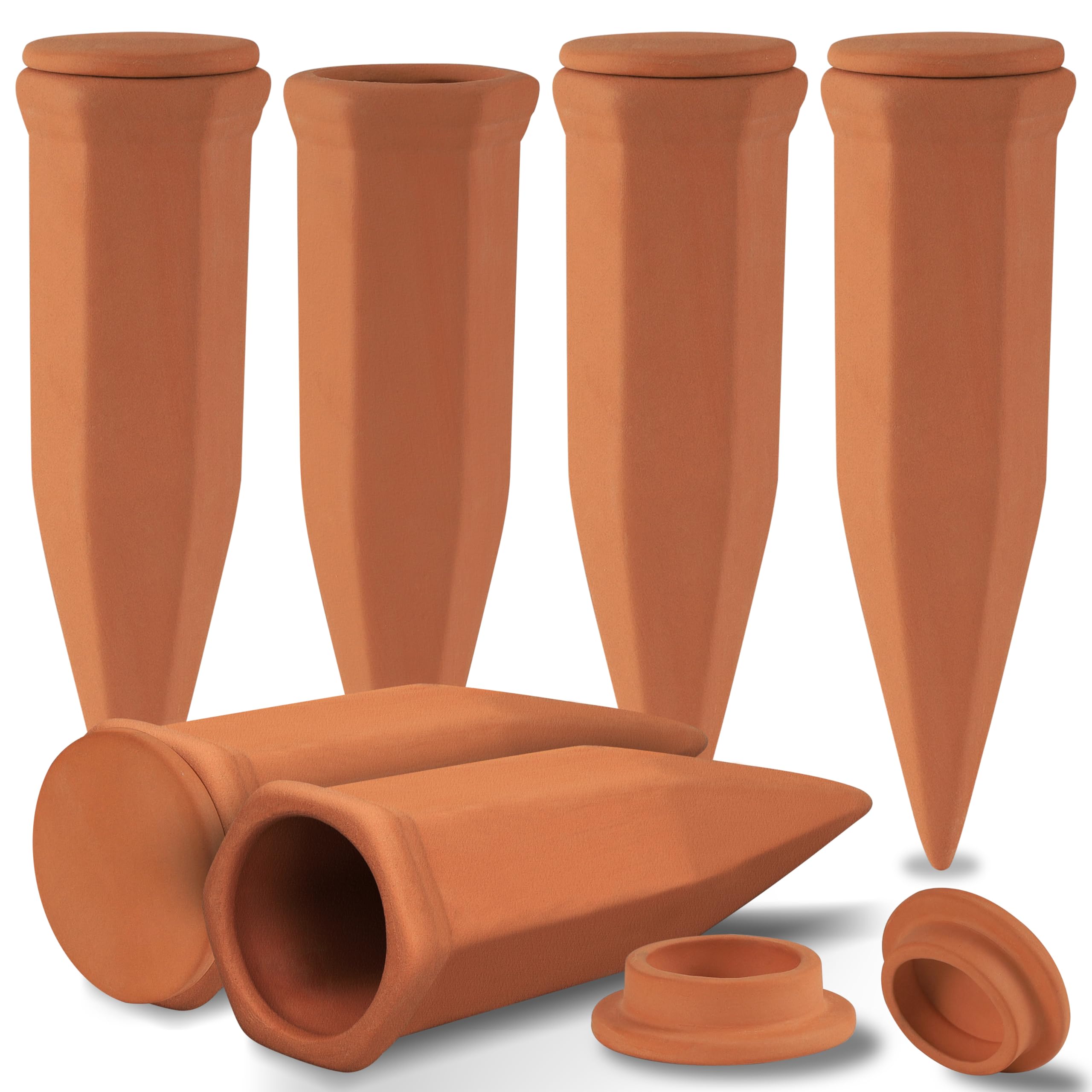
For a simple, chemical-free solution, these 7.1-inch terracotta spikes screw onto standard wine or plastic bottles to create a slow-release drip. The high-fire pottery clay is porous enough to allow water to seep through steadily but not so porous that it empties overnight. Pre-soaking the spikes for 15-30 minutes before first use primes the clay for optimal flow. Once installed, the included lid prevents evaporation and keeps debris out.
Owner feedback from hot climates (Central Florida, Arizona) confirms that a 1-liter bottle lasts 2-3 days for thirsty outdoor plants, while indoor pots with moderate light stretch that to 4-5 days. The design takes water directly to the root zone rather than wetting the soil surface, which reduces evaporation losses by up to 70% compared to top watering. The set of six covers a modest collection without needing any tubing, pumps, or electricity.
The main vulnerability is the clay itself: it can crack if dropped or frozen. Packaging complaints appear in reviews, with some spikes arriving with chipped tops. Terracotta also requires occasional cleaning—mineral deposits can clog the pores after several months of use, reducing flow. Still, for under , this kit is the most cost-effective way to keep six individual pots hydrated during a work trip or short vacation.
What works
- No electricity, batteries, or moving parts
- Accepts standard wine or plastic bottles
- Slow-release delivery reduces evaporation losses
What doesn’t
- Clay spikes are fragile and may break in shipping
- Pores can clog from mineral deposits over time
- Limited to one bottle per spike—not scalable for many pots
7. Cozy Chrysalis Terracotta Self-Watering Planter Insert (4-Pack)
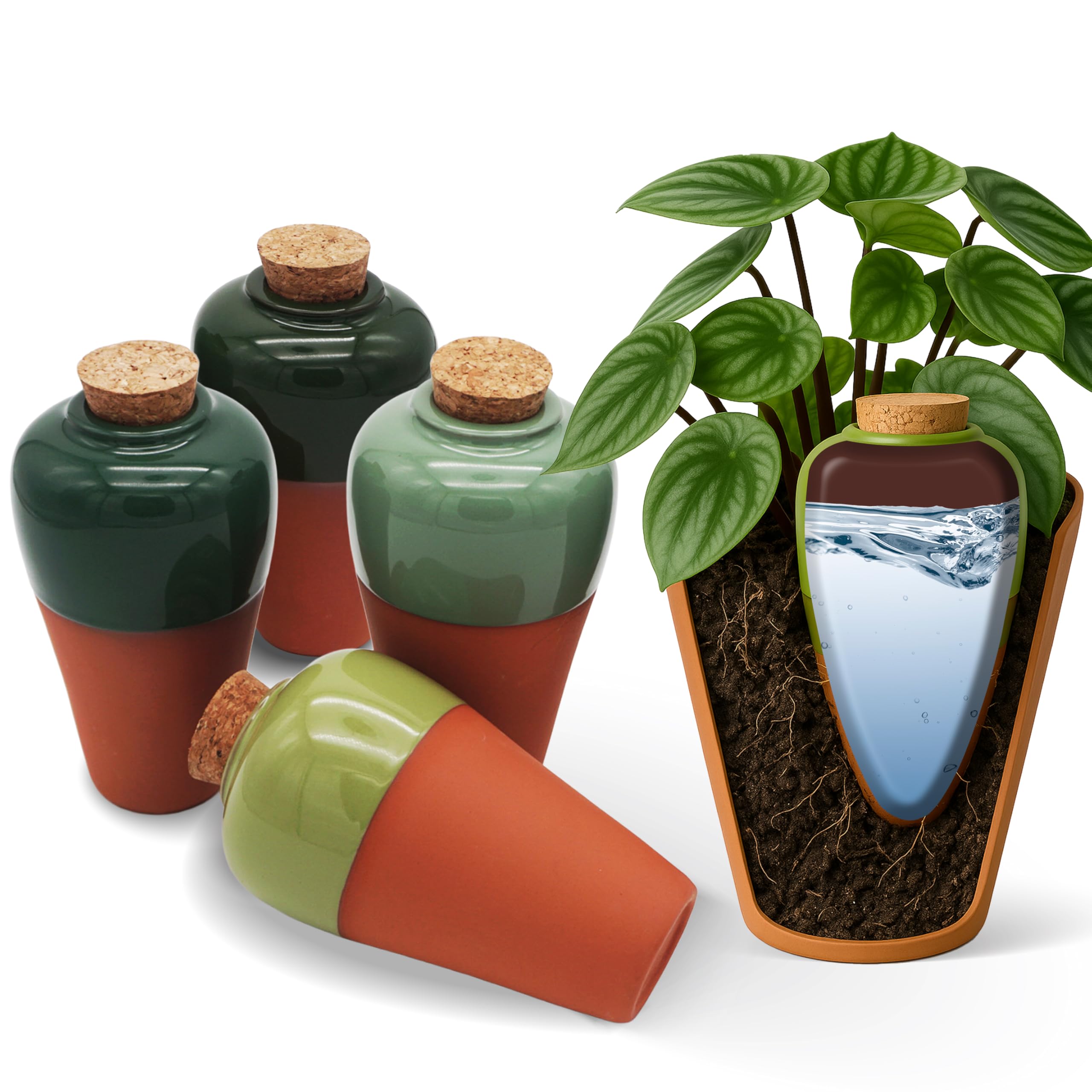
These ollas take the traditional terracotta spike concept and refine it with a slim, tapered base that slides into soil without disturbing root systems. Each olla holds 15 ounces of water and features a glazed top in soft earth tones (sage, olive, forest green) that blends visually with foliage rather than clashing. The glaze seals the top so evaporation only happens through the unglazed body, maximizing water delivery to the roots.
Customers report dramatic results: one reviewer revived a near-dead plant that produced new leaves and blooms within weeks after inserting an olla. The 4-pack covers a small collection or multiple spots in a single large container. Each olla lasts 7-10 days per fill for average houseplants, making it suitable for a long weekend or a work week away. The cork stopper seals neatly and prevents mosquito breeding in the reservoir.
The downside is capacity: 15 ounces is modest, so very thirsty plants like large ferns or calatheas may need refills every 3-4 days. The narrow base also means the ollas can tip over in loose, dry soil if not pressed in firmly. Like all terracotta systems, the porous body will accumulate salts and minerals over time, requiring periodic scrubbing. But for small indoor pots where aesthetics matter, these ollas are the most attractive passive solution available at this price.
What works
- Slim design inserts without damaging roots
- Glazed top and earth-tone colors look decorative
- Lead-free, Prop 65 compliant materials
What doesn’t
- 15-oz capacity requires frequent refills for thirsty plants
- May tip in very loose or dry potting mix
- Clay pores need periodic cleaning from mineral buildup
Hardware & Specs Guide
Pump Flow Rate vs. Emitter Count
A pump rated 12 L/min (like the Spider Farmer’s 25W unit) can supply 8-12 emitters simultaneously. If you need more, you must either split the output with a manifold or upgrade to a higher-GPH pump. The Moistenland and LetPot pumps are lower flow but sufficient for 10-15 pots with gentle drippers. Matching flow rate to emitter count prevents weak drips at the end of the line.
Anti-Siphon Valves and Placement Rules
Without an anti-siphon valve, water will continue dripping after the pump stops if the source tank sits higher than any plant. The LetPot includes this valve. The Moistenland does not—you must place the water source below all plants. The Spider Farmer gravity system bypasses this entirely because it has no pump and relies on gravity with a shut-off valve.
FAQ
Can I use a gravity-fed system for plants that prefer dry soil?
How often should I clean terracotta watering spikes?
Will a drip irrigation system work for a small 3-plant desk setup?
Final Thoughts: The Verdict
For most gardeners, the best indoor plant watering system winner is the Moistenland 15-Pot Kit because it balances digital scheduling, adequate reach, and easy customization for a typical home plant collection. If you want Wi-Fi control and whisper-quiet operation, grab the LetPot LP-D3-GN. And for a zero-electricity, massive-capacity setup that works for weeks without intervention, nothing beats the Spider Farmer Gravity-Fed 4-Pack.