
The fear of kickback and the complexity of mixing gas and oil stop many beginners from ever making the first cut. The right chainsaw erases that anxiety with instant starts, automatic maintenance, and a forgiving power band that keeps you in control.
I’m Rikta — the co-founder and writer behind Lawn Gear Lab. I’ve spent hundreds of hours cross-referencing displacement figures, chain pitch specs, motor watt ratings, and automatic oiler flow rates for small-engine and battery-powered cutting tools, and matching that data against verified owner experiences so new operators don’t get burned by a bad first saw.
This guide isolates the easiest-to-manage models that balance cutting capability with lightweight maneuverability and critical safety features. Finding the right chainsaw for beginners means prioritizing a saw that starts reliably, stops immediately, and stays sharp without constant tinkering.
How To Choose The Best Chainsaw For Beginners
First-time chainsaw buyers often fall for the cheapest gas model they find, only to realize they hate mixing fuel, wrestling a starter cord, or keeping a temperamental carburetor running. The right choice depends on matching power source, bar length, and safety features to the actual work you plan to do.
Electric vs. Gas: The Real Trade-Off for New Users
A cordless electric chainsaw removes the two biggest beginner headaches: engine starting and fuel mixing. Brushless motor models deliver instant torque with a trigger squeeze and require zero pull-start effort. The trade-off is runtime — a 4.0Ah battery pair handles about 60 to 120 cuts on 4×4 lumber before needing a recharge. Gas saws offer unlimited runtime on a tank, but the 25:1 or 50:1 fuel mix, carburetor tuning, and pull-start technique create a learning curve that turns off many first-time owners.
Bar Length and Cutting Capacity
A 12-inch bar is the sweet spot for a beginner. It gives you enough reach to limb branches up to 10 inches thick while keeping the saw light enough to control with two hands. A 16-inch bar adds reach but increases kickback leverage, making it harder for a novice to maintain proper cutting posture. If you are only pruning and felling trees under 12 inches in diameter, stay at 12 or 14 inches.
Safety Features You Cannot Skip
An inertia-activated chain brake is the single most important safety component on a beginner saw. It stops the chain in under 0.1 seconds if kickback throws the bar upward. A lock-off trigger prevents accidental startups, and a low-kickback chain reduces the severity of rebound when the nose of the bar contacts wood. Every saw on this list includes at least two of these three protections.
Automatic Oiling and Tool-Free Tensioning
Manual chain oiling and wrench-based tension adjustments are friction points that beginners hate. Automatic oilers keep the bar and chain lubricated during use, extending chain life and reducing cut friction. External, tool-free tension knobs let you tighten a loose chain in seconds without carrying a socket or screwdriver into the yard. Prioritize both features unless you enjoy stopping every 15 minutes to fiddle with a screw.
Quick Comparison
On smaller screens, swipe sideways to see the full table.
| Model | Category | Best For | Key Spec | Amazon |
|---|---|---|---|---|
| Husqvarna 120 Mark III | Gas | Reliable long-term ownership | 38cc X-Torq, 1.88 HP | Amazon |
| DongCheng 40V 16-Inch | Electric | Heavy cordless cutting power | 16″ bar, 120 cuts per charge | Amazon |
| SEESII 12-Inch Cordless | Electric | Mid-size battery convenience | 1200W brushless, 12″ bar | Amazon |
| SEESII 8-Inch Mini | Electric | Ultra-light pruning | 1000W brushless, 8″ bar | Amazon |
| NEO-TEC 25.4cc Gas | Gas | Lightweight gas performance | 1.2 HP, 8.2 lbs, 12″ bar | Amazon |
| WTHW 25.4cc Top Handle | Gas | Balance-focused arborist style | 1.2 HP, 8.3 lbs, auto oiler | Amazon |
| JPNTECH 25.4cc Gas | Gas | Budget gas introduction | 1.2 HP, 8.6 lbs, 12″ bar | Amazon |
In‑Depth Reviews
1. Husqvarna 120 Mark III Gas Chainsaw

Husqvarna’s 120 Mark III is the saw every beginner should graduate to after their first weekend of cutting. The separate choke and stop-switch controls prevent the accidental flooding that plagues single-lever carburetors, and the stop switch automatically resets when you pull out the choke, removing the guesswork from cold starts.
LowVib technology places dampeners between the engine block and the chassis, cutting vibration transmission to the handles so your hands stay less fatigued during a full afternoon of limbing and bucking. The inertia-activated chain brake stops the chain instantly if kickback throws the bar up, and the 14-inch bar gives enough reach for storm cleanup and firewood processing without the leverage penalty of a 16-inch bar. Owners consistently report first-pull starts even after months of storage.
The automatic oiler keeps the bar and chain lubricated while you cut, and the 10.7-pound dry weight is manageable for a new operator who is still building arm endurance. Some users note that the saw can stall when tilted parallel to the ground on a near-empty tank — a minor quirk that does not affect normal operation. For beginners who want a gas saw that runs as dependably as a cordless tool, this is the benchmark.
What works
- Reliable first-pull starting prevents beginner frustration
- LowVib vibration dampening reduces arm fatigue during long cuts
- Inertia chain brake and lock-off trigger provide solid safety layering
What doesn’t
- Can stall on low fuel when saw is tilted for flush cuts
- Heavier than comparable battery models at 10.7 pounds
2. DongCheng 40V 16-Inch Brushless Cordless Chainsaw
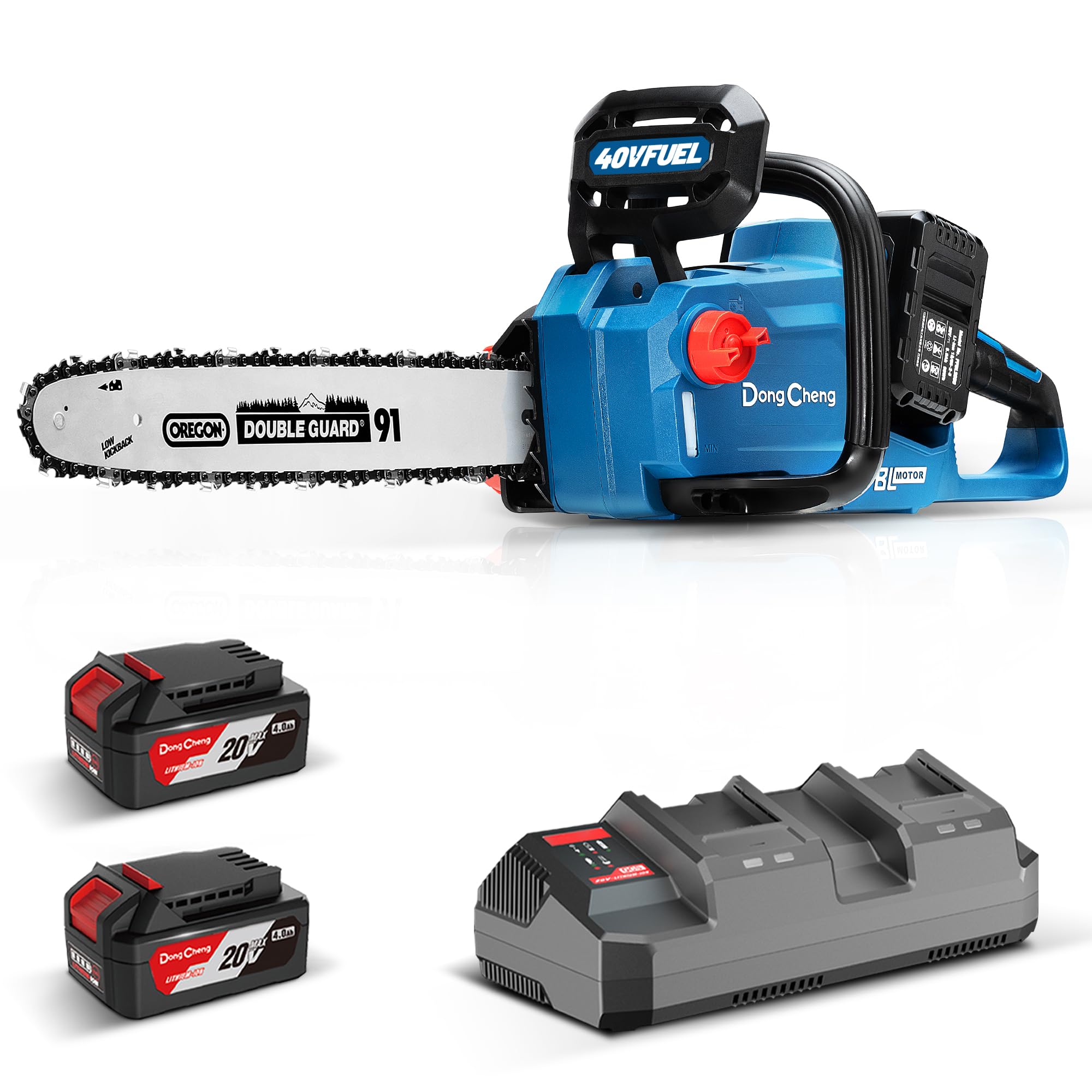
DongCheng packs some serious reach into this cordless package. The 16-inch bar is the longest on this list, and the dual 20V batteries wired in series for 40V total push a high-torque brushless motor that handles felling, bucking, and storm cleanup with authority. The manufacturer rates it for up to 120 cuts on 4×4 lumber per charge cycle — enough output for a full morning of firewood prep without swapping packs.
The tool-free chain tensioning knob and automatic oiling system reduce field maintenance to zero frustration. Simply twist the knob to snug a loose chain, and the auto oiler meters bar lubricant proportionally to the cutting load. The inertia chain brake engages in under 0.1 seconds on kickback, and the lock-out switch prevents accidental startups. Owners report that the included 4.0Ah batteries charge from empty to full in under 20 minutes, which means a quick lunch break tops you off for round two.
One caveat for the first-time user: a 16-inch bar increases the leverage and severity of potential kickback. Beginners must maintain two-handed grip discipline and avoid cutting with the bar tip. A small batch of owners reported a faulty oiler on the first unit, though the replacement ran perfectly. If you want cordless convenience with near-gas cutting capacity, this saw delivers that reach without the fuel fuss.
What works
- 16-inch bar offers gas-like reach in a cordless package
- Tool-free chain tension and auto oiler eliminate maintenance headaches
- Fast 20-minute full charge on each battery reduces downtime
What doesn’t
- Longer bar increases kickback risk for inexperienced users
- Random oiler fault reported in a small number of units
3. SEESII Electric Chainsaw Cordless 12-Inch
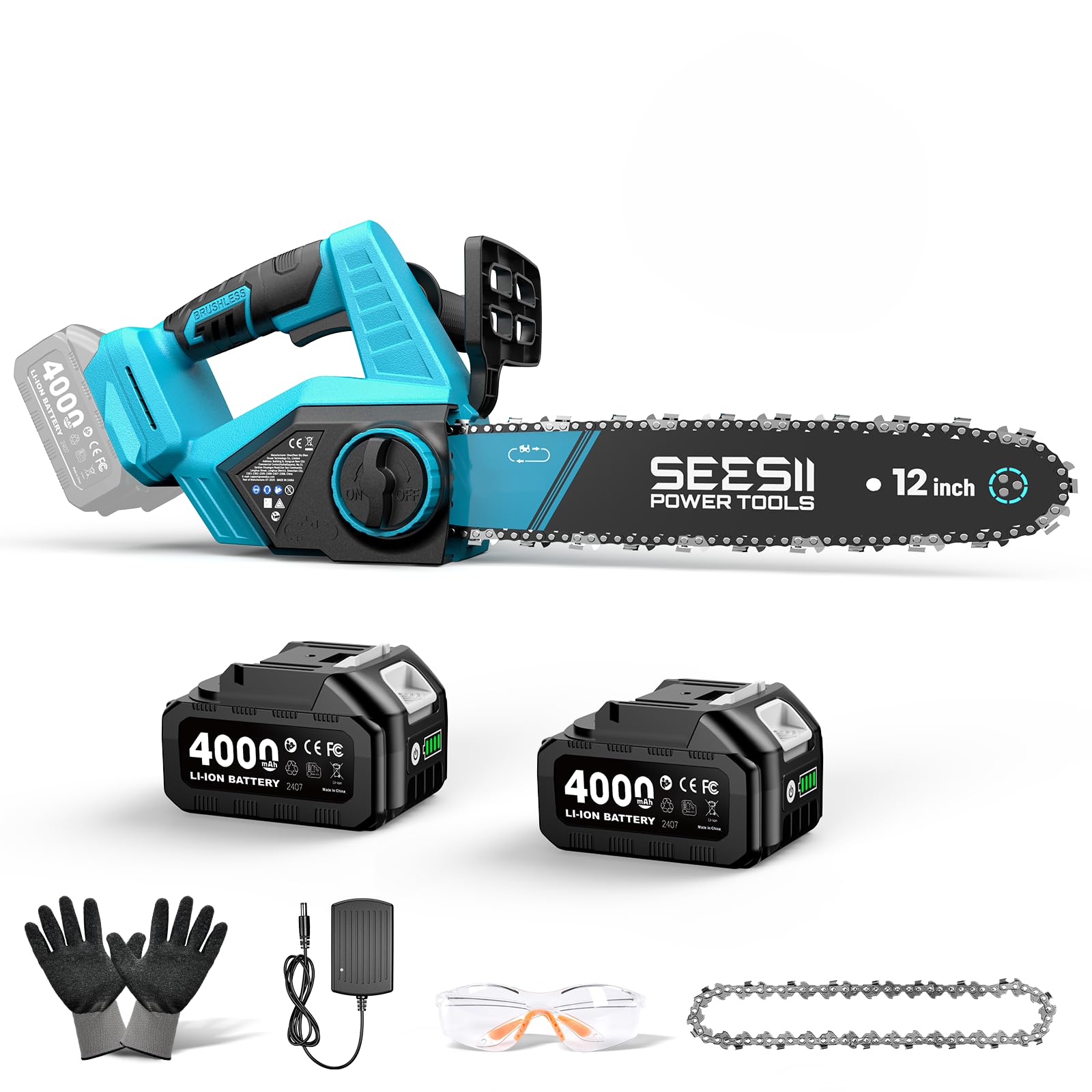
SEESII’s 12-inch cordless saw sits in the middle of the bar-length spectrum and hits the sweet spot for new operators who want enough reach to handle 8- to 10-inch logs without the weight of a full-size electric saw. The 1200W brushless motor delivers chain speeds fast enough to make clean cuts through seasoned oak and maple without bogging down, and the two included 4.0Ah batteries keep you cutting longer than the typical single-pack competitors.
The built-in battery indicator on each pack prevents the sudden-stop scenario that catches beginners off guard — you see the charge level before you start the cut. The auto-oiling system adjusts flow based on chain speed, so you are not over-oiling on light pruning or starving the bar on heavy bucking. The tool-free chain tensioner uses an external knob that any user can adjust without hunting for a wrench.
Owners consistently call it an excellent value, noting that the cutting power rivals gas models in the same displacement class while producing zero fumes and minimal noise. The primary complaint centers on the trigger safety being designed for right-handed users — left-handed operators will find the thumb-reach awkward. For a right-handed beginner who wants instant-start convenience with enough battery stamina to clear a suburban yard, this is the most balanced cordless option on the list.
What works
- 1200W brushless motor cuts hardwoods without stalling
- Twin 4.0Ah batteries with indicator lights prevent runtime surprises
- Speed-matched auto oiler reduces chain wear during heavy cuts
What doesn’t
- Trigger safety is not ambidextrous — awkward for left-handed users
- Chain can loosen during extended use; requires occasional retensioning
4. SEESII Flagship 8-Inch Cordless Mini Chainsaw
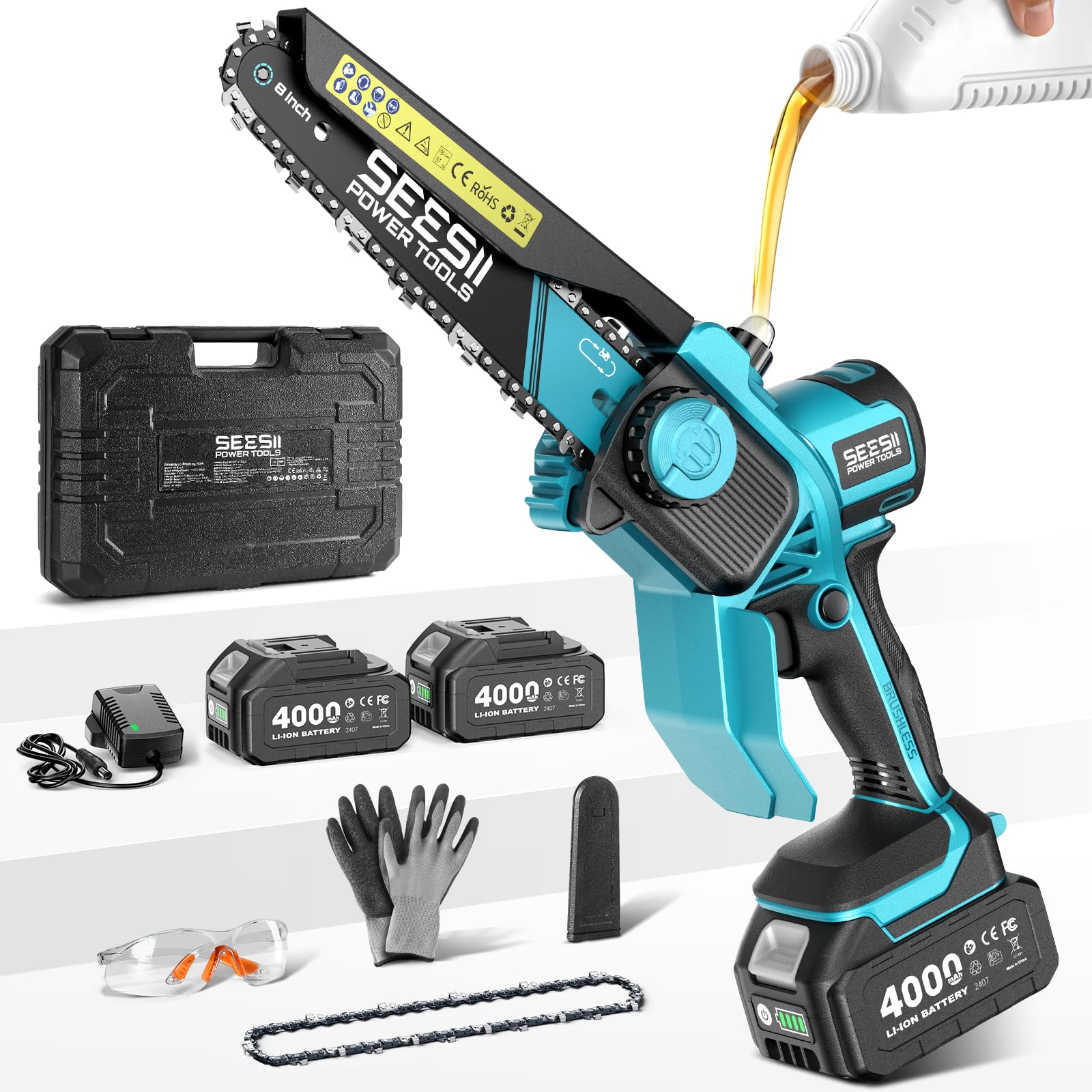
The 8-inch mini form factor is the polar opposite of intimidating. SEESII’s flagship mini weighs barely enough to fatigue your forearm after an hour of continuous use, and the 1000W brushless motor spins the chain at 10 meters per second — fast enough to cleanly slice a 6-inch branch in under 8 seconds. The kit includes two 4000mAh batteries that sustain over 150 cuts per charge pair, which is more than enough for weekend pruning marathons.
Tool-free chain tensioning and an automatic oiler come standard on a saw that costs less than many basic trimmers. The semi-transparent oil reservoir lets you see the level at a glance, and the advanced sealing technology minimizes the bar oil drips that stain concrete driveways. The kit also includes a spare chain, gloves, and safety glasses — everything a first-timer needs to start cutting immediately.
Reviewers note that the chain does loosen during use and requires periodic tightening, which is common on lightweight consumer saws. The safety lockout is positioned on the left side of the handle, making it a right-hand-only tool for comfortable operation. For the beginner whose biggest job is trimming overgrown branches and clearing storm debris under 6 inches thick, this mini eliminates the weight, noise, and complexity that scare off new users entirely.
What works
- Ultra-lightweight design reduces arm fatigue for seniors and smaller users
- Two 4000mAh batteries deliver 150+ cuts per pair
- Includes spare chain, gloves, and safety glasses out of the box
What doesn’t
- Chain loosens with use and requires frequent retensioning
- Right-hand-only safety layout excludes left-handed operators
5. NEO-TEC 12 Inch Top Handle Gas Chainsaw

NEO-TEC’s 25.4cc gas saw combines a top-handle, climbing-friendly form factor with genuine cutting torque at only 8.2 pounds. The 1.2 HP two-stroke engine peaks at 12,000 RPM, making it the fastest-spinning saw in this lineup. The spring-assisted starting system is designed for one-pull ignition, and the wrap-around handle uses rubber dampeners to reduce vibration transmission — you can feel the difference after 30 minutes of continuous pruning.
The 12-inch bar and 0.050-inch gauge chain handle limbing and small tree felling with noticeable aggression. Owners who have cut through 3 acres of mixed hardwoods report that the saw holds up well, with the chain brake functioning reliably and the lightweight chassis making one-handed cuts feasible in tight branch crotches. The precision carburetor is tuned for fuel efficiency, and the 25:1 mix ratio delivers ample lubrication to the piston at high RPM.
Be aware that this saw requires a 25:1 gas-to-oil mix, not the common 50:1 ratio used by many modern saws. Using 50:1 can cause hard starting and no-idle behavior. The air filter cover uses a retaining screw that can break if over-tightened, and replacement parts ship from China. For the beginner who wants gas power without the weight penalty of a full-size rear-handle saw, the NEO-TEC offers impressive portability and cut-speed.
What works
- Only 8.2 pounds with a full bar and chain — easy one-hand control
- 12,000 RPM max speed cuts fast in hardwoods
- Spring-assisted start fires up with one smooth pull
What doesn’t
- Requires 25:1 gas mix — using 50:1 causes starting and idle issues
- Air filter cover screw is fragile; parts ship from China
6. WTHW 25.4CC Top Handle Chainsaw
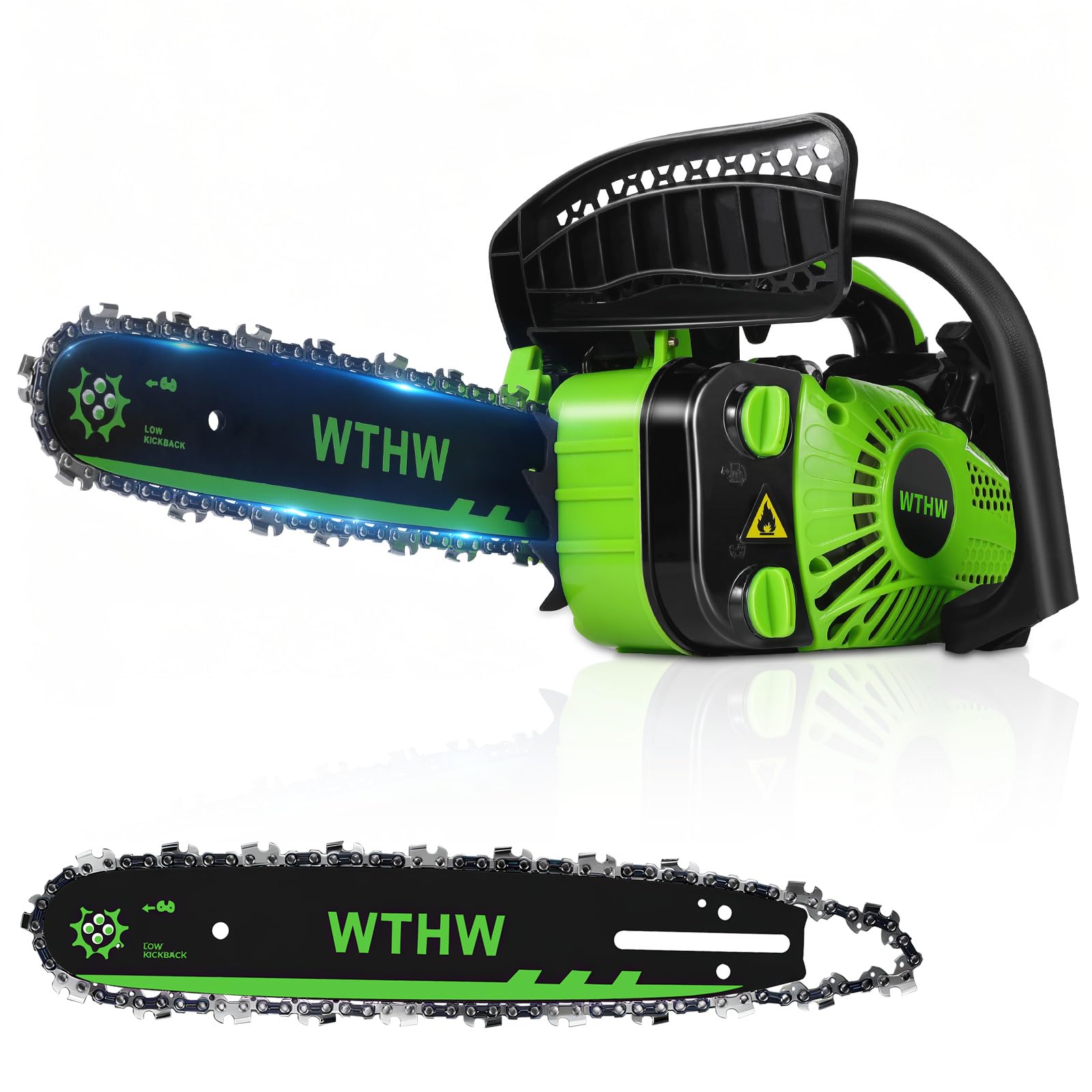
WTHW’s top-handle design centers the engine weight directly over your palm, changing the leverage equation compared to rear-handle saws. At 8.3 pounds, the balance feels neutral whether you are cutting overhead branches while climbing or bucking firewood on the ground. The 25.4cc two-stroke engine delivers 1.2 HP with a maximum chain speed of 9,000 RPM — enough to chew through oak and pine limbs without stalling.
The spring-assisted start system and automatic oiler are the two features that make this saw beginner-friendly despite being gas-powered. The starter cord fires the engine on the first or second pull, and the auto oiler eliminates the manual pumping that interrupts cutting flow on older designs. The dual-trigger throttle lock and rapid-reaction chain brake provide essential safety layers that inspire confidence in a new operator.
Owner feedback is overwhelmingly positive for the price-to-performance ratio, with many noting that it starts easily, runs smoothly, and handles thick branches that a typical cordless mini cannot touch. The included mixing bottle and tool kit mean you have everything to mix fuel and tension the chain on day one. The main limitation is the same as any small gas saw: the carburetor may need a minor idle adjustment after break-in, and you must use fresh fuel mix to avoid ethanol-related issues.
What works
- Balanced top-handle design reduces arm strain in overhead cuts
- Auto oiler and spring-assisted start simplify operation
- Dual-trigger lock and rapid chain brake enhance safety
What doesn’t
- Carburetor may need idle tuning after the break-in period
- Requires fresh 50:1 fuel mix to prevent ethanol-related starting issues
7. JPNTECH 12 Inch Top Handle Gas Chainsaw

JPNTECH’s 25.4cc gas saw is the cheapest method for a beginner to experience true two-stroke cutting power without committing to a premium brand. The 1.2 HP engine spins the 12-inch bar at up to 11,000 RPM, and the spring-assisted pull cord consistently fires the engine within three pulls after assembly. The wrap-around handle and 8.6-pound package make one-handed operation feasible for limbing and trail clearing.
The included installation toolkit and mixing bottle mean the saw is ready to run shortly after unboxing. Owners report that the saw cuts well through hardwoods and small trees, and many note that it has already paid for itself after a day of firewood preparation. The carburetor is pre-set from the factory, though some users had to dial the idle screw down slightly to stop the chain spinning at rest — an easy adjustment covered in the manual.
The downsides reflect the budget price point. The rubber starter handle and recoil assembly feel less robust than premium saws, and the air filter housing allows some fine debris to pass through, which can lead to accelerated wear over time. The included chain is functional but dulls quickly; upgrading to a branded chain improves cutting efficiency noticeably. For the beginner on a tight budget who wants to learn on a gas saw without risking an expensive investment, this is the most accessible entry point.
What works
- Lowest cost entry to gas chainsaw ownership
- Spring-assisted pull cord starts reliably after break-in
- Light enough for one-handed operation during limbing
What doesn’t
- Clutch engagement feels weak on initial bite under load
- Cheap chain dulls quickly; budget for an aftermarket replacement
Hardware & Specs Guide
Displacement vs. Motor Wattage
Gas saws use cubic centimeters (cc) of displacement — the volume the piston sweeps in the cylinder. A 25cc to 38cc range is typical for beginner-friendly saws. Higher cc means more torque and longer bar capability, but also more weight. Cordless saws use motor wattage; 1000W to 1200W brushless motors deliver torque equivalent to a 25cc to 30cc gas engine without the fumes and pull-start effort. Beginners should prioritize 1000W+ brushless for cordless or 25cc+ gas for cutting 6-inch logs consistently.
Chain Pitch, Gauge, and Link Count
Chain pitch (distance between drive links) and gauge (thickness of the drive link tangs) determine compatibility with your bar and sprocket. The standard for beginner 12-inch saws is 3/8-inch low-profile pitch with 0.050-inch gauge. Link count varies by bar length — a 12-inch bar typically runs 44 or 45 drive links. Using the wrong pitch or gauge causes poor cutting performance and accelerates sprocket wear. Always match replacement chains to the bar’s stamped specifications.
Oiler Delivery: Auto vs. Manual
Automatic oilers pump bar oil onto the chain during operation, driven by a mechanical pump connected to the engine or motor. Flow rates vary: budget gas saws may deliver a fixed flow, while premium electric models adjust flow based on chain speed. A manual oiler requires the user to press a plunger periodically — fine for short jobs but easy to forget during long cuts. Running a chain without oil destroys the bar rails in under 30 minutes of continuous cutting. Beginners should insist on an automatic oiler.
Chain Brake Response Time
An inertia-activated chain brake stops the chain when the bar whips upward during kickback. Industry-standard response time is under 0.1 seconds. The brake mechanism uses a weighted lever that slams forward on sudden deceleration — it engages whether you trigger it manually or not. Every saw on this list includes this feature. Test your chain brake before each use: engage it with the saw off, make sure it locks the chain solidly, and confirm the chain stops immediately when you release the brake.
FAQ
Should a beginner start with a gas or electric chainsaw?
What bar length is safest for a beginner chainsaw?
What fuel mix does a 25.4cc gas chainsaw use?
How often should I tension the chain on a new chainsaw?
Is a top-handle chainsaw safe for ground-level use by a beginner?
Final Thoughts: The Verdict
For most gardeners, the chainsaw for beginners winner is the Husqvarna 120 Mark III because it combines Scandinavian engineering reliability with beginner-friendly starting, genuine cutting torque, and excellent vibration dampening in a 14-inch package. If you want cordless convenience with heavy-duty cutting reach, grab the DongCheng 40V 16-Inch. And for pure lightweight value that makes pruning almost effortless, nothing beats the SEESII 8-Inch Mini Chainsaw.