
The real frustration isn’t the grass; it’s the carburetor, the wrong fuel mix, or an engine that simply lacks the torque to cut through heavy brush. This guide isolates the models that actually deliver reliable combustion, consistent line feed, and balanced ergonomics without the marketing spin.
I’m Rikta — the co-founder and writer behind Lawn Gear Lab. I’ve spent countless hours dissecting engine displacements, shaft types, and cutting swaths, cross-referencing them against verified owner feedback to separate the workhorses from the duds.
After analyzing displacement, shaft design, and real-world starting reliability across dozens of models, we’ve identified the best gasoline trimmer for every lawn size and budget.
How To Choose The Best Gasoline Trimmer
Choosing a gasoline trimmer means prioritizing engine type, shaft design, and cutting width over brand recognition. The wrong combination leads to hard starts, poor balance, and frequent line jams.
Engine Displacement and Cycle Type
The engine displacement, measured in cubic centimeters (cc), directly determines torque. A 22cc to 25cc engine handles typical residential grass and light weeds, while 26cc and above is necessary for thick brush and heavy overgrowth. Deciding between a 2-cycle and 4-cycle engine is just as critical. A 2-cycle engine is lighter and more powerful for its size, but requires mixing oil with fuel. A 4-cycle engine uses separate gas and oil, runs quieter, emits fewer fumes, and often provides better low-end torque—at the cost of slightly more weight and complexity.
Shaft Design: Curved vs. Straight
A curved shaft positions the cutting head slightly forward, making the trimmer easier to maneuver around flower beds and fences. It generally suits lighter, home-owner tasks. A straight shaft extends reach under shrubs and edging, and transmits power more efficiently to the head—making it the standard for heavier cutting and attachment use. Straight shafts also use a solid steel drive shaft rather than a flexible cable, which lasts longer under stress.
Cutting Swath and Line Diameter
A wider cutting swath—typically 15 to 17 inches—clears more grass per pass, reducing overall trim time. The line diameter also matters: a 0.095-inch line handles thicker stalks without snapping, while thinner 0.080-inch line is suitable for fine grass. A bump-feed head advances line by tapping the head on the ground, which is more reliable than manual-feed or fixed-line systems. Look for a head that accepts pre-wound spools for easier reloading.
Starting Systems and Ergonomics
Traditional pull-start trimmers require a clean carburetor and correct fuel mix. Models with Smart Start or Spring Assist technology reduce the necessary pull force. Electric start trimmers add a small rechargeable battery for push-button ignition—convenient but heavier. Anti-vibration handles and adjustable D-handles reduce fatigue during extended sessions. Weight is a factor: a 10 to 12 lb trimmer is manageable for most users, while heavier professional models require more arm strength to swing all day.
Quick Comparison
On smaller screens, swipe sideways to see the full table.
| Model | Category | Best For | Key Spec | Amazon |
|---|---|---|---|---|
| SENIX GTC4QL-L | 4-Cycle | Lightweight + eco-friendly trimming | 26.5cc 4QL engine / 17″ cut | Amazon |
| Husqvarna 122C | 2-Cycle | Quiet, lightweight homeowner use | 22cc / 10,000 RPM / 17″ cut | Amazon |
| Troy-Bilt TB22 EC | 2-Cycle | Spring Assist starting | 25cc / 17″ cut / Attach ready | Amazon |
| Husqvarna 122LK | 2-Cycle | Straight shaft + attachment system | 22cc / 19.7″ cut / Straight shaft | Amazon |
| ECHO PAS-225VP | 2-Cycle | Pro-grade edger/trimmer combo | 21.2cc / 17″ cut / PAS system | Amazon |
| ECHO SRM-2620T | 2-Cycle | High torque for heavy brush | 25.4cc / 6,000 RPM / Speed-Feed | Amazon |
| LawnMaster NPTGSP2517A | 2-Cycle | Electric push-start convenience | 25cc / 17″ cut / Split shaft | Amazon |
| NEO-TEC 26cc | 2-Cycle | 3-in-1 trimmer, edger, brush cutter | 26cc / 16″ cut / Split shaft | Amazon |
| Wild Badger Power WB26GTC | 2-Cycle | Budget-friendly curved shaft | 26cc / 15″ cut / Full crank | Amazon |
In‑Depth Reviews
1. SENIX GTC4QL-L

The SENIX GTC4QL-L stands out by pairing a 26.5cc 4QL 4-cycle full crank engine with a curved shaft and D-handle, creating an unusually balanced tool for its power class. The 4-cycle design eliminates the need for oil mixing, runs cleaner with lower emissions, and keeps the engine lubricated even when tilted—so you can edge without worrying about stalling or oil leakage. The patented 4QL Technology claims 20% more compact packaging, and at 11.3 pounds, the weight is competitive for a full crank engine, reducing arm fatigue during longer trimming sessions.
Real-world performance reflects the spec sheet. Owners report it cuts thick briars and heavy brush without bogging down, and the 0.095-inch dual line handles tough weeds without frequent snapping. The bump-feed head is responsive, and the standardized coupler opens up the option to attach other accessories. The curved shaft and front D-handle provide a natural grip for detailed trimming around flower beds and fences, though the curved design limits reach under low shrubs compared to a straight-shaft model.
The 3-year limited warranty is better than most mid-range competitors, and early fuel efficiency is notable—some users report finishing several sessions on one tank. The downsides are minimal but relevant: a small number of units arrive with a belt squeak or insufficient power, suggesting occasional quality control variances. For the combination of no-mix convenience, 17-inch cutting swath, and reliable starting, this is the strongest balanced option in the mid-range tier.
What works
- No gas/oil mixing required, low emissions
- Full crank engine reduces vibration and extends life
- Lightweight for a 4-cycle at 11.3 lbs
- Bump-feed head handles 0.095-inch line reliably
- 3-year limited warranty
What doesn’t
- Curved shaft limits reach compared to straight designs
- Occasional reports of low power or belt squeak
- Some assembly required out of box
2. Husqvarna 122C

The Husqvarna 122C is a curved-shaft, 22cc 2-cycle trimmer engineered specifically for quiet operation and ease of starting. Its low-noise engine design reduces sound output noticeably compared to typical 2-stroke trimmers, making it more neighborhood-friendly. Smart Start technology and an Air Purge system remove air from the carburetor, so the trimmer typically starts in one to two pulls even after sitting for weeks. The 17-inch cutting width and Tap N’ Go head allow quick line advancement without disassembly.
Weighing around 16 pounds, the 122C is heavier than its displacement suggests, but the curved shaft helps offset the weight by keeping the center of mass closer to the operator. The twin-line cutting system spins counter-clockwise and produces a clean cut on consistently maintained grass. The smaller gas tank (relative to competitors) means more frequent refueling, but the reduced noise and easy restart are tangible benefits for homeowners covering medium-sized lots. Multiple reviews highlight it as lighter and quieter than previous Husqvarna models, with a tap-feed system that just works.
The trade-off is power. At 22cc, this engine won’t muscle through dense brush or thick, woody weeds the way a 26cc model will. It’s best suited for regular maintenance trimming rather than heavy clearing. A small number of owners noted surface rust on the muffler on an otherwise new unit, which suggests variable storage conditions. For a quiet, easy-starting trimmer for routine grass trimming, the 122C is a reliable choice.
What works
- Low noise engine design
- Smart Start + Air Purge for easy starting
- Tap N’ Go bump-feed head works consistently
- Lighter feel due to curved shaft geometry
What doesn’t
- 22cc engine lacks torque for thick brush
- Small gas tank requires frequent refills
- Some units arrive with muffler rust
3. Troy-Bilt TB22 EC

The Troy-Bilt TB22 EC brings a 25cc 2-cycle engine paired with Spring Assist starting technology, which reduces the effort required to pull the cord. It’s also JumpStart capable, meaning it can accept an external electric starter (sold separately) if you prefer push-button ignition. The curved shaft puts the cutting head forward for easier maneuvering, and the multi-position adjustable handle reduces vibration transfer to the hands. The 17-inch dual line bump head is standard for the class.
One of the strongest points is durability. Owners report this trimmer outperforms units that are 15+ years old, and several describe it as a direct replacement for older Craftsman and Troy-Bilt models that finally gave out. The Trimmer Plus attachment system means you can swap the head for a blower, edger, or cultivator, extending the tool’s usefulness. Reviews consistently note it starts easily after sitting, cuts tough weeds cleanly, and runs without stalling—as long as the fuel mix is correct and the line is high quality.
The main issue is confusion around the JumpStart feature. Some listings imply it includes the electric starter, but it does not—only the receiver is built in, and the external unit is separate. The trimmer is also not returnable once fuel has been added, so there’s a risk if you buy expecting a feature that’s not included. Weight is 11 pounds, which is manageable but not the lightest. For a solid, no-surprises gas trimmer that starts reliably, the TB22 EC is a proven workhorse.
What works
- Spring Assist reduces pull-start effort
- Compatible with Trimmer Plus attachments
- Proven, long-running design
- Easy starting with correct mix
What doesn’t
- JumpStart electric starter not included
- Not returnable after fuel is added
- Standard 2-cycle noise level
4. Husqvarna 122LK

The Husqvarna 122LK is the straight-shaft sibling to the 122C, designed for users who need better reach under bushes and the ability to accept multiple attachments. It uses the same 22cc 2-cycle engine with Smart Start and the T25 heavy-duty trimmer head, but swaps the curved shaft for a straight steel shaft that transmits power more efficiently. The cutting width jumps to 19.7 inches, making it one of the widest swaths in this comparison—meaning fewer passes to clear a space.
Weighing approximately 10 pounds, it’s lighter than the 122C despite the longer shaft, and the straight design provides a natural line of sight for edging. The attachment system clicks on easily, allowing you to convert it into a pole saw or brush cutter quickly. Owner feedback is largely positive, with many noting it fires up in one or two pulls even after storage, and that runtime hits 45-60 minutes on a tank for standard trimming. It handles thick grass and light brush without struggling.
The main drawbacks are the expected vibration and noise of a small 2-stroke. Some users also report the handle doesn’t attach securely, requiring a workaround or replacement from an older unit. There are isolated incidents of hard starting or stalling, but these appear to be from units that may have sat in inventory for extended periods or received improper fuel mix. For a lightweight straight-shaft trimmer with a 19.7-inch cut and multi-tool capability, the 122LK delivers strong value.
What works
- 19.7″ cutting swath clears quickly
- Straight shaft reaches under shrubs easily
- Smart Start fires in 1-2 pulls
- Attachment compatible for expanded use
What doesn’t
- 22cc lacks torque for heavy brush
- Handle attachment can be loose
- Vibration and noise typical for 2-stroke
5. ECHO PAS-225VP
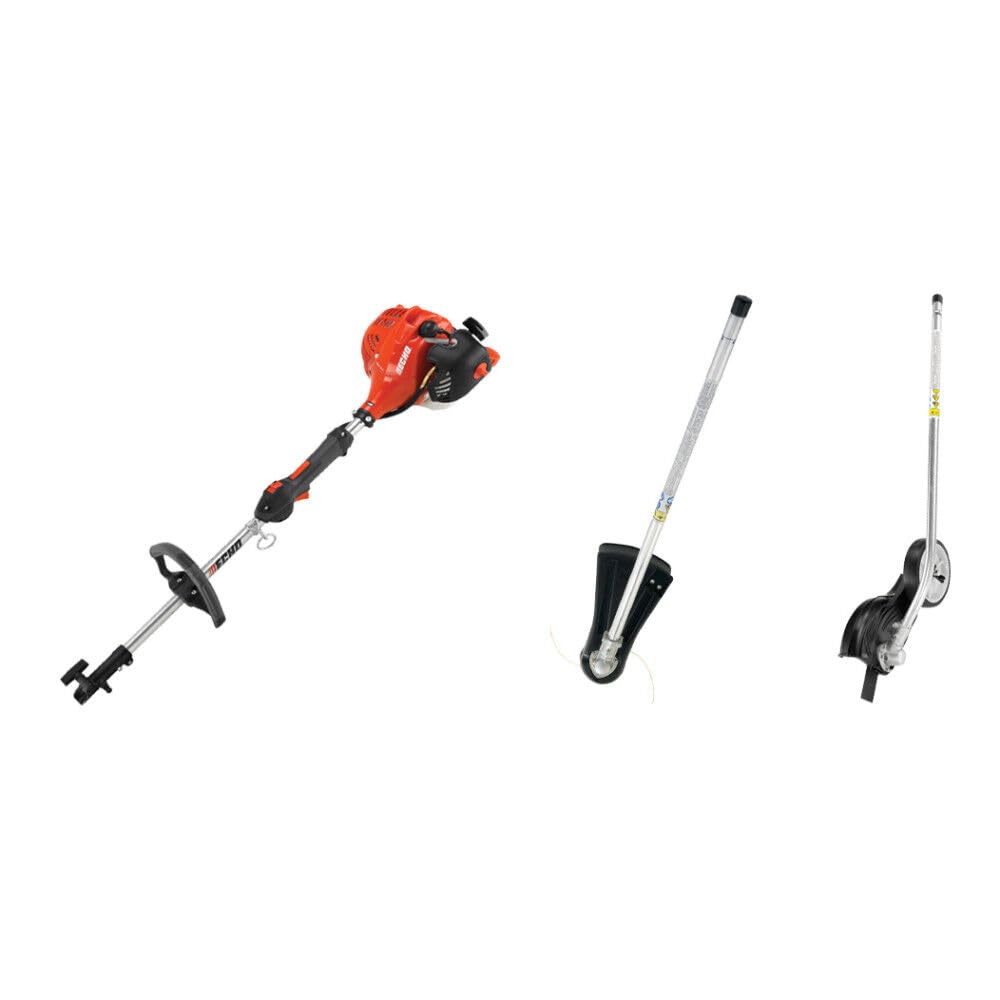
The ECHO PAS-225VP is a Professional Attachment System (PAS) power head kit that comes with a trimmer and edger attachment, built around a 21.2cc 2-cycle engine. Unlike consumer-grade curved shaft models, this uses a straight shaft with metal gearbox, designed for frequent attachment swapping without wearing out the coupling. The edger attachment uses a blade that spins at high RPM for crisp sidewalk edges, and the trimmer head features a simple tap-feed line system. The total weight is 16.2 pounds, reflecting the heavier-duty construction.
Owners transitioning from battery-powered or corded electric trimmers find the ECHO’s gas performance significantly stronger. The engine starts on the first pull after priming (8 pumps, 3 strokes is the common startup ritual), and the edger attachment outperforms 12-amp corded models. The PAS system means you only buy the power head once and add attachments as needed, which can save money over buying separate tools. The build quality is noticeably higher than mid-range brands—metal parts where others use plastic, and better gaskets around the fuel system.
The downsides are the initial effort to start (a manual process of primer bulb and choke pulls) and the fact that it requires a gas/oil mix. Some owners find the edger attachment position awkward for left-handed users. At this price point, you’re paying for the durability and the attachment system rather than cutting-edge power. For a homeowner who wants a professional-grade tool that will last a decade with proper maintenance, the PAS-225VP delivers.
What works
- Professional Attachment System for versatility
- Edger attachment handles concrete edges cleanly
- Metal gearbox and build quality
- First-pull start after proper priming
What doesn’t
- Heavier than consumer models at 16.2 lbs
- Requires gas/oil mixing
- Edger position may feel off for left-handed users
6. ECHO SRM-2620T

The ECHO SRM-2620T is a dedicated line trimmer built around a 25.4cc high-torque 2-cycle engine, designed for users who regularly cut heavy weeds, thick grass, and light brush. Unlike the PAS series, this is a standalone trimmer—no attachment system—but the trade-off is a more rigid, optimized chassis. The Speed-Feed head allows line reloading without removing the spool, a small but real time-saver on large properties. Rated at 6,000 RPM, the engine is tuned for low-end torque rather than high-speed spinning, making it effective for slicing through dense growth without the engine bogging.
Owners frequently compare it favorably against Stihl’s FS 130, noting easier starting and similar cutting power. The build quality is high, with metal brackets and a solid drive shaft that handles repeated abuse. Several users report that it’s overkill for small, manicured lawns but ideal for larger properties, fields, or acreage where heavy weeds are the norm. It starts reliably after proper priming, with experienced owners citing a consistent 6-pull ritual.
The main concern is that some units arrive difficult to start or fail to start at all, suggesting occasional priming issues or stale fuel in the supply chain. The weight is moderate for its class but heavier than smaller-displacement trimmers. There’s no attachment capability, so if you need an edger or brush cutter, you’ll need a separate power head. For pure trimming power in a dedicated gas trimmer, the SRM-2620T is one of the strongest options in its class.
What works
- 25.4cc high-torque engine for heavy brush
- Speed-Feed head for quick line reload
- Rigid, professional-grade build quality
- Easier starting than comparable Stihl models
What doesn’t
- No attachment system
- Occasional hard-start issues on some units
- Heavier than lower-displacement models
7. LawnMaster NPTGSP2517A

The LawnMaster NPTGSP2517A brings electric push-button starting to a 25cc 2-cycle engine, using a rechargeable lithium battery that provides up to 150 starts per charge. This eliminates the primary pain point of gas trimmers—the pull cord. The split shaft design accepts a multi-tool attachment system, allowing you to convert it into a blower, edger, or other yard tools. The dual-line bump-feed trimmer head uses 0.095-inch line for tackling stubborn weeds, and the 420 ml fuel tank provides reasonable runtime for the engine output.
Owner feedback is split sharply between excellent and problematic. On the positive side, when working correctly, the electric start is flawless—push the button and the engine fires immediately. The trimmer has enough power for heavy weeds, and the attachment system is well-engineered. Some users report it starts every time after months of use. The easy-wind head simplifies line replacement, which is a genuine quality-of-life improvement over traditional spools.
The negative reviews consistently mention engine failure within a year of light use—internal failures that won’t start, stalling after short runs, and poor warranty service from the manufacturer. The electric start battery charges separately, and some report it drains or fails. The unit is also relatively heavy for its class at over 19 pounds. For someone with physical limitations who needs a gas trimmer that starts without pulling, the electric start is compelling—but the reliability track record makes it a higher-risk choice.
What works
- Push-button electric start eliminates pull starting
- Split shaft accepts multiple attachments
- 0.095-inch line handles thick weeds
- Easy-wind trimmer head design
What doesn’t
- Reports of engine failure within the first year
- Warranty process can be difficult
- Heavy for a 25cc trimmer at 19+ lbs
8. NEO-TEC 26cc
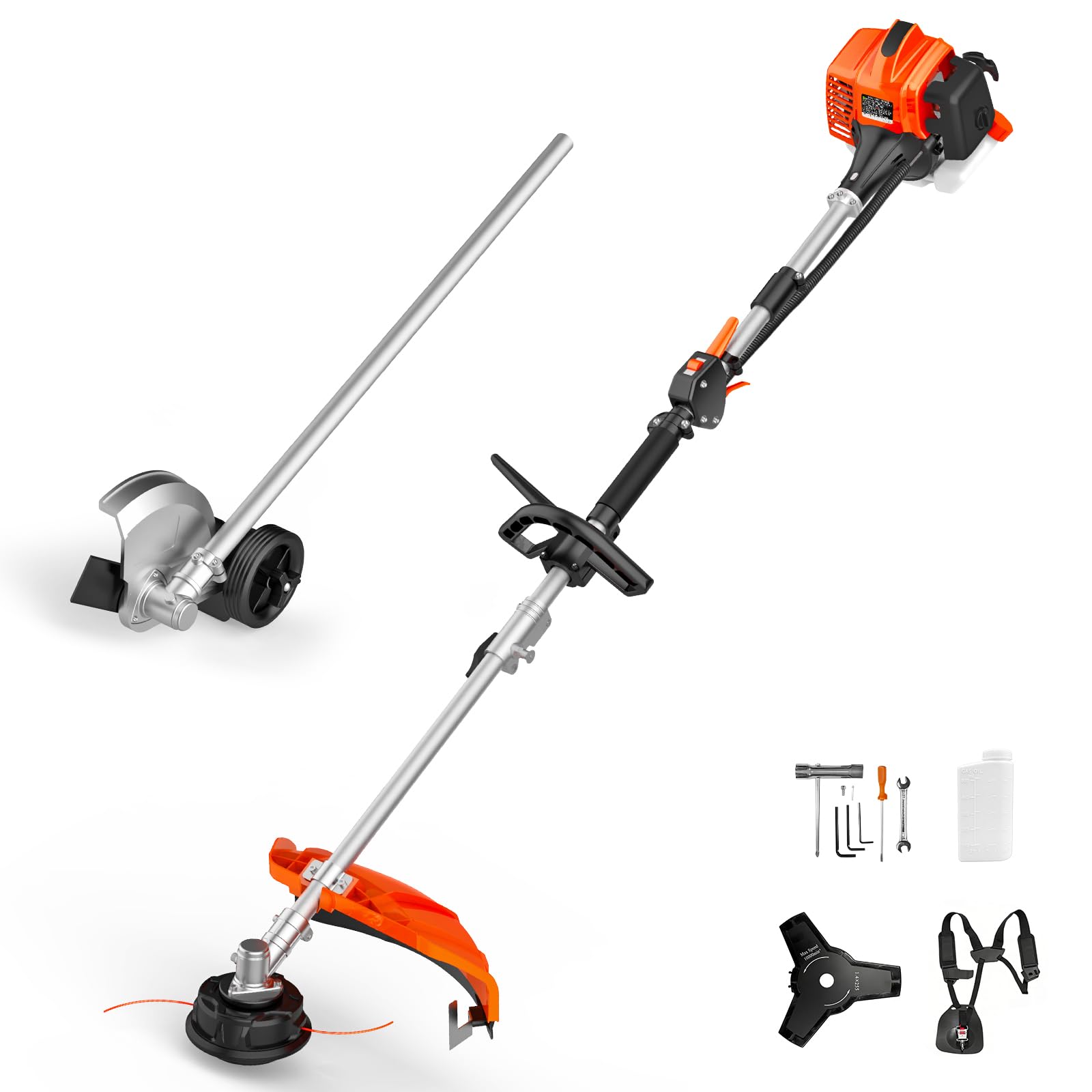
The NEO-TEC 26cc is a split-shaft 3-in-1 gas trimmer kit that includes a 16-inch string trimmer head, a 9-inch edger blade, and a 10-inch brush cutter 3-tooth blade—all out of the box. The EPA-certified 2-cycle engine is rated at 26cc, giving it more displacement than many budget options, and the split shaft allows quick tool changes without tools. The ergonomic handle and adjustable shoulder strap aim to reduce fatigue during longer sessions, and the upgraded starting system is designed for fewer pulls.
The major selling point is the included accessories. You get a brush cutter blade for clearing thick weeds and small saplings, an edger blade for walkways, and the standard trimmer head—three tools for the price of one. Owners report the engine starts reliably and cuts well for typical yard maintenance. The 16-inch cutting width is narrower than some competitors, but the brush cutter blade compensates for clearing heavier growth. The split shaft also makes storage easier, breaking down to a shorter length.
Build quality is adequate for the price point, but some owners note the materials feel less robust than premium brands. The bump-feed head works, but some users prefer a more advanced system. The included shoulder strap helps distribute weight, though the balance with the brush cutter attachment can be slightly off. For a homeowner who needs one tool that can trim, edge, and cut brush, this kit delivers exceptional value without the need to buy separate attachments.
What works
- Includes trimmer, edger, and brush cutter heads
- 26cc engine provides strong power
- Split shaft for compact storage
- Reliable starter system for the price
What doesn’t
- 16″ cut width is narrower than some alternatives
- Build materials feel less premium
- Bump-feed head is basic in design
9. Wild Badger Power WB26GTC

The Wild Badger Power WB26GTC is a 26cc 2-cycle trimmer with a full crank engine and a 60-degree curved shaft, designed for lightweight operation and maneuverability in tight spaces. The full crank design doubles the bearing support compared to half-crank alternatives, which typically translates to longer engine life and reduced vibration. At approximately 9.9 pounds, it’s one of the lightest 26cc gas trimmers available, making it suitable for users who need to trim for extended periods without shoulder fatigue.
The 15-inch cutting width is narrower than most competitors, which means more passes to clear a space, but the trade-off is better access around fences, trees, and irregular flower beds. The curved tube geometry lets you reach under obstacles at awkward angles. The 2-in-1 functionality converts between trimming and edging positions. Owner feedback is mixed—some praise its lightweight feel and power for the size, while others report issues with line jamming, hard starting, or short lifespan. The 0.7 kW rated motor power is adequate for grass but not heavy brush.
Fuel efficiency is decent, and the full crank design does reduce vibration compared to cheaper half-crank models. However, replacement spools can be difficult to find, and the line feed system may require frequent attention. For a budget-conscious buyer who prioritizes low weight and maneuverability over cutting width and brute power, this trimmer fits a specific niche. It’s best suited for small to medium lawns with basic grass maintenance, not for clearing overgrown fields.
What works
- Lightest in class at ~9.9 lbs
- Full crank engine for longer life
- 60-degree curved shaft for tight access
- Fuel-efficient for a 26cc 2-stroke
What doesn’t
- 15″ cutting width reduces coverage per pass
- Replacement spools hard to source
- Some units have hard-starting or jam issues
Hardware & Specs Guide
Engine Displacement (cc)
The cylinder volume directly determines the torque available for cutting. For most homeowners, 22cc to 25cc is sufficient for grass and light weeds. Heavy brush and thick overgrowth require 26cc or higher. Displacement also affects fuel consumption and vibration levels—larger engines usually vibrate less per unit of power, but they add weight.
2-Cycle vs 4-Cycle Engines
A 2-cycle engine fires once per revolution, delivering more power per displacement but requiring pre-mixed gas and oil. A 4-cycle engine fires once per two revolutions, runs quieter, emits fewer fumes, and uses separate oil in a sump—no mixing required. 4-cycle trimmers are heavier but cleaner. 2-cycle trimmers are lighter per unit of power and easier to service at home.
Cutting Swath and Line Diameter
The cutting width, typically 15 to 19.7 inches, determines how much grass is cut per pass. A wider swath speeds up work on large lawns. Line diameter (0.080 vs 0.095 inch) affects durability—thicker line resists snapping in heavy weeds. Bump-feed heads advance line by tapping on the ground, which is more convenient than fixed-line manual feed systems.
Shaft Design: Curved vs Straight
Curved shafts position the head forward for better maneuverability around obstacles. Straight shafts reach farther under bushes and transmit power more efficiently through a steel drive shaft instead of a flexible cable. Straight shafts also accept attachments more reliably. For heavy-duty use, a straight shaft is generally preferred; for light trimming in tight yards, a curved shaft is more comfortable.
FAQ
What is the difference between a full crank and half crank engine?
Can I use a straight shaft trimmer with edging attachments?
Does a 4-cycle gas trimmer really need no oil mixing?
Why does my gas trimmer bog down when I rev it?
How often should I replace the spark plug in a gas trimmer?
Final Thoughts: The Verdict
For most gardeners, the best gasoline trimmer winner is the SENIX GTC4QL-L because it combines a 26.5cc 4-cycle engine with full-crank durability and no-mix convenience at a competitive weight. If you want a quiet, lightweight trimmer for regular grass maintenance, grab the Husqvarna 122C. And for heavy brush clearing where pure torque matters most, nothing beats the ECHO SRM-2620T.