
An at-home composter promises to turn banana peels, eggshells, and coffee grounds into usable fertilizer without the rot smell, fruit flies, or the back strain of turning a pile. But the market is split between electric machines that dry-and-grind in hours and biological units that use microbes to break waste down continuously—and choosing wrong means dealing with wet sludge or a dead machine after the return window closes.
I’m Rikta — the co-founder and writer behind Lawn Gear Lab. I’ve spent dozens of hours cross-referencing motor specs, carbon filter ratings, capacity limits, and real owner feedback to separate the machines that actually produce dry, usable compost from those that leave you with a sticky mess.
Whether you want a countertop unit for nightly processing or a larger biological system for continuous feed, this guide to the best at home composter breaks down the key specs, real-world trade-offs, and which models earn their spot in a busy kitchen.
How To Choose The Best At Home Composter
The at-home composter category splits into two distinct technologies: electric heat-dry-and-grind machines that turn scraps into a dry, coffee-ground-like powder in 4–8 hours, and biological microbial units that use beneficial bacteria to break waste down into true compost continuously. Your choice dictates everything from daily routine to final product quality.
Capacity vs. Household Size
A 2.5L electric unit handles one day of scraps for a single person or couple—you must empty it daily or the material will smell. A 5L electric unit buys you 1–2 days. The 14L biological Reencle can accept daily feedings for weeks before needing to be harvested, making it far better for families or meal-prep-heavy households.
Odor Filtration Quality
The only thing separating a kitchen-friendly machine from a garage exile is the carbon filter. Units with small, non-replaceable foam pads (common on budget electric models) let smells escape by the third cycle. Premium units use thick, replaceable activated carbon cartridges rated for 500–1000 hours and often include a secondary foam gasket seal on the lid.
Noise Tolerance
Electric composters run a grinder motor and a fan. Budget models hit 48–50 dB—fine for daytime but disruptive in an open-plan kitchen after midnight. Biological units like Reencle operate at 28 dB, quieter than a refrigerator hum. If you plan to run the machine overnight, every decibel matters.
True Compost vs. Dehydrated Scraps
Electric machines produce dried, ground-up food scraps—a pre-compost material that still needs soil microbes to break down further before it’s plant-ready. Microbial units produce finished, stable compost straight from the machine. Buy an electric unit for volume reduction and odor control; buy a biological unit if you want immediate soil amendment.
Quick Comparison
On smaller screens, swipe sideways to see the full table.
| Model | Category | Best For | Key Spec | Amazon |
|---|---|---|---|---|
| Reencle Prime | Biological | Continuous microbial composting | 14L capacity, 28 dB noise | Amazon |
| Airthereal Revive R800 | Electric | WiFi monitoring, large dry output | 5L capacity, 3 modes, self-clean | Amazon |
| Food Cycler Eco 5 | Electric | Large bucket, quiet grinding | 5L capacity, Vortech grinding | Amazon |
| FRYLINE 4L | Electric | Ultra-quiet, fast 3-hr cycles | 4L capacity, <40 dB noise | Amazon |
| NutriChef 3L | Electric | Compact countertop, one-button | 3L capacity, dishwasher-safe bucket | Amazon |
| Airthereal Revive R500 | Electric | Entry-level electric composting | 2.5L capacity, cast aluminum bucket | Amazon |
| Homfan 3.5L | Electric | Budget smart display unit | 3.5L capacity, LED display, self-clean | Amazon |
In‑Depth Reviews
1. Reencle Prime Electric Composter – 14L
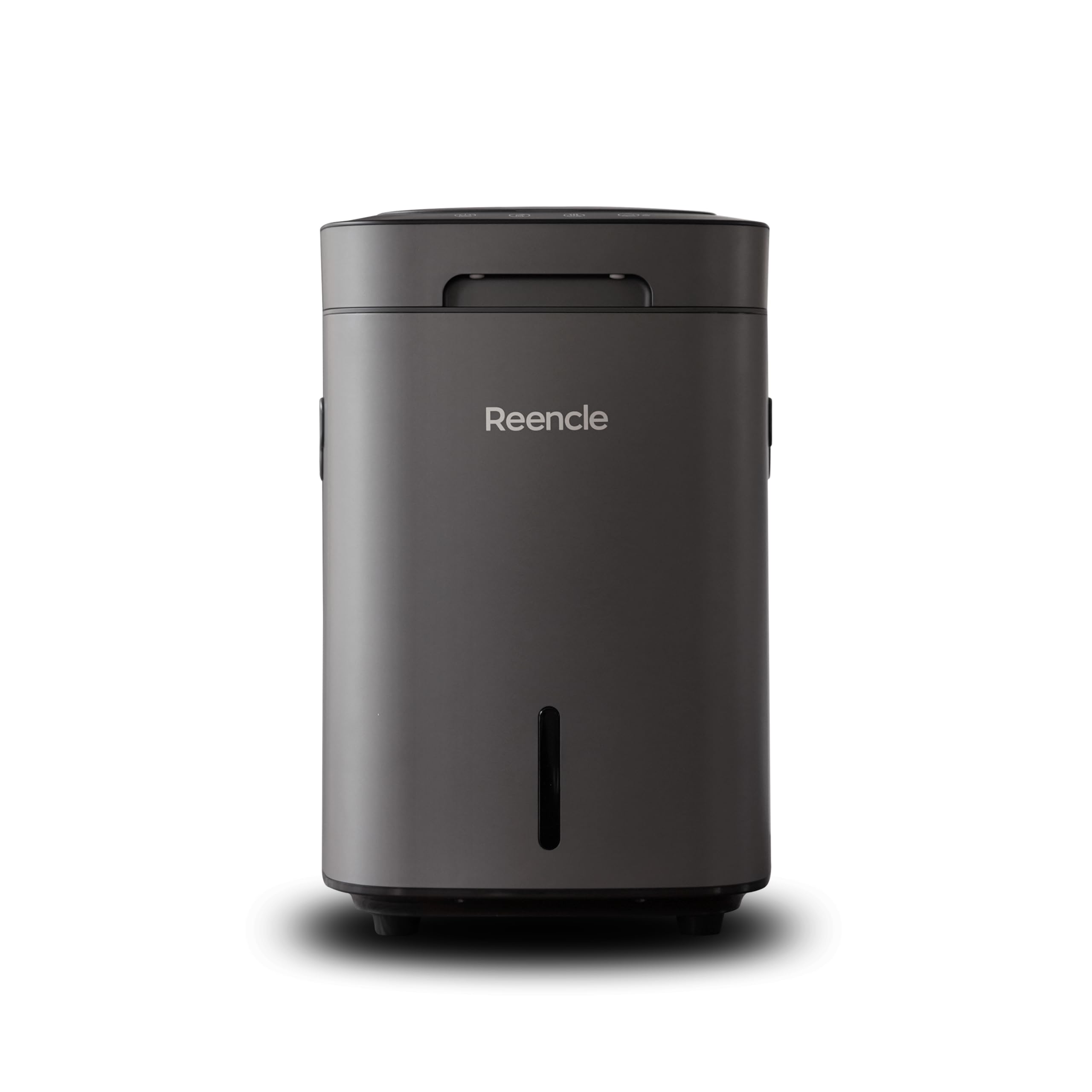
The Reencle Prime uses a patented aerobic microbial process rather than high heat to break down food scraps, meaning it produces true finished compost instead of dehydrated pre-compost. With a 14L capacity, it can handle up to 2.2 lbs of waste daily and only needs emptying weekly or even less often, making it the only model on this list that truly keeps pace with a family kitchen without constant attention.
Owner reports consistently praise the near-silent 28 dB operation—audibly quieter than any electric grinder unit—and the complete absence of odor when the 3-layer filter system is maintained properly. The smell is described as similar to rising bread, not rotting scraps. The unit measures 12 by 13 by 18.4 inches, which is tall enough that it may not fit under standard upper cabinets, but owners say it sits well on a corner countertop.
The trade-off is the upfront investment, and the biological process requires some attention to ingredient balance and moisture levels—you cannot dump a whole pineapple core in without balancing it with drier material. Owners who dial in the process report a year of trouble-free use with no filter replacements needed, while the energy draw remains minimal due to the room-temperature microbial process.
What works
- Produces true finished compost, not just dried scraps
- Extremely quiet at 28 dB
- No odor when properly maintained
What doesn’t
- Requires balancing of food types and moisture levels
- Taller than most countertop electric units
- Higher price point than heat-dry units
2. Airthereal Revive R800 5L Smart WiFi Electric Composter
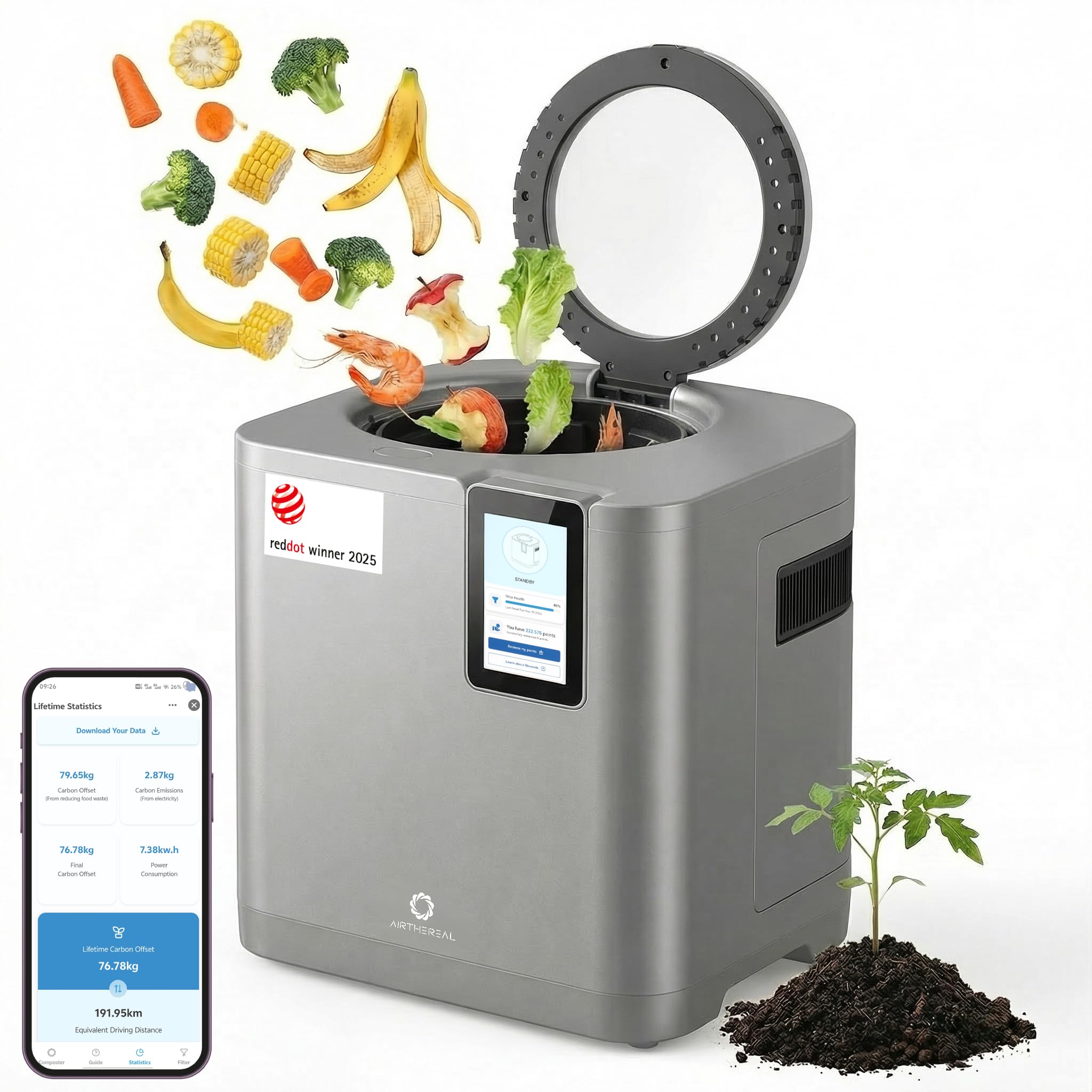
The Airthereal Revive R800 is a 5-liter electric unit that combines high heat drying and grinding with app connectivity, letting you monitor composting progress and track your carbon footprint from your phone. It won a 2025 Red Dot Award for its design, and the three modes—ECO Pre-Compost, Bio Compost, and Self-Clean—give flexibility to process everything from daily veggie peels to heavier mixed loads.
The biodegradable carbon filter keeps odors in check during cycles, and owners report that the machine is genuinely quiet—quiet enough to run overnight without disrupting sleep. The self-cleaning function simplifies maintenance significantly compared to units that require manual scrubbing after every batch. At 25 pounds, this is a heavier, sturdier machine than budget alternatives, and the 5L bucket can handle a family’s daily output in a single run.
However, several owners report occasional jamming, particularly with stringy items like banana peels and avocado skins, and overheating errors when the unit is overloaded. The troubleshooting process for jams can be frustrating, and a small number of owners report unresolved issues with customer support. The 3-year warranty (1.5-year standard plus 1.5-year Amazon extension) offers some peace of mind, but the jam sensitivity is a real operational constraint.
What works
- WiFi connectivity with real-time carbon tracking
- Self-cleaning mode reduces manual effort
- 5L capacity suits families well
What doesn’t
- Prone to jamming with fibrous vegetable materials
- Customer support reported as slow in some cases
- Heavy at 25 pounds, not easily moved
3. Food Cycler Eco 5 5L Kitchen Food Recycler
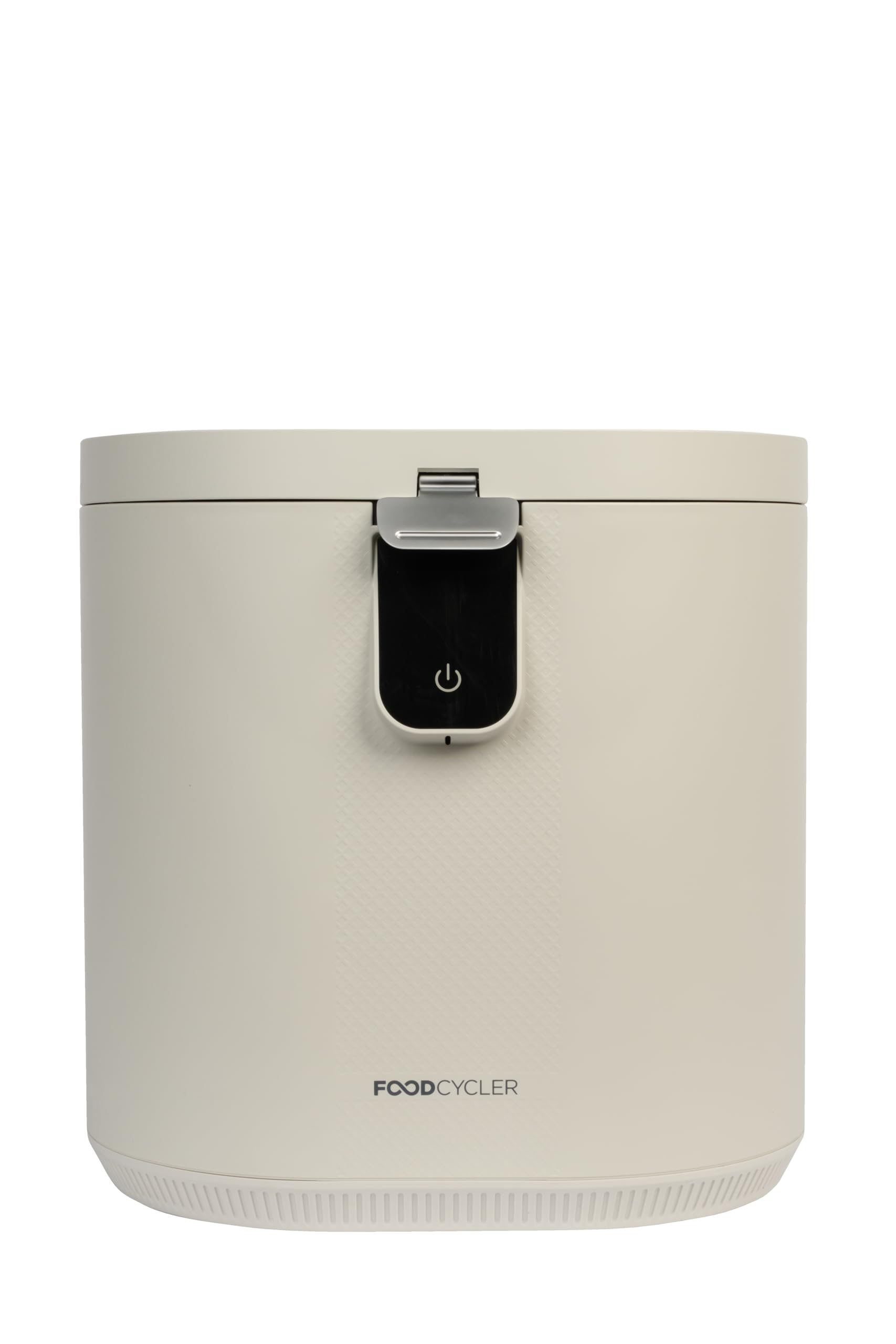
The Food Cycler Eco 5 uses a patented Vortech grinding system that handles pits, peels, bones, and leftovers in a single 8-hour cycle, reducing volume by nearly 90 percent. The 5L bucket is the largest in its class among electric dehydrator-grinders, and the machine’s compact footprint (10.3 by 13.8 by 13.8 inches) fits neatly on most countertops without dominating the space.
Owner feedback is overwhelmingly positive for odor control—the refillable carbon filter keeps the kitchen fresh even when processing strong-smelling scraps like onion skins and fish bones. Noise is consistently described as “near-silent,” with multiple owners noting it is quieter than their previous Lomi unit. The machine weighs about 30 pounds, which is substantial, but that mass contributes to vibration-free operation during grinding cycles.
The primary concern is the higher price point, which puts it in competition with biological units like the Reencle Prime. However, owners who switched from Lomi report that the Eco 5 offers easier maintenance (replaceable carbon cartridges instead of internal filter packs) and a 3-year warranty that Vitamix (the manufacturer) actually honors. A few owners noted that overfilling with high-moisture items like grapes produced wet compost, but this is consistent with all electric dehydrator units.
What works
- Handles bones, pits, and fibrous scraps well
- Quiet operation, near-silent per owner reports
- Simple carbon cartridge replacement
What doesn’t
- Premium price point
- High-moisture loads can result in wet output
- Heavy at 30 pounds
4. FRYLINE 4L Electric Composter
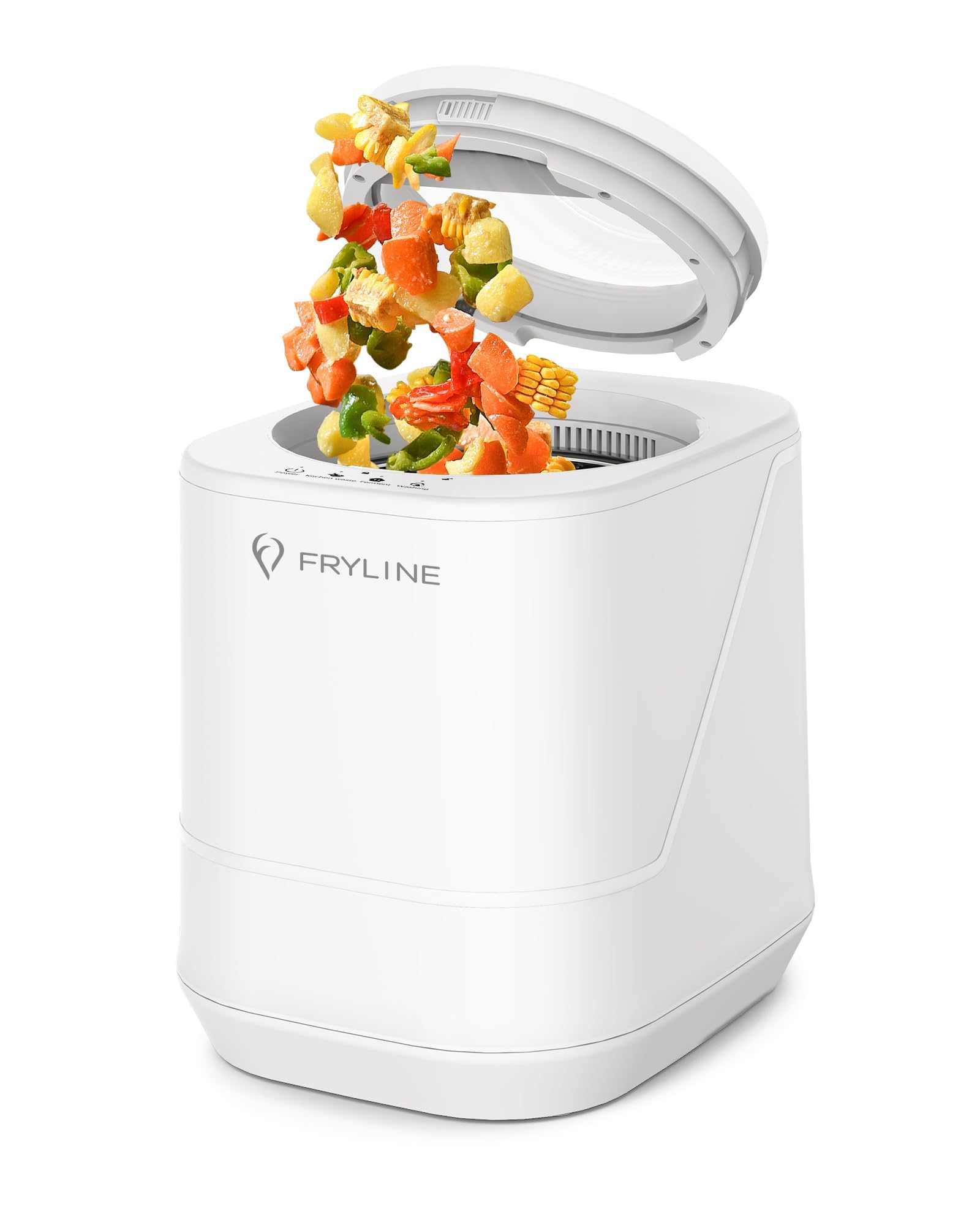
The FRYLINE 4L electric composter stands out for its sub-40 dB noise level—quiet enough to run while you sleep in the same room—and its fast 3-hour cycle time, which is about half the runtime of most competing electric units. The low-speed, high-torque blade design allows it to process most food materials without jamming, and the 4L capacity hits a sweet spot between daily scraping needs and countertop space (16 by 12 by 15 inches).
The high-temperature drying and grinding method reduces waste volume by up to 90 percent, and the large carbon filter is rated for 1000 hours before replacement is needed—well above the average in this category. The transparent lid lets you check progress without interrupting the cycle, and the detachable bucket is dishwasher-safe. Owners overwhelmingly rate it 5 stars, with specific praise for the lack of odor and the automatic shutoff feature that makes overnight runs worry-free.
The machine is a relatively new model, so long-term reliability data is still thin. A few owners noted that the included “small boxes” in the package had unclear purpose, and one owner reported occasional odor during heavy processing loads. The 18-pound weight makes it easy to move between counter and storage, and the three modes (Crush, Ferment, Clean) provide flexibility without being overwhelming.
What works
- Very quiet operation at under 40 dB
- Fast 3-hour cycle time
- Large 1000-hour carbon filter capacity
What doesn’t
- New model with limited long-term reliability data
- Occasional odor with heavy loads
- Some accessory pieces lack documentation
5. NutriChef 3L Electric Kitchen Composter
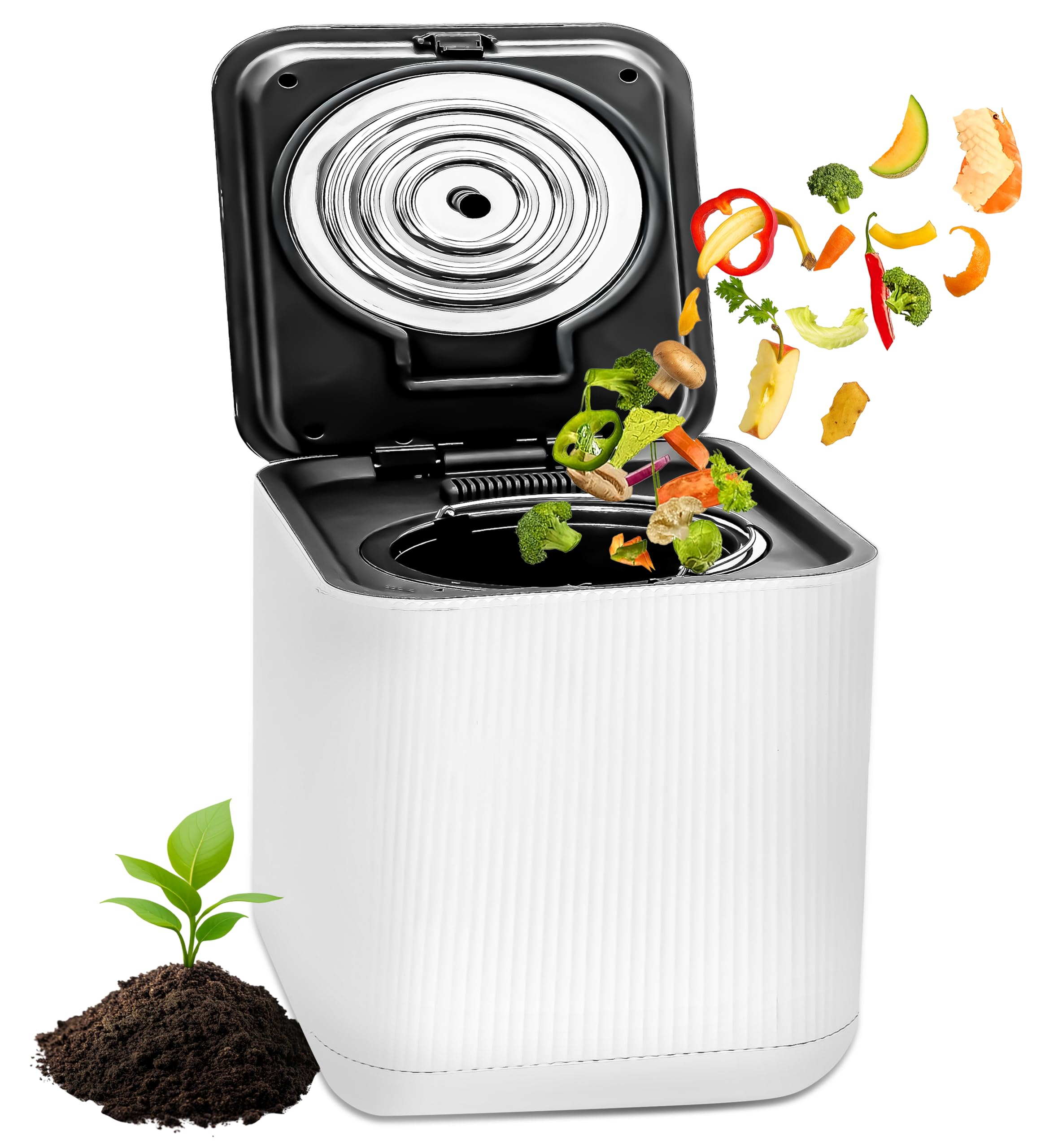
The NutriChef 3L electric composter is a true entry-level countertop unit with a single-button operation that turns vegetable peels, coffee grounds, and eggshells into pre-compost material in 6–10 hours. Its compact dimensions (11 by 13.5 by 12.5 inches) and 20.1-pound weight make it easy to place on any counter, and the removable bucket is dishwasher-safe for quick cleanup.
The advanced odorless filtration system is effective during cycles—multiple owners report no smell at all during operation—and the machine runs quietly enough to be left in a kitchen overnight. The one-button simplicity makes it accessible for anyone who doesn’t want to navigate multiple modes or app connections. Owners praise the fact that it handles whole peppers and large peels without pre-cutting, and the final output is dry enough to use immediately as a soil amendment.
The reliability concerns are significant for this unit. Multiple owners report that the machine fails after 2–4 weeks, producing wet sludge instead of dry powder, and that the manufacturer is unresponsive to warranty claims. The 31-day failure window (just past the Amazon return period) is a recurring pattern in the negative reviews. The filtering system also requires cleaning after nearly every cycle, with a dedicated light that signals cleaning is needed even when the unit looks clean.
What works
- Simple one-button operation
- Dishwasher-safe removable bucket
- Compact footprint for small counters
What doesn’t
- Reports of failure within 2–4 weeks
- Customer support appears unresponsive
- Frequent cleaning light prompts
6. Airthereal Revive R500 2.5L Electric Composter

The Airthereal Revive R500 is a 2.5-liter electric composter that uses a tri-blade SHARKSDEN system to grind food waste into a dry powder over a 4-hour cycle. The cast aluminum bucket is dishwasher-safe and more durable than the plastic buckets on many budget units, and the one-button operation means there’s no learning curve. The unit measures 12.5 by 10 by 12.5 inches and weighs 16.8 pounds, making it the most compact option on this list.
The biodegradable carbon filter helps reduce odors between cycles, but multiple owners note that the filter is not sufficient for strong-smelling scraps—the machine itself can produce noticeable odor during operation, especially with cruciferous vegetables or cooked food waste. The 2.5L capacity is small enough that most owners need to run it daily, and the machine only works well when you maintain the right ratio of browns to greens.
The reliability data is mixed. Some owners report excellent performance for months, with quiet operation and easy cleaning. However, a significant number of owners report that the unit stops heating or grinding within weeks, and the customer support process is described as grueling—requiring photos, videos, resets, and water tests before finally going silent. The 1-year warranty is standard, but enforcement appears inconsistent based on owner reports.
What works
- Compact and lightweight at 16.8 pounds
- Dishwasher-safe aluminum bucket
- Simple one-button operation
What doesn’t
- Odor control is insufficient for strong scraps
- Frequent reliability issues reported
- Small 2.5L capacity requires daily runs
7. Homfan 3.5L Electric Composter Countertop
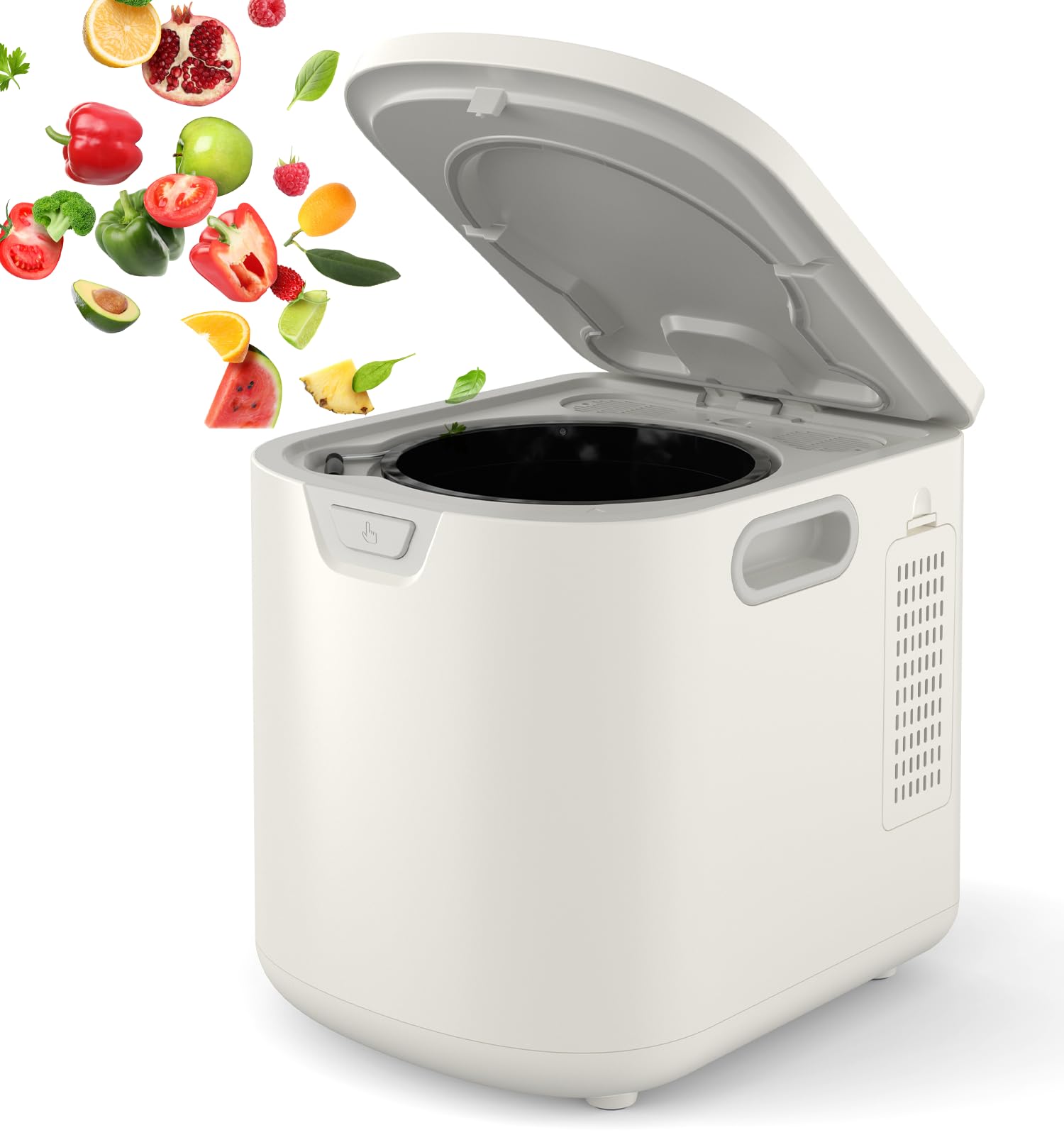
The Homfan 3.5L electric composter brings a smart LED display with three composting modes and a self-cleaning function to the budget tier. The 3.5L capacity is a meaningful step up from the 2.5L units, and the machine processes waste in 2.5 to 20 hours depending on the load, with a claimed 90 percent efficiency rate and energy consumption of only 0.28 kWh per cycle.
The dual activated carbon filter system is an attempt to address the odor problems that plague budget electric units, and owners generally report that the machine is odor-free during operation. Noise levels at 48 dB are similar to most electric units in this class—not silent, but low enough for daytime or garage use. The aluminum bucket is easier to clean than plastic alternatives, and the self-cleaning function genuinely reduces the manual scrubbing needed between cycles.
Owners report that the machine processes kitchen waste well with twice-weekly use over several months, but the odor and noise during operation are noticeable enough that most keep the unit in the garage rather than on the kitchen counter. The handle mechanism on the canister has been reported as loose in some units, and the machine can leak water during processing. The brand has a limited track record, so long-term durability is unproven compared to more established manufacturers.
What works
- Self-cleaning function reduces maintenance
- 3.5L capacity for moderate daily output
- Dual carbon filter system
What doesn’t
- Noise and odor noticeable during operation
- Has been reported to leak water during cycles
- Handle mechanism on canister can be loose
Hardware & Specs Guide
Capacity (Liters)
This is the most critical spec for daily use. A 2.5L unit holds about one day of scraps for one person—you must empty it every night. A 5L unit gives a couple 1–2 days between cycles. The 14L biological Reencle Prime accepts continuous feedings and only needs harvesting every 1–2 weeks. Choose capacity based on household size and how often you want to handle the output.
Decibel Rating (dB)
Electric composters run a grinder motor and a cooling fan that typically produce 40–50 dB, comparable to a refrigerator hum (40 dB) or a quiet conversation (50 dB). Biological units like the Reencle at 28 dB are quieter than a library. If you plan to run the machine in a kitchen or open living space overnight, prioritize units at or below 40 dB. For garage placement, 48–50 dB is fine.
Carbon Filter Quality
Odor control depends entirely on the carbon filter. Budget units use thin foam pads that saturate quickly and let smells escape by the third cycle. Premium units use thick, replaceable activated carbon cartridges rated for 500–1000 hours of runtime. A secondary foam gasket on the lid adds another seal. Check whether replacement filters are readily available before buying—some brands discontinue filter models within a year.
Decomposition Method
Electric machines use high heat (120–160°F) to dehydrate scraps, then grind them into powder. The output is dry and odorless but is technically pre-compost—it still needs soil microbes to break down further. Biological units use aerobic bacteria at room temperature to actually decompose waste into stable compost. If you want immediate soil amendment, choose a biological unit. If you just want volume reduction and odor control, an electric unit works fine.
FAQ
Can I put meat and bones in an electric countertop composter?
How often do I need to replace the carbon filter on an electric composter?
Is the output from an electric composter safe to use directly on plants?
Why does my electric composter sometimes produce wet sludge instead of dry powder?
Final Thoughts: The Verdict
For most gardeners, the at home composter winner is the Reencle Prime because it produces true finished compost instead of dried scraps, operates at a whisper-quiet 28 dB, and accepts continuous feedings without daily emptying. If you want a WiFi-connected electric unit with self-cleaning and app tracking, grab the Airthereal Revive R800. And for the best balance of large capacity and quiet grinding in an electric format, nothing beats the Food Cycler Eco 5.