
The Fuyu or Hachiya in your backyard has a specific hunger that most all-purpose tree foods ignore. Persimmons demand a balanced, low-nitrogen diet with a keen eye on potassium and calcium to set heavy, blemish-free fruit without triggering excessive vegetative growth that leads to fruit drop. Selecting the wrong blend wastes a season and leaves you with split or astringent fruit.
I’m Rikta — the co-founder and writer behind Lawn Gear Lab. My process here involved cross-referencing N-P-K ratios against persimmon-specific horticultural data from extension services, then analyzing hundreds of real owner reports to see which formulas actually prevent leaf scorch, cracking, and premature fruit drop in both American and Asian varieties.
Whether you are feeding a young non-astringent tree or a mature orchard specimen, this guide isolates the best fertilizer for persimmon trees by matching exact nutritional profiles to the tree’s unique growth and dormancy cycles.
How To Choose The Best Fertilizer For Persimmon Trees
Persimmon trees are light feeders compared to apples or peaches. Over-fertilizing with nitrogen pushes lush leaves and weak wood at the expense of fruit set, leading to June drop. The right approach prioritizes a low first number in the N-P-K ratio, adequate potassium for fruit quality, and soluble calcium for cell wall strength.
Understanding the N-P-K Ratio for Persimmons
Look for a ratio where the middle and last numbers (phosphorus and potassium) are equal to or higher than the first (nitrogen). A classic 6-2-4, 3-5-5, or even a 5-10-10 works well. High-nitrogen formulas (like 30-0-0 or 21-7-14) force rank vegetative growth, delay fruit maturity, and increase susceptibility to cold damage. Stick to organic or slow-release sources that feed the soil biology rather than shocking the tree.
Why Calcium and Potassium Are Critical
Persimmons are prone to fruit cracking and spongy tissue when calcium is deficient. A fertilizer that includes calcium carbonate or a separate calcium supplement (like bone meal or gypsum) reduces physiological disorders. Potassium directly improves fruit size, color, and sweetness in varieties like Fuyu and Hachiya. Check the guaranteed analysis for a calcium percentage around 5% to 8% and a potassium content (K₂O) that is not lower than the phosphate (P₂O₅) number.
Granular vs. Liquid: Application and Efficiency
Granular slow-release formulas (like Down To Earth or Espoma) are ideal for in-ground trees because they feed over several months with one or two applications per season. Liquid concentrates (like Farmer’s Secret) work better for container-grown persimmons or for a quick early-season boost, but they require weekly mixing and are less forgiving if over-applied. Spikes offer convenience but concentrate nutrients in a small zone, which can encourage root circling in young trees if not spaced correctly.
Quick Comparison
On smaller screens, swipe sideways to see the full table.
| Model | Category | Best For | Key Spec | Amazon |
|---|---|---|---|---|
| Down To Earth 6-2-4 | Organic Granular | Orchard / in-ground | 6-2-4 with added calcium | Amazon |
| Nelson NutriStar 12-10-10 | Granular | High-yield / mature trees | 12-10-10 with calcium | Amazon |
| FoxFarm Happy Frog Citrus | Organic Granular | Soil microbe health | Slow-release N + Mycorrhizae | Amazon |
| Espoma Tree-Tone 6-3-2 | Organic Granular | General tree feeding | 6-3-2 + 5% calcium | Amazon |
| Jobe’s Organics 3-5-5 Spikes | Spikes | Low-maintenance feeding | 3-5-5 time release | Amazon |
| FoxFarm Japanese Maple 4-3-4 | Organic Granular | Low-pH / container trees | 4-3-4 with mycorrhizae | Amazon |
| Farmer’s Secret Liquid Booster | Liquid Concentrate | Container / quick boost | Super-concentrated (1 tsp/gal) | Amazon |
In‑Depth Reviews
1. Down To Earth Organic Fruit Tree 6-2-4

This premium granular blend hits the ideal N-P-K range for persimmons (6-2-4) with added calcium from calcium carbonate and langbeinite. The low nitrogen index prevents the vegetative surge that causes flower abortion in young Fuyu trees, while the potassium sulfate delivers the high K content persimmons need for dense, sweet fruit. Down To Earth sources from feather meal, fish bone meal, and kelp meal — all OMRI-listed, so there is no risk of synthetic salt burn.
The 5-pound box covers roughly four mature trees for a single spring feeding, and the dry powder texture broadcasts easily under the drip line. Multiple owner reports on older trees mention significant canopy thickening and reduced fruit drop within one season of switching from high-N lawn foods. The calcium component also reduces the risk of blossom end rot, a common issue in persimmon varieties grown in acidic soils.
For the sheer alignment of ratio, organic certification, and inclusion of calcium sulfate, this is the most precise fit for both American and Asian persimmon cultivars.
What works
- Spot-on 6-2-4 ratio with added calcium for fruit quality
- OMRI listed and 100% natural ingredient profile
- Does not expire; stores indefinitely in cool, dry area
What doesn’t
- Powdery texture can be messy to apply on windy days
- Needs several weeks to break down in cold soil
2. Nelson NutriStar 12-10-10
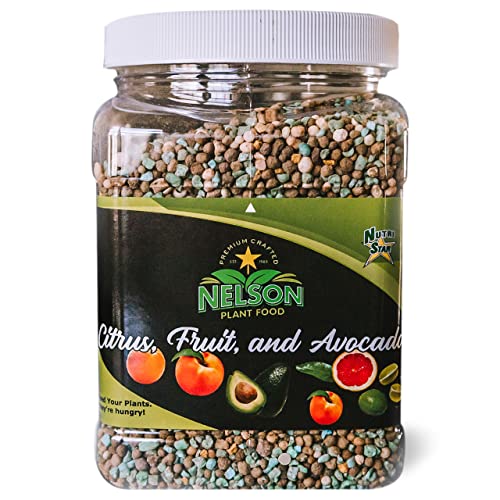
The Nelson NutriStar is a granular 12-10-10 formulation that leans higher on nitrogen than the ideal for persimmons, but the explicit inclusion of calcium and potassium sulfate makes it a powerful tool for mature trees with established canopies. The product literature specifically names persimmons alongside citrus and avocados, which shows the formula was designed with similar nutritional demands in mind. The high potassium (10% K₂O) directly supports larger fruit caliper and sugar content.
In real grower scenarios, this works best on trees that are at least three years old and have a full leaf canopy that can utilize the extra nitrogen without tipping into excessive water sprout production. Owners of mature Hachiya trees report rapid leaf greening within two weeks and a noticeable boost in fruit size by mid-season. The 2-pound bag is compact but covers several trees when used at the labeled rate for in-ground specimens.
If you have a well-established persimmon that needs a mid-growth kicker after a slow spring, the Nelson delivers fast granular availability.
What works
- High potassium drives fruit size and cold hardiness
- Includes calcium for trunk and limb strength
- Works on both in-ground and container trees
What doesn’t
- Nitrogen index is higher than ideal for young or non-vigorous trees
- 2 lb bag is small relative to coverage for a large orchard
3. FoxFarm Happy Frog Citrus & Avocado 7-3-3

FoxFarm’s Happy Frog Citrus line is primarily a 7-3-3 granule with the signature edge of including Mycorrhizal fungi and beneficial soil microbes. For persimmons, the 7-3-3 ratio is slightly nitrogen-heavy, but the slow-release nitrogen source buffers the release rate, and the fungal inoculants dramatically improve phosphorus and water uptake in the feeder root zone. This is particularly valuable for persimmons grown in sandy or degraded soils where root efficiency is the limiting factor.
Owners of both avocado and citrus trees report that this product eliminated leaf yellowing in under two weeks, and persimmon growers using it on young non-astringent trees note a vigorous but not runaway growth habit. The main caution is that the product is primarily alfalfa meal, which is an excellent organic amendment but can feel expensive per pound compared to bulk meals. Watering thoroughly after application prevents the horse-feed smell from attracting pets.
If your persimmon is planted in poor native soil and you want to rebuild the rhizosphere while feeding, the Happy Frog adds microbial life that granular-only blends miss.
What works
- Mycorrhizal fungi boost root efficiency and nutrient uptake
- Slow-release nitrogen prevents rapid flush growth
- Dealers and reviewers note fast greening of chlorotic leaves
What doesn’t
- 7-3-3 ratio is not perfectly tailored for persimmons
- Strong alfalfa odor attracts dogs if left on the surface
4. Espoma Organic Tree-Tone 6-3-2
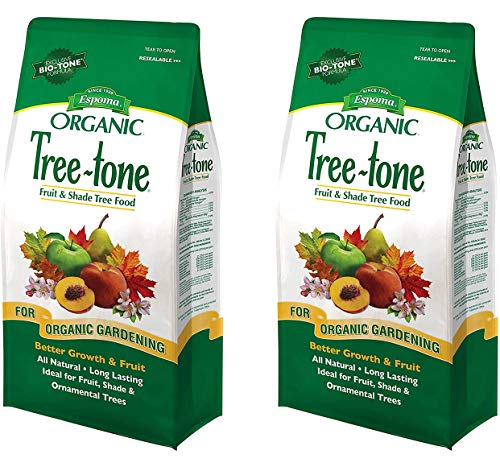
The Espoma Tree-Tone 6-3-2 is one of the most widely used organic tree fertilizers in home orchards, and the 6-3-2 analysis aligns well with persimmon needs when paired with its 5% calcium content. The Bio-tone proprietary formula adds beneficial microbes that help unlock native nutrients, and the product is OMRI-listed for organic production. The pack of two 4-pound bags gives you enough volume for a small orchard for spring and fall applications without a repurchase.
Real owners report that slow-to-leaf trees leafed out fully within one week of an early spring application, and the low salt index makes it virtually impossible to burn roots even if you over-apply along the drip line. The calcium component is especially relevant for persimmon growers who deal with cracked fruit after rain events — calcium strengthens cell walls and reduces spongy fruit tissue. The granular form requires no mixing, which simplifies feeding for multi-tree yards.
For the balance of price, organic certification, and the specific 5% calcium addition, Espoma Tree-Tone is a reliable workhorse for persimmons.
What works
- 5% calcium directly supports fruit firmness and crack resistance
- Two-bag pack offers great coverage at a mid-range cost
- No mixing needed; broadcast granular application
What doesn’t
- Ratio is slightly nitrogen-forward for persimmons
- Organic smell can attract pets and wildlife
5. Jobe’s Organics 3-5-5 Fruit & Citrus Spikes

The Jobe’s Organics 3-5-5 spikes offer a low-nitrogen, high-potassium profile that is actually better suited to persimmons than many citrus-specific granular products. The 3-5-5 N-P-K keeps vegetative growth minimal while supplying ample P and K for root development and fruit set. Each spike is pre-measured and driven into the soil near the drip line, releasing nutrients over a 6–8 week window via the Biozome microorganism complex.
Container-grown persimmon owners benefit from the spike format because it eliminates measuring and the risk of liquid overdose. Users of heritage apple trees reported initial issues from placing spikes too close to the trunk, but correcting to the drip line eliminated leaf burn. For a persimmon in a 20-gallon pot, two spikes per season (spring and early summer) provide a steady feeding curve without the weekly mixing required by liquids.
If you prioritize convenience and a ratio genuinely matched to fruit production over foliage, the Jobe’s spikes remove guesswork from the feeding schedule.
What works
- Low-nitrogen 3-5-5 ratio is ideal for persimmon fruiting
- Pre-measured spikes prevent over-application
- Biozome microbes improve soil condition over time
What doesn’t
- Spikes concentrate nutrients in a small area
- Expensive per feeding compared to granular bulk blends
6. FoxFarm Japanese Maple 4-3-4

The FoxFarm Japanese Maple 4-3-4 is a niche choice for persimmon trees planted in soils with a naturally high pH (above 7.0) where iron chlorosis causes interveinal yellowing. The 4-3-4 ratio is slightly more balanced than most fruit tree blends, and the inclusion of Mycorrhizal fungi helps persimmon roots access micronutrients in alkaline conditions. The formula is designed for “low pH feeders” — plants that prefer slightly acidic conditions — which matches the persimmon’s preferred pH range of 6.0 to 6.5.
In practice, owners of Japanese maples have noted dramatic leaf color improvement and branch strength after switching to this formula, and persimmon trees in high-pH clay soils should see similar results. The easy monthly application (2 tbsp per gallon) gives you precise control over dosing. The main limitation is that the ratio is not designed specifically for fruit production — the potassium (4) is lower than the ideal for fruit sizing — so you may need to supplement with potassium sulfate during the fruit swell period.
For correction of chlorosis in persimmons growing in alkaline or compacted soils, this formula delivers targeted pH management that standard fruit blends ignore.
What works
- Ideal for correcting iron chlorosis in high-pH soils
- Mycorrhizae enhance root efficiency in tough conditions
- Precise liquid dosing for container or small trees
What doesn’t
- Low potassium content may not support maximum fruit size
- Primarily marketed for ornamentals, not fruit trees
7. Farmer’s Secret Citrus Tree Booster

The Farmer’s Secret Citrus Tree Booster is a super-concentrated liquid formula that requires only one teaspoon per gallon of water, making a 32-ounce bottle yield 192 gallons of feeding solution. For container-grown persimmon trees or for a fast spring wake-up, liquid feeding delivers nutrients directly to the root zone within hours rather than weeks. The formulation includes the micronutrient iron, which is critical for preventing chlorosis in persimmon leaves, though it lacks added calcium and magnesium.
Owners of sick lemon trees revived yellow leaves and set new flowers within two to three weeks, and the same response can be expected for persimmons struggling with poor leaf color or slow growth after transplanting. The weekly application schedule (cut dosage in half for containers) makes it simple to integrate into a regular watering routine. However, because the label does not specify an exact N-P-K ratio, you cannot be certain of the macronutrient balance, and multiple reviewers noted the need for a separate calcium/magnesium supplement for long-term health.
Use this booster as a targeted rescue or early-season kicker rather than a complete feeding program for in-ground persimmons.
What works
- Extreme concentration saves money per gallon of feed
- Includes iron for chlorosis correction
- Fast liquid uptake for stressed and container trees
What doesn’t
- No calcium or magnesium in the formula
- Exact N-P-K ratio is not clearly disclosed
Hardware & Specs Guide
N-P-K Ratio & Fruit Development
The ratio of nitrogen to phosphorus to potassium is the single most important spec for a persimmon fertilizer. Nitrogen (N) drives leaf and shoot growth — too much causes fruit drop. Phosphorus (P) supports root establishment and flower initiation. Potassium (K) directly controls fruit size, sweetness, and cold hardiness. For persimmons, an N ratio below 8 and a K ratio at least as high as the N is the safe zone. Products like Down To Earth 6-2-4 and Jobe’s 3-5-5 stay well within this range.
Calcium Content & Physiological Disorders
Calcium is the unsung spec in fruit-tree fertilizers. Persimmons are prone to fruit cracking, blossom end rot, and soft tissue when calcium uptake is insufficient. A fertilizer with 5% to 8% calcium (from calcium carbonate or bone meal) dramatically reduces these issues. Espoma Tree-Tone’s 5% calcium and Down To Earth’s calcium carbonate inclusion are concrete advantages over generic high-N blends that skip this micronutrient entirely.
FAQ
What N-P-K ratio is best for persimmon trees?
Should I fertilize a newly planted persimmon tree in its first year?
Can I use a general fruit tree fertilizer like 10-10-10 on my persimmon?
Final Thoughts: The Verdict
For most gardeners, the fertilizer for persimmon trees winner is the Down To Earth Organic Fruit Tree 6-2-4 because its low nitrogen index, added calcium, and OMRI certification cover every nutritional requirement of both American and Asian persimmon cultivars without risk of over-feeding. If you want the convenience of a pre-measured spike system with a perfect 3-5-5 ratio, grab the Jobe’s Organics Spikes. And for correcting chlorosis in a persimmon struggling with alkaline soil, nothing beats the FoxFarm Japanese Maple 4-3-4 for lowering root zone pH and unlocking iron.