
Quackgrass is one of the most frustrating weeds a lawn owner can face. Its aggressive rhizome root system makes it resistant to many standard weed killers, and it spreads quickly, choking out desirable turf. Unlike annual crabgrass, this perennial invader returns year after year unless dealt with using a specific chemical approach.
I’m Rikta — the co-founder and writer behind Lawn Gear Lab. I spend my time digging through product labels, analyzing active ingredient concentrations, and cross-referencing hundreds of verified owner reports to identify which herbicides actually deliver on their promises. This guide is built on that research.
After evaluating the market, I’ve ranked the top performers to help you find the most effective herbicide for quackgrass for your specific lawn type and infestation level.
How To Choose The Best Herbicide For Quackgrass
Choosing the right herbicide for quackgrass means understanding its biology. Quackgrass spreads through underground rhizomes, so any treatment must translocate through the plant to kill the root system entirely. Spot treatment with a non-selective formula or a selective approach with the right active ingredient is essential.
Active Ingredient Matching
Mesotrione and quinclorac are the two most effective selective options for quackgrass in cool-season lawns. Mesotrione works by inhibiting photosynthesis and turns treated weeds white before they die, while quinclorac targets grassy weeds by disrupting cell growth. Glyphosate remains the gold standard for non-selective spot treatment in garden beds or for lawn renovation.
Surfactant and Spray Dye Are Non-Negotiable
Quackgrass has waxy leaves that repel water-based sprays. A non-ionic surfactant lowers surface tension, allowing the herbicide to spread and penetrate the leaf cuticle. Adding a blue spray dye prevents missed spots and overlapping applications, which can damage surrounding turf.
Application Timing and Lawn Safety
Apply post-emergent herbicides when quackgrass is actively growing and temperatures are between 60-85°F. Avoid applications during drought stress or immediately after mowing. Always check the label for turfgrass tolerance — mesotrione is safe on most cool-season grasses and St. Augustine sod, while quinclorac works best on Bermuda and Zoysia.
Quick Comparison
On smaller screens, swipe sideways to see the full table.
| Model | Category | Best For | Key Spec | Amazon |
|---|---|---|---|---|
| Mesotrione 16 oz | Mesotrione | Cool-season lawns & St. Augustine | 16 fl oz concentrate | Amazon |
| Nufarm Change Up | Three-Way Mix | Broadleaf control + quackgrass | 32 fl oz concentrate | Amazon |
| Select Source Quinclorac 75 | Quinclorac | Bermuda & Zoysia lawns | 75% WDG concentrate | Amazon |
| Primesource Quinclorac 1.5 Select | Quinclorac | Liquid spot treatment | 7.5 fl oz concentrate | Amazon |
| SpeedZone EW | Three-Way Mix | Fast visual results | 20 fl oz concentrate | Amazon |
| Liquid Harvest Mesotrione 8 oz | Mesotrione | Entry-level mesotrione | 8 fl oz concentrate | Amazon |
| Fertilome Weed Free Zone | Three-Way Mix | Large area coverage | 32 fl oz concentrate | Amazon |
In‑Depth Reviews
1. Mesotrione 16 oz (Liquid Harvest)

This 16-ounce mesotrione concentrate delivers the same active ingredient as the brand-name Tenacity at a significantly lower cost per ounce. Mesotrione is one of the few selective herbicides that can suppress quackgrass through both pre-emergent and post-emergent activity, making it a versatile weapon against this perennial weed. It works by inhibiting the HPPD enzyme, causing susceptible plants to bleach white and die back within 2-4 weeks.
This formula is labeled for use on Kentucky bluegrass, tall fescue, perennial ryegrass, fine fescue, centipede grass, buffalo grass, and St. Augustine grass (sod only). Avoid using it on bentgrass, Poa annua, kikuyugrass, zoysiagrass, seashore paspalum, and actively growing bermudagrass. For quackgrass, a follow-up application after 14 days is often necessary to fully exhaust the rhizome system.
The 16-ounce bottle covers up to 8,000 square feet depending on the target weed and application rate. Users report success when mixing with a non-ionic surfactant and a blue spray dye to ensure even coverage. The bleaching effect is normal and temporary on desirable turf, typically reversing within 2-3 weeks as the grass recovers.
What works
- Selective on most cool-season turfgrasses
- Works both pre- and post-emergent
- Good value compared to name-brand Tenacity
What doesn’t
- Requires surfactant for optimal uptake
- Bleaches turf temporarily during treatment
- Not safe for zoysia or active Bermuda
2. Nufarm Change Up (32 oz)

Nufarm Change Up is a premium three-way selective herbicide that combines MCPA, fluroxypyr, and dicamba. This mix offers excellent control of over 200 broadleaf weeds, and while it is not specifically marketed for quackgrass, the fluroxypyr component provides strong activity against tough grassy weeds when applied at the higher labeled rates. It is one of the few selective formulas with tolerance across both cool-season and warm-season turfgrasses, including St. Augustine and centipede grass.
The 32-ounce bottle treats up to 60,000 square feet, making it one of the most cost-effective options for large lawns. Users report visible wilting within 24 hours and full control in 7-10 days on most broadleaf targets. For quackgrass, you will need to apply at the maximum rate of 1.1 oz per 1,000 square feet and add a non-ionic surfactant to penetrate the waxy leaves.
Professional lawn care operators frequently recommend this product for its reliability on warm-season grasses. The three-active blend reduces the chance of resistance developing compared to single-ingredient products. Avoid mowing 3 days before or after application, and do not apply when temperatures exceed 85°F to prevent turf injury.
What works
- Safe on St. Augustine and centipede
- Large coverage per bottle
- Fast visible results on broadleaf weeds
What doesn’t
- Less effective on quackgrass without surfactant
- Requires high label rates for grassy weeds
- Not rainfast for 3-4 hours
3. Select Source Quinclorac 75 (1 lb)
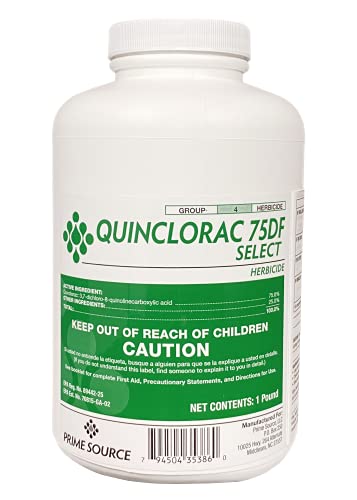
This dry flowable (WDG) formulation contains 75% quinclorac by weight, making it the most concentrated option in this guide. Quinclorac is a selective herbicide that targets grassy weeds like crabgrass, foxtail, and quackgrass by inhibiting cellulose synthesis in susceptible species. For quackgrass, use a mix rate of 0.367 oz (approximately 1.4 teaspoons) per gallon of water with a non-ionic surfactant.
This product is labeled for use on Bermuda grass, Zoysia grass, tall fescue, and Kentucky bluegrass. It is particularly effective on warm-season lawns where mesotrione is not safe. Users report seeing results within 3-5 days on small quackgrass plants, with full control of established clumps taking up to 2 weeks. A second application 14 days after the first is recommended for mature rhizome systems.
The 1-pound container treats approximately 40,000 square feet at the standard crabgrass rate, but quackgrass may require the higher end of the label range. This dry formulation has a longer shelf life than liquid concentrates and does not require refrigeration. Mix with warm water to help the granules dissolve completely before adding surfactant.
What works
- Extremely high active ingredient concentration
- Safe on Bermuda and Zoysia
- Long shelf life in dry form
What doesn’t
- Requires careful mixing to avoid clumping
- Not safe for St. Augustine grass
- May require two applications for quackgrass
4. Primesource Quinclorac 1.5 Select (7.5 oz)

Primesource Quinclorac 1.5 Select is a liquid formulation containing 18.92% quinclorac in an emulsifiable concentrate. This liquid form is easier to measure and mix than dry flowable options, making it a good choice for homeowners who want precise application without dealing with granules. It provides up to 90 days of residual control for labeled grassy weeds when used at the correct rate.
For quackgrass, mix 1.1 oz per gallon of water with a methylated seed oil (MSO) surfactant for optimal leaf penetration. This product is labeled for residential and commercial turf including Bermuda grass, Zoysia grass, tall fescue, and Kentucky bluegrass. Users report success on foxtail and dallisgrass as well, making it a versatile tool for mixed grassy weed infestations.
The 7.5-ounce bottle treats about 5,000 square feet at the standard rate. Reviews note that a second application is often needed for mature quackgrass clumps, but the first application typically causes visible stunting within 5 days. Do not apply to St. Augustine grass or centipede grass, as quinclorac can cause severe injury to these species.
What works
- Easy liquid measuring and mixing
- Works on multiple grassy weeds
- Up to 90 days residual control
What doesn’t
- Small bottle with limited coverage
- Requires MSO surfactant for best results
- Not safe on St. Augustine or centipede
5. SpeedZone EW (20 oz)

SpeedZone EW is a fast-acting selective herbicide that combines 2,4-D, dicamba, MCPP, and carfentrazone-ethyl. While primarily designed for broadleaf weed control, it also lists goosegrass and nimblewill on its label, and many users report suppression of quackgrass when applied at the maximum label rate. The carfentrazone component provides visible results within hours, making it satisfying for spot treatment.
This formula is safe on Kentucky bluegrass, perennial ryegrass, tall fescue, Bermuda grass, and Zoysia grass. It is rainfast in as little as 3 hours, which is faster than most competitive products. The 20-ounce bottle treats approximately 10,000 square feet at the standard rate. For quackgrass, apply at 3 oz per gallon of water and add a non-ionic surfactant to improve leaf adhesion.
Users praise its cool-weather performance, as it works effectively at temperatures as low as 50°F. This makes it a strong option for early spring applications when quackgrass is actively growing but temperatures are still mild. Note that it may not completely kill quackgrass rhizomes with a single application, so plan for a follow-up treatment after 14 days.
What works
- Visible results in hours
- Rainfast in 3 hours
- Effective in cool weather (50°F+)
What doesn’t
- Primarily a broadleaf herbicide
- May need multiple applications
- No measuring cup included
6. Liquid Harvest Mesotrione 8 oz

This 8-ounce mesotrione concentrate from Liquid Harvest is the same active ingredient as the 16-ounce version but in a smaller, more affordable bottle. It is an excellent entry point for homeowners who want to test mesotrione on their lawn before committing to a larger quantity. The product targets 46 broadleaf species and grassy weeds, including crabgrass, barnyard grass, and quackgrass.
For quackgrass, use a mix rate of 1 teaspoon per 2 gallons of water with a non-ionic surfactant. This product requires activation through rainfall or irrigation within 10 days — apply 0.15 inches of water if no rain occurs. The bleaching effect on treated weeds is normal and indicates the herbicide is working. It is safe on most cool-season grasses and St. Augustine sod.
Users report excellent results on crabgrass and clover, with many noting it is the only product that has worked for them after trying multiple other options. For quackgrass, the smaller bottle may only cover 2,000-3,000 square feet depending on the infestation level, so evaluate your lawn size before purchasing. A second application after 14 days is often required for complete rhizome control.
What works
- Low cost for testing mesotrione
- Safe on cool-season turf and St. Augustine
- Works on multiple weed types
What doesn’t
- Small bottle limits coverage
- Requires water activation within 10 days
- May need two applications for quackgrass
7. Fertilome Weed Free Zone (32 oz)
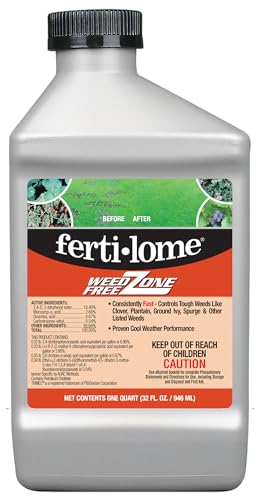
Fertilome Weed Free Zone is a 32-ounce concentrate containing 2,4-D, MCPP, and dicamba that controls over 80 broadleaf weeds including clover, spurge, chickweed, and thistle. While not specifically formulated for quackgrass, its large volume and low cost per ounce make it a practical option for broad-spectrum weed management. For quackgrass, it works best as a secondary treatment after a dedicated graminicide.
This formula is safe on Kentucky bluegrass, Bermudagrass, Bahiagrass, Zoysiagrass, and other listed turfgrasses. It provides visible injury within hours of application, with full dieback in 7-10 days. The 32-ounce bottle treats up to 16,000 square feet, making it one of the highest coverage options in this guide. For best results, apply when broadleaf weeds are young and actively growing in spring, summer, or fall.
Users consistently rate it as the gold standard for creeping Charlie control, and it works reliably on dandelions and spurge. For quackgrass suppression, combine it with a surfactant and apply at the highest label rate. Some users report needing to double the recommended dose for tough weeds like clover, so start with the label rate and increase only if necessary.
What works
- Large 32-ounce bottle for maximum coverage
- Safe on multiple turf types
- Excellent for broadleaf weed control
What doesn’t
- Not a dedicated quackgrass herbicide
- May require double dose for tough weeds
- Manual recommends conservative rates
Hardware & Specs Guide
Active Ingredient Chemistry
Mesotrione (HPPD inhibitor) bleaches treated foliage by blocking carotenoid synthesis, preventing photosynthesis. Quinclorac (cellulose synthesis inhibitor) stops cell wall formation in grassy weeds. Three-way mixes like 2,4-D + dicamba + MCPP use auxin mimicry to cause uncontrolled cell growth and plant death. Each chemistry has specific turfgrass tolerances — mesotrione is cool-season dominant, quinclorac is warm-season dominant.
Surfactant and Adjuvant Requirements
Quackgrass leaves have a thick cuticle that repels water. A non-ionic surfactant at 0.25% v/v reduces surface tension and improves herbicide absorption. Methylated seed oil (MSO) provides even better penetration for quinclorac applications. Blue spray dye at 1-2 drops per gallon marks treated areas to prevent overlap and missed spots. Never skip the surfactant when targeting quackgrass.
FAQ
Will standard broadleaf herbicides kill quackgrass?
Can I apply mesotrione to St. Augustine grass for quackgrass?
How long does it take for quinclorac to kill quackgrass?
Is it safe to reseed after applying these herbicides?
Final Thoughts: The Verdict
For most homeowners, the herbicide for quackgrass winner is the Mesotrione 16 oz because it combines broad turfgrass safety with both pre- and post-emergent activity against quackgrass. If you prefer a warm-season compatible option, grab the Select Source Quinclorac 75 for its powerful dry formulation. And for large-area broadleaf management with quackgrass suppression, nothing beats the SpeedZone EW for fast visual results and cool-weather versatility.