
Nothing collapses a landscape’s curb appeal faster than foliage riddled with powdery mildew, rust, or leaf spot. For tree and shrub owners, the choice isn’t just between brands — it’s between protective chemistry (copper, propiconazole, neem oil) and letting fungal spores overwinter and reinfect year after year. A systemic fungicide that penetrates tissue or a broad-spectrum protectant that leaves a barrier can be the difference between a lush canopy and a skeleton of bare branches.
I’m Rikta — the co-founder and writer behind Lawn Gear Lab. I’ve spent hundreds of hours cross-referencing active-ingredient half-lives, rainfastness claims, and disease-target data with real-world owner observations to determine which bottles actually stop fungal outbreaks on woody ornamentals and fruit-bearing trees.
Whether you are protecting a prized Japanese maple or a row of apple trees, this guide breaks down the concentrated solutions, biological options, and organic sprays that deliver results. This is the definitive analysis of the best fungicide for trees and shrubs.
How To Choose The Best Fungicide For Trees And Shrubs
Selecting a fungicide for woody ornamentals and fruiting trees requires matching the chemical mode of action (protective vs. systemic) to the specific disease lifecycle. Spraying the wrong active ingredient at the wrong growth stage wastes money and leaves trees vulnerable.
Active Ingredient & Disease Spectrum
Copper-based fungicides (like Monterey Liqui-Cop) form a protective barrier that prevents spore germination, making them ideal for dormant-season applications on peach leaf curl and blight. Propiconazole (found in Quali-Pro and Select Source) is a locally systemic triazole that moves through the leaf tissue to stop rust, powdery mildew, and brown patch from the inside. Biological options like the Bacillus subtilis strain in Southern Ag Garden Friendly colonize root and leaf surfaces to outcompete pathogenic fungi without synthetic residues — useful for edible crops and organic programs. Neem oil extracts, as in Garden Safe Fungicide3, work as a contact fungicide, insecticide, and miticide combined, but require thorough coverage and regular reapplication.
Application Method & Coverage
Tree and shrub canopies demand a sprayer that can reach the upper foliage and underside of leaves. Concentrates that mix with water (most products here) are far more economical per gallon than ready-to-use bottles, but require a tank sprayer or hose-end attachment. For large trees, a concentrate that makes 6+ gallons per pint (like Bonide Captain Jack’s Orchard Spray) lowers the per-tree cost significantly. For smaller ornamental shrubs, a ready-to-use sprayer attachment (as on Garden Safe) offers convenience at the cost of shorter reach.
Rainfastness & Residual Control
Rainfastness — the time a fungicide needs to dry before it resists wash-off — is critical for trees and shrubs exposed to overhead irrigation or frequent rain. Copper fungicides with gel formulations (Monterey Liqui-Cop) boast extended rainfastness once dry. Systemic products like propiconazole absorb into the tissue within hours, so rain after drying does not reduce efficacy. For preventive sprays, a longer residual window (14–21 days) reduces the number of applications per season.
Quick Comparison
On smaller screens, swipe sideways to see the full table.
| Model | Category | Best For | Key Spec | Amazon |
|---|---|---|---|---|
| Quali-Pro Propiconazole 14.3 | Systemic Triazole | Large trees & turf | 32 oz concentrate; 14.3% a.i. | Amazon |
| Monterey Liqui-Cop | Copper Protectant | Dormant & preventive | 32 oz concentrate; rainfast | Amazon |
| Bonide Captain Jack’s Orchard Spray | Multi-Purpose | Fruit trees & vegetables | 32 oz; 6.4 gal spray | Amazon |
| Select Source Propiconazole 14.3 | Systemic Triazole | Turf & ornamentals | 16 oz concentrate; low odor | Amazon |
| Garden Safe Fungicide3 | Neem Oil 3-in-1 | Organic shrubs & veggies | 1 gal RTU with sprayer | Amazon |
| Southern Ag Biological Fungicide | Biological | Edible & organic gardens | 16 oz; Bacillus subtilis | Amazon |
| Southern Ag Captan Fungicide | Protectant Powder | Stone fruit & rot control | 8 oz wettable powder | Amazon |
In‑Depth Reviews
1. Quali-Pro Propiconazole 14.3 Fungicide

Quali-Pro’s 14.3% propiconazole formulation delivers the highest concentration of systemic triazole in this lineup. As a locally systemic fungicide, it moves into the leaf tissue to stop rust, powdery mildew, brown patch, and dollar spot from the inside — critical for large trees where surface coverage alone is insufficient. The microemulsion formulation produces less odor than older EC formulations and provides excellent tank-mix stability, making it a favorite among landscape professionals managing trees, shrubs, and turf simultaneously.
Owner reports confirm that two applications spaced fourteen days apart can halt aggressive brown patch on St. Augustine grass and Bermuda, with new green growth visible within a week. For tree-specific diseases like orange rust on blackberry and suspected oak wilt, three sprays at the diluted rate stopped spore production for an entire growing season. The 32-ounce bottle treats up to 1/3 acre of turf, giving it exceptional value per square foot compared to retail granular fungicides. Users caution against spraying in extreme heat to avoid foliar stress.
The locally systemic mode of action means it is absorbed quickly and is rainfast within a few hours of drying, reducing wash-off risk during wet springs. For anyone managing a property with both ornamental trees and a lawn that suffers from summer patch or leaf spot, this single concentrate covers both zones without needing a separate product for each.
What works
- Broad-spectrum systemic control for trees, shrubs, and turf
- Highly concentrated; 32 oz covers large areas economically
- Low-odor microemulsion with excellent tank-mix compatibility
What doesn’t
- Requires full PPE (gloves, respirator, goggles) during mixing
- Not labeled for organic gardening
2. Southern Ag Captan Fungicide

Captan is a broad-spectrum protectant fungicide that has been a standard in commercial orchard management for decades, and Southern Ag’s 8-ounce wettable powder formulation brings that same chemistry to the home grower. It is particularly effective against Botrytis rot (gray mold), brown rot on stone fruits, and leaf spot diseases on cherries and peaches. The powder mixes readily with water and sprays on evenly without clogging nozzles when properly agitated.
Owners of Montmorency tart cherry trees report that consistent applications of Captan throughout the growing season eliminated yellow leaf mold that had plagued the trees for years. Peach growers found that a dormant-season spray program followed by petal-fall and pre-harvest applications drastically reduced mummy brown rot compared to previous untreated seasons. The powder form is shelf-stable for years when stored in a cool, dry place, making the 8-ounce bottle last multiple growing seasons for a small orchard.
Because Captan is a contact protectant rather than a systemic, it requires thorough coverage of all fruit and leaf surfaces, and must be reapplied after heavy rain. It is not labeled for use on vegetables or edible greens, so it should be reserved strictly for orchard trees and ornamental shrubs. For growers battling persistent brown rot on plums, cherries, or peaches, Captan is the most targeted option in this guide.
What works
- Exceptional brown rot and Botrytis control on stone fruit
- Wettable powder mixes easily and stores well
- Cost-effective for multi-year use on a small orchard
What doesn’t
- Contact mode requires thorough coverage and reapplication after rain
- Not suitable for vegetable gardens or edible crops beyond fruit trees
3. Bonide Captain Jack’s Orchard Spray

Bonide’s Orchard Spray is a multi-site fungicide, insecticide, and miticide combined in a single 32-ounce concentrate that yields up to 6.4 gallons of finished spray. It targets powdery mildew, rust, blight, brown rot, leaf spots, and scab while simultaneously controlling beetles, fruit flies, caterpillars, and spider mites. For the home orchardist managing apples, pears, citrus, and stone fruits, this all-in-one formulation simplifies the spray schedule to a single bottle.
User reports from New Hampshire apple and cherry growers confirm that weekly application prevented fruit damage and eliminated tent caterpillars and Japanese beetles within hours of spraying. The slight sulfur residue left on leaves is a visual indicator of coverage but does not harm fruit. The concentrate dilutes at 2.5 fluid ounces per gallon for most diseases, and can be used up to the day before harvest — a major advantage for edible crop growers who need both disease and insect protection without separate applications.
Because it is a contact fungicide rather than a systemic, it must be applied before disease is established for best results. The non-persistent nature means reapplication is necessary after rain. For growers who want one bottle to cover the entire orchard’s pest and disease load, this is the most versatile concentrate available.
What works
- Three-in-one control: fungicide, insecticide, miticide
- Economical yield — one pint makes over 6 gallons
- Safe for use up to day before harvest
What doesn’t
- Contact chemistry requires thorough coverage and rain reapplication
- Leaves a visible sulfur residue on foliage
4. Select Source Propiconazole 14.3

Select Source delivers the same 14.3% propiconazole active ingredient found in premium professional brands at a lower entry cost. This 16-ounce bottle is ideal for homeowners managing a smaller property — a few ornamentals, a lawn section, and a couple of fruit trees — who need systemic disease control without committing to a larger jug. The low-odor formulation is appreciated when spraying near patios or living areas.
Owners using it in rotation with azoxystrobin report excellent control of brown patch and dollar spot on centipede and Bermuda grass. For tree and shrub applications, it stops powdery mildew on roses and rust on deciduous ornamentals with two treatments. The low use rates — typically 1 to 2 ounces per 1000 square feet — mean the bottle stretches further than expected, and the high tank-mix compatibility allows it to be combined with other fungicide classes for resistance management.
The locally systemic action provides residual control for 14 to 21 days depending on disease pressure. For users who want professional-grade chemistry at a budget-friendly entry point, Select Source offers the same core performance as larger commercial brands without the surplus volume.
What works
- Professional-grade propiconazole at an accessible price
- Low-odor formulation suitable for residential use
- Excellent tank-mix partner for resistance rotation
What doesn’t
- Smaller bottle requires more frequent repurchase for large acreage
- Not OMRI-listed for organic production
5. Monterey Liqui-Cop Copper Fungicide

Monterey Liqui-Cop uses a gel formulation of copper ammonium complex to create a long-lasting protective barrier on plant surfaces. It is preventive rather than curative, meaning thorough coverage before infection is essential. The gel dries to a rainfast film that resists wash-off better than standard copper solutions, making it a strong choice for the rainy dormant season when peach leaf curl and bacterial blight are most active.
Orchard owners report that three seasons of dormant applications (2–3 sprays per winter) completely eliminated peach leaf curl on a single tree, with the quart bottle lasting over a decade when stored indoors. Users also mix it with latex paint to coat tree trunks as a deterrent against bark-chewing rodents and voles — an unusual but effective secondary use. For powdery mildew on ornamentals and downy mildew on vegetables, owners confirm it provides season-long protection when applied on a regular schedule.
Copper fungicides are safest when applied during cooler, dry weather to avoid phytotoxicity on tender new growth. Liqui-Cop is OMRI-listed, so it fits organic programs, but users should be aware that it stains surfaces and can cause spotting on fruit if applied near harvest. For a preventive, long-lasting copper option that excels in wet climates, this is the top pick.
What works
- Exceptional rainfastness once dried — resists wash-off in wet weather
- OMRI-listed for organic gardening
- One quart can last years for small orchards
What doesn’t
- Preventive only — cannot cure established infections
- Can cause phytotoxicity on new growth if applied in heat
6. Garden Safe Fungicide3
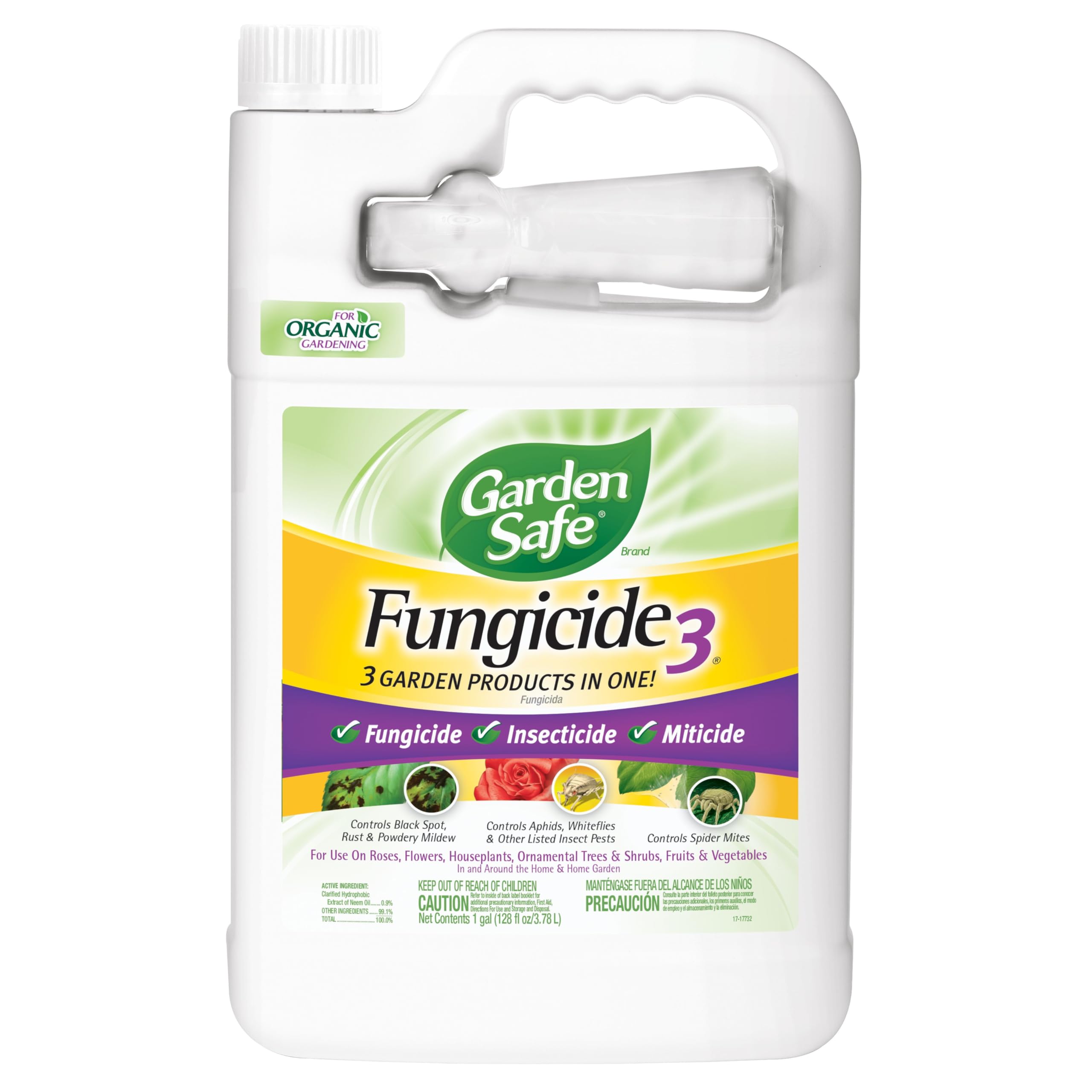
Garden Safe Fungicide3 combines clarified hydrophobic neem oil extract into a single ready-to-use formulation that acts as a fungicide, insecticide, and miticide. The 1-gallon jug includes an integrated sprayer, making it the most convenient option for quick treatment of small to medium shrubs, roses, and ornamental trees. The neem oil works by suffocating fungal spores and insect eggs on contact, and it degrades rapidly in the environment without persistent residues.
Owners of hibiscus, roses, and blueberries report that weekly applications eliminated powdery mildew that had resisted other treatments, turning sickly foliage deep green and improving fruit yields. For vegetable gardeners, the organic certification makes it safe for use on tomatoes and peppers up to the day of harvest. The main trade-off is that the attached sprayer has a short pickup tube — users routinely note the need to tilt the jug or transfer product to a better sprayer for full coverage of tall shrubs.
Because neem oil is a contact fungicide with no systemic activity, it must be applied every 7–14 days for continuous protection. It can cause leaf burn if applied during full sun at temperatures above 85°F. For gardeners who prioritize organic compatibility and want a single bottle that handles both fungal diseases and soft-bodied insects on shrubs, this is the most accessible entry point.
What works
- Three-in-one organic control: fungus, insect, mite
- Ready-to-use with integrated sprayer for quick application
- Safe for edibles up to harvest day
What doesn’t
- Integrated sprayer has limited reach and poor tube design
- Requires frequent reapplication and can burn leaves in hot sun
7. Southern Ag Garden Friendly Biological Fungicide

Southern Ag Garden Friendly uses the beneficial bacterium Bacillus subtilis to colonize root zones and leaf surfaces, outcompeting pathogenic fungi through natural antagonism. It is the only biological option in this guide, and it works through a completely different mechanism than chemical fungicides. As a soil drench, it protects roots from damping-off and root rot; as a foliar spray, it prevents powdery mildew, leaf spot, and blight on vegetables, ornamentals, and fruit trees.
Hydroponic growers and gardeners running water propagation systems report that it stopped stem rot and root rot immediately after application — a problem that had killed previous cuttings. For tomato growers, using it as a weekly soil drench and foliar spray prevented fungal issues entirely and promoted visibly darker, more vigorous foliage. One orchard owner in the high-disease Florida panhandle notes that it reduced pest pressure over time and even acted as a mild bio-fertilizer, darkening grape leaves. The 16-ounce bottle is highly concentrated — the same active ingredient as Hydroguard but at a much higher strength, saving users money per application.
The main limitation is that biological fungicides are preventive, not curative, and require multiple applications to build up the beneficial population. The bottle opening also tends to dribble during measurement. For growers committed to an organic or low-toxicity program, this is the most effective biological option available for trees and shrubs.
What works
- Non-toxic, safe biological control for organic gardens
- Works as both soil drench and foliar spray
- Highly concentrated — far more economical than retail hydroponic brands
What doesn’t
- Preventive only; cannot cure active infections
- Bottle opening design causes messy pouring
Hardware & Specs Guide
Active Ingredient Concentration
The concentration of the active ingredient directly determines how much product you need per gallon of water. Higher percentages (14.3% propiconazole in Quali-Pro and Select Source) mean lower product usage per treatment, reducing cost per application. Lower-concentration copper formulations (Monterey Liqui-Cop at ~27% metallic copper equivalent) require higher mixing rates but offer a broader safety margin on sensitive plants. Always read the label for the exact dilution rate for the target tree or shrub species.
Mode of Action: Systemic vs. Contact
Systemic fungicides (propiconazole) absorb into the plant’s vascular tissue and move through the leaf, offering curative activity against established infections and protection for new growth. Contact fungicides (copper, neem oil, captan) remain on the surface and kill spores as they land — they require thorough, uniform coverage and regular reapplication. For large trees where spray penetration is limited, a systemic product provides more reliable control. For dormant-season prevention on deciduous trees, a contact protectant is often preferred to avoid stressing the plant.
FAQ
Can I use a lawn fungicide on my trees and shrubs?
How often should I spray fungicide on fruit trees?
Is copper fungicide safe for all tree and shrub species?
Final Thoughts: The Verdict
For most gardeners, the best fungicide for trees and shrubs winner is the Quali-Pro Propiconazole 14.3 because its systemic activity, broad-spectrum coverage, and professional concentration provide the most reliable control for woody ornamentals and fruiting trees at a reasonable cost per treatment. If you want a preventive copper that excels in wet climates and fits organic programs, grab the Monterey Liqui-Cop. And for a non-toxic biological approach that protects roots and leaves without synthetic residues, nothing beats the Southern Ag Garden Friendly Biological Fungicide.