
Septoria leaf spot is a persistent fungal disease that targets tomatoes, peppers, and other garden plants, creating small, dark-edged spots that quickly defoliate and reduce yields. Without a targeted treatment plan, the infection spreads through rain splash and overhead watering, making early intervention critical for saving your crop.
I’m Rikta — the co-founder and writer behind Lawn Gear Lab. I’ve spent countless hours analyzing fungicide labels, cross-referencing active ingredients like chlorothalonil and propiconazole, and studying real owner feedback to determine which formulations actually stop Septoria from progressing.
This research-driven guide breaks down the seven most effective options available today to help you choose the right fungicide for septoria leaf spot based on your garden size, plant type, and preferred application method.
How To Choose The Best Fungicide For Septoria Leaf Spot
Septoria lycopersici thrives in warm, wet conditions and attacks from the lower leaves upward. Selecting a fungicide that matches your garden’s stage of infection and your preferred application schedule is the difference between a minor annoyance and a total crop loss.
Systemic vs. Contact Protection
Systemic fungicides like propiconazole and myclobutanil absorb into plant tissue and stop infections from the inside, offering longer residual control between sprays. Contact fungicides such as chlorothalonil and copper ammonium complex coat leaf surfaces to block spore germination but wash off with rain. For Septoria, starting with a systemic product at first signs gives the best chance of halting spread.
Active Ingredient Rotation Is Non‑Negotiable
Septoria can develop resistance if you rely on the same mode of action season after season. Rotating between triazoles (propiconazole, myclobutanil), chloronitriles (chlorothalonil), and multi‑site protectants (copper) keeps the pathogen off balance. A two‑week rotation schedule using two different classes is the standard professional approach for high‑value tomato plots.
Application Method and Coverage Area
Liquid concentrates give you precise mixing ratios for spot‑treating infected beds, while granular systemic options work well for larger lawn or landscape areas where Septoria‑like leaf spots appear on ornamentals. Consider your sprayer type — hose‑end sprayers handle large volumes quickly, but pump sprayers deliver better coverage on the undersides of leaves where Septoria spores first germinate.
Quick Comparison
On smaller screens, swipe sideways to see the full table.
| Model | Category | Best For | Key Spec | Amazon |
|---|---|---|---|---|
| Bonide Fung‑onil Concentrate | Contact | Tomato leaf spot & blight | 32 oz concentrate | Amazon |
| Quali‑Pro Propiconazole 14.3 | Systemic | Lawn & ornamental leaf spot | 32 oz concentrate | Amazon |
| Bonide Rose Rx 3‑in‑1 | Organic | Edible gardens & roses | 16 oz concentrate | Amazon |
| Monterey Fungi‑Max | Systemic | Vegetables & ornamentals | 16 oz concentrate | Amazon |
| Bonide Infuse Granules | Granular Systemic | Lawn & shrub disease | 7.5 lb granules | Amazon |
| Select Source Propiconazole | Systemic | Bermuda & centipede grass | 16 oz concentrate | Amazon |
| Southern Ag Liquid Copper | Contact / Organic | Fruit trees & general spot | 1 gallon concentrate | Amazon |
In‑Depth Reviews
1. Bonide Fung‑onil Multi‑Purpose Concentrate

The 32‑ounce chlorothalonil concentrate from Bonide is the benchmark contact fungicide for serious Septoria outbreaks on tomatoes and vegetables. Its milky‑white suspension clings to leaf surfaces and forms a protective barrier that blocks spore germination. Gardeners report noticeable arrest of yellowing leaf spot spread after two applications spaced ten days apart.
Chlorothalonil is a multi‑site contact fungicide, meaning Septoria finds it extremely difficult to develop resistance — a critical advantage for growers fighting persistent infections year after year. The concentrate mixes easily with water and works with hose‑end or pump sprayers. A single bottle covers substantial garden areas, and the 32‑ounce format delivers many applications at standard mixing rates.
The main trade‑off is that contact fungicides wash off with rain, so you must reapply after heavy weather. Some users note a temporary white residue on fruit that rinses off easily before eating. For edible crops, waiting the labeled pre‑harvest interval is essential. This product is best used as a preventive or early‑stage treatment before Septoria reaches the upper canopy.
What works
- Excellent resistance‑management profile for repeated use
- Large 32‑ounce concentrate delivers many season’s worth of treatments
- Proven performance stopping leaf spot and blight on tomatoes
What doesn’t
- Contact mode needs reapplication after rain or overhead watering
- Leaves a visible white residue on fruit and foliage
2. Quali‑Pro Propiconazole 14.3 Fungicide

Quali‑Pro’s 32‑ounce propiconazole 14.3 concentrate delivers locally systemic disease control that moves into plant tissue for extended protection against leaf spot and brown patch. Designed for turf, ornamentals, and select edibles, this microemulsion formulation produces less odor and better tank stability compared to older emulsifiable concentrates.
Growers combating Septoria on larger landscape plantings appreciate the long‑lasting residual — a single application suppresses disease for up to 14 days, reducing the need for frequent re‑spraying. The concentrate treats over 15,000 square feet of turf at standard rates, making it a cost‑efficient choice for acreage. Owner reports confirm rapid arrest of brown patch on St. Augustine grass and orange rust on blackberries.
Because propiconazole is a single‑site systemic, rotating with a contact fungicide like chlorothalonil is recommended to prevent resistance buildup. Some users note that application during extreme heat can cause temporary leaf stress, so early morning or evening sprays are safest. This fungicide requires full PPE during mixing and application.
What works
- Systemic movement provides longer protection between sprays
- Low‑odor microemulsion mixes cleanly without excessive foaming
- Excellent coverage on large turf areas and ornamental beds
What doesn’t
- Heat‑stress risk if applied during peak sun hours
- Single‑site mode of action requires class rotation
3. Bonide Rose Rx Multi‑Purpose Concentrate

For organic gardeners seeking a single‑bottle solution that handles both fungal leaf spot and soft‑bodied insect pests, the clarified neem oil in Bonide Rose Rx offers a USDA‑certified option. At 16 ounces of concentrate, it mixes with water and covers a range of roses, vegetables, and ornamentals while treating black spot, powdery mildew, and rust alongside aphids and spider mites.
The neem‑based formulation works by disrupting fungal spore development and smothering insect eggs and larvae. Users consistently report that regular applications — every 7 to 14 days — keep Septoria‑like spotting under control without resorting to synthetic chemistry. The product is also safe for use around children and pets once the spray has dried, a major factor for edible garden growers.
The downside is the distinctive sulfurous odor during application, though it dissipates within minutes after drying. Neem oil is primarily preventive and contact‑based, so it may not halt an aggressive Septoria infection that has already colonized lower leaves. Begin applications before disease appears or at the very first leaf‑spot sign for best results.
What works
- Triple‑action protects against fungi, mites, and aphids
- USDA organic approval for edible gardens
- Low toxicity near children and pets after drying
What doesn’t
- Strong garlic‑sulfur smell during mixing and spraying
- Contact‑only action is less effective on established infections
4. Monterey Fungi‑Max with Measuring Spoon
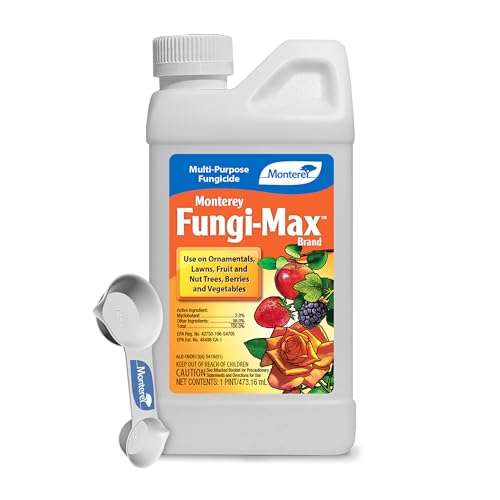
Monterey Fungi‑Max brings myclobutanil — a triazole‑class systemic — into a compact 16‑ounce bottle that treats a wide range of vegetables, ornamentals, turf, and fruit trees. The included measuring spoon simplifies mixing, a small but practical upgrade for gardeners who want precise dilution without guesswork. Each application provides up to two weeks of systemic protection.
Myclobutanil moves upward through the plant’s vascular system, stopping fungal development inside leaf tissue. Gardeners fighting powdery mildew on roses and rust on hawthorn report visible recovery after a single spray. The concentrate is highly efficient — a small amount per gallon means the bottle stretches across multiple seasons for the average home garden.
Like other triazoles, myclobutanil is a single‑site systemic and requires rotation with contact fungicides to avoid resistance. The product is labeled for outdoor use only and should not be applied to edible crops within a certain pre‑harvest window — always check the label for your specific plant. Some users note that very advanced infections may need a second application after the two‑week interval.
What works
- Two‑week residual reduces spray frequency
- Measuring spoon included for accurate mixing
- Broad label covers vegetables, fruit trees, and ornamentals
What doesn’t
- Single‑site systemic needs rotation partner
- Pre‑harvest interval limits application on edibles
5. Bonide Infuse Lawn & Landscape Systemic Granules

When Septoria‑like leaf spot affects large areas of lawn or landscape ornamentals where spraying every leaf is impractical, Bonide Infuse granules offer a set‑and‑forget alternative. The 7.5‑pound bag covers 5,000 square feet, and the systemic active ingredient absorbs through roots to provide two to three months of continuous disease suppression.
This granular formulation is particularly effective on cool and warm‑season turf grasses including Bermudagrass, St. Augustine, and fescue. Homeowners treating brown patch and dollar spot report healthy recovery within weeks of application. The product also works on shrubs and trees — simply scatter around the root zone and water in.
The trade‑off is speed: granules take several days to move into the plant system, so they are not a rescue treatment for an active, fast‑moving Septoria outbreak. Use preventatively in early spring or at the very first sign of leaf spotting. Some users note that granular fungicides alone may not fully stop leaf spot on dense ornamentals, where foliar spray offers more direct coverage.
What works
- Three months of protection from a single granular application
- Zero spraying needed — just scatter and water in
- Safe for all common warm and cool‑season turf grasses
What doesn’t
- Slow uptake makes it unsuitable for rescue treatments
- Granules require thorough watering to activate
6. Select Source Propiconazole 14.3 Concentrate

Select Source’s 16‑ounce propiconazole 14.3 concentrate offers the same systemic active ingredient as premium brands at a budget‑friendly entry point for homeowners managing leaf spot on turf and ornamentals. The low‑odor formulation makes it comfortable to apply around living spaces, and its excellent tank‑mix compatibility allows rotation with azoxystrobin or chlorothalonil.
Gardeners treating brown circle patches on centipede grass and managing general lawn fungus report effective control when used in a bi‑weekly rotation with a different class of fungicide. The concentrate mixes at low use rates — a small bottle goes a long way across multiple growing seasons. Label coverage includes both turf and ornamental applications, making it a dual‑purpose staple.
As a single‑site systemic, propiconazole must be rotated with contact fungicides to maintain long‑term efficacy. Some users mention that advanced leaf spot infections may require two applications 14 days apart for complete control. The bottle lacks a measuring device, so using a separate graduated syringe or measuring spoon is recommended for accurate dilution.
What works
- Very low use rates make the bottle last multiple seasons
- Mixes well with azoxystrobin and other fungicide classes
- Low‑odor formula comfortable for residential application
What doesn’t
- No measuring tool included for accurate mixing
- Single‑site action demands rotation with a contact partner
7. Southern Ag Liquid Copper Fungicide

Southern Ag’s gallon‑size copper ammonium complex concentrate provides a multi‑site contact barrier effective against both fungal diseases and bacterial leaf spots. Containing 8% metallic copper equivalent, it forms a protective film on leaf surfaces that disrupts spore germination and bacterial cell function. The large one‑gallon jug delivers exceptional value for growers with extensive orchard or vegetable plots.
Copper fungicides are one of the oldest and most reliable tools in organic and conventional gardening. Users report excellent results controlling peach leaf curl, pepper blight, and general leaf spotting on fruit trees. The product is also labeled for moss and algae control, adding versatility for paths and structures near garden beds. It works well with hose‑end sprayers for quick coverage of large areas.
Copper is a heavy metal that can accumulate in soil with excessive use, so follow label rates carefully and avoid over‑application. The product can cause phytotoxicity if tank‑mixed with certain fertilizers or pesticides — always test on a small area first. Some customers note that the advertised copper concentration may vary slightly from the actual delivered product, though performance remains consistent across batches.
What works
- Gallons‑ize format covers large fruit and vegetable areas economically
- Controls both fungal and bacterial leaf spot diseases
- Compatible with hose‑end sprayers for fast application
What doesn’t
- Soil copper accumulation risk with heavy repeated use
- Phytotoxicity possible when tank‑mixed with other chemicals
Hardware & Specs Guide
Systemic vs. Contact — The Active Ingredient Map
Systemic fungicides like propiconazole (Select Source, Quali‑Pro) and myclobutanil (Monterey Fungi‑Max) are absorbed into plant tissue and move through the vascular system to stop Septoria from within. Contact fungicides like chlorothalonil (Bonide Fung‑onil) and copper ammonium (Southern Ag Liquid Copper) remain on leaf surfaces to prevent spore germination. For Septoria control, starting with a systemic and following up with a contact rotation gives the broadest protection.
Concentration and Coverage Math
Most liquid concentrates require 1 to 2 ounces per gallon of water. A 16‑ounce bottle of propiconazole yields 8 to 16 gallons of spray solution — enough to cover 4,000 to 8,000 square feet of garden. Granular formulations like Bonide Infuse cover 5,000 square feet at the 7.5‑pound rate. Always calculate your garden’s square footage before purchasing to ensure you buy the right size container for the full treatment window.
Rainfastness and Re‑Entry Intervals
Contact fungicides generally become rainfast within two to four hours of drying, while systemics need just one to two hours before rain is safe. Standard re‑entry intervals for most residential fungicides are 12 to 24 hours. Pre‑harvest intervals (PHI) vary widely — 0 days for neem oil, 7 days for chlorothalonil on tomatoes, and up to 14 days for triazoles on certain fruit. Always consult the product label before harvesting treated crops.
Resistance Management — The Rotation Framework
Septoria can rapidly develop resistance to single‑site fungicides if used exclusively. The industry standard for home gardeners is a 14‑day rotation between two different FRAC code groups: Group 3 (triazoles like propiconazole and myclobutanil), Group M5 (chlorothalonil), and Group M1 (copper). Never apply the same active ingredient more than two consecutive times before switching to a different group.
FAQ
What is the best time of day to apply fungicide for Septoria leaf spot on tomatoes?
How often should I reapply fungicide to control Septoria leaf spot?
Can I use copper fungicide on tomatoes for Septoria leaf spot?
How do I prevent Septoria fungus from coming back after treatment?
Final Thoughts: The Verdict
For most gardeners fighting a current or active Septoria leaf spot outbreak, the fungicide for septoria leaf spot winner is the Bonide Fung‑onil Multi‑Purpose Concentrate because its chlorothalonil active ingredient stops spore germination on contact and carries a low risk of resistance development. If you prefer systemic, longer‑lasting protection with fewer sprays, grab the Quali‑Pro Propiconazole 14.3. And for organic edible gardens where you want one bottle that handles both fungal leaf spot and insect pests safely, nothing beats the Bonide Rose Rx 3‑in‑1 Concentrate.