
Nothing is more frustrating than watching your prized tomatoes, peppers, and squash develop leathery, sunken black spots on the blossom end. That is blossom end rot, a classic symptom of calcium deficiency during fruit development, and it cuts your harvest short exactly when the yield should be peaking. Reaching for a calcium soil amendment is the correct instinct, but choosing the wrong form — gypsum versus lime versus a liquid chelate — can leave the problem untreated or even make your soil chemistry worse. This guide breaks down exactly which calcium source works for your specific soil pH, application method, and crop timeline.
I’m Rikta — the co-founder and writer behind Lawn Gear Lab. I’ve spent countless hours studying agronomic data sheets, analyzing calcium solubility rates, and cross-referencing thousands of verified owner reports to map exactly how each calcium soil amendment behaves under real garden conditions.
Whether you’re fixing a clay-heavy lawn, raising pH for a vegetable bed, or providing fast soluble calcium to container plants, this deep-dive into the best calcium soil amendment for every use case will save you from making a costly mistake in your garden plan.
How To Choose The Best Calcium Soil Amendment
Selecting the right calcium source hinges on three factors: your current soil pH, the speed of correction you need, and whether you want a secondary nutrient like sulfur or magnesium. Apply the wrong form, and you either ignore the root cause or push your soil into an unfavorable pH range.
pH and the Calcium Source Decision
If your soil is already alkaline (pH above 7.0), adding calcium carbonate lime will push it even higher, locking up micronutrients like iron and zinc. For neutral or alkaline soils, choose calcium sulfate dihydrate (gypsum), which delivers calcium without altering pH. For acidic soils (pH below 6.0), prilled dolomitic or calcitic lime is ideal because it raises pH while providing calcium.
Solubility and Release Speed
Water-soluble calcium nitrate acts within days, making it perfect for correcting blossom end rot on fruiting vegetables mid-season. Granular gypsum and oyster shell flour release calcium slowly over weeks to months, better suited for pre-plant soil conditioning. Liquid Cal-Mag supplements provide immediate availability in hydroponic systems or as foliar sprays.
Secondary Nutrient Needs
Gypsum adds sulfur, which benefits protein synthesis in leafy greens and onions. Dolomitic lime supplies magnesium, essential for chlorophyll production. Calcium nitrate delivers nitrogen alongside calcium, promoting leafy growth in tandem with fruit development. Oyster shell flour adds trace minerals and buffers pH gently without risking over-liming.
Quick Comparison
On smaller screens, swipe sideways to see the full table.
| Model | Category | Best For | Key Spec | Amazon |
|---|---|---|---|---|
| Down To Earth Prilled Garden Lime | Lime | Raising acidic soil pH | Calcium Carbonate 80%+ | Amazon |
| Cz Garden Calcium Nitrate 15.5-0-0 | Nitrate | Fast mid-season correction | 19% Ca, 15.5% N, water soluble | Amazon |
| Olympus Myco Gypsum Powder | Gypsum | Soil structure & pH neutrality | 97-99% Calcium Sulfate | Amazon |
| Cz Garden Organic Gypsum Powder | Gypsum | OMRI organic certification | Calcium Sulfate Dihydrate | Amazon |
| Cz Garden Oyster Shell Flour | Shell Flour | Slow pH buffering & poultry | High-purity OMRI listed | Amazon |
| TPS Nutrients Cal-Mag Complete | Liquid | Hydroponics & container plants | 32 oz, micronutrients included | Amazon |
| Alpha Chemicals Calcium Sulfate | Gypsum | Lab-grade mushroom cultivation | Very fine powder, dissolves hot | Amazon |
In‑Depth Reviews
1. Down To Earth Prilled Garden Lime
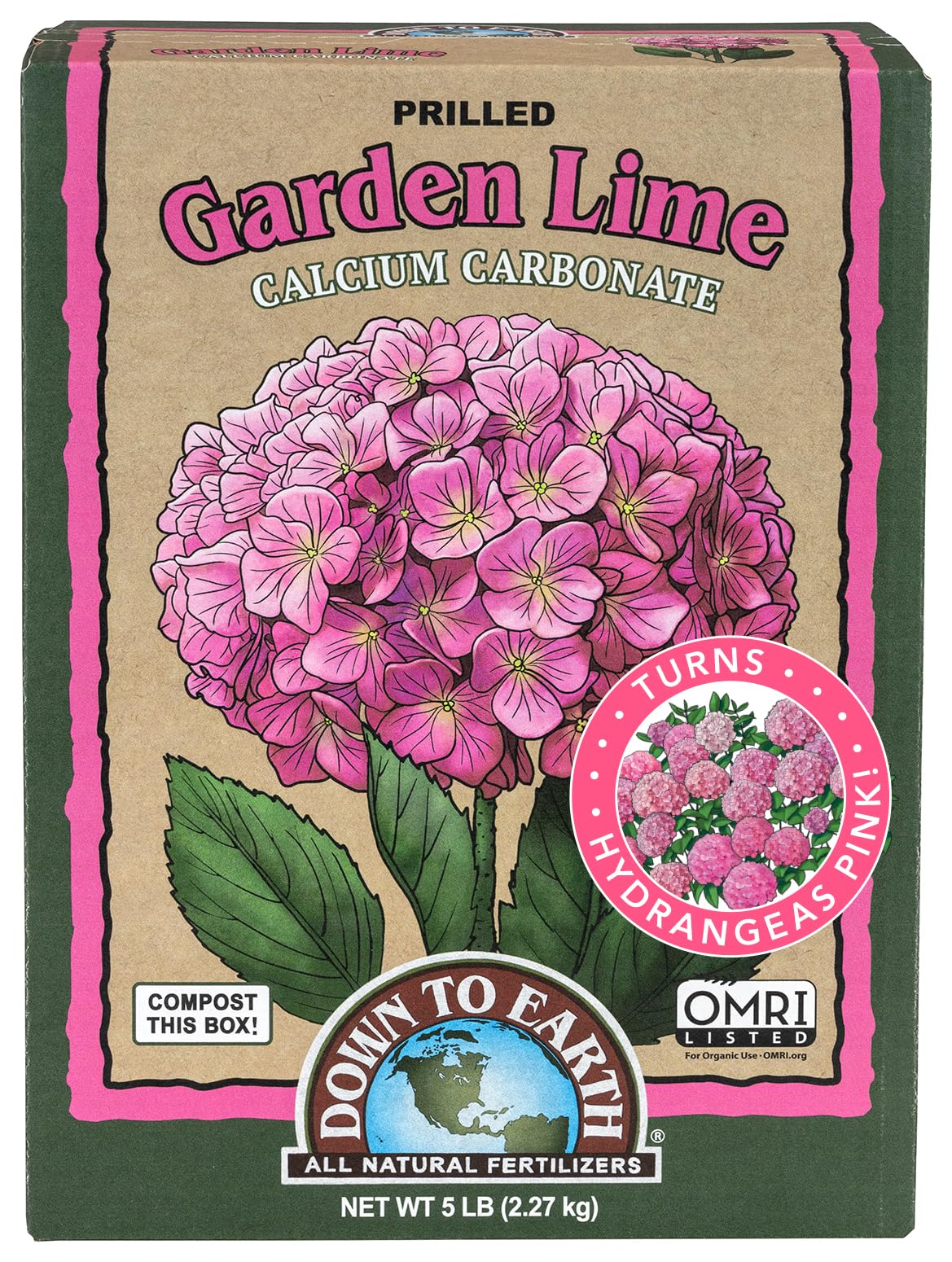
The Down To Earth Prilled Garden Lime delivers high-purity calcium carbonate in a low-dust prilled form that spreads evenly across lawns, vegetable beds, and turf. At roughly 80% calcium carbonate content, it efficiently neutralizes acidic soil while supplying structural calcium for cell wall development. The OMRI listing confirms it meets USDA organic standards, so it fits seamlessly into certified organic production systems.
The 5-pound bag is practical for small gardens and targeted bed preparation, not the bulk coverage of a full-acre field. Finely ground particles react with soil moisture relatively quickly compared to agricultural-grade pebble lime, providing measurable pH shifts within weeks. Users consistently report strong root development and improved blossom-end-rot prevention on peppers and tomatoes when applied at the labelled rate.
One important distinction: this product raises soil pH, so it should never be used around acid-loving plants like blueberries, azaleas, or rhododendrons. The prilled texture minimizes airborne dust during application, an advantage over powdery lime formulations. For gardeners managing acidic soil and needing simultaneous calcium delivery and pH correction, this is the most complete single-bag solution.
What works
- Prilled granules reduce dust compared to powder lime
- Reliable pH lift for acidic soils under vegetables
- OMRI listed for certified organic use
What doesn’t
- Will harm acid-loving plants if applied nearby
- Effect on pH takes weeks, not days
2. Cz Garden Calcium Nitrate 15.5-0-0

The Cz Garden Calcium Nitrate 15.5-0-0 offers the fastest calcium correction of any amendment in this lineup because it is completely water-soluble and delivers nitrogen simultaneously. The 19 percent calcium content paired with 15.5 percent nitrogen makes it ideal for mid-season rescue treatments when blossom end rot appears on tomatoes, zucchini, or peppers. The greenhouse-grade purity means it dissolves without leaving an oily residue that can clog drip irrigation emitters.
Users report visible improvements in as little as ten days, with arrested blossom end rot development on new fruit. The resealable pouch packaging retains moisture control, important because calcium nitrate is hygroscopic and will cake if exposed to humidity. This product suits hydroponic systems, drip irrigation, and foliar sprays equally well — the label provides a 321 feeding schedule that adapts to different grow methods.
The main trade-off is nitrogen content: if your soil already has high nitrogen levels, applying this can trigger excessive foliage growth at the expense of fruiting. It is not suitable for organic certification due to its synthetic nitrate form. For gardeners who prioritize fast, measurable calcium correction and can manage the nitrogen input, this is the most effective tactical tool available.
What works
- Fully water-soluble for immediate plant uptake
- Clears blossom end rot within 10-14 days
- Resealable bag protects against moisture clumping
What doesn’t
- Contains synthetic nitrogen, not organic certified
- Extra nitrogen can delay fruiting if overused
3. Olympus Myco Gypsum Powder

The Olympus Myco Gypsum Powder stands out for its certified 97-99 percent calcium sulfate dihydrate purity, a level that matters when you need predictable chemistry for mushroom substrates or precise soil conditioning. At this purity grade, the gypsum dissolves more consistently than agricultural-grade alternatives, delivering calcium and sulfur without introducing trace contaminants. The 5-pound bag suits hobby mycology and garden-scale soil amendment equally well.
The powder helps loosen compacted clay soils by flocculating clay particles, improving water infiltration and root penetration. Users running avocado trees in large planters report reversal of salt-burn leaf browning after application, confirming its efficacy in container environments where soluble salt buildup is common. The product does not alter soil pH, making it safe for use around acid-loving ornamentals and alkaline-adapted plants alike.
Because this is a very fine powder, it generates more dust during handling than prilled or granular forms, so a dust mask is recommended during application. Mixing it into the top few inches of soil or substrate speeds integration. For growers who want lab-grade calcium sulfate without filler material or pH-altering properties, this is the cleanest option available.
What works
- Exceptional 97-99% purity for consistent results
- Reduces clay compaction without raising pH
- Effective for salt buildup recovery in containers
What doesn’t
- Fine powder creates airborne dust during use
- No secondary macronutrients beyond calcium and sulfur
4. Cz Garden Organic Gypsum Powder

The Cz Garden Organic Gypsum Powder is the OMRI-listed pick for certified organic growers who need a calcium sulfate source without synthetic additives. Each 5-pound bag provides calcium sulfate dihydrate manufactured in the USA, and the resealable heavy-duty pouch makes storage practical for repeated use across multiple seasons. Customer reports show consistent success stopping blossom end rot on Roma tomatoes and improving clay soil structure in raised beds.
The product includes both calcium and sulfur, supporting protein synthesis in leafy crops while also flocculating dense clay particles. Users mention visible improvement in water penetration after one season of application, which directly benefits root zone oxygenation. The pH-neutral profile means you can apply it alongside acid-loving plants without worrying about a lime-induced deficiency lockout.
Some users find the powder texture dusty, though less so than lab-grade gypsum products. Application rates of 1-2 ounces per gallon as a soil drench work well for targeted container treatment. Compared to straight lime, this is the better choice when your soil pH is already in the optimal 6.0-7.0 range and you need calcium without shifting the alkalinity needle.
What works
- OMRI listed for organic farming compliance
- Resealable packaging keeps powder dry longer
- Effective on clay soil structure and water penetration
What doesn’t
- Powder can be dusty during application
- Requires soil incorporation for best results
5. Cz Garden Oyster Shell Flour
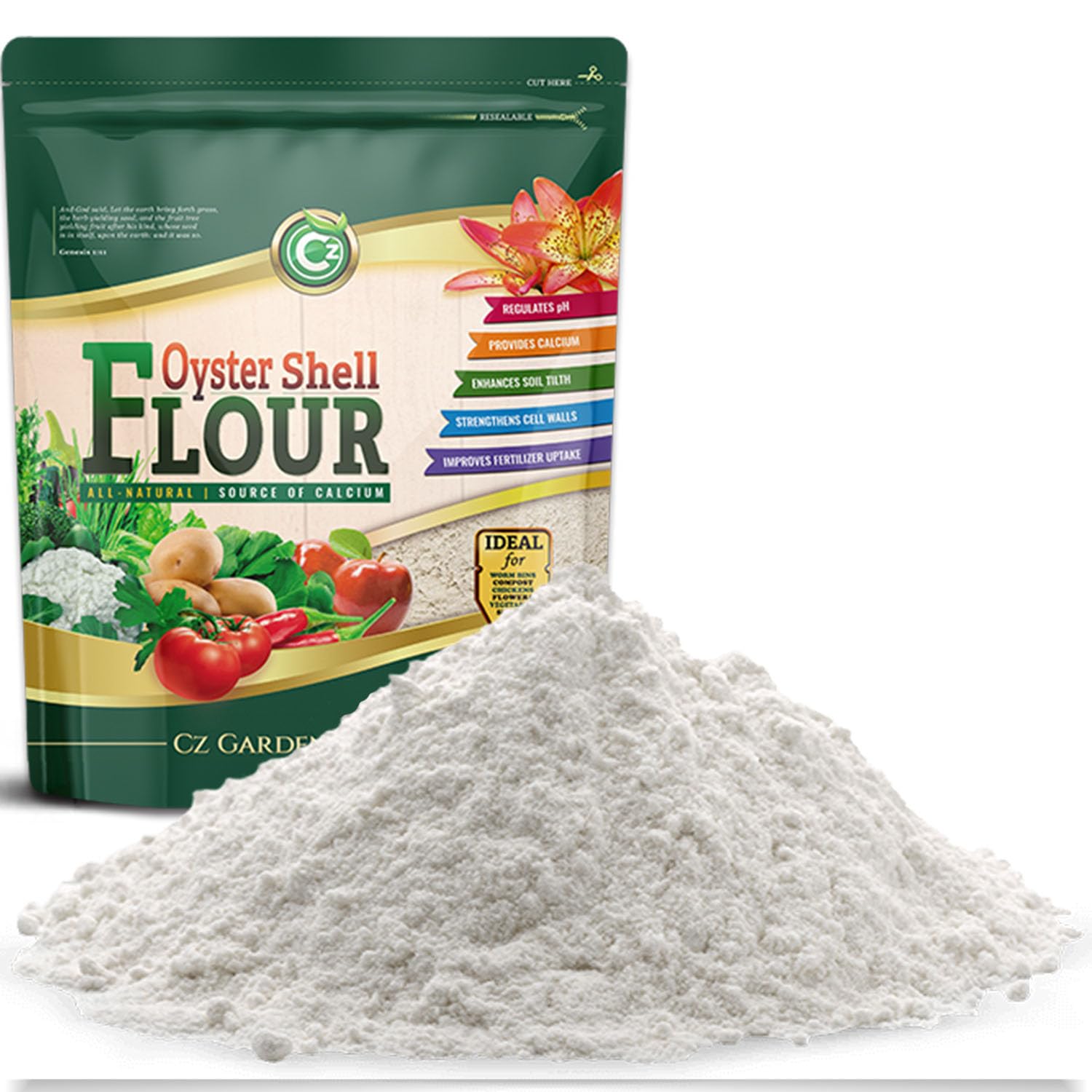
The Cz Garden Oyster Shell Flour provides calcium carbonate from a natural biological source, releasing its calcium content gradually as microbial activity breaks down the shell particles in the soil. This slow-release profile makes it ideal for long-term soil buffering rather than emergency blossom end rot treatment. The OMRI listing confirms it can be used in certified organic garden beds without compromising certification.
Beyond garden use, this product serves chicken keepers who need to improve eggshell strength — many users report that older hens reluctant to eat coarse oyster shell bits readily consume the flour form when mixed into feed. The dual-purpose utility means a single bag covers both soil amendment and poultry supplementation. In worm bins, the flour provides grit and calcium that supports worm reproduction and compost quality.
The main limitation is speed: oyster shell flour takes months to fully break down and correct a calcium deficiency in progress. For gardeners planning a season ahead, mixing it into beds in autumn provides available calcium by the following spring. For immediate correction of blossom end rot mid-season, a faster soluble product should be used instead, with oyster shell flour serving as the long-term maintenance layer.
What works
- Slow, gentle calcium release that won’t burn roots
- Dual-purpose for both garden and poultry calcium needs
- Supports worm bin activity and soil microbiology
What doesn’t
- Too slow for correcting active blossom end rot
- Raises pH, unsuitable for alkaline soils
6. TPS Nutrients Cal-Mag Complete

The TPS Nutrients Cal-Mag Complete is a liquid calcium-magnesium supplement formulated for hydroponic systems, coco coir, and indoor container gardens where granular amendments cannot be incorporated. The 32-ounce bottle includes micronutrients such as iron, zinc, and manganese alongside the primary calcium and magnesium, covering secondary deficiencies that often accompany calcium shortage in soilless media.
Users running indoor tomato and pepper setups report total elimination of blossom end rot after switching to this product, with plants reaching yields exceeding 200 pounds in a single season. The concentrated formulation requires only 1 milliliter per gallon during the flowering and fruiting phase, making the bottle last multiple cycles. It is also effective as a foliar spray for rapid foliar absorption when soil pH issues block root uptake.
The liquid form is less economical per gram of calcium than dry amendments, and you must store it away from freezing temperatures to maintain suspension stability. For hydroponic growers or gardeners using soilless mixes that lack the natural calcium buffering of mineral soil, this is the most convenient and immediately available calcium delivery method in this lineup.
What works
- Immediately available for hydroponic and foliar use
- Includes trace micronutrients for comprehensive correction
- Highly concentrated, small dosage per gallon
What doesn’t
- Higher cost per gram of calcium than dry amendments
- Must be stored above freezing to maintain suspension
7. Alpha Chemicals Calcium Sulfate

The Alpha Chemicals Calcium Sulfate Dihydrate is a straightforward, no-frills feed-grade gypsum that appeals to experienced growers who understand their soil chemistry needs. The very fine powder dissolves readily in hot water — about two-thirds of a cup per five gallons — making it useful for mushroom substrate preparation where uniform calcium distribution is critical. It provides the same calcium sulfate chemistry as garden-label gypsum without any soil-clinging additives.
Users primarily purchase this for mushroom cultivation and hydroponic nutrient blending, since the lab-grade fineness eliminates grit that could clog sprayers or delay dissolution. When applied to clay soil in raised beds, it helped flocculate particles and improve drainage. The price point per pound is among the lowest, though the packaging is a basic bag without resealability, which matters for long-term storage in humid environments.
The main drawback is the lack of instructions tailored to garden use — the product ships with minimal label directions, assuming the buyer already knows application rates. There is also no OMRI organic certification, so certified growers should verify compliance with their program. For budget-conscious mycologists or experienced soil managers who need pure calcium sulfate without marketing markup, this delivers the chemistry with no extras.
What works
- Lab-grade fineness dissolves easily in hot water
- Most economical cost per pound in this roundup
- Excellent for mushroom substrate preparation
What doesn’t
- No OMRI listing for organic certification
- Minimal label guidance for garden application rates
Hardware & Specs Guide
Calcium Carbonate vs. Calcium Sulfate
Calcium carbonate (lime) raises soil pH and is best for acidic soils below 6.0. Calcium sulfate (gypsum) provides calcium without altering pH, making it safe for neutral and alkaline soils. The choice between them hinges on one soil test result: your current pH measurement.
Water Solubility and Plant Availability
Calcium nitrate is 100% water-soluble, providing calcium ions to plant roots within hours. Gypsum is sparingly soluble, releasing calcium over weeks. Oyster shell flour relies on microbial breakdown and releases calcium over months. Match solubility speed to the urgency of the deficiency.
FAQ
Can I use gypsum and lime together in the same bed?
How quickly does oyster shell flour correct blossom end rot?
Final Thoughts: The Verdict
For most gardeners, the best calcium soil amendment is the Cz Garden Calcium Nitrate 15.5-0-0 because it delivers fast, water-soluble calcium that stops blossom end rot within two weeks. If you need to raise soil pH while providing calcium, go with the Down To Earth Prilled Garden Lime. For pH-neutral clay soil conditioning and mushroom substrates, the Olympus Myco Gypsum Powder is your best bet.