
A corded chainsaw delivers nonstop torque and eliminates the two biggest frustrations of gas and battery models: stale fuel and dead batteries. Whether you’re cleaning up after a storm, feeding a wood stove, or trimming overgrown limbs, a corded electric saw pulls consistent power from the wall outlet, meaning no downtime for charging or refueling. The trade-off is a shorter reach, limited by your extension cord, but the payoff is a lighter, quieter, and nearly maintenance-free cutting machine that starts every single time you squeeze the trigger.
I’m Rikta — the co-founder and writer behind Lawn Gear Lab. I’ve spent hundreds of hours comparing motor amperage, bar length, chain speed, auto-oiling systems, and self-sharpening mechanisms across dozens of models, reading through thousands of owner reports to separate the real performers from the ones that fail in the field.
This guide focuses exclusively on models that earn a spot in the conversation around the best corded chainsaw, evaluating each on build quality, cutting speed, safety features, and long-term durability so you can buy with confidence.
How To Choose The Best Corded Chainsaw
Not all corded chainsaws are built the same. The biggest differentiators are motor amperage, bar length, chain maintenance features, and safety. The wrong pick means frustrating cuts, frequent chain adjustments, or premature motor failure — the right pick means years of reliable service.
Motor Amperage and Cutting Power
The motor’s amp rating is the single most important spec on a corded chainsaw. A 12-amp motor is adequate for limbs up to about 10 inches in diameter and occasional light pruning. A 15-amp motor, on the other hand, delivers the sustained torque needed to rip through 18-inch logs and dense hardwoods without bogging down. If you plan to cut firewood or tackle storm cleanup, skip the 12-amp models and go straight for 15 amps.
Bar Length and Cutting Capacity
Bar length determines the maximum diameter of log you can cut in a single pass. A 14-inch bar handles pruning and small branches, a 16-inch bar is the sweet spot for most homeowners, and an 18-inch bar gives you the capacity to fell medium trees and process larger rounds. Keep in mind that a longer bar demands more motor power to drive the chain effectively — an 18-inch bar without a strong motor will cut slowly and overheat.
Auto-Oiling System and Chain Tensioning
Every corded chainsaw worth buying includes an automatic oiler that lubricates the bar and chain during operation. The key differences are oil tank visibility (a clear window lets you see the level at a glance) and tool-free tensioning, which lets you tighten the chain without carrying a wrench. Consistent oil flow and easy tension adjustment are the two things that separate models that last from models that chew through chains and bars.
Safety Features
A handle-mounted trigger lockout prevents accidental startups, and an automatic kickback brake stops the chain in a fraction of a second if the bar kicks upward. Look for both — together they form the baseline safety package. The chain should also stop within a few seconds of releasing the trigger; models that take longer to stop can be dangerous during reactive cuts.
Quick Comparison
On smaller screens, swipe sideways to see the full table.
| Model | Category | Best For | Key Spec | Amazon |
|---|---|---|---|---|
| Oregon CS1500 (Product 6) | Premium | All-around heavy cutting with self-sharpening | 15A / 18-inch bar / Self-sharpening | Amazon |
| Oregon CS1500 Oil Kit (Product 7) | Premium | Self-sharpening with included oil | 15A / 18-inch bar / Self-sharpening + 32 oz oil | Amazon |
| WEN CP1518 | Mid-Range | Powerful budget-friendly 18-inch cutter | 15A / 18-inch bar / 41 ft/s chain speed | Amazon |
| BLACK+DECKER CS1216 | Mid-Range | Trusted brand for general yard tasks | 12A / 16-inch bar / Tool-free tensioning | Amazon |
| Sun Joe SWJ599E | Budget | Light pruning and limb trimming | 9A / 14-inch bar / Lightweight 7.7 lbs | Amazon |
| SENIX CSE12-M | Budget | Entry-level homeowner cutting | 12A / 16-inch bar / 13.5 m/s chain speed | Amazon |
| ReliaRoads Brushless (Battery) | Alternative | Cordless flexibility for Dewalt battery users | 40V (2x20V) / 16-inch bar / Brushless | Amazon |
In‑Depth Reviews
1. Oregon CS1500 Self-Sharpening Electric Chain Saw

The Oregon CS1500 is the benchmark for corded chainsaws, combining a 15-amp motor with a game-changing integrated PowerSharp self-sharpening system. Instead of stopping work to file or replace a dull chain, you simply activate the sharpener, and within 3 to 5 seconds the chain is cutting like new. This feature alone saves hours over the life of the saw, especially when cutting dirty or abrasive wood that dulls a chain quickly. The 18-inch bar maximizes cutting capacity for a wide range of tasks, from processing firewood to clearing storm debris.
Beyond the sharpening system, the CS1500 offers tool-free chain tensioning and an automatic oiler with a clear reservoir window. The chain brake and trigger lockout provide solid safety redundancy. Owners consistently report this saw running strong for five years or more under heavy use — some have cut over 12 cords of wood before needing minor repairs like brush replacements, which Oregon makes easy with accessible parts. At 12.6 pounds, it’s not the lightest model, but the weight is well-balanced and contributes to a stable, controlled cut.
The only recurring theme in owner feedback is that the chain must be kept very tight; if it loosens even slightly, it can jump off the bar during a cut. This is not a design flaw — it’s a characteristic of any high-torque chainsaw — but it does mean you will use the tool-free tensioner frequently. The dedicated PowerSharp chain is more expensive to replace than a standard chain, but the ability to sharpen in seconds between cuts makes the added cost worth it for anyone who cuts regularly.
What works
- PowerSharp self-sharpening works in seconds between cuts
- 15-amp motor powers through 18-inch hardwood rounds with ease
- Tool-free tensioning and clear oil window simplify maintenance
- Proven long-term reliability — many users report 5+ years of heavy service
What doesn’t
- Dedicated PowerSharp chain costs more to replace than standard chain
- Chain loosens quickly and can jump the bar if not kept tight
- Housing gets warm during extended cutting sessions on large logs
2. Oregon CS1500 2400W with Oil Kit

This variant of the Oregon CS1500 is essentially the same proven 15-amp, 18-inch self-sharpening saw, but it ships with a full quart of Oregon’s premium bar and chain oil. The oil has a tacky formulation that stays on the chain longer than standard bar oil, reducing drip and extending lubrication intervals — a meaningful advantage during longer cutting sessions. If you have never used a chainsaw before, starting with the right oil from day one prevents a dry startup that can damage the bar and chain.
The 2400W motor (15 amps at 120V) delivers the same consistent torque that makes the CS1500 platform a favorite among serious homeowners. The self-sharpener, tool-free tensioner, and automatic oiler function identically to the standalone model. Owners report that the included oil lasts through multiple sessions, and the thicker viscosity noticed by several users seems to reduce chain wear compared to generic oils. The saw is sold as a kit, so there is no need to buy oil separately for the first several tanks.
A small but notable inconvenience is that the first unit received by some owners had a defective motor that smoked within the first 30 minutes. Oregon’s customer service handled these exchanges without hassle, and the replacement units performed flawlessly. This QC issue appears to affect a low percentage of units, but it is worth mentioning — if you get a good one (which the vast majority do), it will last for years. The self-sharpener chain still costs more to replace than a standard chain, but the bundled oil at this price point partially offsets that long-term expense.
What works
- Includes a full quart of premium tacky bar oil — no separate purchase needed
- Self-sharpening system and tool-free tensioning save significant time
- Powerful 15-amp motor easily handles 14-inch and larger diameter trees
- Great value for a complete kit with oil included
What doesn’t
- Small risk of receiving a defective motor unit (though warranty exchange is smooth)
- Self-sharpening replacement chain is more expensive than standard chain
- Chain must stay tight to prevent derailing during cuts
3. WEN CP1518 15-Amp 18-Inch Corded Chainsaw

The WEN CP1518 punches well above its price point, pairing a 15-amp motor with an 18-inch bar and a chain speed of 41 feet per second. That combination gives it the fastest chain speed among the models in this guide, translating to cleaner cuts and less bogging when the bar is fully buried in dense wood. Users report that it handled live pine with heavy sap and a 27-inch diameter trunk without any sign of motor strain — impressive for a corded electric saw at this price tier.
The CP1518 includes all the modern conveniences you need: an automatic oiler, tool-free chain tensioning, a kickback brake, and a cable strain relief notch to prevent the extension cord from pulling loose. The oil tank window is clear and easy to read, so you will not accidentally run dry. Assembly is straightforward despite the minimal printed instructions — common sense gets the bar and chain on in under ten minutes. The protective sheath and two-year warranty round out a package that is hard to beat on pure specs.
Where the WEN falls short of the Oregon is in long-term consistency. Several owners reported that the chain tends to fall off if it loosens during a cut, and a small number experienced motor failure after cutting just one or two small trees. The majority have no issues and get years of reliable use, but the failure rate appears higher than on the Oregon CS1500. This is the trade-off for a lower price: you get the same raw power and features, but the build quality and QC are not quite at the same level. For homeowners on a tighter budget who need 18-inch capacity, this is still a strong choice.
What works
- 15-amp motor and 41 ft/s chain speed deliver very fast cutting
- Auto-oiler with clear window and tool-free tensioning are convenient
- Kickback brake and strain relief notch add critical safety and reliability
- Excellent price-to-performance ratio for an 18-inch saw
What doesn’t
- Chain loosens frequently and may derail if not checked every few cuts
- Small but noticable risk of motor failure within the first session
- Assembly instructions are poor — you will rely on common sense
4. BLACK+DECKER CS1216 12-Amp 16-Inch Corded Chainsaw
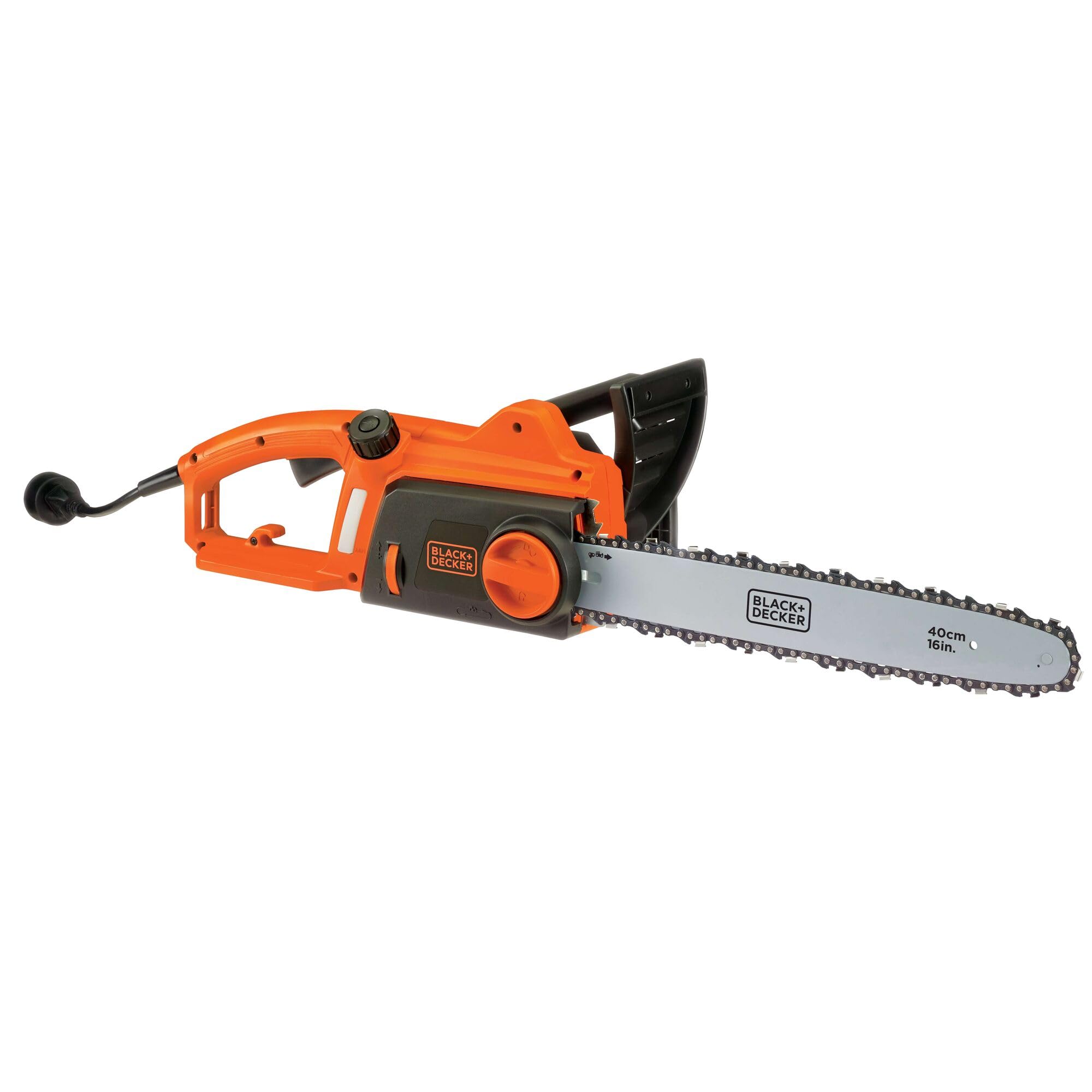
The BLACK+DECKER CS1216 is the default recommendation for homeowners who need a reliable corded saw for routine yard cleanup without the cost or complexity of a premium model. The 12-amp motor is adequate for branches and logs up to about 14 inches in diameter, and the 16-inch bar provides enough reach for most pruning and light tree removal tasks. The low-kickback bar and chain design, combined with the tool-free chain tensioning system, makes this one of the easiest saws to set up and operate safely right out of the box.
The automatic oiler keeps the chain lubricated, and the clear oil window is positioned so you can see the level at a glance. Owners who transitioned from failing gas saws consistently praise how effortlessly the CS1216 starts and runs — no pull cord, no choke, no fuel mixing. It works reliably with a 100-foot 12/3 extension cord, giving you plenty of reach around a typical suburban yard. The saw also runs much quieter than any gas equivalent, meaning you can use it earlier in the morning or later in the evening without disturbing neighbors.
The main limitations are the 12-amp motor’s reduced torque compared to a 15-amp saw, and the chain’s tendency to jump off the bar when under sideways pressure if the tension isn’t perfect. The chain also takes 5 to 6 seconds to stop after releasing the trigger, which is longer than the instant stop on many newer models. Some users also find the rear handle grip is a bit tight, making it harder to release the trigger quickly during one-handed operation. For light to medium use, these are minor trade-offs; for heavy, continuous cutting, the 15-amp models are a better fit.
What works
- Very reliable electric start — no gas engine maintenance required
- 12-amp motor handles 14-inch logs with consistent power
- Tool-free tensioning and clear oil window simplify daily use
- Lightweight and quiet for neighborhood-friendly operation
What doesn’t
- 12-amp motor lacks the torque for heavy, sustained cutting in hardwoods
- Chain takes 5-6 seconds to stop after releasing the trigger
- Chain can derail under sideways pressure if tension isn’t perfect
- Rear handle grip is tight, making one-handed operation cumbersome
5. Sun Joe SWJ599E 14-inch 9-Amp Corded Chainsaw

The Sun Joe SWJ599E is the lightest saw in this guide at just 7.7 pounds, and it is purpose-built for users who prioritize maneuverability over raw power. The 9-amp motor and 14-inch bar are designed for trimming and pruning branches up to about 6 inches in diameter — not for felling trees or processing firewood. The reduced weight makes it an excellent choice for ladder work, overhead limbs, and tasks where swinging a heavier saw would cause arm fatigue within minutes.
The automatic oiler with a window to gauge oil level works effectively, and the chain stays lubricated throughout a session. Several owners, including some with less upper-body strength, reported that the SWJ599E allowed them to cut down small trees and bushes without needing to hire a gardener — a testament to the saw’s accessible design. It also works surprisingly well for indoor demolition tasks like cutting thick MDF cabinet material, producing minimal sawdust and low noise compared to a circular saw.
The trade-offs are significant. The 9-amp motor will bog down if you try to force it through wood larger than 6 inches, and the chain can dull after just 10 or so cuts if you are cutting dirty or gritty wood. The flat-head screw for chain tensioning is recessed and sits very close to the chain, making it difficult to adjust without risking contact with the teeth. This is a frustrating design choice that undermines an otherwise user-friendly saw. For light, occasional pruning, the Sun Joe is a capable little workhorse; for anything approaching serious cutting, step up to a 12-amp or 15-amp model.
What works
- Very lightweight at 7.7 lbs — ideal for overhead pruning and ladder use
- Auto-oiler with clear window keeps the chain properly lubed
- Low noise and minimal vibration compared to gas saws
- Easy setup and intuitive operation for beginners
What doesn’t
- 9-amp motor lacks the torque for cuts over 6 inches in diameter
- Chain dulls relatively quickly on dirty or gritty wood
- Chain tension screw is recessed and difficult to access safely
6. SENIX CSE12-M 12-Amp 16-Inch Corded Chainsaw
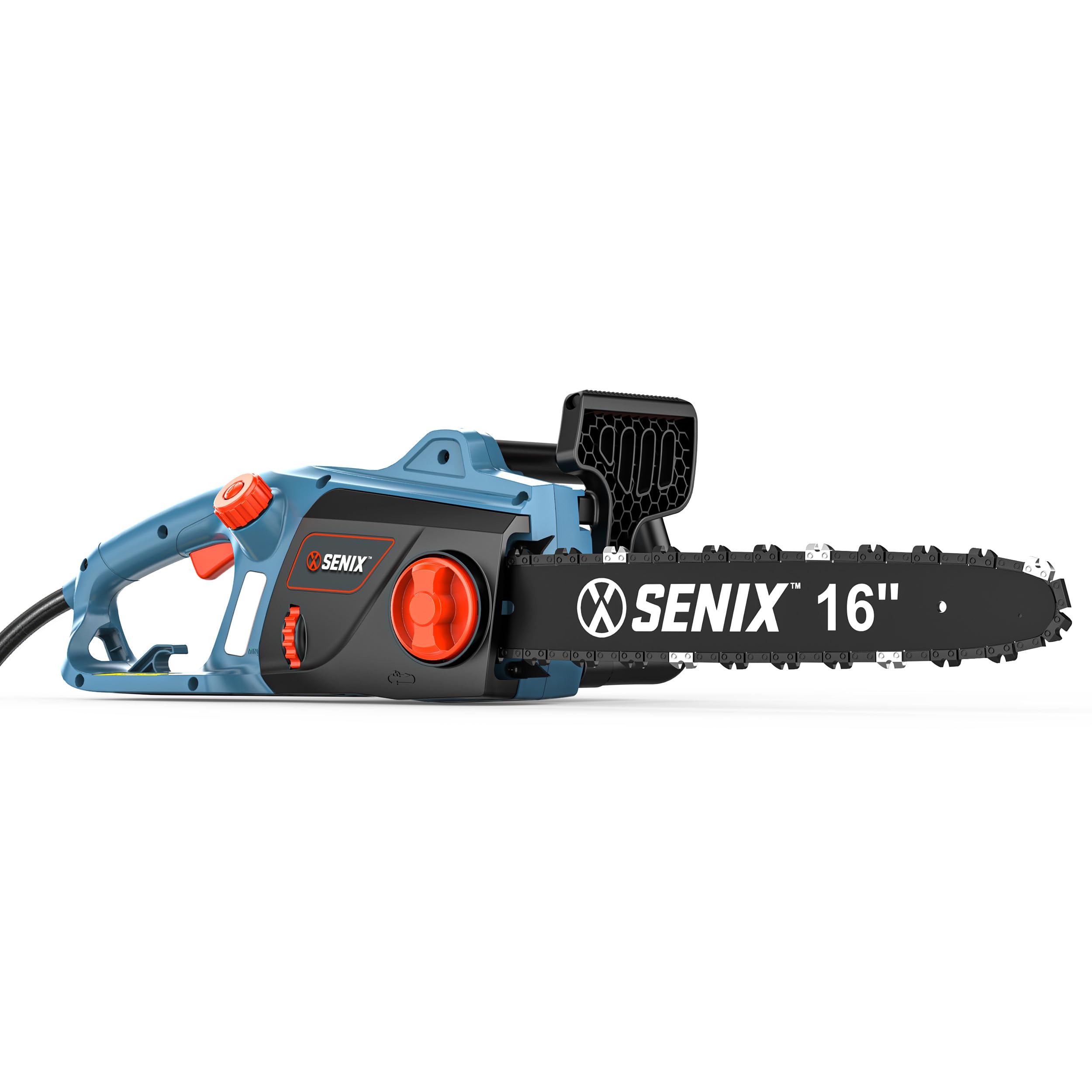
The SENIX CSE12-M offers a 12-amp motor, a 16-inch bar, and a 13.5 m/s chain speed at an entry-level price point that competes directly with the BLACK+DECKER CS1216. The motor is rated at 3.5 horsepower — a number that reflects peak output rather than sustained torque — but in practice it cuts through 12-inch hardwood logs and 8-inch stumps without stalling when used properly. The auto-oiling system holds 5.8 ounces of oil, and the trigger lockout and automatic kickback brake provide the same safety baseline as more expensive models.
Several owners reported that the SENIX handled three cords of firewood without any mechanical issues, which is strong performance for a saw in this tier. The tool-free chain tensioning works smoothly, and the included bar and chain cover protects the saw during storage. The lightweight design, around 13 pounds, reduces fatigue during moderate cutting sessions. The 2-year warranty provides reasonable peace of mind for a saw at this price point.
The downside is inconsistent quality control. A significant number of owners received units that broke immediately — the motor failed or the chain derailed uncontrollably within minutes of first use. Others reported that the chain requires very frequent tightening, sometimes after every few cuts, and that the saw heats up noticeably when cutting oversized stumps. Instructions are poorly written and confusing for first-time chainsaw users. When it works, the SENIX delivers excellent value; but the risk of receiving a lemon is higher than with the more established brands.
What works
- 12-amp motor with 16-inch bar handles up to 12-inch logs in normal use
- Auto-oiling system and tool-free tensioning simplify daily operation
- Very affordable entry point for homeowners with light cutting needs
- Includes bar cover and scrench tool for basic maintenance
What doesn’t
- Inconsistent QC — some units break immediately or fail to start
- Chain requires very frequent tightening, sometimes after every cut
- Instructions are poorly written and confusing
- Saw heats up noticeably during extended use on large wood
7. ReliaRoads 16-Inch Brushless Cordless Chainsaw (for Dewalt Battery Users)

The ReliaRoads brushless chainsaw is included here as a cordless alternative for readers who already own Dewalt 20V MAX batteries and want the flexibility of a battery-powered saw without buying into a separate battery platform. It runs on two Dewalt-compatible 20V MAX batteries wired in series to produce 40V, using a brushless motor for higher efficiency and longer runtime than a brushed equivalent. The 16-inch bar and automatic oil pump make it suitable for pruning and light to medium cutting tasks.
The saw’s chain brake stops the chain in 0.1 seconds, and the rapid-stop feature halts rotation within 1.5 seconds of releasing the trigger — faster than many corded models. Owners who used high-quality Dewalt batteries (4-8Ah each) reported that the saw cuts through 15-inch green elm like butter and that the battery life exceeds one hour of intermittent use. The brushless motor runs cooler and quieter than a brushed motor, and the lack of a power cord makes it easy to take up a ladder or into the middle of a large yard without worrying about extension cord reach.
The biggest catch is that batteries are not included. You need two Dewalt 20V MAX batteries (each at least 4Ah, ideally 6-8Ah) to get adequate runtime. Using cheap aftermarket batteries can cause the saw to heat up quickly and deliver reduced power. The chain also needs tension adjustment after several cuts — a normal characteristic but one that requires attention. This saw is not a replacement for a corded or gas saw for heavy firewood processing, but for Dewalt users who want a cordless pruning saw that fits their existing tool ecosystem, it is a capable and affordable option.
What works
- Uses standard Dewalt 20V MAX batteries — no new battery platform needed
- Brushless motor delivers strong cutting power with up to 54 ft/s chain speed
- Chain brake and rapid-stop provide fast, reliable safety
- Lightweight and cordless for easy maneuverability on ladders and in tight spaces
What doesn’t
- Batteries not included — requires two compatible 20V MAX batteries
- Underpowered for heavy firewood processing compared to 15-amp corded saws
- Chain needs regular tension checks and adjustments during use
- Cheaper aftermarket batteries can overheat and reduce performance
Hardware & Specs Guide
Motor Amperage (12A vs 15A)
The motor amperage is the most important spec for determining cutting capability. A 12-amp motor is sufficient for pruning and cutting branches up to 12-14 inches in diameter. A 15-amp motor delivers about 25 percent more torque, allowing the saw to maintain chain speed under load when cutting through large hardwood logs or dense, frozen wood. If you plan to cut firewood or process storm debris regularly, choose a 15-amp model — the extra power prevents the saw from bogging down and reduces the risk of the motor overheating during sustained use.
Self-Sharpening Systems
Self-sharpening systems, like Oregon’s PowerSharp, allow you to sharpen the chain in seconds while the saw is running by pressing a button or lever that engages a sharpening stone against the chain. This eliminates the need to remove the bar and chain for manual filing and extends the usable life of the chain between replacements. The trade-off is that the chain is proprietary and costs more to replace than a standard chain. For users who cut frequently or in dirty wood that dulls chains fast, the convenience outweighs the cost.
Auto-Oiling and Oil Window Visibility
Every corded chainsaw in this guide includes an automatic oiler that pumps bar and chain oil from a reservoir onto the bar rails and chain links during operation. The two critical quality indicators are tank capacity and window visibility. A larger tank (5-8 ounces) means fewer refills during a long session. A clear, well-positioned oil window lets you see the oil level without stopping to remove the cap. Models with dark or poorly placed windows force you to guess — and running the saw dry for even a minute can permanently damage the bar and chain.
Tool-Free Chain Tensioning
Chain tensioning is the most frequent adjustment you will make on a corded chainsaw. A saw with a tool-free tensioning system uses a knob or dial that you turn by hand to tighten or loosen the chain, without needing a scrench or socket wrench. This feature is a major convenience because chains stretch as they warm up during use, and a loose chain can derail, kick back, or cut poorly. All the mid-range and premium models in this guide include tool-free tensioning; budget models may still use a screw-and-nut design that requires a tool to adjust.
FAQ
Can a corded chainsaw cut as fast as a gas chainsaw?
How long of an extension cord can I use with a corded chainsaw?
Why does my corded chainsaw keep throwing the chain off the bar?
Is a self-sharpening chainsaw worth the extra cost?
Can I use a corded chainsaw in the rain or wet conditions?
Final Thoughts: The Verdict
For most gardeners, the best corded chainsaw winner is the Oregon CS1500 because its 15-amp motor, 18-inch bar, and integrated self-sharpening system deliver the best combination of power, convenience, and long-term reliability at a mid-range price. If you want a dedicated self-sharpening kit with a quart of premium oil included, grab the Oregon CS1500 Oil Kit. And for the best value in an 18-inch saw with the fastest chain speed, nothing beats the WEN CP1518.