
A commercial trimmer isn’t just a weed wacker with a bigger price tag — it’s a machine engineered for daily abuse, longer runtimes, and cutting through growth that would stall a residential model in seconds. Whether you’re running a landscaping crew or maintaining acreage that demands real torque, the difference between a trimmer that lasts the season and one that dies by July comes down to displacement, cooling, and how the power gets to the head.
I’m Rikta — the co-founder and writer behind Lawn Gear Lab. I’ve spent hundreds of hours cross-referencing manufacturer spec sheets, analyzing owner testimony from commercial users, and comparing the measurable metrics — cc displacement, RPM curves, cutting swath, line diameter, and battery voltage — that define whether a trimmer can handle real work or is just dressed up for the hardware store shelf.
This guide breaks down nine models built for sustained use so you can confidently select the best commercial trimmer that matches the specific vegetation and daily demands of your property or business.
How To Choose The Best Commercial Trimmer
The wrong trimmer choice leads to constant downtime, failed starts, and the expensive realization that you bought a machine built for weekend touch-ups, not the daily grind. Commercial trimmers differ from consumer models in three critical areas: the power source’s ability to sustain torque under load, the durability of the drivetrain, and the serviceability of wear parts like the head and air filter. Here is how to evaluate each.
Engine Displacement vs. Battery Voltage
Gas-powered commercial trimmers typically start at 25cc and go up to 30.5cc or higher. The displacement directly correlates to torque — a 28cc engine can spin through thick blackberry canes and saplings where a 22cc engine would bog and stall. On the battery side, voltage tells only half the story; a 60V platform can deliver high RPM, but the amp-hour rating determines how long that power lasts. For sustained commercial use, look for at least 4Ah on a 60V system or 8Ah on an 18V/20V system. Anything less and you’ll be swapping batteries more often than you’re trimming.
Shaft Design and Gear Ratio
Straight shafts dominate the commercial category because they transfer power more efficiently from the engine or motor to the cutting head. Curved shafts are lighter but lose mechanical advantage. A 2:1 high-torque gear ratio (common on pro-grade models like the ECHO X Series) delivers more rotational force to the head, allowing the trimmer to power through heavy grass without the engine bogging. If you’re cutting mainly ditch weeds and soft grass, a standard ratio works fine. For woody vines and saplings, prioritize a high-torque gear setup.
Cutting Swath and Line Diameter
Wider cutting swaths (16 to 20 inches) clear more ground per pass, which matters when you’re covering acres. But a wider swath also demands more power from the engine or motor. A 20-inch swath on a 28cc gas trimmer is productive; the same swath on a lower-voltage battery trimmer will drain the battery faster without delivering clean cuts. Line diameter is equally important. Standard .080-inch line works for light grass, but .095-inch or even .105-inch line is necessary for thick weeds and small brush. Make sure the trimmer head is rated for the thicker line you intend to use.
Vibration Control and Operator Fatigue
Commercial operators spend hours running a trimmer each day. Models with built-in anti-vibration systems — like Husqvarna’s LowVib technology — dramatically reduce hand-arm vibration syndrome and allow longer work sessions without numbness. Weight distribution also matters. A trimmer with a top-mounted motor or engine shifts the center of gravity closer to the operator, reducing the feeling of the head dragging. If you’re running a crew, vibration control and balance directly affect daily productivity and long-term operator health.
Attachment Compatibility and Ecosystem
Many commercial-grade trimmers accept attachments such as edgers, pole saws, hedge trimmers, and brushcutters. A single powerhead that accepts multiple tools is more cost-effective than buying separate machines, but attachment compatibility varies. Husqvarna, Milwaukee (QUIK-LOK), and DEWALT all offer proprietary or universal attachment systems. If you plan to use attachments, verify that the system is robust enough for daily swapping and that the attachments are readily available. Some pro-grade models like the Husqvarna 122RJ come with both a trimmer head and a grass blade, giving you two tools in one box.
Quick Comparison
On smaller screens, swipe sideways to see the full table.
| Model | Category | Best For | Key Spec | Amazon |
|---|---|---|---|---|
| Husqvarna 330LK | Gas Mid-Range | Large acreage, daily pro use | 28cc engine, 20-inch swath | Amazon |
| ECHO SRM-3020T | Gas Premium | Extreme brush, commercial crew | 30.5cc, 2:1 gear ratio, 1.8HP | Amazon |
| Husqvarna 122RJ | Gas Multi-Tool | Multi-tasking with blade & string | 22cc, includes grass blade | Amazon |
| Milwaukee 2825-20ST | Battery Mid-Range | Demanding trimming on M18 platform | 6200 RPM, 16-inch swath | Amazon |
| DEWALT DCST972B | Battery Premium | High power, universal attachments | 60V, 17-inch adjustable swath | Amazon |
| Milwaukee M18 Fuel QUIK-LOK | Battery Mid-Range | Switching tasks with QUIK-LOK system | 31cc gas-equivalent power | Amazon |
| Greenworks ST60L254 | Battery Value | Quiet trimming, mid-size yards | 60V, 6000 RPM, 16-inch swath | Amazon |
| Husqvarna 122LK | Gas Entry | Light commercial, mixed property | 22cc, 17-inch swath | Amazon |
| DEWALT DCHT821B | Battery Entry | Hedge trimming, light brush cleanup | 20V, 22-inch dual-action blades | Amazon |
In‑Depth Reviews
1. Husqvarna 330LK Gas String Trimmer

If you are covering multiple acres weekly and need a trimmer that starts reliably and pulls hard through thick grass, the 330LK justifies its mid-range price through pure displacement and thoughtful engineering. The 28cc engine delivers an 8000 RPM top speed, and the customizable cutting width — switchable between 18 inches for maximum torque in dense patches and 20 inches for open-area efficiency — gives operators real flexibility without swapping tools.
The Rapid Replace trimmer head is a genuine time-saver for daily commercial use. Instead of fighting with spool disassembly, you align, load, and twist for a complete line change in under two minutes. The spring-assisted starting mechanism reduces pull effort by 30 percent, which directly reduces operator fatigue when the trimmer is fired up dozens of times per day. Combined with the LowVib anti-vibration system, this trimmer is designed for sustained runtime.
Multiple owner reports from large-property users confirm the 330LK runs without issues through multiple tanks of gas weekly, though the handle design can loosen during the initial break-in period and requires retightening. The new Rapid Replace head has been flagged by some heavy-use operators for failing to engage after several seasons of intense work on acreage with horses and rough terrain, but these cases are outliers against a long history of Husqvarna durability.
What works
- Customizable 18 to 20-inch cutting swath adapts to grass density and terrain.
- Spring-assisted start combined with LowVib reduces daily operator strain significantly.
- Rapid Replace head allows fast line reloading without tools or disassembly.
What doesn’t
- Handle assembly can loosen during the first few tanks of gas and needs periodic tightening.
- Some long-term owners report the Rapid Replace mechanism failing after years of heavy commercial abuse.
2. ECHO SRM-3020T Gas String Trimmer
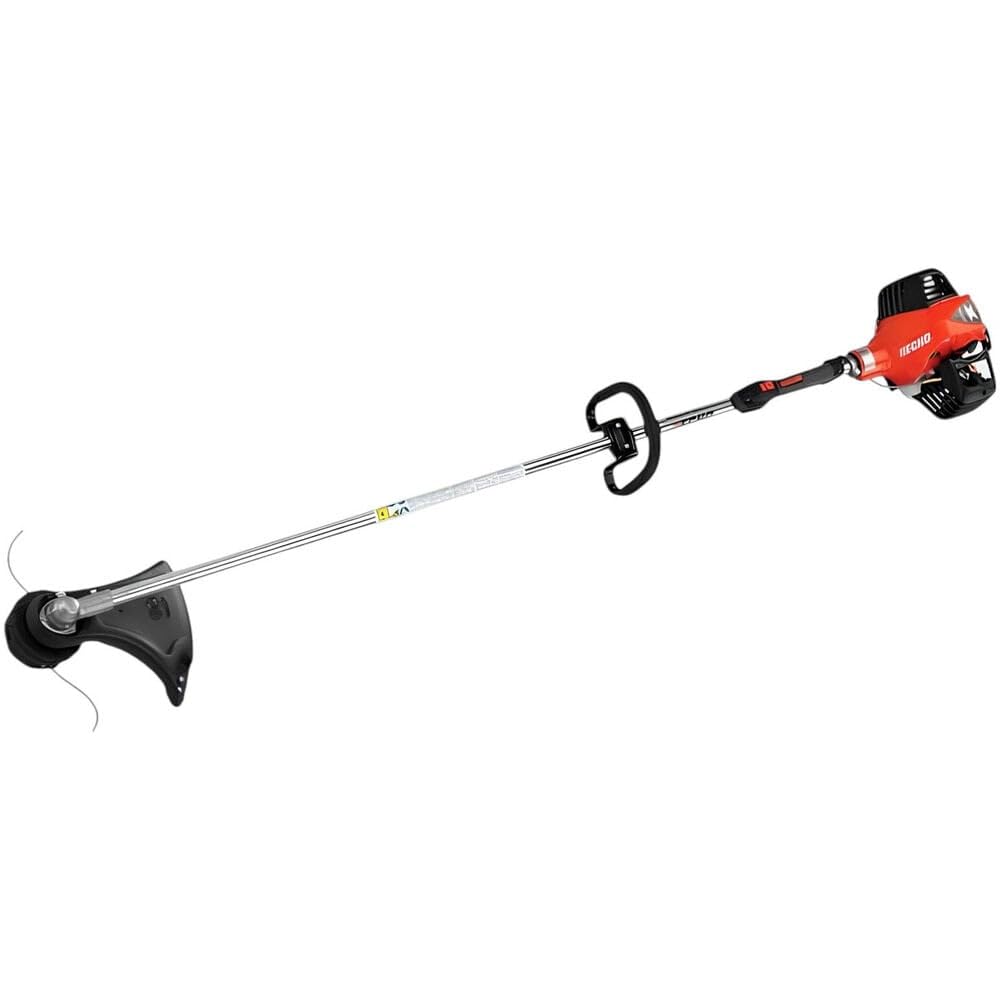
When the job site includes six-foot-tall brush, multiflora rose, and saplings up to half an inch thick, only a machine with the displacement and gear reduction of the ECHO SRM-3020T will deliver consistent results without bogging. The 30.5cc professional-grade engine produces 1.8 horsepower, but the defining feature is the 2:1 high-torque gear ratio that turns that horsepower into sustained cutting force at the head — the kind of torque that keeps the blade spinning even when you’re buried in woody vines.
The tool-less air filtration system is a commercial necessity, not a convenience. Two-stage filtration dramatically extends the interval between servicing, which matters when the trimmer is running all day in dusty conditions. Owners of this model report cutting through heavy weeds up to three-quarters of an inch thick and small trees without any loss of RPM. The ECHO also accepts line diameters up to .155 inches without modification, though you need to wind the spool tightly to avoid line tangling under itself in the head.
At over 12 pounds and with the power to pull hard through tough brush, the SRM-3020T is not a lightweight machine. Some users note that the vibration, while manageable for short bursts, can cause shoulder fatigue over an eight-hour day, and the high-torque gear ratio means the head can kick if it catches a hidden root or rock. A few isolated complaints about long-term reliability exist, but the overwhelming consensus from lawn care professionals is that this is the trimmer they reach for when a job requires brute force.
What works
- 2:1 gear ratio provides exceptional torque for cutting thick brush, vines, and small saplings.
- Tool-less two-stage air filtration system reduces downtime for field servicing.
- Accepts heavy .155-inch line without modification, suitable for extreme vegetation.
What doesn’t
- Heavier build and high torque can cause shoulder fatigue and kickback during prolonged use.
- Some owners report long-term reliability issues that require repairs challenging to justify at this price point.
3. Husqvarna 122RJ Gas Weed Eater and Brushcutter
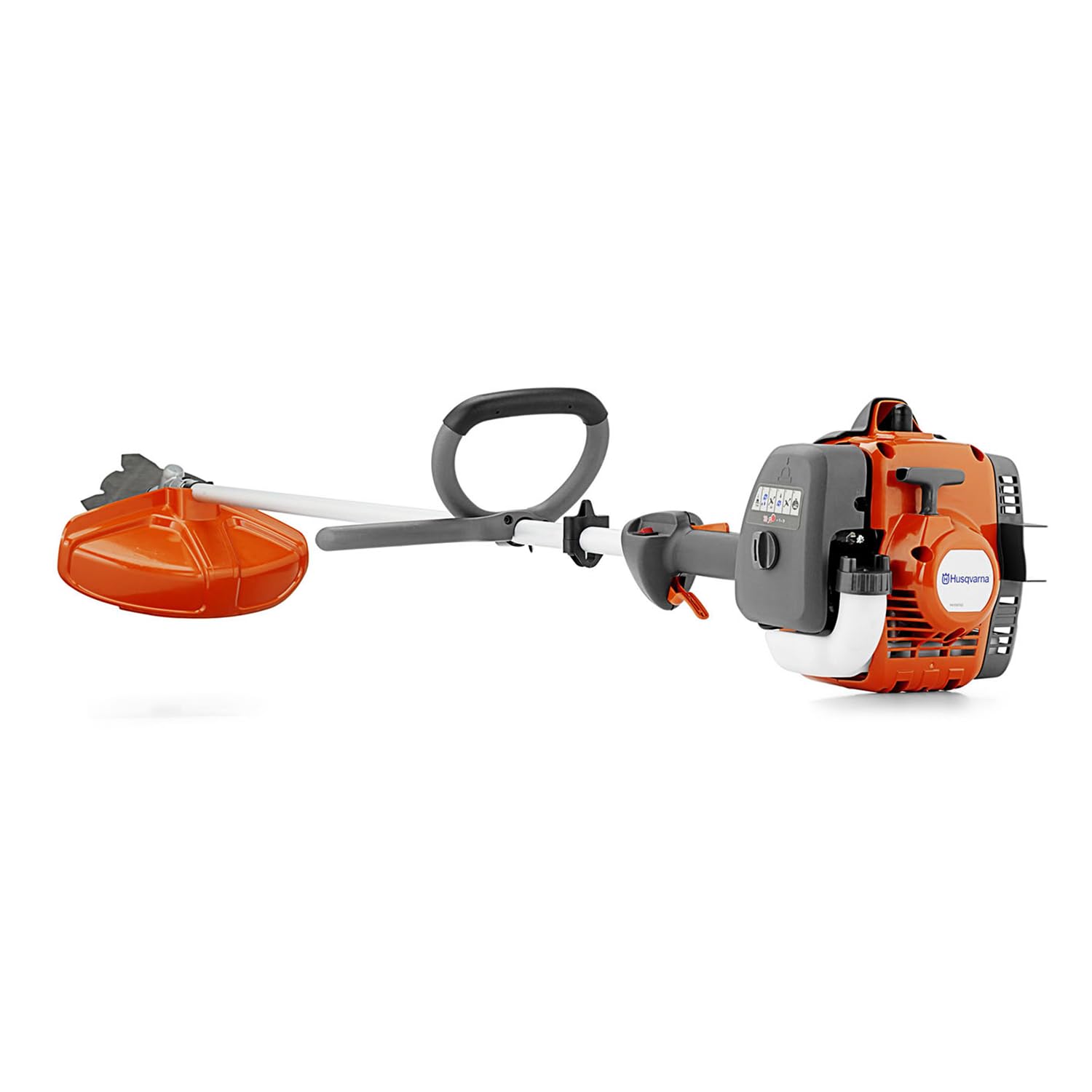
The 122RJ is essentially the 122LK engine package reconfigured with a barrier bar, a J-handle for safer operation, and a bundled grass blade that turns a string trimmer into a brushcutter right out of the box. This dual-tool capability matters for commercial operators who need to switch between tidying fence lines and clearing heavier invasive growth without buying a second machine. The Smart Start system and air purge work together to make first-pull starting the norm rather than the exception, even after the machine has been sitting in a hot truck bed.
Several owners specifically note that the 122RJ cuts through half-inch brush and branches up to an inch thick with confidence, and the straight shaft enables good reach under low-hanging branches. The included harness provides meaningful support for the 12.5-pound weight, improving balance during long sessions. The unit is also compatible with Husqvarna’s full attachment range, making it a modular investment that can grow with your needs.
Build quality concerns appear in a minority of reviews, with one owner reporting a protective guard detaching and a front plastic plate broken on arrival. Another report describes the engine losing power and dying after roughly ten hours of use, which points to potential manufacturing variability. The manual also lacks instructions for restringing the trimmer head, forcing users to find guidance online. For the price, the 122RJ offers strong capability if you get a well-built unit, but the consistency is not guaranteed across the board.
What works
- Includes both string trimmer head and grass blade for immediate dual-purpose use.
- Smart Start and Air Purge systems deliver reliable first- or second-pull starting.
- Cuts through thick brush and small branches with sufficient torque for its displacement class.
What doesn’t
- Manufacturing quality control issues reported, including damaged parts on arrival and early engine failure.
- Owner’s manual does not include instructions for restringing the trimmer head.
4. Milwaukee 2825-20ST M18 Cordless Brushless String Trimmer

The Milwaukee 2825-20ST proves that battery-powered trimmers can genuinely match gas performance for demanding daily use. The brushless motor spins up to 6200 RPM and delivers cutting performance that multiple owners describe as equal to or better than their previous gas units, with the added benefit of instant start and no fuel mixing. The trimmer accepts both .080 and .095-inch line diameters and features an adjustable cutting swath from 14 to 16 inches, allowing you to trade width for power depending on the density of the vegetation.
Battery life is the critical variable on this platform. Owners using High Output 4Ah batteries report approximately 15 to 20 minutes of runtime when cutting through tall, thick weeds — enough for a typical residential lot but requiring multiple batteries for full-acre commercial work. The trimmer is surprisingly lightweight at 12.7 pounds, but the lack of a trigger lock and the absence of a shoulder strap are notable omissions for a tool in this performance tier. The easy-load trimmer head works well once you get the hang of it, but the string advance mechanism can be stiff initially and may require manual feeding to get started.
User feedback consistently highlights the sheer power of this trimmer. One review reports cutting through thick wire buried in the brush without stalling — an extreme example of the motor’s torque reserve. The main complaint, beyond battery runtime, is the absence of a trigger lock, which some operators find unsafe when setting the trimmer down between passes. If you are already invested in the M18 platform with multiple High Output batteries, this trimmer offers near-gas power without the maintenance.
What works
- Brushless motor delivers genuine gas-comparable power and torque for thick weeds and brush.
- Lightweight design reduces fatigue during extended trimming sessions.
- Adjustable cutting swath adapts to different vegetation density.
What doesn’t
- No trigger lock or shoulder strap included, reducing safety and comfort for commercial use.
- Battery runtime is limited on 4Ah packs when cutting heavy growth; needs larger batteries for sustained work.
5. DEWALT DCST972B String Trimmer

The DEWALT DCST972B is the 60V flagship that separates itself from the lower-voltage DEWALT trimmers through raw power retention. Unlike the 20V models that lose cutting force as the battery depletes, the 60V platform sustains RPM through the full discharge cycle, which is critical for commercial operators who cannot afford to have the trimmer fade on the last 15 minutes of a job. The variable-speed trigger and hi/lo speed control give you fine-grained control over power delivery, making it possible to use high RPM for thick overgrowth and dial it back for delicate edging without changing the head.
The top-mounted motor design is a significant advantage over the bottom-motor DEWALT models that tend to fail due to debris ingress and overheating at the head. Owners who have upgraded from the 20V version consistently report that the DCST972B is more durable and runs cooler. The adjustable 15 to 17-inch cutting swath works with .080-inch dual line or .095-inch line, giving flexibility for different conditions. The universal attachment capability means you can swap in edgers, pole saws, and other attachments from the DEWALT system.
The trade-off is battery runtime, which is the most common complaint among owners. A 6Ah battery delivers roughly 20 to 25 minutes of runtime on the low setting, and switching to high-speed mode drains the pack noticeably faster. The trimmer is also heavy enough that the lack of an included shoulder strap is a problem for long sessions. The power is undeniable — several owners describe it as more powerful than their gas trimmers — but you need a fleet of large-capacity batteries to make it work for full-day commercial trimming.
What works
- 60V platform maintains consistent cutting power throughout the battery discharge cycle.
- Top-mounted motor avoids debris damage, improving durability compared to bottom-motor designs.
What doesn’t
- Battery runtime is short — roughly 20 minutes on high with a 6Ah pack, requiring multiple batteries for commercial work.
- No shoulder strap included despite the heavy weight, contributing to operator fatigue during extended use.
6. Milwaukee M18 Fuel String Trimmer W/Quik-LOK
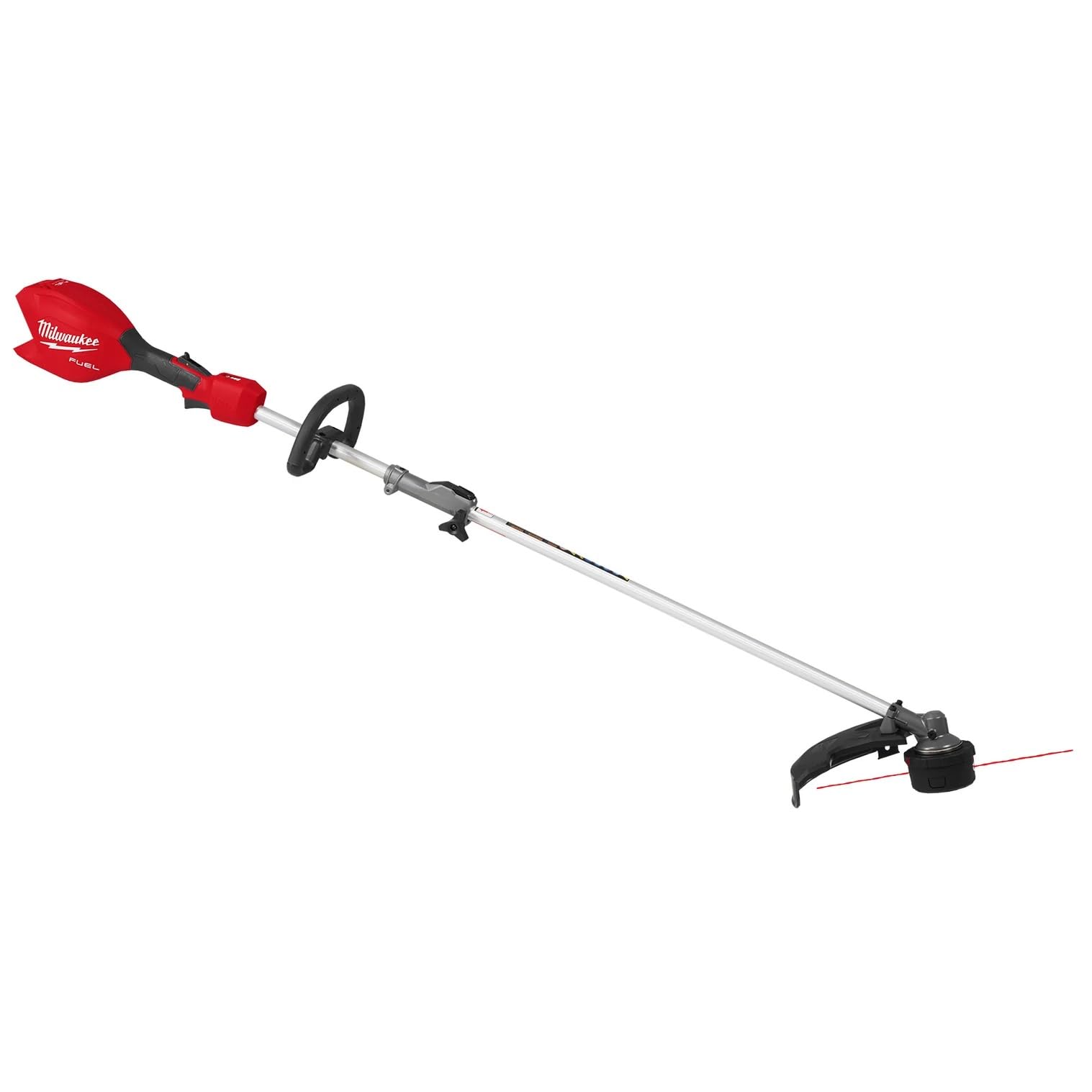
The M18 Fuel QUIK-LOK trimmer is engineered for operators who need one powerhead to handle multiple tasks across a workday. The POWERSTATE brushless motor is rated to deliver more power than 31cc gas powerheads, which positions it as one of the strongest battery trimmers on the market. The QUIK-LOK system is the most capable attachment interface available for battery trimmers, compatible with 13 different attachments including hedge trimmers, pole saws, edgers, and even a chainsaw attachment — all swapping in seconds without tools.
Owner feedback emphasizes the well-balanced design that makes the trimmer feel lighter than its 13.2 pounds suggests. The quiet operation is a major advantage for early-morning or residential-adjacent commercial work, and the instant-start electric motor eliminates the frustration of pull-cord failures that plague gas units in humid conditions. The bump-feed head is easy to reload once you learn the sequence, though some users report that the included trimmer line is cheap and breaks faster than aftermarket line.
The primary limitation of this trimmer, consistent across reviews, is that the included trimmer line is below the standard you would expect from a tool at this price point. Owners recommend replacing the factory line immediately with a premium .095-inch line. Additionally, while the motor is powerful enough for most grass and light brush, some operators wish it had a notch more torque for heavy saplings and dense vines. The QUIK-LOK compatibility remains the strongest reason to choose this trimmer — if you already own or plan to buy the attachments, this powerhead becomes the center of a complete landscaping tool ecosystem.
What works
- QUIK-LOK system offers the widest attachment compatibility among battery trimmers, including hedge trimmers and pole saws.
- Well-balanced design and quiet operation make it comfortable for extended daily use.
What doesn’t
- Included trimmer line is low-quality and prone to breaking; replacement with premium line is almost mandatory.
- Torque reserve is slightly less than high-displacement gas models when cutting thick saplings or dense woody vines.
7. Greenworks 60V 16-Inch Brushless Cordless String Trimmer

The Greenworks ST60L254 sits at a price point that undercuts most of the competition, but the 60V brushless motor and 6000 RPM spec sheet suggest it punches well above its weight class. Multiple owners report that it delivers power equal to or exceeding the Milwaukee M18 Fuel trimmer, which costs significantly more. The included 2.5Ah battery charges in about 45 minutes and runs for roughly 53 minutes on a full charge, giving you enough runtime for a half-acre property with heavy trimming needs.
The spin-to-load head design is genuinely innovative for the entry-level price segment. You reload .095-inch line by twisting the housing, eliminating the manual winding that frustrates owners of bump-feed heads. The trimmer weighs only 11.2 pounds with the battery installed, and the rotating handle reduces wrist strain during angled trimming. At 68dB, it is quiet enough for early-morning work without drawing complaints, and the CARB-certified zero-emissions operation is an advantage for environmentally-conscious commercial operators.
The build quality is the main concern. Several owners describe the trimmer as feeling like a “plastic kids toy” despite its strong performance. The spindle gap can allow long grass to jam between the head and the shaft, particularly with invasive species like common reed. The included 2.5Ah battery is adequate for a single property but insufficient for a full commercial day — you will need at least two spare batteries to run this trimmer continuously. For the price, the performance-to-dollar ratio is excellent, but the plastic construction raises questions about long-term durability under daily professional use.
What works
- Spin-to-load head eliminates manual line winding, saving significant time during field reloading.
- Impressive 6000 RPM brushless motor delivers power comparable to premium battery trimmers at a lower price point.
What doesn’t
- Plastic-heavy construction feels less durable than metal-hub competitors, raising concerns for daily commercial abuse.
- Spindle gap design allows long grass and reeds to jam between the head and shaft.
8. Husqvarna 122LK Grass Trimmer

The Husqvarna 122LK is the entry point into the Husqvarna gas lineup, and it is designed for the operator who needs gas reliability — no batteries to charge, no charging downtime — but does not require the displacement or durability of the 330LK. The 22cc, 2-cycle engine is rated for homeowner use, but the straight shaft, Smart Start system, and T25 trimmer head compatibility make it suitable for lighter commercial tasks like trimming around commercial properties and maintaining fence lines on smaller acreage.
The 122LK shines in its simplicity and starting reliability. Owners consistently report that the engine fires on the first or second pull thanks to the Smart Start decompression system. The multi-tool compatibility is a real advantage for the price, allowing you to attach Husqvarna edgers and cultivators to the same powerhead. At 10.6 pounds, it is lighter than most gas trimmers in its class, which reduces fatigue during extended operation.
Reliability is the most divisive aspect of the 122LK. While many owners report years of trouble-free operation, a significant minority describe chronic hard-starting, engine bogging, and stalling after only 15 minutes of runtime. One review posted a full failure after minimal use, with carburetor adjustment attempts failing to resolve the issue. The vibration level is also noticeable, particularly during sustained trimming, as this model lacks the LowVib system found on Husqvarna’s higher-tier trimmers. If you are buying for light commercial use, the 122LK offers good value, but the inconsistent quality control means you are taking a risk on the specific unit you receive.
What works
- Smart Start system delivers reliable starting, typically firing on the first or second pull.
- Multi-tool attachment compatibility extends the powerhead’s utility beyond string trimming.
What doesn’t
- Quality control is inconsistent, with a meaningful number of units exhibiting chronic hard-starting and pre-mature engine failure.
- Higher vibration levels compared to premium Husqvarna models; lacks the LowVib anti-vibration system.
9. DEWALT 20V MAX 22″ Cordless Hedge Trimmer (DCHT821B)
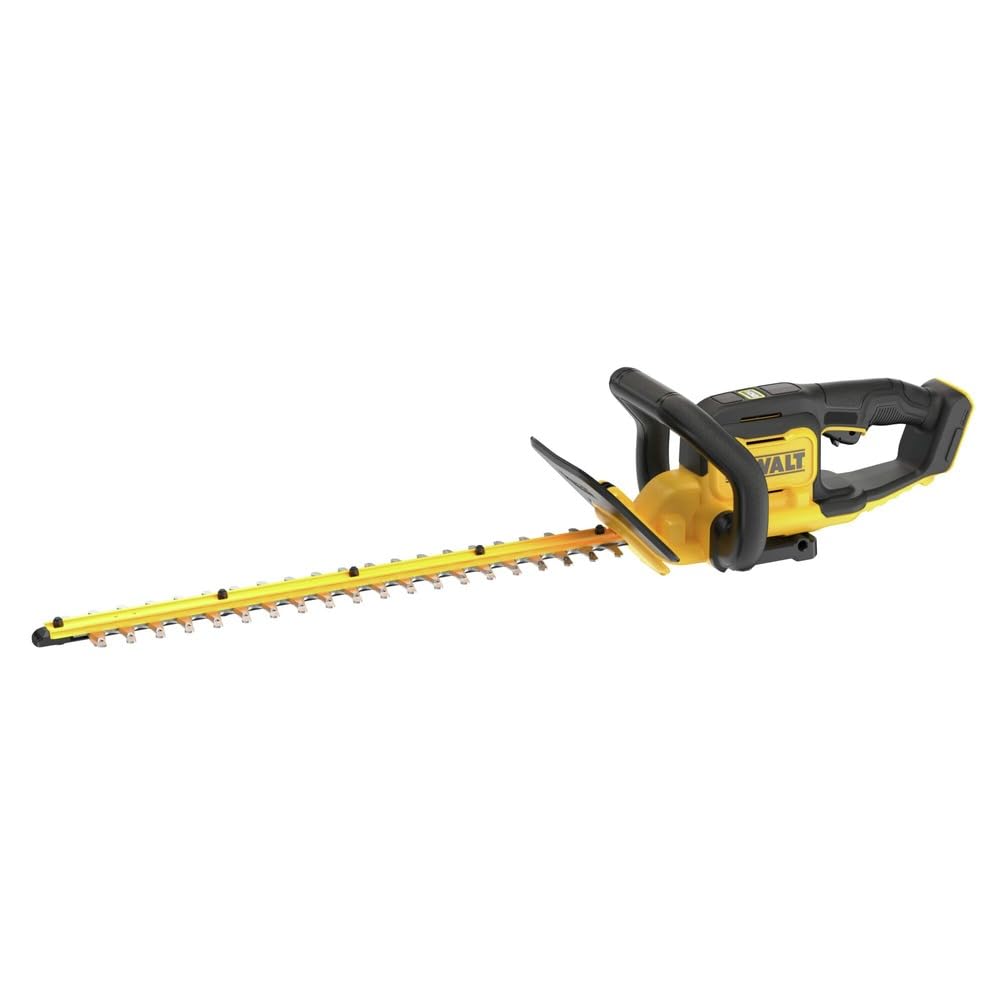
The DCHT821B is not a string trimmer, but a hedge trimmer that earns a spot in a commercial equipment guide because of its exceptional runtime and cutting capacity on a 20V platform. The laser-cut, 22-inch hooked tooth blades deliver clean, fast cuts on branches up to 3/4 inch thick, and the high-output motor handles overgrowth that would stall most 20V hedge trimmers. The friction clutch protects the transmission when you hit hidden obstacles, which is essential for commercial operators working fast through overgrown hedges.
The defining advantage of this hedge trimmer is the runtime. Owners report up to 78 minutes of continuous trimming on a single 5Ah battery, which is extraordinary for a 20V device. The compact design — 39 percent more compact than previous DEWALT models — improves maneuverability when working around tight corners and dense shrubbery. The tool is also remarkably lightweight at 9.7 pounds, reducing arm fatigue during extended overhead trimming.
This is a bare-tool purchase, meaning there is no battery or charger included. If you do not already own DEWALT 20V batteries, the initial investment is significantly higher than the tool price suggests. The cutting capacity is limited to 3/4-inch branches; anything thicker will stall the blades or require manual pruning before you can continue. For commercial operators who need a dedicated hedge trimmer with long runtime for hedge maintenance alongside string trimming work, the DCHT821B is a reliable choice, but it is a specialized tool, not a general-purpose ground trimmer.
What works
- Outstanding runtime of up to 78 minutes on a single 5Ah battery for a 20V platform.
- Compact and lightweight design reduces fatigue during overhead and detailed hedge trimming.
What doesn’t
- Bare tool — requires separate purchase of DEWALT 20V battery and charger, increasing total cost.
- Limited to branches 3/4-inch or thinner; thicker material requires manual pre-cutting.
Hardware & Specs Guide
Displacement & Torque (Gas Trimmers)
Engine displacement, measured in cubic centimeters (cc), is the most direct indicator of a gas trimmer’s ability to sustain cutting power under heavy load. Consumer-grade trimmers typically use 22cc to 25cc engines, while true commercial models like the ECHO SRM-3020T use 30.5cc engines. The gear ratio is equally important: a 2:1 high-torque ratio multiplies engine torque at the cutting head, allowing the trimmer to power through thick vines and small saplings without slowing. Standard gear ratios work for grass, but if you are cutting woody vegetation daily, prioritize models with high-torque gearing.
Battery Voltage & Amp-Hour Runtime (Battery Trimmers)
Battery trimmers operate on a voltage-amperage curve that determines both peak power and sustained runtime. Higher voltage systems like 60V deliver more consistent RPM throughout the discharge cycle compared to lower-voltage systems like 20V, which lose cutting force as the battery drains. Amp-hour (Ah) ratings indicate total energy capacity: a 6Ah pack on a 60V trimmer stores roughly three times the energy of a 2Ah pack on the same system. For commercial use, plan on at least 4Ah packs, and calculate runtime based on vegetation density — thick grass can drain a pack in 15 to 20 minutes, while light edging can stretch it to 45 minutes.
Cutting Swath and Line Diameter
The cutting swath determines how much ground you cover per pass, but wider swaths require more power. A 16 to 17-inch swath balances coverage and power draw for most commercial work, while 20-inch swaths are best reserved for high-displacement gas trimmers. Line diameter is a separate variable. Standard .080-inch line snaps quickly in thick growth, so commercial operators should use .095-inch or .105-inch line rated for heavy brush. Verify that the trimmer head is designed to accept thicker line without modification — some heads have internal channels that only work with specific diameters.
Attachment Systems and Modularity
Attachment-capable trimmers turn a powerhead into a multi-tool platform. Husqvarna’s system uses a detachable shaft with click-on attachments including edgers, cultivators, and hedge trimmers. Milwaukee’s QUIK-LOK system offers the widest compatibility among battery trimmers, supporting 13 attachments. DEWALT’s universal system works with third-party attachments. The attachment interface must be robust enough for daily swapping — plastic locking collars tend to wear out faster than metal-reinforced systems. If you plan to use attachments more than once a week, a dedicated attachment-capable powerhead is a better investment than a dedicated trimmer.
FAQ
What cc displacement do I need for heavy brush and saplings?
Is a battery trimmer powerful enough for commercial landscaping work?
What does the gear ratio mean on a gas trimmer and why does it matter?
Can I use .105-inch trimmer line in a trimmer rated for .095-inch line?
How do anti-vibration systems reduce operator fatigue?
Final Thoughts: The Verdict
For most commercial operators, the best commercial trimmer winner is the Husqvarna 330LK because it combines a powerful 28cc engine, a customizable 18 to 20-inch cutting swath, and LowVib vibration control at a price that balances capability and cost for daily professional use. If you need maximum torque for extreme brush and saplings, grab the ECHO SRM-3020T with its 30.5cc engine and 2:1 high-torque gearing. And for battery-powered trimming with unmatched attachment versatility, nothing beats the Milwaukee M18 Fuel QUIK-LOK.