
Tall fescue is a cool-season grass that wakes up hungry. A spring feeding with the right nitrogen-to-potassium ratio drives deep root growth and a thick green canopy before summer heat arrives. Get the ratio wrong and you’ll either blast it with fast green that fades or starve it of the potassium it needs for stress tolerance. This guide breaks down the best granular and liquid formulations for tall fescue in early spring.
I’m Rikta — the co-founder and writer behind Lawn Gear Lab. I’ve studied the soil chemistry and slow-release nitrogen technology behind large-scale turf management and synthesized thousands of owner reports to identify the formulas that actually balance spring green-up with root resilience.
Whether you’re overseeding thin patches or pushing an established lawn to peak density, choosing the right spring fertilizer for tall fescue means matching the NPK to your soil test and the product’s release profile to your region’s frost date.
How To Choose The Best Spring Fertilizer For Tall Fescue
Tall fescue enters its primary growth phase when soil temperatures hit 50–65°F. Unlike Bermuda or Zoysia, it demands a spring application rich in nitrogen to fuel leaf expansion but balanced with potassium to reinforce cell walls against the coming summer. Here are the three specs you need to evaluate before buying.
N-P-K Ratio — The First Number Matters Most
Look for a first number (nitrogen) between 16 and 30 for a spring push on established tall fescue. A ratio like 24-0-6 delivers high nitrogen with a potassium buffer to prevent lodging and improve drought tolerance. Avoid formulas with more than 4 or 5 in the middle number (phosphorus) unless a soil test confirms a deficiency — most fescue lawns already hold enough phosphorus.
Nitrogen Release Profile — Slow vs. Quick
Blended products that combine 60–70% slow-release nitrogen (polymer-coated or sulfur-coated urea) with 30–40% quick-release provide immediate green-up in the first 10 days and steady feeding for up to eight weeks. Pure quick-release can scorch fescue if applied when daytime highs suddenly spike above 80°F. Pure slow-release may leave the lawn pale during the critical early spring window.
Additional Micronutrients — Iron and Humic Acid
Iron at 1–3% concentration deepens color without forcing excessive leaf growth, which is useful for fescue that already has good density. Humic acid or Bio-Nite additives improve nutrient uptake in cool, wet spring soils where root activity is still ramping up. These extras matter more for fescue than for warm-season grasses because cool-spring soil biology is less efficient.
Quick Comparison
On smaller screens, swipe sideways to see the full table.
| Model | Category | Best For | Key Spec | Amazon |
|---|---|---|---|---|
| Yard Mastery 24-0-6 Flagship | Granular | Large established lawns | 24% slow-release N, 45 lb bag | Amazon |
| The Andersons PGF 16-0-8 | Granular | Phosphorus-sensitive soils | Humic DG, 8-week feeding | Amazon |
| Yard Mastery 7-0-20 Stress Blend | Granular | Late spring / early summer transition | 3% iron, Bio-Nite technology | Amazon |
| Petramax 28-0-0 Liquid N | Liquid | Quick green-up between granular apps | 70% quick / 30% slow release | Amazon |
| Fertilome 15-0-15 Centipede | Granular | Multi-grass yards (fescue mix-ins) | 15% N, 15% K, 5,000 sq ft | Amazon |
| Farmer’s Secret 8-16-8 Booster | Liquid | Small patches or seedling feeding | Super-concentrated 32 oz bottle | Amazon |
In‑Depth Reviews
1. Yard Mastery 24-0-6 Flagship Granular Lawn Fertilizer

The 24-0-6 ratio is tailor-made for tall fescue’s spring appetite: heavy nitrogen for leaf expansion and 6% potassium to harden cell walls before the heat arrives. The 24% nitrogen is entirely slow-release, so you won’t see a flush of top growth that forces you to mow twice a week, but the 3% iron delivers a deep green tint within 10–14 days of application.
Each 45 lb bag covers 15,000 sq ft at the standard 3 lb per 1,000 sq ft rate. That’s a whole-season supply for a quarter-acre lawn with no mid-spring respray needed. Bio-Nite additive enhances microbial activity in cool spring soil, which helps fescue roots access the potassium fraction earlier than standard granular formulas.
Customers consistently report neighbors asking what lawn service they use after a single application. The slow-release profile matches fescue’s natural growth curve better than any other bag in this comparison: green-up starts reliably in week two and holds steady for six to eight weeks.
What works
- Massive coverage per bag reduces overall cost per season.
- Iron + Bio-Nite combo provides visible color without excess top growth.
- 24% slow-release nitrogen nearly eliminates burn risk on established fescue.
What doesn’t
- Empty bag weight is 45 pounds — heavy to carry from garage to spreader.
- Not ideal for small lawns because the bag treats such a large area.
2. The Andersons Professional PGF 16-0-8 Fertilizer with Humic DG
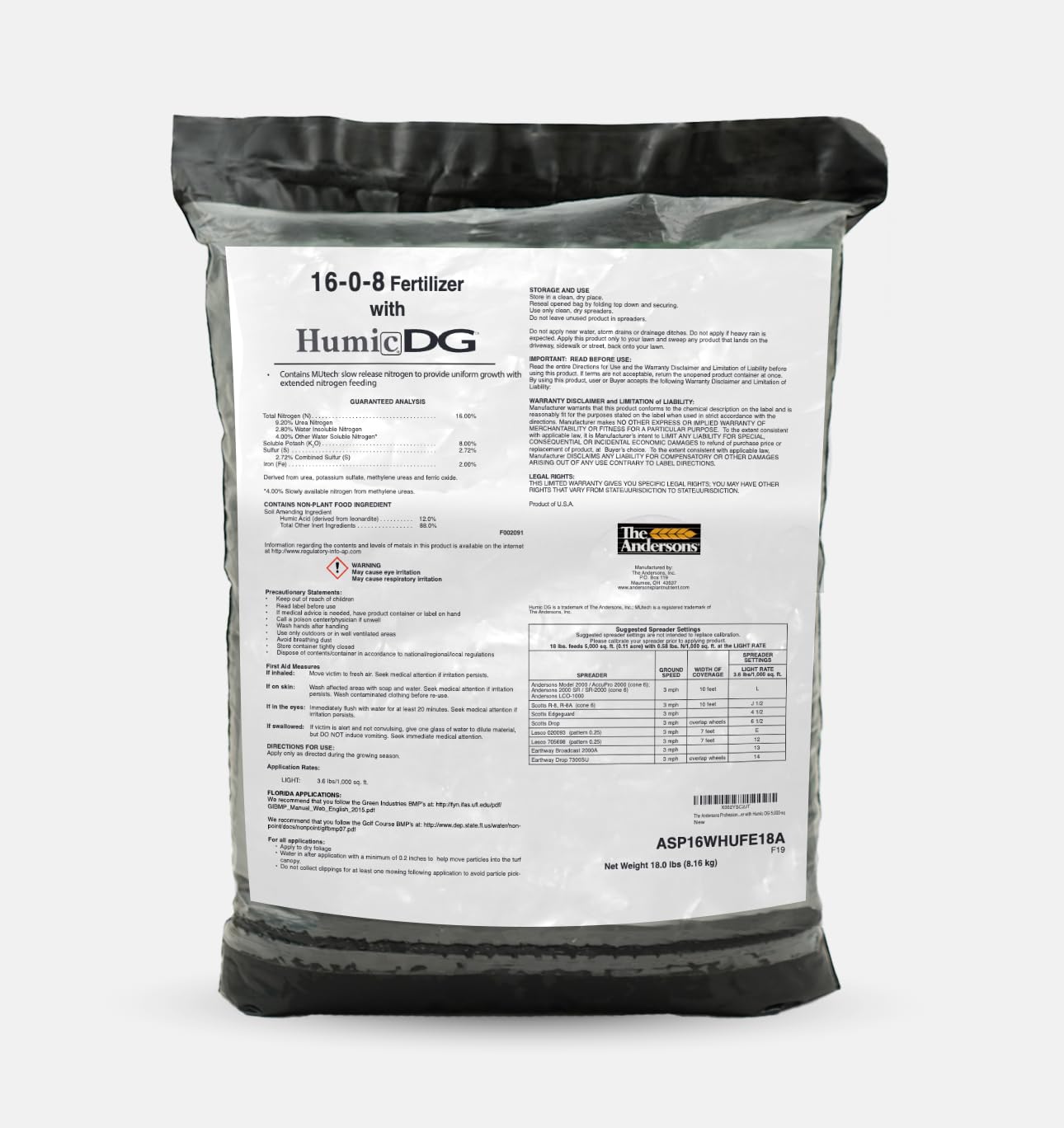
This phosphorus-free formula is the go-to for anyone who has tested their soil and found already-high phosphorus levels. The 16% nitrogen is split between quick-release for immediate color and slow-release for sustained feeding, while the 8% potassium provides solid stress protection as spring transitions into early summer. The 18 lb bag covers roughly 5,000 sq ft.
The real differentiator is the Humic DG technology. Each granule contains dispersed humic acid that boosts cation exchange capacity in the root zone, which matters more for tall fescue in spring than for warm-season grasses because cool soil limits natural nutrient cycling. The super-fine particle size also means you get about twice the number of granules per square foot, which reduces streaking when applied with a rotary spreader.
Professional lawn care operators frequently recommend this bag for the first spring application on fescue lawns. The 909 customer ratings average 4.7 stars, with owners emphasizing the uniform greening and the absence of the “striped lawn” look that larger granules cause.
What works
- Zero phosphorus protects against runoff and fits high-P soil profiles.
- Humic DG improves nutrient release in cool spring soil temperatures.
- Small granule size prevents striping and delivers uniform coverage.
What doesn’t
- Per-pound cost is higher than standard big-box store granulars.
- Not labeled for sale in California or Oregon due to state regulations.
3. Yard Mastery 7-0-20 Summer Lawn and Turf Stress Granular Fertilizer

Application logic for tall fescue: use this bag as your last spring feeding or first summer feeding when temperatures begin to consistently exceed 80°F. The 7% nitrogen is modest enough that it won’t push vulnerable new growth into a heat wave, while the 20% potassium — the highest in this roundup — reinforces turf cell walls against drought and foot traffic.
The 3% iron content provides a visible green-up even on low nitrogen, which is useful when you want color without triggering a growth surge. The 18 lb bag covers 6,000 sq ft, and the Bio-Nite additive helps the potassium release steadily rather than leaching out during spring rains. Owner feedback highlights that this formula rescues fescue lawns that went into summer already stressed from fungal pressure or thin root mass.
Tall fescue managers in transition zone states (Kentucky, Missouri, Virginia) often pair this with a high-N early spring app to get the best of both worlds: rapid green-up in March, then stress protection in May. The timing is the key — apply too early and the low nitrogen may leave the lawn undernourished during the peak spring growth window.
What works
- Extremely high potassium load prepares fescue for summer heat stress.
- Iron provides deep color without forcing excess leaf growth.
- Bio-Nite helps nutrient retention in sandy or leach-prone soils.
What doesn’t
- Low nitrogen content means it should not be your only spring application.
- Best results require applying when temps are below 80°F for several days.
4. Petramax Liquid Nitrogen Fertilizer 28-0-0

This 32 oz liquid concentrate delivers a 28-0-0 punch with a blended release profile: 70% quick-release for visible green in 3–5 days and 30% polymer-coated slow-release to feed for about three weeks between applications. For tall fescue, liquid nitrogen is best used as a foliar supplement between granular applications — it fills the color gap when you’re waiting for soil temperatures to rise enough for the granular slow-release to activate.
The mixing ratio is forgiving: 5 oz per gallon for maintenance gives about 0.5 lb of N per 1,000 sq ft, or 10 oz per gallon for a heavier correction. At the maintenance rate, a single bottle treats up to 12,800 sq ft, making it economical for follow-up shots. Customers report it corrects yellowing in nitrogen-deficient fescue patches within a week.
The liquid form is useful for spot-treating thin areas where granular spreaders can’t distribute evenly — such as narrow side strips or newly seeded sections too tender for granular application. PetraTools is a Pennsylvania-based company with responsive customer support, and the bottle includes clear mixing instructions for backpack sprayers.
What works
- Visible color change within a week on nitrogen-deficient fescue.
- 30% slow-release reduces burn risk vs. pure quick-release liquids.
- Large coverage area makes it economical for supplementary feeding.
What doesn’t
- Zero potassium; cannot replace a complete spring granular program.
- Requires a sprayer — not a simple “attach hose and spray” product.
5. Fertilome Centipede Lawn Fertilizer 15-0-15
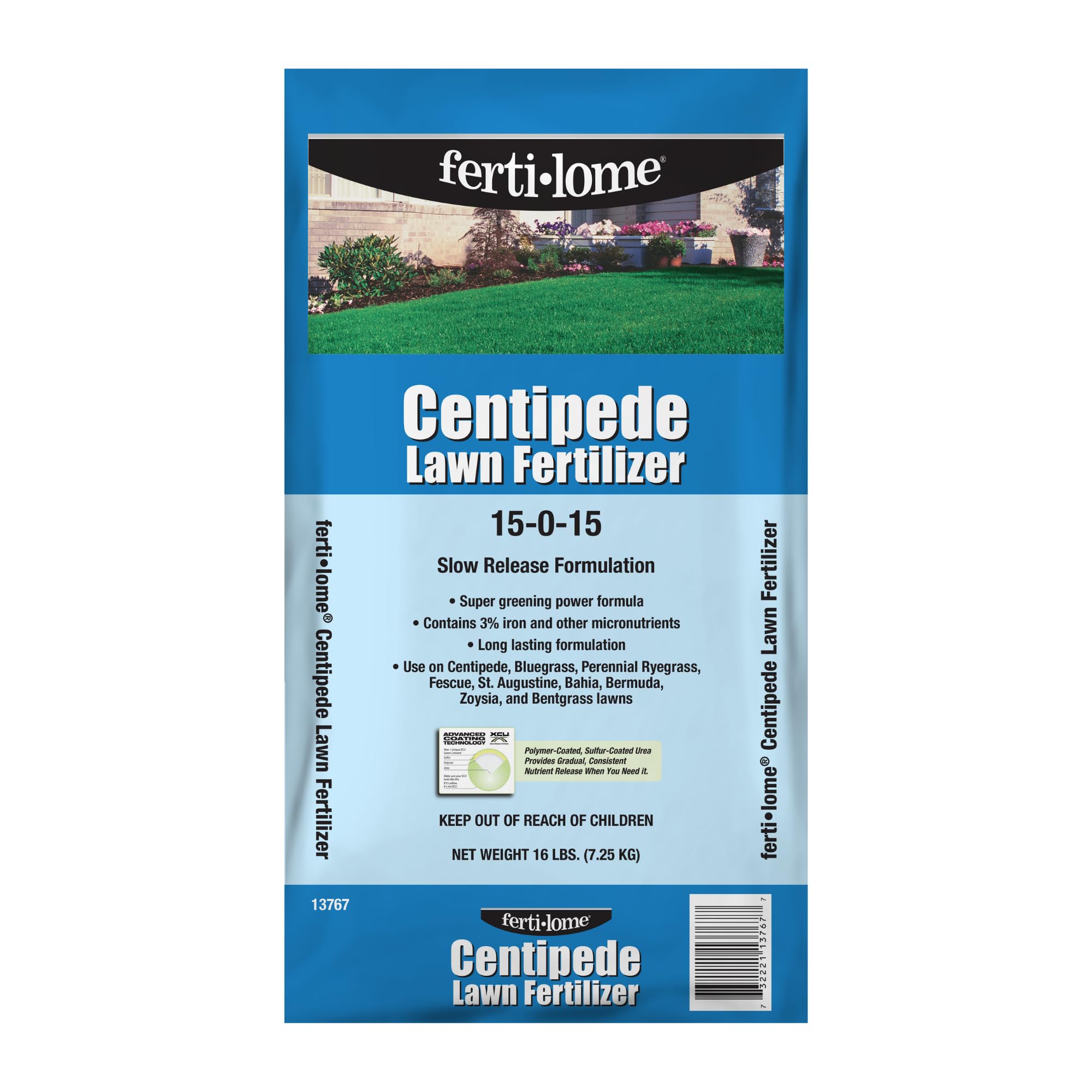
Although the label emphasizes centipede grass, the 15-0-15 analysis is perfectly viable for tall fescue lawns that are mixed with other cool-season species. The equal nitrogen and potassium ratio (15% each) supports moderate green-up with a strong stress-protection floor. The zero phosphate means you can apply it without worrying about runoff into waterways or seedling burn on newly seeded patches.
The 16 lb bag covers 5,000 sq ft when applied at the recommended 4 lb per 1,000 sq ft. The granules are standard particle size — not as fine as the Andersons, but still distribute evenly through a rotary spreader on medium setting. Slow-release nitrogen reduces the risk of burn, and the formula is designed for early spring and early fall timings, which aligns with fescue’s core growing seasons.
Owners in transition zone lawns with a mix of fescue and centipede or zoysia report that this single bag pulls double duty — green-up grass types across the whole lawn without needing separate products. If your lawn has more than 30% warm-season grass mixed into the fescue, this balanced formula works better than a high-N-only fescue product.
What works
- Balanced N-K ratio works across mixed-species lawns.
- Zero phosphorus makes it safe for environmentally sensitive areas.
- Timing instructions match fescue’s spring and fall growth windows.
What doesn’t
- 15% nitrogen is lower than ideal for a dedicated tall fescue stand.
- Labeled primarily for centipede, which may confuse some buyers.
6. Farmer’s Secret Spring Booster Fertilizer 8-16-8

This super-concentrated liquid uses an 8-16-8 ratio that is phosphorus-heavy, which makes it more suited for garden vegetables and flowerbeds than for a full fescue lawn. However, it works as a quick root stimulant for newly plugged or sprigged tall fescue patches during early spring establishment. The dilution ratio of 1 teaspoon per gallon of water means a single 32 oz bottle produces 192 gallons of finished solution.
The phosphorus content (16%) supports root development in seedlings, which can help spring-seeded fescue get established before summer heat arrives. The potassium (8%) is moderate but sufficient for early-season resilience. The liquid format makes it easy to target specific bare spots without fertilizing the entire lawn, so it’s a practical tool for spot repairs or small gardens that contain fescue as a border grass.
Customer reviews highlight fast results on container plants and seedlings, but for an established tall fescue stand, this product lacks the nitrogen ceiling needed for dense coverage. It’s best viewed as a supplement for new growth areas or for gardeners who maintain mixed ornamental spaces where fescue is a minority grass.
What works
- Extremely concentrated — small bottle goes a long way.
- High phosphorus helps new fescue seedlings establish roots quickly.
- Liquid format allows precise spot application on thin patches.
What doesn’t
- 8% nitrogen is too low for full-lawn spring feeding of tall fescue.
- High phosphorus ratio is unnecessary and potentially wasteful for established lawns.
Hardware & Specs Guide
Nitrogen Release Format
For tall fescue, polymer-coated slow-release nitrogen (often called SCU or PCSCU) provides the best match to the grass’s mid-spring growth curve. Products like the Yard Mastery 24-0-6 and The Andersons PGF use coated granules that release nutrients as soil temperatures rise above 55°F. Quick-release urea works faster but requires soil moisture and risks volatilization loss in dry springs. A blended product with 60–80% slow-release is the safe benchmark for a single spring application.
Potassium and Iron Content
Tall fescue translocates potassium to cell walls in response to heat and drought stress. The optimal spring potassium range is 6–10% for lawns that will experience summer stress. Iron (chelated or sulfate forms) at 1–3% improves chlorophyll production without stimulating excess leaf growth, which is a key advantage when you want dark green color without mowing every four days. The Yard Mastery Stress Blend at 20% potassium is the highest in this category, designed specifically for the late-spring handoff to summer.
Application Rate and Coverage Mathematics
Granular products are labeled in pounds per 1,000 sq ft. A 3 lb per 1,000 sq ft rate of a 24-0-6 product delivers 0.72 lb of actual nitrogen per 1,000 sq ft — the sweet spot for a single early spring feeding on established fescue. Liquid products like Petramax are measured in ounces per gallon; always calibrate your sprayer output to match the labeled N rate. Overshooting 1 lb of actual N per 1,000 sq ft in a single liquid pass risks foliar burn, especially if temperatures rise above 75°F within 48 hours.
pH Compatibility and Soil Testing
Tall fescue prefers soil pH between 5.8 and 6.5. If your pH drifts below 5.5, nitrogen uptake efficiency drops sharply regardless of the fertilizer brand. Apply lime at least 30 days before your spring fertilizer application to correct acidic soil. Products with humic acid (such as The Andersons PGF) can temporarily improve nutrient availability in borderline pH, but they are not a replacement for proper soil pH management.
FAQ
When should I apply spring fertilizer to tall fescue?
Is liquid or granular spring fertilizer better for tall fescue?
How much nitrogen per 1,000 sq ft does tall fescue need in spring?
Final Thoughts: The Verdict
For most gardeners, the spring fertilizer for tall fescue winner is the Yard Mastery 24-0-6 Flagship because its high slow-release nitrogen and added iron drive dense, deep-green growth for the entire spring window on a single bag. If you need a phosphorus-free formula for tested soil, grab the Andersons PGF 16-0-8. And for protecting fescue from summer heat stress at the end of spring, nothing beats the Yard Mastery 7-0-20 Stress Blend.