
That tough, tangled root ball that laughs at your trowel—a real Hori Hori knife solves it in one levered motion. Unlike a digging fork or weeder, this Japanese-origin blade combines a sharp straight edge with aggressive serrations, a spear or trailing point for prying, and a full tang that transfers every pound of force into the soil. Whether you are dividing perennials, grubbing out dandelions, or transplanting seedlings, the best Hori Hori garden knife cuts your task time in half.
I’m Rikta — the co-founder and writer behind Lawn Gear Lab. I’ve spent over 80 hours comparing blade steels, handle geometries, sheath construction, and edge retention data across dozens of popular models to find the standout options for real gardeners.
This guide covers seven top-rated knives, from budget-friendly steel to premium Japanese- forged options, to help you find the best hori hori garden knife for your specific growing conditions and digging habits.
How To Choose The Best Hori Hori Garden Knife
The right Hori Hori replaces a trowel, a weeder, a root saw, and a soil knife. But not all blades are built to handle the same workload. Here are the three critical factors to consider before you buy.
Blade Steel and Hardness (HRC)
Stainless steel is standard, but the hardness rating tells you how long the edge lasts. A blade rated HRC 58 (like the Nisaku) holds a sharp edge through dozens of digging sessions and resists rolling when you hit rocks. Softer stainless steels around HRC 50–53 may dull faster and require frequent touch-ups with a sharpening rod. If you work in clay or rocky soil, prioritize a blade at HRC 56 or higher.
Full Tang vs. Partial Tang Handle Construction
A full-tang knife has a single piece of steel extending from the tip through the entire handle. This eliminates weak joints and allows you to pry up heavy stones or lever out deep roots without the blade separating from the handle. Partial-tang designs (common on very cheap knives) can snap at the handle junction under high lateral force. Check the handle rivets—three or more solid rivets on a full-tang handle indicate a knife built for heavy duty.
Edge Configuration: Serrated vs. Straight vs. Both
The best Hori Hori knives carry a dual edge: one straight side for slicing stems and twine, and one serrated side for sawing through thick roots and woody stalks. Some models add a twine-cutting notch near the handle or a spear-point tip for piercing compacted soil. If you primarily dig and transplant, a blade with a deep concave sweep and a sharp point is ideal. If you cut roots all day, prioritize aggressive serrations that run at least halfway down the blade.
Quick Comparison
On smaller screens, swipe sideways to see the full table.
| Model | Category | Best For | Key Spec | Amazon |
|---|---|---|---|---|
| Nisaku NJP651 | Premium Japanese | Roots & rocky soil | HRC 58 hardened steel, 7.25″ blade | Amazon |
| A.M. Leonard Deluxe | Pro Grade | Professional landscaping | 300-lb pressure rating, twine notch | Amazon |
| Root Slayer 16211 | Carbon Steel | Aggressive root cutting | Ripsaw teeth, inverted V tip | Amazon |
| SHALL Hori Hori | Rosewood Handle | All-around gardening | 7″ stainless, 6-inch depth scale | Amazon |
| WORKPRO Hori Hori | Ergonomic | Transplanting and weeding | TRP handle, depth markings | Amazon |
| Zenport K245 ZenBori | Lightweight Utility | Portability and visibility | Orange handle, dual-edge 6″ blade | Amazon |
| CIELCERA 12″ with Sharpener | Value Pack | Budget-friendly starter set | Includes sharpening rod and sheath | Amazon |
In‑Depth Reviews
1. Nisaku NJP651 Hori Weeding & Digging Knife

The Nisaku NJP651 is the benchmark for this category, using authentic Tomita Japanese stainless steel hardened to HRC 58—the hardest blade in this roundup. The 7.25-inch concave blade resists rust and scratching, and the hourglass profile displaces soil efficiently rather than bulldozing it. Inch markers are laser-engraved on the steel for precise planting depth measurement, a feature rarely found on budget knives.
Full-tang construction runs through a comfortable wooden handle secured with three rivets, and the included premium leather sheath has a belt loop for daily carry. The blade requires cleaning and drying after each use to prevent moisture from affecting the wood handle.
This is the knife for serious gardeners who want traditional Japanese craftsmanship and a blade that won’t roll or chip in rocky soil. The concave sweep lets you scoop out planting holes with fewer passes compared to flatter blades, making it ideal for transplanting bulbs and dividing perennials.
What works
- HRC 58 hardness holds a razor edge through many seasons
- Concave blade geometry scoops soil faster than flat designs
- Laser-engraved inch markers for accurate depth control
What doesn’t
- Wood handle requires rinsing and drying after every use to avoid cracking
- Premium price reflects genuine Japanese steel—no budget compromise
2. A.M. Leonard Deluxe Soil Knife

A favorite among professional landscapers, the A.M. Leonard Deluxe is built from a single piece of stainless steel that the company rates to withstand 300 pounds of pressure. The 6-inch spear-point blade carries a deep serrated edge on one side and a tapered slicing edge on the other, plus a twine-cutting notch near the handle that saves you from reaching for separate snips. Bright orange composite handle offers a wide safety guard and a non-slip grip in wet conditions.
Depth gauge markings are etched into the steel, eliminating guesswork when planting bulbs or setting seedlings at the correct depth. The Deluxe model improves on the classic Leonard soil knife with deeper serrations that chop through non-woody stems and roots more aggressively. Owners praise its durability after years of prying out stones and cutting through crabgrass roots without any handle loosening.
For gardeners who work in heavy clay or need a knife that doubles as a small pry bar for pavers, the Leonard Deluxe is the right choice. The twine notch is sharp—it will snag a glove or skin if you are not careful—but once you learn to respect it, the notch becomes one of the most convenient features on the blade.
What works
- 300-lb pressure rating handles prying and heavy digging without bending
- Integrated twine notch eliminates reaching for a separate cutter
- Wide safety guard protects fingers during forceful pushes
What doesn’t
- Twine notch can snag gloves and skin if not handled carefully
- No sheath included—requires a separate purchase for pocket carry
3. Root Slayer 16211 Garden Soil Knife

The Root Slayer takes a different approach than the Japanese-style knives: instead of a standard stainless steel, it uses a powder-coated high-carbon steel blade with aggressive ripsaw teeth on one edge. The inverted V tip is designed to penetrate compacted soil and clay more easily than a spear point, and the 7.5-inch blade gives you extra reach for deeper roots. The handle is made of a non-latex thermoplastic grip over a polypropylene core, offering a secure hold even when wet.
This tool is not just a Hori Hori—it is a dedicated root slayer. The serrated edge specifically targets thick, woody roots that would dull a straight edge quickly. Owners who use it for dividing ornamental grasses or cutting through burdock taproots report it outperforms general-purpose garden knives in pure root-sawing work. The carbon steel blade can be sharpened with a file, though the powder coating will show wear at the edge over time.
If your primary struggle is cutting through tough, established root systems in heavy soil, the Root Slayer gives you the most aggressive cutting geometry in this lineup. The downside is that the carbon steel requires more attention to rust prevention than stainless models—wipe it dry after every use and apply a light oil occasionally.
What works
- Ripsaw teeth slice through woody roots faster than standard serrations
- Inverted V tip breaks through compacted clay without slipping
- Ergonomic non-latex handle stays grippy in wet conditions
What doesn’t
- Carbon steel blade requires diligent drying and oiling to prevent rust
- Powder coating may chip on the cutting edge after repeated sharpening
4. SHALL Hori Hori Japanese Garden Knife

The SHALL Hori Hori balances aesthetics with function, featuring a full-tang rosewood handle secured by three reinforced rivets. The 7-inch stainless steel blade has a curved trailing-point shape, a sharp straight edge, a serrated edge, and a rope-cutting notch—plus a 6-inch depth measurement scale etched into the steel. At 9.5 ounces, it feels substantial in the hand without being tiring to carry for extended weeding sessions.
The leather sheath is reinforced with seven rivets and includes a metal snap closure and a hide rope for hanging. Owners who used this knife to plant over 500 bulbs in a single season report that it made the job easier than a dedicated bulb digger. The mirror-polished finish resists rust well, and the rosewood handle provides a warmer grip than synthetic handles, though it is more sensitive to moisture.
This is a strong pick for gardeners who want a classic-looking Hori Hori that delivers modern performance. The curved blade is especially good for cutting banana plant leaves and making upward chops near stalks. Just be sure to dry the rosewood handle after wet use to prevent the wood from expanding or cracking over seasons.
What works
- Rosewood handle and reinforced leather sheath feel premium in hand
- Curved trailing-point blade excels at upward cuts on thick stalks
- 6-inch measurement scale is engraved, not painted, so it won’t wear off
What doesn’t
- Rosewood handle requires thorough drying after wet use to avoid swelling
- Blade is slightly thinner than some heavy-duty competitors at 2.5 mm
5. WORKPRO Hori Hori Garden Knife

The WORKPRO Hori Hori packs a 7-inch full-tang stainless steel blade with a dual edge—one side sharp and serrated for roots, the other straight for slicing stems and twine. The compound bevel grind produces a tough edge that resists chipping, and the blade includes large, easy-to-read inch and millimeter markings for depth work. The TRP (thermoplastic rubber) handle is ergonomically contoured and features a hanging hole for easy storage.
Owners have used this knife for heavy tasks like prying out sprinkler heads and digging in compacted soil, noting that the full-tang construction gives it enough rigidity to replace both a trowel and a weeder. The included Oxford sheath with belt loops keeps the blade secure and allows hands-free carry. Some users report that the straight edge is not quite sharp enough out of the box for pruning woody branches, but it cuts through non-woody suckers and twine with ease.
If you need a reliable, comfortable Hori Hori at a mid-range price point, the WORKPRO delivers solid construction and smart features. The TRP handle offers better grip than smooth wood when wet, and the hanging hole is a small but appreciated detail for organization.
What works
- Full-tang stainless steel blade handles prying and heavy soil without flex
- Ergonomic TRP handle stays slip-resistant even when muddy
- Depth markings in both inches and millimeters for precise planting
What doesn’t
- Straight edge may need a touch-up to slice thicker woody branches cleanly
- Oxford sheath is functional but not as durable as leather over long use
6. Zenport K245 ZenBori Soil Knife
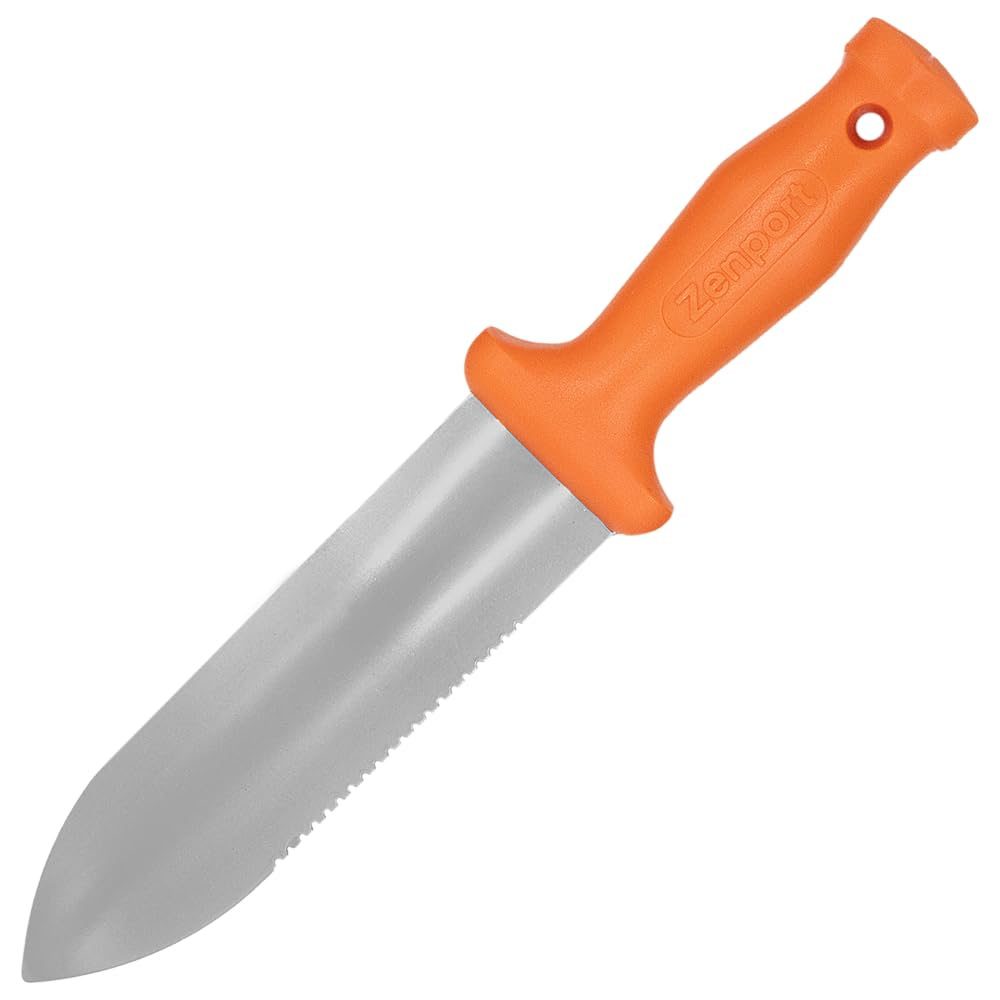
The Zenport K245 ZenBori is a no-nonsense full-tang stainless steel knife with a 6-inch spear-point blade that combines a serrated edge for sawing roots with a straight edge for clean cuts. The bright orange plastic handle is the defining feature—it provides a secure, non-slip grip in wet and muddy conditions and is highly visible in a tool bag or garden bed. This knife weighs just 8 ounces, making it easy to carry around all day without fatigue.
Owners consistently praise the handle visibility, noting that they no longer lose their knife in the garden dirt. The blade is sturdy enough for metal detecting tasks and cutting clean plugs from turf. The main trade-off is the missing extras: there is no sheath, no depth measurement markings, and the blade is shorter than the 7-inch models in this roundup. For gardeners who prioritize portability and findability over additional features, the ZenBori is a well-built, purpose-driven tool.
If you often leave your garden knife in the dirt or wish you had a brighter color to spot at a glance, the Zenport K245 solves that problem elegantly. It lacks the premium finish of the Nisaku or the Leonard, but its practical design and lower weight make it a solid sidekick for daily weeding and transplanting.
What works
- High-visibility orange handle is easy to spot in soil and tool sheds
- Lightweight at 8 ounces reduces hand fatigue during extended use
- Full-tang stainless steel provides reliable durability at a modest weight
What doesn’t
- No sheath or depth markings included
- 6-inch blade is shorter than many competitors, limiting reach for deep roots
7. CIELCERA 12″ Hori Hori Garden Knife

The CIELCERA 12-inch Hori Hori stands out for its sheer blade length—at 12 inches overall, it gives you extra reach for deep planting holes and long-rooted weeds. The stainless steel blade has both a serrated and a straight edge, a wooden full-tang handle, and a thick leather sheath. As a bonus, it includes a free diamond sharpening rod, which many budget-priced knives omit entirely.
Owner feedback after a year of daily use is overwhelmingly positive: the blade has not rusted, the handle has not split, and the sharpening rod keeps the edge workable. The knife is heavier than the other models here, which some users find reassuring for prying, but others may prefer a lighter tool for detail weeding. A small number of owners reported that the handle rivets loosened over time, causing a slight wobble.
For gardeners on a tight budget who still want a full-tang Hori Hori with a quality sheath and a sharpening tool included, the CIELCERA is an exceptional value. The longer blade is a genuine advantage for reaching deep soil pockets, and the included diamond rod extends the service life of the edge considerably.
What works
- 12-inch overall length provides extra reach for deep planting and long roots
- Includes a diamond sharpening rod and thick leather sheath out of the box
- Full-tang wood handle with no reported rust or splitting after a year
What doesn’t
- Heavier weight may cause fatigue during long weeding sessions
- Occasional reports of handle rivets loosening over extended use
Hardware & Specs Guide
Blade Hardness (HRC Scale)
HRC stands for Rockwell Hardness, a standard measure of steel hardness. A higher HRC number means the blade can hold a sharper edge longer but may be more brittle. For a Hori Hori garden knife, HRC 56–58 is the sweet spot—hard enough to stay sharp through a season of digging but tough enough to resist chipping when you hit a buried rock. Knives below HRC 54 will dull faster in sandy or clay-heavy soil and will need more frequent sharpening.
Concave vs. Flat Blade Geometry
Traditional Japanese Hori Horis use a concave (hollow-ground) blade that creates a scooping action when you dig. The curved shape displaces soil to the sides, making it easier to dig a clean hole for planting. Flat-ground blades are simpler to manufacture and provide a consistent cutting angle, but they tend to bulldoze soil rather than scoop it. If you do a lot of transplanting, a concave blade will save you significant effort compared to a flat one.
Full Tang vs. Rat-Tail or Partial Tang
A full-tang knife is cut from a single piece of steel that extends the full length of the handle. This design transfers every bit of force from your hand to the blade tip, making it ideal for prying rocks, levering out roots, and pushing through compacted soil. Rat-tail tangs (where the steel narrows to a thin rod inside the handle) or partial tangs are weaker and can snap at the handle junction under heavy lateral force. Always check the product images for visible rivets on the handle—three or more on a full-tang knife indicate a well-built tool.
Sheath Materials: Leather vs. Oxford vs. Nylon
Leather sheaths (like those on the Nisaku, SHALL, and CIELCERA) offer the best durability and a classic look, but they require occasional conditioning and can hold moisture if stored wet. Oxford sheaths (like the WORKPRO’s) are lighter and machine-washable but wear faster at the seams. Nylon or synthetic sheaths are the lightest and cheapest but provide the least protection for the blade edge. For daily carry in a tool belt, a leather sheath with a metal snap closure is the most secure option.
FAQ
What is the best blade length for a Hori Hori garden knife?
How often should I sharpen a Hori Hori knife?
Can I use a Hori Hori knife as a pry bar for rocks?
What type of blade edge is best for cutting roots?
How do I maintain the wooden handle of a Hori Hori knife?
Final Thoughts: The Verdict
For most gardeners, the best hori hori garden knife winner is the Nisaku NJP651 because its HRC 58 hardened steel and concave blade geometry cut through roots and scoop soil with noticeably less effort than competitors. If you want professional-grade durability with a twine notch and a 300-lb pressure rating, grab the A.M. Leonard Deluxe. And for aggressive root cutting in heavy clay or rocky ground, nothing beats the Root Slayer 16211 with its aggressive ripsaw teeth and inverted V tip.