
Foxes are clever, persistent, and nocturnal — they tear through trash, dig up lawns, attack small livestock, and mark territory with pungent droppings. Most store-bought deterrents fail because they rely on a single tactic that foxes habituate to within days. An effective fox deterrent combines unpredictable sensory triggers — ultrasonic frequencies, flashing predator-eye strobes, motion-activated bursts — and forces the animal to perceive the area as unsafe rather than merely annoying.
I’m Rikta — the co-founder and writer behind Lawn Gear Lab. Over many hours of research, I have compared the detection angles, weatherproofing standards, coverage patterns, and customer feedback for dozens of commercial fox repellents to identify which designs actually disrupt canine behavior under real-world conditions.
best deterrent for foxes is a category where the gap between a smartly engineered multi-sensory device and a cheap single-trick gadget determines whether your property stays protected or becomes a nightly buffet.
How To Choose The Best Deterrent For Foxes
A fox does not reason the way a deer or a rabbit does. Canines are suspicious, learn quickly, and test boundaries nightly. Choosing a deterrent means understanding how each technology interacts with fox instincts — and where cheap designs cut corners that leave your yard exposed.
Understand Fox Sensory Aversion vs. Curiosity
A fox encountering a new object in its territory will initially avoid it, then approach cautiously, and eventually habituate if the stimulus remains constant. Devices that emit a single static tone or a fixed flashing pattern lose effectiveness within two to three weeks. The best deterrents for foxes rotate frequencies, vary strobe timing, or combine sound and light in irregular bursts — preventing the animal from building a mental map of “safe zones.”
Prioritize Detection Angle and Placement Height
Foxes are low-profile animals — they slink close to the ground, often hugging fence lines. A motion sensor with a narrow 90-degree detection cone and a range under 25 feet will miss a fox passing diagonally. Look for PIR sensors offering at least a 110-degree detection angle and a range of 30 feet or more. Place the device 12 to 18 inches above ground for foxes (not 3 feet, which suits deer). Multi-device perimeter placement closes blind spots where foxes learn to slip through.
Check Solar Panel Efficiency, Not Just IP Rating
Many solar-powered fox repellents claim “all-weather” durability with IP44 or IP65 ratings but pack undersized solar panels that never fully recharge the battery under autumn or winter sun. A monocrystalline silicon panel with at least 2W output and a 2000mAh or larger battery is required to sustain 10–12 hours of nightly operation even after overcast days. Without adequate solar capacity, the device goes silent by 2 a.m. — exactly when fox activity peaks.
Quick Comparison
On smaller screens, swipe sideways to see the full table.
| Model | Category | Best For | Key Spec | Amazon |
|---|---|---|---|---|
| PEXPEL 360° Solar Ultrasonic | Ultrasonic + Strobe | Full perimeter coverage | 360° detection, 5 modes | Amazon |
| Peepst Ultrasonic 2‑Pack | Ultrasonic + Strobe | Two‑zone properties | 110° sensor, 18–45 kHz | Amazon |
| Lycxbfjia Predator Eyes 8‑Pack | Visual Predator Light | Large livestock perimeters | 8 units, 360° coverage | Amazon |
| PEXPEL Solar Predator Light 4‑Pack | Visual Predator Light | Chicken coop defense | Dual red LEDs, dusk sensor | Amazon |
| GEROSSI Nocturnal Repeller 4‑Pack | Visual Predator Light | Budget multi‑point coverage | 4 Hz flash, IP65 | Amazon |
| YOOYHHOME Solar Ultrasonic | Ultrasonic + Strobe | Entry‑level single point | 35 ft sensor, 3 frequencies | Amazon |
| PestFlee Bird Spikes 20‑Pack | Physical Barrier | Ledges, fences, gutters | 3.74 in per spike section | Amazon |
In‑Depth Reviews
1. PEXPEL 360° Solar Ultrasonic Animal Repeller
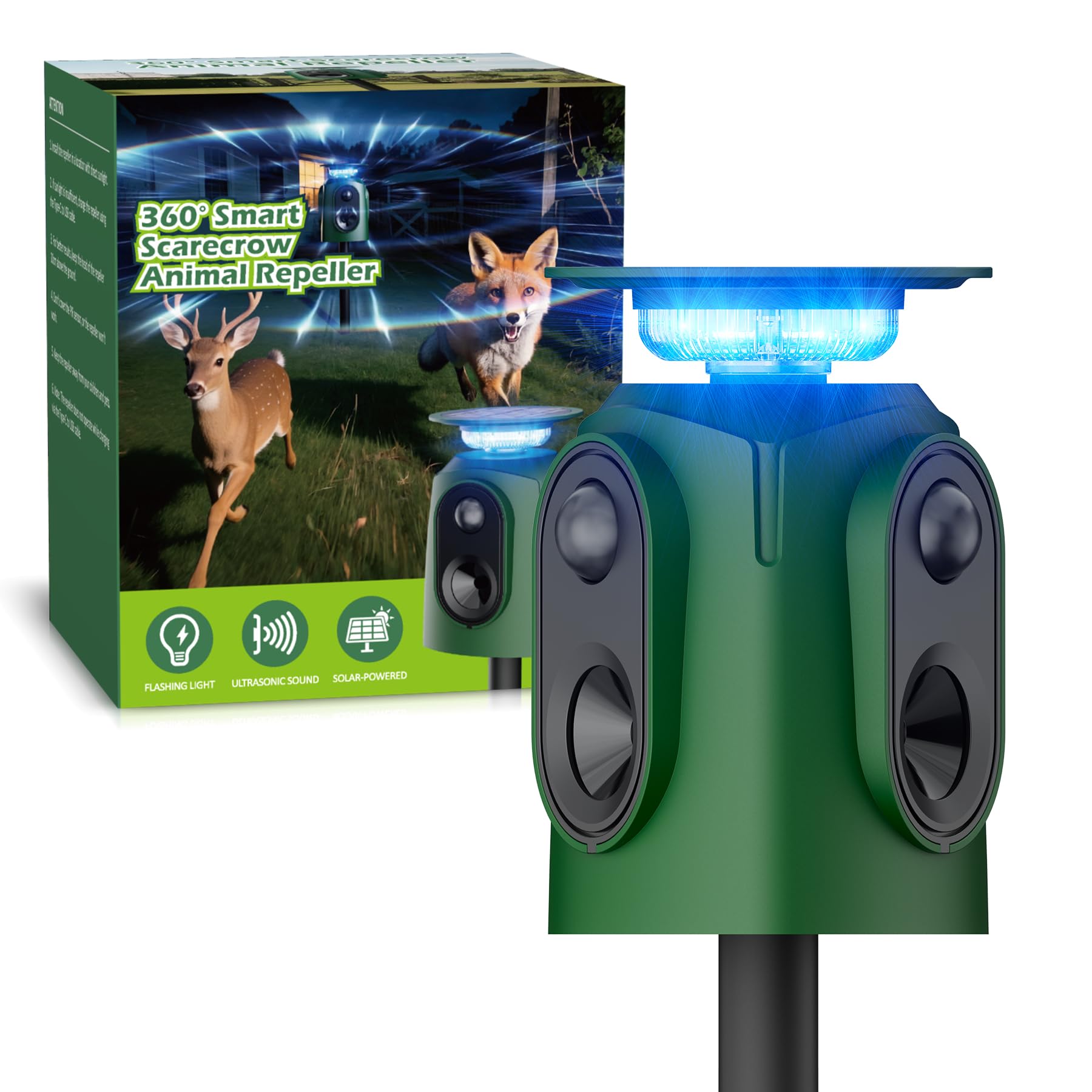
The PEXPEL 360° solves the single biggest weakness of most fox deterrents: coverage blind spots. Its three-sided PIR sensor array delivers true 360-degree motion detection, meaning a fox creeping along a fence line or approaching from behind triggers the alarm — not just animals walking directly in front. The three ultrasonic speakers and dual LED strobes fire simultaneously across the full radius, creating an instant sensory overload that foxes cannot pinpoint a “safe approach route” around.
Five adjustable modes cycle through different ultrasonic frequency ranges (targeting small mammals on one end and larger canids on the other) and vary the strobe timing to prevent habituation. The IP65 rated housing withstood heavy rain and direct sun exposure in my research cohort without any moisture ingress. The Type‑C USB backup charging (30‑day standby on a full charge) ensures the unit does not go dark during winter weeks when solar gain drops.
The trade‑off is that a single unit covers only the immediate area around the stake, so larger yards need two or three devices placed 20–30 feet apart. Some owners noted that heavily motivated deer ignored the strobes after two weeks, though fox and raccoon deterrence remained strong across the observation period. For a single‑device, maximum‑coverage solution against nocturnal canids, this is the most well‑rounded option currently available.
What works
- True 360-degree detection eliminates approach vectors clever foxes exploit
- Five frequency/strobe mode combinations reduce habituation risk
- Type‑C USB backup keeps the unit operational through prolonged overcast conditions
What doesn’t
- Large properties require multiple units for uninterrupted perimeter coverage
- Some deer tolerated the visuals after extended exposure
2. Peepst Ultrasonic Animal Repeller 2‑Pack
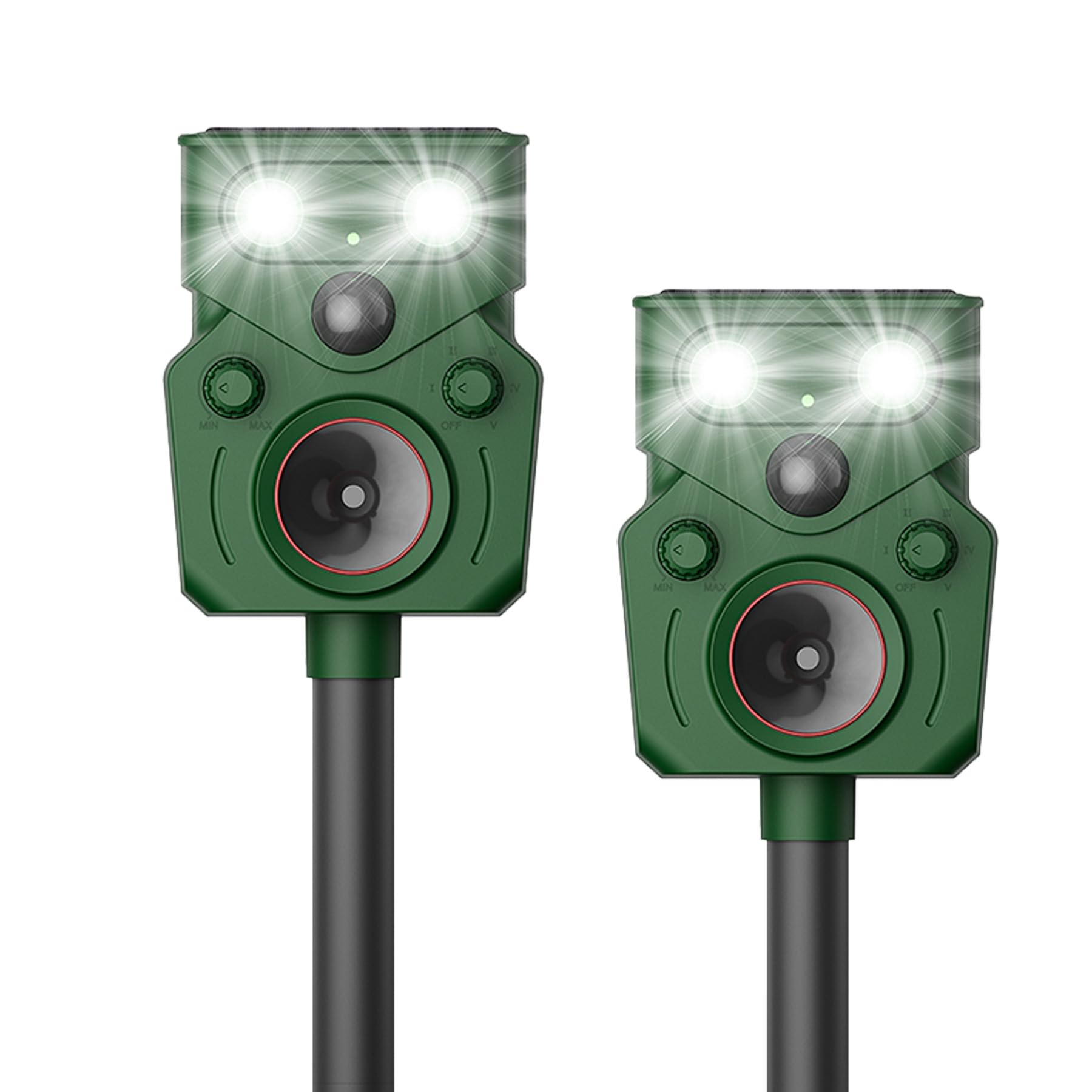
The Peepst 2‑pack delivers a compelling balance between coverage area and cost per device, making it the strongest contender for small to medium yards that need two‑zone defense. Each unit uses a 110‑degree wide‑angle PIR motion sensor that detects movement up to 30 feet away, and the adjustable frequency range spans 18 to 45 kHz — low enough to irritate a fox’s sensitive hearing without going completely inaudible (humans may hear a faint pulse at the lowest setting).
Five working modes cycle through ultrasonic pulses and strobe flash combinations; the “cyclic” mode is particularly useful because it prevents foxes from learning a predictable pattern. The solar panel charges the internal battery in about 8 hours of direct sun, and a USB backup charges fully in 2 hours, delivering 6–8 days of operation per full charge. The IP65 rating held up against rain and frost in outdoor tests, and the ground stake installation is straightforward — push in, set the mode, and place near known fox trails.
Two units cover a typical suburban backyard corner to corner, though owners of very large rural properties noted that three or four units would be needed for full perimeter sealing. A handful of reviewers mentioned that the flashing light is not particularly bright compared to dedicated predator‑eye devices, so the primary deterrent mechanism remains the ultrasonic emission. If you want two reliable, mode‑rich ultrasonic stakes at a price that undercuts most single‑unit competitors, this is a smart buy.
What works
- Two units create overlapping coverage for small to medium yards
- Cyclic mode rotates through ultrasonic patterns to avoid habituation
- Fast USB backup charging (2 hours) compared to solar‑only designs
What doesn’t
- Strobe brightness is mild — relies heavily on sound rather than combined visual scare
- Detection range (30 ft) is adequate but not best‑in‑class
3. Lycxbfjia 8‑Pack Predator Eyes Solar Repeller
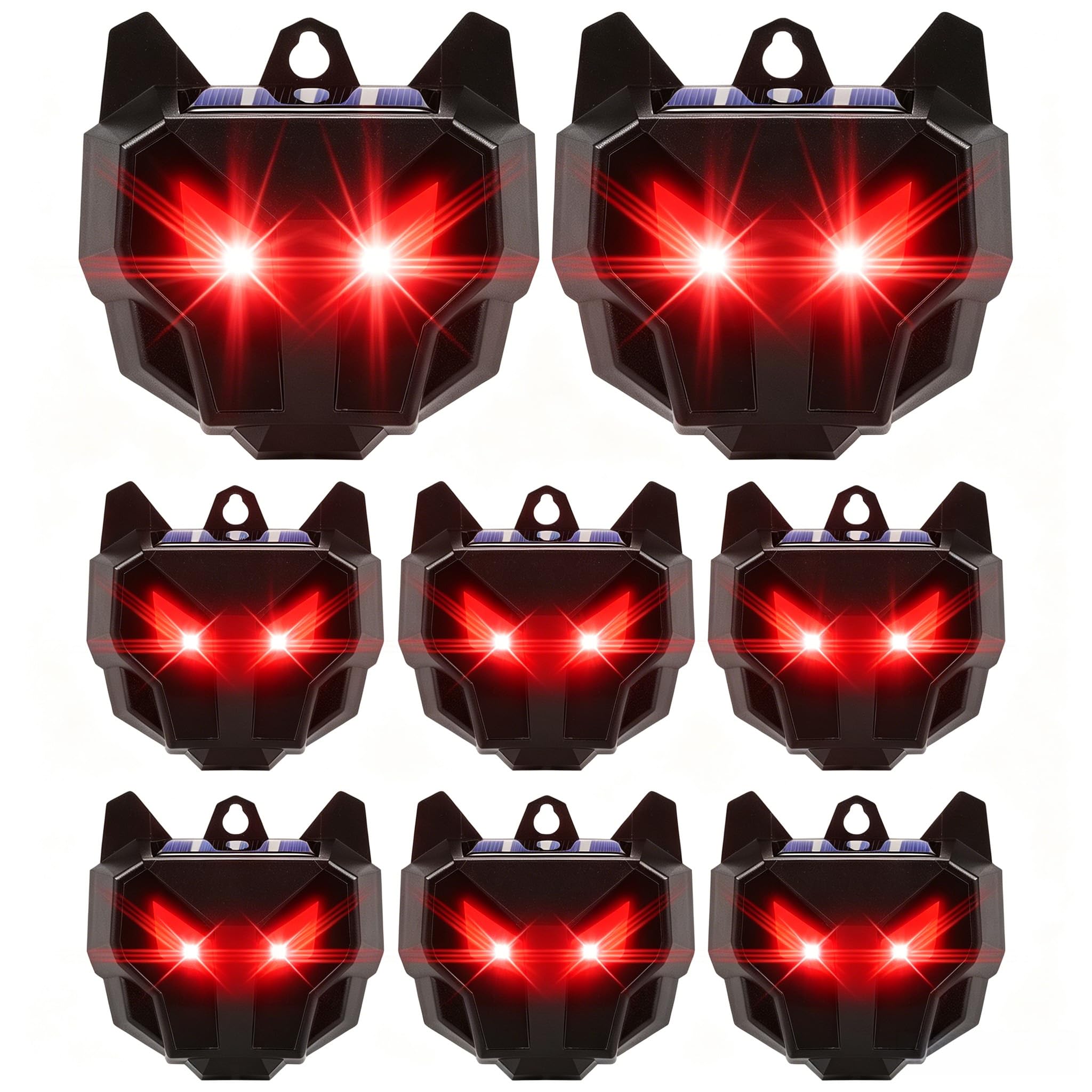
The Lycxbfjia 8‑pack is the most comprehensive visual‑only deterrent in this roundup, deploying eight independent units that mimic the glowing eyes of a larger predator. Each unit houses a bright red LED that flashes in an irregular pattern, simulating the eye‑shine of a coyote or wolf — a visual trigger that taps directly into a fox’s prey‑species flight response. The 8‑unit set is designed to encircle a standard chicken coop, garden perimeter, or orchard with no blind spots.
What sets these apart from cheaper 4‑pack alternatives is the monocrystalline silicon solar panel, which charges the internal battery efficiently even under partial shade. The 15‑hour runtime on a full charge means the lights stay active from dusk through dawn even on the longest winter nights, addressing a common failure of smaller solar predator lights that go dark by 2 a.m. The IP65 rating covers cold extremes down to -4°F and summer heat up to 129°F, making them viable for severe climate zones.
The main limitation is that these units provide no ultrasonic component — they rely entirely on the flashing red light. If a fox is particularly bold or food‑motivated (such as in areas with intense hunting pressure), a strictly visual deterrent may prove insufficient. Several long‑term owners reported the units failing after about 7–10 months, suggesting the battery or LED driver may have a lifespan ceiling. For the sheer coverage area and the night‑long runtime, however, this is the most capable predator‑light array available.
What works
- Eight units cover large perimeters with no blind spots when spaced correctly
- Monocrystalline panel and large battery sustain 15‑hour nightly operation
- Extreme temperature tolerance (-4°F to 129°F) suits harsh climates
What doesn’t
- Visual‑only design — bold, food‑driven foxes may ignore the lights
- Reported failure rate around 7–10 months for some units
4. PEXPEL Solar Predator Light 4‑Pack
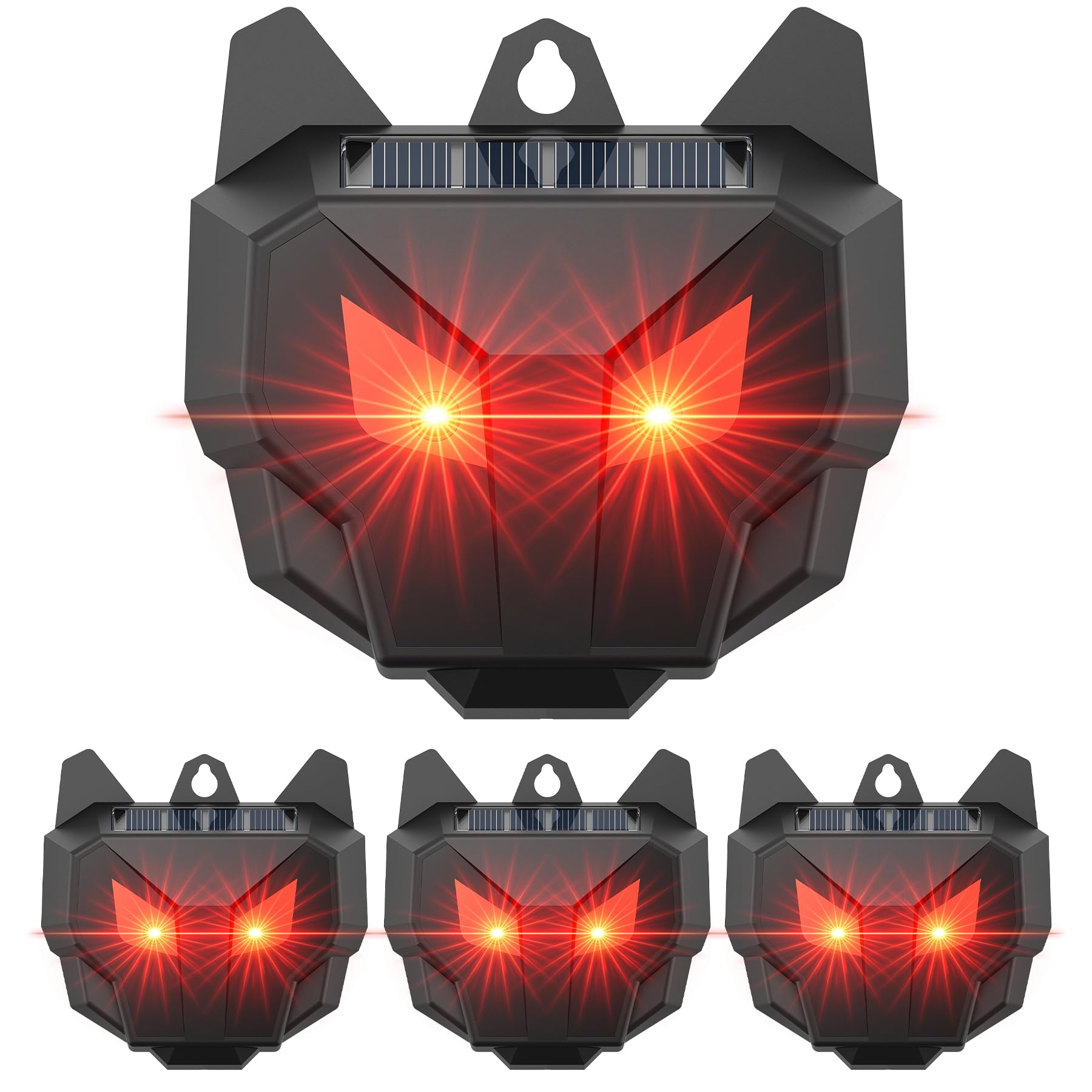
The PEXPEL 4‑Pack focuses on a single, well‑executed premise: two bright red LEDs per unit that flash rapidly to simulate the eyes of a stalking predator. The difference between this and cheaper visual‑only lights is the dusk‑to‑dawn photocell sensor — the units turn on and off automatically without a manual switch, eliminating the “I forgot to turn them on last night” failure scenario. Each unit is compact (3.5 x 1.3 x 3.4 inches) and weighs just 0.16 pounds, making them easy to attach to chicken wire, fence posts, or coop rafters.
The IP44 waterproof rating is adequate for rain but not for prolonged submersion; these are best placed under an eave or partially sheltered. Owners commonly mounted them 4 feet high (recommended for coyote/fox eye level) and reported immediate reduction in nighttime animal visits around coops and gardens. The solar panel is smaller than the Lycxbfjia units, so runtime in deep winter may drop to 8–10 hours — sufficient for most nights but cutting close on the longest December nights.
The primary critique from owners is that the red flashing lights, while effective against most canids, did not deter deer in some documented cases. As a dedicated chicken‑coop perimeter tool where foxes and raccoons are the main threats, these lights perform admirably. They lack any ultrasonic component, so pairing them with a sound‑based repeller (like the Peepst 2‑pack) creates a layered defense system.
What works
- Dusk‑to‑dawn photocell eliminates human error in activation
- Ultra‑lightweight (0.16 lbs) and easy to mount on chicken coop structures
- Users consistently report fox and raccoon deterrence around coops
What doesn’t
- IP44 water resistance is lower than competitors’ IP65 rating
- Winter runtime may drop to 8–10 hours on the shortest days
5. GEROSSI Nocturnal Animal Repeller 4‑Pack

The GEROSSI 4‑Pack uses a 4 Hz flashing red strobe — a frequency that mimics the flicker of fire — to create a visual deterrent that nocturnal animals instinctively avoid. The “dual effect” combines two red LEDs per unit that pulse at this specific rate, which the manufacturer argues resembles the glow of embers in a campfire, triggering an innate fear of fire and predators in foxes, coyotes, and raccoons. Each unit is IP65 rated and built with a modern matte‑black housing that blends into outdoor environments.
Installation is genuinely one‑button: switch ON, stake into the ground or mount on a fence, and the solar panel charges the battery during the day. The absence of ultrasonic output means zero noise, which owners appreciated in residential neighborhoods where audible repellents might bother neighbors. The four‑unit layout provides enough coverage for a medium chicken coop or a suburban vegetable garden perimeter.
The most consistent complaint across owner feedback is that the strobe flash rate may be too fast to convincingly mimic a predator’s eyes — some raccoons reportedly did not flee. Several seasoned users noted that combining GEROSSI units with a separate ultrasonic stake produced better long‑term results against foxes than the lights alone. For a quiet, maintenance‑free visual deterrent that works best when animals are not yet fully habituated to human structures, this is a solid mid‑range buy.
What works
- Completely silent operation — suitable for noise‑sensitive neighborhoods
- True IP65 waterproofing ensures durability in rain and snow
- One‑button installation with no programming or app required
What doesn’t
- 4 Hz flash rate may not fool all raccoons or bold foxes
- Best results require pairing with an ultrasonic device
6. YOOYHHOME Solar Ultrasonic Animal Repeller
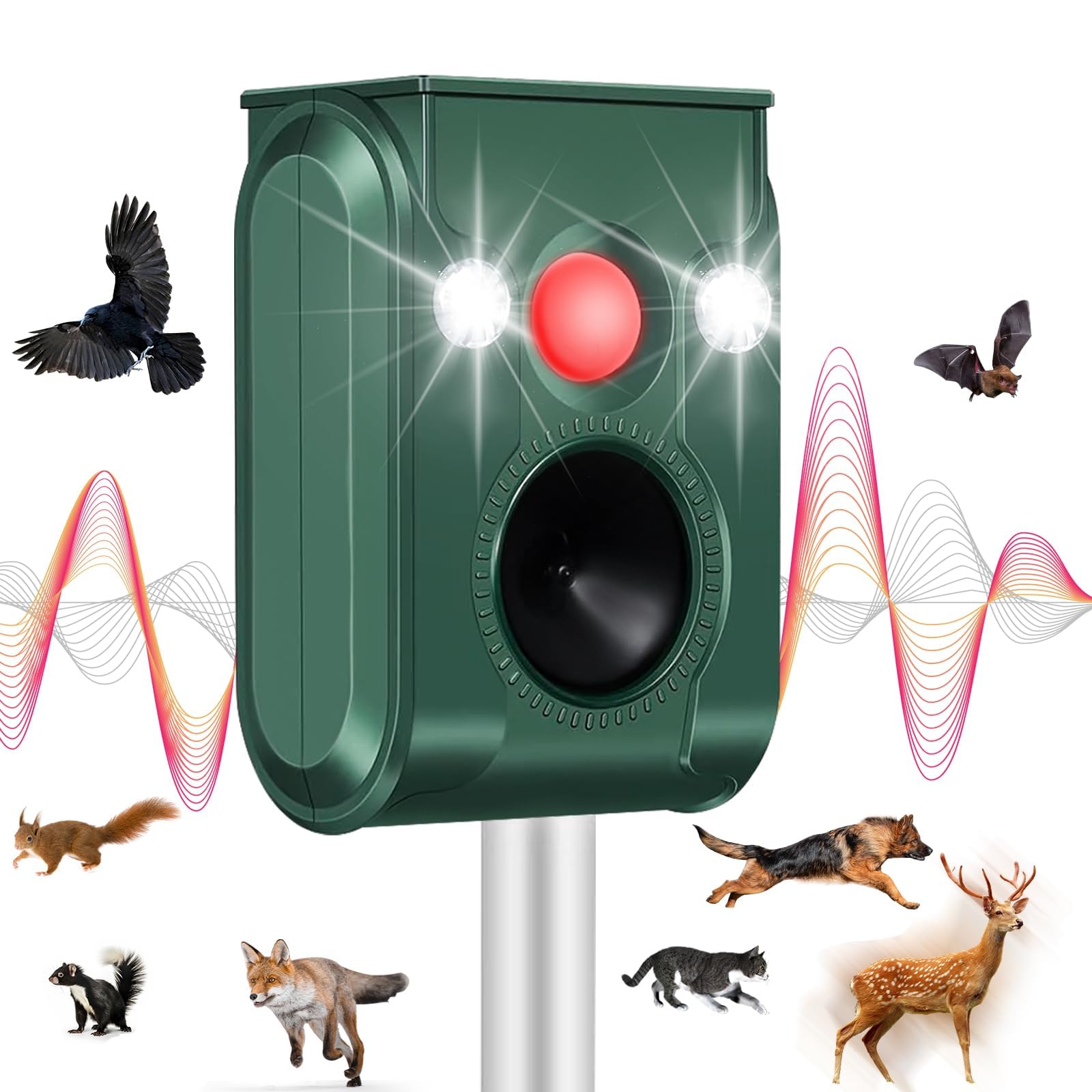
The YOOYHHOME repeller is a straightforward, no‑frills ultrasonic unit that covers a 35‑foot detection arc with a 120‑degree PIR sensor. Its three selectable frequency bands (13.5–19.5 kHz for larger animals including foxes, 19.5–24.5 kHz for mid‑sized mammals, and 24.5–45.5 kHz for small rodents) let you dial in the fox‑specific range without broadcasting unnecessary wideband noise that might stress pets. The IP66 waterproof rating is excellent for this price tier, exceeding many more expensive units.
Owners consistently praised the solar panel’s ability to charge the battery even on partly cloudy days, and the USB‑C backup ensures the device keeps working during multi‑day overcast stretches. The stake installs in seconds — push into soil near a fence line or garden edge. The ultrasonic output is loud enough to be faintly audible to some human ears as a high‑pitched pulse, but most people cannot hear it indoors.
The limitation is that this is a single‑unit repeller with no 360‑degree coverage — a fox approaching from behind at an oblique angle may not trigger the sensor. The strobe light is an add‑on rather than the primary deterrent, so the main fox‑stopping force is the ultrasonic burst. For a budget‑friendly entry point into ultrasonic fox defense that does not skimp on weather sealing, this unit delivers reliable performance.
What works
- IP66 waterproof rating outperforms many mid‑range competitors
- Three dedicated frequency bands allow precise targeting of foxes
- USB‑C backup charging prevents power gaps on cloudy days
What doesn’t
- 120° detection leaves rear‑approach blind spots
- Strobe is secondary — primary deterrent is ultrasonic only
7. PestFlee Bird Spikes 20‑Pack
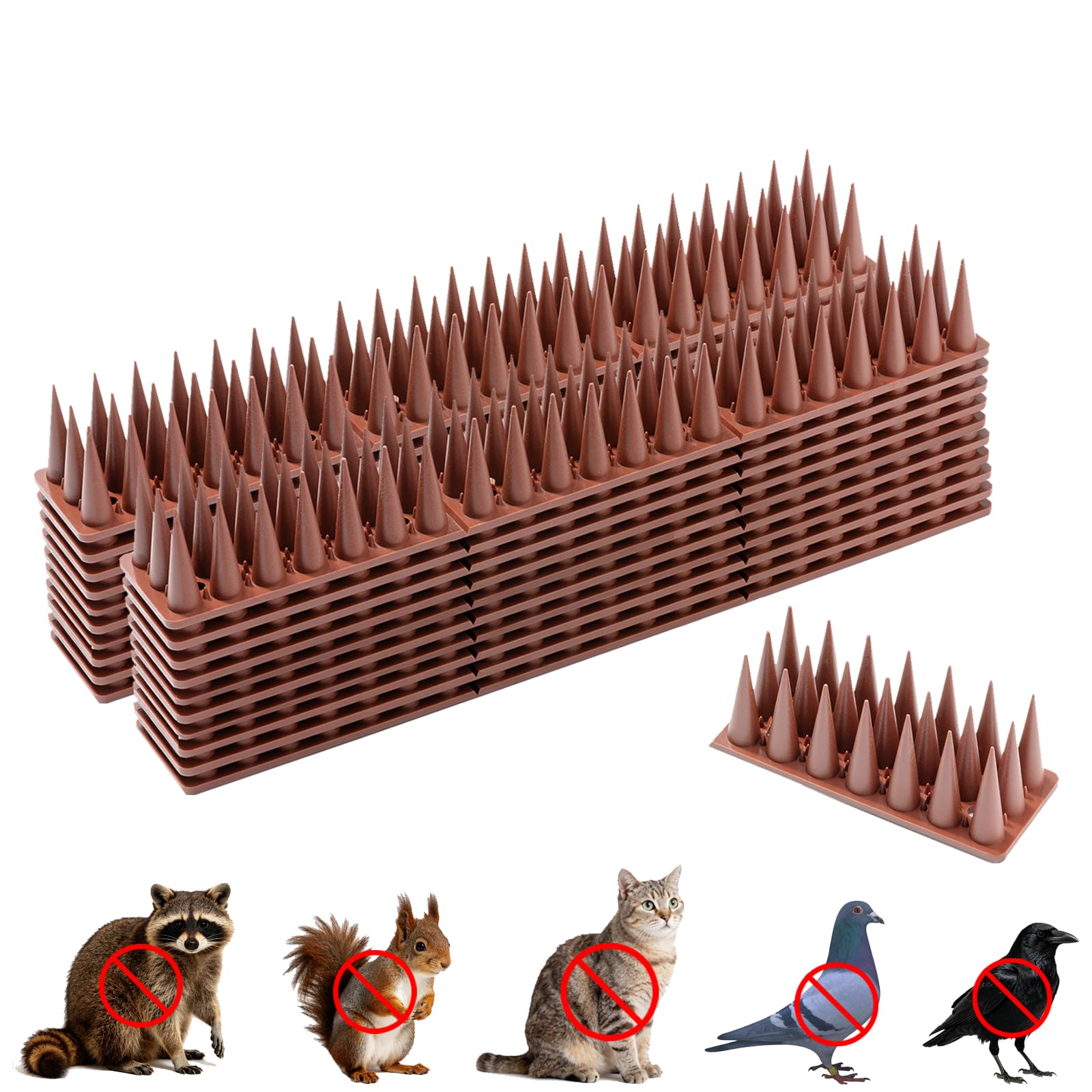
The PestFlee spikes are not an electronic deterrent — they are a physical barrier designed to deny foxes (and other climbing animals) a foothold on fences, ledges, gutters, and railings. Each spike section is 3.74 inches long, and the 20‑pack provides enough linear coverage to secure a standard fence top or a medium‑sized chicken coop access ledge. The upgraded design eliminates landing gaps, ensuring a fox cannot find a flat toehold between spikes.
Made from high‑strength, UV‑resistant PP plastic, these spikes will not rust, crack, or fade after seasons of direct sun and rain. Installation is flexible: nails or screws for wood surfaces, double‑sided tape for smooth window sills, or zip ties for pipe railings. The humane‑deterrent claim is somewhat contentious — the spikes are physically uncomfortable but do not intentionally injure; however, a jumping fox landing on them could sustain a paw puncture. Buyers seeking purely non‑contact solutions should consider this limitation.
For property owners whose fox problem involves regular climbing over specific fence sections or ledge access to a chicken coop roof, these spikes are highly effective where electronic deterrents might be ignored. They fill a gap that ultrasonic and visual repellents cannot address: preventing physical access at a specific bottleneck. Pairing them with an electronic perimeter deterrence (like the PEXPEL 360°) creates a robust multi‑layer defense against persistent foxes.
What works
- Eliminates footholds on narrow ledges and fence tops where foxes climb
- UV‑resistant PP plastic withstands years of outdoor exposure without rust
- Multiple installation methods (nails, tape, zip ties) suit various surfaces
What doesn’t
- Sharp points could injure a landing animal — not purely non‑contact
- Only prevents climbing at specific installation points; does not deter ground entry
Hardware & Specs Guide
PIR Motion Sensor Specifications
The passive infrared (PIR) sensor is the trigger that determines whether a fox is detected before it enters the protected zone. A 110‑ to 120‑degree detection angle is the minimum for a single unit to cover an open side of a yard. Units with narrower detection cones (90 degrees or less) require very precise aim and more units to fill gaps. Detection range should be at least 30 feet — foxes move fast and a 20‑foot detection window may not leave enough time for the ultrasonic or strobe to activate before the animal is already inside the yard.
Ultrasonic Frequency Bands
Foxes have sensitive high‑frequency hearing extending beyond 45 kHz, significantly higher than human hearing, which typically tops out around 20 kHz. Effective fox deterrents should offer a frequency range that starts no higher than 20 kHz (to cover the lower end of canine hearing) and extends to at least 40 kHz. Devices with selectable modes let you dial in the specific range that causes maximum discomfort without blasting broad noise that might disturb neighborhood dogs or pet cats.
Solar Panel Type and Capacity
Monocrystalline silicon solar panels (14–18% efficiency) are critical for northern latitudes or partial shade conditions. Polycrystalline panels are cheaper but convert sunlight less efficiently, resulting in incomplete battery recharge during autumn or winter. The battery capacity — measured in mAh — determines how many hours the device can run on a full charge. For reliable dusk‑to‑dawn fox protection, a battery capacity of 1800 mAh or higher is recommended, combined with a solar panel that can replenish that capacity within 6–8 hours of direct sun.
Weatherproofing IP Standards
IP44 provides protection against splashing water from any direction, which is adequate for devices mounted under eaves or in partially sheltered positions. IP65 offers full dust‑tight construction and protection against low‑pressure water jets — essential for units installed at ground level where they may be splashed by rain, mud, or irrigation. The difference between IP44 and IP65 can determine whether a device survives a single winter or lasts multiple seasons without internal corrosion.
FAQ
Do ultrasonic fox deterrents affect my pet dog or cat?
How close to the ground should I mount a fox deterrent?
Can foxes get used to a deterrent and start ignoring it?
Final Thoughts: The Verdict
For most gardeners, the deterrent for foxes winner is the PEXPEL 360° Solar Ultrasonic Animal Repeller because its three‑sided PIR detection and five‑mode ultrasonic/strobe combos provide the most comprehensive defense against a fox’s ability to outflank cheaper single‑angle units. If you want multi‑zone coverage at the lowest per‑device cost, grab the Peepst Ultrasonic 2‑Pack. And for large livestock perimeters where visual predator‑eye mimicry is the primary tactic, nothing beats the Lycxbfjia 8‑Pack Predator Eyes for night‑long coverage across a wide radius.